
Copyright©2018 NTT Corp. All Rights Reserved.
Vacuum More Efficient Than Ever
Masahiko Sawada
NTT Open Source Software Center
@PGCon 2018
2Copyright©2018 NTT Corp. All Rights Reserved.
• Masahiko Sawada

from Tokyo, Japan
• PostgreSQL contributor

Multiple synchronous replication: FIRST and ANY methods (9.6 and
10)

Freeze map (9.6)

Skipping cleanup index vacuum (11)
Who Am I?
3Copyright©2018 NTT Corp. All Rights Reserved.
• What Is Vacuum?
• Three Vacuum Improvements
• Problems
• Solutions
• Challenges
• Evaluations
• Conclusion
Agenda
4Copyright©2018 NTT Corp. All Rights Reserved.
• PostgreSQL garbage collection feature
• Recover or reuse disk space occupied
• VACUUM command
• =# VACUUM tbl1, tbl2;
• =# VACUUM (ANALYZE, VERBOSE) tbl1;
• Auto vacuum
• autovacuum launcher process
• autovacuum worker processes
What Is Vacuum?
5Copyright©2018 NTT Corp. All Rights Reserved.
• Auto Vacuum (8.1~)
• Vacuum Delay (8.1~)
• Visibility Map (8.4~)
• Freeze Map (part of visibility map) (9.6~)
• Skipping index cleanup (11~)
History of Vacuum Evolution
6Copyright©2018 NTT Corp. All Rights Reserved.
1. Shorten the vacuum execution time
• Use resource as much as possible
• Reduce the amount of work
• Work in parallel
2. But, reduce impact on transaction processing
• Work lazily
What’s Needed For “Good Vacuum”?
7Copyright©2018 NTT Corp. All Rights Reserved.
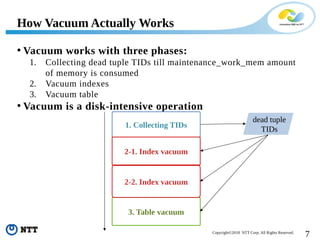
• Vacuum works with three phases:
1. Collecting dead tuple TIDs till maintenance_work_mem amount
of memory is consumed
2. Vacuum indexes
3. Vacuum table
• Vacuum is a disk-intensive operation
How Vacuum Actually Works
1. Collecting TIDs
3. Table vacuum
2-1. Index vacuum
2-2. Index vacuum
dead tuple
TIDs
8Copyright©2018 NTT Corp. All Rights Reserved.
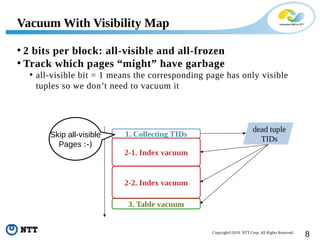
• 2 bits per block: all-visible and all-frozen
• Track which pages “might” have garbage
• all-visible bit = 1 means the corresponding page has only visible
tuples so we don’t need to vacuum it
Vacuum With Visibility Map
1. Collecting TIDs
3. Table vacuum
2-1. Index vacuum
2-2. Index vacuum
dead tuple
TIDs
Skip all-visible
Pages :-)
9Copyright©2018 NTT Corp. All Rights Reserved.
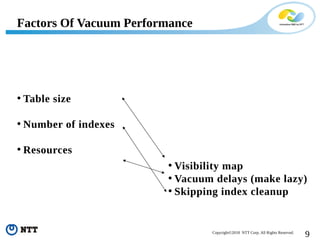
• Table size
• Number of indexes
• Resources
Factors Of Vacuum Performance
• Visibility map
• Vacuum delays (make lazy)
• Skipping index cleanup
10Copyright©2018 NTT Corp. All Rights Reserved.
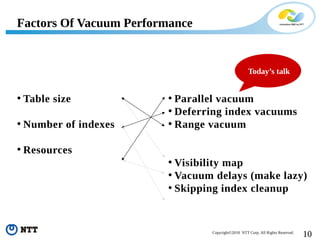
• Table size
• Number of indexes
• Resources
Factors Of Vacuum Performance
• Parallel vacuum
• Deferring index vacuums
• Range vacuum
• Visibility map
• Vacuum delays (make lazy)
• Skipping index cleanup
Today’s talk
11Copyright©2018 NTT Corp. All Rights Reserved.
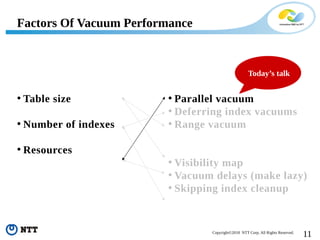
• Table size
• Number of indexes
• Resources
Factors Of Vacuum Performance
• Parallel vacuum
• Deferring index vacuums
• Range vacuum
• Visibility map
• Vacuum delays (make lazy)
• Skipping index cleanup
Today’s talk
12Copyright©2018 NTT Corp. All Rights Reserved.
PARALLEL VACUUM
13Copyright©2018 NTT Corp. All Rights Reserved.
• Vacuum is performed by single process
• Vacuum could take a very long time
• Over days or even more!
• Taking longer time if table has multiple indexes
On Very Large Table
14Copyright©2018 NTT Corp. All Rights Reserved.
 Divide a large table
 Reduce autovacuum_delay_cost/limit
• Additional burden on the disk I/O instead
Current Solutions
15Copyright©2018 NTT Corp. All Rights Reserved.
• Execute vacuum with parallel workers
• Shorten the execution time of vacuum
• Note that this will consume more disk I/O
• A patch has been proposed
• “Block level Parallel Vacuum” (2016)
• However, must resolve RelExt lock issue first
• Please refer to “Moving relation extension locks out of heavyweight
lock manager” (2016)
Idea: Parallel Vacuum
16Copyright©2018 NTT Corp. All Rights Reserved.
How Does It Work?
Collect TIDs
Vacuum Table
Vacuum IndexA Vacuum IndexB
Collect TIDs Collect TIDs
Vacuum Table
Vacuum Table
Collect TIDs
Collect TIDs Collect TIDs
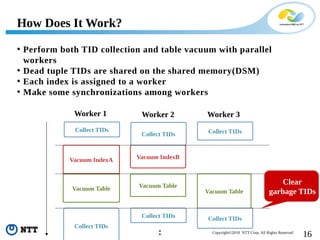
• Perform both TID collection and table vacuum with parallel
workers
• Dead tuple TIDs are shared on the shared memory(DSM)
• Each index is assigned to a worker
• Make some synchronizations among workers
Worker 1 Worker 3Worker 2
:
Clear
garbage TIDs
17Copyright©2018 NTT Corp. All Rights Reserved.
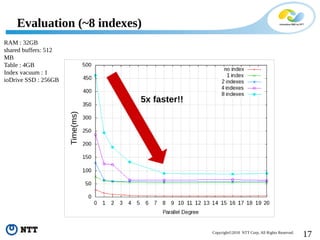
Evaluation (~8 indexes)
5x faster!!
RAM : 32GB
shared buffers: 512
MB
Table : 4GB
Index vacuum : 1
ioDrive SSD : 256GB
Time(ms)
18Copyright©2018 NTT Corp. All Rights Reserved.
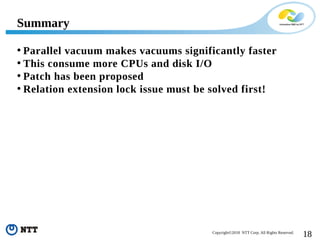
• Parallel vacuum makes vacuums significantly faster
• This consume more CPUs and disk I/O
• Patch has been proposed
• Relation extension lock issue must be solved first!
Summary
19Copyright©2018 NTT Corp. All Rights Reserved.
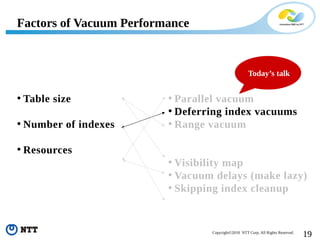
• Table size
• Number of indexes
• Resources
Factors of Vacuum Performance
• Parallel vacuum
• Deferring index vacuums
• Range vacuum
• Visibility map
• Vacuum delays (make lazy)
• Skipping index cleanup
Today’s talk
20Copyright©2018 NTT Corp. All Rights Reserved.
DEFERRING INDEX VACUUM
21Copyright©2018 NTT Corp. All Rights Reserved.
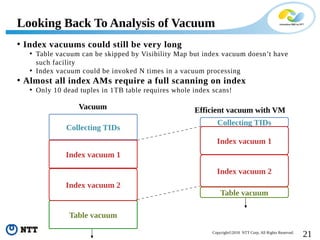
• Index vacuums could still be very long
• Table vacuum can be skipped by Visibility Map but index vacuum doesn’t have
such facility
• Index vacuum could be invoked N times in a vacuum processing
• Almost all index AMs require a full scanning on index
• Only 10 dead tuples in 1TB table requires whole index scans!
Looking Back To Analysis of Vacuum
Collecting TIDs
Table vacuum
Index vacuum 1
Index vacuum 2
Collecting TIDs
Table vacuum
Index vacuum 1
Index vacuum 2
Vacuum Efficient vacuum with VM
22Copyright©2018 NTT Corp. All Rights Reserved.
 Don’t trigger auto-vacuum with a small threshold
• What about manual vacuum?
• Indexes are not easy to bloat than tables
 Increase maintenance_work_mem to avoid calling
index vacuuming multiple times
• However, still requires index vacuum at least once
Current Solutions
23Copyright©2018 NTT Corp. All Rights Reserved.
• Spool garbage TIDs
• Don't trigger index vacuum unless the amount of spooled
garbage TIDs reached to the threshold
• Reduce the number of index vacuum
Idea: Deferring Index Vacuum
24Copyright©2018 NTT Corp. All Rights Reserved.
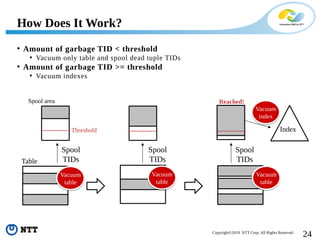
• Amount of garbage TID < threshold
• Vacuum only table and spool dead tuple TIDs
• Amount of garbage TID >= threshold
• Vacuum indexes
How Does It Work?
Table
Spool
TIDs
Spool
TIDs
Spool
TIDs
Index
Spool area
Threshold
Reached!
Vacuum
table
Vacuum
table
Vacuum
table
Vacuum
table
Vacuum
table
Vacuum
table
Vacuum
index
Vacuum
index
25Copyright©2018 NTT Corp. All Rights Reserved.
• There are related discussions
• “Proposal: Another attempt at vacuum improvements” (2011)
• “Single pass vacuum – take1” (2011)
• But it breaks on-disk format
Related Discussions
26Copyright©2018 NTT Corp. All Rights Reserved.
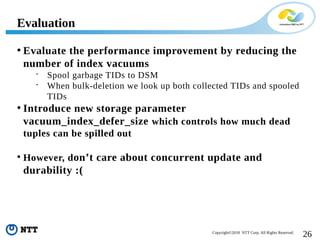
• Evaluate the performance improvement by reducing the
number of index vacuums
 Spool garbage TIDs to DSM
 When bulk-deletion we look up both collected TIDs and spooled
TIDs
• Introduce new storage parameter
vacuum_index_defer_size which controls how much dead
tuples can be spilled out
• However, don’t care about concurrent update and
durability :(
Evaluation
27Copyright©2018 NTT Corp. All Rights Reserved.
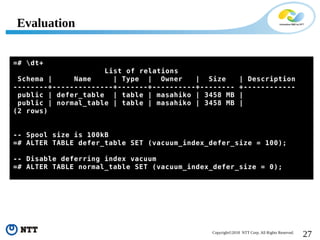
=# dt+
List of relations
Schema | Name | Type | Owner | Size | Description
--------+--------------+-------+----------+-------- +------------
public | defer_table | table | masahiko | 3458 MB |
public | normal_table | table | masahiko | 3458 MB |
(2 rows)
-- Spool size is 100kB
=# ALTER TABLE defer_table SET (vacuum_index_defer_size = 100);
-- Disable deferring index vacuum
=# ALTER TABLE normal_table SET (vacuum_index_defer_size = 0);
Evaluation
28Copyright©2018 NTT Corp. All Rights Reserved.
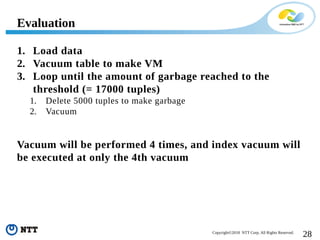
1. Load data
2. Vacuum table to make VM
3. Loop until the amount of garbage reached to the
threshold (= 17000 tuples)
1. Delete 5000 tuples to make garbage
2. Vacuum
Vacuum will be performed 4 times, and index vacuum will
be executed at only the 4th vacuum
Evaluation
29Copyright©2018 NTT Corp. All Rights Reserved.
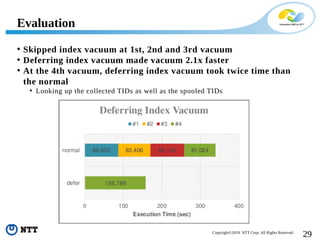
Evaluation
• Skipped index vacuum at 1st, 2nd and 3rd vacuum
• Deferring index vacuum made vacuum 2.1x faster
• At the 4th vacuum, deferring index vacuum took twice time than
the normal
• Looking up the collected TIDs as well as the spooled TIDs
30Copyright©2018 NTT Corp. All Rights Reserved.
• Deferring index vacuum have potentials of speed up
vacuums much
• In this evaluation, it speeds up 2.1x faster
• More tricks are required for the correct implementation
• To prevent vacuumed item pointers from being reused before index
vacuum
• To avoid breaking on-disk format
Summary
31Copyright©2018 NTT Corp. All Rights Reserved.
• Table size
• Number of indexes
• Resources
Factors Of Vacuum Performance
• Parallel vacuum
• Deferring index vacuums
• Range vacuum
• Visibility map
• Vacuum delays (make lazy)
• Skipping index cleanup
Today’s talk
32Copyright©2018 NTT Corp. All Rights Reserved.
RANGE VACUUM
33Copyright©2018 NTT Corp. All Rights Reserved.
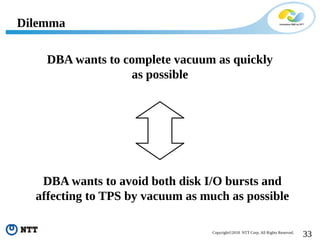
Dilemma
DBA wants to avoid both disk I/O bursts and
affecting to TPS by vacuum as much as possible
DBA wants to complete vacuum as quickly
as possible
34Copyright©2018 NTT Corp. All Rights Reserved.
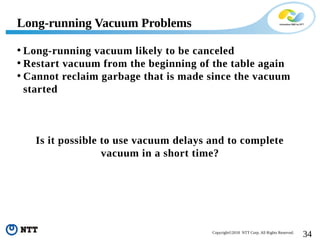
• Long-running vacuum likely to be canceled
• Restart vacuum from the beginning of the table again
• Cannot reclaim garbage that is made since the vacuum
started
Is it possible to use vacuum delays and to complete
vacuum in a short time?
Long-running Vacuum Problems
35Copyright©2018 NTT Corp. All Rights Reserved.
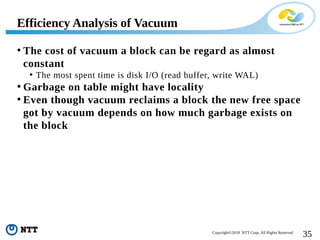
• The cost of vacuum a block can be regard as almost
constant
• The most spent time is disk I/O (read buffer, write WAL)
• Garbage on table might have locality
• Even though vacuum reclaims a block the new free space
got by vacuum depends on how much garbage exists on
the block
Efficiency Analysis of Vacuum
36Copyright©2018 NTT Corp. All Rights Reserved.
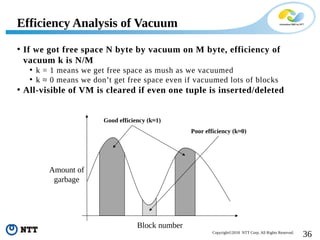
• If we got free space N byte by vacuum on M byte, efficiency of
vacuum k is N/M
• k = 1 means we get free space as mush as we vacuumed
• k ≈ 0 means we don’t get free space even if vacuumed lots of blocks
• All-visible of VM is cleared if even one tuple is inserted/deleted
Efficiency Analysis of Vacuum
Block number
Amount of
garbage
Good efficiency (k≈1)
Poor efficiency (k≈0)
37Copyright©2018 NTT Corp. All Rights Reserved.
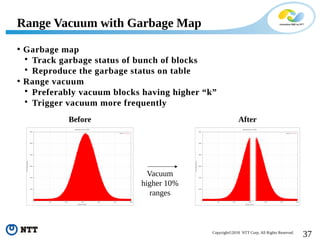
Range Vacuum with Garbage Map
Before After
Vacuum
higher 10%
ranges
• Garbage map

Track garbage status of bunch of blocks

Reproduce the garbage status on table
• Range vacuum

Preferably vacuum blocks having higher “k”

Trigger vacuum more frequently
38Copyright©2018 NTT Corp. All Rights Reserved.
• WAL-based
• WAL knows the all block change information
• Don’t increase transaction latency as mush as possible
• Logical decoding didn’t match (so far)
• Need to track block-level changes
• Need to track aborted transactions
• “WALker” module
• A background worker that continues to read WAL
• Invoke corresponding plugin callbacks
• “garbagemap” plugin builds garbage maps
• Repository at https://github.com/MasahikoSawada/walker
Building Garbage Maps
39Copyright©2018 NTT Corp. All Rights Reserved.
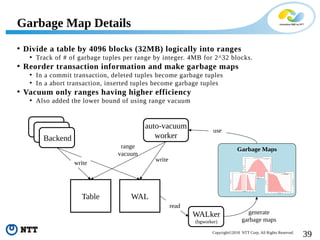
• Divide a table by 4096 blocks (32MB) logically into ranges
• Track of # of garbage tuples per range by integer. 4MB for 2^32 blocks.
• Reorder transaction information and make garbage maps
• In a commit transaction, deleted tuples become garbage tuples
• In a abort transaction, inserted tuples become garbage tuples
• Vacuum only ranges having higher efficiency
• Also added the lower bound of using range vacuum
Garbage Map Details
WAL
WALker
(bgworker)
Backend
Backend
Backend
auto-vacuum
worker
Table
write
range
vacuum
read
generate
garbage maps
use
Garbage Maps
write
40Copyright©2018 NTT Corp. All Rights Reserved.
• Machine
• 144cores, 126GB RAM, 1.5TB SSD
• Target
• master branch (ff49430 snapshot) and with range vacuum feature
• Configurations
• autovacuum_vacuum_scale_factor = 0.04
• autovacuum_vacuum_cost_limit = 1000 (default is 200)
• autovaucum_vacuum_cost_delay = 20ms (by default)
• Workload
• pgbench (TPC-B) at scale factor 16000 (about 200GB)
• Using custom script (gaussian : uniformly = 9 : 1)
• 5 hours
• Run open-transaction for 10 min with 30 min intervals (to generate garbage
faster)
• Observation
• Transaction TPS
• Transaction latency
• Relation size
Evaluation
41Copyright©2018 NTT Corp. All Rights Reserved.
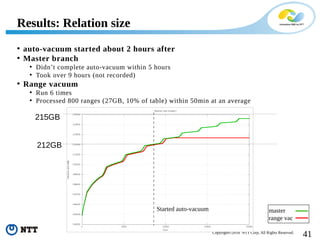
Results: Relation size
• auto-vacuum started about 2 hours after
• Master branch
• Didn’t complete auto-vacuum within 5 hours
• Took over 9 hours (not recorded)
• Range vacuum
• Run 6 times
• Processed 800 ranges (27GB, 10% of table) within 50min at an average
Started auto-vacuum master
range vac
212GB
215GB
42Copyright©2018 NTT Corp. All Rights Reserved.
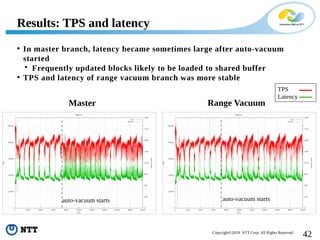
Results: TPS and latency
• In master branch, latency became sometimes large after auto-vacuum
started

Frequently updated blocks likely to be loaded to shared buffer
• TPS and latency of range vacuum branch was more stable
TPS
Latency
Master Range Vacuum
auto-vacuum starts auto-vacuum starts
43Copyright©2018 NTT Corp. All Rights Reserved.
• Range vacuum reclaims garbage space with minimum
side-affects in a short time
• Invoking range vacuum more frequently also means
calling index vacuum more frequently as well
• Combining with deferring index vacuum would be good idea
• Each range has the number of garbage tuples
• Could be the size of garbage instead
• Need to vacuum whole table if garbage placed uniformly
on the table
Summary
44Copyright©2018 NTT Corp. All Rights Reserved.
• Improvement ideas
• Parallel vacuum
• Deferring index vacuum
• Range vacuum and garbage map
• More improvement points
• Auto vacuum scheduling
• Patch is proposed
• Resource managements
• Using cgroups
• etc
Conclusion
45Copyright©2018 NTT Corp. All Rights Reserved.
Thank you!
Masahiko Sawada
Mail: sawada.mshk@gmail.com
Twitter: @sawada_masahiko
46Copyright©2018 NTT Corp. All Rights Reserved.
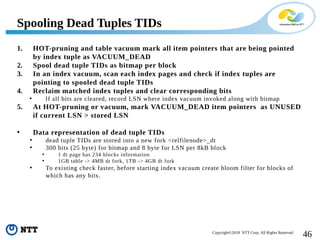
1. HOT-pruning and table vacuum mark all item pointers that are being pointed
by index tuple as VACUUM_DEAD
2. Spool dead tuple TIDs as bitmap per block
3. In an index vacuum, scan each index pages and check if index tuples are
pointing to spooled dead tuple TIDs
4. Reclaim matched index tuples and clear corresponding bits
• If all bits are cleared, record LSN where index vacuum invoked along with bitmap
5. At HOT-pruning or vacuum, mark VACUUM_DEAD item pointers as UNUSED
if current LSN > stored LSN
• Data representation of dead tuple TIDs
• dead tuple TIDs are stored into a new fork <relfilenode>_dt
• 300 bits (25 byte) for bitmap and 8 byte for LSN per 8kB block
• 1 dt page has 234 blocks information
• 1GB table -> 4MB dt fork, 1TB -> 4GB dt fork
• To existing check faster, before starting index vacuum create bloom filter for blocks of
which has any bits.
Spooling Dead Tuples TIDs
47Copyright©2018 NTT Corp. All Rights Reserved.
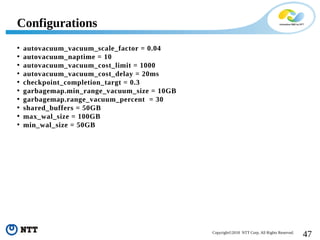
• autovacuum_vacuum_scale_factor = 0.04
• autovacuum_naptime = 10
• autovacuum_vacuum_cost_limit = 1000
• autovacuum_vacuum_cost_delay = 20ms
• checkpoint_completion_targt = 0.3
• garbagemap.min_range_vacuum_size = 10GB
• garbagemap.range_vacuum_percent = 30
• shared_buffers = 50GB
• max_wal_size = 100GB
• min_wal_size = 50GB
Configurations
48Copyright©2018 NTT Corp. All Rights Reserved.
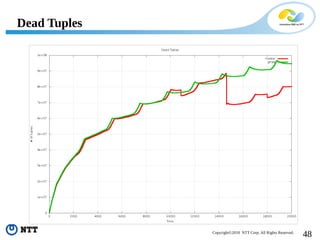
Dead Tuples

Vacuum more efficient than ever

  • 1.
    Copyright©2018 NTT Corp.All Rights Reserved. Vacuum More Efficient Than Ever Masahiko Sawada NTT Open Source Software Center @PGCon 2018
  • 2.
    2Copyright©2018 NTT Corp.All Rights Reserved. • Masahiko Sawada  from Tokyo, Japan • PostgreSQL contributor  Multiple synchronous replication: FIRST and ANY methods (9.6 and 10)  Freeze map (9.6)  Skipping cleanup index vacuum (11) Who Am I?
  • 3.
    3Copyright©2018 NTT Corp.All Rights Reserved. • What Is Vacuum? • Three Vacuum Improvements • Problems • Solutions • Challenges • Evaluations • Conclusion Agenda
  • 4.
    4Copyright©2018 NTT Corp.All Rights Reserved. • PostgreSQL garbage collection feature • Recover or reuse disk space occupied • VACUUM command • =# VACUUM tbl1, tbl2; • =# VACUUM (ANALYZE, VERBOSE) tbl1; • Auto vacuum • autovacuum launcher process • autovacuum worker processes What Is Vacuum?
  • 5.
    5Copyright©2018 NTT Corp.All Rights Reserved. • Auto Vacuum (8.1~) • Vacuum Delay (8.1~) • Visibility Map (8.4~) • Freeze Map (part of visibility map) (9.6~) • Skipping index cleanup (11~) History of Vacuum Evolution
  • 6.
    6Copyright©2018 NTT Corp.All Rights Reserved. 1. Shorten the vacuum execution time • Use resource as much as possible • Reduce the amount of work • Work in parallel 2. But, reduce impact on transaction processing • Work lazily What’s Needed For “Good Vacuum”?
  • 7.
    7Copyright©2018 NTT Corp.All Rights Reserved. • Vacuum works with three phases: 1. Collecting dead tuple TIDs till maintenance_work_mem amount of memory is consumed 2. Vacuum indexes 3. Vacuum table • Vacuum is a disk-intensive operation How Vacuum Actually Works 1. Collecting TIDs 3. Table vacuum 2-1. Index vacuum 2-2. Index vacuum dead tuple TIDs
  • 8.
    8Copyright©2018 NTT Corp.All Rights Reserved. • 2 bits per block: all-visible and all-frozen • Track which pages “might” have garbage • all-visible bit = 1 means the corresponding page has only visible tuples so we don’t need to vacuum it Vacuum With Visibility Map 1. Collecting TIDs 3. Table vacuum 2-1. Index vacuum 2-2. Index vacuum dead tuple TIDs Skip all-visible Pages :-)
  • 9.
    9Copyright©2018 NTT Corp.All Rights Reserved. • Table size • Number of indexes • Resources Factors Of Vacuum Performance • Visibility map • Vacuum delays (make lazy) • Skipping index cleanup
  • 10.
    10Copyright©2018 NTT Corp.All Rights Reserved. • Table size • Number of indexes • Resources Factors Of Vacuum Performance • Parallel vacuum • Deferring index vacuums • Range vacuum • Visibility map • Vacuum delays (make lazy) • Skipping index cleanup Today’s talk
  • 11.
    11Copyright©2018 NTT Corp.All Rights Reserved. • Table size • Number of indexes • Resources Factors Of Vacuum Performance • Parallel vacuum • Deferring index vacuums • Range vacuum • Visibility map • Vacuum delays (make lazy) • Skipping index cleanup Today’s talk
  • 12.
    12Copyright©2018 NTT Corp.All Rights Reserved. PARALLEL VACUUM
  • 13.
    13Copyright©2018 NTT Corp.All Rights Reserved. • Vacuum is performed by single process • Vacuum could take a very long time • Over days or even more! • Taking longer time if table has multiple indexes On Very Large Table
  • 14.
    14Copyright©2018 NTT Corp.All Rights Reserved.  Divide a large table  Reduce autovacuum_delay_cost/limit • Additional burden on the disk I/O instead Current Solutions
  • 15.
    15Copyright©2018 NTT Corp.All Rights Reserved. • Execute vacuum with parallel workers • Shorten the execution time of vacuum • Note that this will consume more disk I/O • A patch has been proposed • “Block level Parallel Vacuum” (2016) • However, must resolve RelExt lock issue first • Please refer to “Moving relation extension locks out of heavyweight lock manager” (2016) Idea: Parallel Vacuum
  • 16.
    16Copyright©2018 NTT Corp.All Rights Reserved. How Does It Work? Collect TIDs Vacuum Table Vacuum IndexA Vacuum IndexB Collect TIDs Collect TIDs Vacuum Table Vacuum Table Collect TIDs Collect TIDs Collect TIDs • Perform both TID collection and table vacuum with parallel workers • Dead tuple TIDs are shared on the shared memory(DSM) • Each index is assigned to a worker • Make some synchronizations among workers Worker 1 Worker 3Worker 2 : Clear garbage TIDs
  • 17.
    17Copyright©2018 NTT Corp.All Rights Reserved. Evaluation (~8 indexes) 5x faster!! RAM : 32GB shared buffers: 512 MB Table : 4GB Index vacuum : 1 ioDrive SSD : 256GB Time(ms)
  • 18.
    18Copyright©2018 NTT Corp.All Rights Reserved. • Parallel vacuum makes vacuums significantly faster • This consume more CPUs and disk I/O • Patch has been proposed • Relation extension lock issue must be solved first! Summary
  • 19.
    19Copyright©2018 NTT Corp.All Rights Reserved. • Table size • Number of indexes • Resources Factors of Vacuum Performance • Parallel vacuum • Deferring index vacuums • Range vacuum • Visibility map • Vacuum delays (make lazy) • Skipping index cleanup Today’s talk
  • 20.
    20Copyright©2018 NTT Corp.All Rights Reserved. DEFERRING INDEX VACUUM
  • 21.
    21Copyright©2018 NTT Corp.All Rights Reserved. • Index vacuums could still be very long • Table vacuum can be skipped by Visibility Map but index vacuum doesn’t have such facility • Index vacuum could be invoked N times in a vacuum processing • Almost all index AMs require a full scanning on index • Only 10 dead tuples in 1TB table requires whole index scans! Looking Back To Analysis of Vacuum Collecting TIDs Table vacuum Index vacuum 1 Index vacuum 2 Collecting TIDs Table vacuum Index vacuum 1 Index vacuum 2 Vacuum Efficient vacuum with VM
  • 22.
    22Copyright©2018 NTT Corp.All Rights Reserved.  Don’t trigger auto-vacuum with a small threshold • What about manual vacuum? • Indexes are not easy to bloat than tables  Increase maintenance_work_mem to avoid calling index vacuuming multiple times • However, still requires index vacuum at least once Current Solutions
  • 23.
    23Copyright©2018 NTT Corp.All Rights Reserved. • Spool garbage TIDs • Don't trigger index vacuum unless the amount of spooled garbage TIDs reached to the threshold • Reduce the number of index vacuum Idea: Deferring Index Vacuum
  • 24.
    24Copyright©2018 NTT Corp.All Rights Reserved. • Amount of garbage TID < threshold • Vacuum only table and spool dead tuple TIDs • Amount of garbage TID >= threshold • Vacuum indexes How Does It Work? Table Spool TIDs Spool TIDs Spool TIDs Index Spool area Threshold Reached! Vacuum table Vacuum table Vacuum table Vacuum table Vacuum table Vacuum table Vacuum index Vacuum index
  • 25.
    25Copyright©2018 NTT Corp.All Rights Reserved. • There are related discussions • “Proposal: Another attempt at vacuum improvements” (2011) • “Single pass vacuum – take1” (2011) • But it breaks on-disk format Related Discussions
  • 26.
    26Copyright©2018 NTT Corp.All Rights Reserved. • Evaluate the performance improvement by reducing the number of index vacuums  Spool garbage TIDs to DSM  When bulk-deletion we look up both collected TIDs and spooled TIDs • Introduce new storage parameter vacuum_index_defer_size which controls how much dead tuples can be spilled out • However, don’t care about concurrent update and durability :( Evaluation
  • 27.
    27Copyright©2018 NTT Corp.All Rights Reserved. =# dt+ List of relations Schema | Name | Type | Owner | Size | Description --------+--------------+-------+----------+-------- +------------ public | defer_table | table | masahiko | 3458 MB | public | normal_table | table | masahiko | 3458 MB | (2 rows) -- Spool size is 100kB =# ALTER TABLE defer_table SET (vacuum_index_defer_size = 100); -- Disable deferring index vacuum =# ALTER TABLE normal_table SET (vacuum_index_defer_size = 0); Evaluation
  • 28.
    28Copyright©2018 NTT Corp.All Rights Reserved. 1. Load data 2. Vacuum table to make VM 3. Loop until the amount of garbage reached to the threshold (= 17000 tuples) 1. Delete 5000 tuples to make garbage 2. Vacuum Vacuum will be performed 4 times, and index vacuum will be executed at only the 4th vacuum Evaluation
  • 29.
    29Copyright©2018 NTT Corp.All Rights Reserved. Evaluation • Skipped index vacuum at 1st, 2nd and 3rd vacuum • Deferring index vacuum made vacuum 2.1x faster • At the 4th vacuum, deferring index vacuum took twice time than the normal • Looking up the collected TIDs as well as the spooled TIDs
  • 30.
    30Copyright©2018 NTT Corp.All Rights Reserved. • Deferring index vacuum have potentials of speed up vacuums much • In this evaluation, it speeds up 2.1x faster • More tricks are required for the correct implementation • To prevent vacuumed item pointers from being reused before index vacuum • To avoid breaking on-disk format Summary
  • 31.
    31Copyright©2018 NTT Corp.All Rights Reserved. • Table size • Number of indexes • Resources Factors Of Vacuum Performance • Parallel vacuum • Deferring index vacuums • Range vacuum • Visibility map • Vacuum delays (make lazy) • Skipping index cleanup Today’s talk
  • 32.
    32Copyright©2018 NTT Corp.All Rights Reserved. RANGE VACUUM
  • 33.
    33Copyright©2018 NTT Corp.All Rights Reserved. Dilemma DBA wants to avoid both disk I/O bursts and affecting to TPS by vacuum as much as possible DBA wants to complete vacuum as quickly as possible
  • 34.
    34Copyright©2018 NTT Corp.All Rights Reserved. • Long-running vacuum likely to be canceled • Restart vacuum from the beginning of the table again • Cannot reclaim garbage that is made since the vacuum started Is it possible to use vacuum delays and to complete vacuum in a short time? Long-running Vacuum Problems
  • 35.
    35Copyright©2018 NTT Corp.All Rights Reserved. • The cost of vacuum a block can be regard as almost constant • The most spent time is disk I/O (read buffer, write WAL) • Garbage on table might have locality • Even though vacuum reclaims a block the new free space got by vacuum depends on how much garbage exists on the block Efficiency Analysis of Vacuum
  • 36.
    36Copyright©2018 NTT Corp.All Rights Reserved. • If we got free space N byte by vacuum on M byte, efficiency of vacuum k is N/M • k = 1 means we get free space as mush as we vacuumed • k ≈ 0 means we don’t get free space even if vacuumed lots of blocks • All-visible of VM is cleared if even one tuple is inserted/deleted Efficiency Analysis of Vacuum Block number Amount of garbage Good efficiency (k≈1) Poor efficiency (k≈0)
  • 37.
    37Copyright©2018 NTT Corp.All Rights Reserved. Range Vacuum with Garbage Map Before After Vacuum higher 10% ranges • Garbage map  Track garbage status of bunch of blocks  Reproduce the garbage status on table • Range vacuum  Preferably vacuum blocks having higher “k”  Trigger vacuum more frequently
  • 38.
    38Copyright©2018 NTT Corp.All Rights Reserved. • WAL-based • WAL knows the all block change information • Don’t increase transaction latency as mush as possible • Logical decoding didn’t match (so far) • Need to track block-level changes • Need to track aborted transactions • “WALker” module • A background worker that continues to read WAL • Invoke corresponding plugin callbacks • “garbagemap” plugin builds garbage maps • Repository at https://github.com/MasahikoSawada/walker Building Garbage Maps
  • 39.
    39Copyright©2018 NTT Corp.All Rights Reserved. • Divide a table by 4096 blocks (32MB) logically into ranges • Track of # of garbage tuples per range by integer. 4MB for 2^32 blocks. • Reorder transaction information and make garbage maps • In a commit transaction, deleted tuples become garbage tuples • In a abort transaction, inserted tuples become garbage tuples • Vacuum only ranges having higher efficiency • Also added the lower bound of using range vacuum Garbage Map Details WAL WALker (bgworker) Backend Backend Backend auto-vacuum worker Table write range vacuum read generate garbage maps use Garbage Maps write
  • 40.
    40Copyright©2018 NTT Corp.All Rights Reserved. • Machine • 144cores, 126GB RAM, 1.5TB SSD • Target • master branch (ff49430 snapshot) and with range vacuum feature • Configurations • autovacuum_vacuum_scale_factor = 0.04 • autovacuum_vacuum_cost_limit = 1000 (default is 200) • autovaucum_vacuum_cost_delay = 20ms (by default) • Workload • pgbench (TPC-B) at scale factor 16000 (about 200GB) • Using custom script (gaussian : uniformly = 9 : 1) • 5 hours • Run open-transaction for 10 min with 30 min intervals (to generate garbage faster) • Observation • Transaction TPS • Transaction latency • Relation size Evaluation
  • 41.
    41Copyright©2018 NTT Corp.All Rights Reserved. Results: Relation size • auto-vacuum started about 2 hours after • Master branch • Didn’t complete auto-vacuum within 5 hours • Took over 9 hours (not recorded) • Range vacuum • Run 6 times • Processed 800 ranges (27GB, 10% of table) within 50min at an average Started auto-vacuum master range vac 212GB 215GB
  • 42.
    42Copyright©2018 NTT Corp.All Rights Reserved. Results: TPS and latency • In master branch, latency became sometimes large after auto-vacuum started  Frequently updated blocks likely to be loaded to shared buffer • TPS and latency of range vacuum branch was more stable TPS Latency Master Range Vacuum auto-vacuum starts auto-vacuum starts
  • 43.
    43Copyright©2018 NTT Corp.All Rights Reserved. • Range vacuum reclaims garbage space with minimum side-affects in a short time • Invoking range vacuum more frequently also means calling index vacuum more frequently as well • Combining with deferring index vacuum would be good idea • Each range has the number of garbage tuples • Could be the size of garbage instead • Need to vacuum whole table if garbage placed uniformly on the table Summary
  • 44.
    44Copyright©2018 NTT Corp.All Rights Reserved. • Improvement ideas • Parallel vacuum • Deferring index vacuum • Range vacuum and garbage map • More improvement points • Auto vacuum scheduling • Patch is proposed • Resource managements • Using cgroups • etc Conclusion
  • 45.
    45Copyright©2018 NTT Corp.All Rights Reserved. Thank you! Masahiko Sawada Mail: sawada.mshk@gmail.com Twitter: @sawada_masahiko
  • 46.
    46Copyright©2018 NTT Corp.All Rights Reserved. 1. HOT-pruning and table vacuum mark all item pointers that are being pointed by index tuple as VACUUM_DEAD 2. Spool dead tuple TIDs as bitmap per block 3. In an index vacuum, scan each index pages and check if index tuples are pointing to spooled dead tuple TIDs 4. Reclaim matched index tuples and clear corresponding bits • If all bits are cleared, record LSN where index vacuum invoked along with bitmap 5. At HOT-pruning or vacuum, mark VACUUM_DEAD item pointers as UNUSED if current LSN > stored LSN • Data representation of dead tuple TIDs • dead tuple TIDs are stored into a new fork <relfilenode>_dt • 300 bits (25 byte) for bitmap and 8 byte for LSN per 8kB block • 1 dt page has 234 blocks information • 1GB table -> 4MB dt fork, 1TB -> 4GB dt fork • To existing check faster, before starting index vacuum create bloom filter for blocks of which has any bits. Spooling Dead Tuples TIDs
  • 47.
    47Copyright©2018 NTT Corp.All Rights Reserved. • autovacuum_vacuum_scale_factor = 0.04 • autovacuum_naptime = 10 • autovacuum_vacuum_cost_limit = 1000 • autovacuum_vacuum_cost_delay = 20ms • checkpoint_completion_targt = 0.3 • garbagemap.min_range_vacuum_size = 10GB • garbagemap.range_vacuum_percent = 30 • shared_buffers = 50GB • max_wal_size = 100GB • min_wal_size = 50GB Configurations
  • 48.
    48Copyright©2018 NTT Corp.All Rights Reserved. Dead Tuples