Download to read offline
![S.R. Verma Int. Journal of Engineering Research and Applications www.ijera.com
ISSN : 2248-9622, Vol. 4, Issue 12( Part 6), December 2014, pp.144-149
www.ijera.com 144 | P a g e
Effect of Nozzle Design and Processing Parameter on
Characteristics of Glass/Polypropylene Hybrid Yarns
Dr Hireni Mankodi*, Dr Pravin Patel*
*(Department of Textile Engineering, The M.S University, Vadodara 390001)
ABSTRACT
Among the various methods commingling process is comparatively better alternative to produce hybrid yarns.
The required properties of hybrid yarns can be obtained by controlling main processing parameters such as air
pressure, overfeed and take-up speed along with proper selection of nozzle (jet) design. The commingling
machine has been fabricated to study the commingling parameters. The nozzle is the most important element of
the commingling machine. The design specification of commingling jet along with the processing parameters
decides the final characteristics of yarn. In the present study two different types of jets have been selected to
investigate commingling characteristics of glass/polypropylene hybrid yarn.
Keywords – Commingling, Hybrid yarn, Nozzle, Nip Frequency, Nip stability
I. INTRODUCTION
Recently thermoplastic polymer composites are
increasingly used as alternative to natural material.
Owing to the high melt viscosities of thermoplastic
polymers, the matrix has to be combined with the
fibre at the preform stage in such a way that the
polymer does not have to flow long distances to
achieve fibre wetting during consolidation. Probably
the greatest potential for further shortening of
impregnation time lay in the advancement of
combination techniques. One of the outstanding
advantages of commingled yarns lies in their
potential of intimate blending of reinforcement
material like glass, carbon etc with matrix fibers like
Polypropylene, Polyester etc by simultaneously
retaining the flexibility of the original fibre tow [6].
The commingled yarns are mainly characterized by
having regular nips which have been act as a binding
point between open portions. In the present study,
the hybrid yarns were manufactured from glass/
polypropylene using different type of nozzles with
constant take up speed and different level of air
pressure and overfeed.
II. MATERIAL AND METHODS
The various hybrid yarns have been prepared
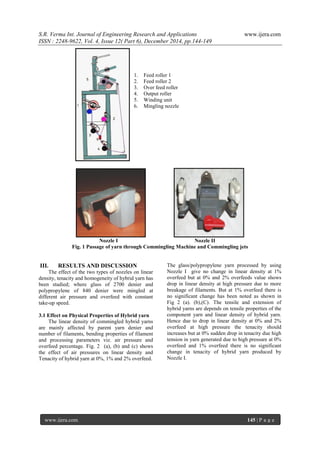
using commingling machine as shown in Fig.1 using
glass and polypropylene filament yarns. The various
hybrid yarns have been prepared to study the effect
of nozzle design and processing parameter on
commingling behavior of hybrid yarn.
The various hybrid yarns have been made at 50
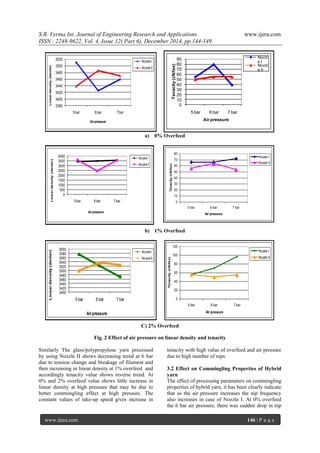
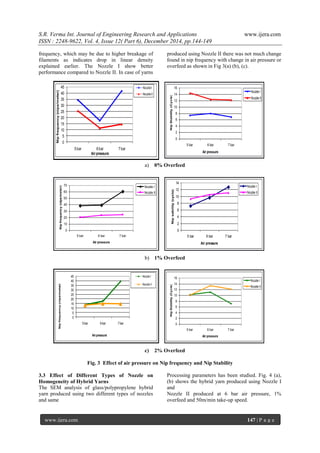
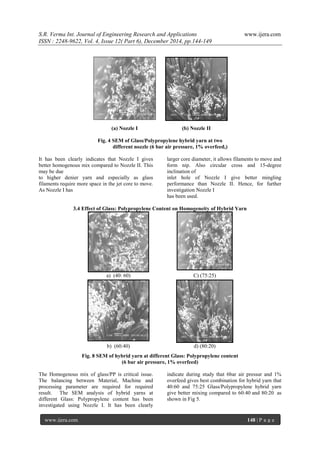
m/min constant Take up speed and three level of Air
pressure 5bar, 6 bar, 7bar and overfeed value
0%,1%,2% combination. The Fig.1 Nozzle I is
ceramic jet with circular cross section having 2 inlet
hole with 150
inclination, 1,5mm diameter of inlet
hole, 40mm channel length and 2.5mm channel
diameter. Fig.1 Nozzle II is the metallic jet with
semi circular cross section (Nozzle 2) having 2
inlet hole with 150
inclination, 1,0mm diameter of
inlet hole, 20mm channel length and 1.5mm channel
diameter respectively.
In order to study the qualitative and quantitative
effect of the type of nozzle on the commingling
hybrid yarns, various samples of hybrid yarns have
been made from glass/polypropylene filaments to
study the mechanical properties such as tenacity,
extension at break. The mingling characteristics
have been evaluated in terms of nip frequency, nip
stability
RESEARCH ARTICLE OPEN ACCESS](https://image.slidesharecdn.com/v041206144149-150115055141-conversion-gate02/85/Effect-of-Nozzle-Design-and-Processing-Parameter-on-Characteristics-of-Glass-Polypropylene-Hybrid-Yarns-1-320.jpg)
![S.R. Verma Int. Journal of Engineering Research and Applications www.ijera.com
ISSN : 2248-9622, Vol. 4, Issue 12( Part 6), December 2014, pp.144-149
www.ijera.com 149 | P a g e
IV. CONCLUSIONS
The study on commingled hybrid yarn with
different Nozzle Design and Glass/Polypropylene
Proportion conclude that the nozzle geometry plays
important role in deciding commingling
performance of different hybrid yarn. Hence proper
selection of nozzle is required as per the type and
linear density of each component yarn. Circular
cross sectional shape of main yarn channel in jet is
more suitable for glass/polypropylene hybrid
yarn compared to semi circular cross sectional
shape. Circular ceramic nozzle gives better
commingling properties and the effect is more
prominent at 1% overfeed and higher air pressure (6
bar and 7 bar).The hybrid yarn with different Glass:
Polypropylene content viz. 75:25 gives better
commingling properties. The hybrid yarns with
Glass: Polypropylene content of 75:25 and 40:60
give homogenous mixing of matrix and reinforced
filament within hybrid yarn.
REFERANCE
[1.] B. Lauke et. al;Effect of hybrid yarn
structure on the delamination behaviour of
thermoplastic composite, Composites part
A, 29 A, 1397-1409 ,(1998).
[2.] Chig-Iuan Su. et. al; Image analysis of
composite yarn cross sections, Textile
Research Journal, 69(3), 203-207, (1999).
[3.] Krucniska et. al; Preliminary studies on the
manufacturing of hybrid yarn designed for
thermoplastic composite, April/June (2000).
[4.] Hireni Mankodi, Pravin Patel; Hybrid Yarns
For Thermoplastic Composites: A scope of
Technical Textile Application,World
conference (83rd TIWC) on Quality Textile
for Quality Life, organized by The Textile
Institute and Donghua University, shanghai,
China, 23rd
-27th
May (2004).
[5.] Hireni Mankodi, Pravin Patel; New
engineering material for textile composite,
Proceeding of the HPTEX, 337-345, July
(2004).
[6.] V. Ogale and R. Alagirusamy, Textile
preforms for advanced composites, Indian
Journal of Fibre and Textile Research, Vol.
29, 366-375, September (2004).
[7.] Hireni Mankodi, Pravin Patel; Study the
effect of commingling Parameters on Glass /
Polypropylene Hybrid Yarns Properties,
Autex Research Journal, Vol 9,No 3, pp 70-
73, September (2009)
[8.] Hireni Mankodi, Studies On Glass/Pp/Cu
Laminates From Conductive Hybrid Yarns”
Man Made Textile, September (2010)
[9.] A.C. Long; Design and manufacture of
textile composites
[10.] Hireni Mankodi, Ch 2: Development in
Hybrid Yarn “Specialist yarn and fabric
structures: developments and applications”
edited by H, Gong ( WOODHEAD,
Publishers Ltd, UK)](https://image.slidesharecdn.com/v041206144149-150115055141-conversion-gate02/85/Effect-of-Nozzle-Design-and-Processing-Parameter-on-Characteristics-of-Glass-Polypropylene-Hybrid-Yarns-6-320.jpg)

The study investigates the effects of nozzle design and processing parameters on the characteristics of glass/polypropylene hybrid yarns, highlighting that the commingling process is effective for producing these yarns. It concludes that the design of the nozzle, particularly the circular ceramic nozzle, significantly influences the commingling performance and that optimal parameters include 1% overfeed and higher air pressures. The findings suggest that a proper balance between glass and polypropylene content enhances the homogeneity and mechanical properties of the hybrid yarn.


![Ceramic coating [tio2 zro2] on aluminium 6061 t6 for anti](https://cdn.slidesharecdn.com/ss_thumbnails/ceramiccoatingtio2-zro2onaluminium6061t6foranti-140821045215-phpapp01-thumbnail.jpg?width=640&height=640&fit=bounds)


![5G Explained! A High Level Overview [Introduction]](https://cdn.slidesharecdn.com/ss_thumbnails/5gexplainedahighleveloverview-260119165306-cc137a3e-thumbnail.jpg?width=640&height=640&fit=bounds)


