User eXperience
Carlos J. Costa
2013/2014
What the #$%@ is UX Design?
●

ww.youtube.com/watch?v=Ovj4hFxko7c
User Experience
●
●

●

●

often abbreviated "UX"
is the quality of experience a person has when
interacting with a specific design.
Source:
Knemeyer, Dirk and Svoboda, Eric (2006). User Experience - UX. from
http://www.interaction-design.org/encyclopedia/user_experience_or_ux.html
Customer Experience
●

the user experience, mostly called “customer experience” when referring
to e-commerce websites; the totality of the experience of a user when
visiting a website.

●

Their impressions and feelings.

●

Whether they’re successful.

●

Whether they enjoy themselves.

●

Whether they feel like coming back again.

●

The extent to which they encounter problems, confusions, and bugs.

●

Source

●

Usability First - Usability Glossary - customer experience | Usability First. (n.d.). Retrieved from
http://www.usabilityfirst.com/glossary/customer-experience/
User Experience
●

●

●

A set of material rendered by a user agent
which may be perceived by a user and with
which interaction may be possible.

Glossary of Terms for Device Independence, W3C Working Draft 18
January 2005
http://www.w3.org/TR/di-gloss/#def-user-experience
User Experience
●

www.youtube.com/watch?v=O94kYyzqvTc
The Elements of User Experience
●

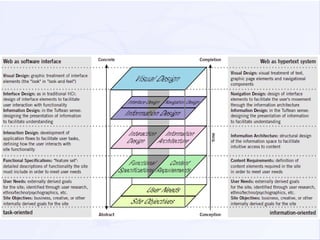
Jesse James Garrett, 2000

●

A basic duality:

●

The Web was originally conceived as a hypertextual information space;

●

●

●

but the development of increasingly sophisticated front- and back-end
technologies has fostered its use as a remote software interface.
This dual nature has led to much confusion,as user experience practitioners
have attempted to adapt their terminology to cases beyond the scope of its
original application.
The goal of this document is to define some of these terms within their
appropriate contexts, and to clarify the underlying relationships among
these various elements
User Experience Honeycomb
(Peter Morville,2004)

●

●

●

●

●

●

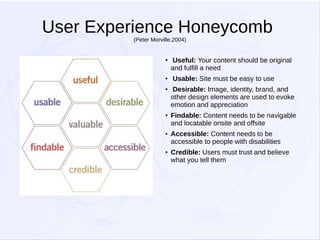
Useful: Your content should be original
and fulfill a need
Usable: Site must be easy to use
Desirable: Image, identity, brand, and
other design elements are used to evoke
emotion and appreciation
Findable: Content needs to be navigable
and locatable onsite and offsite
Accessible: Content needs to be
accessible to people with disabilities
Credible: Users must trust and believe
what you tell them
●

●

●

●

●

●

●

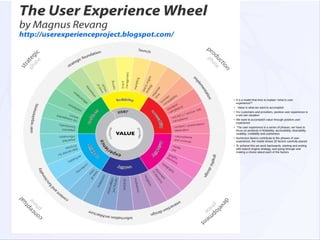
It is a model that tries to explain “what is user
experience?”
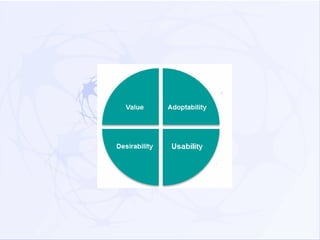
Value is what we want to accomplish
For customers and providers, positive user experience is
a win-win situation
We want to accomplish value through positive user
experience
The user experience is a series of phases, we have to
focus on positivity in findability, accessibility, desirability,
usability, credibility and usefulness
Numerous factors contribute to the phases of user
experience, the model shows 30 factors carefully placed
To achieve this we work backwards, starting and ending
with search engine strategy, and going through and
making a choice about each of the factors
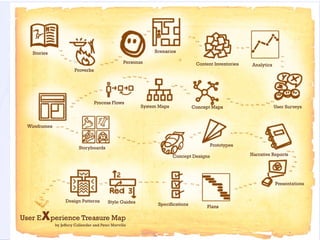
User Experience Tresury Map
●
●

●

Jeffery Callender and Peter Morville, 2009
a concise representation of the common
deliverables found in a design process.
http://semanticstudios.com/publications/semantics/000228.php
●
●

●
●
●
●
●
●
●

●
●
●
●
●
●
●
●
●
●
●
●
●
●
●
●
●
●
●
●
●
●

●
●
●
●

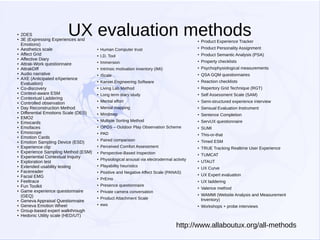
UX evaluation methods

2DES
3E (Expressing Experiences and
Emotions)
Aesthetics scale
Affect Grid
Affective Diary
Attrak-Work questionnaire
AttrakDiff
Audio narrative
AXE (Anticipated eXperience
Evaluation)
Co-discovery
Context-aware ESM
Contextual Laddering
Controlled observation
Day Reconstruction Method
Differential Emotions Scale (DES)
EMO2
Emocards
Emofaces
Emoscope
Emotion Cards
Emotion Sampling Device (ESD)
Experience clip
Experience Sampling Method (ESM)
Experiential Contextual Inquiry
Exploration test
Extended usability testing
Facereader
Facial EMG
Feeltrace
Fun Toolkit
Game experience questionnaire
(GEQ)
Geneva Appraisal Questionnaire
Geneva Emotion Wheel
Group-based expert walkthrough
Hedonic Utility scale (HED/UT)

●

Product Experience Tracker

●

Human Computer trust

●

Product Personality Assignment

●

I.D. Tool

●

Product Semantic Analysis (PSA)

●

Immersion

●

Property checklists

●

Intrinsic motivation inventory (IMI)

●

Psychophysiological measurements

●

iScale

●

QSA GQM questionnaires

●

Kansei Engineering Software

●

Reaction checklists

●

Living Lab Method

●

Repertory Grid Technique (RGT)

●

Long term diary study

●

Self Assessment Scale (SAM)

●

Mental effort

●

Semi-structured experience interview

●

Mental mapping

●

Sensual Evaluation Instrument

●

Mindmap

●

Sentence Completion

●

Multiple Sorting Method

●

ServUX questionnaire

●

OPOS – Outdoor Play Observation Scheme

●

SUMI

●

PAD

●

This-or-that

●

Paired comparison

●

Timed ESM

●

Perceived Comfort Assessment

●

TRUE Tracking Realtime User Experience

●

Perspective-Based Inspection

●

Physiological arousal via electrodermal activity

TUMCAT

●

●

Playability heuristics

UTAUT

●

●

UX Curve

●

UX Expert evaluation

●

UX laddering

●

Valence method

●

●

●

Positive and Negative Affect Scale (PANAS)
PrEmo
Presence questionnaire

●

Private camera conversation

●

Product Attachment Scale

●

ews

●

●

WAMMI (Website Analysis and Measurement
Inventory)
Workshops + probe interviews

http://www.allaboutux.org/all-methods
User Experience
●

http://www.youtube.com/watch?v=3J85SUZFXNM

User eXperience

  • 1.
  • 3.
    What the #$%@is UX Design? ● ww.youtube.com/watch?v=Ovj4hFxko7c
  • 4.
    User Experience ● ● ● ● often abbreviated"UX" is the quality of experience a person has when interacting with a specific design. Source: Knemeyer, Dirk and Svoboda, Eric (2006). User Experience - UX. from http://www.interaction-design.org/encyclopedia/user_experience_or_ux.html
  • 5.
    Customer Experience ● the userexperience, mostly called “customer experience” when referring to e-commerce websites; the totality of the experience of a user when visiting a website. ● Their impressions and feelings. ● Whether they’re successful. ● Whether they enjoy themselves. ● Whether they feel like coming back again. ● The extent to which they encounter problems, confusions, and bugs. ● Source ● Usability First - Usability Glossary - customer experience | Usability First. (n.d.). Retrieved from http://www.usabilityfirst.com/glossary/customer-experience/
  • 6.
    User Experience ● ● ● A setof material rendered by a user agent which may be perceived by a user and with which interaction may be possible. Glossary of Terms for Device Independence, W3C Working Draft 18 January 2005 http://www.w3.org/TR/di-gloss/#def-user-experience
  • 7.
  • 8.
    The Elements ofUser Experience ● Jesse James Garrett, 2000 ● A basic duality: ● The Web was originally conceived as a hypertextual information space; ● ● ● but the development of increasingly sophisticated front- and back-end technologies has fostered its use as a remote software interface. This dual nature has led to much confusion,as user experience practitioners have attempted to adapt their terminology to cases beyond the scope of its original application. The goal of this document is to define some of these terms within their appropriate contexts, and to clarify the underlying relationships among these various elements
  • 10.
    User Experience Honeycomb (PeterMorville,2004) ● ● ● ● ● ● Useful: Your content should be original and fulfill a need Usable: Site must be easy to use Desirable: Image, identity, brand, and other design elements are used to evoke emotion and appreciation Findable: Content needs to be navigable and locatable onsite and offsite Accessible: Content needs to be accessible to people with disabilities Credible: Users must trust and believe what you tell them
  • 11.
    ● ● ● ● ● ● ● It is amodel that tries to explain “what is user experience?” Value is what we want to accomplish For customers and providers, positive user experience is a win-win situation We want to accomplish value through positive user experience The user experience is a series of phases, we have to focus on positivity in findability, accessibility, desirability, usability, credibility and usefulness Numerous factors contribute to the phases of user experience, the model shows 30 factors carefully placed To achieve this we work backwards, starting and ending with search engine strategy, and going through and making a choice about each of the factors
  • 12.
    User Experience TresuryMap ● ● ● Jeffery Callender and Peter Morville, 2009 a concise representation of the common deliverables found in a design process. http://semanticstudios.com/publications/semantics/000228.php
  • 14.
    ● ● ● ● ● ● ● ● ● ● ● ● ● ● ● ● ● ● ● ● ● ● ● ● ● ● ● ● ● ● ● ● ● ● ● UX evaluation methods 2DES 3E(Expressing Experiences and Emotions) Aesthetics scale Affect Grid Affective Diary Attrak-Work questionnaire AttrakDiff Audio narrative AXE (Anticipated eXperience Evaluation) Co-discovery Context-aware ESM Contextual Laddering Controlled observation Day Reconstruction Method Differential Emotions Scale (DES) EMO2 Emocards Emofaces Emoscope Emotion Cards Emotion Sampling Device (ESD) Experience clip Experience Sampling Method (ESM) Experiential Contextual Inquiry Exploration test Extended usability testing Facereader Facial EMG Feeltrace Fun Toolkit Game experience questionnaire (GEQ) Geneva Appraisal Questionnaire Geneva Emotion Wheel Group-based expert walkthrough Hedonic Utility scale (HED/UT) ● Product Experience Tracker ● Human Computer trust ● Product Personality Assignment ● I.D. Tool ● Product Semantic Analysis (PSA) ● Immersion ● Property checklists ● Intrinsic motivation inventory (IMI) ● Psychophysiological measurements ● iScale ● QSA GQM questionnaires ● Kansei Engineering Software ● Reaction checklists ● Living Lab Method ● Repertory Grid Technique (RGT) ● Long term diary study ● Self Assessment Scale (SAM) ● Mental effort ● Semi-structured experience interview ● Mental mapping ● Sensual Evaluation Instrument ● Mindmap ● Sentence Completion ● Multiple Sorting Method ● ServUX questionnaire ● OPOS – Outdoor Play Observation Scheme ● SUMI ● PAD ● This-or-that ● Paired comparison ● Timed ESM ● Perceived Comfort Assessment ● TRUE Tracking Realtime User Experience ● Perspective-Based Inspection ● Physiological arousal via electrodermal activity TUMCAT ● ● Playability heuristics UTAUT ● ● UX Curve ● UX Expert evaluation ● UX laddering ● Valence method ● ● ● Positive and Negative Affect Scale (PANAS) PrEmo Presence questionnaire ● Private camera conversation ● Product Attachment Scale ● ews ● ● WAMMI (Website Analysis and Measurement Inventory) Workshops + probe interviews http://www.allaboutux.org/all-methods
  • 16.