UX Research in an Agile Development Cycle
26 April 2017
Ed Hertzog
Sr. UX Engineer
Georgia Spangenberg
Sr. Researcher
#OOUX
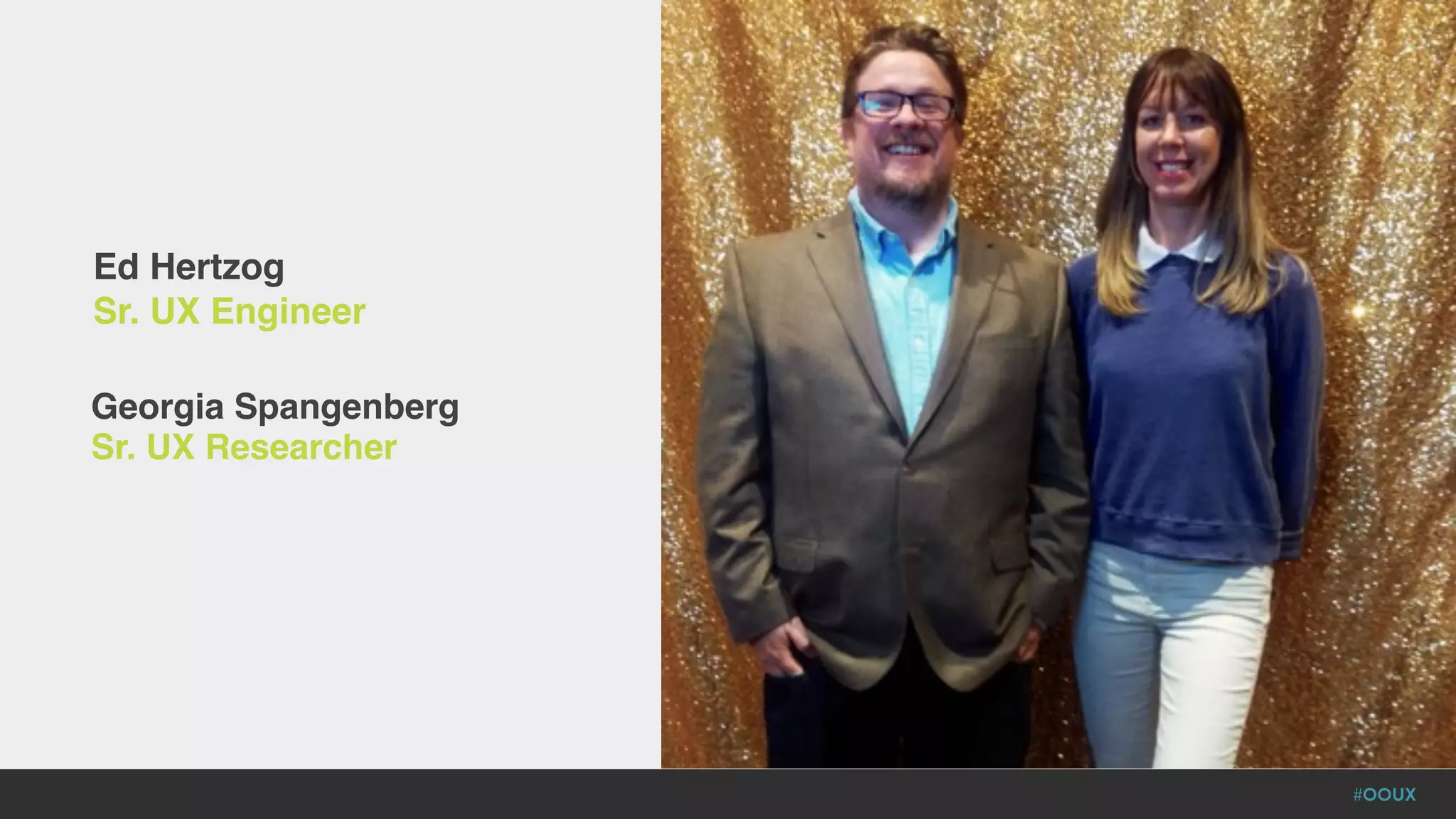
Georgia Spangenberg
Sr. UX Researcher
Ed Hertzog
Sr. UX Engineer
#OOUX
Discussion Points
How to run research on tight timelines
How to plan research while still designing
How object-oriented UX can improve the Agile process
#OOUX
Agile as in…
From our frame of reference (at Intuitive)
Project-based (e.g., websites versus product/software development)
Typically 2 or 3-week design & development sprints (can range from 6 weeks to
6 months)
#OOUX
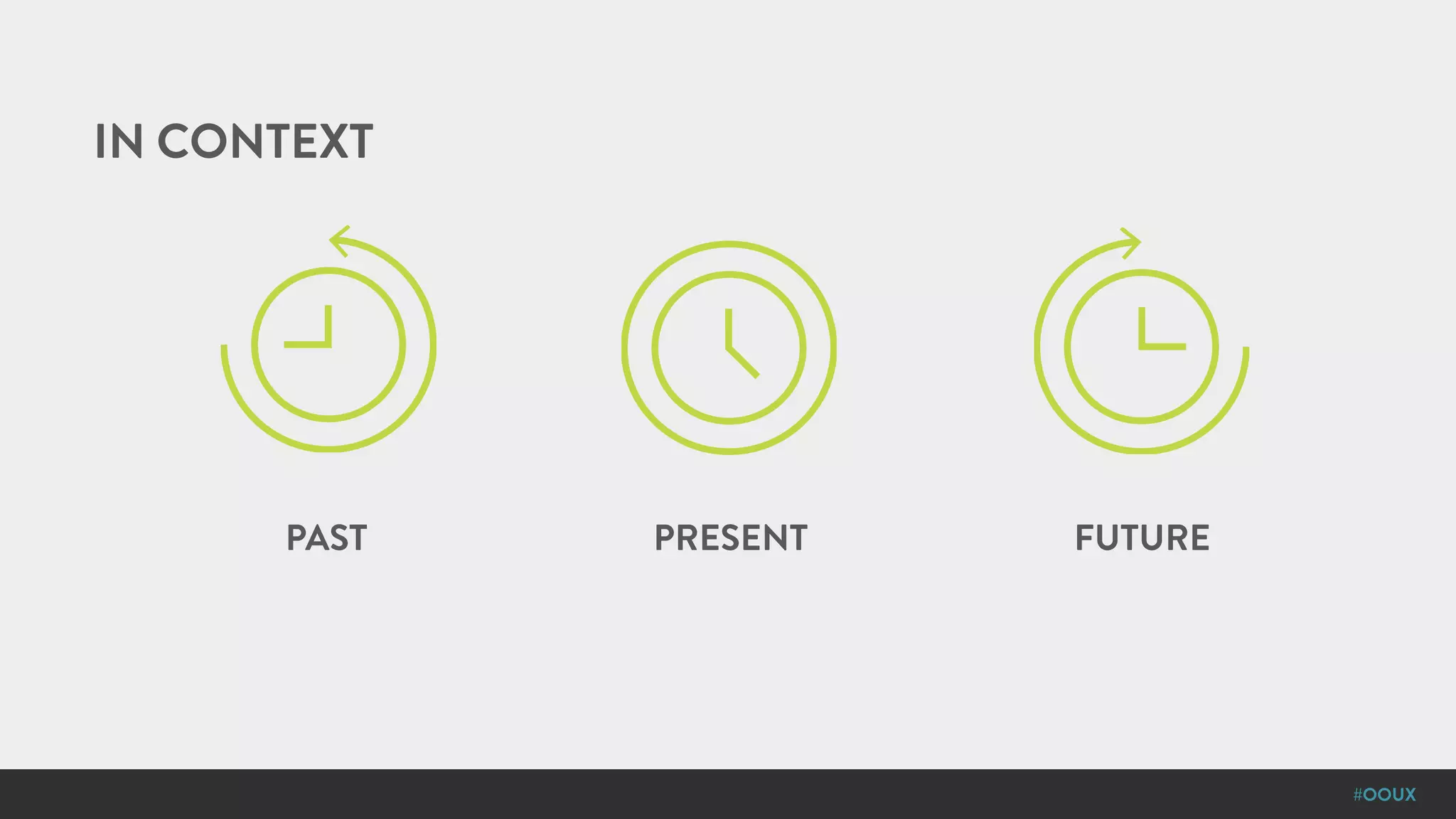
IN CONTEXT
PAST PRESENT FUTURE
#OOUX
THE PAST
#OOUX
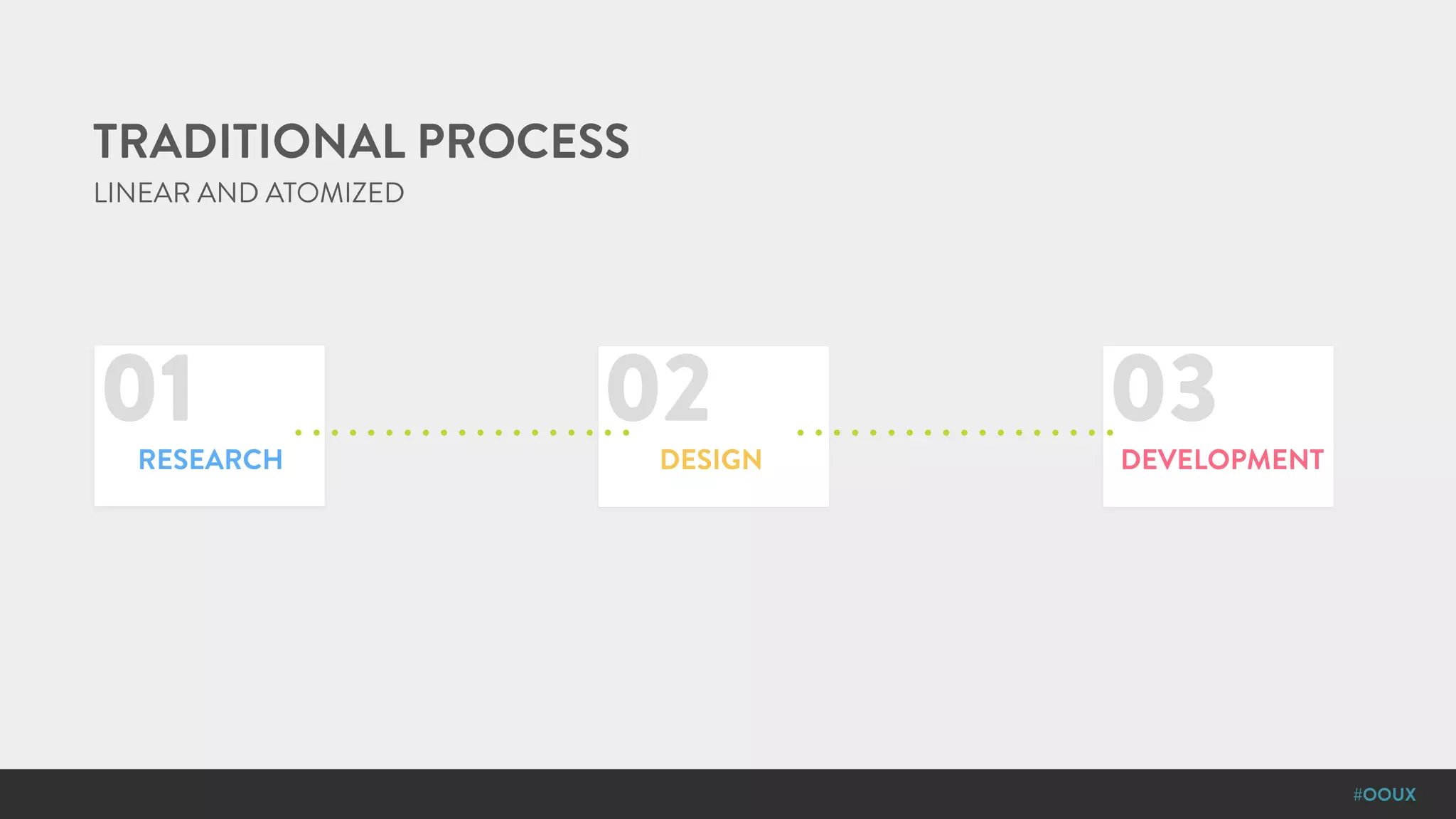
LINEAR AND ATOMIZED
TRADITIONAL PROCESS
01 02 03
RESEARCH DESIGN DEVELOPMENT
#OOUX
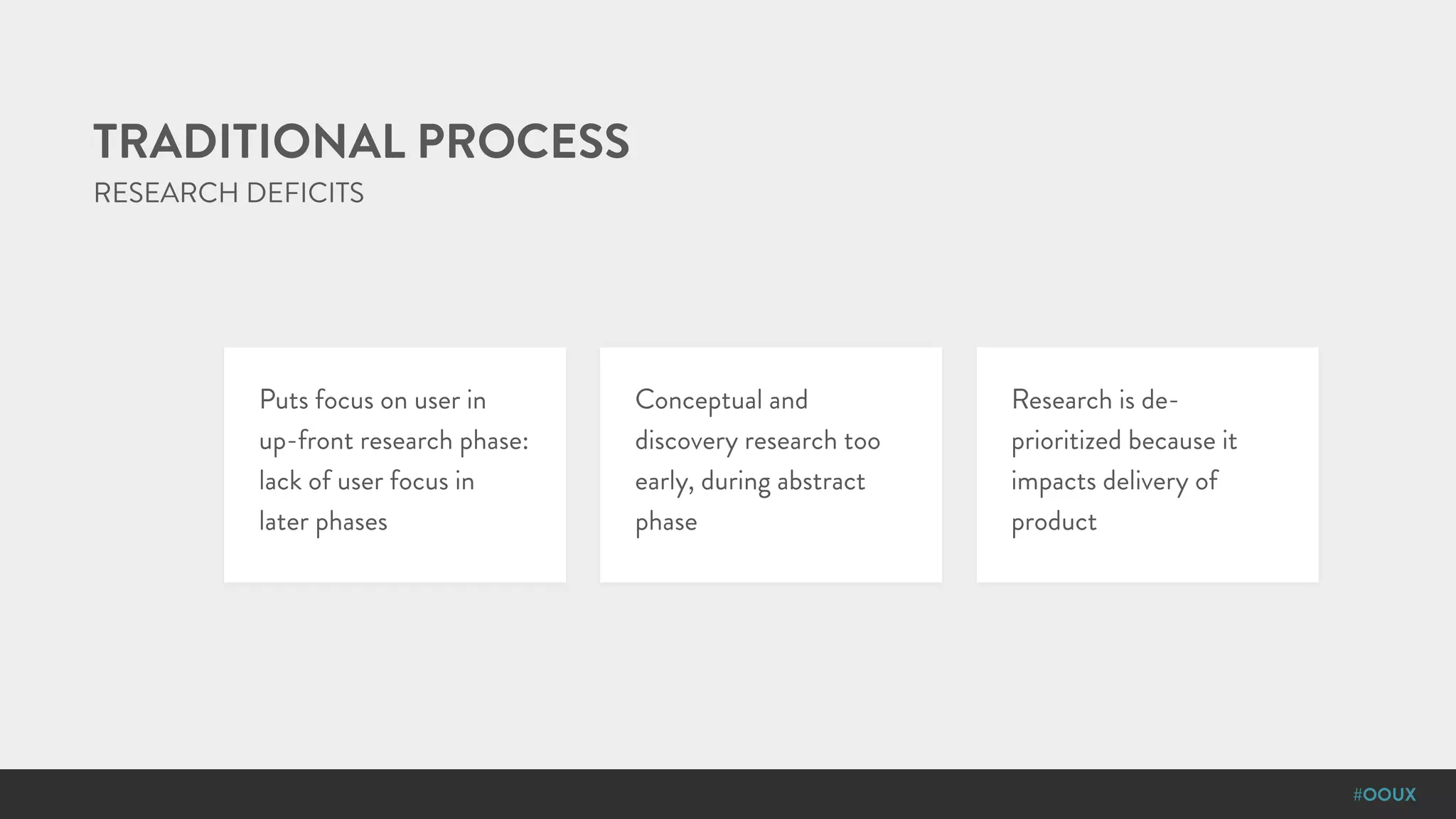
RESEARCH DEFICITS
TRADITIONAL PROCESS
Puts focus on user in
up-front research phase:
lack of user focus in
later phases
Conceptual and
discovery research too
early, during abstract
phase
Research is de-
prioritized because it
impacts delivery of
product
#OOUX
DESIGN DEFICITS
TRADITIONAL PROCESS
Interactive focus - lacks
opportunities for
abstraction
Atomized focus on
interaction before data
Voice of user can be lost
#OOUX
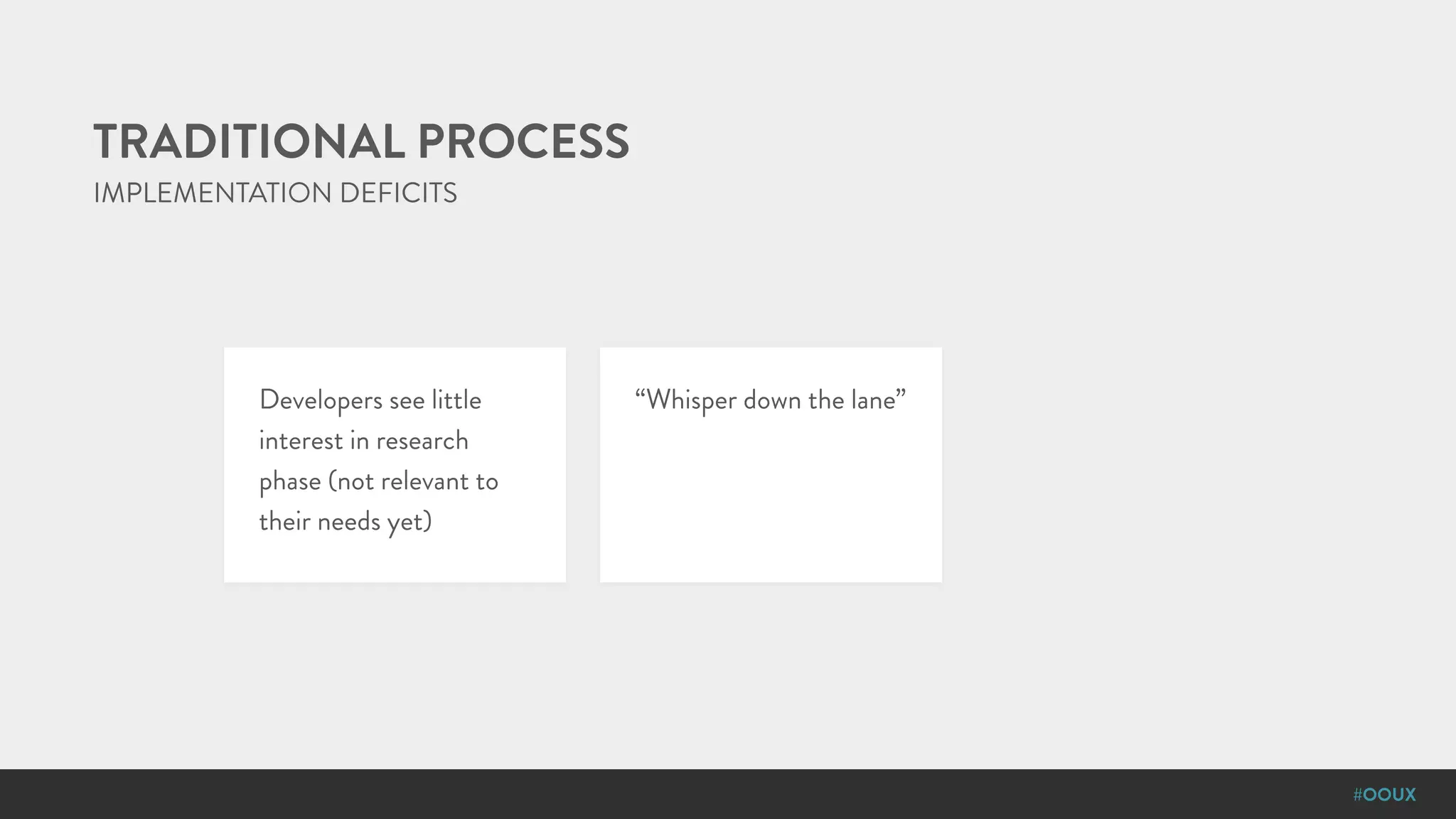
IMPLEMENTATION DEFICITS
TRADITIONAL PROCESS
Developers see little
interest in research
phase (not relevant to
their needs yet)
β€œWhisper down the lane”
#OOUX
WHAT IS THE PROCESS REALLY LIKE?
PROCEDURAL DESIGN & PROGRAMMING
#OOUX
How have we moved beyond that?
#OOUX
THE PRESENT
#OOUX
A shift in mindset.
#OOUX
A SHIFT IN MINDSET
Research engaged
throughout the project;
all disciplines use sprints
to deliver value.
Research is a design and
development tool for
creating a β€œuser-center
designed” product.
Abandon the assembly
line process, research
doesn’t have to impact
timeline.
#OOUX
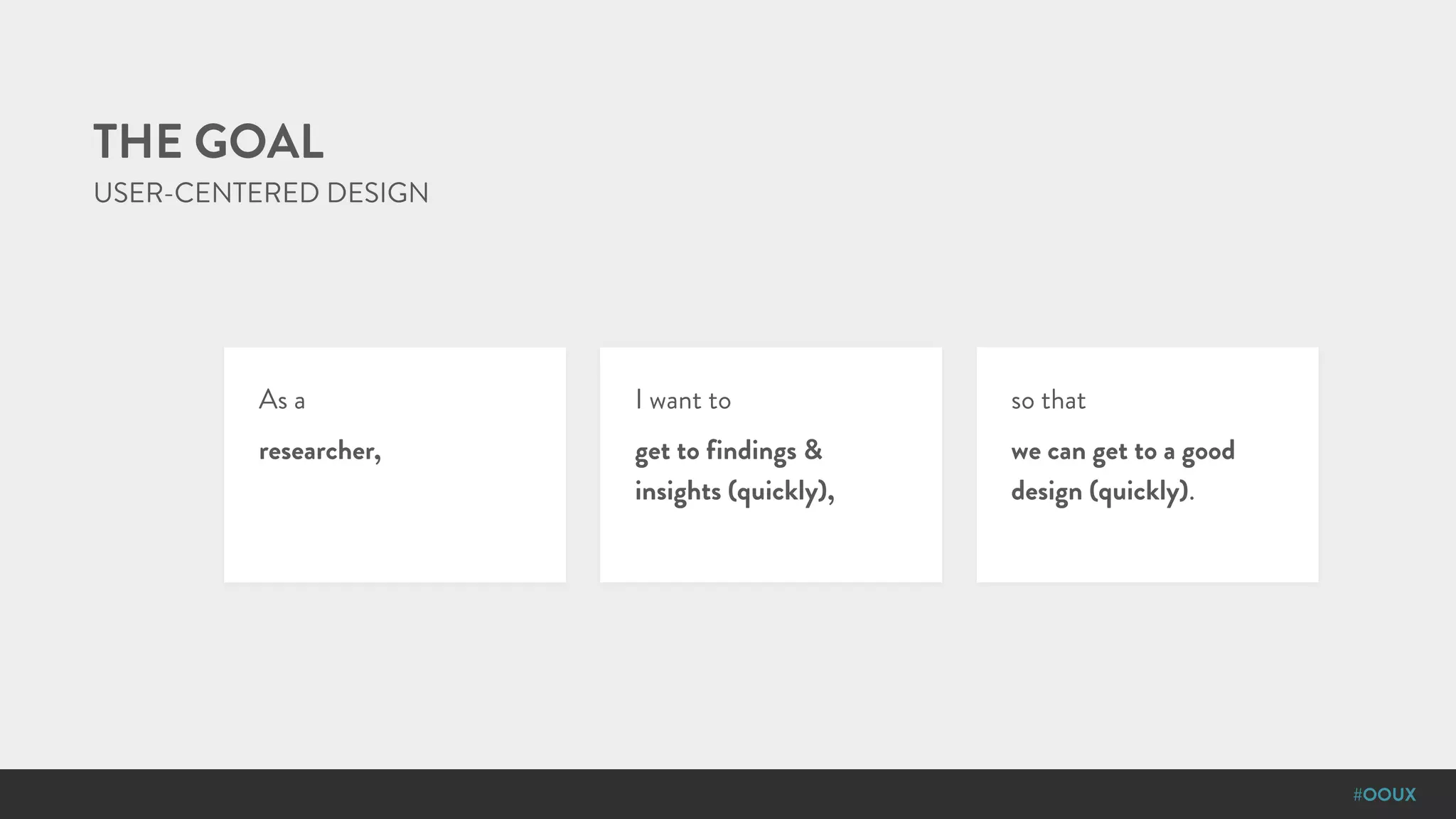
THE GOAL
As a
researcher,
I want to
get to findings &
insights (quickly),
so that
we can get to a good
design (quickly).
USER-CENTERED DESIGN
#OOUX
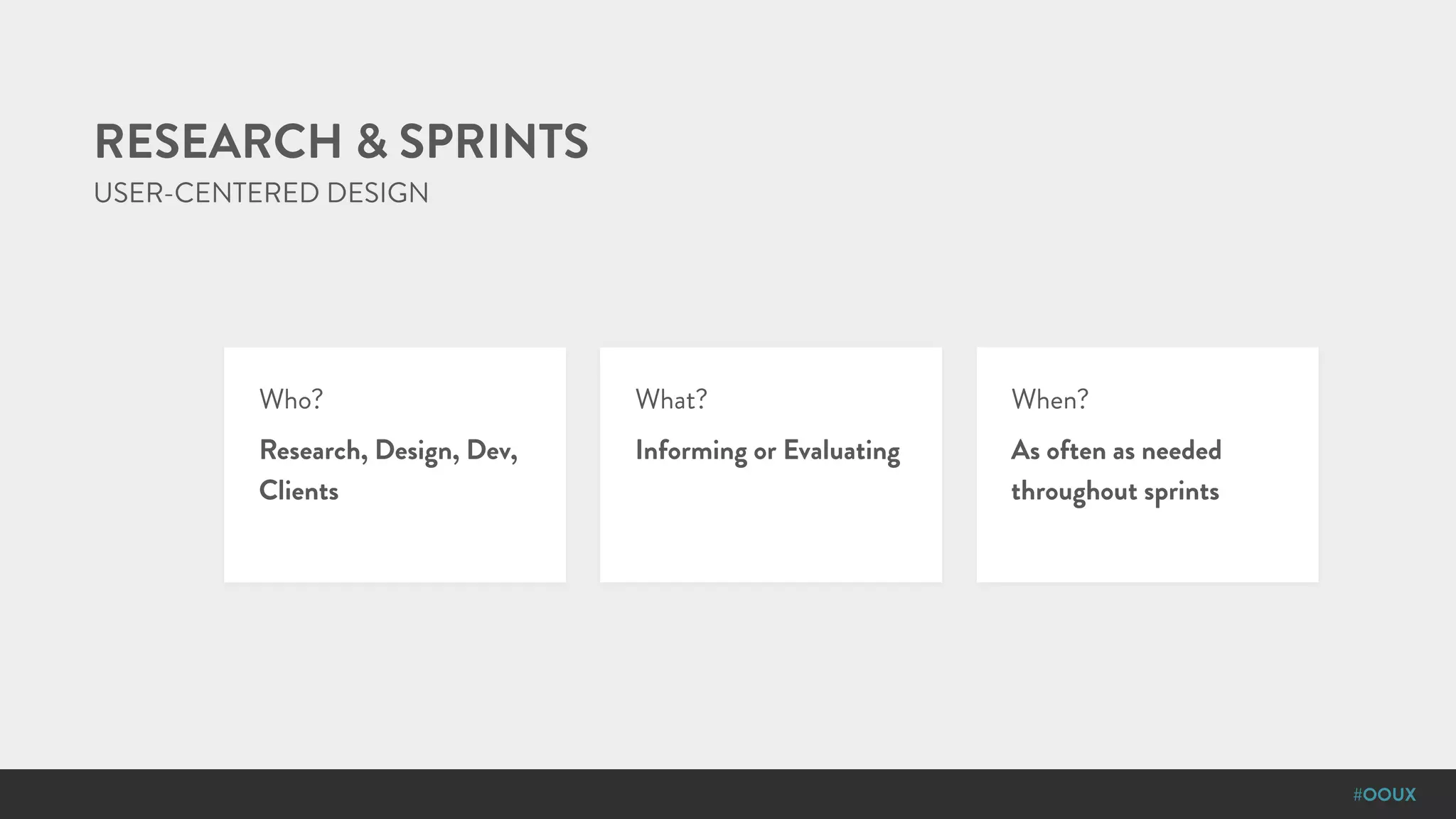
RESEARCH & SPRINTS
Who?
Research, Design, Dev,
Clients
What?
Informing or Evaluating
When?
As often as needed
throughout sprints
USER-CENTERED DESIGN
#OOUX
What’s it look like?
#OOUX
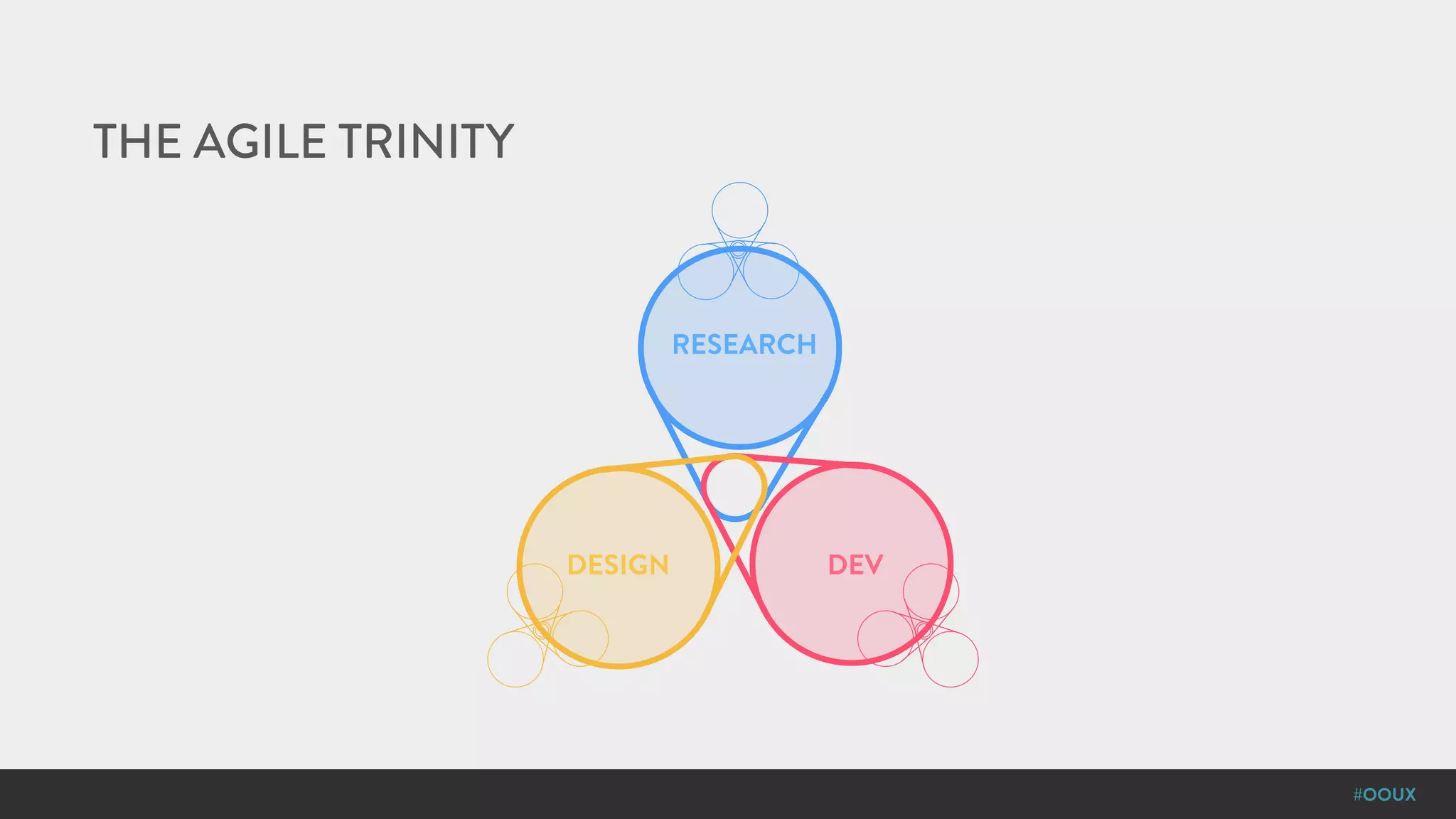
THE AGILE TRINITY
RESEARCH
DESIGN DEV
#OOUX
SPRINT SPRINT SPRINT
RESEARCH DESIGN DEVELOPMENT
#OOUX
A CASE STUDY
PROJECT BACKGROUND
Challenge
Website redesign to create a dedicated experience for advisors
Establish a new look and feel to communicate launch of new
brand
Leverage and re-architect existing content
Timeline
6 month timeline / 8 Sprints (3 wks each)
Deliverable
Working prototype that demonstrates new user experience and
key workflows with usable code
#OOUX
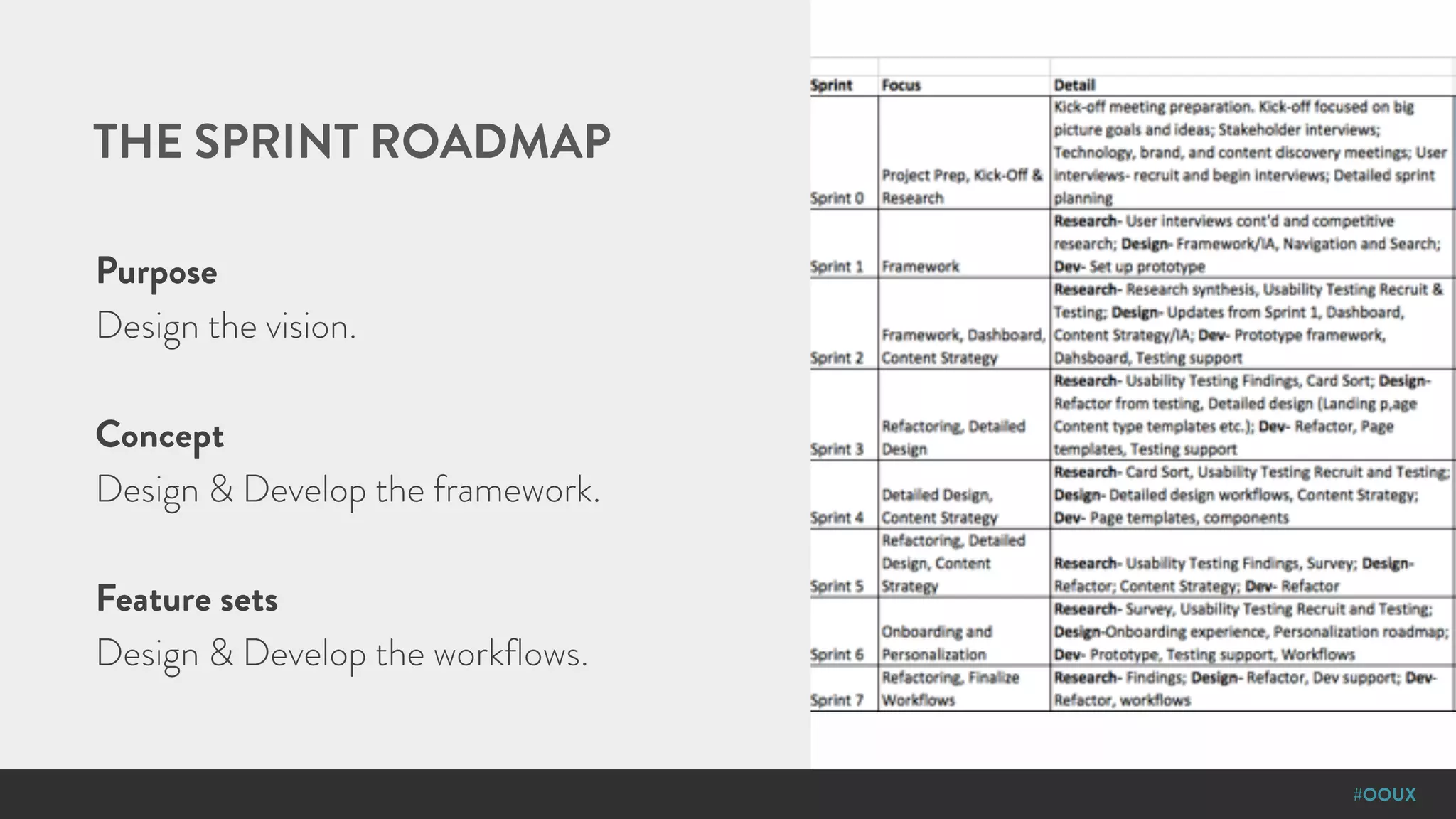
THE SPRINT ROADMAP
Purpose
Design the vision.
Concept
Design & Develop the framework.
Feature sets
Design & Develop the workflows.
#OOUX
5 PRACTICES FOR AGILE RESEARCH
The Research Protocol
The Observation Guide
The Post-Testing Debrief
The β€œReport”
The Refactoring Sprint
#OOUX
THE RESEARCH PROTOCOL
Study Goals
Document the objectives for the study.
Key Tasks
Document what’s being tested
#OOUX
THE OBSERVATION GUIDE
Observation guide to keep observers on task
What are we testing?
What did you observe?
#OOUX
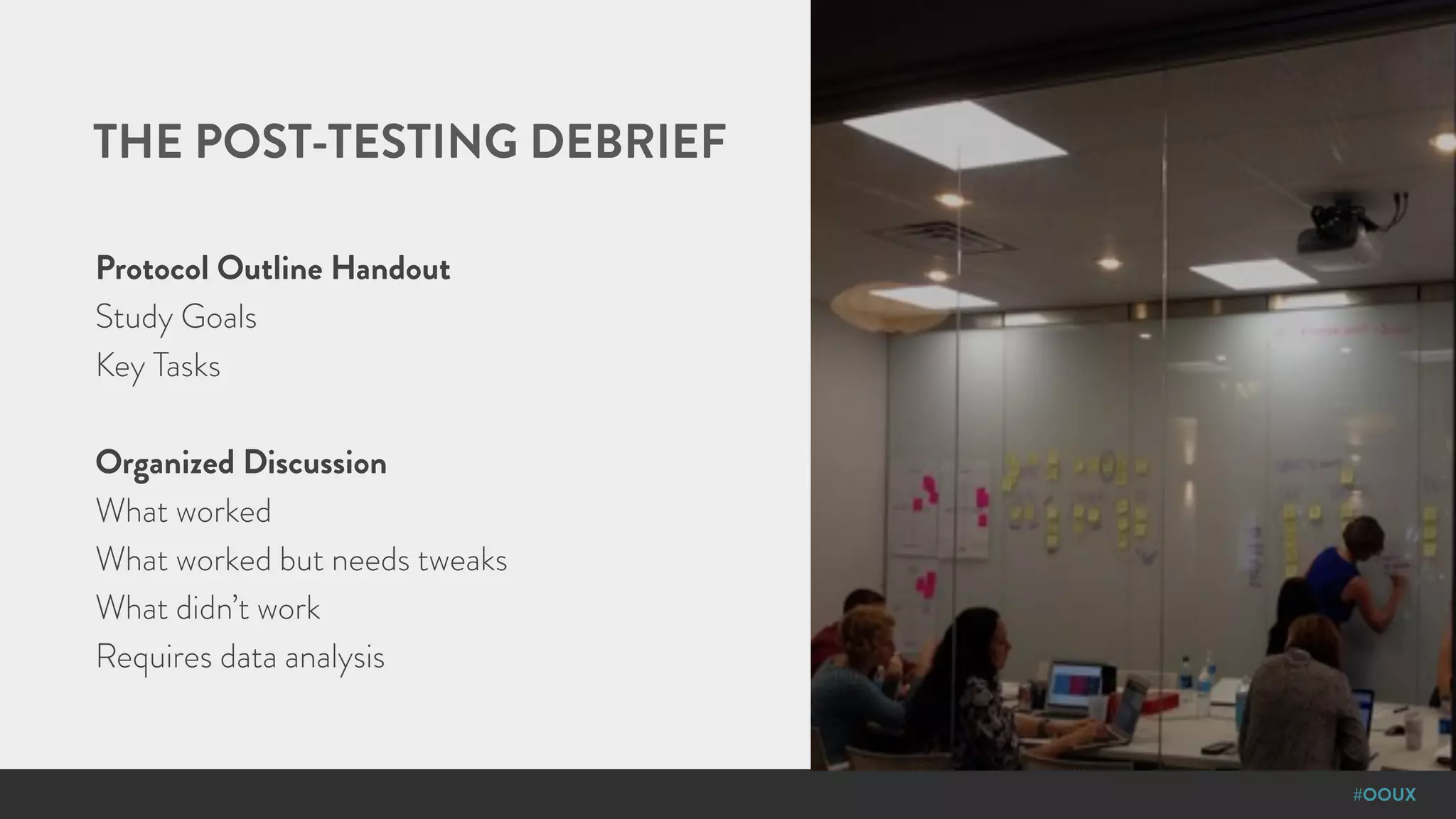
THE POST-TESTING DEBRIEF
Protocol Outline Handout
Study Goals
Key Tasks
Organized Discussion
What worked
What worked but needs tweaks
What didn’t work
Requires data analysis
#OOUX
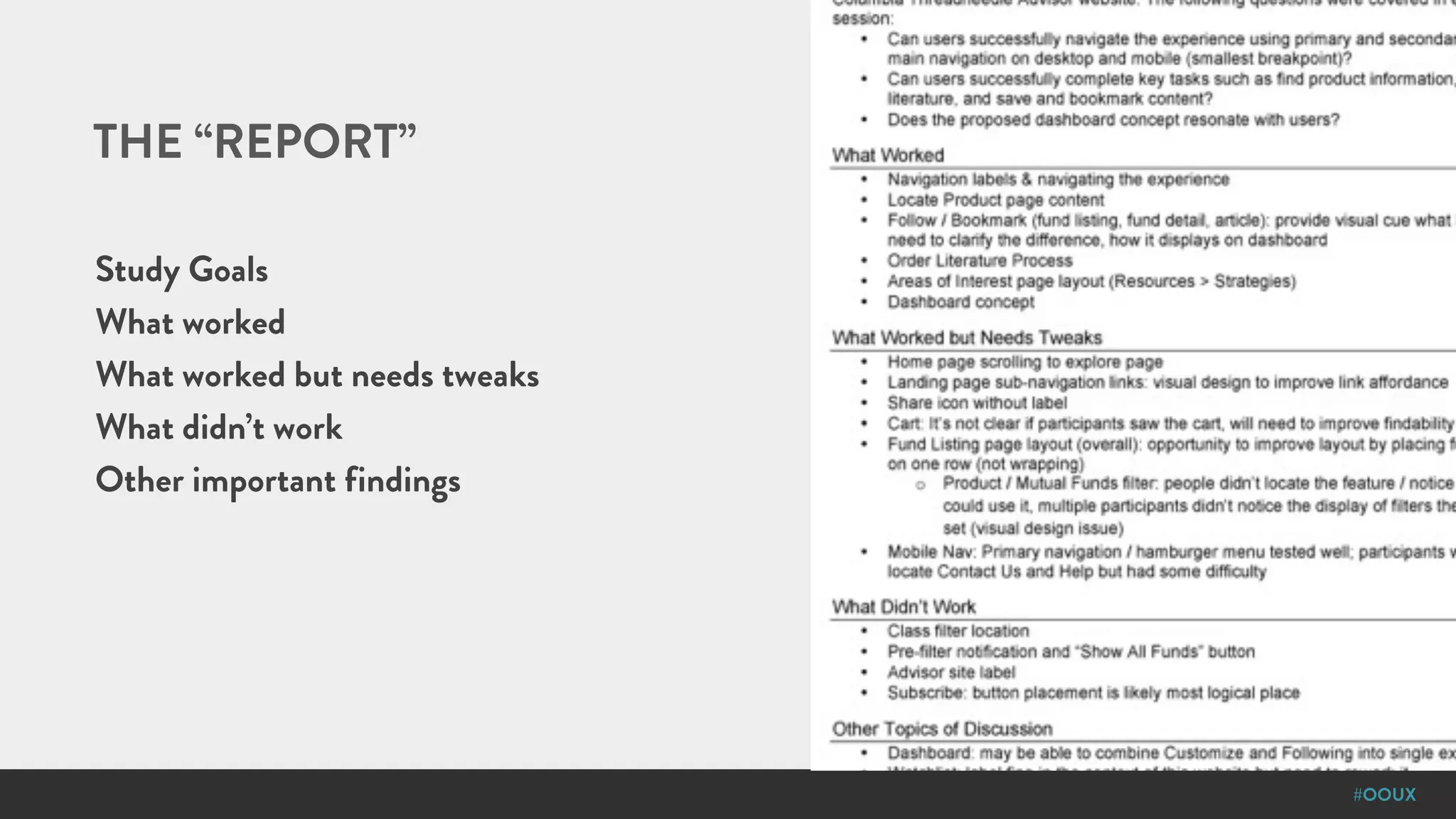
THE β€œREPORT”
Study Goals
What worked
What worked but needs tweaks
What didn’t work
Other important findings
#OOUX
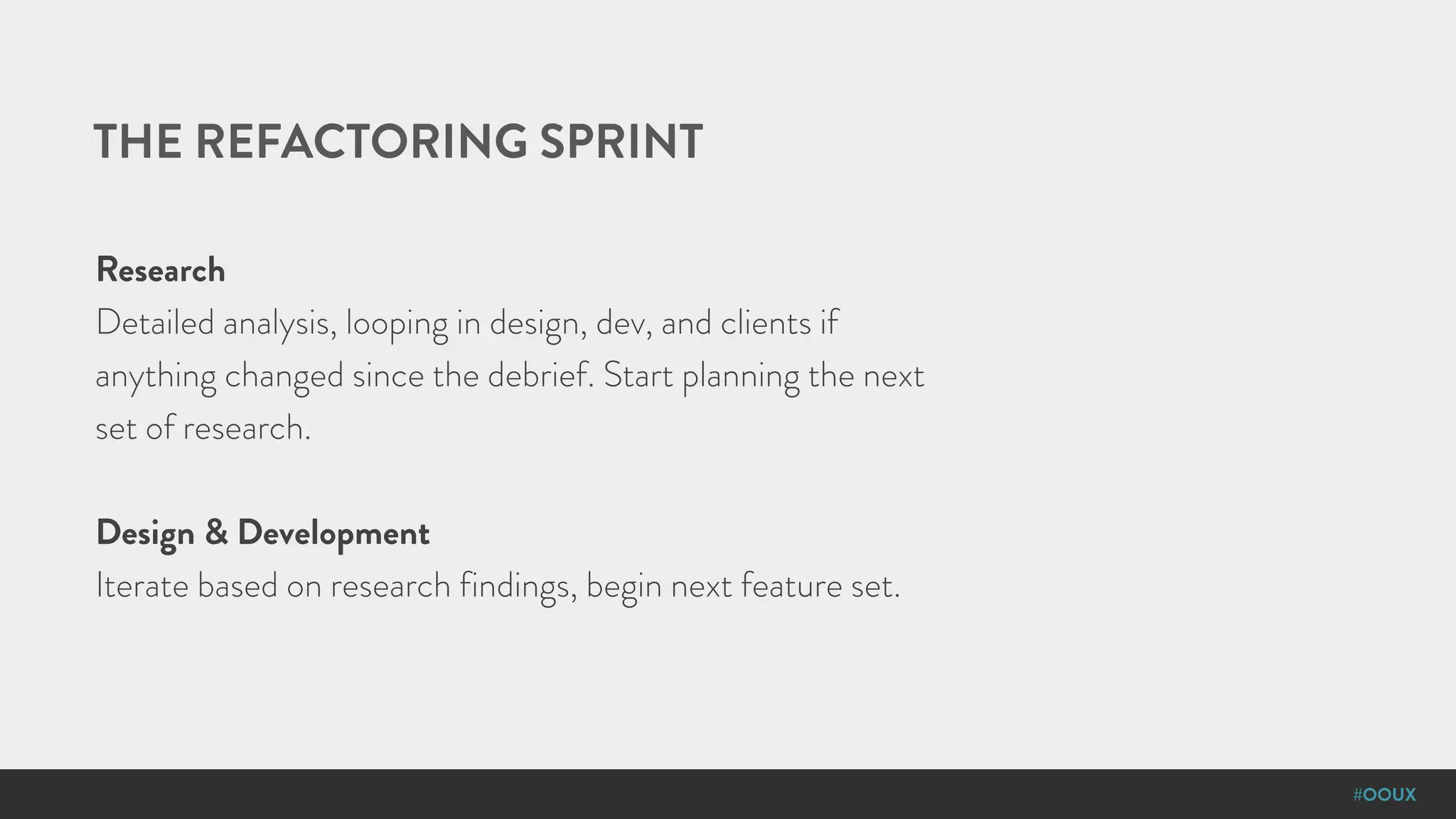
THE REFACTORING SPRINT
Research
Detailed analysis, looping in design, dev, and clients if
anything changed since the debrief. Start planning the next
set of research.
Design & Development
Iterate based on research findings, begin next feature set.
#OOUX
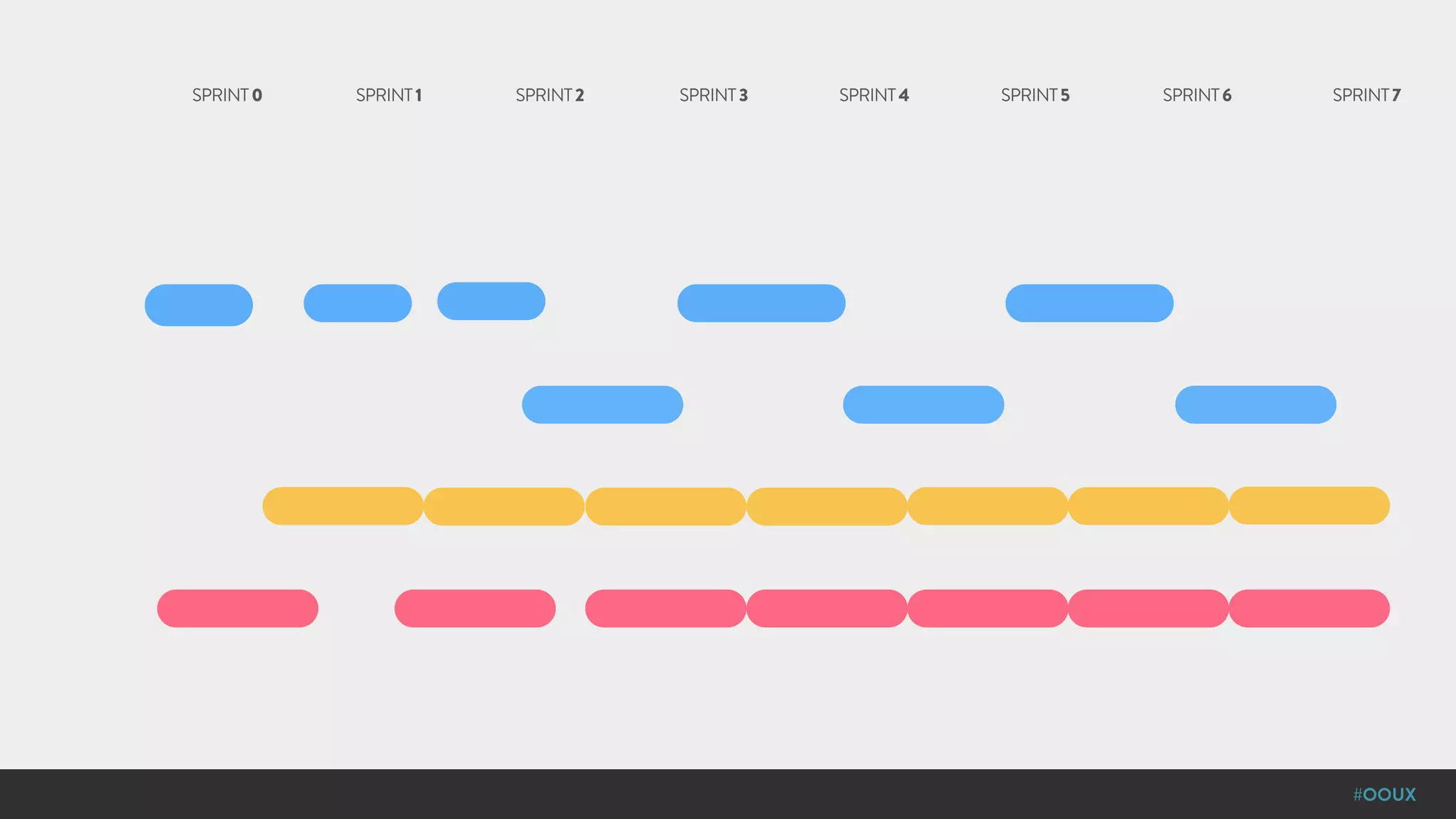
SPRINT0 SPRINT1 SPRINT2 SPRINT3 SPRINT4 SPRINT5 SPRINT6 SPRINT7
RESEARCH
DESIGN
DEV
RESEARCH
to inform
to evaluate
#OOUX
SPRINT0 SPRINT1 SPRINT2 SPRINT3 SPRINT4 SPRI
RESEARCH
DESIGN
DEV
#OOUX
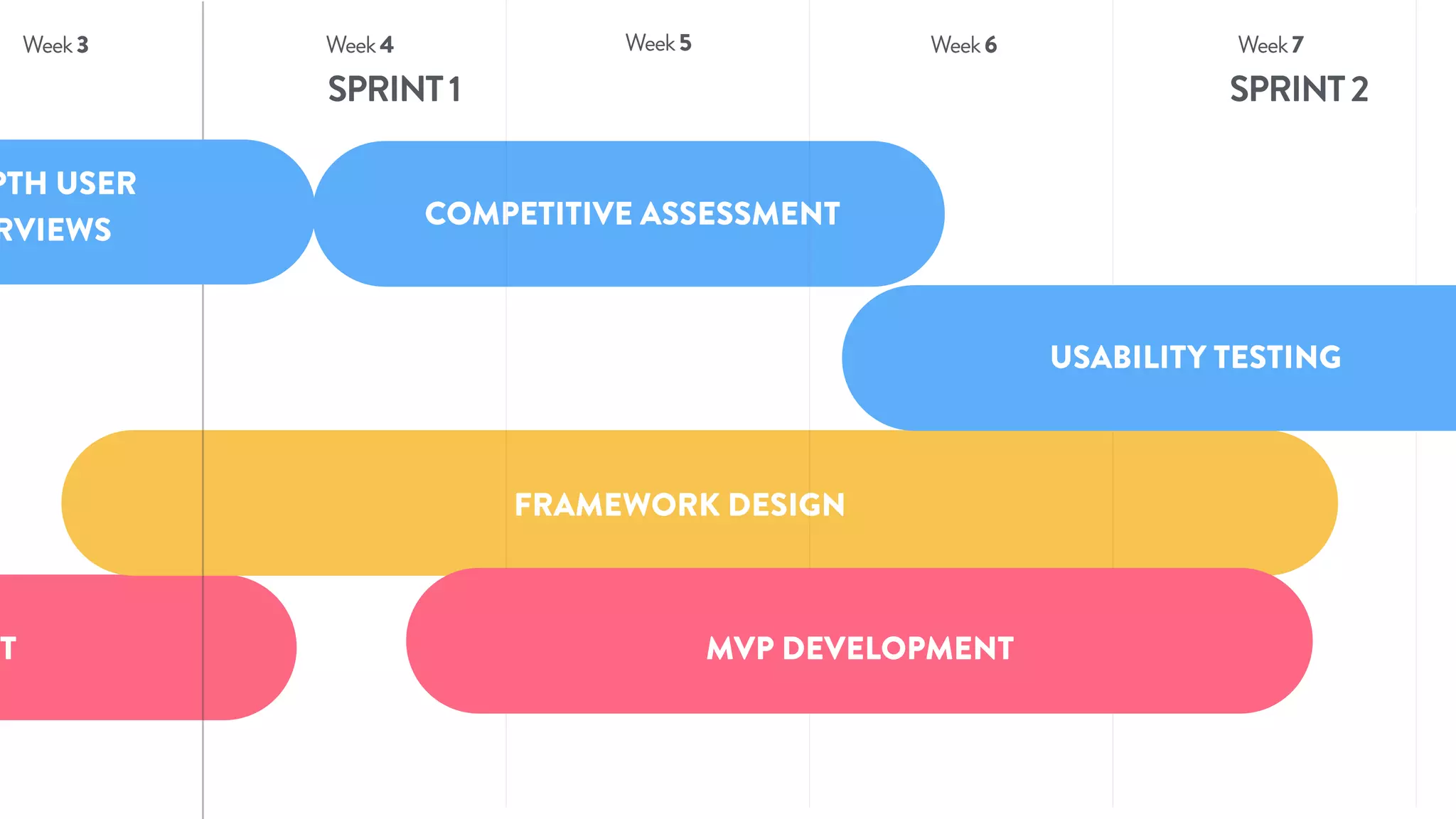
STAKEHOLDER
INTERVIEWS
IN-DEPTH USER
INTERVIEWS
TECH ASSESSMENT
COMP
SPRINT0
Week3 Week4Week1 Week2
SPRINT1
RESEARCH
DESIGN
DEV
#OOUX
FRAMEWORK DESIGN
NT
COMPETITIVE ASSESSMENT
Week3 Week4 Week6Week5 Week7
RESEARCH SYN
USABILITY TESTING
SPRINT1 SPRINT2
MVP DEVELOPMENT
PTH USER
RVIEWS
#OOUX
SPRINT0 SPRINT1 SPRINT2 SPRINT3 SPRINT4 SPRINT5 SPRINT6 SPRINT7
#OOUX
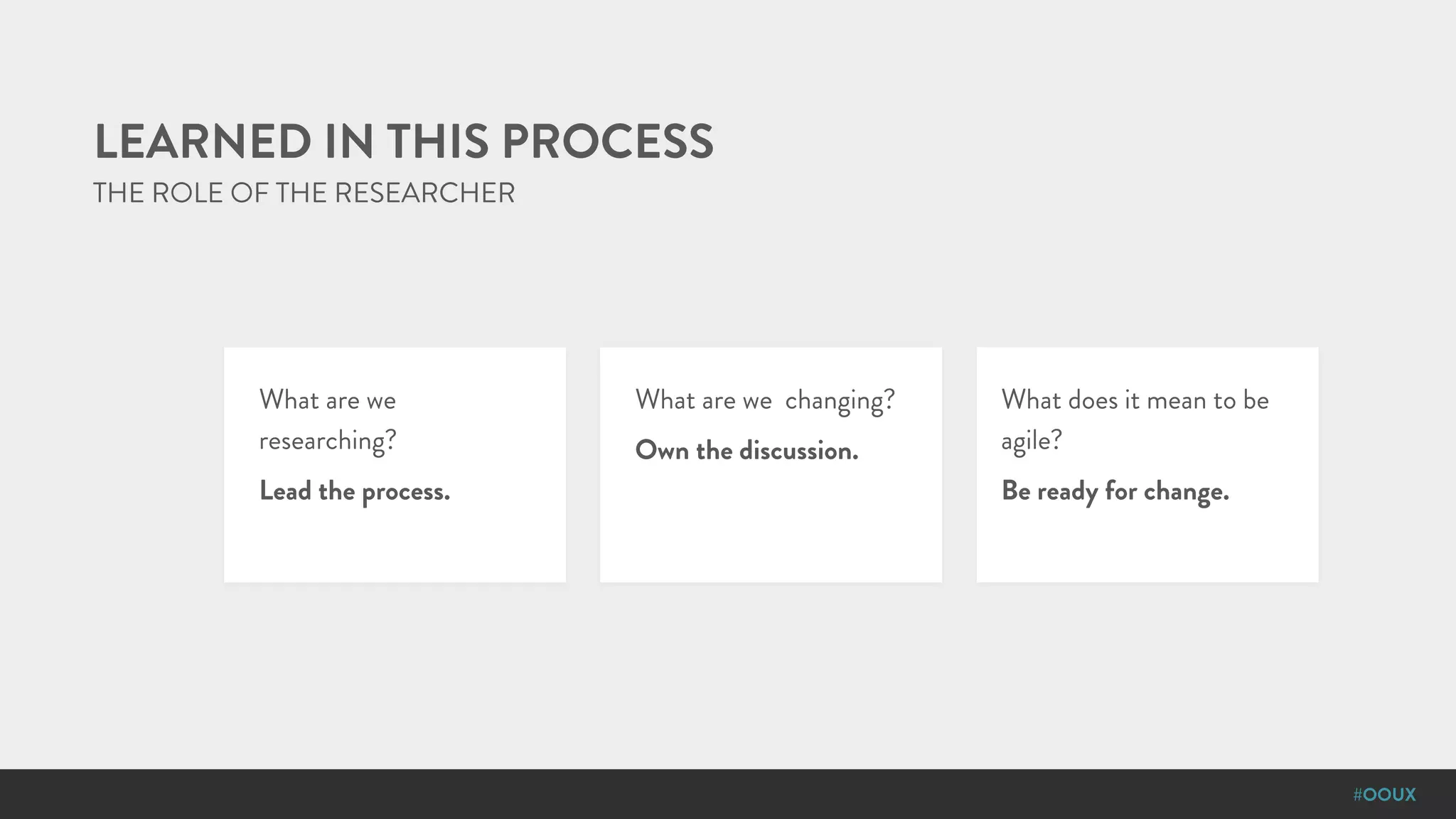
LEARNED IN THIS PROCESS
What are we
researching?
Lead the process.
What are we changing?
Own the discussion.
What does it mean to be
agile?
Be ready for change.
THE ROLE OF THE RESEARCHER
#OOUX
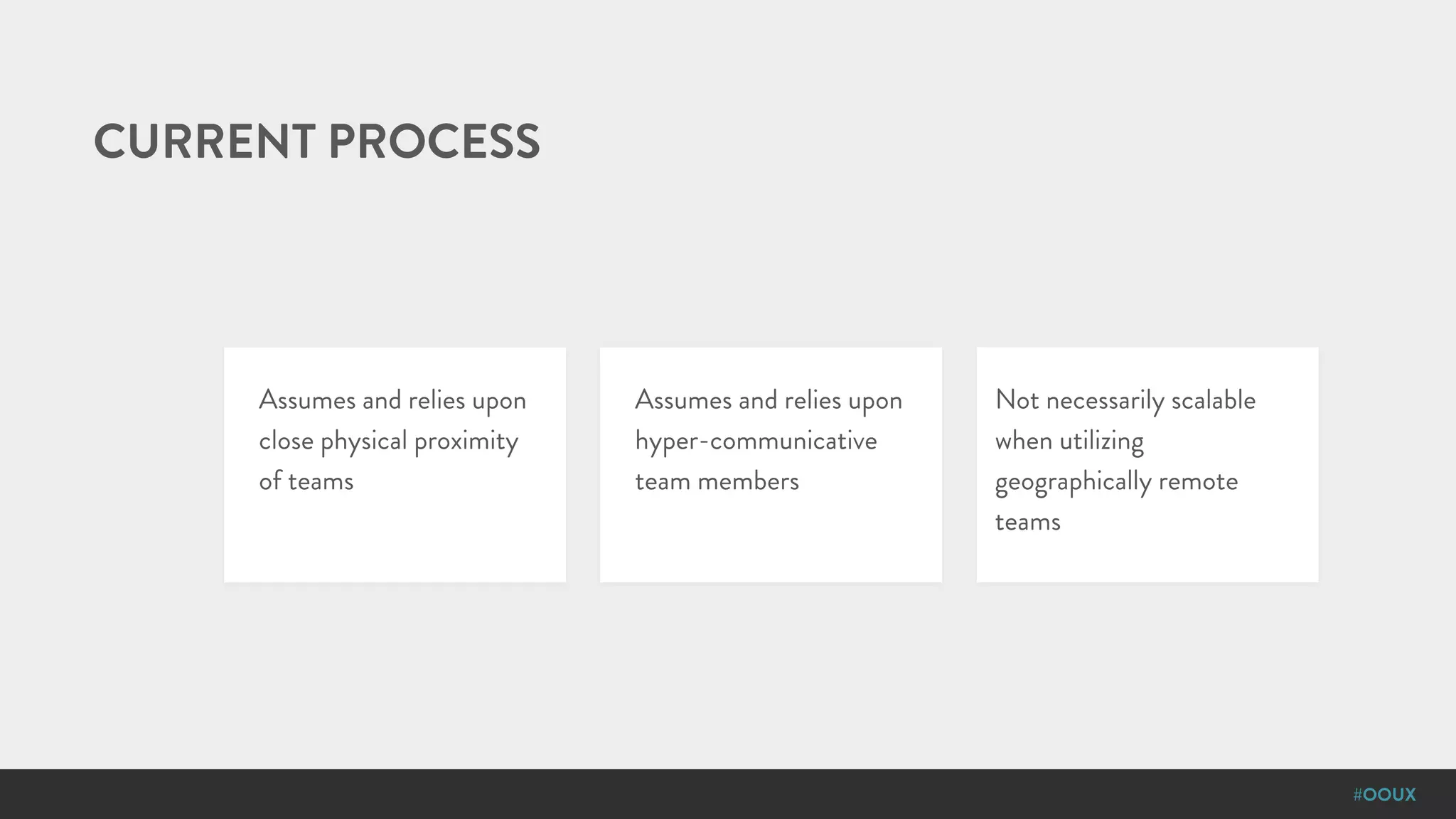
CURRENT PROCESS
Assumes and relies upon
close physical proximity
of teams
Assumes and relies upon
hyper-communicative
team members
Not necessarily scalable
when utilizing
geographically remote
teams
#OOUX
How can we iterate on this process?
#OOUX
THE FUTURE
#OOUX
A change in mindset.
#OOUX
Object-Oriented UX
#OOUX
A change in mindset.
#OOUX
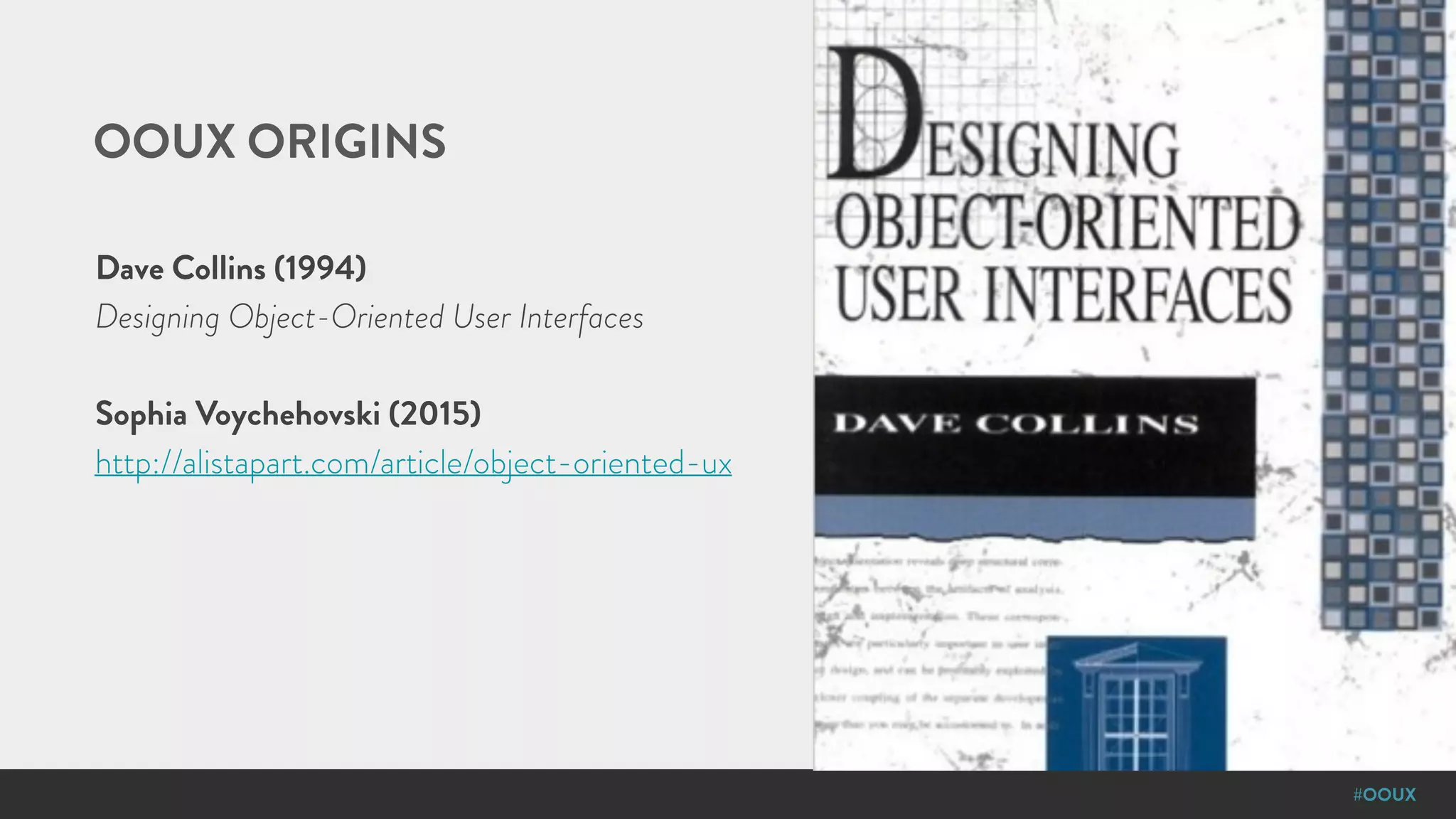
OOUX ORIGINS
Dave Collins (1994)
Designing Object-Oriented User Interfaces
Sophia Voychehovski (2015)
http://alistapart.com/article/object-oriented-ux
#OOUX
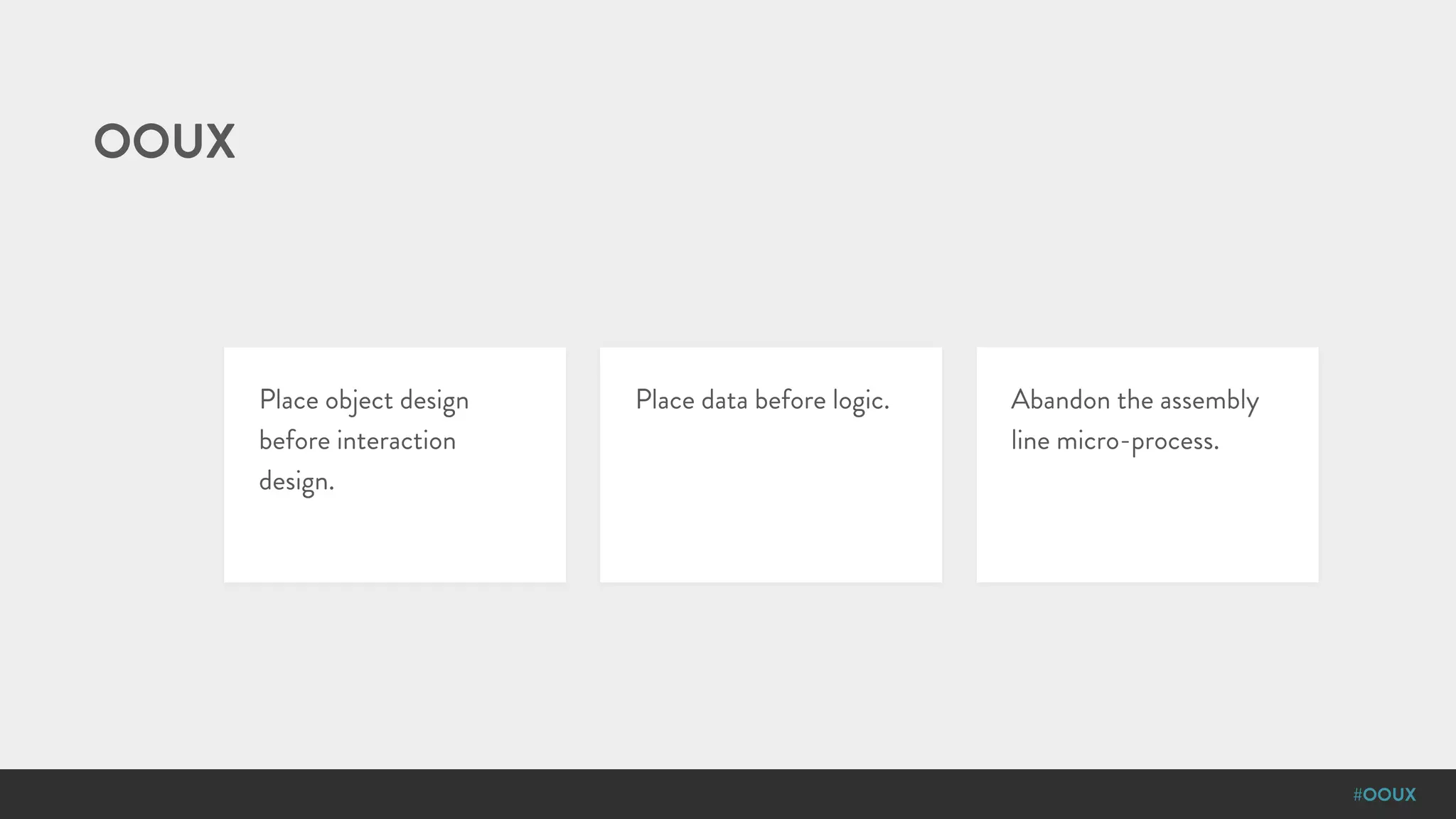
OOUX
Place object design
before interaction
design.
Place data before logic. Abandon the assembly
line micro-process.
#OOUX
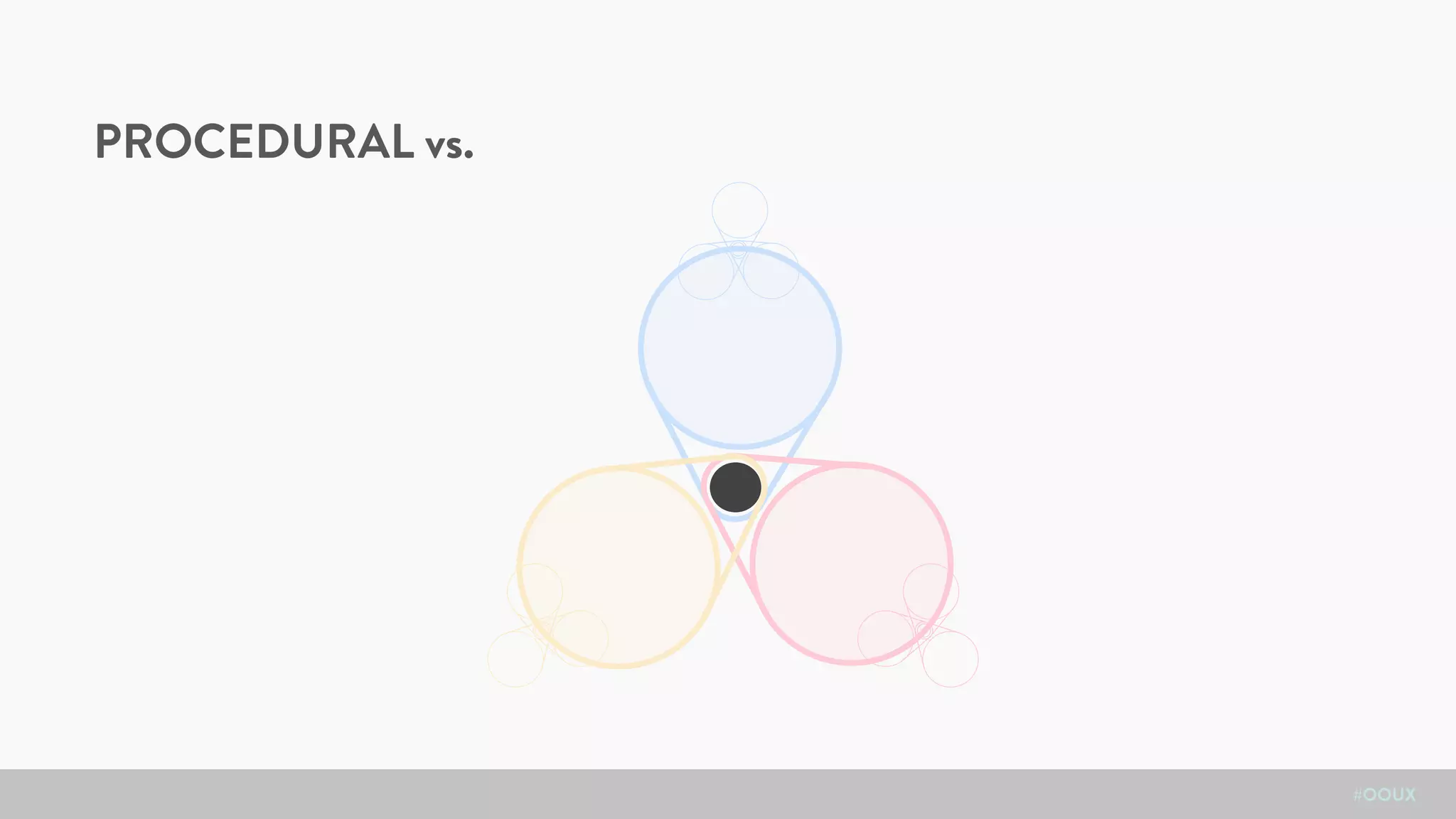
PROCEDURAL
#OOUX
PROCEDURAL vs.
#OOUX
PROCEDURAL vs. OBJECT ORIENTED
#OOUX
WHY DO WE WANT TO DO THIS?
So we can think about the entire system in line with real-world
objects in users’ mental model, not digital-world actions.
We don’t go to a web site because we want to search, filter, or
check-out. We go to a web site because we want a plane ticket. We
want relationships. We want food.
We want a book.
We want things.
#OOUX
You might be thinking, this all sounds great, but we have a lot of
invested in Agile.
We have user stories, we have workflows, we have a minimal viable
product we need to produce in a few weeks.
What does that all mean?
BUT WE’RE SO INVESTED IN AGILE!
#OOUX
Start with a discrete β€œobject”, which can have associated
β€œactions” and β€œadjectives” associated with it.
OOUX & β€œTHINGS”
Example:
Object: Coin
Verb: Rate
Adjective: Year
#OOUX
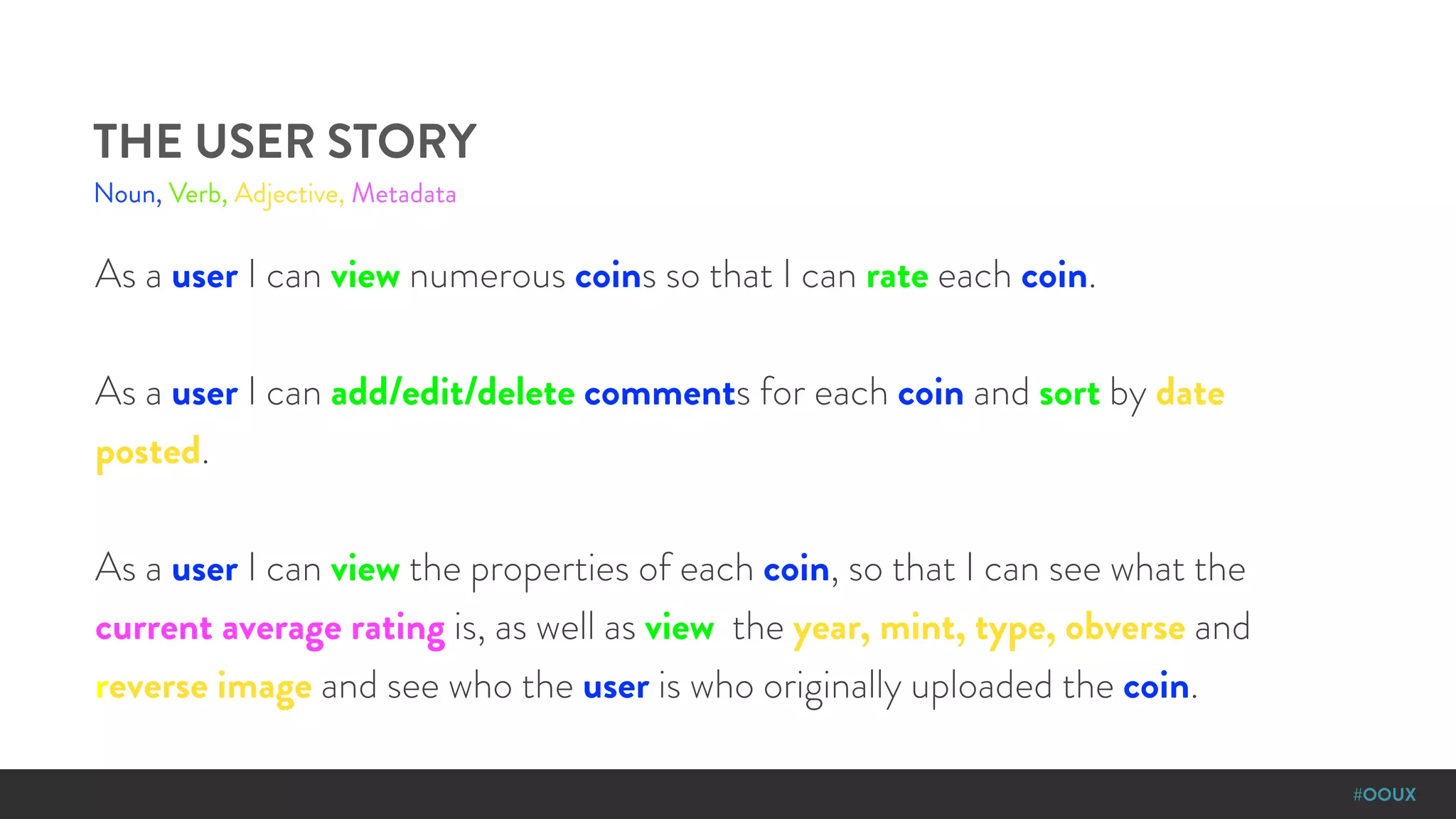
As a user I can view numerous coins so that I can rate each coin.
As a user I can add/edit/delete comments for each coin and sort by date
posted.
As a user I can view the properties of each coin, so that I can see what the
current average rating is, as well as view the year, mint, type, obverse and
reverse image and see who the user is who originally uploaded the coin.
THE USER STORY
Noun, Verb, Adjective, Metadata
#OOUX
1. Nouns are objects
2.Verbs are methods of objects (CTAs)
3.Adjectives are properties of objects
4.Collection of adjectives are metadata
5.Find relationships between objects
6.Find dependencies between objects
7.Code before wireframes (!)
Object Mapping
More on Sophia Voychehovski’s Object Mapping process
http://rewiredux.com/ooux
#OOUX
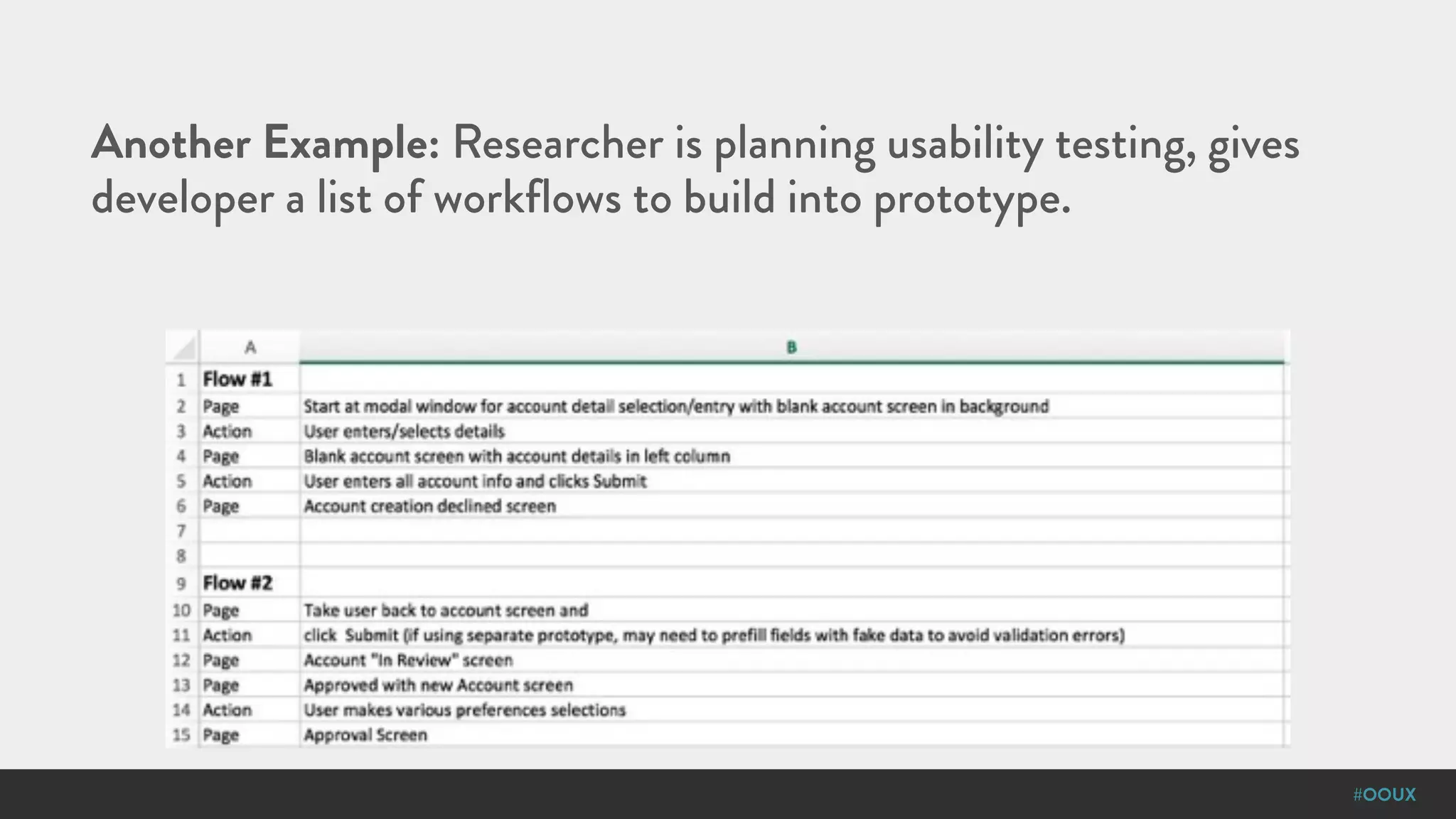
Another Example: Researcher is planning usability testing, gives
developer a list of workflows to build into prototype.
#OOUX
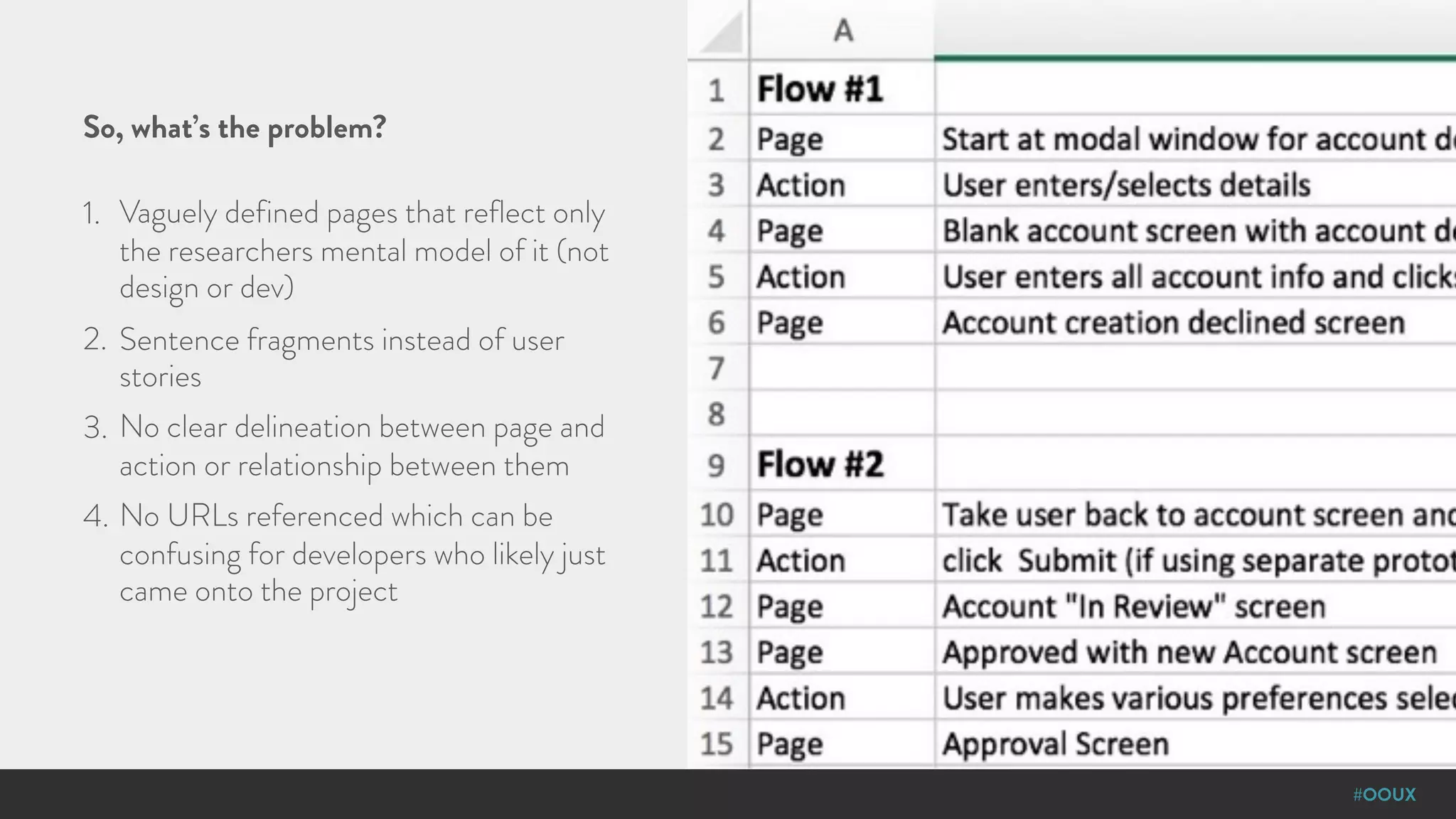
So, what’s the problem?
1. Vaguely defined pages that reflect only
the researchers mental model of it (not
design or dev)
2. Sentence fragments instead of user
stories
3. No clear delineation between page and
action or relationship between them
4. No URLs referenced which can be
confusing for developers who likely just
came onto the project
#OOUX
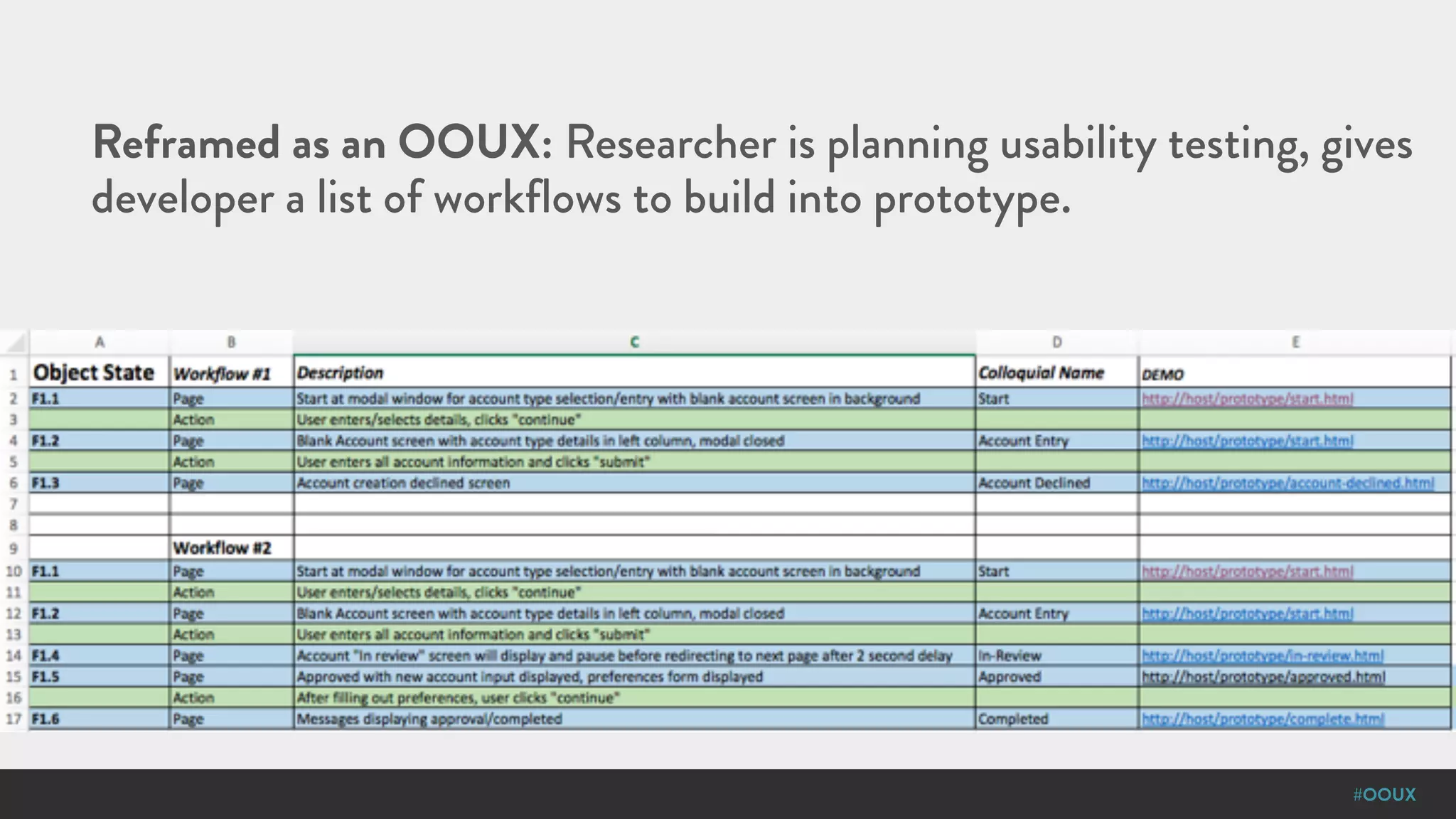
Reframed as an OOUX: Researcher is planning usability testing, gives
developer a list of workflows to build into prototype.
#OOUX
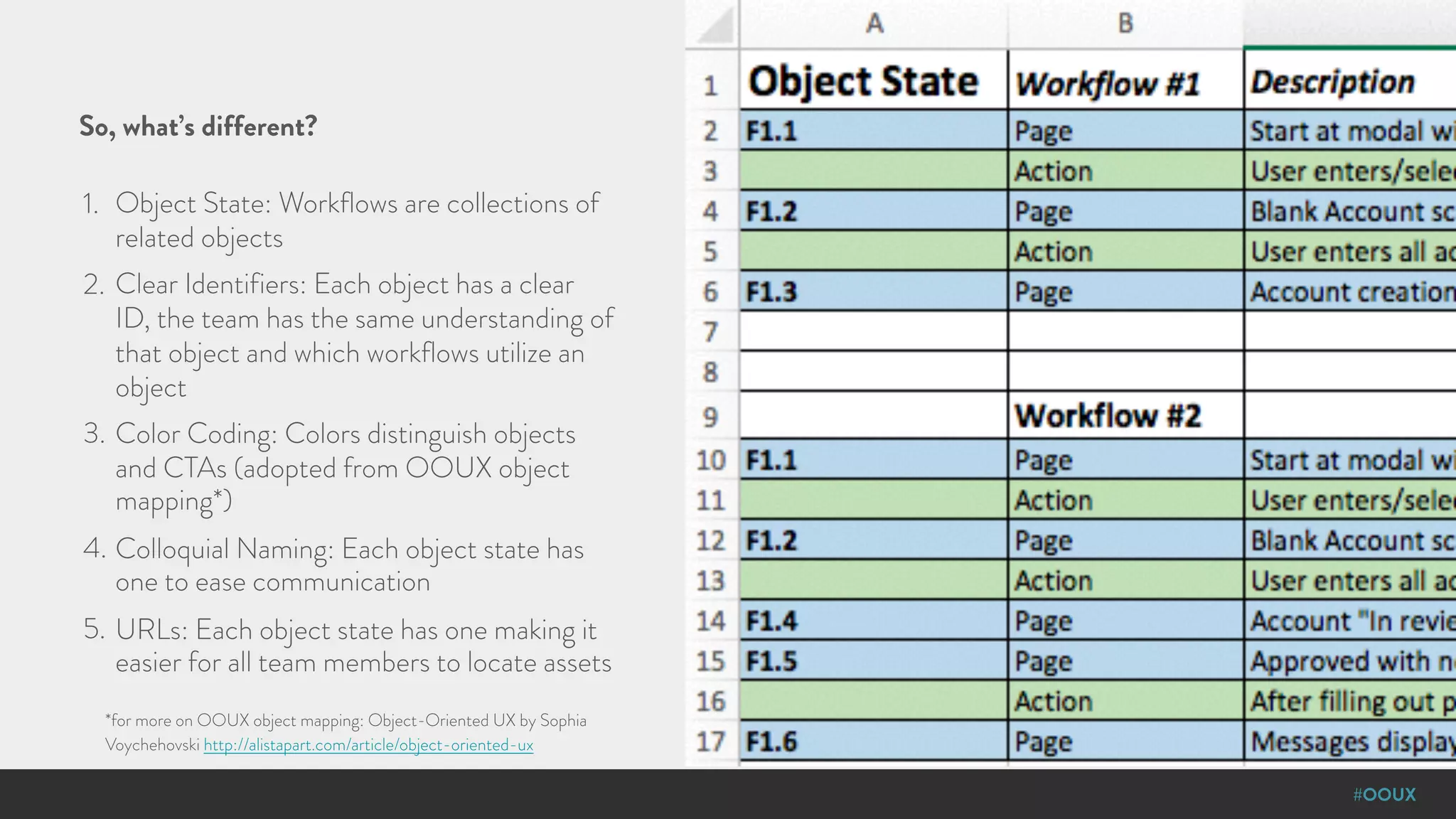
So, what’s different?
1. Object State: Workflows are collections of
related objects
2. Clear Identifiers: Each object has a clear
ID, the team has the same understanding of
that object and which workflows utilize an
object
3. Color Coding: Colors distinguish objects
and CTAs (adopted from OOUX object
mapping*)
4. Colloquial Naming: Each object state has
one to ease communication
5. URLs: Each object state has one making it
easier for all team members to locate assets
*for more on OOUX object mapping: Object-Oriented UX by Sophia
Voychehovski http://alistapart.com/article/object-oriented-ux
#OOUX
THE EFFECT OF OOUX ON PROCESS?
Research, then design, then development
vs.
Research and design and development
#OOUX
SPEAK THE SAME LANGUAGE
#OOUX
…about this idea?
…what role research and design play in defining objects?
…other challenges we should solve for?
WHAT DO YOU THINK?
#OOUX
THANK YOU
Ed Hertzog
ed.hertzog@ey.com
edhertzog@gmail.com
Georgia Spangenberg
georgia.spangenberg@ey.com
georgiaspangenberg@gmail.com

UX Research in the Agile Cycle