DEVELOPING A CORPORATE
ACQUISITION STRATEGY
Case studies, Concepts, and Debatable Ideas
Kenny Ong
CNI Holdings Berhad
www.myCNI.com.my www.OOBEY.com
1. M&A Trends
2. Rationale for M&As
3. Strategies, Structure, and Optimizing Value in
M&As
4. Considerations, Risks and Pitfalls
www.myCNI.com.my www.OOBEY.com
• How to fail without trying
The Roadmap to Failure
by Fred Wiersema and Mike Treacy
Before we start…
www.myCNI.com.my www.OOBEY.com
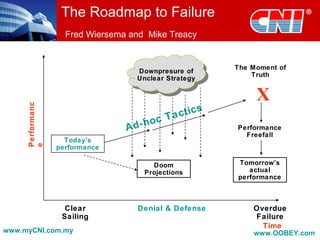
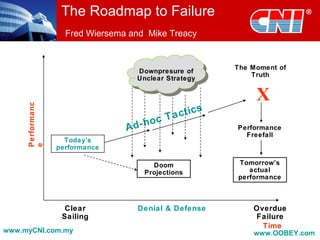
The Roadmap to Failure
Fred Wiersema and Mike TreacyPerformanc
e
Time
Clear
Sailing
Today’s
performance
Ad-hoc Tactics
Denial & Defense
Doom
Projections
Overdue
Failure
The Moment of
Truth
X
Performance
Freefall
Tomorrow’s
actual
performance
Downpresure of
Unclear Strategy
www.myCNI.com.my www.OOBEY.com
Denial and Defense
• “It’s not really good value our competitor is
offering, because it doesn’t include a lot of our
features.” - ABC vs Air Asia
• “It’s good value but not in our preferred
customer market.” - ABC vs Toyota
• “Sure they’re hurting us, but with their unfair
advantage, what can we do?” – ABC vs MILO
• “The rules we are playing by have always
worked before” – AMEX vs VISA
www.myCNI.com.my www.OOBEY.com
The Roadmap to Failure
Fred Wiersema and Mike TreacyPerformanc
e
Time
Clear
Sailing
Today’s
performance
Ad-hoc Tactics
Denial & Defense
Doom
Projections
Overdue
Failure
The Moment of
Truth
X
Performance
Freefall
Tomorrow’s
actual
performance
Downpresure of
Unclear Strategy
www.myCNI.com.my www.OOBEY.com
Ad Hoc Tactics
• Selectively hold discounts to hold business that has
started to go elsewhere
• Introduce new promotions, terms, conditions, and offers to
confuse and cloud the market
• Beef up customer service by adding people to fix mess-
ups and quicken delayed shipments
• Delay capital investments and adjust accounting methods
to portray quarterly financial results more favorably
• Introduce “new and improved” products that are new in
form, but not in substantive ways that are of consequence
to purchasers
• Merge, Acquire, Joint Venture and Ally out of desperation
or without proper considerations
www.myCNI.com.my www.OOBEY.com
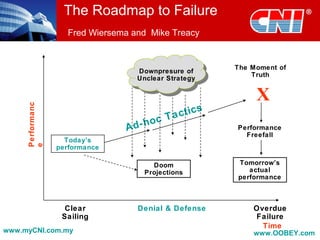
The Roadmap to Failure
Fred Wiersema and Mike TreacyPerformanc
e
Time
Clear
Sailing
Today’s
performance
Ad-hoc Tactics
Denial & Defense
Doom
Projections
Overdue
Failure
The Moment of
Truth
X
Performance
Freefall
Tomorrow’s
actual
performance
Downpresure of
Unclear Strategy
www.myCNI.com.my www.OOBEY.com
“What is the moral of
the story?”
www.myCNI.com.my www.OOBEY.com
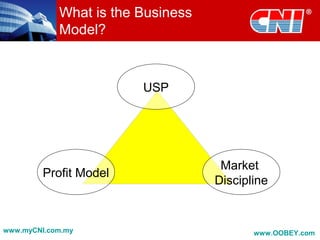
What is the Business
Model?
USP
Market
Discipline
Profit Model
www.myCNI.com.my www.OOBEY.com
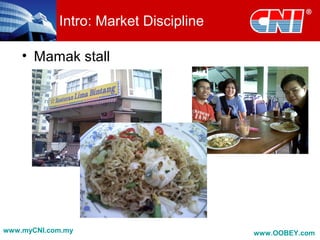
Intro: Market Discipline
• Mamak stall
www.myCNI.com.my www.OOBEY.com
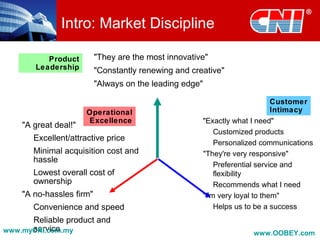
Intro: Market Discipline
"They are the most innovative"
"Constantly renewing and creative"
"Always on the leading edge"
"A great deal!"
Excellent/attractive price
Minimal acquisition cost and
hassle
Lowest overall cost of
ownership
"A no-hassles firm"
Convenience and speed
Reliable product and
service
"Exactly what I need"
Customized products
Personalized communications
"They're very responsive"
Preferential service and
flexibility
Recommends what I need
"I'm very loyal to them"
Helps us to be a success
Product
Leadership
Operational
Excellence
Customer
Intimacy
www.myCNI.com.my www.OOBEY.com
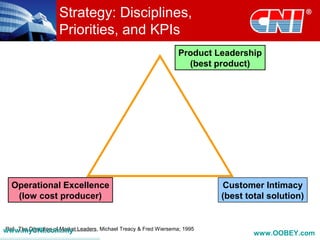
Operational Excellence
(low cost producer)
Ref: The Discipline of Market Leaders, Michael Treacy & Fred Wiersema; 1995
Product Leadership
(best product)
Customer Intimacy
(best total solution)
Strategy: Disciplines,
Priorities, and KPIs
www.myCNI.com.my www.OOBEY.com
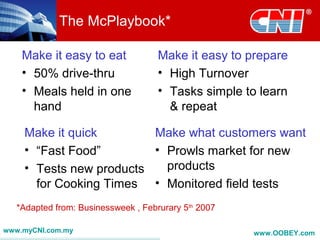
The McPlaybook*
Make it easy to eat
• 50% drive-thru
• Meals held in one
hand
Make it easy to prepare
• High Turnover
• Tasks simple to learn
& repeat
Make it quick
• “Fast Food”
• Tests new products
for Cooking Times
Make what customers want
• Prowls market for new
products
• Monitored field tests
*Adapted from: Businessweek , Februrary 5th
2007
www.myCNI.com.my www.OOBEY.com
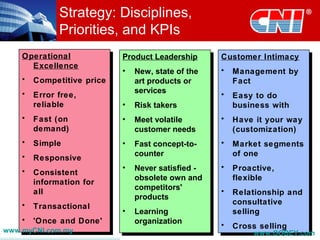
Operational
Excellence
• Competitive price
• Error free,
reliable
• Fast (on
demand)
• Simple
• Responsive
• Consistent
information for
all
• Transactional
• 'Once and Done'
Operational
Excellence
• Competitive price
• Error free,
reliable
• Fast (on
demand)
• Simple
• Responsive
• Consistent
information for
all
• Transactional
• 'Once and Done'
Customer Intimacy
• Management by
Fact
• Easy to do
business with
• Have it your way
(customization)
• Market segments
of one
• Proactive,
flexible
• Relationship and
consultative
selling
• Cross selling
Customer Intimacy
• Management by
Fact
• Easy to do
business with
• Have it your way
(customization)
• Market segments
of one
• Proactive,
flexible
• Relationship and
consultative
selling
• Cross selling
Product Leadership
• New, state of the
art products or
services
• Risk takers
• Meet volatile
customer needs
• Fast concept-to-
counter
• Never satisfied -
obsolete own and
competitors'
products
• Learning
organization
Product Leadership
• New, state of the
art products or
services
• Risk takers
• Meet volatile
customer needs
• Fast concept-to-
counter
• Never satisfied -
obsolete own and
competitors'
products
• Learning
organization
Strategy: Disciplines,
Priorities, and KPIs
www.myCNI.com.my www.OOBEY.com
Operational Excellence
(low cost producer)
Ref: The Discipline of Market Leaders, Michael Treacy & Fred Wiersema; 1995
Product Leadership
(best product)
Customer Intimacy
(best total solution)
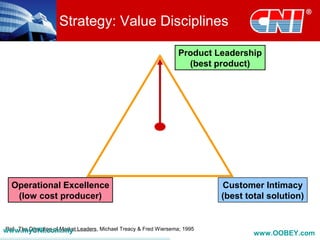
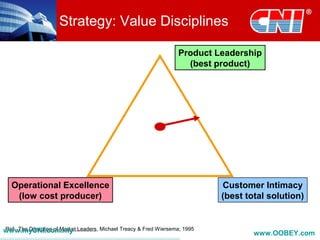
Strategy: Value Disciplines
www.myCNI.com.my www.OOBEY.com
Operational Excellence
(low cost producer)
Ref: The Discipline of Market Leaders, Michael Treacy & Fred Wiersema; 1995
Product Leadership
(best product)
Customer Intimacy
(best total solution)
Strategy: Value Disciplines
www.myCNI.com.my www.OOBEY.com
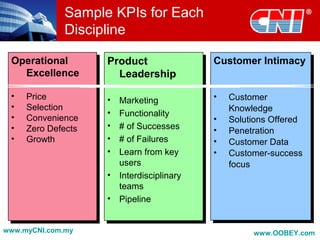
Sample KPIs for Each
Discipline
Operational
Excellence
• Price
• Selection
• Convenience
• Zero Defects
• Growth
Operational
Excellence
• Price
• Selection
• Convenience
• Zero Defects
• Growth
Customer Intimacy
• Customer
Knowledge
• Solutions Offered
• Penetration
• Customer Data
• Customer-success
focus
Customer Intimacy
• Customer
Knowledge
• Solutions Offered
• Penetration
• Customer Data
• Customer-success
focus
Product
Leadership
• Marketing
• Functionality
• # of Successes
• # of Failures
• Learn from key
users
• Interdisciplinary
teams
• Pipeline
Product
Leadership
• Marketing
• Functionality
• # of Successes
• # of Failures
• Learn from key
users
• Interdisciplinary
teams
• Pipeline
www.myCNI.com.my www.OOBEY.com
1. M&A Trends
www.myCNI.com.my www.OOBEY.com
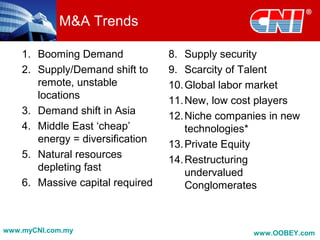
M&A Trends
1. Booming Demand
2. Supply/Demand shift to
remote, unstable
locations
3. Demand shift in Asia
4. Middle East ‘cheap’
energy = diversification
5. Natural resources
depleting fast
6. Massive capital required
8. Supply security
9. Scarcity of Talent
10.Global labor market
11.New, low cost players
12.Niche companies in new
technologies*
13.Private Equity
14.Restructuring
undervalued
Conglomerates
www.myCNI.com.my www.OOBEY.com
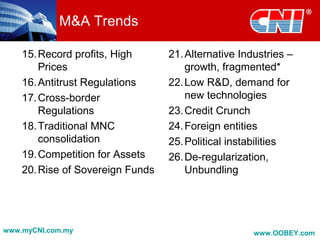
M&A Trends
21.Alternative Industries –
growth, fragmented*
22.Low R&D, demand for
new technologies
23.Credit Crunch
24.Foreign entities
25.Political instabilities
26.De-regularization,
Unbundling
15.Record profits, High
Prices
16.Antitrust Regulations
17.Cross-border
Regulations
18.Traditional MNC
consolidation
19.Competition for Assets
20.Rise of Sovereign Funds
www.myCNI.com.my www.OOBEY.com
Biggest Trend
“Earnings Per Share growth expectations
are way above what companies can
achieve in most territories from organic
growth alone”
John McConomy, US Power and Utilities Transaction Services Leader,
PricewaterhouseCoopers
www.myCNI.com.my www.OOBEY.com
2. Rationale for M&As
www.myCNI.com.my www.OOBEY.com
Two Major Rationale for
M&As:
1. Cost Reduction
2. Growth
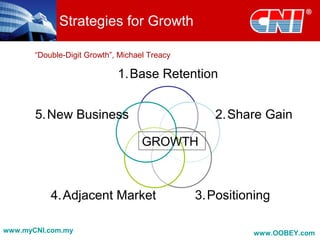
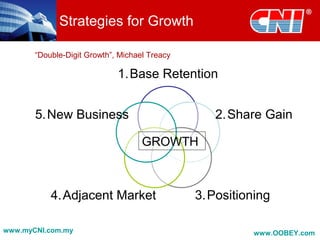
Strategies for Growth
1.Base Retention
2.Share Gain
3.Positioning4.Adjacent Market
5.New Business
GROWTH
“Double-Digit Growth”, Michael Treacy
www.myCNI.com.my www.OOBEY.com
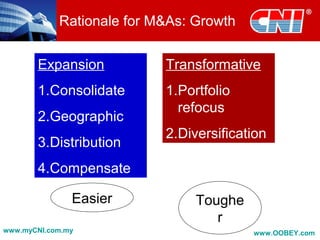
Rationale for M&As: Growth
Expansion
1.Consolidate
2.Geographic
3.Distribution
4.Compensate
Transformative
1.Portfolio
refocus
2.Diversification
Easier Toughe
r
www.myCNI.com.my www.OOBEY.com
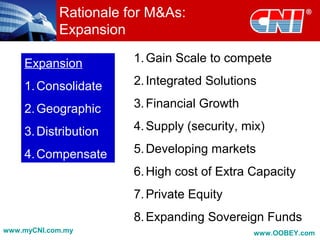
Rationale for M&As:
Expansion
Expansion
1.Consolidate
2.Geographic
3.Distribution
4.Compensate
1.Gain Scale to compete
2.Integrated Solutions
3.Financial Growth
4.Supply (security, mix)
5.Developing markets
6.High cost of Extra Capacity
7.Private Equity
8.Expanding Sovereign Funds
www.myCNI.com.my www.OOBEY.com
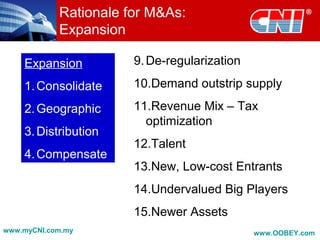
Rationale for M&As:
Expansion
Expansion
1.Consolidate
2.Geographic
3.Distribution
4.Compensate
9.De-regularization
10.Demand outstrip supply
11.Revenue Mix – Tax
optimization
12.Talent
13.New, Low-cost Entrants
14.Undervalued Big Players
15.Newer Assets
www.myCNI.com.my www.OOBEY.com
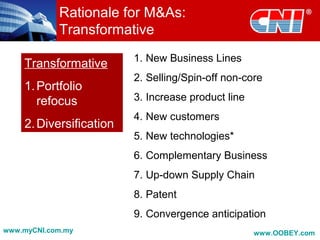
Rationale for M&As:
Transformative
Transformative
1.Portfolio
refocus
2.Diversification
1. New Business Lines
2. Selling/Spin-off non-core
3. Increase product line
4. New customers
5. New technologies*
6. Complementary Business
7. Up-down Supply Chain
8. Patent
9. Convergence anticipation
www.myCNI.com.my www.OOBEY.com
Rationale for M&As: Cross
Sectors
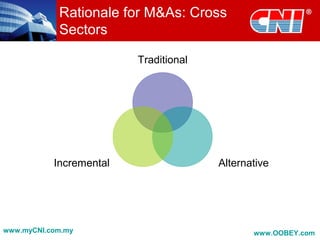
Traditional
AlternativeIncremental
www.myCNI.com.my www.OOBEY.com
Rationale for M&As: Cross
Sectors
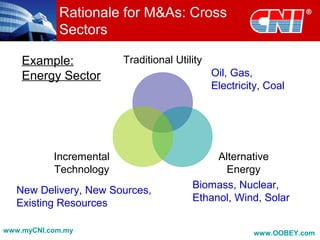
Traditional Utility
Alternative
Energy
Incremental
Technology
New Delivery, New Sources,
Existing Resources
Oil, Gas,
Electricity, Coal
Biomass, Nuclear,
Ethanol, Wind, Solar
www.myCNI.com.my www.OOBEY.com
Example:
Energy Sector
Possible ‘Outside’ Acquirers
or Investors
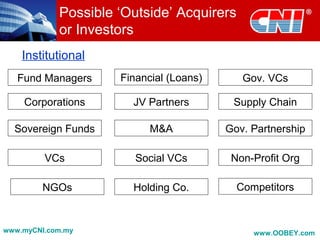
Institutional
Fund Managers
Corporations
Sovereign Funds
VCs
NGOs
Non-Profit Org
Financial (Loans)
JV Partners
M&A
Social VCs
Holding Co.
Gov. VCs
Supply Chain
Gov. Partnership
Competitors
www.myCNI.com.my www.OOBEY.com
Why do ‘Outsiders’ Acquire
or Invest?
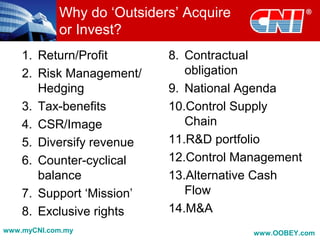
1. Return/Profit
2. Risk Management/
Hedging
3. Tax-benefits
4. CSR/Image
5. Diversify revenue
6. Counter-cyclical
balance
7. Support ‘Mission’
8. Exclusive rights
8. Contractual
obligation
9. National Agenda
10.Control Supply
Chain
11.R&D portfolio
12.Control Management
13.Alternative Cash
Flow
14.M&A
www.myCNI.com.my www.OOBEY.com
3. Strategies, Structure, and
Optimizing Value in M&As
www.myCNI.com.my www.OOBEY.com
Strategies for Growth
1.Base Retention
2.Share Gain
3.Positioning4.Adjacent Market
5.New Business
GROWTH
“Double-Digit Growth”, Michael Treacy
www.myCNI.com.my www.OOBEY.com
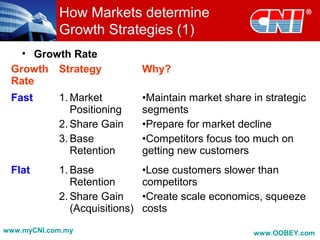
How Markets determine
Growth Strategies (1)
• Growth Rate
Growth
Rate
Strategy Why?
Fast 1. Market
Positioning
2. Share Gain
3. Base
Retention
•Maintain market share in strategic
segments
•Prepare for market decline
•Competitors focus too much on
getting new customers
Flat 1. Base
Retention
2. Share Gain
(Acquisitions)
•Lose customers slower than
competitors
•Create scale economics, squeeze
costs
www.myCNI.com.my www.OOBEY.com
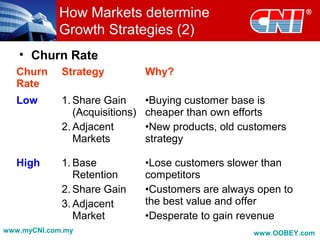
• Churn Rate
Churn
Rate
Strategy Why?
Low 1. Share Gain
(Acquisitions)
2. Adjacent
Markets
•Buying customer base is
cheaper than own efforts
•New products, old customers
strategy
High 1. Base
Retention
2. Share Gain
3. Adjacent
Market
•Lose customers slower than
competitors
•Customers are always open to
the best value and offer
•Desperate to gain revenue
How Markets determine
Growth Strategies (2)
www.myCNI.com.my www.OOBEY.com
How Markets determine
Growth Strategies (3)
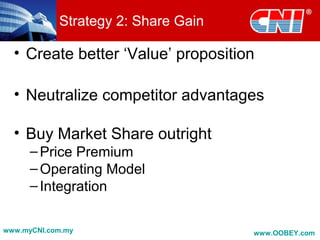
Fast Growth,
Low Churn
1.Market Positioning
2.Share Gain (M&A)
3.Base Retention
4.Adjacent Markets (M&A)
•Example: Energy Sector
www.myCNI.com.my www.OOBEY.com
• Create better ‘Value’ proposition
• Neutralize competitor advantages
• Buy Market Share outright
–Price Premium
–Operating Model
–Integration
Strategy 2: Share Gain
www.myCNI.com.my www.OOBEY.com
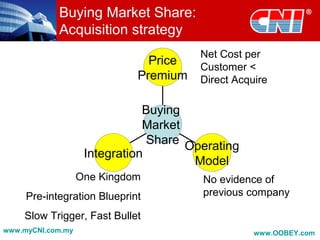
Buying Market Share:
Acquisition strategy
Integration
Operating
Model
Price
Premium
Buying
Market
Share
Net Cost per
Customer <
Direct Acquire
No evidence of
previous company
One Kingdom
Pre-integration Blueprint
Slow Trigger, Fast Bullet
www.myCNI.com.my www.OOBEY.com
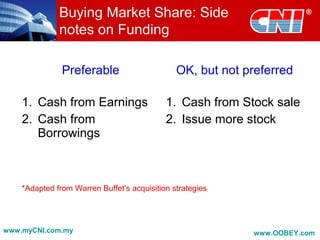
Buying Market Share: Side
notes on Funding
Preferable OK, but not preferred
1. Cash from Earnings
2. Cash from
Borrowings
1. Cash from Stock sale
2. Issue more stock
www.myCNI.com.my www.OOBEY.com
*Adapted from Warren Buffet’s acquisition strategies
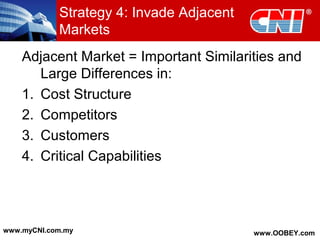
Strategy 4: Invade Adjacent
Markets
Adjacent Market = Important Similarities and
Large Differences in:
1. Cost Structure
2. Competitors
3. Customers
4. Critical Capabilities
www.myCNI.com.my www.OOBEY.com
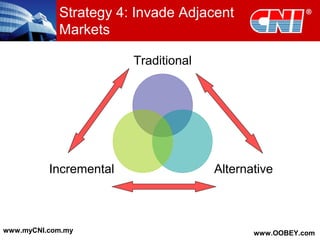
Strategy 4: Invade Adjacent
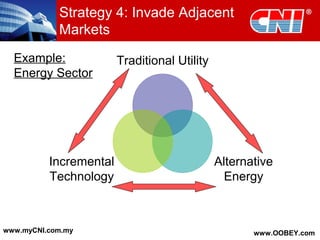
Markets
Traditional
AlternativeIncremental
www.myCNI.com.my www.OOBEY.com
Strategy 4: Invade Adjacent
Markets
Traditional Utility
Alternative
Energy
Incremental
Technology
www.myCNI.com.my www.OOBEY.com
Example:
Energy Sector
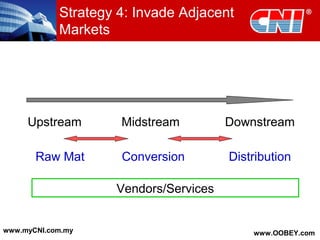
Strategy 4: Invade Adjacent
Markets
Upstream Midstream Downstream
DistributionConversionRaw Mat
Vendors/Services
www.myCNI.com.my www.OOBEY.com
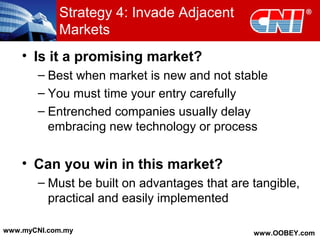
• Is it a promising market?
– Best when market is new and not stable
– You must time your entry carefully
– Entrenched companies usually delay
embracing new technology or process
• Can you win in this market?
– Must be built on advantages that are tangible,
practical and easily implemented
Strategy 4: Invade Adjacent
Markets
www.myCNI.com.my www.OOBEY.com
• Can you match the Standards of
Competition in this Market?
–You do have to meet the quality level that is
common in the market
–Three Standards:- Technology,
Relationships, Business-model
–You must have 80 percent of the capabilities
you need to match competitor’s Standards
Strategy 4: Invade Adjacent
Markets
www.myCNI.com.my www.OOBEY.com
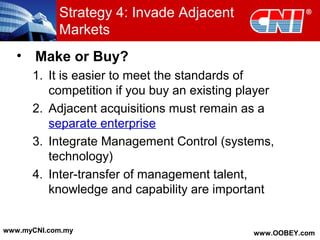
• Make or Buy?
1. It is easier to meet the standards of
competition if you buy an existing player
2. Adjacent acquisitions must remain as a
separate enterprise
3. Integrate Management Control (systems,
technology)
4. Inter-transfer of management talent,
knowledge and capability are important
Strategy 4: Invade Adjacent
Markets
www.myCNI.com.my www.OOBEY.com
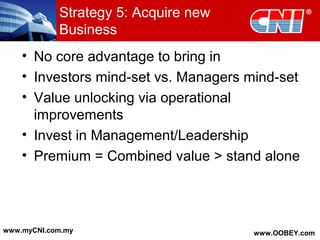
Strategy 5: Acquire new
Business
• No core advantage to bring in
• Investors mind-set vs. Managers mind-set
• Value unlocking via operational
improvements
• Invest in Management/Leadership
• Premium = Combined value > stand alone
www.myCNI.com.my www.OOBEY.com
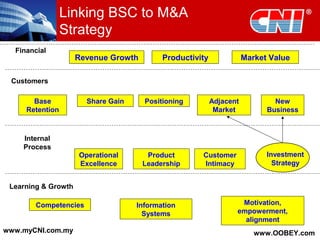
Revenue Growth
Base
Retention
Share Gain Positioning Adjacent
Market
New
Business
Operational
Excellence
Product
Leadership
Customer
Intimacy
Competencies Information
Systems
Motivation,
empowerment,
alignment
Financial
Learning & Growth
Internal
Process
Customers
Investment
Strategy
Productivity Market Value
Linking BSC to M&A
Strategy
www.myCNI.com.my www.OOBEY.com
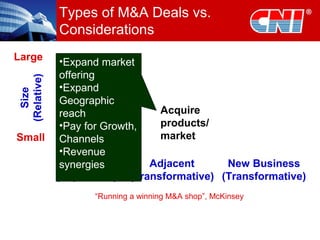
4. Considerations, Risks and Pitfalls
www.myCNI.com.my www.OOBEY.com
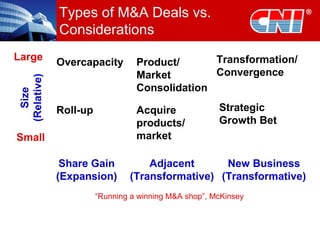
Types of M&A Deals vs.
Considerations
Overcapacity Product/
Market
Consolidation
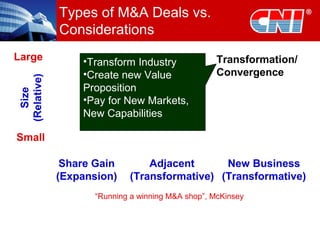
Transformation/
Convergence
Roll-up Acquire
products/
market
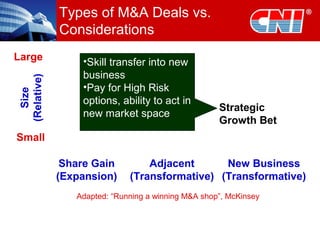
Strategic
Growth Bet
Size
(Relative)
Share Gain
(Expansion)
Adjacent
(Transformative)
New Business
(Transformative)
Small
Large
“Running a winning M&A shop”, McKinsey
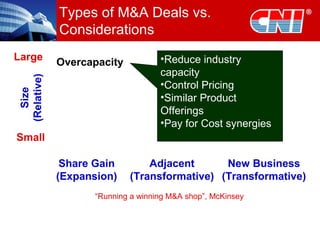
Types of M&A Deals vs.
Considerations
Overcapacity
Size
(Relative)
Share Gain
(Expansion)
Adjacent
(Transformative)
New Business
(Transformative)
Small
Large
“Running a winning M&A shop”, McKinsey
•Reduce industry
capacity
•Control Pricing
•Similar Product
Offerings
•Pay for Cost synergies
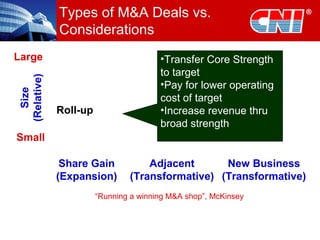
Types of M&A Deals vs.
Considerations
Roll-up
Size
(Relative)
Share Gain
(Expansion)
Adjacent
(Transformative)
New Business
(Transformative)
Small
Large
“Running a winning M&A shop”, McKinsey
•Transfer Core Strength
to target
•Pay for lower operating
cost of target
•Increase revenue thru
broad strength
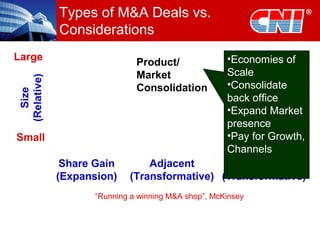
Types of M&A Deals vs.
Considerations
Product/
Market
Consolidation
Size
(Relative)
Share Gain
(Expansion)
Adjacent
(Transformative)
New Business
(Transformative)
Small
Large
“Running a winning M&A shop”, McKinsey
•Economies of
Scale
•Consolidate
back office
•Expand Market
presence
•Pay for Growth,
Channels
Types of M&A Deals vs.
Considerations
Acquire
products/
market
Size
(Relative)
Share Gain
(Expansion)
Adjacent
(Transformative)
New Business
(Transformative)
Small
Large
“Running a winning M&A shop”, McKinsey
•Expand market
offering
•Expand
Geographic
reach
•Pay for Growth,
Channels
•Revenue
synergies
Types of M&A Deals vs.
Considerations
Transformation/
Convergence
Size
(Relative)
Share Gain
(Expansion)
Adjacent
(Transformative)
New Business
(Transformative)
Small
Large
“Running a winning M&A shop”, McKinsey
•Transform Industry
•Create new Value
Proposition
•Pay for New Markets,
New Capabilities
Types of M&A Deals vs.
Considerations
Strategic
Growth Bet
Size
(Relative)
Share Gain
(Expansion)
Adjacent
(Transformative)
New Business
(Transformative)
Small
Large
Adapted: “Running a winning M&A shop”, McKinsey
•Skill transfer into new
business
•Pay for High Risk
options, ability to act in
new market space
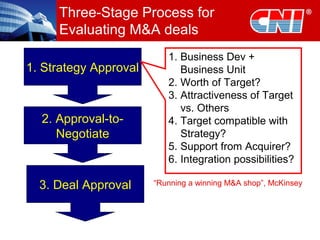
Three-Stage Process for
Evaluating M&A deals
1. Strategy Approval
2. Approval-to-
Negotiate
3. Deal Approval
1. Business Dev +
Business Unit
2. Worth of Target?
3. Attractiveness of Target
vs. Others
4. Target compatible with
Strategy?
5. Support from Acquirer?
6. Integration possibilities?
“Running a winning M&A shop”, McKinsey
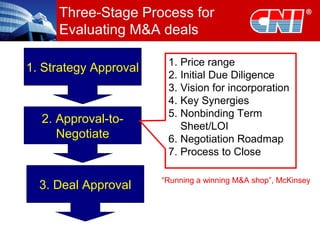
Three-Stage Process for
Evaluating M&A deals
1. Strategy Approval
2. Approval-to-
Negotiate
3. Deal Approval
1. Price range
2. Initial Due Diligence
3. Vision for incorporation
4. Key Synergies
5. Nonbinding Term
Sheet/LOI
6. Negotiation Roadmap
7. Process to Close
“Running a winning M&A shop”, McKinsey
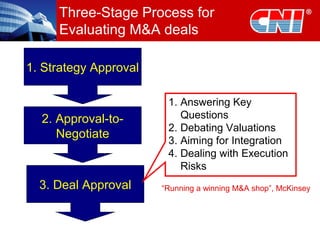
Three-Stage Process for
Evaluating M&A deals
1. Strategy Approval
2. Approval-to-
Negotiate
3. Deal Approval
1. Answering Key
Questions
2. Debating Valuations
3. Aiming for Integration
4. Dealing with Execution
Risks
“Running a winning M&A shop”, McKinsey
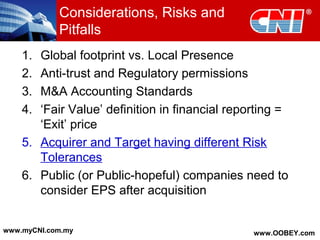
Considerations, Risks and
Pitfalls
1. Global footprint vs. Local Presence
2. Anti-trust and Regulatory permissions
3. M&A Accounting Standards
4. ‘Fair Value’ definition in financial reporting =
‘Exit’ price
5. Acquirer and Target having different Risk
Tolerances
6. Public (or Public-hopeful) companies need to
consider EPS after acquisition
www.myCNI.com.my www.OOBEY.com
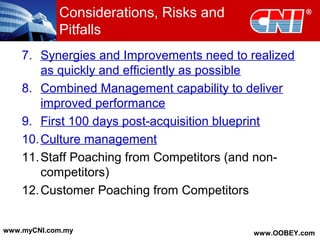
Considerations, Risks and
Pitfalls
7. Synergies and Improvements need to realized
as quickly and efficiently as possible
8. Combined Management capability to deliver
improved performance
9. First 100 days post-acquisition blueprint
10.Culture management
11.Staff Poaching from Competitors (and non-
competitors)
12.Customer Poaching from Competitors
www.myCNI.com.my www.OOBEY.com
Consideration: Alternative
Deals to M&A
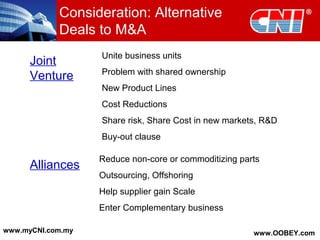
“When companies are unwilling to sell or
acquisition premiums are too high,
alliances are the next best thing to a
merger. In other cases, they are actually
preferable to M&A”
David Hernst, Principal, McKinsey’s Washington, DC
www.myCNI.com.my www.OOBEY.com
Consideration: Alternative
Deals to M&A
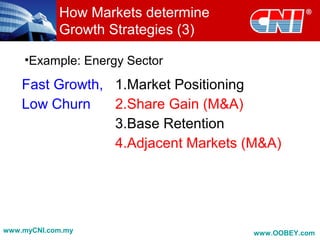
Joint
Venture
Unite business units
Problem with shared ownership
New Product Lines
Cost Reductions
Share risk, Share Cost in new markets, R&D
Buy-out clause
Alliances
Reduce non-core or commoditizing parts
Outsourcing, Offshoring
Help supplier gain Scale
Enter Complementary business
www.myCNI.com.my www.OOBEY.com
End Note for M&A
“Go where the money is...
then marry for love”
F. Scott Fitzgerald, Author
www.myCNI.com.my www.OOBEY.com
Thank You.
soft copy of slides:
www.totallyunrelatedrandomanddebatable.
blogspot.com

M&A Developing a Corporate Acquisition Strategy

  • 1.
    DEVELOPING A CORPORATE ACQUISITIONSTRATEGY Case studies, Concepts, and Debatable Ideas Kenny Ong CNI Holdings Berhad www.myCNI.com.my www.OOBEY.com
  • 2.
    1. M&A Trends 2.Rationale for M&As 3. Strategies, Structure, and Optimizing Value in M&As 4. Considerations, Risks and Pitfalls www.myCNI.com.my www.OOBEY.com
  • 3.
    • How tofail without trying The Roadmap to Failure by Fred Wiersema and Mike Treacy Before we start… www.myCNI.com.my www.OOBEY.com
  • 4.
    The Roadmap toFailure Fred Wiersema and Mike TreacyPerformanc e Time Clear Sailing Today’s performance Ad-hoc Tactics Denial & Defense Doom Projections Overdue Failure The Moment of Truth X Performance Freefall Tomorrow’s actual performance Downpresure of Unclear Strategy www.myCNI.com.my www.OOBEY.com
  • 5.
    Denial and Defense •“It’s not really good value our competitor is offering, because it doesn’t include a lot of our features.” - ABC vs Air Asia • “It’s good value but not in our preferred customer market.” - ABC vs Toyota • “Sure they’re hurting us, but with their unfair advantage, what can we do?” – ABC vs MILO • “The rules we are playing by have always worked before” – AMEX vs VISA www.myCNI.com.my www.OOBEY.com
  • 6.
    The Roadmap toFailure Fred Wiersema and Mike TreacyPerformanc e Time Clear Sailing Today’s performance Ad-hoc Tactics Denial & Defense Doom Projections Overdue Failure The Moment of Truth X Performance Freefall Tomorrow’s actual performance Downpresure of Unclear Strategy www.myCNI.com.my www.OOBEY.com
  • 7.
    Ad Hoc Tactics •Selectively hold discounts to hold business that has started to go elsewhere • Introduce new promotions, terms, conditions, and offers to confuse and cloud the market • Beef up customer service by adding people to fix mess- ups and quicken delayed shipments • Delay capital investments and adjust accounting methods to portray quarterly financial results more favorably • Introduce “new and improved” products that are new in form, but not in substantive ways that are of consequence to purchasers • Merge, Acquire, Joint Venture and Ally out of desperation or without proper considerations www.myCNI.com.my www.OOBEY.com
  • 8.
    The Roadmap toFailure Fred Wiersema and Mike TreacyPerformanc e Time Clear Sailing Today’s performance Ad-hoc Tactics Denial & Defense Doom Projections Overdue Failure The Moment of Truth X Performance Freefall Tomorrow’s actual performance Downpresure of Unclear Strategy www.myCNI.com.my www.OOBEY.com
  • 9.
    “What is themoral of the story?” www.myCNI.com.my www.OOBEY.com
  • 10.
    What is theBusiness Model? USP Market Discipline Profit Model www.myCNI.com.my www.OOBEY.com
  • 11.
    Intro: Market Discipline •Mamak stall www.myCNI.com.my www.OOBEY.com
  • 12.
    Intro: Market Discipline "Theyare the most innovative" "Constantly renewing and creative" "Always on the leading edge" "A great deal!" Excellent/attractive price Minimal acquisition cost and hassle Lowest overall cost of ownership "A no-hassles firm" Convenience and speed Reliable product and service "Exactly what I need" Customized products Personalized communications "They're very responsive" Preferential service and flexibility Recommends what I need "I'm very loyal to them" Helps us to be a success Product Leadership Operational Excellence Customer Intimacy www.myCNI.com.my www.OOBEY.com
  • 13.
    Operational Excellence (low costproducer) Ref: The Discipline of Market Leaders, Michael Treacy & Fred Wiersema; 1995 Product Leadership (best product) Customer Intimacy (best total solution) Strategy: Disciplines, Priorities, and KPIs www.myCNI.com.my www.OOBEY.com
  • 14.
    The McPlaybook* Make iteasy to eat • 50% drive-thru • Meals held in one hand Make it easy to prepare • High Turnover • Tasks simple to learn & repeat Make it quick • “Fast Food” • Tests new products for Cooking Times Make what customers want • Prowls market for new products • Monitored field tests *Adapted from: Businessweek , Februrary 5th 2007 www.myCNI.com.my www.OOBEY.com
  • 15.
    Operational Excellence • Competitive price •Error free, reliable • Fast (on demand) • Simple • Responsive • Consistent information for all • Transactional • 'Once and Done' Operational Excellence • Competitive price • Error free, reliable • Fast (on demand) • Simple • Responsive • Consistent information for all • Transactional • 'Once and Done' Customer Intimacy • Management by Fact • Easy to do business with • Have it your way (customization) • Market segments of one • Proactive, flexible • Relationship and consultative selling • Cross selling Customer Intimacy • Management by Fact • Easy to do business with • Have it your way (customization) • Market segments of one • Proactive, flexible • Relationship and consultative selling • Cross selling Product Leadership • New, state of the art products or services • Risk takers • Meet volatile customer needs • Fast concept-to- counter • Never satisfied - obsolete own and competitors' products • Learning organization Product Leadership • New, state of the art products or services • Risk takers • Meet volatile customer needs • Fast concept-to- counter • Never satisfied - obsolete own and competitors' products • Learning organization Strategy: Disciplines, Priorities, and KPIs www.myCNI.com.my www.OOBEY.com
  • 16.
    Operational Excellence (low costproducer) Ref: The Discipline of Market Leaders, Michael Treacy & Fred Wiersema; 1995 Product Leadership (best product) Customer Intimacy (best total solution) Strategy: Value Disciplines www.myCNI.com.my www.OOBEY.com
  • 17.
    Operational Excellence (low costproducer) Ref: The Discipline of Market Leaders, Michael Treacy & Fred Wiersema; 1995 Product Leadership (best product) Customer Intimacy (best total solution) Strategy: Value Disciplines www.myCNI.com.my www.OOBEY.com
  • 18.
    Sample KPIs forEach Discipline Operational Excellence • Price • Selection • Convenience • Zero Defects • Growth Operational Excellence • Price • Selection • Convenience • Zero Defects • Growth Customer Intimacy • Customer Knowledge • Solutions Offered • Penetration • Customer Data • Customer-success focus Customer Intimacy • Customer Knowledge • Solutions Offered • Penetration • Customer Data • Customer-success focus Product Leadership • Marketing • Functionality • # of Successes • # of Failures • Learn from key users • Interdisciplinary teams • Pipeline Product Leadership • Marketing • Functionality • # of Successes • # of Failures • Learn from key users • Interdisciplinary teams • Pipeline www.myCNI.com.my www.OOBEY.com
  • 19.
  • 20.
    M&A Trends 1. BoomingDemand 2. Supply/Demand shift to remote, unstable locations 3. Demand shift in Asia 4. Middle East ‘cheap’ energy = diversification 5. Natural resources depleting fast 6. Massive capital required 8. Supply security 9. Scarcity of Talent 10.Global labor market 11.New, low cost players 12.Niche companies in new technologies* 13.Private Equity 14.Restructuring undervalued Conglomerates www.myCNI.com.my www.OOBEY.com
  • 21.
    M&A Trends 21.Alternative Industries– growth, fragmented* 22.Low R&D, demand for new technologies 23.Credit Crunch 24.Foreign entities 25.Political instabilities 26.De-regularization, Unbundling 15.Record profits, High Prices 16.Antitrust Regulations 17.Cross-border Regulations 18.Traditional MNC consolidation 19.Competition for Assets 20.Rise of Sovereign Funds www.myCNI.com.my www.OOBEY.com
  • 22.
    Biggest Trend “Earnings PerShare growth expectations are way above what companies can achieve in most territories from organic growth alone” John McConomy, US Power and Utilities Transaction Services Leader, PricewaterhouseCoopers www.myCNI.com.my www.OOBEY.com
  • 23.
    2. Rationale forM&As www.myCNI.com.my www.OOBEY.com
  • 24.
    Two Major Rationalefor M&As: 1. Cost Reduction 2. Growth
  • 25.
    Strategies for Growth 1.BaseRetention 2.Share Gain 3.Positioning4.Adjacent Market 5.New Business GROWTH “Double-Digit Growth”, Michael Treacy www.myCNI.com.my www.OOBEY.com
  • 26.
    Rationale for M&As:Growth Expansion 1.Consolidate 2.Geographic 3.Distribution 4.Compensate Transformative 1.Portfolio refocus 2.Diversification Easier Toughe r www.myCNI.com.my www.OOBEY.com
  • 27.
    Rationale for M&As: Expansion Expansion 1.Consolidate 2.Geographic 3.Distribution 4.Compensate 1.GainScale to compete 2.Integrated Solutions 3.Financial Growth 4.Supply (security, mix) 5.Developing markets 6.High cost of Extra Capacity 7.Private Equity 8.Expanding Sovereign Funds www.myCNI.com.my www.OOBEY.com
  • 28.
    Rationale for M&As: Expansion Expansion 1.Consolidate 2.Geographic 3.Distribution 4.Compensate 9.De-regularization 10.Demandoutstrip supply 11.Revenue Mix – Tax optimization 12.Talent 13.New, Low-cost Entrants 14.Undervalued Big Players 15.Newer Assets www.myCNI.com.my www.OOBEY.com
  • 29.
    Rationale for M&As: Transformative Transformative 1.Portfolio refocus 2.Diversification 1.New Business Lines 2. Selling/Spin-off non-core 3. Increase product line 4. New customers 5. New technologies* 6. Complementary Business 7. Up-down Supply Chain 8. Patent 9. Convergence anticipation www.myCNI.com.my www.OOBEY.com
  • 30.
    Rationale for M&As:Cross Sectors Traditional AlternativeIncremental www.myCNI.com.my www.OOBEY.com
  • 31.
    Rationale for M&As:Cross Sectors Traditional Utility Alternative Energy Incremental Technology New Delivery, New Sources, Existing Resources Oil, Gas, Electricity, Coal Biomass, Nuclear, Ethanol, Wind, Solar www.myCNI.com.my www.OOBEY.com Example: Energy Sector
  • 32.
    Possible ‘Outside’ Acquirers orInvestors Institutional Fund Managers Corporations Sovereign Funds VCs NGOs Non-Profit Org Financial (Loans) JV Partners M&A Social VCs Holding Co. Gov. VCs Supply Chain Gov. Partnership Competitors www.myCNI.com.my www.OOBEY.com
  • 33.
    Why do ‘Outsiders’Acquire or Invest? 1. Return/Profit 2. Risk Management/ Hedging 3. Tax-benefits 4. CSR/Image 5. Diversify revenue 6. Counter-cyclical balance 7. Support ‘Mission’ 8. Exclusive rights 8. Contractual obligation 9. National Agenda 10.Control Supply Chain 11.R&D portfolio 12.Control Management 13.Alternative Cash Flow 14.M&A www.myCNI.com.my www.OOBEY.com
  • 34.
    3. Strategies, Structure,and Optimizing Value in M&As www.myCNI.com.my www.OOBEY.com
  • 35.
    Strategies for Growth 1.BaseRetention 2.Share Gain 3.Positioning4.Adjacent Market 5.New Business GROWTH “Double-Digit Growth”, Michael Treacy www.myCNI.com.my www.OOBEY.com
  • 36.
    How Markets determine GrowthStrategies (1) • Growth Rate Growth Rate Strategy Why? Fast 1. Market Positioning 2. Share Gain 3. Base Retention •Maintain market share in strategic segments •Prepare for market decline •Competitors focus too much on getting new customers Flat 1. Base Retention 2. Share Gain (Acquisitions) •Lose customers slower than competitors •Create scale economics, squeeze costs www.myCNI.com.my www.OOBEY.com
  • 37.
    • Churn Rate Churn Rate StrategyWhy? Low 1. Share Gain (Acquisitions) 2. Adjacent Markets •Buying customer base is cheaper than own efforts •New products, old customers strategy High 1. Base Retention 2. Share Gain 3. Adjacent Market •Lose customers slower than competitors •Customers are always open to the best value and offer •Desperate to gain revenue How Markets determine Growth Strategies (2) www.myCNI.com.my www.OOBEY.com
  • 38.
    How Markets determine GrowthStrategies (3) Fast Growth, Low Churn 1.Market Positioning 2.Share Gain (M&A) 3.Base Retention 4.Adjacent Markets (M&A) •Example: Energy Sector www.myCNI.com.my www.OOBEY.com
  • 39.
    • Create better‘Value’ proposition • Neutralize competitor advantages • Buy Market Share outright –Price Premium –Operating Model –Integration Strategy 2: Share Gain www.myCNI.com.my www.OOBEY.com
  • 40.
    Buying Market Share: Acquisitionstrategy Integration Operating Model Price Premium Buying Market Share Net Cost per Customer < Direct Acquire No evidence of previous company One Kingdom Pre-integration Blueprint Slow Trigger, Fast Bullet www.myCNI.com.my www.OOBEY.com
  • 41.
    Buying Market Share:Side notes on Funding Preferable OK, but not preferred 1. Cash from Earnings 2. Cash from Borrowings 1. Cash from Stock sale 2. Issue more stock www.myCNI.com.my www.OOBEY.com *Adapted from Warren Buffet’s acquisition strategies
  • 42.
    Strategy 4: InvadeAdjacent Markets Adjacent Market = Important Similarities and Large Differences in: 1. Cost Structure 2. Competitors 3. Customers 4. Critical Capabilities www.myCNI.com.my www.OOBEY.com
  • 43.
    Strategy 4: InvadeAdjacent Markets Traditional AlternativeIncremental www.myCNI.com.my www.OOBEY.com
  • 44.
    Strategy 4: InvadeAdjacent Markets Traditional Utility Alternative Energy Incremental Technology www.myCNI.com.my www.OOBEY.com Example: Energy Sector
  • 45.
    Strategy 4: InvadeAdjacent Markets Upstream Midstream Downstream DistributionConversionRaw Mat Vendors/Services www.myCNI.com.my www.OOBEY.com
  • 46.
    • Is ita promising market? – Best when market is new and not stable – You must time your entry carefully – Entrenched companies usually delay embracing new technology or process • Can you win in this market? – Must be built on advantages that are tangible, practical and easily implemented Strategy 4: Invade Adjacent Markets www.myCNI.com.my www.OOBEY.com
  • 47.
    • Can youmatch the Standards of Competition in this Market? –You do have to meet the quality level that is common in the market –Three Standards:- Technology, Relationships, Business-model –You must have 80 percent of the capabilities you need to match competitor’s Standards Strategy 4: Invade Adjacent Markets www.myCNI.com.my www.OOBEY.com
  • 48.
    • Make orBuy? 1. It is easier to meet the standards of competition if you buy an existing player 2. Adjacent acquisitions must remain as a separate enterprise 3. Integrate Management Control (systems, technology) 4. Inter-transfer of management talent, knowledge and capability are important Strategy 4: Invade Adjacent Markets www.myCNI.com.my www.OOBEY.com
  • 49.
    Strategy 5: Acquirenew Business • No core advantage to bring in • Investors mind-set vs. Managers mind-set • Value unlocking via operational improvements • Invest in Management/Leadership • Premium = Combined value > stand alone www.myCNI.com.my www.OOBEY.com
  • 50.
    Revenue Growth Base Retention Share GainPositioning Adjacent Market New Business Operational Excellence Product Leadership Customer Intimacy Competencies Information Systems Motivation, empowerment, alignment Financial Learning & Growth Internal Process Customers Investment Strategy Productivity Market Value Linking BSC to M&A Strategy www.myCNI.com.my www.OOBEY.com
  • 51.
    4. Considerations, Risksand Pitfalls www.myCNI.com.my www.OOBEY.com
  • 52.
    Types of M&ADeals vs. Considerations Overcapacity Product/ Market Consolidation Transformation/ Convergence Roll-up Acquire products/ market Strategic Growth Bet Size (Relative) Share Gain (Expansion) Adjacent (Transformative) New Business (Transformative) Small Large “Running a winning M&A shop”, McKinsey
  • 53.
    Types of M&ADeals vs. Considerations Overcapacity Size (Relative) Share Gain (Expansion) Adjacent (Transformative) New Business (Transformative) Small Large “Running a winning M&A shop”, McKinsey •Reduce industry capacity •Control Pricing •Similar Product Offerings •Pay for Cost synergies
  • 54.
    Types of M&ADeals vs. Considerations Roll-up Size (Relative) Share Gain (Expansion) Adjacent (Transformative) New Business (Transformative) Small Large “Running a winning M&A shop”, McKinsey •Transfer Core Strength to target •Pay for lower operating cost of target •Increase revenue thru broad strength
  • 55.
    Types of M&ADeals vs. Considerations Product/ Market Consolidation Size (Relative) Share Gain (Expansion) Adjacent (Transformative) New Business (Transformative) Small Large “Running a winning M&A shop”, McKinsey •Economies of Scale •Consolidate back office •Expand Market presence •Pay for Growth, Channels
  • 56.
    Types of M&ADeals vs. Considerations Acquire products/ market Size (Relative) Share Gain (Expansion) Adjacent (Transformative) New Business (Transformative) Small Large “Running a winning M&A shop”, McKinsey •Expand market offering •Expand Geographic reach •Pay for Growth, Channels •Revenue synergies
  • 57.
    Types of M&ADeals vs. Considerations Transformation/ Convergence Size (Relative) Share Gain (Expansion) Adjacent (Transformative) New Business (Transformative) Small Large “Running a winning M&A shop”, McKinsey •Transform Industry •Create new Value Proposition •Pay for New Markets, New Capabilities
  • 58.
    Types of M&ADeals vs. Considerations Strategic Growth Bet Size (Relative) Share Gain (Expansion) Adjacent (Transformative) New Business (Transformative) Small Large Adapted: “Running a winning M&A shop”, McKinsey •Skill transfer into new business •Pay for High Risk options, ability to act in new market space
  • 59.
    Three-Stage Process for EvaluatingM&A deals 1. Strategy Approval 2. Approval-to- Negotiate 3. Deal Approval 1. Business Dev + Business Unit 2. Worth of Target? 3. Attractiveness of Target vs. Others 4. Target compatible with Strategy? 5. Support from Acquirer? 6. Integration possibilities? “Running a winning M&A shop”, McKinsey
  • 60.
    Three-Stage Process for EvaluatingM&A deals 1. Strategy Approval 2. Approval-to- Negotiate 3. Deal Approval 1. Price range 2. Initial Due Diligence 3. Vision for incorporation 4. Key Synergies 5. Nonbinding Term Sheet/LOI 6. Negotiation Roadmap 7. Process to Close “Running a winning M&A shop”, McKinsey
  • 61.
    Three-Stage Process for EvaluatingM&A deals 1. Strategy Approval 2. Approval-to- Negotiate 3. Deal Approval 1. Answering Key Questions 2. Debating Valuations 3. Aiming for Integration 4. Dealing with Execution Risks “Running a winning M&A shop”, McKinsey
  • 62.
    Considerations, Risks and Pitfalls 1.Global footprint vs. Local Presence 2. Anti-trust and Regulatory permissions 3. M&A Accounting Standards 4. ‘Fair Value’ definition in financial reporting = ‘Exit’ price 5. Acquirer and Target having different Risk Tolerances 6. Public (or Public-hopeful) companies need to consider EPS after acquisition www.myCNI.com.my www.OOBEY.com
  • 63.
    Considerations, Risks and Pitfalls 7.Synergies and Improvements need to realized as quickly and efficiently as possible 8. Combined Management capability to deliver improved performance 9. First 100 days post-acquisition blueprint 10.Culture management 11.Staff Poaching from Competitors (and non- competitors) 12.Customer Poaching from Competitors www.myCNI.com.my www.OOBEY.com
  • 64.
    Consideration: Alternative Deals toM&A “When companies are unwilling to sell or acquisition premiums are too high, alliances are the next best thing to a merger. In other cases, they are actually preferable to M&A” David Hernst, Principal, McKinsey’s Washington, DC www.myCNI.com.my www.OOBEY.com
  • 65.
    Consideration: Alternative Deals toM&A Joint Venture Unite business units Problem with shared ownership New Product Lines Cost Reductions Share risk, Share Cost in new markets, R&D Buy-out clause Alliances Reduce non-core or commoditizing parts Outsourcing, Offshoring Help supplier gain Scale Enter Complementary business www.myCNI.com.my www.OOBEY.com
  • 66.
    End Note forM&A “Go where the money is... then marry for love” F. Scott Fitzgerald, Author www.myCNI.com.my www.OOBEY.com
  • 67.
    Thank You. soft copyof slides: www.totallyunrelatedrandomanddebatable. blogspot.com

Editor's Notes

  • #4 Intro: “How to fail without trying” Why this intro? -
  • #10 Moral 1: The Right Business Strategy comes first, not M&amp;As to boost the busines. If the Business Model is wrong, the M&amp;A will be wrong no matter how. Good M&amp;As cannot correct a Bad business model!
  • #11 Example: Google USP – Search, Free! Profit Model – Ad revenue MKt Discipline – Operational Excellence Example: Air Asia USP – Budget Profit Model – Lowest Cost, Maximum Seats Mkt Discipline – Operational Excellence
  • #12 How do I choose which Mamak stall I want to go to? For Food (best maggi goreng, teh ice) For Convenience (near office, lights to read, el fresco, parking) For Service (pre-order Teh Tarik, fast ordering and serving, pleasant &amp; courteous) It is very hard to find a Mamak stall that has all the features. I am also not interested in all the features also. I will choose the Mamak stall depending on the Experience I would like to have at that particular moment in time.
  • #13 How does the Customer define “Great Experience”? - It depends on their own perceptions. Problem is…this differs depending on the Customer! If you are very good in something that the Customer does not value, it will not improve the Experience.
  • #14 To Excel – Must be a Leader in ONE of the disciplines but the other two must be at least at industry standard
  • #15 Example of successful customer loyalty strategy focusing on Operational Excellence and Product Leadership while maintaining market standard on Customer Service without indulging in it
  • #16 Refer to Handout 1: Value Disciplines
  • #17 OPTION 1
  • #18 OPTION 2 But…. I cannot tell you which path CNI has taken!
  • #21 Niche companies in new technologies*: petroleum, biotechnology, clean fuel
  • #22 Growth in Alternative Energy*: Ethanol Blending, Wind
  • #26 2 and 3 are ‘Expansion’ 4 and 5 are ‘Transformative’
  • #33 Each Investor type has a different ‘interest’ in the company they are investing in **View Next slide for their possible motives..
  • #34 Example of Risk Management/Hedging – Abu Dhabi Fund, Temasek Example of Exclusive Rights and R&amp;D Portfolio – Microsoft buying stake into Facebook (widgets, web 2.0, internet Ads, SaaS, Cloud Computing), Microsoft also will sell Internet ads for Facebook, combined fight to Google, exchange for the opportunity to broker ad placements to non-English language versions that are anticipated to be introduced in the coming months, Microsoft the exclusive provider of standard banner advertising on Facebook using Microsoft’s digital advertising solutions and the Microsoft® adCenter platform.