
UW Community-Oriented Public Health Practice
Rosetta Eun Ryong Lee
Seattle Girls’ School
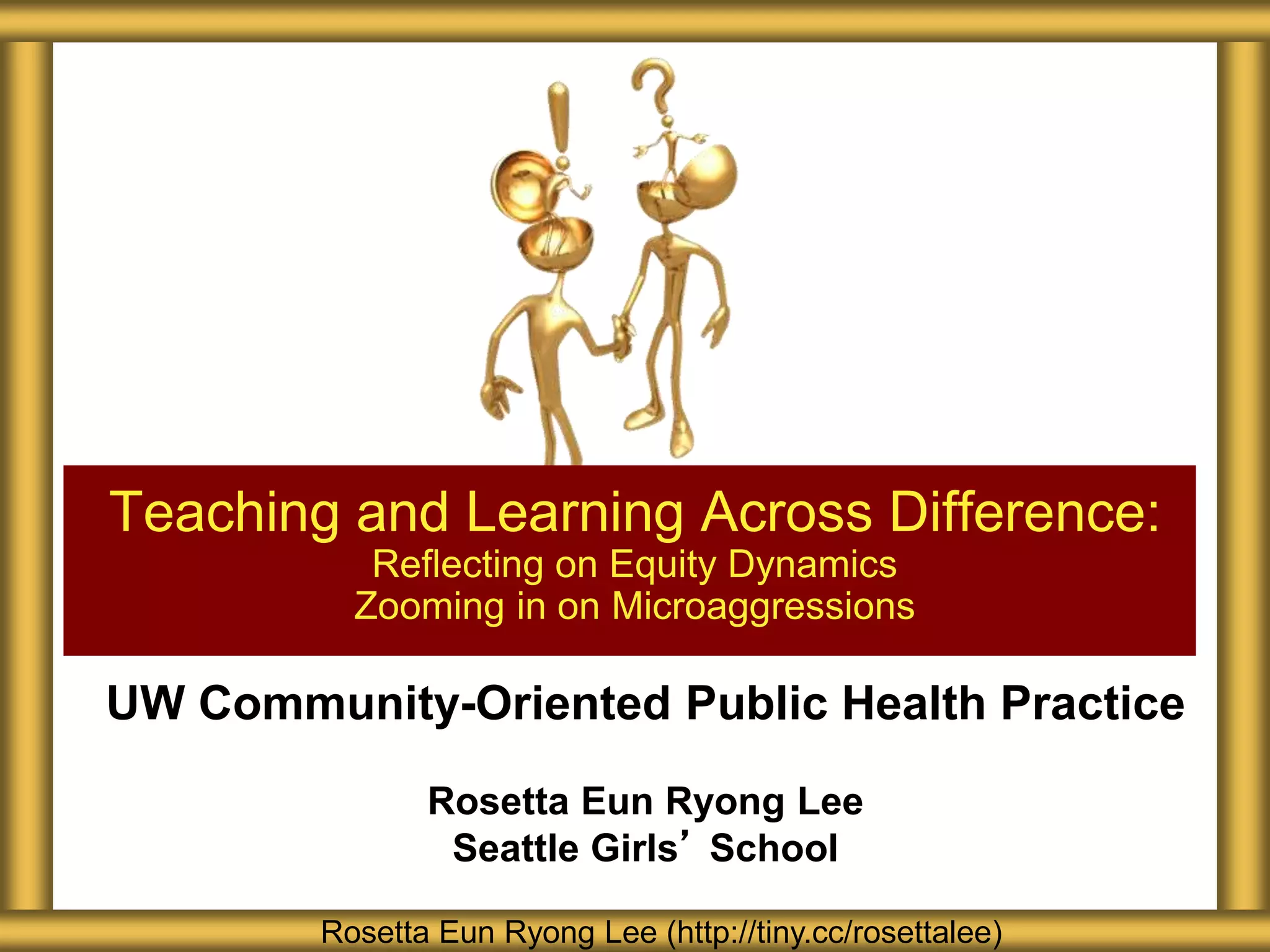
Teaching and Learning Across Difference:
Reflecting on Equity Dynamics
Zooming in on Microaggressions
Rosetta Eun Ryong Lee (http://tiny.cc/rosettalee)
About Seattle Girls’ School
Rosetta Eun Ryong Lee (http://tiny.cc/rosettalee)
Agenda
 Experiences Across Difference
 Zooming in on Microaggressions
 Navigating Microaggressions
Rosetta Eun Ryong Lee (http://tiny.cc/rosettalee)
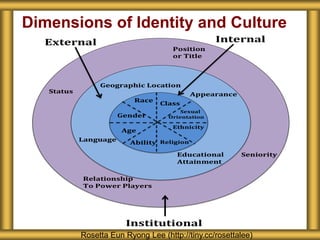
Race
Religion
Class
Gender
Sexual
Orientation
Ability
Age
Ethnicity
Geographic Location
Language
Educational
Attainment
Appearance
Seniority
Position
or Title
Status
Relationship
To Power Players
InternalExternal
Institutional
Dimensions of Identity and Culture
Rosetta Eun Ryong Lee (http://tiny.cc/rosettalee)
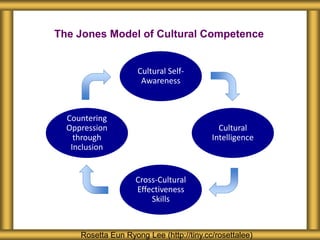
The Jones Model of Cultural Competence
Cultural Self-
Awareness
Cultural
Intelligence
Cross-Cultural
Effectiveness
Skills
Countering
Oppression
through
Inclusion
Experiences Across Difference
Internalized Oppression/Dominance
Stereotype Threat
Accumulated Impact/
Microaggressions
Code/Mode Switching
Fish Seeing the Water
“Normal” versus “Good”
“Intent” versus “Impact”
Rosetta Eun Ryong Lee (http://tiny.cc/rosettalee)
Discussion
What is interesting,
surprising, or thought
provoking about what you
have learned so far?
What are the most salient
or frequently experienced
dynamics in this
environment?
Rosetta Eun Ryong Lee (http://tiny.cc/rosettalee)
Break
Rosetta Eun Ryong Lee (http://tiny.cc/rosettalee)
Zooming in on
Microaggressions
Rosetta Eun Ryong Lee (http://tiny.cc/rosettalee)
Accumulated Impact
Regular, Frequent, and Pervasive
Based on Stereotype
Often Unintended
 Microassaults
– Explicit
– Conscious and Deliberate
– Backstage Spaces
 Microinsults
– Hidden
– Often Unknown or Unintended
– Frontstage Spaces
 Microinvalidation
Zooming In: Microaggressions
Rosetta Eun Ryong Lee (http://tiny.cc/rosettalee)
 Alien in Own Land
 Ascription of Intelligence
 Colorblindness
 Criminality/Assumption of Criminal Status
 Denial of Individual Racism
 Myth of Meritocracy
 Pathologizing Cultural Values/Styles
 Second-Class Citizen
 Environmental
Microaggressions/Macroaggressions
Racial Microaggressions
Rosetta Eun Ryong Lee (http://tiny.cc/rosettalee)
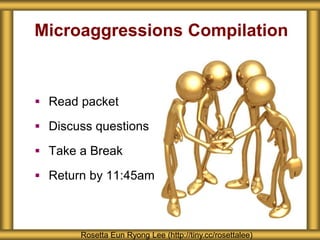
Microaggressions Compilation
 Read packet
 Discuss questions
 Take a Break
 Return by 11:45am
Rosetta Eun Ryong Lee (http://tiny.cc/rosettalee)
Break
Rosetta Eun Ryong Lee (http://tiny.cc/rosettalee)
Navigating Microaggressions
Rosetta Eun Ryong Lee (http://tiny.cc/rosettalee)
Debunking Some Myths
Rosetta Eun Ryong Lee (http://tiny.cc/rosettalee)
 All or None
 Mistakes
 Apologies
 “Tonsils” Theory
 Vulnerability
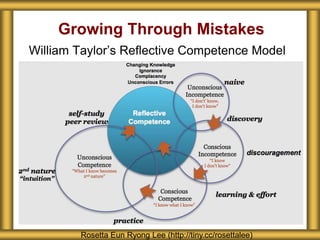
Growing Through Mistakes
William Taylor’s Reflective Competence Model
Rosetta Eun Ryong Lee (http://tiny.cc/rosettalee)
Speaking From the Heart
Rosetta Eun Ryong Lee (http://tiny.cc/rosettalee)
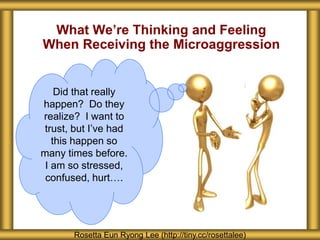
What We’re Thinking and Feeling
When Receiving the Microaggression
Rosetta Eun Ryong Lee (http://tiny.cc/rosettalee)
Did that really
happen? Do they
realize? I want to
trust, but I’ve had
this happen so
many times before.
I am so stressed,
confused, hurt….
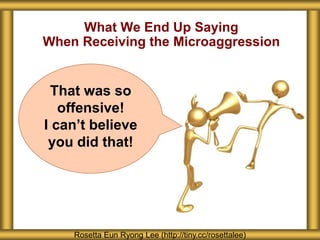
What We End Up Saying
When Receiving the Microaggression
Rosetta Eun Ryong Lee (http://tiny.cc/rosettalee)
That was so
offensive!
I can’t believe
you did that!
Be A DEAR….
Rosetta Eun Ryong Lee (http://tiny.cc/rosettalee)
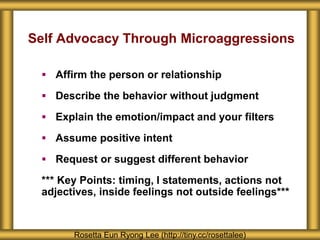
Self Advocacy Through Microaggressions
 Affirm the person or relationship
 Describe the behavior without judgment
 Explain the emotion/impact and your filters
 Assume positive intent
 Request or suggest different behavior
*** Key Points: timing, I statements, actions not
adjectives, inside feelings not outside feelings***
Rosetta Eun Ryong Lee (http://tiny.cc/rosettalee)
Self Advocacy Through Microaggressions:
An Example
I appreciate having you as a colleague. We work
together well, and I respect the contributions you make
to the team. Earlier today, when someone corrected
you on using the correct gender pronouns for me, I
heard you say, “Well it’s so difficult, and they should
know others are going to mess up a lot.” I was hurt
when I heard these things. My gender is something
that I have had to defend and affirm since I was a kid.
Every day, every space, I have to come out, reaffirm,
and defend. It’s frustrating and saddening that I have
to do the same with someone I see every day and work
side by side with. I imagine you didn’t mean for me to
feel that way. Can I ask that you make bigger efforts to
get my pronouns right, and take it seriously when you
make a mistake and someone corrects you?
Rosetta Eun Ryong Lee (http://tiny.cc/rosettalee)
Self Advocacy Through Microaggressions:
An Example
I think you and I both agree we all have a
right to be respected and heard in this
community. When we were disagreeing
about budgets, you said “You’re being
overdramatic,” and later, you called me a
“drama queen.” Statements like this make it
sound like I am being too emotional and
that my concerns are drama rather than real
issues. I am assuming you don’t intend to
police my tone or dismiss my concerns. I
would appreciate your not saying things
like this anymore. Thank you.
Rosetta Eun Ryong Lee (http://tiny.cc/rosettalee)
Being A Witness
Rosetta Eun Ryong Lee (http://tiny.cc/rosettalee)
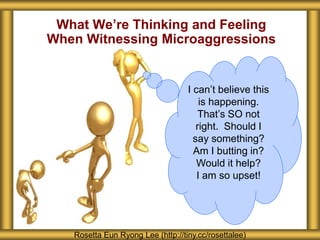
What We’re Thinking and Feeling
When Witnessing Microaggressions
Rosetta Eun Ryong Lee (http://tiny.cc/rosettalee)
I can’t believe this
is happening.
That’s SO not
right. Should I
say something?
Am I butting in?
Would it help?
I am so upset!
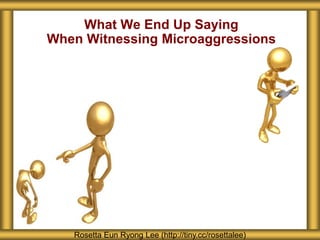
What We End Up Saying
When Witnessing Microaggressions
Rosetta Eun Ryong Lee (http://tiny.cc/rosettalee)
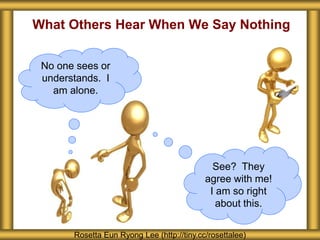
What Others Hear When We Say Nothing
Rosetta Eun Ryong Lee (http://tiny.cc/rosettalee)
See? They
agree with me!
I am so right
about this.
No one sees or
understands. I
am alone.
They were born
innocent…
Rosetta Eun Ryong Lee (http://tiny.cc/rosettalee)
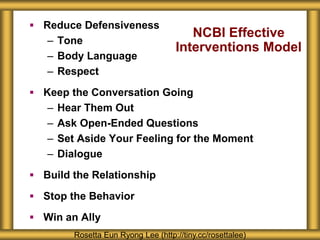
NCBI Effective
Interventions Model
 Reduce Defensiveness
– Tone
– Body Language
– Respect
 Keep the Conversation Going
– Hear Them Out
– Ask Open-Ended Questions
– Set Aside Your Feeling for the Moment
– Dialogue
 Build the Relationship
 Stop the Behavior
 Win an Ally
Rosetta Eun Ryong Lee (http://tiny.cc/rosettalee)
Intervening in Microaggressions: Examples
 Ask open ended questions
– “He looked suspicious”
– “How did he look? How was he acting? Why was that suspicious?”
 Find out the experience motivating the comment
– “Why can’t they just speak English around here?”
– “It must be hard not to understand what people are saying around you.”
– “I’m sick of my taxes paying for freeloaders”
– “Tell me more about about that.”
 Use exaggerated humor to highlight what’s going on
(use sparingly)
– “You’re gay - what do gay people think about this issue?”
– “I’m not sure – I’ll go ask. It may take me a while, since there are so many of us.”
 Join the person and do not make yourself superior
– “She got that award because she’s Black and female.”
– “You know, I hear that a lot. I’ve been trying to figure out why we seem to think when a
Black woman gets recognized it must be because of ‘diversity’ or ‘affirmative action’
reasons rather than that she earned it.”
Rosetta Eun Ryong Lee (http://tiny.cc/rosettalee)
Listening to the Real Message
Rosetta Eun Ryong Lee (http://tiny.cc/rosettalee)
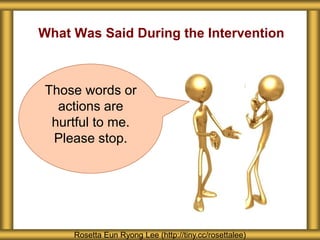
What Was Said During the Intervention
Rosetta Eun Ryong Lee (http://tiny.cc/rosettalee)
Those words or
actions are
hurtful to me.
Please stop.
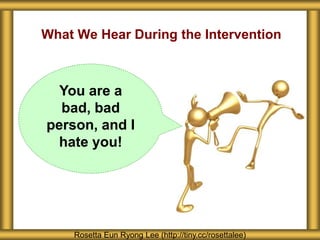
What We Hear During the Intervention
Rosetta Eun Ryong Lee (http://tiny.cc/rosettalee)
You are a
bad, bad
person, and I
hate you!
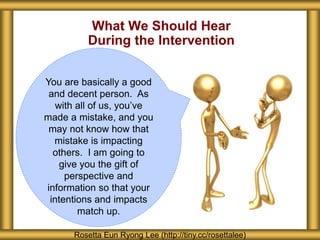
What We Should Hear
During the Intervention
Rosetta Eun Ryong Lee (http://tiny.cc/rosettalee)
You are basically a good
and decent person. As
with all of us, you’ve
made a mistake, and you
may not know how that
mistake is impacting
others. I am going to
give you the gift of
perspective and
information so that your
intentions and impacts
match up.
It’s a gift…
Rosetta Eun Ryong Lee (http://tiny.cc/rosettalee)
When You’re Told About
Microaggressive Impact You Created
 Listen with full attention
 Don’t try to defend or respond right away
– Take deep breaths
– Acknowledge your feelings
 Your mistakes don’t define you
– Be worthy of their trust and gift
 Prioritize the Impact over Intent
– Apologize for real
*** Moving through these moments with grace is
called shame resilience. It’s a vital skill***
Rosetta Eun Ryong Lee (http://tiny.cc/rosettalee)
When You’re Told About
Microaggressive Impact You Created:
Examples
Rosetta Eun Ryong Lee (http://tiny.cc/rosettalee)
 “I really appreciate your telling me this.”
 “I’m so embarrassed that I did that.”
 “I’m so sorry my words and actions made you feel
that way. No matter what I intended, it hurt you.”
 “I’m pretty overwhelmed right now, and I don’t
want to respond in a way I’d regret. Do you think
you can help me come up with a better way to
handle that situation after I take a few minutes?”
 “I wanted to go back to a moment I don’t think I
handled very well… Can we talk?”
Process Break
What is interesting,
surprising, or thought
provoking about what you
have learned so far?
How might you use this
learning in your everyday
interactions?
Rosetta Eun Ryong Lee (http://tiny.cc/rosettalee)
Final Words of Advice:
Recognize Your Triggers
Rosetta Eun Ryong Lee (http://tiny.cc/rosettalee)
Find Your Bucket People
Rosetta Eun Ryong Lee (http://tiny.cc/rosettalee)
Practice Makes
Less Freeze-Ups
Rosetta Eun Ryong Lee (http://tiny.cc/rosettalee)
If You Messed Up and You Know It,
Don’t Wait for the Intervention –
Just Apologize
Rosetta Eun Ryong Lee (http://tiny.cc/rosettalee)
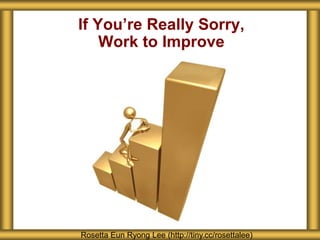
If You’re Really Sorry,
Work to Improve
Rosetta Eun Ryong Lee (http://tiny.cc/rosettalee)
Build Authentic Relationships
Rosetta Eun Ryong Lee (http://tiny.cc/rosettalee)
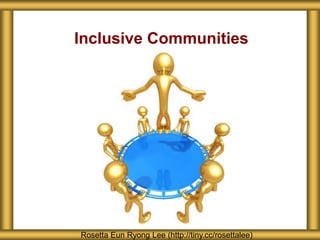
Inclusive Communities
Rosetta Eun Ryong Lee (http://tiny.cc/rosettalee)
Presenter Information
Rosetta Eun Ryong Lee
6th Faculty and
Professional Outreach
Seattle Girls’ School
2706 S Jackson Street
Seattle WA 98144
(206) 805-6562
rlee@seattlegirlsschool.org
http://tiny.cc/rosettalee
Rosetta Eun Ryong Lee (http://tiny.cc/rosettalee)
Communication Resources
• “Stereotype Threat” by Joshua Aronson
• Brenda J. Allen, Difference Matters: Communicating
Social Identity
• William Gudykunst, Cross-Cultural and Intercultural
Comunication
• Milton Bennett, PhD, Intercultural Communication
Institute www.intercultural.org
• “Non-Verbal Communication Across Cultures” by Erica
Hagen, Intercultural Communication Resources
• Thiagi.com
• Thrive! Team Dynamics
• http://www.analytictech.com/mb021/action_science_
history.htm
Rosetta Eun Ryong Lee (http://tiny.cc/rosettalee)
Miscellaneous Resources
• Karen Bradberry and Johnnie Foreman, “Privilege and
Power,” Summer Diversity Institute, National Association
of Independent Schools, 2009
• Po Bronson and Ashley Merryman, Nurture Shock
• Kevin Jennings, GLSEN (Gay Lesbian and Straight Education
Network) www.glsen.org
• Allan G. Johnson, Privilege, Power, and Difference
• Johnnie McKinley, “Leveling the Playing Field and Raising
African American Students’ Achievement in Twenty-nine
Urban Classrooms,” New Horizons for Learning,
http://www.newhorizons.org/strategies/differentiated/
mckinley.htm
Michael J Nakkula and Eric Toshalis, Understanding Youth.
Rosetta Eun Ryong Lee (http://tiny.cc/rosettalee)

UW Community-Oriented Public Health Practice Microaggressions

  • 1.
    UW Community-Oriented PublicHealth Practice Rosetta Eun Ryong Lee Seattle Girls’ School Teaching and Learning Across Difference: Reflecting on Equity Dynamics Zooming in on Microaggressions Rosetta Eun Ryong Lee (http://tiny.cc/rosettalee)
  • 2.
    About Seattle Girls’School Rosetta Eun Ryong Lee (http://tiny.cc/rosettalee)
  • 3.
    Agenda  Experiences AcrossDifference  Zooming in on Microaggressions  Navigating Microaggressions Rosetta Eun Ryong Lee (http://tiny.cc/rosettalee)
  • 4.
    Race Religion Class Gender Sexual Orientation Ability Age Ethnicity Geographic Location Language Educational Attainment Appearance Seniority Position or Title Status Relationship ToPower Players InternalExternal Institutional Dimensions of Identity and Culture Rosetta Eun Ryong Lee (http://tiny.cc/rosettalee)
  • 5.
    Rosetta Eun RyongLee (http://tiny.cc/rosettalee) The Jones Model of Cultural Competence Cultural Self- Awareness Cultural Intelligence Cross-Cultural Effectiveness Skills Countering Oppression through Inclusion
  • 6.
    Experiences Across Difference InternalizedOppression/Dominance Stereotype Threat Accumulated Impact/ Microaggressions Code/Mode Switching Fish Seeing the Water “Normal” versus “Good” “Intent” versus “Impact” Rosetta Eun Ryong Lee (http://tiny.cc/rosettalee)
  • 7.
    Discussion What is interesting, surprising,or thought provoking about what you have learned so far? What are the most salient or frequently experienced dynamics in this environment? Rosetta Eun Ryong Lee (http://tiny.cc/rosettalee)
  • 8.
    Break Rosetta Eun RyongLee (http://tiny.cc/rosettalee)
  • 9.
    Zooming in on Microaggressions RosettaEun Ryong Lee (http://tiny.cc/rosettalee) Accumulated Impact Regular, Frequent, and Pervasive Based on Stereotype Often Unintended
  • 10.
     Microassaults – Explicit –Conscious and Deliberate – Backstage Spaces  Microinsults – Hidden – Often Unknown or Unintended – Frontstage Spaces  Microinvalidation Zooming In: Microaggressions Rosetta Eun Ryong Lee (http://tiny.cc/rosettalee)
  • 11.
     Alien inOwn Land  Ascription of Intelligence  Colorblindness  Criminality/Assumption of Criminal Status  Denial of Individual Racism  Myth of Meritocracy  Pathologizing Cultural Values/Styles  Second-Class Citizen  Environmental Microaggressions/Macroaggressions Racial Microaggressions Rosetta Eun Ryong Lee (http://tiny.cc/rosettalee)
  • 12.
    Microaggressions Compilation  Readpacket  Discuss questions  Take a Break  Return by 11:45am Rosetta Eun Ryong Lee (http://tiny.cc/rosettalee)
  • 13.
    Break Rosetta Eun RyongLee (http://tiny.cc/rosettalee)
  • 14.
    Navigating Microaggressions Rosetta EunRyong Lee (http://tiny.cc/rosettalee)
  • 15.
    Debunking Some Myths RosettaEun Ryong Lee (http://tiny.cc/rosettalee)  All or None  Mistakes  Apologies  “Tonsils” Theory  Vulnerability
  • 16.
    Growing Through Mistakes WilliamTaylor’s Reflective Competence Model Rosetta Eun Ryong Lee (http://tiny.cc/rosettalee)
  • 17.
    Speaking From theHeart Rosetta Eun Ryong Lee (http://tiny.cc/rosettalee)
  • 18.
    What We’re Thinkingand Feeling When Receiving the Microaggression Rosetta Eun Ryong Lee (http://tiny.cc/rosettalee) Did that really happen? Do they realize? I want to trust, but I’ve had this happen so many times before. I am so stressed, confused, hurt….
  • 19.
    What We EndUp Saying When Receiving the Microaggression Rosetta Eun Ryong Lee (http://tiny.cc/rosettalee) That was so offensive! I can’t believe you did that!
  • 20.
    Be A DEAR…. RosettaEun Ryong Lee (http://tiny.cc/rosettalee)
  • 21.
    Self Advocacy ThroughMicroaggressions  Affirm the person or relationship  Describe the behavior without judgment  Explain the emotion/impact and your filters  Assume positive intent  Request or suggest different behavior *** Key Points: timing, I statements, actions not adjectives, inside feelings not outside feelings*** Rosetta Eun Ryong Lee (http://tiny.cc/rosettalee)
  • 22.
    Self Advocacy ThroughMicroaggressions: An Example I appreciate having you as a colleague. We work together well, and I respect the contributions you make to the team. Earlier today, when someone corrected you on using the correct gender pronouns for me, I heard you say, “Well it’s so difficult, and they should know others are going to mess up a lot.” I was hurt when I heard these things. My gender is something that I have had to defend and affirm since I was a kid. Every day, every space, I have to come out, reaffirm, and defend. It’s frustrating and saddening that I have to do the same with someone I see every day and work side by side with. I imagine you didn’t mean for me to feel that way. Can I ask that you make bigger efforts to get my pronouns right, and take it seriously when you make a mistake and someone corrects you? Rosetta Eun Ryong Lee (http://tiny.cc/rosettalee)
  • 23.
    Self Advocacy ThroughMicroaggressions: An Example I think you and I both agree we all have a right to be respected and heard in this community. When we were disagreeing about budgets, you said “You’re being overdramatic,” and later, you called me a “drama queen.” Statements like this make it sound like I am being too emotional and that my concerns are drama rather than real issues. I am assuming you don’t intend to police my tone or dismiss my concerns. I would appreciate your not saying things like this anymore. Thank you. Rosetta Eun Ryong Lee (http://tiny.cc/rosettalee)
  • 24.
    Being A Witness RosettaEun Ryong Lee (http://tiny.cc/rosettalee)
  • 25.
    What We’re Thinkingand Feeling When Witnessing Microaggressions Rosetta Eun Ryong Lee (http://tiny.cc/rosettalee) I can’t believe this is happening. That’s SO not right. Should I say something? Am I butting in? Would it help? I am so upset!
  • 26.
    What We EndUp Saying When Witnessing Microaggressions Rosetta Eun Ryong Lee (http://tiny.cc/rosettalee)
  • 27.
    What Others HearWhen We Say Nothing Rosetta Eun Ryong Lee (http://tiny.cc/rosettalee) See? They agree with me! I am so right about this. No one sees or understands. I am alone.
  • 28.
    They were born innocent… RosettaEun Ryong Lee (http://tiny.cc/rosettalee)
  • 29.
    NCBI Effective Interventions Model Reduce Defensiveness – Tone – Body Language – Respect  Keep the Conversation Going – Hear Them Out – Ask Open-Ended Questions – Set Aside Your Feeling for the Moment – Dialogue  Build the Relationship  Stop the Behavior  Win an Ally Rosetta Eun Ryong Lee (http://tiny.cc/rosettalee)
  • 30.
    Intervening in Microaggressions:Examples  Ask open ended questions – “He looked suspicious” – “How did he look? How was he acting? Why was that suspicious?”  Find out the experience motivating the comment – “Why can’t they just speak English around here?” – “It must be hard not to understand what people are saying around you.” – “I’m sick of my taxes paying for freeloaders” – “Tell me more about about that.”  Use exaggerated humor to highlight what’s going on (use sparingly) – “You’re gay - what do gay people think about this issue?” – “I’m not sure – I’ll go ask. It may take me a while, since there are so many of us.”  Join the person and do not make yourself superior – “She got that award because she’s Black and female.” – “You know, I hear that a lot. I’ve been trying to figure out why we seem to think when a Black woman gets recognized it must be because of ‘diversity’ or ‘affirmative action’ reasons rather than that she earned it.” Rosetta Eun Ryong Lee (http://tiny.cc/rosettalee)
  • 31.
    Listening to theReal Message Rosetta Eun Ryong Lee (http://tiny.cc/rosettalee)
  • 32.
    What Was SaidDuring the Intervention Rosetta Eun Ryong Lee (http://tiny.cc/rosettalee) Those words or actions are hurtful to me. Please stop.
  • 33.
    What We HearDuring the Intervention Rosetta Eun Ryong Lee (http://tiny.cc/rosettalee) You are a bad, bad person, and I hate you!
  • 34.
    What We ShouldHear During the Intervention Rosetta Eun Ryong Lee (http://tiny.cc/rosettalee) You are basically a good and decent person. As with all of us, you’ve made a mistake, and you may not know how that mistake is impacting others. I am going to give you the gift of perspective and information so that your intentions and impacts match up.
  • 35.
    It’s a gift… RosettaEun Ryong Lee (http://tiny.cc/rosettalee)
  • 36.
    When You’re ToldAbout Microaggressive Impact You Created  Listen with full attention  Don’t try to defend or respond right away – Take deep breaths – Acknowledge your feelings  Your mistakes don’t define you – Be worthy of their trust and gift  Prioritize the Impact over Intent – Apologize for real *** Moving through these moments with grace is called shame resilience. It’s a vital skill*** Rosetta Eun Ryong Lee (http://tiny.cc/rosettalee)
  • 37.
    When You’re ToldAbout Microaggressive Impact You Created: Examples Rosetta Eun Ryong Lee (http://tiny.cc/rosettalee)  “I really appreciate your telling me this.”  “I’m so embarrassed that I did that.”  “I’m so sorry my words and actions made you feel that way. No matter what I intended, it hurt you.”  “I’m pretty overwhelmed right now, and I don’t want to respond in a way I’d regret. Do you think you can help me come up with a better way to handle that situation after I take a few minutes?”  “I wanted to go back to a moment I don’t think I handled very well… Can we talk?”
  • 38.
    Process Break What isinteresting, surprising, or thought provoking about what you have learned so far? How might you use this learning in your everyday interactions? Rosetta Eun Ryong Lee (http://tiny.cc/rosettalee)
  • 39.
    Final Words ofAdvice: Recognize Your Triggers Rosetta Eun Ryong Lee (http://tiny.cc/rosettalee)
  • 40.
    Find Your BucketPeople Rosetta Eun Ryong Lee (http://tiny.cc/rosettalee)
  • 41.
    Practice Makes Less Freeze-Ups RosettaEun Ryong Lee (http://tiny.cc/rosettalee)
  • 42.
    If You MessedUp and You Know It, Don’t Wait for the Intervention – Just Apologize Rosetta Eun Ryong Lee (http://tiny.cc/rosettalee)
  • 43.
    If You’re ReallySorry, Work to Improve Rosetta Eun Ryong Lee (http://tiny.cc/rosettalee)
  • 44.
    Build Authentic Relationships RosettaEun Ryong Lee (http://tiny.cc/rosettalee)
  • 45.
    Inclusive Communities Rosetta EunRyong Lee (http://tiny.cc/rosettalee)
  • 46.
    Presenter Information Rosetta EunRyong Lee 6th Faculty and Professional Outreach Seattle Girls’ School 2706 S Jackson Street Seattle WA 98144 (206) 805-6562 rlee@seattlegirlsschool.org http://tiny.cc/rosettalee Rosetta Eun Ryong Lee (http://tiny.cc/rosettalee)
  • 47.
    Communication Resources • “StereotypeThreat” by Joshua Aronson • Brenda J. Allen, Difference Matters: Communicating Social Identity • William Gudykunst, Cross-Cultural and Intercultural Comunication • Milton Bennett, PhD, Intercultural Communication Institute www.intercultural.org • “Non-Verbal Communication Across Cultures” by Erica Hagen, Intercultural Communication Resources • Thiagi.com • Thrive! Team Dynamics • http://www.analytictech.com/mb021/action_science_ history.htm Rosetta Eun Ryong Lee (http://tiny.cc/rosettalee)
  • 48.
    Miscellaneous Resources • KarenBradberry and Johnnie Foreman, “Privilege and Power,” Summer Diversity Institute, National Association of Independent Schools, 2009 • Po Bronson and Ashley Merryman, Nurture Shock • Kevin Jennings, GLSEN (Gay Lesbian and Straight Education Network) www.glsen.org • Allan G. Johnson, Privilege, Power, and Difference • Johnnie McKinley, “Leveling the Playing Field and Raising African American Students’ Achievement in Twenty-nine Urban Classrooms,” New Horizons for Learning, http://www.newhorizons.org/strategies/differentiated/ mckinley.htm Michael J Nakkula and Eric Toshalis, Understanding Youth. Rosetta Eun Ryong Lee (http://tiny.cc/rosettalee)