UV for Water Treatment
Presented by PureTerra Ventures
UV OVERVIEW
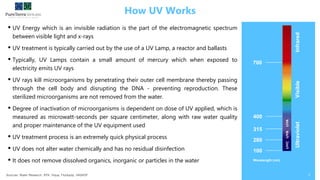
How UV Works
3
100
280
315
400
700
UltravioletVisibleInfrared
Wavelength (nm)
• UV Energy which is an invisible radiation is the part of the electromagnetic spectrum
between visible light and x-rays
• UV treatment is typically carried out by the use of a UV Lamp, a reactor and ballasts
• Typically, UV Lamps contain a small amount of mercury which when exposed to
electricity emits UV rays
• UV rays kill microorganisms by penetrating their outer cell membrane thereby passing
through the cell body and disrupting the DNA - preventing reproduction. These
sterilized microorganisms are not removed from the water.
• Degree of inactivation of microorganisms is dependent on dose of UV applied, which is
measured as microwatt-seconds per square centimeter, along with raw water quality
and proper maintenance of the UV equipment used
• UV treatment process is an extremely quick physical process
• UV does not alter water chemically and has no residual disinfection
• It does not remove dissolved organics, inorganic or particles in the water
Sources: Water Research, EPA, Viqua, Fluidquip, HASADF
HISTORY
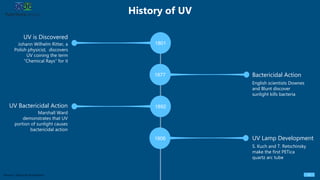
History of UV
5Source: Spectral Innovations
Johann Wilhelm Ritter, a
Polish physicist, discovers
UV coining the term
“Chemical Rays” for it
UV is Discovered
English scientists Downes
and Blunt discover
sunlight kills bacteria
Bactericidal Action
Marshall Ward
demonstrates that UV
portion of sunlight causes
bactericidal action
UV Bactericidal Action
S. Kuch and T. Retschinsky
make the first PETica
quartz arc tube
UV Lamp Development
1801
1877
1892
1906
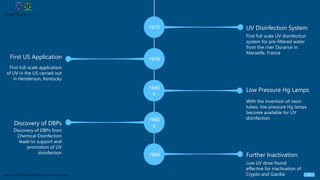
6Source: RES’EAU-WaterNet Strategic Network
First full-scale application
of UV in the US carried out
in Henderson, Kentucky
First US Application
With the invention of neon
tubes, low pressure Hg lamps
become available for UV
disinfection
Low Pressure Hg Lamps
Discovery of DBPs from
Chemical Disinfection
leads to support and
promotion of UV
disinfection
Discovery of DBPs
Low UV dose found
effective for inactivation of
Crypto and Giardia
Further Inactivation
First full scale UV disinfection
system for pre-filtered water
from the river Durance in
Marseille, France
UV Disinfection System1910
1916
1940
s
1960
s
1998
PROCESS
Pretreatment of Wastewater before UV
Disinfection
8Sources: Texas A&M
• Wastewater must pass through advanced pretreatment to remove most of the organic matter and suspended solids before it passes
through the UV disinfection unit
• This is critical because UV radiation needs to come in direct contact with the microorganisms in wastewater, which may be
prohibited if there are constituents present that shield the pathogenic microorganisms
• Advanced pretreatment components deployed will vary from plant to plant. In general, advanced pretreatment components include:
• Aerobic Treatment Units (ATU) - ATUs use biological processes to transform both dissolved and solid constituents into gases, cell
mass, and non-degradable material
• Constructed Wetlands - The constructed wetland is a basin or cell containing microorganisms, media, and plants that provide
treatment of incoming effluent
• Lagoons - A lagoon is a large basin of wastewater that is undergoing a combination of chemical, physical, and biological treatment
processes. It may be aerobic, facultative, partial-mixed aerated or anaerobic.
• Media Filters - Trickling filter, sand/gravel filter, foam filter, peat filter, textile filter, up-flow filter
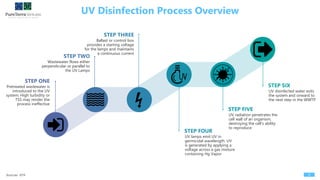
UV Disinfection Process Overview
9Sources: EPA
Pretreated wastewater is
introduced to the UV
system. High turbidity or
TSS may render the
process ineffective
STEP ONE
Wastewater flows either
perpendicular or parallel to
the UV Lamps
STEP TWO
Ballast or control box
provides a starting voltage
for the lamps and maintains
a continuous current
STEP THREE
UV lamps emit UV in
germicidal wavelength. UV
is generated by applying a
voltage across a gas mixture
containing Hg Vapor
STEP FOUR
UV radiation penetrates the
cell wall of an organism,
destroying the cell’s ability
to reproduce
STEP FIVE
UV disinfected water exits
the system and onward to
the next step in the WWTP
STEP SIX
Organisms Destructed and Dosage Required
for 99.9% Destruction
Sources: Water Research 10
UV SYSTEM
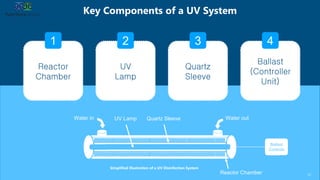
Key Components of a UV System
12
Simplified Illustration of a UV Disinfection System
Water in Water out
Reactor Chamber
Quartz SleeveUV Lamp
Ballast
Controls
Reactor
Chamber
UV
Lamp
Quartz
Sleeve
Ballast
(Controller
Unit)
1 2 3 4
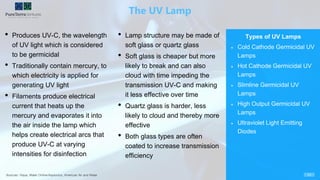
The UV Lamp
13Sources: Viqua, Water Online/Aquionics, American Air and Water
Types of UV Lamps
Cold Cathode Germicidal UV
Lamps
Hot Cathode Germicidal UV
Lamps
Slimline Germicidal UV
Lamps
High Output Germicidal UV
Lamps
Ultraviolet Light Emitting
Diodes
• Produces UV-C, the wavelength
of UV light which is considered
to be germicidal
• Traditionally contain mercury, to
which electricity is applied for
generating UV light
• Filaments produce electrical
current that heats up the
mercury and evaporates it into
the air inside the lamp which
helps create electrical arcs that
produce UV-C at varying
intensities for disinfection
• Lamp structure may be made of
soft glass or quartz glass
• Soft glass is cheaper but more
likely to break and can also
cloud with time impeding the
transmission UV-C and making
it less effective over time
• Quartz glass is harder, less
likely to cloud and thereby more
effective
• Both glass types are often
coated to increase transmission
efficiency
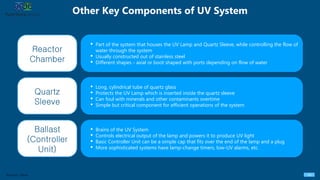
Other Key Components of UV System
14Sources: Viqua
Reactor
Chamber
Quartz
Sleeve
Ballast
(Controller
Unit)
• Part of the system that houses the UV Lamp and Quartz Sleeve, while controlling the flow of
water through the system
• Usually constructed out of stainless steel
• Different shapes - axial or boot shaped with ports depending on flow of water
• Long, cylindrical tube of quartz glass
• Protects the UV Lamp which is inserted inside the quartz sleeve
• Can foul with minerals and other contaminants overtime
• Simple but critical component for efficient operations of the system
• Brains of the UV System
• Controls electrical output of the lamp and powers it to produce UV light
• Basic Controller Unit can be a simple cap that fits over the end of the lamp and a plug
• More sophisticated systems have lamp-change timers, low-UV alarms, etc.
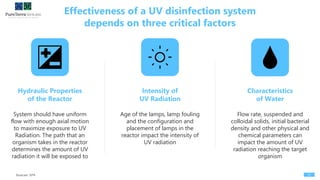
Effectiveness of a UV disinfection system
depends on three critical factors
15Sources: EPA
Hydraulic Properties
of the Reactor
System should have uniform
flow with enough axial motion
to maximize exposure to UV
Radiation. The path that an
organism takes in the reactor
determines the amount of UV
radiation it will be exposed to
Intensity of
UV Radiation
Age of the lamps, lamp fouling
and the configuration and
placement of lamps in the
reactor impact the intensity of
UV radiation
Characteristics
of Water
Flow rate, suspended and
colloidal solids, initial bacterial
density and other physical and
chemical parameters can
impact the amount of UV
radiation reaching the target
organism
Operations & maintenance to ensure that
sufficient UV radiation is transmitted
16Sources: EPA
SURFACE CLEANING
All surfaces between the UV radiation and
the target organisms must be clean
QUARTZ SLEEVE CLEANING
Mechanical wipers, ultrasonics or
chemicals can be used for cleaning the
quartz sleeve
PILOT TESTING
System should be pilot-tested before full-
scale deployment to ensure discharge
permits are met
LAMP USE
Operating procedures implemented to
reduce on/off cycles since efficacy
reduces with repeated cycles
LAMP REPLACEMENT
Average life lamp ranges from 8,760 to
14,000 working hours and usually
replaced after 12,000 hours of use
BALLAST
Must be compatible with the lamps and
should be ventilated to protect excessive
heating which may shorten its life
1
2
3
4
5
6
Inadequate cleaning is one of the most common causes of a UV system’s ineffectiveness
UV LAMPS
Types of UV Lamps
18Sources: American Air and Water, MDT Mag, Atlantic Ultraviolet Corp
Cold Cathode Germicidal UV Lamps
UV Light Emitting Diodes (LEDs)
Hot Cathode Germicidal UV Lamps
Slimline Germicidal UV Lamps
High Output Germicidal UV Lamps
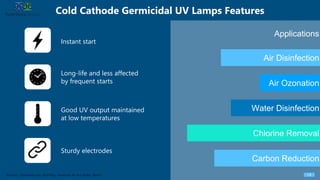
Cold Cathode Germicidal UV Lamps Features
19Sources: UltraViolet.com, WQPMag, American Air and Water, Rexim
Instant start
Long-life and less affected
by frequent starts
Good UV output maintained
at low temperatures
Sturdy electrodes
Air Disinfection
Air Ozonation
Water Disinfection
Chlorine Removal
Carbon Reduction
Applications
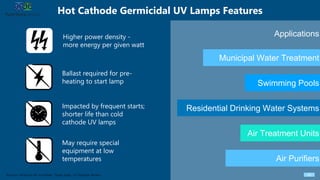
Hot Cathode Germicidal UV Lamps Features
20Sources: American Air and Water, Texas State, UV Sterilizer Review
Ballast required for pre-
heating to start lamp
Impacted by frequent starts;
shorter life than cold
cathode UV lamps
May require special
equipment at low
temperatures
Higher power density -
more energy per given watt
Municipal Water Treatment
Swimming Pools
Residential Drinking Water Systems
Air Treatment Units
Air Purifiers
Applications
Slimline Cathode Germicidal UV Lamps Features
21Sources: American Air and Water
Instant start
Low maintenance and low
cost of maintenance
Indirect Air Irradiation
Conveyor Lines
Surface Sterilization
Air Cooling & Heating Systems
Water Sterilization
Applications
Suitable for high-intensity
UV applications
Long-life governed by the
lasting of the filaments
High Output Germicidal UV Lamps Features
22Sources: American Air and Water, Light Sources
Up to 66% higher output
than same size standard
lamps
Consisted UV emission and
high stability
Forced Air Duct Systems
Water Disinfection
Odor Control
Photochemical Applications
Applications
Increased efficiency
translates to lower footprint
Operates at wide
temperature range
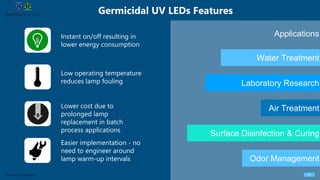
Germicidal UV LEDs Features
23Sources: Aquisense
Instant on/off resulting in
lower energy consumption
Easier implementation - no
need to engineer around
lamp warm-up intervals
Water Treatment
Laboratory Research
Air Treatment
Surface Disinfection & Curing
Odor Management
Applications
Low operating temperature
reduces lamp fouling
Lower cost due to
prolonged lamp
replacement in batch
process applications
ADVANTAGES
User Friendly
The process is considered to be user-
friendly for operators, particularly due
to elimination of hazardous chemicals
Advantages of Using UV Systems
25Sources: EPA
Effective
UV Disinfection is effective at
inactivating most viruses, spores and
cysts
Physical Process
Eradicates the need to generate,
handle, transport or store hazardous or
corrosive chemicals
No Residual Effect
The process has no residual effect
which can be harmful to human or
aquatic life
Shorter Contact Time
UV has a shorter contact time of
approximately 20-30 seconds with low-
pressure lamps
Low Footprint
Equipment for UV Disinfection
requires lesser space than other
methods
DRAWBACKS
A preventive maintenance program is required to ensure
fouling of tubes is controlled
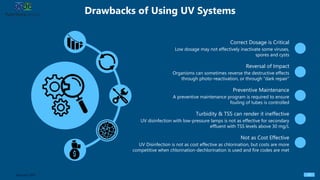
Drawbacks of Using UV Systems
27Sources: EPA
Correct Dosage is Critical
Low dosage may not effectively inactivate some viruses,
spores and cysts
Reversal of Impact
Organisms can sometimes reverse the destructive effects
through photo-reactivation, or through “dark repair”
Preventive Maintenance
Turbidity & TSS can render it ineffective
UV disinfection with low-pressure lamps is not as effective for secondary
effluent with TSS levels above 30 mg/L
Not as Cost Effective
UV Disinfection is not as cost effective as chlorination, but costs are more
competitive when chlorination-dechlorination is used and fire codes are met
REGULATIONS
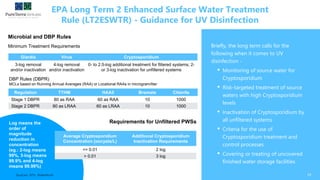
EPA Long Term 2 Enhanced Surface Water Treatment
Rule (LT2ESWTR) - Guidance for UV Disinfection
29Sources: EPA, WaterWorld
Briefly, the long term calls for the
following when it comes to UV
disinfection -
• Monitoring of source water for
Cryptosporidium
• Risk-targeted treatment of source
waters with high Cryptosporidium
levels
• Inactivation of Cryptosporidium by
all unfiltered systems
• Criteria for the use of
Cryptosporidium treatment and
control processes
• Covering or treating of uncovered
finished water storage facilities
Microbial and DBP Rules
Giardia Virus Cryptosporidium
3-log removal
and/or inactivation
4-log removal
and/or inactivation
0- to 2.5-log additional treatment for filtered systems; 2-
or 3-log inactivation for unfiltered systems
Minimum Treatment Requirements
Log means the
order of
magnitude
reduction in
concentration
(eg.: 2-log means
99%, 3-log means
99.9% and 4-log
means 99.99%)
DBP Rules (DBPR)
MCLs based on Running Annual Averages (RAA) or Locational RAAs in microgram/liter
Regulation TTHM HAA5 Bromate Chlorite
Stage 1 DBPR 80 as RAA 60 as RAA 10 1000
Stage 2 DBPR 80 as LRAA 60 as LRAA 10 1000
Requirements for Unfiltered PWSs
Average Cryptosporidium
Concentration (oocysts/L)
Additional Cryptosporidium
Inactivation Requirements
<= 0.01 2 log
> 0.01 3 log
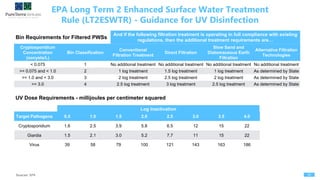
EPA Long Term 2 Enhanced Surface Water Treatment
Rule (LT2ESWTR) - Guidance for UV Disinfection
30Sources: EPA
Bin Requirements for Filtered PWSs
Cryptosporidium
Concentration
(oocysts/L)
Bin Classification
Conventional
Filtration Treatment
Direct Filtration
Slow Sand and
Diatomaceous Earth
Filtration
Alternative Filtration
Technologies
< 0.075 1 No additional treatment No additional treatment No additional treatment No additional treatment
>= 0.075 and < 1.0 2 1 log treatment 1.5 log treatment 1 log treatment As determined by State
>= 1.0 and < 3.0 3 2 log treatment 2.5 log treatment 2 log treatment As determined by State
>= 3.0 4 2.5 log treatment 3 log treatment 2.5 log treatment As determined by State
And if the following filtration treatment is operating in full compliance with existing
regulations, then the additional treatment requirements are…
UV Dose Requirements - millijoules per centimeter squared
Target Pathogens 0.5 1.0 1.5 2.0 2.5 3.0 3.5 4.0
Cryptosporidium 1.6 2.5 3.9 5.8 6.5 12 15 22
Giardia 1.5 2.1 3.0 5.2 7.7 11 15 22
Virus 39 58 79 100 121 143 163 186
Log Inactivation
APPLICATIONS
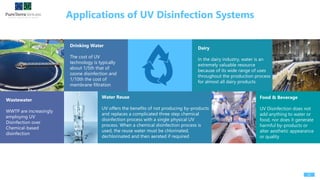
Applications of UV Disinfection Systems
32
Wastewater
WWTP are increasingly
employing UV
Disinfection over
Chemical-based
disinfection
Drinking Water
The cost of UV
technology is typically
about 1/5th that of
ozone disinfection and
1/10th the cost of
membrane filtration
Water Reuse
UV offers the benefits of not producing by-products
and replaces a complicated three step chemical
disinfection process with a single physical UV
process. When a chemical disinfection process is
used, the reuse water must be chlorinated,
dechlorinated and then aerated if required
Dairy
In the dairy industry, water is an
extremely valuable resource
because of its wide range of uses
throughout the production process
for almost all dairy products
Food & Beverage
UV Disinfection does not
add anything to water or
food, nor does it generate
harmful by-products or
alter aesthetic appearance
or quality
MARKET
Market Overview
34Sources: Markets & Markets, Transparency Market Research
$1.72
bn
$4.27
bn
0
1.25
2.5
3.75
5
2016 2023
Global UV Disinfection Market
1. The growth in the global UV disinfection market is anticipated to be
driven by:
Growing need for safe drinking water in developing countries
Increasing favorable government initiatives
Rising awareness among users
Need for eco-friendly disinfection systems
2. The UV disinfection equipment market is characterized by a high level
of consolidation
Strong foothold of the larger players acts as a barrier to enter for
smaller players who find themselves restricted to local territory
Eventually, the mature, bigger players acquire the smaller, local
players in order to expand geographical reach and gain intact
customer bases in regional markets
Dominated by private-sector players
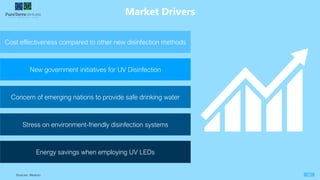
Market Drivers
35Sources: Medium
Cost effectiveness compared to other new disinfection methods
New government initiatives for UV Disinfection
Concern of emerging nations to provide safe drinking water
Stress on environment-friendly disinfection systems
Energy savings when employing UV LEDs
Market Restraints
36Sources: Medium
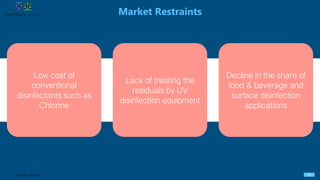
Low cost of
conventional
disinfectants such as
Chlorine
Lack of treating the
residuals by UV
disinfection equipment
Decline in the share of
food & beverage and
surface disinfection
applications
North America is the hub for UV Disinfection
Equipment Market…
37Sources: Medium
…driven by the stress on hygiene and safety concerns, especially in food and
healthcare industries
KEY PLAYERS
Major Players
39Sources: Markets & Markets, Transparency Market Research, Medium
Collectively held 55% of the Global UV Disinfection
Equipment market share in 2016
Major Players in the UV Disinfection Ecosystem
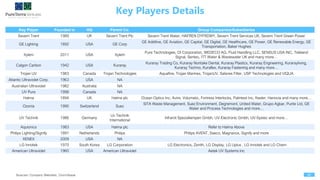
Key Players Details
40Sources: Company Websites, Crunchbase
Key Player Founded in HQ Parent Co. Group Companies/Subsidiaries
Severn Trent 1989 UK Severn Trent Plc Severn Trent Water, HAFREN DYFRDWY, Severn Trent Services UK, Severn Trent Green Power
GE Lighting 1892 USA GE Corp
GE Additive, GE Aviation, GE Capital, GE Digital, GE Healthcare, GE Power, GE Renewable Energy, GE
Transportation, Baker Hughes
Xylem 2011 USA Xylem
Pure Technologies, OI Corporation, WEDECO AG, Fluid Handling LLC, SENSUS USA INC, Tideland
Signal, Sentec, ITT Water & Wastewater UK and many more…
Calgon Carbon 1942 USA Kuraray
Kuraray Trading Co, Kuraray Noritake Dental, Kuraray Plastics, Kuraray Engineering, Kurarayliving,
Kuraray Techno, Kuraflex, Kuraray Fastening and many more…
Trojan UV 1983 Canada Trojan Technologies Aquafine, Trojan Marinex, TrojanUV, Salsnes Filter, USP Technologies and VIQUA
Atlantic Ultraviolet Corp. 1963 USA NA
Australian Ultraviolet 1982 Australia NA
UV Pure 1998 Canada NA
Halma 1894 UK Halma plc Ocean Optics Inc, Avire, Volumatic, Fortress Interlocks, Palintest Inc, Keeler, Hanovia and many more…
Ozonia 1990 Switzerland Suez
SITA Waste Management, Suez Environment, Degremont, United Water, Grupo Agbar, Purite Ltd, GE
Water and Process Technologies and more…
UV Technik 1986 Germany
Uv Technik
International
Infrarot Speziallampen Gmbh, UV-Electronic Gmbh, UV-Systec and more…
Aquionics 1983 USA Halma plc Refer to Halma Above
Philips Lighting/Signify 1891 Netherlands Philips Philips AVENT, Saeco, Magnavox, Signify and more
XENEX 2009 USA NA
LG Innotek 1970 South Korea LG Corporation LG Electronics, Zenith, LG Display, LG Uplus , LG Innotek and LG Chem
American Ultraviolet 1960 USA American Ultraviolet Aetek UV Systems Inc
DEALS
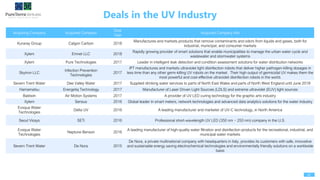
Deals in the UV Industry
42
Acquiring Company Acquired Company
Deal
Year
Acquired Company Info
Kuraray Group Calgon Carbon 2018
Manufactures and markets products that remove contaminants and odors from liquids and gases, both for
industrial, municipal, and consumer markets
Xylem Emnet LLC 2018
Rapidly growing provider of smart solutions that enable municipalities to manage the urban water cycle and
wastewater and stormwater systems
Xylem Pure Technologies 2017 Leader in intelligent leak detection and condition assessment solutions for water distribution networks
Skytron LLC
Infection Prevention
Technologies
2017
IPT manufactures and markets ultraviolet light disinfection robots that deliver higher pathogen-killing dosages in
less time than any other germ-killing UV robots on the market. Their high output of germicidal UV makes them the
most powerful and cost-effective ultraviolet disinfection robots in the world.
Severn Trent Water Dee Valley Water 2017 Supplied drinking water services to parts of North East Wales and parts of North West England until June 2018
Hamamatsu Energetiq Technology 2017 Manufacturer of Laser Driven Light Sources (LDLS) and extreme ultraviolet (EUV) light sources
Baldwin Air Motion Systems 2017 A provider of UV LED curing technology for the graphic arts industry
Xylem Sensus 2016 Global leader in smart meters, network technologies and advanced data analytics solutions for the water industry
Evoqua Water
Technologies
Delta UV 2016 A leading manufacturer and marketer of UV-C technology, in North America
Seoul Viosys SETi 2016 Professional short-wavelength UV LED (350 nm ~ 250 nm) company in the U.S.
Evoqua Water
Technologies
Neptune Benson 2016
A leading manufacturer of high-quality water filtration and disinfection products for the recreational, industrial, and
municipal water markets
Severn Trent Water De Nora 2015
De Nora, a private multinational company with headquarters in Italy, provides its customers with safe, innovative
and sustainable energy saving electrochemical technologies and environmentally friendly solutions on a worldwide
basis
Deals in the UV Industry
43
Acquiring Company Acquired Company
Deal
Year
Acquired Company Info
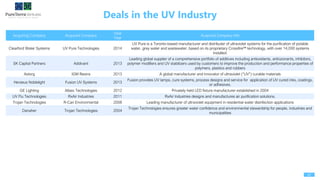
Clearford Water Systems UV Pure Technologies 2014
UV Pure is a Toronto-based manufacturer and distributer of ultraviolet systems for the purification of potable
water, grey water and wastewater, based on its proprietary Crossfire™ technology, with over 14,000 systems
installed.
SK Capital Partners Addivant 2013
Leading global supplier of a comprehensive portfolio of additives including antioxidants, antiozonants, inhibitors,
polymer modifiers and UV stabilizers used by customers to improve the production and performance properties of
polymers, plastics and rubbers
Astorg IGM Resins 2013 A global manufacturer and innovator of ultraviolet (“UV”) curable materials
Heraeus Noblelight Fusion UV Systems 2013
Fusion provides UV lamps, cure systems, process designs and service for application of UV cured inks, coatings,
or adhesives.
GE Lighting Albeo Technologies 2012 Privately held LED fixture manufacturer established in 2004
UV Flu Technologies RxAir Industries 2011 RxAir Industries designs and manufactures air purification solutions.
Trojan Technologies R-Can Environmental 2008 Leading manufacturer of ultraviolet equipment in residential water disinfection applications
Danaher Trojan Technologies 2004
Trojan Technologies ensures greater water confidence and environmental stewardship for people, industries and
municipalities
Get in Touch
Meet with us in China, the Netherlands or in your office
China
HQ525 Creative Garden, Office A401
,55 Jinyu Road,
Minhang District, Shanghai 201103,
China
The Netherlands
Tappersweg 35
Haarlem
2031ET
The Netherlands
Our Phone
(+86) 21 6402 7352
Email / Website
info@pureterra.com
www.pureterra.com

UV for water treatment

  • 1.
    UV for WaterTreatment Presented by PureTerra Ventures
  • 2.
  • 3.
    How UV Works 3 100 280 315 400 700 UltravioletVisibleInfrared Wavelength(nm) • UV Energy which is an invisible radiation is the part of the electromagnetic spectrum between visible light and x-rays • UV treatment is typically carried out by the use of a UV Lamp, a reactor and ballasts • Typically, UV Lamps contain a small amount of mercury which when exposed to electricity emits UV rays • UV rays kill microorganisms by penetrating their outer cell membrane thereby passing through the cell body and disrupting the DNA - preventing reproduction. These sterilized microorganisms are not removed from the water. • Degree of inactivation of microorganisms is dependent on dose of UV applied, which is measured as microwatt-seconds per square centimeter, along with raw water quality and proper maintenance of the UV equipment used • UV treatment process is an extremely quick physical process • UV does not alter water chemically and has no residual disinfection • It does not remove dissolved organics, inorganic or particles in the water Sources: Water Research, EPA, Viqua, Fluidquip, HASADF
  • 4.
  • 5.
    History of UV 5Source:Spectral Innovations Johann Wilhelm Ritter, a Polish physicist, discovers UV coining the term “Chemical Rays” for it UV is Discovered English scientists Downes and Blunt discover sunlight kills bacteria Bactericidal Action Marshall Ward demonstrates that UV portion of sunlight causes bactericidal action UV Bactericidal Action S. Kuch and T. Retschinsky make the first PETica quartz arc tube UV Lamp Development 1801 1877 1892 1906
  • 6.
    6Source: RES’EAU-WaterNet StrategicNetwork First full-scale application of UV in the US carried out in Henderson, Kentucky First US Application With the invention of neon tubes, low pressure Hg lamps become available for UV disinfection Low Pressure Hg Lamps Discovery of DBPs from Chemical Disinfection leads to support and promotion of UV disinfection Discovery of DBPs Low UV dose found effective for inactivation of Crypto and Giardia Further Inactivation First full scale UV disinfection system for pre-filtered water from the river Durance in Marseille, France UV Disinfection System1910 1916 1940 s 1960 s 1998
  • 7.
  • 8.
    Pretreatment of Wastewaterbefore UV Disinfection 8Sources: Texas A&M • Wastewater must pass through advanced pretreatment to remove most of the organic matter and suspended solids before it passes through the UV disinfection unit • This is critical because UV radiation needs to come in direct contact with the microorganisms in wastewater, which may be prohibited if there are constituents present that shield the pathogenic microorganisms • Advanced pretreatment components deployed will vary from plant to plant. In general, advanced pretreatment components include: • Aerobic Treatment Units (ATU) - ATUs use biological processes to transform both dissolved and solid constituents into gases, cell mass, and non-degradable material • Constructed Wetlands - The constructed wetland is a basin or cell containing microorganisms, media, and plants that provide treatment of incoming effluent • Lagoons - A lagoon is a large basin of wastewater that is undergoing a combination of chemical, physical, and biological treatment processes. It may be aerobic, facultative, partial-mixed aerated or anaerobic. • Media Filters - Trickling filter, sand/gravel filter, foam filter, peat filter, textile filter, up-flow filter
  • 9.
    UV Disinfection ProcessOverview 9Sources: EPA Pretreated wastewater is introduced to the UV system. High turbidity or TSS may render the process ineffective STEP ONE Wastewater flows either perpendicular or parallel to the UV Lamps STEP TWO Ballast or control box provides a starting voltage for the lamps and maintains a continuous current STEP THREE UV lamps emit UV in germicidal wavelength. UV is generated by applying a voltage across a gas mixture containing Hg Vapor STEP FOUR UV radiation penetrates the cell wall of an organism, destroying the cell’s ability to reproduce STEP FIVE UV disinfected water exits the system and onward to the next step in the WWTP STEP SIX
  • 10.
    Organisms Destructed andDosage Required for 99.9% Destruction Sources: Water Research 10
  • 11.
  • 12.
    Key Components ofa UV System 12 Simplified Illustration of a UV Disinfection System Water in Water out Reactor Chamber Quartz SleeveUV Lamp Ballast Controls Reactor Chamber UV Lamp Quartz Sleeve Ballast (Controller Unit) 1 2 3 4
  • 13.
    The UV Lamp 13Sources:Viqua, Water Online/Aquionics, American Air and Water Types of UV Lamps Cold Cathode Germicidal UV Lamps Hot Cathode Germicidal UV Lamps Slimline Germicidal UV Lamps High Output Germicidal UV Lamps Ultraviolet Light Emitting Diodes • Produces UV-C, the wavelength of UV light which is considered to be germicidal • Traditionally contain mercury, to which electricity is applied for generating UV light • Filaments produce electrical current that heats up the mercury and evaporates it into the air inside the lamp which helps create electrical arcs that produce UV-C at varying intensities for disinfection • Lamp structure may be made of soft glass or quartz glass • Soft glass is cheaper but more likely to break and can also cloud with time impeding the transmission UV-C and making it less effective over time • Quartz glass is harder, less likely to cloud and thereby more effective • Both glass types are often coated to increase transmission efficiency
  • 14.
    Other Key Componentsof UV System 14Sources: Viqua Reactor Chamber Quartz Sleeve Ballast (Controller Unit) • Part of the system that houses the UV Lamp and Quartz Sleeve, while controlling the flow of water through the system • Usually constructed out of stainless steel • Different shapes - axial or boot shaped with ports depending on flow of water • Long, cylindrical tube of quartz glass • Protects the UV Lamp which is inserted inside the quartz sleeve • Can foul with minerals and other contaminants overtime • Simple but critical component for efficient operations of the system • Brains of the UV System • Controls electrical output of the lamp and powers it to produce UV light • Basic Controller Unit can be a simple cap that fits over the end of the lamp and a plug • More sophisticated systems have lamp-change timers, low-UV alarms, etc.
  • 15.
    Effectiveness of aUV disinfection system depends on three critical factors 15Sources: EPA Hydraulic Properties of the Reactor System should have uniform flow with enough axial motion to maximize exposure to UV Radiation. The path that an organism takes in the reactor determines the amount of UV radiation it will be exposed to Intensity of UV Radiation Age of the lamps, lamp fouling and the configuration and placement of lamps in the reactor impact the intensity of UV radiation Characteristics of Water Flow rate, suspended and colloidal solids, initial bacterial density and other physical and chemical parameters can impact the amount of UV radiation reaching the target organism
  • 16.
    Operations & maintenanceto ensure that sufficient UV radiation is transmitted 16Sources: EPA SURFACE CLEANING All surfaces between the UV radiation and the target organisms must be clean QUARTZ SLEEVE CLEANING Mechanical wipers, ultrasonics or chemicals can be used for cleaning the quartz sleeve PILOT TESTING System should be pilot-tested before full- scale deployment to ensure discharge permits are met LAMP USE Operating procedures implemented to reduce on/off cycles since efficacy reduces with repeated cycles LAMP REPLACEMENT Average life lamp ranges from 8,760 to 14,000 working hours and usually replaced after 12,000 hours of use BALLAST Must be compatible with the lamps and should be ventilated to protect excessive heating which may shorten its life 1 2 3 4 5 6 Inadequate cleaning is one of the most common causes of a UV system’s ineffectiveness
  • 17.
  • 18.
    Types of UVLamps 18Sources: American Air and Water, MDT Mag, Atlantic Ultraviolet Corp Cold Cathode Germicidal UV Lamps UV Light Emitting Diodes (LEDs) Hot Cathode Germicidal UV Lamps Slimline Germicidal UV Lamps High Output Germicidal UV Lamps
  • 19.
    Cold Cathode GermicidalUV Lamps Features 19Sources: UltraViolet.com, WQPMag, American Air and Water, Rexim Instant start Long-life and less affected by frequent starts Good UV output maintained at low temperatures Sturdy electrodes Air Disinfection Air Ozonation Water Disinfection Chlorine Removal Carbon Reduction Applications
  • 20.
    Hot Cathode GermicidalUV Lamps Features 20Sources: American Air and Water, Texas State, UV Sterilizer Review Ballast required for pre- heating to start lamp Impacted by frequent starts; shorter life than cold cathode UV lamps May require special equipment at low temperatures Higher power density - more energy per given watt Municipal Water Treatment Swimming Pools Residential Drinking Water Systems Air Treatment Units Air Purifiers Applications
  • 21.
    Slimline Cathode GermicidalUV Lamps Features 21Sources: American Air and Water Instant start Low maintenance and low cost of maintenance Indirect Air Irradiation Conveyor Lines Surface Sterilization Air Cooling & Heating Systems Water Sterilization Applications Suitable for high-intensity UV applications Long-life governed by the lasting of the filaments
  • 22.
    High Output GermicidalUV Lamps Features 22Sources: American Air and Water, Light Sources Up to 66% higher output than same size standard lamps Consisted UV emission and high stability Forced Air Duct Systems Water Disinfection Odor Control Photochemical Applications Applications Increased efficiency translates to lower footprint Operates at wide temperature range
  • 23.
    Germicidal UV LEDsFeatures 23Sources: Aquisense Instant on/off resulting in lower energy consumption Easier implementation - no need to engineer around lamp warm-up intervals Water Treatment Laboratory Research Air Treatment Surface Disinfection & Curing Odor Management Applications Low operating temperature reduces lamp fouling Lower cost due to prolonged lamp replacement in batch process applications
  • 24.
  • 25.
    User Friendly The processis considered to be user- friendly for operators, particularly due to elimination of hazardous chemicals Advantages of Using UV Systems 25Sources: EPA Effective UV Disinfection is effective at inactivating most viruses, spores and cysts Physical Process Eradicates the need to generate, handle, transport or store hazardous or corrosive chemicals No Residual Effect The process has no residual effect which can be harmful to human or aquatic life Shorter Contact Time UV has a shorter contact time of approximately 20-30 seconds with low- pressure lamps Low Footprint Equipment for UV Disinfection requires lesser space than other methods
  • 26.
  • 27.
    A preventive maintenanceprogram is required to ensure fouling of tubes is controlled Drawbacks of Using UV Systems 27Sources: EPA Correct Dosage is Critical Low dosage may not effectively inactivate some viruses, spores and cysts Reversal of Impact Organisms can sometimes reverse the destructive effects through photo-reactivation, or through “dark repair” Preventive Maintenance Turbidity & TSS can render it ineffective UV disinfection with low-pressure lamps is not as effective for secondary effluent with TSS levels above 30 mg/L Not as Cost Effective UV Disinfection is not as cost effective as chlorination, but costs are more competitive when chlorination-dechlorination is used and fire codes are met
  • 28.
  • 29.
    EPA Long Term2 Enhanced Surface Water Treatment Rule (LT2ESWTR) - Guidance for UV Disinfection 29Sources: EPA, WaterWorld Briefly, the long term calls for the following when it comes to UV disinfection - • Monitoring of source water for Cryptosporidium • Risk-targeted treatment of source waters with high Cryptosporidium levels • Inactivation of Cryptosporidium by all unfiltered systems • Criteria for the use of Cryptosporidium treatment and control processes • Covering or treating of uncovered finished water storage facilities Microbial and DBP Rules Giardia Virus Cryptosporidium 3-log removal and/or inactivation 4-log removal and/or inactivation 0- to 2.5-log additional treatment for filtered systems; 2- or 3-log inactivation for unfiltered systems Minimum Treatment Requirements Log means the order of magnitude reduction in concentration (eg.: 2-log means 99%, 3-log means 99.9% and 4-log means 99.99%) DBP Rules (DBPR) MCLs based on Running Annual Averages (RAA) or Locational RAAs in microgram/liter Regulation TTHM HAA5 Bromate Chlorite Stage 1 DBPR 80 as RAA 60 as RAA 10 1000 Stage 2 DBPR 80 as LRAA 60 as LRAA 10 1000 Requirements for Unfiltered PWSs Average Cryptosporidium Concentration (oocysts/L) Additional Cryptosporidium Inactivation Requirements <= 0.01 2 log > 0.01 3 log
  • 30.
    EPA Long Term2 Enhanced Surface Water Treatment Rule (LT2ESWTR) - Guidance for UV Disinfection 30Sources: EPA Bin Requirements for Filtered PWSs Cryptosporidium Concentration (oocysts/L) Bin Classification Conventional Filtration Treatment Direct Filtration Slow Sand and Diatomaceous Earth Filtration Alternative Filtration Technologies < 0.075 1 No additional treatment No additional treatment No additional treatment No additional treatment >= 0.075 and < 1.0 2 1 log treatment 1.5 log treatment 1 log treatment As determined by State >= 1.0 and < 3.0 3 2 log treatment 2.5 log treatment 2 log treatment As determined by State >= 3.0 4 2.5 log treatment 3 log treatment 2.5 log treatment As determined by State And if the following filtration treatment is operating in full compliance with existing regulations, then the additional treatment requirements are… UV Dose Requirements - millijoules per centimeter squared Target Pathogens 0.5 1.0 1.5 2.0 2.5 3.0 3.5 4.0 Cryptosporidium 1.6 2.5 3.9 5.8 6.5 12 15 22 Giardia 1.5 2.1 3.0 5.2 7.7 11 15 22 Virus 39 58 79 100 121 143 163 186 Log Inactivation
  • 31.
  • 32.
    Applications of UVDisinfection Systems 32 Wastewater WWTP are increasingly employing UV Disinfection over Chemical-based disinfection Drinking Water The cost of UV technology is typically about 1/5th that of ozone disinfection and 1/10th the cost of membrane filtration Water Reuse UV offers the benefits of not producing by-products and replaces a complicated three step chemical disinfection process with a single physical UV process. When a chemical disinfection process is used, the reuse water must be chlorinated, dechlorinated and then aerated if required Dairy In the dairy industry, water is an extremely valuable resource because of its wide range of uses throughout the production process for almost all dairy products Food & Beverage UV Disinfection does not add anything to water or food, nor does it generate harmful by-products or alter aesthetic appearance or quality
  • 33.
  • 34.
    Market Overview 34Sources: Markets& Markets, Transparency Market Research $1.72 bn $4.27 bn 0 1.25 2.5 3.75 5 2016 2023 Global UV Disinfection Market 1. The growth in the global UV disinfection market is anticipated to be driven by: Growing need for safe drinking water in developing countries Increasing favorable government initiatives Rising awareness among users Need for eco-friendly disinfection systems 2. The UV disinfection equipment market is characterized by a high level of consolidation Strong foothold of the larger players acts as a barrier to enter for smaller players who find themselves restricted to local territory Eventually, the mature, bigger players acquire the smaller, local players in order to expand geographical reach and gain intact customer bases in regional markets Dominated by private-sector players
  • 35.
    Market Drivers 35Sources: Medium Costeffectiveness compared to other new disinfection methods New government initiatives for UV Disinfection Concern of emerging nations to provide safe drinking water Stress on environment-friendly disinfection systems Energy savings when employing UV LEDs
  • 36.
    Market Restraints 36Sources: Medium Lowcost of conventional disinfectants such as Chlorine Lack of treating the residuals by UV disinfection equipment Decline in the share of food & beverage and surface disinfection applications
  • 37.
    North America isthe hub for UV Disinfection Equipment Market… 37Sources: Medium …driven by the stress on hygiene and safety concerns, especially in food and healthcare industries
  • 38.
  • 39.
    Major Players 39Sources: Markets& Markets, Transparency Market Research, Medium Collectively held 55% of the Global UV Disinfection Equipment market share in 2016 Major Players in the UV Disinfection Ecosystem
  • 40.
    Key Players Details 40Sources:Company Websites, Crunchbase Key Player Founded in HQ Parent Co. Group Companies/Subsidiaries Severn Trent 1989 UK Severn Trent Plc Severn Trent Water, HAFREN DYFRDWY, Severn Trent Services UK, Severn Trent Green Power GE Lighting 1892 USA GE Corp GE Additive, GE Aviation, GE Capital, GE Digital, GE Healthcare, GE Power, GE Renewable Energy, GE Transportation, Baker Hughes Xylem 2011 USA Xylem Pure Technologies, OI Corporation, WEDECO AG, Fluid Handling LLC, SENSUS USA INC, Tideland Signal, Sentec, ITT Water & Wastewater UK and many more… Calgon Carbon 1942 USA Kuraray Kuraray Trading Co, Kuraray Noritake Dental, Kuraray Plastics, Kuraray Engineering, Kurarayliving, Kuraray Techno, Kuraflex, Kuraray Fastening and many more… Trojan UV 1983 Canada Trojan Technologies Aquafine, Trojan Marinex, TrojanUV, Salsnes Filter, USP Technologies and VIQUA Atlantic Ultraviolet Corp. 1963 USA NA Australian Ultraviolet 1982 Australia NA UV Pure 1998 Canada NA Halma 1894 UK Halma plc Ocean Optics Inc, Avire, Volumatic, Fortress Interlocks, Palintest Inc, Keeler, Hanovia and many more… Ozonia 1990 Switzerland Suez SITA Waste Management, Suez Environment, Degremont, United Water, Grupo Agbar, Purite Ltd, GE Water and Process Technologies and more… UV Technik 1986 Germany Uv Technik International Infrarot Speziallampen Gmbh, UV-Electronic Gmbh, UV-Systec and more… Aquionics 1983 USA Halma plc Refer to Halma Above Philips Lighting/Signify 1891 Netherlands Philips Philips AVENT, Saeco, Magnavox, Signify and more XENEX 2009 USA NA LG Innotek 1970 South Korea LG Corporation LG Electronics, Zenith, LG Display, LG Uplus , LG Innotek and LG Chem American Ultraviolet 1960 USA American Ultraviolet Aetek UV Systems Inc
  • 41.
  • 42.
    Deals in theUV Industry 42 Acquiring Company Acquired Company Deal Year Acquired Company Info Kuraray Group Calgon Carbon 2018 Manufactures and markets products that remove contaminants and odors from liquids and gases, both for industrial, municipal, and consumer markets Xylem Emnet LLC 2018 Rapidly growing provider of smart solutions that enable municipalities to manage the urban water cycle and wastewater and stormwater systems Xylem Pure Technologies 2017 Leader in intelligent leak detection and condition assessment solutions for water distribution networks Skytron LLC Infection Prevention Technologies 2017 IPT manufactures and markets ultraviolet light disinfection robots that deliver higher pathogen-killing dosages in less time than any other germ-killing UV robots on the market. Their high output of germicidal UV makes them the most powerful and cost-effective ultraviolet disinfection robots in the world. Severn Trent Water Dee Valley Water 2017 Supplied drinking water services to parts of North East Wales and parts of North West England until June 2018 Hamamatsu Energetiq Technology 2017 Manufacturer of Laser Driven Light Sources (LDLS) and extreme ultraviolet (EUV) light sources Baldwin Air Motion Systems 2017 A provider of UV LED curing technology for the graphic arts industry Xylem Sensus 2016 Global leader in smart meters, network technologies and advanced data analytics solutions for the water industry Evoqua Water Technologies Delta UV 2016 A leading manufacturer and marketer of UV-C technology, in North America Seoul Viosys SETi 2016 Professional short-wavelength UV LED (350 nm ~ 250 nm) company in the U.S. Evoqua Water Technologies Neptune Benson 2016 A leading manufacturer of high-quality water filtration and disinfection products for the recreational, industrial, and municipal water markets Severn Trent Water De Nora 2015 De Nora, a private multinational company with headquarters in Italy, provides its customers with safe, innovative and sustainable energy saving electrochemical technologies and environmentally friendly solutions on a worldwide basis
  • 43.
    Deals in theUV Industry 43 Acquiring Company Acquired Company Deal Year Acquired Company Info Clearford Water Systems UV Pure Technologies 2014 UV Pure is a Toronto-based manufacturer and distributer of ultraviolet systems for the purification of potable water, grey water and wastewater, based on its proprietary Crossfire™ technology, with over 14,000 systems installed. SK Capital Partners Addivant 2013 Leading global supplier of a comprehensive portfolio of additives including antioxidants, antiozonants, inhibitors, polymer modifiers and UV stabilizers used by customers to improve the production and performance properties of polymers, plastics and rubbers Astorg IGM Resins 2013 A global manufacturer and innovator of ultraviolet (“UV”) curable materials Heraeus Noblelight Fusion UV Systems 2013 Fusion provides UV lamps, cure systems, process designs and service for application of UV cured inks, coatings, or adhesives. GE Lighting Albeo Technologies 2012 Privately held LED fixture manufacturer established in 2004 UV Flu Technologies RxAir Industries 2011 RxAir Industries designs and manufactures air purification solutions. Trojan Technologies R-Can Environmental 2008 Leading manufacturer of ultraviolet equipment in residential water disinfection applications Danaher Trojan Technologies 2004 Trojan Technologies ensures greater water confidence and environmental stewardship for people, industries and municipalities
  • 44.
    Get in Touch Meetwith us in China, the Netherlands or in your office China HQ525 Creative Garden, Office A401 ,55 Jinyu Road, Minhang District, Shanghai 201103, China The Netherlands Tappersweg 35 Haarlem 2031ET The Netherlands Our Phone (+86) 21 6402 7352 Email / Website info@pureterra.com www.pureterra.com