UTILIZING OPEN
ARCHITECTURE TO DESIGN A
TRANSFORMATIVE LEARNING
EXPERIENCE
DR. AL MOUMIN, MISHKAT
THE OBJECTIVES OF SHIFTING TO THE OPEN
ARCHITECTURE
Support the academic
progress of adult learners
in language acquisition.
Provide opportunities for
the adult learners to
reach a higher level in
their second language.
THE CONNECTIONS BETWEEN OPEN
ARCHITECTURE AND TRANSFORMATIVE LEARNING
• Open architecture creates a valuable opportunity
to incorporate a transformative learning
experience.
• Transformative learning empowers both the
teacher and the student.
H/M
DEFINITION: WHAT IS TRANSFORMATIVE
LEARNING?
The process of making a new or revised
interpretation of the meaning of an experience,
which guides subsequent understanding,
appreciation and action. (Mezirow 1990)
WHAT IS THE ROLE OF THE TEACHER?
The teacher is neither a director, nor a facilitator.
The teacher is a mediator who helps the learner
explore the community—there is no destination,
only stations in this journey called learning.
TRIGGER SELF-REFLECTION
• It is not about, “Here is how we order food, book a room in a hotel, or talk
about politics. I will model, and then you do it.”
• It is more about, “What does it mean when people don’t offer you food or
insist on you having more?”
• What does it mean when you turn them down or accept their offer?
• What does it mean when the host doesn’t offer enough or doesn’t offer meat
or declines to eat with you?
• What does it mean when the host offers you coffee and you put it on the
table and don’t drink it?
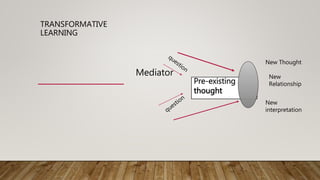
TRANSFORMATIVE
LEARNING
Mediator
New Thought
New
Relationship
New
interpretation
ENGAGE THE
LEARNER IN
CRITICAL
SELF-REFLECTION
• Provoke ideas, generate discussion, and
promote the comprehensive exploration
of subject matter.
• Promote critical thinking skills because
these types of questions expect students
to apply, analyze, synthesize, and evaluate
information instead of simply recalling
facts.
• Equip the students with the needs skills
and strategies to perform under pressure
and tackle demanding situations such as
tests and exams (Bastos & Ramos, 2017).
FRAME OF REFERENCE
• Questioning claims with a direct impact
on a frame of reference; a structure the
learner uses to understand a life
experience.
• Objectives (not destinations) changing
the frame of reference, but without
dictating or guiding the learner as to
what the new frame will be. The learner
arrives the final conclusion on his or her
own.
learning
will
transpire
ENGAGING CRITICAL THINKING SKILLS VS RECITING
INFORMATION
“The Language Defense Institute consists of several schools where
students learn different languages. The institute has three Arabic
language schools, where teachers from different Arab countries teach.
American military instructors participate in teaching too. These
teachers are serving in the US Army, Navy, Air Force, or Marine Corps.
The commander of the Institute is usually an army officer at the rank
of lieutenant colonel or a colonel. The students are housed in
barracks inside the Institute and each barrack belongs to the military
branch in which the students serve.”
QUESTIONS THAT PROVOKE CRITICAL THINKING
SKILLS
Critical Thinking Questions
• What conclusions can you draw regarding the
size of the Institute and why?
• What can you conclude based on examining the
number of the Arabic schools within the
Institute?
• What is the purpose of having American Military
Instructors at the Institute?
• Why is the leader of the Institute from the
Army?
• Why do students live inside the Institute?
Traditional Questions
• What was said about the
Arabic schools? Mention two
details.
• What was said about the
American instructors?
Mention two details
• Who leads the Institute?
Mention two details.
ELEMENTS OF A TRANSFORMATIVE LEARNING
EXPERIENCE
Questioning a thesis, a claim, an argument or a position that the learner previously
experienced.
• Social Injustice
• Human Rights
• Criminal Injustice
• Ecological Issues
• Ecological Injustice
CLASSROOM IMPLICATION
INFORMATIVE
The learner’s role is to understand the
information obtained in conversation
with someone, or engaging in reading a
book , watching a TV show, or listening
to a song,
TRANSFORMATIVE
The learner’s role is to assess the intent,
qualifications, authenticity, and accuracy
of the information obtained through
conversations, books, media…., etc. and
to take an action based on the
assessment.
The learner becomes an activist, an
advocate for a cause. The learner is
enabled.
WHAT ABOUT THE VOCABULARY?
• The learner is an investigator who explores the teacher’s
inquiry or question.
• Vocabulary emerges from the learner’s findings and the
teacher’s guidance.
• Vocabulary is generated as a natural result of the
interaction with the transformative experience/content.
THE CULTURAL FRAMEWORK
A dense and deep cultural framework:
Explores the
values
underneath
the iceberg.
Examines how
the cultural
framework can
be utilized to
generate critical
self-reflection.
CONNECT TO A
COMMUNITY
Language is the tool to:
• Explore and analyze the dense cultural
framework, not just to communicate.
• Generate a frame of reference, an
understanding of how to interact with the
target community.
• Enable the learner to become an advocate.
PROGRESSIVE CURRICULUM
• A progressive curriculum, known as the open architecture, is more
flexible and receptive to the inclusion of a transformative
experience.
• The concept of open architecture originated from computer
software engineering. The architecture is defined as “the set of
principal design decisions governing a system.” (Medvidovic &
Taylor 2010).
THE ARCHITECTURE
• Engages the full range of designed activities and
includes the participants in the design process.
(Taylor & Hoek, 2007).
• Utilizes higher level concepts such as a
component, but not a procedure.
• A component in computer software engineering
consists of a wide range of functions (Gill & Tomer,
2010)
ELEMENTS OF OPEN ARCHITECTURE COMPONENT
COMPUTER DESIGN
• A component including a full range of
activities to include all participants.
• Utilize higher level concepts
components.
• Step away from the procedure
approach; a series of steps leading a
specific outcome.
LANGUAGE AND DLI CONTEXT
• A teaching hour including different
activities that engages all the students.
• Utilize tasks that engage the higher order
thinking skills of the students.
• Step away from machinal drills; series of
steps, underline, select a word, add a suffix,
leading to specific out such completing a
sentence.
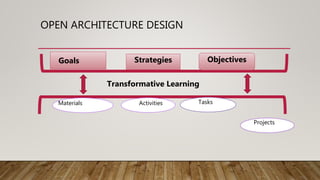
OPEN ARCHITECTURE DESIGN
ObjectivesGoals Strategies
Materials Activities Tasks
Projects
Transformative Learning
WHERE TO ADD THE TRANSFORMATIVE
EXPERIENCE?
• A transformative experience is a component attached to
the traditional curriculum.
• Teachers design a supplemental component alongside
the traditional materials.
Test TE Test
Unit.1 Unit. II Unit. III
TE
Unit. IV Unit.
V
Unit.
VI
Unit.
VII
Unit. VIII Unit. IX Unit. X
TE
M(H)
THE OPEN ARCHITECTURE ENCOMPASSES THE
TRANSFORMATIVE EXPERIENCE
Topic
TE
Transformative Experience = TE
CONCLUSIONS
Creating a transformative learning experience is
essential to reach a higher level in the target
language.
Creating
Adopting an open architecture approach to design
the curriculum, provides more opportunities to
incorporate a transformative learning experience.
Adopting
THANK YOU
Questions?

Utilizing Open Architecture to Design a Transformative Learning Experience

  • 1.
    UTILIZING OPEN ARCHITECTURE TODESIGN A TRANSFORMATIVE LEARNING EXPERIENCE DR. AL MOUMIN, MISHKAT
  • 2.
    THE OBJECTIVES OFSHIFTING TO THE OPEN ARCHITECTURE Support the academic progress of adult learners in language acquisition. Provide opportunities for the adult learners to reach a higher level in their second language.
  • 3.
    THE CONNECTIONS BETWEENOPEN ARCHITECTURE AND TRANSFORMATIVE LEARNING • Open architecture creates a valuable opportunity to incorporate a transformative learning experience. • Transformative learning empowers both the teacher and the student. H/M
  • 4.
    DEFINITION: WHAT ISTRANSFORMATIVE LEARNING? The process of making a new or revised interpretation of the meaning of an experience, which guides subsequent understanding, appreciation and action. (Mezirow 1990)
  • 5.
    WHAT IS THEROLE OF THE TEACHER? The teacher is neither a director, nor a facilitator. The teacher is a mediator who helps the learner explore the community—there is no destination, only stations in this journey called learning.
  • 6.
    TRIGGER SELF-REFLECTION • Itis not about, “Here is how we order food, book a room in a hotel, or talk about politics. I will model, and then you do it.” • It is more about, “What does it mean when people don’t offer you food or insist on you having more?” • What does it mean when you turn them down or accept their offer? • What does it mean when the host doesn’t offer enough or doesn’t offer meat or declines to eat with you? • What does it mean when the host offers you coffee and you put it on the table and don’t drink it?
  • 7.
  • 8.
    ENGAGE THE LEARNER IN CRITICAL SELF-REFLECTION •Provoke ideas, generate discussion, and promote the comprehensive exploration of subject matter. • Promote critical thinking skills because these types of questions expect students to apply, analyze, synthesize, and evaluate information instead of simply recalling facts. • Equip the students with the needs skills and strategies to perform under pressure and tackle demanding situations such as tests and exams (Bastos & Ramos, 2017).
  • 9.
    FRAME OF REFERENCE •Questioning claims with a direct impact on a frame of reference; a structure the learner uses to understand a life experience. • Objectives (not destinations) changing the frame of reference, but without dictating or guiding the learner as to what the new frame will be. The learner arrives the final conclusion on his or her own. learning will transpire
  • 10.
    ENGAGING CRITICAL THINKINGSKILLS VS RECITING INFORMATION “The Language Defense Institute consists of several schools where students learn different languages. The institute has three Arabic language schools, where teachers from different Arab countries teach. American military instructors participate in teaching too. These teachers are serving in the US Army, Navy, Air Force, or Marine Corps. The commander of the Institute is usually an army officer at the rank of lieutenant colonel or a colonel. The students are housed in barracks inside the Institute and each barrack belongs to the military branch in which the students serve.”
  • 11.
    QUESTIONS THAT PROVOKECRITICAL THINKING SKILLS Critical Thinking Questions • What conclusions can you draw regarding the size of the Institute and why? • What can you conclude based on examining the number of the Arabic schools within the Institute? • What is the purpose of having American Military Instructors at the Institute? • Why is the leader of the Institute from the Army? • Why do students live inside the Institute? Traditional Questions • What was said about the Arabic schools? Mention two details. • What was said about the American instructors? Mention two details • Who leads the Institute? Mention two details.
  • 12.
    ELEMENTS OF ATRANSFORMATIVE LEARNING EXPERIENCE Questioning a thesis, a claim, an argument or a position that the learner previously experienced. • Social Injustice • Human Rights • Criminal Injustice • Ecological Issues • Ecological Injustice
  • 13.
    CLASSROOM IMPLICATION INFORMATIVE The learner’srole is to understand the information obtained in conversation with someone, or engaging in reading a book , watching a TV show, or listening to a song, TRANSFORMATIVE The learner’s role is to assess the intent, qualifications, authenticity, and accuracy of the information obtained through conversations, books, media…., etc. and to take an action based on the assessment. The learner becomes an activist, an advocate for a cause. The learner is enabled.
  • 14.
    WHAT ABOUT THEVOCABULARY? • The learner is an investigator who explores the teacher’s inquiry or question. • Vocabulary emerges from the learner’s findings and the teacher’s guidance. • Vocabulary is generated as a natural result of the interaction with the transformative experience/content.
  • 15.
    THE CULTURAL FRAMEWORK Adense and deep cultural framework: Explores the values underneath the iceberg. Examines how the cultural framework can be utilized to generate critical self-reflection.
  • 16.
    CONNECT TO A COMMUNITY Languageis the tool to: • Explore and analyze the dense cultural framework, not just to communicate. • Generate a frame of reference, an understanding of how to interact with the target community. • Enable the learner to become an advocate.
  • 17.
    PROGRESSIVE CURRICULUM • Aprogressive curriculum, known as the open architecture, is more flexible and receptive to the inclusion of a transformative experience. • The concept of open architecture originated from computer software engineering. The architecture is defined as “the set of principal design decisions governing a system.” (Medvidovic & Taylor 2010).
  • 18.
    THE ARCHITECTURE • Engagesthe full range of designed activities and includes the participants in the design process. (Taylor & Hoek, 2007). • Utilizes higher level concepts such as a component, but not a procedure. • A component in computer software engineering consists of a wide range of functions (Gill & Tomer, 2010)
  • 19.
    ELEMENTS OF OPENARCHITECTURE COMPONENT COMPUTER DESIGN • A component including a full range of activities to include all participants. • Utilize higher level concepts components. • Step away from the procedure approach; a series of steps leading a specific outcome. LANGUAGE AND DLI CONTEXT • A teaching hour including different activities that engages all the students. • Utilize tasks that engage the higher order thinking skills of the students. • Step away from machinal drills; series of steps, underline, select a word, add a suffix, leading to specific out such completing a sentence.
  • 20.
    OPEN ARCHITECTURE DESIGN ObjectivesGoalsStrategies Materials Activities Tasks Projects Transformative Learning
  • 21.
    WHERE TO ADDTHE TRANSFORMATIVE EXPERIENCE? • A transformative experience is a component attached to the traditional curriculum. • Teachers design a supplemental component alongside the traditional materials. Test TE Test Unit.1 Unit. II Unit. III TE Unit. IV Unit. V Unit. VI Unit. VII Unit. VIII Unit. IX Unit. X TE M(H)
  • 22.
    THE OPEN ARCHITECTUREENCOMPASSES THE TRANSFORMATIVE EXPERIENCE Topic TE Transformative Experience = TE
  • 23.
    CONCLUSIONS Creating a transformativelearning experience is essential to reach a higher level in the target language. Creating Adopting an open architecture approach to design the curriculum, provides more opportunities to incorporate a transformative learning experience. Adopting
  • 24.

Editor's Notes