UTILITY POTHOLING
Services in Virginia Beach,
VA
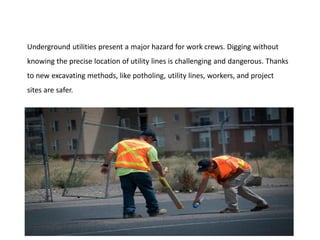
Underground utilities present a major hazard for work crews. Digging without
knowing the precise location of utility lines is challenging and dangerous. Thanks
to new excavating methods, like potholing, utility lines, workers, and project
sites are safer.
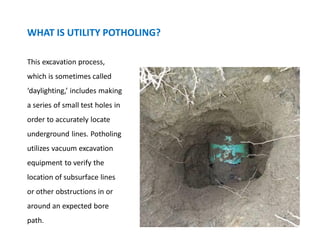
WHAT IS UTILITY POTHOLING?
This excavation process,
which is sometimes called
‘daylighting,’ includes making
a series of small test holes in
order to accurately locate
underground lines. Potholing
utilizes vacuum excavation
equipment to verify the
location of subsurface lines
or other obstructions in or
around an expected bore
path.
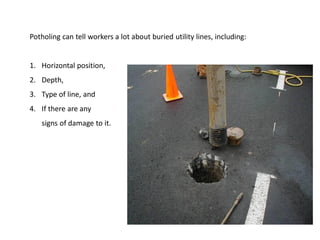
Potholing can tell workers a lot about buried utility lines, including:
1. Horizontal position,
2. Depth,
3. Type of line, and
4. If there are any
signs of damage to it.
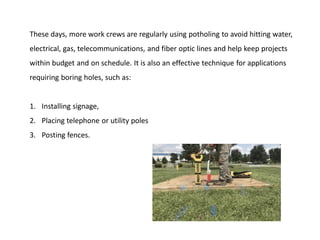
These days, more work crews are regularly using potholing to avoid hitting water,
electrical, gas, telecommunications, and fiber optic lines and help keep projects
within budget and on schedule. It is also an effective technique for applications
requiring boring holes, such as:
1. Installing signage,
2. Placing telephone or utility poles
3. Posting fences.
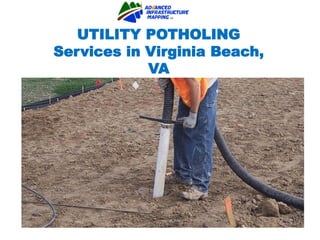
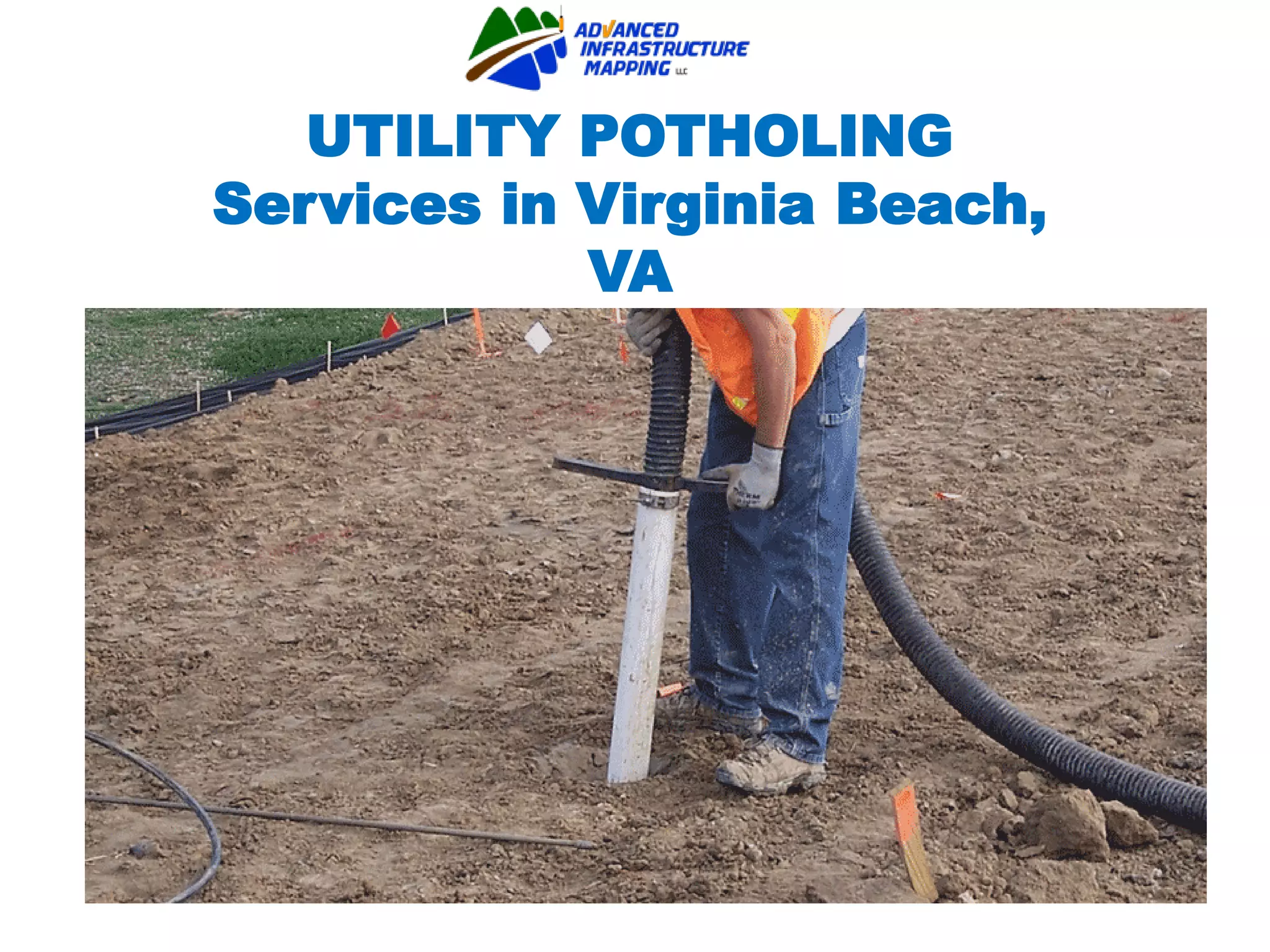
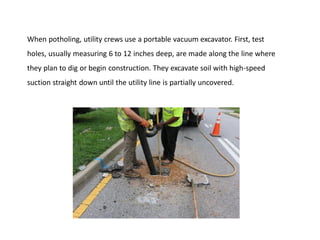
When potholing, utility crews use a portable vacuum excavator. First, test
holes, usually measuring 6 to 12 inches deep, are made along the line where
they plan to dig or begin construction. They excavate soil with high-speed
suction straight down until the utility line is partially uncovered.
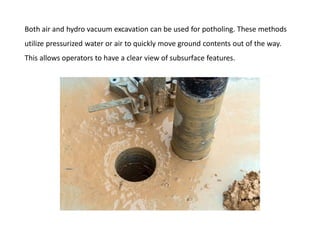
Both air and hydro vacuum excavation can be used for potholing. These methods
utilize pressurized water or air to quickly move ground contents out of the way.
This allows operators to have a clear view of subsurface features.
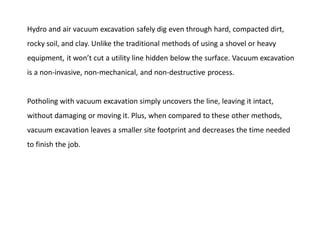
Hydro and air vacuum excavation safely dig even through hard, compacted dirt,
rocky soil, and clay. Unlike the traditional methods of using a shovel or heavy
equipment, it won’t cut a utility line hidden below the surface. Vacuum excavation
is a non-invasive, non-mechanical, and non-destructive process.
Potholing with vacuum excavation simply uncovers the line, leaving it intact,
without damaging or moving it. Plus, when compared to these other methods,
vacuum excavation leaves a smaller site footprint and decreases the time needed
to finish the job.
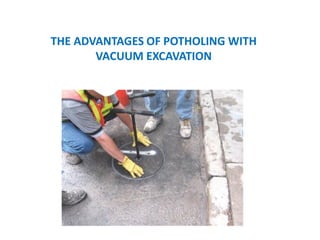
THE ADVANTAGES OF POTHOLING WITH
VACUUM EXCAVATION
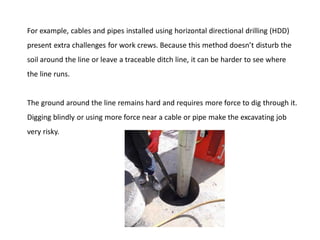
For example, cables and pipes installed using horizontal directional drilling (HDD)
present extra challenges for work crews. Because this method doesn’t disturb the
soil around the line or leave a traceable ditch line, it can be harder to see where
the line runs.
The ground around the line remains hard and requires more force to dig through it.
Digging blindly or using more force near a cable or pipe make the excavating job
very risky.
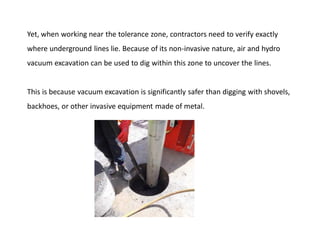
Yet, when working near the tolerance zone, contractors need to verify exactly
where underground lines lie. Because of its non-invasive nature, air and hydro
vacuum excavation can be used to dig within this zone to uncover the lines.
This is because vacuum excavation is significantly safer than digging with shovels,
backhoes, or other invasive equipment made of metal.
The information gained from potholing allows excavation and construction
projects to proceed without the fear of striking any underground feature.
Potholing is much more accurate and fast than relying on charts and utility maps
which may be incorrect or out of date. In all, potholing helps avoid, if not
eliminate, the following:
1. Life-threatening accidents,
2. Damaged underground utility lines,
3. Service interruptions and outages,
4. Equipment damage,
5. Costly repairs,
6. Contractor fines,
7. Liability issues, and
8. Frustrating project delays.
Advanced Infrastructure Mapping, LLC is able to demonstrate a
thorough knowledge and understanding of major SUE activities and
is able to provide these services to the extent desired by the
contracting agency.
AIM’s Expertise and Competence
Experience – Employees of Advanced Infrastructure Mapping, LLC are well-
trained, experienced, highly motivated, and capable.
Timeliness – The Resources utilized by Advanced Infrastructure Mapping, LLC
provide us with the ability to perform our services in a timely and in
professional manner.
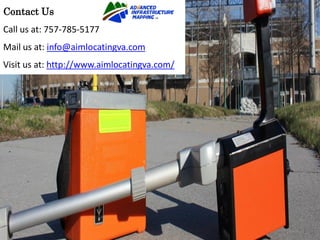
Equipment – A wide range of equipment is necessary to detect
the variety of subsurface utilities that may be present. Equipment
utilized by Advanced Infrastructure Mapping, LLC includes state
of the art designating equipment; vacuum excavation or
comparable non-destructive locating equipment; and software
systems compatible with those of the contracting agency.
Insurance – Advanced Infrastructure Mapping, LLC has
adequate insurance covering all aspects of SUE work.
Minimum amounts should be in accordance with the
contracting agency’s requirements.
Contact Us
Call us at: 757-785-5177
Mail us at: info@aimlocatingva.com
Visit us at: http://www.aimlocatingva.com/

UTILITY POTHOLING Services in Virginia Beach, VA

  • 1.
  • 3.
    Underground utilities presenta major hazard for work crews. Digging without knowing the precise location of utility lines is challenging and dangerous. Thanks to new excavating methods, like potholing, utility lines, workers, and project sites are safer.
  • 4.
    WHAT IS UTILITYPOTHOLING? This excavation process, which is sometimes called ‘daylighting,’ includes making a series of small test holes in order to accurately locate underground lines. Potholing utilizes vacuum excavation equipment to verify the location of subsurface lines or other obstructions in or around an expected bore path.
  • 5.
    Potholing can tellworkers a lot about buried utility lines, including: 1. Horizontal position, 2. Depth, 3. Type of line, and 4. If there are any signs of damage to it.
  • 6.
    These days, morework crews are regularly using potholing to avoid hitting water, electrical, gas, telecommunications, and fiber optic lines and help keep projects within budget and on schedule. It is also an effective technique for applications requiring boring holes, such as: 1. Installing signage, 2. Placing telephone or utility poles 3. Posting fences.
  • 7.
    When potholing, utilitycrews use a portable vacuum excavator. First, test holes, usually measuring 6 to 12 inches deep, are made along the line where they plan to dig or begin construction. They excavate soil with high-speed suction straight down until the utility line is partially uncovered.
  • 8.
    Both air andhydro vacuum excavation can be used for potholing. These methods utilize pressurized water or air to quickly move ground contents out of the way. This allows operators to have a clear view of subsurface features.
  • 9.
    Hydro and airvacuum excavation safely dig even through hard, compacted dirt, rocky soil, and clay. Unlike the traditional methods of using a shovel or heavy equipment, it won’t cut a utility line hidden below the surface. Vacuum excavation is a non-invasive, non-mechanical, and non-destructive process. Potholing with vacuum excavation simply uncovers the line, leaving it intact, without damaging or moving it. Plus, when compared to these other methods, vacuum excavation leaves a smaller site footprint and decreases the time needed to finish the job.
  • 10.
    THE ADVANTAGES OFPOTHOLING WITH VACUUM EXCAVATION
  • 11.
    For example, cablesand pipes installed using horizontal directional drilling (HDD) present extra challenges for work crews. Because this method doesn’t disturb the soil around the line or leave a traceable ditch line, it can be harder to see where the line runs. The ground around the line remains hard and requires more force to dig through it. Digging blindly or using more force near a cable or pipe make the excavating job very risky.
  • 12.
    Yet, when workingnear the tolerance zone, contractors need to verify exactly where underground lines lie. Because of its non-invasive nature, air and hydro vacuum excavation can be used to dig within this zone to uncover the lines. This is because vacuum excavation is significantly safer than digging with shovels, backhoes, or other invasive equipment made of metal.
  • 13.
    The information gainedfrom potholing allows excavation and construction projects to proceed without the fear of striking any underground feature. Potholing is much more accurate and fast than relying on charts and utility maps which may be incorrect or out of date. In all, potholing helps avoid, if not eliminate, the following: 1. Life-threatening accidents, 2. Damaged underground utility lines, 3. Service interruptions and outages, 4. Equipment damage, 5. Costly repairs, 6. Contractor fines, 7. Liability issues, and 8. Frustrating project delays.
  • 14.
    Advanced Infrastructure Mapping,LLC is able to demonstrate a thorough knowledge and understanding of major SUE activities and is able to provide these services to the extent desired by the contracting agency. AIM’s Expertise and Competence
  • 15.
    Experience – Employeesof Advanced Infrastructure Mapping, LLC are well- trained, experienced, highly motivated, and capable. Timeliness – The Resources utilized by Advanced Infrastructure Mapping, LLC provide us with the ability to perform our services in a timely and in professional manner.
  • 16.
    Equipment – Awide range of equipment is necessary to detect the variety of subsurface utilities that may be present. Equipment utilized by Advanced Infrastructure Mapping, LLC includes state of the art designating equipment; vacuum excavation or comparable non-destructive locating equipment; and software systems compatible with those of the contracting agency.
  • 17.
    Insurance – AdvancedInfrastructure Mapping, LLC has adequate insurance covering all aspects of SUE work. Minimum amounts should be in accordance with the contracting agency’s requirements.
  • 18.
    Contact Us Call usat: 757-785-5177 Mail us at: info@aimlocatingva.com Visit us at: http://www.aimlocatingva.com/