URINARY TRACT INFECTION
Getachew Wondafrash
(MD ,Internist, nephrologist)
2-4-14EC
My Outline of presentation
• Introduction and Definitions
• Epidemiology and Risk Factors
• Etiology and Pathogenesis
• Diagnosis
• Treatment
• Prognosis
• Which of the following is NOT true about UTI
A UTI is more common in male than female in
infancy
B-The most common cause is E- coli both in
cystitis and pylonephritis
C -The most way of acquiring pylonephritis is
hematogenous
D-Genetic factors are risk factor for UTI
E- All are true
• Which of the following is manifestation of
prostatis except
A -Frequency , urgency
B -Suprapupic discomfort
C -Fever and dysuria
D -Nocturia
E- None of the above
• Which of the following is manifestation of
cystitis except
A -Frequency , urgency and hematuria
B -Suprapupic discomfort
C -Fever and dysuria
D- Nocturia
E- None of the above
• Uncomplicated UTI refers to acute cystitis or
pyelonephritis in which of the following except
A-Non pregnant outpatient women
B-Without anatomic abnormalities
C-Without Instrumentation
of the urinary tract
D-UTI with renal stone
E-UTI in Men
F-ALL
UTI :Introduction
• Urinary tract infection is the presence of
microbial pathogens in the normally sterile
urinary tract.
• Infections are overwhelmingly bacterial
although fungi(various species of
Candida),viruses(e.g. JC, Adenoviruses) and
parasites may cause UTI.
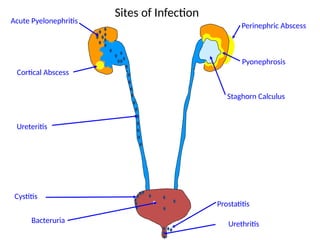
Acute Pyelonephritis
Pyonephrosis
Perinephric Abscess
Staghorn Calculus
Ureteritis
Prostatitis
Urethritis
Bacteruria
Cystitis
Cortical Abscess
Sites of Infection
Definitions
• UTI may be asymptomatic (subclinical infection
without symptoms) or symptomatic ( disease).
• Thus, the term UTI encompasses a variety of
clinical entities, including asymptomatic
bacteriuria (ABU), cystitis, prostatitis, and
pyelonephritis.
• The distinction between symptomatic UTI and
ABU has major clinical implications.
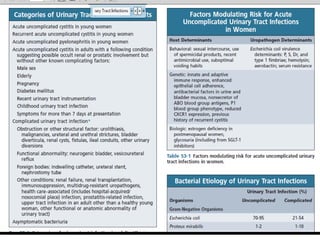
• Uncomplicated UTI refers to acute cystitis or
pyelonephritis in
1- Non pregnant outpatient women .
2-
Without anatomic abnormalities,
3 -Without instrumentation of the urinary
tract;
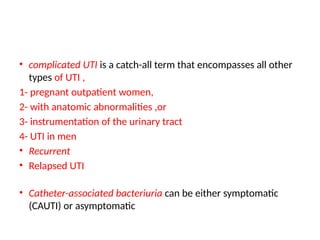
• complicated UTI is a catch-all term that encompasses all other
types of UTI ,
1- pregnant outpatient women,
2- with anatomic abnormalities ,or
3- instrumentation of the urinary tract
4- UTI in men
• Recurrent
• Relapsed UTI
• Catheter-associated bacteriuria can be either symptomatic
(CAUTI) or asymptomatic
Epidemiology and Risk Factors
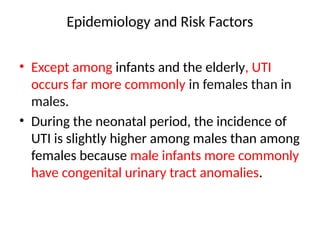
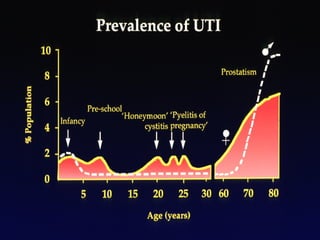
• Except among infants and the elderly, UTI
occurs far more commonly in females than in
males.
• During the neonatal period, the incidence of
UTI is slightly higher among males than among
females because male infants more commonly
have congenital urinary tract anomalies.
• Which of the following is not a risk factor for UTI
A -Being female
B -Frequent sexual intercourse,
C -Use of spermicide,
D -A new sexual partner,
E -A first UTI before 15 years of age,
F -A maternal history of UTI
G- Lack of circumcision
• The only consistently documented behavioral risk
factors for recurrent UTI
• include frequent sexual intercourse and
• spermicide use.
• In postmenopausal women, anatomic factors
affecting bladder emptying, such as cystoceles,
urinary incontinence, and residual urine, are
most strongly associated with recurrent UTI.
• In pregnant women, ABU has clinical consequences, and both
screening for and treatment of this condition are indicated.
• Specifically, ABU during pregnancy is associated with
• -preterm birth and perinatal mortality for the fetus and with
• pyelonephritis for the mother.
• A Cochrane meta-analysis found that treatment of ABU in
pregnant women decreased the risk of pyelonephritis by 75%.
• The majority of men with UTI have a
functional or anatomic abnormality of the
urinary tract, most commonly urinary
obstruction secondary to prostatic
hypertrophy.
• Lack of circumcision
Etiology
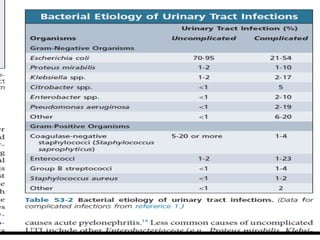
• The uropathogens causing UTI vary by clinical syndrome but are usually
enteric gram-negative rods that have migrated to the urinary tract.
• In acute uncomplicated cystitis in the United States, the etiologic agents
are highly predictable
• E. coli accounts for 75–90% of isolates;
• Staphylococcus saprophyticus for 5–15% (with particularly frequent
isolation from younger women); and
• Klebsiella species, Proteus species, Enterococcus species, Citrobacter
species, and other organisms for 5–10%.
• The spectrum of agents causing uncomplicated pyelonephritis is similar,
with E. coli predominating.
Pathogenesis
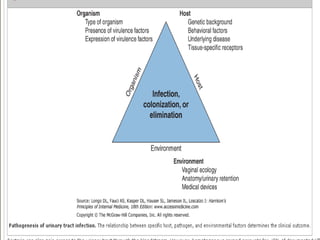
• The urinary tract can be viewed as an anatomic
unit united by a continuous column of urine
extending from the urethra to the kidneys.
• In the majority of UTIs, bacteria establish
infection by ascending from the urethra to the
bladder.
• Which of the following is not true about
bloodstream or hematogenously acquired
UTI
A- It account around 10 %of UTI only
B- Most common cause is E coli
C- Caused by Salmonella and S. aureus
D- Candiduria is common
E- None
• Bacteria can also gain access to the urinary
tract through the bloodstream.
hematogenously
• However, hematogenous spread accounts for
<2% of documented UTIs and usually results
from bacteremia caused by relatively virulent
organisms, such as Salmonella and S. aureus.
• Hematogenous infections may produce focal
abscesses or areas of pyelonephritis within a kidney
and result in positive urine cultures.
• The pathogenesis of candiduria is distinct in that the
hematogenous route is common.
• The presence of Candida in the urine of a
noninstrumented immunocompetent patient implies
either genital contamination or potentially
widespread visceral dissemination.
• P fimbriae are important in the pathogenesis of
pyelonephritis and subsequent bloodstream invasion from
the kidney.
• Another adhesin is the type 1 pilus (fimbria), which all E.
coli strains possess but not all E. coli strains express.
• Type 1 pili are thought to play a key role in initiating E. coli
bladder infection; they mediate binding to uroplakins on
the luminal surface of bladder uroepithelial cells.
Approach to the Patient:
• Clinical Manifestations
• The most important issue to be addressed when a UTI is suspected
is the characterization of the clinical syndrome as
-
• ABU,
• Uncomplicated cystitis,
• Pyelonephritis, -
• Prostatitis, or
• Complicated UTI.
• This information will shape the diagnostic and therapeutic
approach.
Acute Pyelonephritis
Lower Tract Infection
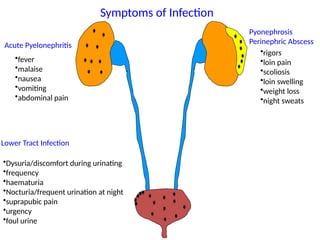
Symptoms of Infection
Pyonephrosis
Perinephric Abscess
•fever
•malaise
•nausea
•vomiting
•abdominal pain
•rigors
•loin pain
•scoliosis
•loin swelling
•weight loss
•night sweats
•Dysuria/discomfort during urinating
•frequency
•haematuria
•Nocturia/frequent urination at night
•suprapubic pain
•urgency
•foul urine
Asymptomatic Bacteriuria
• A diagnosis of ABU can be considered only
when the patient does not have local or
systemic symptoms referable to the urinary
tract.
Cystitis
The typical symptoms of cystitis are
• Dysuria, urinary frequency, and urgency.
• Nocturia, hesitancy, suprapubic discomfort, and gross
hematuria are often noted as well.
• Unilateral back or flank pain is generally an indication that
the upper urinary tract is involved.
• Fever is also an indication of invasive infection of either the
kidney or the prostate.
Pyelonephritis
• Mild pyelonephritis can present as low-grade
fever with or without lower-back or costovertebral-angle pain, whereas
• Severe pyelonephritis can manifest as high fever, rigors, nausea, vomiting,
and flank and/or loin pain.
• Symptoms are generally acute in onset, and symptoms of cystitis may not be
present.
• Fever is the main feature distinguishing cystitis and pyelonephritis.
• The fever of pyelonephritis typically exhibits a high, spiking "picket-fence"
pattern and resolves over 72 h of therapy.
• Bacteremia develops in 20–30% of cases of pyelonephritis.
Which of the following is correct association
• A - Diabetes - obstructive uropathy - acute papillary
necrosis .
• B-Papillary necrosis - sickle cell disease- analgesic
nephropathy,
• C- Emphysematous pyelonephritis - diabetic patients
• D- Xanthogranulomatous pyelonephritis - staghorn
calculi),
• E - All
• Patients with diabetes may present with obstructive uropathy
associated with acute papillary necrosis when the sloughed papillae
obstruct the ureter.
• Papillary necrosis may also be evident in some cases of pyelonephritis
complicated by obstruction, sickle cell disease, analgesic
nephropathy, or combinations of these conditions
• Emphysematous pyelonephritis is a particularly severe form of the
disease that is associated with the production of gas in renal and
perinephric tissues and occurs almost exclusively in diabetic patients
• Xanthogranulomatous pyelonephritis occurs when chronic urinary
obstruction (often by staghorn calculi), together with chronic
infection, leads to suppurative destruction of renal tissue
• Most staghorn calculi are infection stones composed of struvite
and/or carbonate apatite.
• Sometimes, cysteine, uric acid, whewellite and brushite stones also
assume a staghorn configuration when located in the kidney.
• It is very important in stone crushing to know the composition and
architecture of the stones.
• Pyelonephritis can also be complicated by intraparenchymal abscess
formation; this situation should be suspected when a patient has
continued fever and/or bacteremia despite antibacterial therapy.
Prostatitis
• Prostatitis includes both infectious and noninfectious abnormalities of
the prostate gland.
• Infections can be acute or chronic, are almost always bacterial in
nature, and are far less common than the noninfectious entity of
chronic pelvic pain syndrome (formerly known as chronic prostatitis).
• Acute bacterial prostatitis presents as dysuria, frequency, and pain in
the prostatic, pelvic, or perineal area
• Fever and chills are usually present, and symptoms of bladder outlet
obstruction are common.
• Chronic bacterial prostatitis presents more insidiously as recurrent
episodes of cystitis, sometimes with associated pelvic and perineal
pain.
• Men who present with recurrent cystitis should be evaluated for a
prostatic focus.
Complicated UTI
• Complicated UTI presents as a symptomatic
episode of cystitis or pyelonephritis in a man
or woman with an,
• anatomic predisposition to infection,
• with a foreign body in the urinary tract, or
• with factors predisposing to a delayed
response to therapy.
Diagnostic Tools
History
• The diagnosis of any the UTI syndromes or
ABU begins with a detailed history
• The history given by the patient has a high
predictive value in uncomplicated cystitis.
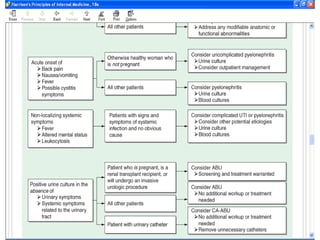
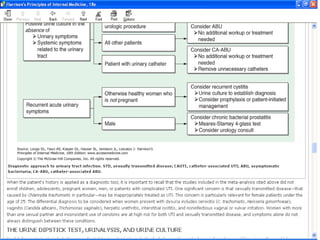
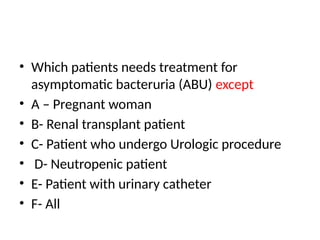
• Which patients needs treatment for
asymptomatic bacteruria (ABU) except
• A – Pregnant woman
• B- Renal transplant patient
• C- Patient who undergo Urologic procedure
• D- Neutropenic patient
• E- Patient with urinary catheter
• F- All
• One significant concern is that sexually transmitted
disease—that caused by Chlamydia trachomatis in
particular—may be inappropriately treated as UTI.
• This concern is particularly relevant for female
patients under the age of 25.
Diagnosis of Urinary Tract Infection
Protein Trace commonly present
Dip stick Nitrites (many false negatives),
Leucocyte dipslide (esterase)
Blood Trace commonly present
Microscopy Leucocytes, tubular casts,
organisms
Culture Dipslide, plating
The longer you keep a specimen before plating the
greater the possibility of a positive culture
The Urine Dipstick Test, Urinalysis, and Urine Culture
• Useful diagnostic tools include the urine
dipstick test and urinalysis,
• Urine culture
• Only members of the family
Enterobacteriaceae convert nitrate to nitrite,
and enough nitrite must accumulate in the
urine to reach the threshold of detection.
The leukocyte esterase test detects this enzyme
in the host's polymorphonuclear leukocytes in
the urine, whether the cells are intact or lysed.
• Urine microscopy reveals pyuria in nearly all
cases of cystitis and hematuria in ~30% of
cases.
• Either nitrite or leukocyte esterase positivity can be interpreted as a
positive result.
• Blood in the urine may also suggest a diagnosis of UTI
• A dipstick test negative for both nitrite and leukocyte esterase in the
same type of patient should prompt consideration of other
explanations for the patient's symptoms and collection of urine for
culture.
• A negative dipstick test is not sufficiently sensitive to rule out
bacteriuria in pregnant women, in whom it is important to detect all
episodes of bacteriuria.
The gold standard for diagnosis of UTI is
• A- Urine analysis
• B-Blood culture
• C- Urine culture
• D- Leukocyte esterase test
• E- Urine nitrate tests
• F –All are the gold standard
• The detection of bacteria in a urine culture is
the diagnostic "gold standard
• In men, the minimal level indicating infection
appears to be 103
/mL.
• In women, the minimal level indicating
infection appears to be 105
/mL
Diagnosis
• The approach to diagnosis is influenced by which
of the clinical UTI syndromes is suspected .
• Uncomplicated Cystitis in Women
• Uncomplicated cystitis in women can be treated
on the basis of history alone.
• However, if the symptoms are not specific or if a
reliable history cannot be obtained, then a urine
dipstick test should be performed.
Cystitis in Men
• The signs and symptoms of cystitis in men are
similar to those in women,.
• Collection of urine for culture is strongly
recommended .
• Men with febrile UTI often have an elevated
serum level of prostate-specific antigen as well
as an enlarged prostate and enlarged seminal
vesicles on ultrasound—findings indicative of
prostate involvement.
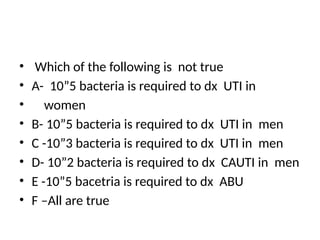
• Which of the following is not true
• A- 10”5 bacteria is required to dx UTI in
• women
• B- 10”5 bacteria is required to dx UTI in men
• C -10”3 bacteria is required to dx UTI in men
• D- 10”2 bacteria is required to dx CAUTI in men
• E -10”5 bacetria is required to dx ABU
• F –All are true
Asymptomatic Bacteriuria
• The diagnosis of ABU involves both
microbiologic and clinical criteria.
• 1-The microbiologic criterion is usually 105
bacterial cfu/mL except in catheter-associated
disease CAUTI, in which case 102
cfu/mL is the
cutoff.
• 2-The clinical criterion is that the person has
no signs or symptoms referable to UTI.
Treatment: Urinary Tract Infections
• Antimicrobial therapy is warranted for any
symptomatic UTI.
• The choice of antimicrobial agent and the dose
and duration of therapy depend on the site of
infection and the presence or absence of
complicating conditions.
• Each category of UTI warrants a different approach
based on the particular clinical syndrome.
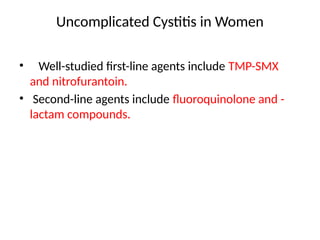
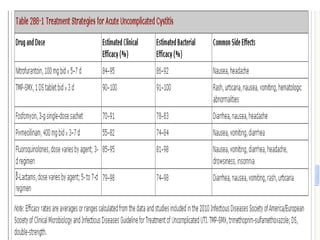
Uncomplicated Cystitis in Women
• Well-studied first-line agents include TMP-SMX
and nitrofurantoin.
• Second-line agents include fluoroquinolone and -
lactam compounds.
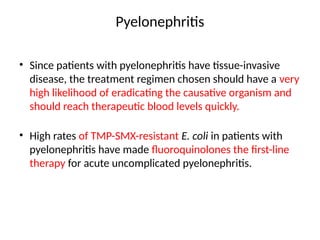
Pyelonephritis
• Since patients with pyelonephritis have tissue-invasive
disease, the treatment regimen chosen should have a very
high likelihood of eradicating the causative organism and
should reach therapeutic blood levels quickly.
• High rates of TMP-SMX-resistant E. coli in patients with
pyelonephritis have made fluoroquinolones the first-line
therapy for acute uncomplicated pyelonephritis.
• Options for parenteral therapy for uncomplicated
pyelonephritis include fluoroquinolones, an aminoglycoside
with or without ampicillin, an extended-spectrum
cephalosporin with or without an aminoglycoside, or a
carbapenem.
• In general, the treatment of such patients should be guided
by urine culture results.
• Once the patient has responded clinically, oral therapy
should be substituted for parenteral therapy.
UTI in Pregnant Women
• Nitrofurantoin, ampicillin, and the
cephalosporins are considered relatively safe
in early pregnancy.
• For pregnant women with overt
pyelonephritis, parenteral -lactam therapy
with or without aminoglycosides is the
standard of care.
• Sulfonamides should clearly be avoided both
in the first trimester (because of possible
teratogenic effects) and near term (because of
a possible role in the development of
kernicterus).
• Fluoroquinolones are avoided because of
possible adverse effects on fetal cartilage
development
UTI in Men
• Since the prostate is involved in the majority
of cases of febrile UTI in men, the goal in
these patients is to eradicate the prostatic
infection as well as the bladder infection.
• In men with apparently uncomplicated UTI, a
7- to 14-day course of a fluoroquinolone or
TMP-SMX is recommended.
• If acute bacterial prostatitis
Therapy can be tailored to urine culture
results and should be continued for 2–4 weeks.
• For documented chronic bacterial prostatitis, a 4- to
6-week course of antibiotics is often necessary.
• Recurrences, which are not uncommon in chronic
prostatitis, often warrant a 12-week course of
treatment.
• The typical signs and symptoms of UTI, including pain,
urgency, dysuria, fever, peripheral leukocytosis, and pyuria,
have less predictive value for the diagnosis of infection in
catheterized patients
• Furthermore, the presence of bacteria in the urine of a
patient who is febrile and catheterized does not necessarily
predict CAUTI, and other explanations for the fever should
be considered.
• The etiology of CAUTI is diverse, and urine culture results
are essential to guide treatment.
• Fairly good evidence supports the practice of catheter change
during treatment for CAUTI.
• The goal is to remove biofilm-associated organisms that could
serve as a nidus for reinfection.
• Pathology studies reveal that many patients with long-term
catheters have occult pyelonephritis.
• In general, a 7- to 14-day course of antibiotics is recommended,
but further studies on the optimal duration of therapy are needed.
• The best strategy for prevention of CAUTI is to
avoid insertion of unnecessary catheters and
to remove catheters once they are no longer
necessary.
Candiduria
• The appearance of Candida in the urine is an increasingly common
complication of indwelling catheterization, particularly for patients in
the intensive care unit, those taking broad-spectrum antimicrobial
drugs, and those with underlying diabetes mellitus.
• C. albicans is still the most common isolate, although C. glabrata and
other non-albicans species are also isolated frequently.
• The clinical presentation varies from an asymptomatic laboratory
finding to pyelonephritis and even sepsis.
• In asymptomatic patients, removal of the urethral catheter results in
resolution of candiduria in more than one-third of cases.
• Treatment is recommended for patients who have symptomatic
cystitis or pyelonephritis and for those who are at high risk for
disseminated disease.
• High-risk patients include those with neutropenia, those who
are undergoing urologic manipulation, and low-birth-weight
infants.
• Fluconazole (200–400 mg/d for 14 days) achieves high levels in
urine and is the first-line regimen for Candida infections of the
urinary tract.
Prevention of Recurrent UTI in Women
• Recurrence of uncomplicated cystitis in reproductive-age
women is common, and a preventive strategy is indicated if
recurrent UTIs are interfering with a patient's lifestyle.
• Three prophylactic strategies are available: continuous,
postcoital, or patient-initiated therapy.
• Continuous prophylaxis and postcoital prophylaxis usually
entail low doses of TMP-SMX, a fluoroquinolone, or
nitrofurantoin.
• These regimens are all highly effective during the
period of active antibiotic intake.
• Typically, a prophylactic regimen is prescribed for
6 months and then discontinued, at which point
the rate of recurrent UTI often returns to baseline.
• If bothersome infections recur, the prophylactic
program can be reinstituted for a longer period.
Prognosis
• Cystitis is a risk factor for recurrent cystitis and pyelonephritis.
• ABU is common among elderly and catheterized patients but does not
in itself increase the risk of death.
• The relationships among recurrent UTI, chronic pyelonephritis, and
renal insufficiency have been widely studied.
• In the absence of anatomic abnormalities, recurrent infection in
children and adults does not lead to chronic pyelonephritis or to renal
failure. .
Thank you

UTI by Dr Getachew (1)................pptx

  • 1.
    URINARY TRACT INFECTION GetachewWondafrash (MD ,Internist, nephrologist) 2-4-14EC
  • 2.
    My Outline ofpresentation • Introduction and Definitions • Epidemiology and Risk Factors • Etiology and Pathogenesis • Diagnosis • Treatment • Prognosis
  • 3.
    • Which ofthe following is NOT true about UTI A UTI is more common in male than female in infancy B-The most common cause is E- coli both in cystitis and pylonephritis C -The most way of acquiring pylonephritis is hematogenous D-Genetic factors are risk factor for UTI E- All are true
  • 4.
    • Which ofthe following is manifestation of prostatis except A -Frequency , urgency B -Suprapupic discomfort C -Fever and dysuria D -Nocturia E- None of the above
  • 5.
    • Which ofthe following is manifestation of cystitis except A -Frequency , urgency and hematuria B -Suprapupic discomfort C -Fever and dysuria D- Nocturia E- None of the above
  • 6.
    • Uncomplicated UTIrefers to acute cystitis or pyelonephritis in which of the following except A-Non pregnant outpatient women B-Without anatomic abnormalities C-Without Instrumentation of the urinary tract D-UTI with renal stone E-UTI in Men F-ALL
  • 7.
    UTI :Introduction • Urinarytract infection is the presence of microbial pathogens in the normally sterile urinary tract. • Infections are overwhelmingly bacterial although fungi(various species of Candida),viruses(e.g. JC, Adenoviruses) and parasites may cause UTI.
  • 8.
    Acute Pyelonephritis Pyonephrosis Perinephric Abscess StaghornCalculus Ureteritis Prostatitis Urethritis Bacteruria Cystitis Cortical Abscess Sites of Infection
  • 9.
    Definitions • UTI maybe asymptomatic (subclinical infection without symptoms) or symptomatic ( disease). • Thus, the term UTI encompasses a variety of clinical entities, including asymptomatic bacteriuria (ABU), cystitis, prostatitis, and pyelonephritis. • The distinction between symptomatic UTI and ABU has major clinical implications.
  • 10.
    • Uncomplicated UTIrefers to acute cystitis or pyelonephritis in 1- Non pregnant outpatient women . 2- Without anatomic abnormalities, 3 -Without instrumentation of the urinary tract;
  • 12.
    • complicated UTIis a catch-all term that encompasses all other types of UTI , 1- pregnant outpatient women, 2- with anatomic abnormalities ,or 3- instrumentation of the urinary tract 4- UTI in men • Recurrent • Relapsed UTI • Catheter-associated bacteriuria can be either symptomatic (CAUTI) or asymptomatic
  • 13.
    Epidemiology and RiskFactors • Except among infants and the elderly, UTI occurs far more commonly in females than in males. • During the neonatal period, the incidence of UTI is slightly higher among males than among females because male infants more commonly have congenital urinary tract anomalies.
  • 15.
    • Which ofthe following is not a risk factor for UTI A -Being female B -Frequent sexual intercourse, C -Use of spermicide, D -A new sexual partner, E -A first UTI before 15 years of age, F -A maternal history of UTI G- Lack of circumcision
  • 16.
    • The onlyconsistently documented behavioral risk factors for recurrent UTI • include frequent sexual intercourse and • spermicide use. • In postmenopausal women, anatomic factors affecting bladder emptying, such as cystoceles, urinary incontinence, and residual urine, are most strongly associated with recurrent UTI.
  • 17.
    • In pregnantwomen, ABU has clinical consequences, and both screening for and treatment of this condition are indicated. • Specifically, ABU during pregnancy is associated with • -preterm birth and perinatal mortality for the fetus and with • pyelonephritis for the mother. • A Cochrane meta-analysis found that treatment of ABU in pregnant women decreased the risk of pyelonephritis by 75%.
  • 18.
    • The majorityof men with UTI have a functional or anatomic abnormality of the urinary tract, most commonly urinary obstruction secondary to prostatic hypertrophy. • Lack of circumcision
  • 19.
    Etiology • The uropathogenscausing UTI vary by clinical syndrome but are usually enteric gram-negative rods that have migrated to the urinary tract. • In acute uncomplicated cystitis in the United States, the etiologic agents are highly predictable • E. coli accounts for 75–90% of isolates; • Staphylococcus saprophyticus for 5–15% (with particularly frequent isolation from younger women); and • Klebsiella species, Proteus species, Enterococcus species, Citrobacter species, and other organisms for 5–10%. • The spectrum of agents causing uncomplicated pyelonephritis is similar, with E. coli predominating.
  • 21.
    Pathogenesis • The urinarytract can be viewed as an anatomic unit united by a continuous column of urine extending from the urethra to the kidneys. • In the majority of UTIs, bacteria establish infection by ascending from the urethra to the bladder.
  • 22.
    • Which ofthe following is not true about bloodstream or hematogenously acquired UTI A- It account around 10 %of UTI only B- Most common cause is E coli C- Caused by Salmonella and S. aureus D- Candiduria is common E- None
  • 23.
    • Bacteria canalso gain access to the urinary tract through the bloodstream. hematogenously • However, hematogenous spread accounts for <2% of documented UTIs and usually results from bacteremia caused by relatively virulent organisms, such as Salmonella and S. aureus.
  • 24.
    • Hematogenous infectionsmay produce focal abscesses or areas of pyelonephritis within a kidney and result in positive urine cultures. • The pathogenesis of candiduria is distinct in that the hematogenous route is common. • The presence of Candida in the urine of a noninstrumented immunocompetent patient implies either genital contamination or potentially widespread visceral dissemination.
  • 26.
    • P fimbriaeare important in the pathogenesis of pyelonephritis and subsequent bloodstream invasion from the kidney. • Another adhesin is the type 1 pilus (fimbria), which all E. coli strains possess but not all E. coli strains express. • Type 1 pili are thought to play a key role in initiating E. coli bladder infection; they mediate binding to uroplakins on the luminal surface of bladder uroepithelial cells.
  • 27.
    Approach to thePatient: • Clinical Manifestations • The most important issue to be addressed when a UTI is suspected is the characterization of the clinical syndrome as - • ABU, • Uncomplicated cystitis, • Pyelonephritis, - • Prostatitis, or • Complicated UTI. • This information will shape the diagnostic and therapeutic approach.
  • 28.
    Acute Pyelonephritis Lower TractInfection Symptoms of Infection Pyonephrosis Perinephric Abscess •fever •malaise •nausea •vomiting •abdominal pain •rigors •loin pain •scoliosis •loin swelling •weight loss •night sweats •Dysuria/discomfort during urinating •frequency •haematuria •Nocturia/frequent urination at night •suprapubic pain •urgency •foul urine
  • 29.
    Asymptomatic Bacteriuria • Adiagnosis of ABU can be considered only when the patient does not have local or systemic symptoms referable to the urinary tract.
  • 30.
    Cystitis The typical symptomsof cystitis are • Dysuria, urinary frequency, and urgency. • Nocturia, hesitancy, suprapubic discomfort, and gross hematuria are often noted as well. • Unilateral back or flank pain is generally an indication that the upper urinary tract is involved. • Fever is also an indication of invasive infection of either the kidney or the prostate.
  • 31.
    Pyelonephritis • Mild pyelonephritiscan present as low-grade fever with or without lower-back or costovertebral-angle pain, whereas • Severe pyelonephritis can manifest as high fever, rigors, nausea, vomiting, and flank and/or loin pain. • Symptoms are generally acute in onset, and symptoms of cystitis may not be present. • Fever is the main feature distinguishing cystitis and pyelonephritis. • The fever of pyelonephritis typically exhibits a high, spiking "picket-fence" pattern and resolves over 72 h of therapy. • Bacteremia develops in 20–30% of cases of pyelonephritis.
  • 32.
    Which of thefollowing is correct association • A - Diabetes - obstructive uropathy - acute papillary necrosis . • B-Papillary necrosis - sickle cell disease- analgesic nephropathy, • C- Emphysematous pyelonephritis - diabetic patients • D- Xanthogranulomatous pyelonephritis - staghorn calculi), • E - All
  • 33.
    • Patients withdiabetes may present with obstructive uropathy associated with acute papillary necrosis when the sloughed papillae obstruct the ureter. • Papillary necrosis may also be evident in some cases of pyelonephritis complicated by obstruction, sickle cell disease, analgesic nephropathy, or combinations of these conditions
  • 34.
    • Emphysematous pyelonephritisis a particularly severe form of the disease that is associated with the production of gas in renal and perinephric tissues and occurs almost exclusively in diabetic patients • Xanthogranulomatous pyelonephritis occurs when chronic urinary obstruction (often by staghorn calculi), together with chronic infection, leads to suppurative destruction of renal tissue • Most staghorn calculi are infection stones composed of struvite and/or carbonate apatite. • Sometimes, cysteine, uric acid, whewellite and brushite stones also assume a staghorn configuration when located in the kidney. • It is very important in stone crushing to know the composition and architecture of the stones. • Pyelonephritis can also be complicated by intraparenchymal abscess formation; this situation should be suspected when a patient has continued fever and/or bacteremia despite antibacterial therapy.
  • 35.
    Prostatitis • Prostatitis includesboth infectious and noninfectious abnormalities of the prostate gland. • Infections can be acute or chronic, are almost always bacterial in nature, and are far less common than the noninfectious entity of chronic pelvic pain syndrome (formerly known as chronic prostatitis).
  • 36.
    • Acute bacterialprostatitis presents as dysuria, frequency, and pain in the prostatic, pelvic, or perineal area • Fever and chills are usually present, and symptoms of bladder outlet obstruction are common. • Chronic bacterial prostatitis presents more insidiously as recurrent episodes of cystitis, sometimes with associated pelvic and perineal pain. • Men who present with recurrent cystitis should be evaluated for a prostatic focus.
  • 37.
    Complicated UTI • ComplicatedUTI presents as a symptomatic episode of cystitis or pyelonephritis in a man or woman with an, • anatomic predisposition to infection, • with a foreign body in the urinary tract, or • with factors predisposing to a delayed response to therapy.
  • 38.
    Diagnostic Tools History • Thediagnosis of any the UTI syndromes or ABU begins with a detailed history • The history given by the patient has a high predictive value in uncomplicated cystitis.
  • 42.
    • Which patientsneeds treatment for asymptomatic bacteruria (ABU) except • A – Pregnant woman • B- Renal transplant patient • C- Patient who undergo Urologic procedure • D- Neutropenic patient • E- Patient with urinary catheter • F- All
  • 43.
    • One significantconcern is that sexually transmitted disease—that caused by Chlamydia trachomatis in particular—may be inappropriately treated as UTI. • This concern is particularly relevant for female patients under the age of 25.
  • 44.
    Diagnosis of UrinaryTract Infection Protein Trace commonly present Dip stick Nitrites (many false negatives), Leucocyte dipslide (esterase) Blood Trace commonly present Microscopy Leucocytes, tubular casts, organisms Culture Dipslide, plating The longer you keep a specimen before plating the greater the possibility of a positive culture
  • 45.
    The Urine DipstickTest, Urinalysis, and Urine Culture • Useful diagnostic tools include the urine dipstick test and urinalysis, • Urine culture • Only members of the family Enterobacteriaceae convert nitrate to nitrite, and enough nitrite must accumulate in the urine to reach the threshold of detection.
  • 46.
    The leukocyte esterasetest detects this enzyme in the host's polymorphonuclear leukocytes in the urine, whether the cells are intact or lysed.
  • 47.
    • Urine microscopyreveals pyuria in nearly all cases of cystitis and hematuria in ~30% of cases.
  • 48.
    • Either nitriteor leukocyte esterase positivity can be interpreted as a positive result. • Blood in the urine may also suggest a diagnosis of UTI • A dipstick test negative for both nitrite and leukocyte esterase in the same type of patient should prompt consideration of other explanations for the patient's symptoms and collection of urine for culture. • A negative dipstick test is not sufficiently sensitive to rule out bacteriuria in pregnant women, in whom it is important to detect all episodes of bacteriuria.
  • 49.
    The gold standardfor diagnosis of UTI is • A- Urine analysis • B-Blood culture • C- Urine culture • D- Leukocyte esterase test • E- Urine nitrate tests • F –All are the gold standard
  • 50.
    • The detectionof bacteria in a urine culture is the diagnostic "gold standard
  • 51.
    • In men,the minimal level indicating infection appears to be 103 /mL. • In women, the minimal level indicating infection appears to be 105 /mL
  • 52.
    Diagnosis • The approachto diagnosis is influenced by which of the clinical UTI syndromes is suspected . • Uncomplicated Cystitis in Women • Uncomplicated cystitis in women can be treated on the basis of history alone. • However, if the symptoms are not specific or if a reliable history cannot be obtained, then a urine dipstick test should be performed.
  • 53.
    Cystitis in Men •The signs and symptoms of cystitis in men are similar to those in women,. • Collection of urine for culture is strongly recommended .
  • 54.
    • Men withfebrile UTI often have an elevated serum level of prostate-specific antigen as well as an enlarged prostate and enlarged seminal vesicles on ultrasound—findings indicative of prostate involvement.
  • 55.
    • Which ofthe following is not true • A- 10”5 bacteria is required to dx UTI in • women • B- 10”5 bacteria is required to dx UTI in men • C -10”3 bacteria is required to dx UTI in men • D- 10”2 bacteria is required to dx CAUTI in men • E -10”5 bacetria is required to dx ABU • F –All are true
  • 56.
    Asymptomatic Bacteriuria • Thediagnosis of ABU involves both microbiologic and clinical criteria. • 1-The microbiologic criterion is usually 105 bacterial cfu/mL except in catheter-associated disease CAUTI, in which case 102 cfu/mL is the cutoff. • 2-The clinical criterion is that the person has no signs or symptoms referable to UTI.
  • 57.
    Treatment: Urinary TractInfections • Antimicrobial therapy is warranted for any symptomatic UTI. • The choice of antimicrobial agent and the dose and duration of therapy depend on the site of infection and the presence or absence of complicating conditions. • Each category of UTI warrants a different approach based on the particular clinical syndrome.
  • 58.
    Uncomplicated Cystitis inWomen • Well-studied first-line agents include TMP-SMX and nitrofurantoin. • Second-line agents include fluoroquinolone and - lactam compounds.
  • 60.
    Pyelonephritis • Since patientswith pyelonephritis have tissue-invasive disease, the treatment regimen chosen should have a very high likelihood of eradicating the causative organism and should reach therapeutic blood levels quickly. • High rates of TMP-SMX-resistant E. coli in patients with pyelonephritis have made fluoroquinolones the first-line therapy for acute uncomplicated pyelonephritis.
  • 61.
    • Options forparenteral therapy for uncomplicated pyelonephritis include fluoroquinolones, an aminoglycoside with or without ampicillin, an extended-spectrum cephalosporin with or without an aminoglycoside, or a carbapenem. • In general, the treatment of such patients should be guided by urine culture results. • Once the patient has responded clinically, oral therapy should be substituted for parenteral therapy.
  • 62.
    UTI in PregnantWomen • Nitrofurantoin, ampicillin, and the cephalosporins are considered relatively safe in early pregnancy. • For pregnant women with overt pyelonephritis, parenteral -lactam therapy with or without aminoglycosides is the standard of care.
  • 63.
    • Sulfonamides shouldclearly be avoided both in the first trimester (because of possible teratogenic effects) and near term (because of a possible role in the development of kernicterus). • Fluoroquinolones are avoided because of possible adverse effects on fetal cartilage development
  • 64.
    UTI in Men •Since the prostate is involved in the majority of cases of febrile UTI in men, the goal in these patients is to eradicate the prostatic infection as well as the bladder infection. • In men with apparently uncomplicated UTI, a 7- to 14-day course of a fluoroquinolone or TMP-SMX is recommended.
  • 65.
    • If acutebacterial prostatitis Therapy can be tailored to urine culture results and should be continued for 2–4 weeks. • For documented chronic bacterial prostatitis, a 4- to 6-week course of antibiotics is often necessary. • Recurrences, which are not uncommon in chronic prostatitis, often warrant a 12-week course of treatment.
  • 66.
    • The typicalsigns and symptoms of UTI, including pain, urgency, dysuria, fever, peripheral leukocytosis, and pyuria, have less predictive value for the diagnosis of infection in catheterized patients • Furthermore, the presence of bacteria in the urine of a patient who is febrile and catheterized does not necessarily predict CAUTI, and other explanations for the fever should be considered. • The etiology of CAUTI is diverse, and urine culture results are essential to guide treatment.
  • 67.
    • Fairly goodevidence supports the practice of catheter change during treatment for CAUTI. • The goal is to remove biofilm-associated organisms that could serve as a nidus for reinfection. • Pathology studies reveal that many patients with long-term catheters have occult pyelonephritis. • In general, a 7- to 14-day course of antibiotics is recommended, but further studies on the optimal duration of therapy are needed.
  • 68.
    • The beststrategy for prevention of CAUTI is to avoid insertion of unnecessary catheters and to remove catheters once they are no longer necessary.
  • 69.
    Candiduria • The appearanceof Candida in the urine is an increasingly common complication of indwelling catheterization, particularly for patients in the intensive care unit, those taking broad-spectrum antimicrobial drugs, and those with underlying diabetes mellitus. • C. albicans is still the most common isolate, although C. glabrata and other non-albicans species are also isolated frequently. • The clinical presentation varies from an asymptomatic laboratory finding to pyelonephritis and even sepsis. • In asymptomatic patients, removal of the urethral catheter results in resolution of candiduria in more than one-third of cases.
  • 70.
    • Treatment isrecommended for patients who have symptomatic cystitis or pyelonephritis and for those who are at high risk for disseminated disease. • High-risk patients include those with neutropenia, those who are undergoing urologic manipulation, and low-birth-weight infants. • Fluconazole (200–400 mg/d for 14 days) achieves high levels in urine and is the first-line regimen for Candida infections of the urinary tract.
  • 71.
    Prevention of RecurrentUTI in Women • Recurrence of uncomplicated cystitis in reproductive-age women is common, and a preventive strategy is indicated if recurrent UTIs are interfering with a patient's lifestyle. • Three prophylactic strategies are available: continuous, postcoital, or patient-initiated therapy. • Continuous prophylaxis and postcoital prophylaxis usually entail low doses of TMP-SMX, a fluoroquinolone, or nitrofurantoin.
  • 72.
    • These regimensare all highly effective during the period of active antibiotic intake. • Typically, a prophylactic regimen is prescribed for 6 months and then discontinued, at which point the rate of recurrent UTI often returns to baseline. • If bothersome infections recur, the prophylactic program can be reinstituted for a longer period.
  • 73.
    Prognosis • Cystitis isa risk factor for recurrent cystitis and pyelonephritis. • ABU is common among elderly and catheterized patients but does not in itself increase the risk of death. • The relationships among recurrent UTI, chronic pyelonephritis, and renal insufficiency have been widely studied. • In the absence of anatomic abnormalities, recurrent infection in children and adults does not lead to chronic pyelonephritis or to renal failure. .
  • 74.