
The USSR
in World War II
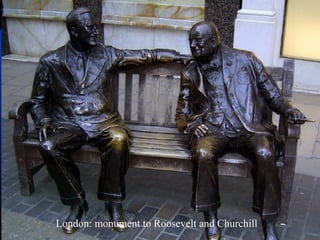
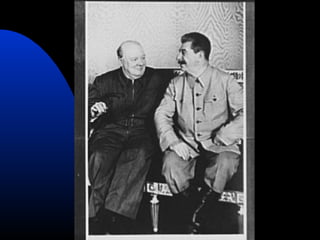
London: monument to Roosevelt and Churchill
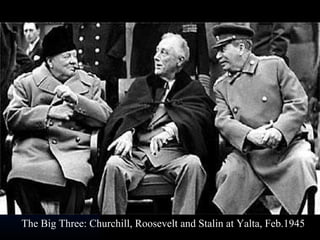
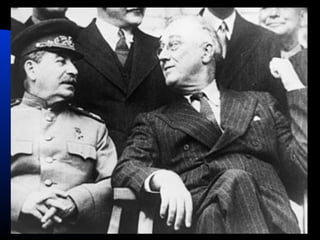
The Big Three: Churchill, Roosevelt and Stalin at Yalta, Feb.1945
 The ultimate test of the Russian battle order has usually
been war
 The Romanov Empire failed that test in WWI – and fell
 By the time of the next test – WWII, the Russian state was
transformed into a more formidable machine
 The “socialist” organization of the country was aimed at
making the state more militarily capable
 A similar logic unfolded in Italy and Germany under
different forms of “socialism”
 They talked of “socialism”, but they meant winning world
wars
 If the essence of War Communism was to win the Russian
civil war, the essence of Stalinism was to win in World War
II
 Belief in the inevitability of war – of one kind or another
 The slide to war
 Forced modernization
 The Great Terror of 1937-38
 Skirmishes in the 1930s: China, Spain
 Diplomatic maneuvers in 1934-39: attempts to contain the
fascist powers, then a non-aggression pact with Hitler
Global civil war and interstate conflict
 Fierce Left-Right struggles in European countries since
WWI, the lure and fear of revolution
 Stalinism in Russia as a new stage in the Russian civil
war: forced modernization to strengthen the state and
make it fit for the next round of interstate wars
 Fascism as a new stage in European Left-Right conflict:
to defeat the Left internally and externally
 Projection of the internal conflicts on interstate relations
 The Spanish Civil War
 Appeasement: betrayal of Czechoslovakia
 The fall of democracies across Europe due to both
internal (Left vs. Right) and external (actions of Germany,
Italy, and the Soviet Union)
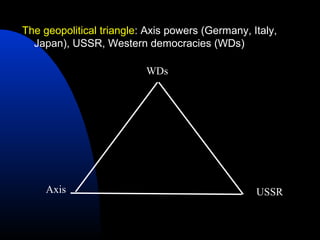
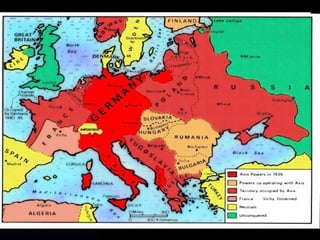
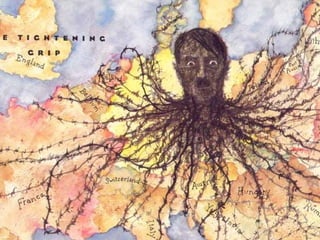
The geopolitical triangle: Axis powers (Germany, Italy,
Japan), USSR, Western democracies (WDs)
USSR
WDs
Axis
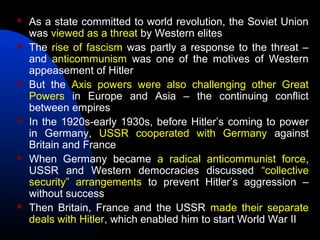
 As a state committed to world revolution, the Soviet Union
was viewed as a threat by Western elites
 The rise of fascism was partly a response to the threat –
and anticommunism was one of the motives of Western
appeasement of Hitler
 But the Axis powers were also challenging other Great
Powers in Europe and Asia – the continuing conflict
between empires
 In the 1920s-early 1930s, before Hitler’s coming to power
in Germany, USSR cooperated with Germany against
Britain and France
 When Germany became a radical anticommunist force,
USSR and Western democracies discussed “collective
security” arrangements to prevent Hitler’s aggression –
without success
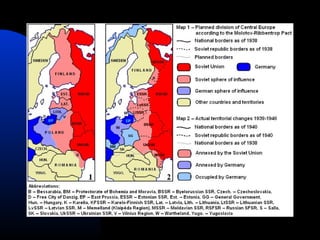
 Then Britain, France and the USSR made their separate
deals with Hitler, which enabled him to start World War II
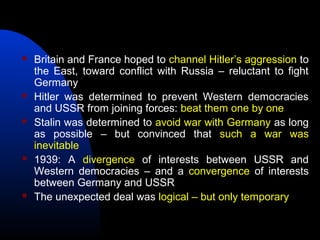
 Britain and France hoped to channel Hitler’s aggression to
the East, toward conflict with Russia – reluctant to fight
Germany
 Hitler was determined to prevent Western democracies
and USSR from joining forces: beat them one by one
 Stalin was determined to avoid war with Germany as long
as possible – but convinced that such a war was
inevitable
 1939: A divergence of interests between USSR and
Western democracies – and a convergence of interests
between Germany and USSR
 The unexpected deal was logical – but only temporary
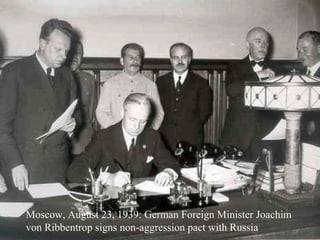
Moscow, August 23, 1939: German Foreign Minister Joachim
von Ribbentrop signs non-aggression pact with Russia
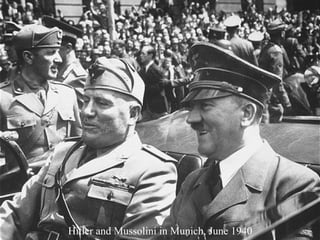
Hitler and Mussolini in Munich, June 1940
1939-1941: growing tensions between USSR and Germany
 At first: division of the spoils. But then:
 Germany’s unexpected triumph in the West emboldens
Hitler
 Hitler’s strategic goal of conquering the USSR was never
abandoned – for geopolitical and ideological reasons
 Stalin expected the new war to generate a new wave of
revolutions – and intended to get involved
 By 1941, his fear of German power became the
overwhelming factor
 He was appeasing Hitler – and preparing for war against
him at the same time
 Each of the two intended to strike first
 Hitler preempted Stalin and delivered a crushing blow
 Operation Barbarossa
 June 22, 1941
 Over 4.5 million troops of the Axis powers invaded
the USSR along an 1,800 mile front
 Goals:
 Total destruction of the Soviet state
 Colonization of the Soviet territory, together with
allies – Japan especially
 Enslavement of the population, turning the territory
into a resource base for the Third Reich
 The Nazi invasion :
 http://www.youtube.com/watch?
v=StYywx7Uzok&feature=related
 BBC, “War of the Century”, Parts
2,3,4
 Hitler explaining the future war against Russia, March 1941:
 “It is a struggle between two ideologies… Communism
presents an enormous danger for the future. A communist
has never been and never will be our comrade. It is a
struggle for annihilation. If we think otherwise, then, even if
we should crush the enemy, the communist threat will rise
again in 30 years…
 This war will be vastly different from the onw in the West. In
the East, brutality is a benefit for the future. Commanders
must be ready for sacrifice and overcome their doubts.”
 From the diary of General F. Halder, Chief of Staff, Land
Forces, Germany
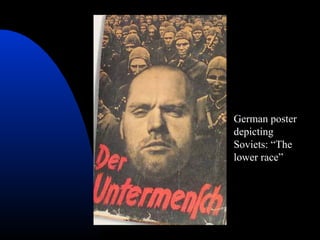
German poster
depicting
Soviets: “The
lower race”
 STAKES IN THE BATTLE FOR RUSSIA
 Will the Soviet state survive?
 Will Soviet society as a product of the transformations since
1917 be crushed?
 Will the Soviet Union become a German colony?
 How many Soviet citizens will survive?
 Will genocide become a new global norm?
 What will become of the world?
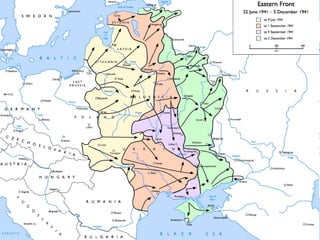
 In the first 10 days, German armies moved 550 km into
Soviet territory
 In the first 20 days of the war, the Red Army lost 1/5 of its
manpower – 600,000 men
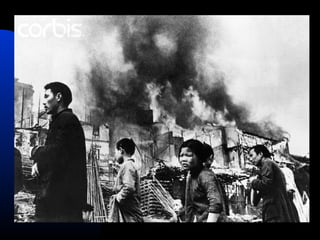
 By July, 20 mln. Soviets found themselves under
occupation. Nazi terror began.
 Resistance
 Redeployment of industry to the East
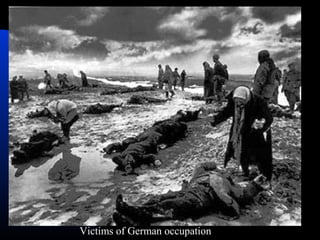
Victims of German occupation
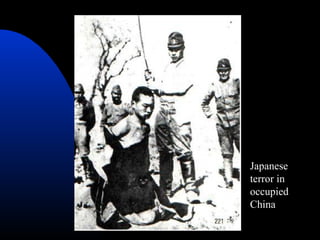
Japanese
terror in
occupied
China
 Resistance
 http://www.youtube.com/watch?
v=4IAfigTgzmU&feature=related
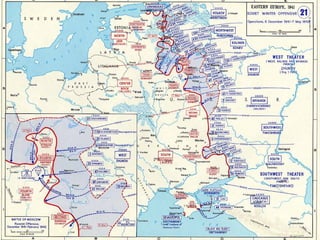
 The Battle of Moscow: September
1941 – January 1942
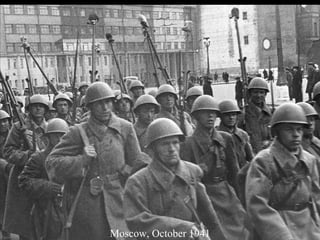
Moscow, October 1941
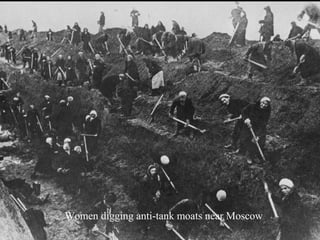
Women digging anti-tank moats near Moscow
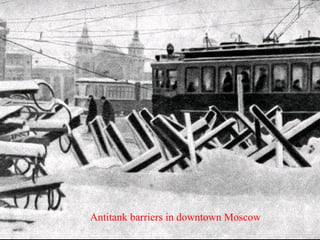
Antitank barriers in downtown Moscow
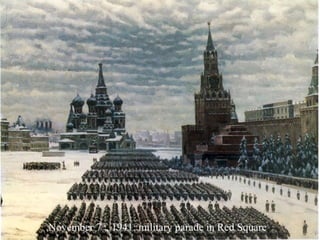
November 7th
, 1941: military parade in Red Square
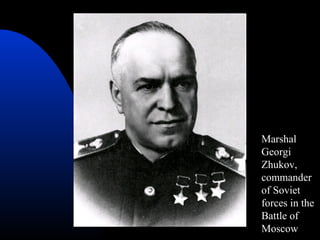
Marshal
Georgi
Zhukov,
commander
of Soviet
forces in the
Battle of
Moscow
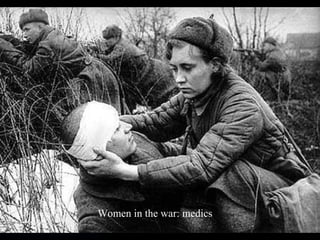
Women in the war: medics
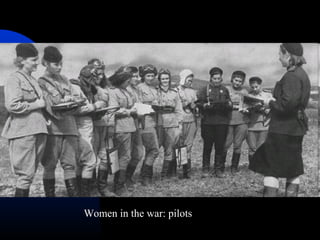
Women in the war: pilots
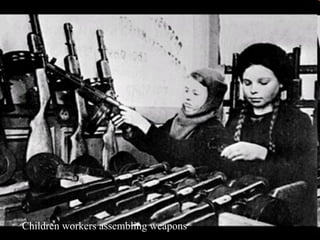
Children workers assembling weapons
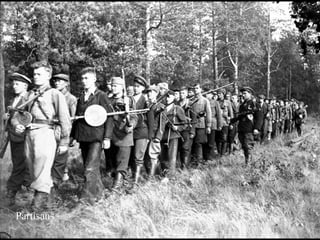
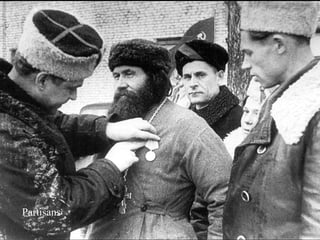
Partisans
Partisans
 The Battle of Moscow was the first
Soviet victory over Nazi Germany.
 Casualties in the battle of Moscow:
 250,000 – 400,000 German
 600,000 – 1,300,000 Soviet
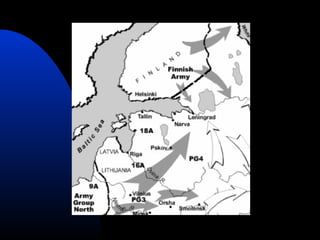
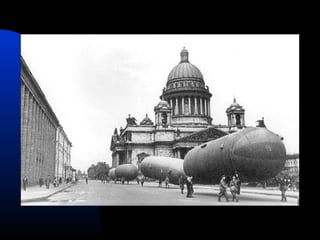
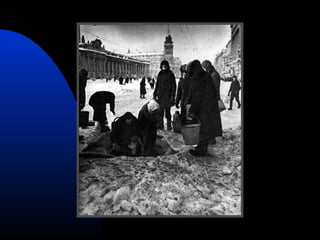
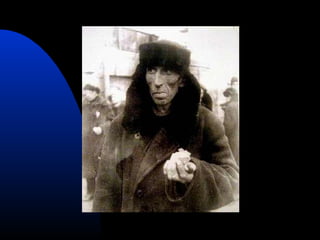
The Siege of Leningrad
 September 1941 – November 1943
 The Germans and Finns failed to take the city
 The cost to Soviet population:
 About 1.4 million people were rescued by military
evacuation from the besieged city of Leningrad in
two years between September 1941 and November
1943.
 Another 1.2 million civilians perished in the city.
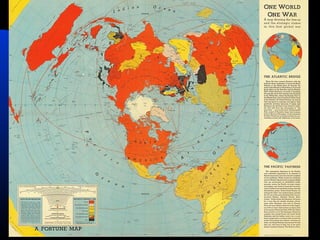
 In 1939-41, states of the Global Right attacked the world
order, aiming at global primacy
 Western democracies joined forces with the communist
state in a defensive Center-Left coalition against the Right
 The battle for Russia became decisive for the defeat of the
Global Right
 US and British aid to the Soviet ally, 1941-45:
 Food - $1.5 bln. in
 Automobiles – 427,000
 Warplanes – 22,000
 Tanks – 13,000
 Warships – over 500
 Explosives – 350,000 tons
 Other supplies
 Total estimated cost of Allied aid to USSR in contemporary
prices –
 $100 bln.
 America at war:
 http://www.youtube.com/watch?
v=G5u8E4s57I0&feature=related
 The turning point of World War II:
Stalingrad
 http://www.youtube.com/watch?
v=G5u8E4s57I0&feature=related
 The Battle of Stalingrad claimed over two million
casualties, more than any other battle in human history
 It was also one of the longest: it raged for 199 days
 Killed, wounded or captured at Stalingrad:
 Soviets: 1,290,000
 Germans and allies: 850,000
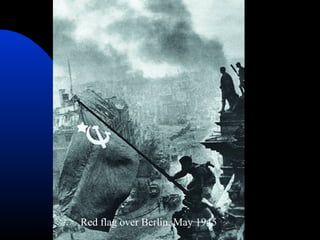
Red flag over Berlin, May 1945
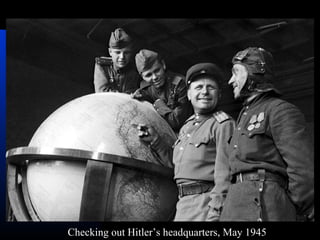
Checking out Hitler’s headquarters, May 1945
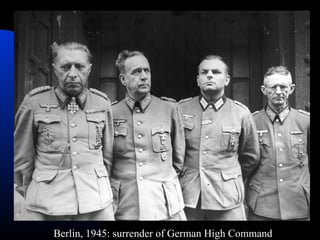
Berlin, 1945: surrender of German High Command
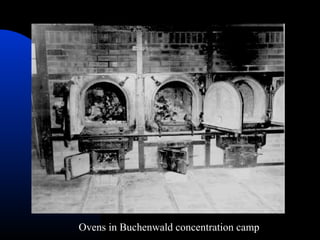
Ovens in Buchenwald concentration camp
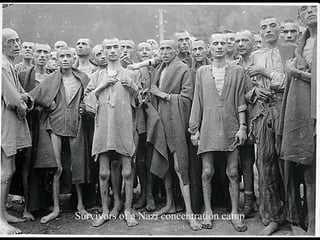
Survivors of a Nazi concentration camp
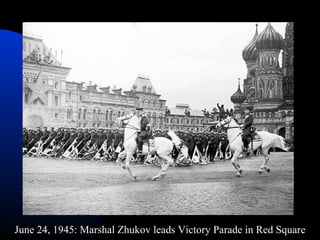
June 24, 1945: Marshal Zhukov leads Victory Parade in Red Square
 Victory Parade in Red Square, June 24,
1945:
 http://www.youtube.com/watch?
v=QDQ2gQttPBs&NR=1
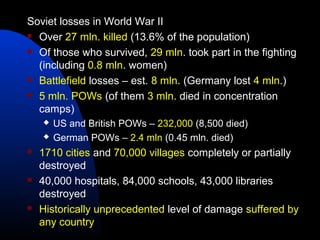
Soviet losses in World War II
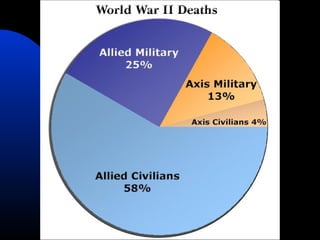
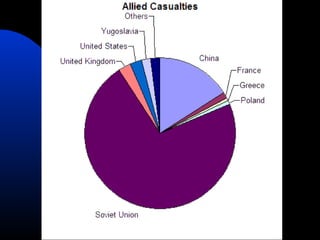
 Over 27 mln. killed (13.6% of the population)
 Of those who survived, 29 mln. took part in the fighting
(including 0.8 mln. women)
 Battlefield losses – est. 8 mln. (Germany lost 4 mln.)
 5 mln. POWs (of them 3 mln. died in concentration
camps)
 US and British POWs – 232,000 (8,500 died)
 German POWs – 2.4 mln (0.45 mln. died)
 1710 cities and 70,000 villages completely or partially
destroyed
 40,000 hospitals, 84,000 schools, 43,000 libraries
destroyed
 Historically unprecedented level of damage suffered by
any country
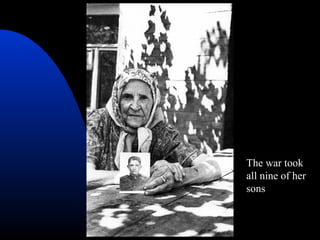
The war took
all nine of her
sons
http://www.youtube.com/watch?
v=da1e9Sz8I8k&feature=related

USSR in world war II

  • 1.
  • 2.
    London: monument toRoosevelt and Churchill
  • 3.
    The Big Three:Churchill, Roosevelt and Stalin at Yalta, Feb.1945
  • 4.
     The ultimatetest of the Russian battle order has usually been war  The Romanov Empire failed that test in WWI – and fell  By the time of the next test – WWII, the Russian state was transformed into a more formidable machine  The “socialist” organization of the country was aimed at making the state more militarily capable  A similar logic unfolded in Italy and Germany under different forms of “socialism”  They talked of “socialism”, but they meant winning world wars
  • 5.
     If theessence of War Communism was to win the Russian civil war, the essence of Stalinism was to win in World War II  Belief in the inevitability of war – of one kind or another  The slide to war  Forced modernization  The Great Terror of 1937-38  Skirmishes in the 1930s: China, Spain  Diplomatic maneuvers in 1934-39: attempts to contain the fascist powers, then a non-aggression pact with Hitler
  • 6.
    Global civil warand interstate conflict  Fierce Left-Right struggles in European countries since WWI, the lure and fear of revolution  Stalinism in Russia as a new stage in the Russian civil war: forced modernization to strengthen the state and make it fit for the next round of interstate wars  Fascism as a new stage in European Left-Right conflict: to defeat the Left internally and externally  Projection of the internal conflicts on interstate relations  The Spanish Civil War  Appeasement: betrayal of Czechoslovakia  The fall of democracies across Europe due to both internal (Left vs. Right) and external (actions of Germany, Italy, and the Soviet Union)
  • 7.
    The geopolitical triangle:Axis powers (Germany, Italy, Japan), USSR, Western democracies (WDs) USSR WDs Axis
  • 8.
     As astate committed to world revolution, the Soviet Union was viewed as a threat by Western elites  The rise of fascism was partly a response to the threat – and anticommunism was one of the motives of Western appeasement of Hitler  But the Axis powers were also challenging other Great Powers in Europe and Asia – the continuing conflict between empires  In the 1920s-early 1930s, before Hitler’s coming to power in Germany, USSR cooperated with Germany against Britain and France  When Germany became a radical anticommunist force, USSR and Western democracies discussed “collective security” arrangements to prevent Hitler’s aggression – without success  Then Britain, France and the USSR made their separate deals with Hitler, which enabled him to start World War II
  • 9.
     Britain andFrance hoped to channel Hitler’s aggression to the East, toward conflict with Russia – reluctant to fight Germany  Hitler was determined to prevent Western democracies and USSR from joining forces: beat them one by one  Stalin was determined to avoid war with Germany as long as possible – but convinced that such a war was inevitable  1939: A divergence of interests between USSR and Western democracies – and a convergence of interests between Germany and USSR  The unexpected deal was logical – but only temporary
  • 10.
    Moscow, August 23,1939: German Foreign Minister Joachim von Ribbentrop signs non-aggression pact with Russia
  • 14.
    Hitler and Mussoliniin Munich, June 1940
  • 15.
    1939-1941: growing tensionsbetween USSR and Germany  At first: division of the spoils. But then:  Germany’s unexpected triumph in the West emboldens Hitler  Hitler’s strategic goal of conquering the USSR was never abandoned – for geopolitical and ideological reasons  Stalin expected the new war to generate a new wave of revolutions – and intended to get involved  By 1941, his fear of German power became the overwhelming factor  He was appeasing Hitler – and preparing for war against him at the same time  Each of the two intended to strike first  Hitler preempted Stalin and delivered a crushing blow
  • 16.
     Operation Barbarossa June 22, 1941  Over 4.5 million troops of the Axis powers invaded the USSR along an 1,800 mile front  Goals:  Total destruction of the Soviet state  Colonization of the Soviet territory, together with allies – Japan especially  Enslavement of the population, turning the territory into a resource base for the Third Reich
  • 17.
     The Naziinvasion :  http://www.youtube.com/watch? v=StYywx7Uzok&feature=related  BBC, “War of the Century”, Parts 2,3,4
  • 18.
     Hitler explainingthe future war against Russia, March 1941:  “It is a struggle between two ideologies… Communism presents an enormous danger for the future. A communist has never been and never will be our comrade. It is a struggle for annihilation. If we think otherwise, then, even if we should crush the enemy, the communist threat will rise again in 30 years…  This war will be vastly different from the onw in the West. In the East, brutality is a benefit for the future. Commanders must be ready for sacrifice and overcome their doubts.”  From the diary of General F. Halder, Chief of Staff, Land Forces, Germany
  • 19.
  • 21.
     STAKES INTHE BATTLE FOR RUSSIA  Will the Soviet state survive?  Will Soviet society as a product of the transformations since 1917 be crushed?  Will the Soviet Union become a German colony?  How many Soviet citizens will survive?  Will genocide become a new global norm?  What will become of the world?
  • 22.
     In thefirst 10 days, German armies moved 550 km into Soviet territory  In the first 20 days of the war, the Red Army lost 1/5 of its manpower – 600,000 men  By July, 20 mln. Soviets found themselves under occupation. Nazi terror began.  Resistance  Redeployment of industry to the East
  • 23.
  • 24.
  • 26.
  • 27.
     The Battleof Moscow: September 1941 – January 1942
  • 28.
  • 29.
    Women digging anti-tankmoats near Moscow
  • 30.
    Antitank barriers indowntown Moscow
  • 31.
    November 7th , 1941:military parade in Red Square
  • 32.
  • 33.
    Women in thewar: medics
  • 35.
    Women in thewar: pilots
  • 36.
  • 37.
  • 38.
  • 40.
     The Battleof Moscow was the first Soviet victory over Nazi Germany.  Casualties in the battle of Moscow:  250,000 – 400,000 German  600,000 – 1,300,000 Soviet
  • 42.
    The Siege ofLeningrad  September 1941 – November 1943  The Germans and Finns failed to take the city  The cost to Soviet population:  About 1.4 million people were rescued by military evacuation from the besieged city of Leningrad in two years between September 1941 and November 1943.  Another 1.2 million civilians perished in the city.
  • 47.
     In 1939-41,states of the Global Right attacked the world order, aiming at global primacy  Western democracies joined forces with the communist state in a defensive Center-Left coalition against the Right  The battle for Russia became decisive for the defeat of the Global Right
  • 51.
     US andBritish aid to the Soviet ally, 1941-45:  Food - $1.5 bln. in  Automobiles – 427,000  Warplanes – 22,000  Tanks – 13,000  Warships – over 500  Explosives – 350,000 tons  Other supplies  Total estimated cost of Allied aid to USSR in contemporary prices –  $100 bln.
  • 52.
     America atwar:  http://www.youtube.com/watch? v=G5u8E4s57I0&feature=related
  • 53.
     The turningpoint of World War II: Stalingrad  http://www.youtube.com/watch? v=G5u8E4s57I0&feature=related
  • 54.
     The Battleof Stalingrad claimed over two million casualties, more than any other battle in human history  It was also one of the longest: it raged for 199 days  Killed, wounded or captured at Stalingrad:  Soviets: 1,290,000  Germans and allies: 850,000
  • 57.
    Red flag overBerlin, May 1945
  • 58.
    Checking out Hitler’sheadquarters, May 1945
  • 59.
    Berlin, 1945: surrenderof German High Command
  • 60.
    Ovens in Buchenwaldconcentration camp
  • 61.
    Survivors of aNazi concentration camp
  • 63.
    June 24, 1945:Marshal Zhukov leads Victory Parade in Red Square
  • 64.
     Victory Paradein Red Square, June 24, 1945:  http://www.youtube.com/watch? v=QDQ2gQttPBs&NR=1
  • 67.
    Soviet losses inWorld War II  Over 27 mln. killed (13.6% of the population)  Of those who survived, 29 mln. took part in the fighting (including 0.8 mln. women)  Battlefield losses – est. 8 mln. (Germany lost 4 mln.)  5 mln. POWs (of them 3 mln. died in concentration camps)  US and British POWs – 232,000 (8,500 died)  German POWs – 2.4 mln (0.45 mln. died)  1710 cities and 70,000 villages completely or partially destroyed  40,000 hospitals, 84,000 schools, 43,000 libraries destroyed  Historically unprecedented level of damage suffered by any country
  • 68.
    The war took allnine of her sons
  • 69.