Ultrasonic
machining(USM)
Martin
Aeronautical
Over view :
Principle
Components
Specifications
Parameters
Advantages
Dis advantages
Applications
Principle:
• Ultrasonic machining is a non-traditional machining
process means of uniform stock material removal
which is used to erode material in form of fine holes
and cavities in hard or brittle workpiece.
• it uses formed tools,vibrations of high frequency
and a suitable abrasive material to remove the
material
• Frequency>20,000hz
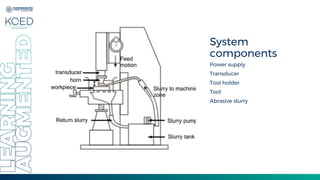
System
components
Power supply
Transducer
Tool holder
Tool
Abrasive slurry
Abrasive slurry:
Abrasive material:
• boron carbide
• Silicon carbide
• Corundum
• Diamond
• Boron silicon carbide
Liquid:
• Water
• Benzene
• Glycerol
• Oils
• High viscosity
decreases MMR
Specifications:
• The tool should be made up of low carbon steel or
stainless steel for good performance
• Tools are usually 25 mm long;its size is equal to hole
size minus twice the size of abrasives.
• Mass of the tool should be minimum possible so that
it does not absorb the ultrasonic energy.
• Surface finish of tool should be notified as it
replicates in the workpiece.
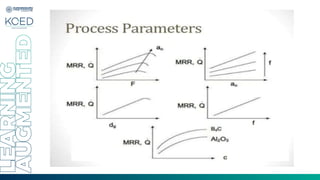
Process parameters
• Amplitute of vibration(a)-15-50 micro-meter
• Frequency of vibration(f)-19-25khz
• Feed force(F)
• Feed pressure(p)
• Abrasive size-15-150micro-meter
• Contact area of tool-A
• Volume concentration of abrasive in slurry-C.
Advantage
• Machining any materials regardless their conductivity.
• It is used for machining of semi conductor such as silicon
, germanium ,.etc.
• USM is suitable to precise machining of brittle material
• USM does not produce electric,thermal,chemical
abnormal surface.
• Can drill circular or non-circular holes in very hard
material.
• Less stress because of its non-thermal characteristics
Disadvantages
• USM has low material rate.(3-15mm/min)
• Tool wears fast in USM.
• machining area and depth is restraint in USM
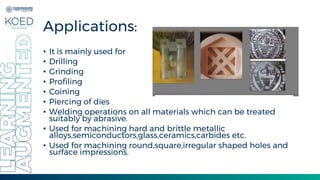
Applications:
• It is mainly used for
• Drilling
• Grinding
• Profiling
• Coining
• Piercing of dies
• Welding operations on all materials which can be treated
suitably by abrasive.
• Used for machining hard and brittle metallic
alloys,semiconductors,glass,ceramics,carbides etc.
• Used for machining round,square,irregular shaped holes and
surface impressions.
Educational videos:
https://youtu.be/5w6szZtOg5w
https://youtu.be/jj9s5NhzfnY
USM.PPT (1).pptx

USM.PPT (1).pptx

  • 1.
  • 2.
  • 3.
    Principle: • Ultrasonic machiningis a non-traditional machining process means of uniform stock material removal which is used to erode material in form of fine holes and cavities in hard or brittle workpiece. • it uses formed tools,vibrations of high frequency and a suitable abrasive material to remove the material • Frequency>20,000hz
  • 4.
  • 5.
    Abrasive slurry: Abrasive material: •boron carbide • Silicon carbide • Corundum • Diamond • Boron silicon carbide Liquid: • Water • Benzene • Glycerol • Oils • High viscosity decreases MMR
  • 6.
    Specifications: • The toolshould be made up of low carbon steel or stainless steel for good performance • Tools are usually 25 mm long;its size is equal to hole size minus twice the size of abrasives. • Mass of the tool should be minimum possible so that it does not absorb the ultrasonic energy. • Surface finish of tool should be notified as it replicates in the workpiece.
  • 7.
    Process parameters • Amplituteof vibration(a)-15-50 micro-meter • Frequency of vibration(f)-19-25khz • Feed force(F) • Feed pressure(p) • Abrasive size-15-150micro-meter • Contact area of tool-A • Volume concentration of abrasive in slurry-C.
  • 9.
    Advantage • Machining anymaterials regardless their conductivity. • It is used for machining of semi conductor such as silicon , germanium ,.etc. • USM is suitable to precise machining of brittle material • USM does not produce electric,thermal,chemical abnormal surface. • Can drill circular or non-circular holes in very hard material. • Less stress because of its non-thermal characteristics
  • 10.
    Disadvantages • USM haslow material rate.(3-15mm/min) • Tool wears fast in USM. • machining area and depth is restraint in USM
  • 11.
    Applications: • It ismainly used for • Drilling • Grinding • Profiling • Coining • Piercing of dies • Welding operations on all materials which can be treated suitably by abrasive. • Used for machining hard and brittle metallic alloys,semiconductors,glass,ceramics,carbides etc. • Used for machining round,square,irregular shaped holes and surface impressions.
  • 12.