Donald Thibeau, Director of Product Mangement
donald@hedera.com
Xin Li, Senior Software Engineer
xin.li@swirlds.com
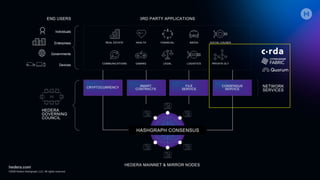
HEDERA
GOVERNING
COUNCIL
NETWORK
SERVICES
CRYPTOCURRENCY SMART
CONTRACTS
FILE
SERVICE
CONSENSUS
SERVICE
HASHGRAPH CONSENSUS
HEDERA MAINNET & MIRROR NODES
END USERS 3RD PARTY APPLICATIONS
LEGALGAMING LOGISTICSCOMMUNICATIONS PRIVATE DLT
MEDIAHEALTHREAL ESTATE SOCIAL CAUSESFINANCIAL
Individuals
Enterprises
Devices
Governments
Public vs. Private
Advantage Disadvantage
Private
• Privacy configuration
• Governance
• Centralization
• Scale
• Vendor lock in
Public
• Decentralization • Performance
• Anonymity
• Regulatory concerns
The Hedera Consensus Service
Hedera: Providing decentralization of a public network with privacy
and compliance controls of a private network.
PRIVACY
FINALITY
TRUST
AVAILABILITY
HEDERA
CONSENSUS
PRIVATE NETWORK PRIVATE NETWORK
CUSTOMIZATION
DATA ENCRYPTION
PERFORMANCE
IDENTITYMANAGEMENT
Encrypted
transaction
Transaction
timestamp
Pluggable Consensus with HCS
Hedera Consensus Service provides auditable
log of transaction for distinct tokens.
Permissioned networks now share a single
consensus engine, enabling:
• Custom data access and encryption
• Custom token definitions
• Verifiable timestamps
• Decentralized, shared service
• Finality of transaction order
• High performance
Hedera supports integrations between the
Hedera Consensus Service, Hyperledger Fabric,
and R3’s Corda
Hedera mainnet
Hedera mirrornet
• Message
• TopicID
• Submitting Account
Hedera
HCS Message Submission
Hedera mainnet
Hedera mirrornet
• Consensus Timestamp
• Sequence Number
• Running Hash
Hedera
HCS Message Response
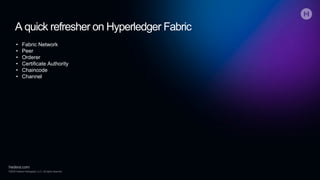
A quick refresher on Hyperledger Fabric
• Fabric Network
• Peer
• Orderer
• Certificate Authority
• Chaincode
• Channel
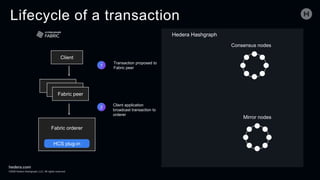
Lifecycle of a transaction
1
Transaction proposed to
Fabric peer
2
Client application
broadcast transaction to
orderer
Client
Fabric peer
Fabric orderer
HCS plug-in
Consensus nodes
Mirror nodes
Hedera Hashgraph
Lifecycle of a transaction
3
Transaction fragmented
into messages,
associated with topicID
4
Messages submitted to
topic using HCS
Client
Fabric peer
Fabric orderer
HCS plug-in
Hedera Hashgraph
Consensus nodes
Mirror nodes
Lifecycle of a transaction
5
Event reaches
consensus,
receiving
consensus
timestamp and
state proof
Client
Fabric peer
Fabric orderer
HCS plug-in
Hedera Hashgraph
Consensus nodes
Mirror nodes
Lifecycle of a transaction
6 Notify of message order
Client
Fabric peer
Fabric orderer
HCS plug-in
Consensus nodes
Mirror nodes
Hedera Hashgraph
Lifecycle of a transaction
Client
Fabric peer
Fabric orderer
HCS plug-in
Consensus nodes
Mirror nodes
7
Transaction
reassembled,
put in block
8
Ordered
transactions
given to peers
9
Endorsed
responses
collected
Hedera Hashgraph
HCS-based Orderer
Orderer
Hedera SDK
Common
HCS Plug-in
Config handling Channel mgmt
Common txn
handling
Block cutter
AtomicBroadcast
Config
handling
Channel
mgmt
Txn handling
Consenter Chain
Broadcast transaction to orderer Deliver ordered blocks
Notify of consensus messages from
mirror node
Submit messages to mainnet

Using the Hedera Consensus Service with Hyperledger Fabric

  • 1.
    Donald Thibeau, Directorof Product Mangement donald@hedera.com Xin Li, Senior Software Engineer xin.li@swirlds.com
  • 2.
    HEDERA GOVERNING COUNCIL NETWORK SERVICES CRYPTOCURRENCY SMART CONTRACTS FILE SERVICE CONSENSUS SERVICE HASHGRAPH CONSENSUS HEDERAMAINNET & MIRROR NODES END USERS 3RD PARTY APPLICATIONS LEGALGAMING LOGISTICSCOMMUNICATIONS PRIVATE DLT MEDIAHEALTHREAL ESTATE SOCIAL CAUSESFINANCIAL Individuals Enterprises Devices Governments
  • 3.
    Public vs. Private AdvantageDisadvantage Private • Privacy configuration • Governance • Centralization • Scale • Vendor lock in Public • Decentralization • Performance • Anonymity • Regulatory concerns
  • 4.
    The Hedera ConsensusService Hedera: Providing decentralization of a public network with privacy and compliance controls of a private network.
  • 5.
    PRIVACY FINALITY TRUST AVAILABILITY HEDERA CONSENSUS PRIVATE NETWORK PRIVATENETWORK CUSTOMIZATION DATA ENCRYPTION PERFORMANCE IDENTITYMANAGEMENT Encrypted transaction Transaction timestamp Pluggable Consensus with HCS Hedera Consensus Service provides auditable log of transaction for distinct tokens. Permissioned networks now share a single consensus engine, enabling: • Custom data access and encryption • Custom token definitions • Verifiable timestamps • Decentralized, shared service • Finality of transaction order • High performance Hedera supports integrations between the Hedera Consensus Service, Hyperledger Fabric, and R3’s Corda
  • 6.
    Hedera mainnet Hedera mirrornet •Message • TopicID • Submitting Account Hedera HCS Message Submission
  • 7.
    Hedera mainnet Hedera mirrornet •Consensus Timestamp • Sequence Number • Running Hash Hedera HCS Message Response
  • 8.
    A quick refresheron Hyperledger Fabric • Fabric Network • Peer • Orderer • Certificate Authority • Chaincode • Channel
  • 9.
    Lifecycle of atransaction 1 Transaction proposed to Fabric peer 2 Client application broadcast transaction to orderer Client Fabric peer Fabric orderer HCS plug-in Consensus nodes Mirror nodes Hedera Hashgraph
  • 10.
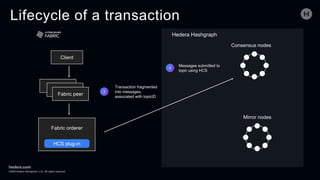
    Lifecycle of atransaction 3 Transaction fragmented into messages, associated with topicID 4 Messages submitted to topic using HCS Client Fabric peer Fabric orderer HCS plug-in Hedera Hashgraph Consensus nodes Mirror nodes
  • 11.
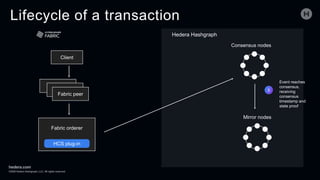
    Lifecycle of atransaction 5 Event reaches consensus, receiving consensus timestamp and state proof Client Fabric peer Fabric orderer HCS plug-in Hedera Hashgraph Consensus nodes Mirror nodes
  • 12.
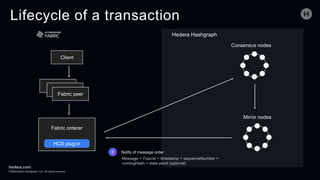
    Lifecycle of atransaction 6 Notify of message order Client Fabric peer Fabric orderer HCS plug-in Consensus nodes Mirror nodes Hedera Hashgraph
  • 13.
    Lifecycle of atransaction Client Fabric peer Fabric orderer HCS plug-in Consensus nodes Mirror nodes 7 Transaction reassembled, put in block 8 Ordered transactions given to peers 9 Endorsed responses collected Hedera Hashgraph
  • 14.
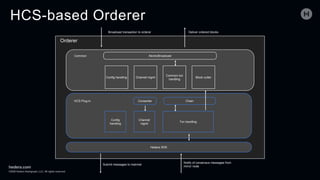
    HCS-based Orderer Orderer Hedera SDK Common HCSPlug-in Config handling Channel mgmt Common txn handling Block cutter AtomicBroadcast Config handling Channel mgmt Txn handling Consenter Chain Broadcast transaction to orderer Deliver ordered blocks Notify of consensus messages from mirror node Submit messages to mainnet

Editor's Notes

  • #2 Hey good afternoon everybody! I’m excited to talk to you all today about Hedera Hashgraph — we’re an enterprise-grade public network for decentralized applications.
  • #7  In September of 2019, Hedera launched it global public network – the mainnet. A network that everyone in the world can leverage. A public ledger where the nodes operate at the highest known level of trust - – Asynchronous Byzantine Fault Tolerence – or ABFT for short. Attack resistant and able to come to consensus independently in a matter of seconds. Since the launch of the network - anyone anywhere has been able to create accounts and build decentralized applications. CLICK Importantly, unlike other networks, Hedera does not store state. Data does not reside on the network for more than a few minutes. Therefore Hedera - and several third parties – have launched mirror nodes so that transaction history can be managed. While Mirror nodes do not participate in consensus, mirror nodes can provide a public record of transactions and the state. In addition, mirror nodes offer flexibility for the owner to choose what to store and for how long. So the mirror node is a means for storing and retrieving transaction history long after the record has ceased to exist on the Hedera mainnet. CLICK And finally we have the concept of an application network – or appnet for short. An appnet is simply software that is executed collectively across Hedera’s global public network. These applications interact in order to achieve a specific common goal or task – settlement between airlines for example, or payments between two organizations or individuals. Importantly, the party’s that interact do not need to trust one another as they inherit the trust from Hedera. Trust in the order of transactions, the time they happen and proof that they occurred.
  • #8  In September of 2019, Hedera launched it global public network – the mainnet. A network that everyone in the world can leverage. A public ledger where the nodes operate at the highest known level of trust - – Asynchronous Byzantine Fault Tolerence – or ABFT for short. Attack resistant and able to come to consensus independently in a matter of seconds. Since the launch of the network - anyone anywhere has been able to create accounts and build decentralized applications. CLICK Importantly, unlike other networks, Hedera does not store state. Data does not reside on the network for more than a few minutes. Therefore Hedera - and several third parties – have launched mirror nodes so that transaction history can be managed. While Mirror nodes do not participate in consensus, mirror nodes can provide a public record of transactions and the state. In addition, mirror nodes offer flexibility for the owner to choose what to store and for how long. So the mirror node is a means for storing and retrieving transaction history long after the record has ceased to exist on the Hedera mainnet. CLICK And finally we have the concept of an application network – or appnet for short. An appnet is simply software that is executed collectively across Hedera’s global public network. These applications interact in order to achieve a specific common goal or task – settlement between airlines for example, or payments between two organizations or individuals. Importantly, the party’s that interact do not need to trust one another as they inherit the trust from Hedera. Trust in the order of transactions, the time they happen and proof that they occurred.