Using the
Australian Core
Skills Framework
ACSF
This Photo by Unknown Author is licensed under CC BY-SA-NC
This Photo by Unknown Author is licensed under CC BY-SA
Reading
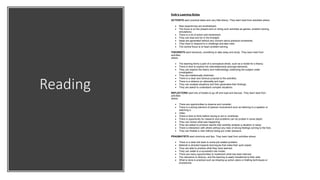
Requires reading and understanding of:
• Level 1 – very personally familiar, relevant and explicit texts
• Level 2 – just familiar texts and topics
• Level 3 – some familiar, but also some unfamiliar or new texts
• Level 4 – complex texts including an ability to critically understand
them
• Level 5 – a range of complex texts and an ability to pull ideas together
across multiple texts
Reading
Kolb’s Learning Styles
ACTIVISTS want practical tasks and very little theory. They learn best from activities where:
 New experiences are emphasised;
 The focus is on the present and on doing such activities as games, problem solving,
simulations;
 There is a lot of action and excitement;
 They can lead and be in the limelight;
 Ideas are generated without any concern about practical constraints;
 They have to respond to a challenge and take risks;
 The central focus is on team problem-solving.
THEORISTS want handouts, something to take away and study. They learn best from
activities
where:
 The learning forms a part of a conceptual whole, such as a model for a theory;
 There is time to explore the interrelationship amongst elements;
 They can explore the theory and methodology underlying the subject under
investigation;
 They are intellectually stretched;
 There is a clear and obvious purpose to the activities;
 There is a reliance on rationality and logic;
 They can analyse situations and then generalise their findings;
 They are asked to understand complex situations.
REFLECTORS want lots of breaks to go off and read and discuss. They learn best from
activities
where:
 There are opportunities to observe and consider;
 There is a strong element of passive involvement such as listening to a speaker or
watching a
 video;
 There is time to think before having to act or contribute;
 There is opportunity for research and problems can be probed in some depth;
 They can review what was happening;
 They are asked to produce reports that carefully analyse a situation or issue;
 There is interaction with others without any risks of strong feelings coming to the fore;
 They can finalise a view without being put under pressure.
PRAGMATISTS want shortcuts and tips. They learn best from activities where:
 There is a clear link back to some job-related problem;
 Material is directed towards techniques that make their work easier;
 They are able to practice what they have learned;
 They can relate to a successful role model;
 There are many opportunities to implement what has been learned;
 The relevance is obvious, and the learning is easily transferred to their jobs;
 What is done is practical such as drawing up action plans or trialling techniques or
procedures.
Writing
• Level 1 – Writes about a simple idea, opinion, fact or message
• Level 2 – Writes for a limited range of reasons and audiences
• Level 3 – Writes texts using a type or format that suits the purpose
• Level 4 – Writes complex texts using a format and style that suits the
purpose and audience
• Level 5 – Writes a range of complex texts for a range of purposes and
audiences
Writing
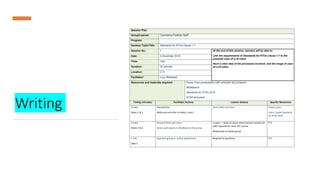
Session Plan
Group/Learner: Commerce Portfolio Staff
Program:
Session Topic/Title: Standards for RTOs Clause 1.7
Session No.: 1 At the end of this session, learners will be able to:
Link the requirements of Standards for RTOs clause 1.7 to the
potential uses of LLN robot.
Have a clear idea of the processes involved, and the range of uses
of LLN robot.
Date: 5 December 2016
Time: 1pm
Duration: 20 minutes
Location: C12
Facilitator: Lucy Wellstead
Resources and materials required: Power Point presentation with computer and projector
Whiteboard
Standards for RTOs 2015
ACSF document
Timing (minutes) Facilitator Actions Learner Actions Specific Resources
2 mins
Slides 1 & 2
Introduction:
Welcome and refer to slides 1 and 2
View slides and listen Power point
Users’ Guide Standards
for RTOs 2015
3 mins
Slides 3 & 4
Request think pair share
Select participants to feedback to the group
In pairs – relate occasion where learner lacked LLN
skills required for their VET course.
Relate back to whole group
P.P.
1 min
Slide 5
Question group re: online applications Respond to questions P.P.
Oral communication
• Level 1 – Speech and understanding is only of short and simple
language
• Level 2 – Can speak and understand everyday language
• Level 3 – Can speak about and understand unfamiliar topics as well as
familiar
• Level 4 – Speaks and understands language in a range of contexts
• Level 5 – Speaks and understands complex language in range of
context.
Checking my work
Your turn
This Photo by Unknown Author is licensed under CC BY-SA-NC

Using the ACSF

  • 1.
  • 2.
    This Photo byUnknown Author is licensed under CC BY-SA-NC
  • 3.
    This Photo byUnknown Author is licensed under CC BY-SA
  • 6.
    Reading Requires reading andunderstanding of: • Level 1 – very personally familiar, relevant and explicit texts • Level 2 – just familiar texts and topics • Level 3 – some familiar, but also some unfamiliar or new texts • Level 4 – complex texts including an ability to critically understand them • Level 5 – a range of complex texts and an ability to pull ideas together across multiple texts
  • 7.
    Reading Kolb’s Learning Styles ACTIVISTSwant practical tasks and very little theory. They learn best from activities where:  New experiences are emphasised;  The focus is on the present and on doing such activities as games, problem solving, simulations;  There is a lot of action and excitement;  They can lead and be in the limelight;  Ideas are generated without any concern about practical constraints;  They have to respond to a challenge and take risks;  The central focus is on team problem-solving. THEORISTS want handouts, something to take away and study. They learn best from activities where:  The learning forms a part of a conceptual whole, such as a model for a theory;  There is time to explore the interrelationship amongst elements;  They can explore the theory and methodology underlying the subject under investigation;  They are intellectually stretched;  There is a clear and obvious purpose to the activities;  There is a reliance on rationality and logic;  They can analyse situations and then generalise their findings;  They are asked to understand complex situations. REFLECTORS want lots of breaks to go off and read and discuss. They learn best from activities where:  There are opportunities to observe and consider;  There is a strong element of passive involvement such as listening to a speaker or watching a  video;  There is time to think before having to act or contribute;  There is opportunity for research and problems can be probed in some depth;  They can review what was happening;  They are asked to produce reports that carefully analyse a situation or issue;  There is interaction with others without any risks of strong feelings coming to the fore;  They can finalise a view without being put under pressure. PRAGMATISTS want shortcuts and tips. They learn best from activities where:  There is a clear link back to some job-related problem;  Material is directed towards techniques that make their work easier;  They are able to practice what they have learned;  They can relate to a successful role model;  There are many opportunities to implement what has been learned;  The relevance is obvious, and the learning is easily transferred to their jobs;  What is done is practical such as drawing up action plans or trialling techniques or procedures.
  • 8.
    Writing • Level 1– Writes about a simple idea, opinion, fact or message • Level 2 – Writes for a limited range of reasons and audiences • Level 3 – Writes texts using a type or format that suits the purpose • Level 4 – Writes complex texts using a format and style that suits the purpose and audience • Level 5 – Writes a range of complex texts for a range of purposes and audiences
  • 9.
    Writing Session Plan Group/Learner: CommercePortfolio Staff Program: Session Topic/Title: Standards for RTOs Clause 1.7 Session No.: 1 At the end of this session, learners will be able to: Link the requirements of Standards for RTOs clause 1.7 to the potential uses of LLN robot. Have a clear idea of the processes involved, and the range of uses of LLN robot. Date: 5 December 2016 Time: 1pm Duration: 20 minutes Location: C12 Facilitator: Lucy Wellstead Resources and materials required: Power Point presentation with computer and projector Whiteboard Standards for RTOs 2015 ACSF document Timing (minutes) Facilitator Actions Learner Actions Specific Resources 2 mins Slides 1 & 2 Introduction: Welcome and refer to slides 1 and 2 View slides and listen Power point Users’ Guide Standards for RTOs 2015 3 mins Slides 3 & 4 Request think pair share Select participants to feedback to the group In pairs – relate occasion where learner lacked LLN skills required for their VET course. Relate back to whole group P.P. 1 min Slide 5 Question group re: online applications Respond to questions P.P.
  • 10.
    Oral communication • Level1 – Speech and understanding is only of short and simple language • Level 2 – Can speak and understand everyday language • Level 3 – Can speak about and understand unfamiliar topics as well as familiar • Level 4 – Speaks and understands language in a range of contexts • Level 5 – Speaks and understands complex language in range of context.
  • 11.
  • 12.
    Your turn This Photoby Unknown Author is licensed under CC BY-SA-NC

Editor's Notes

  • #2 Welcome to this session ’Using the ACSF’. Before we start, take a moment to think about why it is that we want to address adult LLN skills. Remember the statistics from the ABS on Australian adult workers and their ability to engage in further training and employment. In my work as an LLN lecturer, I have learners referred for training or support if their LLN skills are below what they need in order to get a job, get a different job, or engage in training.
  • #3 In this situation there are a couple of things to consider. One is, what is the level of the learner? If I have a discussion with a learner, they might say “Well, I’m not really good at maths.” But what does that mean “I’m not really good at maths.” When I then go on to assess the learner I may end up surprised at how good their maths actually is. Conversely, a learner might tell me that maths is their strong point, and I may end up surprised at what they’re actually not able to do. So what I’ve learned is that I can’t really rely completely on what the learner says.
  • #4 What we need is something that helps us to measure someone’s mathematical ability (and other LLN skills), so that we can put a number on it or quantify it. That way, as professionals, we’re speaking the same language when we are talking about a learner’s levels across the LLN Core Skills. Luckily there are tools that help us to do this, and we’ll be learning about these and using them.
  • #5 Another consideration when working with a learner is ‘what are their goals or ambitions?’ Do they want to get a Certificate 3 and work in Aged Care, or do they want to become a Registered Nurse. This is critical to consider in light of their current LLN skills because it will tell us how realistic their goals are, in the short term; how much work it’s going to be for them to get there, their likelihood of success and how much support they might need to develop competence. As industry area specialists, you would know, even if only at a sub-conscious level, what the LLN skill requirements are for the work area you are training students for. We’ve also already looked at identifying the LLN skills in a unit of competence. If we’re going to give a number to the LLN level of a learner, we really need to be able to give a number to the LLN in training and work so that we can clearly see any mismatch between the training and the learner.
  • #6 What if there was a tool that could put a number on the LLN skills of your prospective learner, and a number on the skills of your training or work area? If there was, do you think this could help you to help your students? There is such a tool, and it’s called the Australian Core Skills Framework, or ACSF. As its’ name implies, it has been created for an Australian context, and the 5 core skills that it includes are learning, reading, writing, oral communication (encompassing speaking and listening), and numeracy. For this TAE unit, we’re mostly interested in the last 4 as these make up the L, L and N in LLN, but it may help to know that learning is a core skill as well and impacts on a learner’s ability to make progress in their training It is an employability skill as well. We’ve already found the LLN skills in a UoC, now we’re going to work out the ACSF levels for those skills. The ACSF has five levels, from 1 through to 5. In the same way that the AQF (Australian Qualifications Framework) is a hierarchy of levels of performance expected within qualification levels, the ACSF is a hierarchy too. However, the levels are not equivalent in any way. In some qualifications eg. Electrotechnology, students will need a very high level of maths in the ACSF, but not so high in oral communication. Conversely, a student in Community Services will require a very high level in oral communication but not much maths at all. The ACSF is a very detailed document but we don’t need to go into great depth here, we just need an understanding and a working knowledge of it so that we can make best use of it. 3 general principles as we move up the 5 levels in the ACSF are that we move from simple to complex; from concrete to abstract; and from familiar to unfamiliar. Let’s first look at what this means in reading, writing and oral communication. You can read about the ACSF on pages 66 to 71 of the McGraw Hill text in more detail. The information I’m presenting here has a slightly different focus, so it is well worth exploring the information in the text as well.
  • #7 This is my summary of how the demands of reading increases across the 5 levels. Generally, texts are more complex and often longer as we move up through the levels. I’m going to ask you to pause the recording soon and complete the first Blackboard Activity for this session. This activity will give you time to think about the ACSF and to use it. In this activity you will read a text that a Cert IV TAE student would be likely to read. Then, using the summary above, you will choose which ACSF level for reading would be required to read and understand the given text. It is not an exact science because the movement from 1 through to 5 is a continuum and even experts in this field may disagree for something that is on the boundary of 2 levels. The value of this activity is that you engage in the thinking process, and justify your levelling of the reading, rather than get it ‘right’. You can stop the recording now to do the activity.
  • #8 Well, what did you think? I thought the text would require ACSF level 4 to read and understand. My justification for that is because it is a complex text, there are a lot of unfamiliar concepts and terms in it, and it is quite a long text. I didn’t put it at level 5 but I can certainly understand if any of you did.
  • #9 This is my summary of how the complexity of writing increases across the 5 levels. Generally, the texts are longer and more complex as we move up through the levels, and there is an expectation that grammar, spelling and punctuation will improve also. In the same way as we did with reading there is an activity for you to decide what writing level a learner would be demonstrating for a given piece of writing. You can stop the recording and do Blackboard Activity 2.
  • #10 Well, what did you think this time? I thought level 3 because it uses a template suitable for a lesson session. However, I have seen many session plans of greater complexity that integrate more ideas, that would demonstrate level 4 in writing.
  • #11 This is my summary of how oral communication is described across the 5 levels. Generally, the texts are longer as we move up through the levels. Just a note that oral communication is broken down into speaking and listening. Learners can be, and often are, stronger or a higher level in one sub-skill compared to the other. For example, some speakers of English as an additional language understand more through listening than they are able to communicate through speaking. So, from looking at these core skills, you’ve hopefully been able to see that there is a continuum of development from level 1 through to level 5. The reading and the writing samples that we looked at before are taken from materials used in the unit Provide Work Skill Instruction. Let’s think now about the Oral Communication level that a trainer would need. I think it could sit at level 3 or 4, depending on the context of the work skill instruction. My rationale for level 3 over level 4 is that the work skill instruction would usually be within a defined context, rather than across a range of contexts.
  • #12 Once again, there’s a way to check that my evaluation is on a par with other professionals. There’s a facility in LLN Robot, that specifies the ACSF level requirements for the core skills of a unit. Reading, writing and oral communication for Provide Work Skill Instruction are all rated at level 3.
  • #13 Once again, it’s your turn. Using the work you have already completed with Make a Presentation, finding the required LLN skills, go back now, and work out what ACSF level you think would be required in reading, writing and oral communication.