Sarah Honeychurch: @NomadWarMachine
Shazia Ahmed: @ShaziaAhmed
Using Facebook groups for Peer
Assisted Learning: building
communities and enhancing the
student experience
How many of you …
• Use Facebook?
• Use Facebook professionally?
• Know the difference between:
– a profile, page and a group?
• Understand Facebook’s privacy settings?
Background
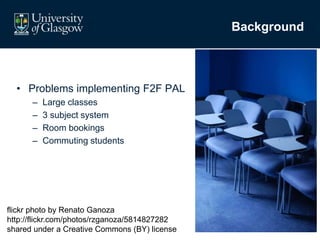
• Problems implementing F2F PAL
– Large classes
– 3 subject system
– Room bookings
– Commuting students
flickr photo by Renato Ganoza
http://flickr.com/photos/rzganoza/5814827282
shared under a Creative Commons (BY) license
The beginnings
Year 1
• L1 Maths
• L1 Comp Sci
Year 2
• Groups rolled over to L2
• L1 Maths
• L1 Comp Sci
• L1 Physics and Astro
• L1 Engineering
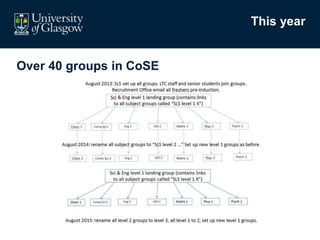
Over 40 groups in CoSE
This year
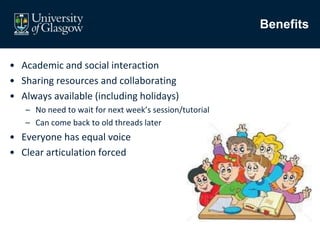
Benefits
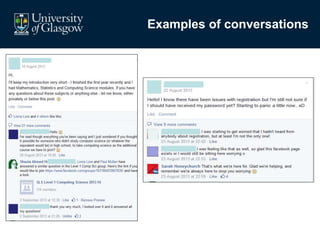
• Academic and social interaction
• Sharing resources and collaborating
• Always available (including holidays)
– No need to wait for next week’s session/tutorial
– Can come back to old threads later
• Everyone has equal voice
• Clear articulation forced
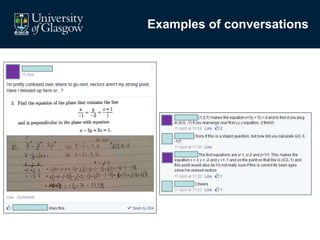
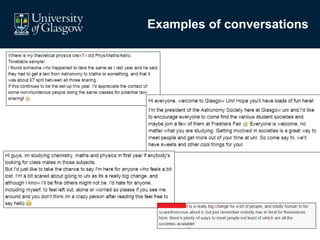
Examples of conversations
Feedback
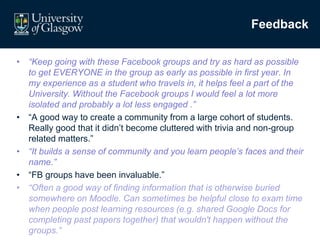
• “Keep going with these Facebook groups and try as hard as possible
to get EVERYONE in the group as early as possible in first year. In
my experience as a student who travels in, it helps feel a part of the
University. Without the Facebook groups I would feel a lot more
isolated and probably a lot less engaged .”
• “A good way to create a community from a large cohort of students.
Really good that it didn’t become cluttered with trivia and non-group
related matters.”
• “It builds a sense of community and you learn people’s faces and their
name.”
• “FB groups have been invaluable.”
• “Often a good way of finding information that is otherwise buried
somewhere on Moodle. Can sometimes be helpful close to exam time
when people post learning resources (e.g. shared Google Docs for
completing past papers together) that wouldn't happen without the
groups.”
Feedback
• “Personally it gives me confidence because if someone posts a
question that you were stuck on also...it makes you feel less stupid
because you know that other people are also struggling with some
concepts in the course, it’s not just you.”
• “Reading how people approach different problems.”
• “It’s like being in a tutorial sometimes.”
• “If you're stuck / need to know some piece of information it takes
literally seconds to hop on Facebook and make a post. Also, because
the uptake of the groups, in terms of membership, is so high, you're
likely to get an accurate response very quickly.”
• “During term time things being identified in notes/exercises such as
typos or mistakes were helpful.”
• “Getting other perspectives on topics. Collaborative exam solutions.”
Disadvantages
• “Dear Shazia & Sarah
It annoys me that I might be missing out on interesting
discussions. I think that it is great to encourage learning
and to discuss mathematics. However, I refuse to use
Facebook. Moreover, I don't think Facebook is the correct
place for discussing mathematics - University is the
correct place. I don't want my university experience to
become part of Facebook. Kind Regards Anon”
• “Didn't want to join them because I'm not interested in
updates from my classmates, I use Facebook just for
social events, messaging.”
Discussion
• Would you use this sort of model
with your students?
• Why (not)?
Sarah Honeychurch: @NomadWarMachine
Shazia Ahmed: @ShaziaAhmed
Using Facebook groups for Peer
Assisted Learning: building
communities and enhancing the
student experience

Using Facebook groups for Peer Assisted Learning: building communities and enhancing the student experience

  • 1.
    Sarah Honeychurch: @NomadWarMachine ShaziaAhmed: @ShaziaAhmed Using Facebook groups for Peer Assisted Learning: building communities and enhancing the student experience
  • 2.
    How many ofyou … • Use Facebook? • Use Facebook professionally? • Know the difference between: – a profile, page and a group? • Understand Facebook’s privacy settings?
  • 3.
    Background • Problems implementingF2F PAL – Large classes – 3 subject system – Room bookings – Commuting students flickr photo by Renato Ganoza http://flickr.com/photos/rzganoza/5814827282 shared under a Creative Commons (BY) license
  • 4.
    The beginnings Year 1 •L1 Maths • L1 Comp Sci Year 2 • Groups rolled over to L2 • L1 Maths • L1 Comp Sci • L1 Physics and Astro • L1 Engineering
  • 5.
    Over 40 groupsin CoSE This year
  • 6.
    Benefits • Academic andsocial interaction • Sharing resources and collaborating • Always available (including holidays) – No need to wait for next week’s session/tutorial – Can come back to old threads later • Everyone has equal voice • Clear articulation forced
  • 7.
  • 8.
  • 9.
  • 10.
    Feedback • “Keep goingwith these Facebook groups and try as hard as possible to get EVERYONE in the group as early as possible in first year. In my experience as a student who travels in, it helps feel a part of the University. Without the Facebook groups I would feel a lot more isolated and probably a lot less engaged .” • “A good way to create a community from a large cohort of students. Really good that it didn’t become cluttered with trivia and non-group related matters.” • “It builds a sense of community and you learn people’s faces and their name.” • “FB groups have been invaluable.” • “Often a good way of finding information that is otherwise buried somewhere on Moodle. Can sometimes be helpful close to exam time when people post learning resources (e.g. shared Google Docs for completing past papers together) that wouldn't happen without the groups.”
  • 11.
    Feedback • “Personally itgives me confidence because if someone posts a question that you were stuck on also...it makes you feel less stupid because you know that other people are also struggling with some concepts in the course, it’s not just you.” • “Reading how people approach different problems.” • “It’s like being in a tutorial sometimes.” • “If you're stuck / need to know some piece of information it takes literally seconds to hop on Facebook and make a post. Also, because the uptake of the groups, in terms of membership, is so high, you're likely to get an accurate response very quickly.” • “During term time things being identified in notes/exercises such as typos or mistakes were helpful.” • “Getting other perspectives on topics. Collaborative exam solutions.”
  • 12.
    Disadvantages • “Dear Shazia& Sarah It annoys me that I might be missing out on interesting discussions. I think that it is great to encourage learning and to discuss mathematics. However, I refuse to use Facebook. Moreover, I don't think Facebook is the correct place for discussing mathematics - University is the correct place. I don't want my university experience to become part of Facebook. Kind Regards Anon” • “Didn't want to join them because I'm not interested in updates from my classmates, I use Facebook just for social events, messaging.”
  • 13.
    Discussion • Would youuse this sort of model with your students? • Why (not)?
  • 14.
    Sarah Honeychurch: @NomadWarMachine ShaziaAhmed: @ShaziaAhmed Using Facebook groups for Peer Assisted Learning: building communities and enhancing the student experience