CASE INTERVIEW AND
FRAMEWORKS WORKSHOP
McKinsey&Company
September 12, 2003
TODAY’S TOPICS
• Case interview overview
– Purpose
– Types
– Suggested approach
• Successful problem solving
• Interviewing with McKinsey
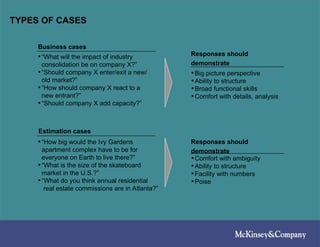
TYPES OF CASES
•“What will the impact of industry
consolidation be on company X?”
•“Should company X enter/exit a new/
old market?”
•“How should company X react to a
new entrant?”
•“Should company X add capacity?”
•“How big would the Ivy Gardens
apartment complex have to be for
everyone on Earth to live there?”
•“What is the size of the skateboard
market in the U.S.?”
•“What do you think annual residential
real estate commissions are in Atlanta?”
•Big picture perspective
•Ability to structure
•Broad functional skills
•Comfort with details, analysis
•Comfort with ambiguity
•Ability to structure
•Facility with numbers
•Poise
Business cases
Estimation cases
Responses should
demonstrate
Responses should
demonstrate
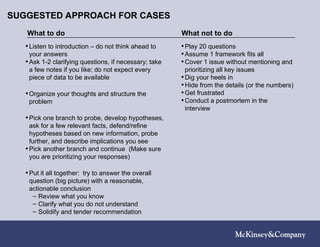
SUGGESTED APPROACH FOR CASES
•Listen to introduction – do not think ahead to
your answers
•Ask 1-2 clarifying questions, if necessary; take
a few notes if you like; do not expect every
piece of data to be available
•Organize your thoughts and structure the
problem
•Pick one branch to probe, develop hypotheses,
ask for a few relevant facts, defend/refine
hypotheses based on new information, probe
further, and describe implications you see
•Pick another branch and continue (Make sure
you are prioritizing your responses)
•Put it all together: try to answer the overall
question (big picture) with a reasonable,
actionable conclusion
– Review what you know
– Clarify what you do not understand
– Solidify and tender recommendation
•Play 20 questions
•Assume 1 framework fits all
•Cover 1 issue without mentioning and
prioritizing all key issues
•Dig your heels in
•Hide from the details (or the numbers)
•Get frustrated
•Conduct a postmortem in the
interview
What to do What not to do
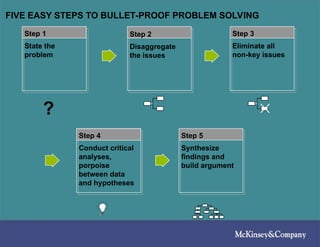
FIVE EASY STEPS TO BULLET-PROOF PROBLEM SOLVING
Step 1
State the
problem
Step 2
Disaggregate
the issues
Step 3
Eliminate all
non-key issues
Step 4
Conduct critical
analyses,
porpoise
between data
and hypotheses
Step 5
Synthesize
findings and
build argument
?
Clear statement
of problem to be
solved or issue to
be resolved
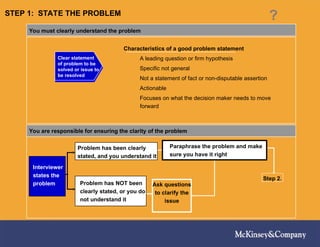
STEP 1: STATE THE PROBLEM
?
You must clearly understand the problem
Ask questions
to clarify the
issue
Step 2.
You are responsible for ensuring the clarity of the problem
Paraphrase the problem and make
sure you have it right
Problem has been clearly
stated, and you understand it
Problem has NOT been
clearly stated, or you do
not understand it
Interviewer
states the
problem
Characteristics of a good problem statement
A leading question or firm hypothesis
Specific not general
Not a statement of fact or non-disputable assertion
Actionable
Focuses on what the decision maker needs to move
forward
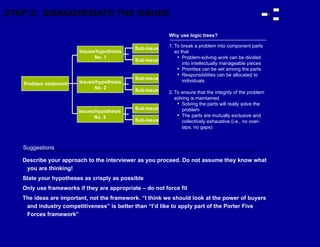
STEP 2: DISAGGREGATE THE ISSUES
Why use logic trees?
1. To break a problem into component parts
so that
• Problem-solving work can be divided
into intellectually manageable pieces
• Priorities can be set among the parts
• Responsibilities can be allocated to
individuals
2. To ensure that the integrity of the problem
solving is maintained
• Solving the parts will really solve the
problem
• The parts are mutually exclusive and
collectively exhaustive (i.e., no over-
laps, no gaps)
Sub-issue
Sub-issue
Issues/hypothesis
No. 1
Issues/hypothesis
No. 2
Issues/hypothesis
No. 3
Problem statement
Suggestions
Describe your approach to the interviewer as you proceed. Do not assume they know what
you are thinking!
State your hypotheses as crisply as possible
Only use frameworks if they are appropriate – do not force fit
The ideas are important, not the framework. “I think we should look at the power of buyers
and industry competitiveness” is better than “I’d like to apply part of the Porter Five
Forces framework”
Sub-issue
Sub-issue
Sub-issue
Sub-issue
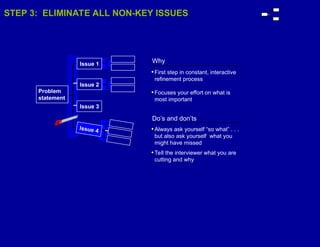
STEP 3: ELIMINATE ALL NON-KEY ISSUES
•First step in constant, interactive
refinement process
•Focuses your effort on what is
most important
•Always ask yourself “so what” . . .
but also ask yourself what you
might have missed
•Tell the interviewer what you are
cutting and why
Problem
statement
Issue 1
Issue 2
Issue 3
Issue 4
Why
Do’s and don’ts
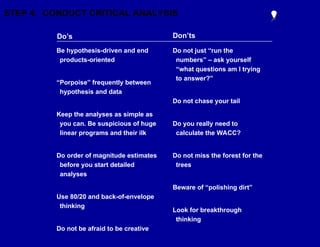
STEP 4: CONDUCT CRITICAL ANALYSIS
Be hypothesis-driven and end
products-oriented
“Porpoise” frequently between
hypothesis and data
Keep the analyses as simple as
you can. Be suspicious of huge
linear programs and their ilk
Do order of magnitude estimates
before you start detailed
analyses
Use 80/20 and back-of-envelope
thinking
Do not be afraid to be creative
Do not just “run the
numbers” – ask yourself
“what questions am I trying
to answer?”
Do not chase your tail
Do you really need to
calculate the WACC?
Do not miss the forest for the
trees
Beware of “polishing dirt”
Look for breakthrough
thinking
Do’s Don’ts
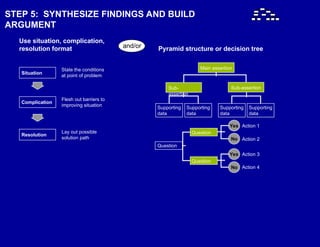
STEP 5: SYNTHESIZE FINDINGS AND BUILD
ARGUMENT
Complication
Situation
Resolution
Use situation, complication,
resolution format Pyramid structure or decision tree
Main assertion
Supporting
data
Supporting
data
Supporting
data
Supporting
data
Question
Sub-
assertion
Sub-assertion
Question
State the conditions
at point of problem
Flesh out barriers to
improving situation
Lay out possible
solution path
and/or
Yes
No
Question
Yes
No
Action 1
Action 2
Action 3
Action 4
Discussion Topics
Interviewing with McKinsey
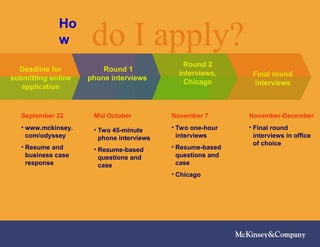
Final round
interviews
Ho
w
September 22
do I apply?
Round 2
interviews,
Chicago
Round 1
phone interviews
Deadline for
submitting online
application
• Two 45-minute
phone interviews
• Resume-based
questions and
case
• Two one-hour
interviews
• Resume-based
questions and
case
• Chicago
• Final round
interviews in office
of choice
Mid October November 7 November-December
• www.mckinsey.
com/odyssey
• Resume and
business case
response
PResentation for preparation of case interview

PResentation for preparation of case interview

  • 1.
    CASE INTERVIEW AND FRAMEWORKSWORKSHOP McKinsey&Company September 12, 2003
  • 2.
    TODAY’S TOPICS • Caseinterview overview – Purpose – Types – Suggested approach • Successful problem solving • Interviewing with McKinsey
  • 3.
    TYPES OF CASES •“Whatwill the impact of industry consolidation be on company X?” •“Should company X enter/exit a new/ old market?” •“How should company X react to a new entrant?” •“Should company X add capacity?” •“How big would the Ivy Gardens apartment complex have to be for everyone on Earth to live there?” •“What is the size of the skateboard market in the U.S.?” •“What do you think annual residential real estate commissions are in Atlanta?” •Big picture perspective •Ability to structure •Broad functional skills •Comfort with details, analysis •Comfort with ambiguity •Ability to structure •Facility with numbers •Poise Business cases Estimation cases Responses should demonstrate Responses should demonstrate
  • 4.
    SUGGESTED APPROACH FORCASES •Listen to introduction – do not think ahead to your answers •Ask 1-2 clarifying questions, if necessary; take a few notes if you like; do not expect every piece of data to be available •Organize your thoughts and structure the problem •Pick one branch to probe, develop hypotheses, ask for a few relevant facts, defend/refine hypotheses based on new information, probe further, and describe implications you see •Pick another branch and continue (Make sure you are prioritizing your responses) •Put it all together: try to answer the overall question (big picture) with a reasonable, actionable conclusion – Review what you know – Clarify what you do not understand – Solidify and tender recommendation •Play 20 questions •Assume 1 framework fits all •Cover 1 issue without mentioning and prioritizing all key issues •Dig your heels in •Hide from the details (or the numbers) •Get frustrated •Conduct a postmortem in the interview What to do What not to do
  • 5.
    FIVE EASY STEPSTO BULLET-PROOF PROBLEM SOLVING Step 1 State the problem Step 2 Disaggregate the issues Step 3 Eliminate all non-key issues Step 4 Conduct critical analyses, porpoise between data and hypotheses Step 5 Synthesize findings and build argument ?
  • 6.
    Clear statement of problemto be solved or issue to be resolved STEP 1: STATE THE PROBLEM ? You must clearly understand the problem Ask questions to clarify the issue Step 2. You are responsible for ensuring the clarity of the problem Paraphrase the problem and make sure you have it right Problem has been clearly stated, and you understand it Problem has NOT been clearly stated, or you do not understand it Interviewer states the problem Characteristics of a good problem statement A leading question or firm hypothesis Specific not general Not a statement of fact or non-disputable assertion Actionable Focuses on what the decision maker needs to move forward
  • 7.
    STEP 2: DISAGGREGATETHE ISSUES Why use logic trees? 1. To break a problem into component parts so that • Problem-solving work can be divided into intellectually manageable pieces • Priorities can be set among the parts • Responsibilities can be allocated to individuals 2. To ensure that the integrity of the problem solving is maintained • Solving the parts will really solve the problem • The parts are mutually exclusive and collectively exhaustive (i.e., no over- laps, no gaps) Sub-issue Sub-issue Issues/hypothesis No. 1 Issues/hypothesis No. 2 Issues/hypothesis No. 3 Problem statement Suggestions Describe your approach to the interviewer as you proceed. Do not assume they know what you are thinking! State your hypotheses as crisply as possible Only use frameworks if they are appropriate – do not force fit The ideas are important, not the framework. “I think we should look at the power of buyers and industry competitiveness” is better than “I’d like to apply part of the Porter Five Forces framework” Sub-issue Sub-issue Sub-issue Sub-issue
  • 8.
    STEP 3: ELIMINATEALL NON-KEY ISSUES •First step in constant, interactive refinement process •Focuses your effort on what is most important •Always ask yourself “so what” . . . but also ask yourself what you might have missed •Tell the interviewer what you are cutting and why Problem statement Issue 1 Issue 2 Issue 3 Issue 4 Why Do’s and don’ts
  • 9.
    STEP 4: CONDUCTCRITICAL ANALYSIS Be hypothesis-driven and end products-oriented “Porpoise” frequently between hypothesis and data Keep the analyses as simple as you can. Be suspicious of huge linear programs and their ilk Do order of magnitude estimates before you start detailed analyses Use 80/20 and back-of-envelope thinking Do not be afraid to be creative Do not just “run the numbers” – ask yourself “what questions am I trying to answer?” Do not chase your tail Do you really need to calculate the WACC? Do not miss the forest for the trees Beware of “polishing dirt” Look for breakthrough thinking Do’s Don’ts
  • 10.
    STEP 5: SYNTHESIZEFINDINGS AND BUILD ARGUMENT Complication Situation Resolution Use situation, complication, resolution format Pyramid structure or decision tree Main assertion Supporting data Supporting data Supporting data Supporting data Question Sub- assertion Sub-assertion Question State the conditions at point of problem Flesh out barriers to improving situation Lay out possible solution path and/or Yes No Question Yes No Action 1 Action 2 Action 3 Action 4
  • 11.
  • 12.
    Final round interviews Ho w September 22 doI apply? Round 2 interviews, Chicago Round 1 phone interviews Deadline for submitting online application • Two 45-minute phone interviews • Resume-based questions and case • Two one-hour interviews • Resume-based questions and case • Chicago • Final round interviews in office of choice Mid October November 7 November-December • www.mckinsey. com/odyssey • Resume and business case response