International Research Journal of Engineering and Technology (IRJET) e-ISSN: 2395-0056
Volume: 10 Issue: 01 | Jan 2023 www.irjet.net p-ISSN: 2395-0072
© 2022, IRJET | Impact Factor value: 7.529 | ISO 9001:2008 Certified Journal | Page 370
User Experience Versus Marketing
Snehashish De
Student, Dept. of I.T. Thadomal Shahani Engineering College, Bandra (w), Mumbai 400050 , India
---------------------------------------------------------------------***---------------------------------------------------------------------
Abstract - User experience research (UX research) is a
study of users that offers vital insights into their expectations,
needs and behavior’s. UX research as a whole is a huge trend.
In the domains of ui design and human-computer interaction,
user experience (UX) has grown in prominence during thelast
ten years (HCI). With the advancement of technology,
engaging products become not only more productive and
practical but also attractive, fashionable items. Both
practitioners and academics appear to support UX as a
competitive alternative to traditional HCI, motivated by the
belief that a narrow focus on interactive tools fails to capture
the diversity and advancingaspectsoftechnologyuse. Further,
when you examine a product on social media, it frequently
starts to display the same pictures to encourage you to buy it.
It has a method of discovering not just what you watched but
also how frequently. The future of marketing is digital. There
is no need to physically inspect the products to determine the
features when it comes to purchasing anything. There has
been conflict between these two (UX and Marketing) foravery
long time. People have always contrastedthesetwo, andbased
on particular standards, one has always prevailed over the
other. However, people have forgotten that these two coexist
and have an impact on one another.
Keywords: UX research, UX design, Marketing , Problem
Definition, Ideation, Data Visualization, User Testing .
1. USER EXPERIENCE
It's crucial that you comprehend thefundamentaldifferences
between UX design and other disciplines like wireframing,
usability, graphic design and a plethora of others. User
experience design (abbreviated UX, UXD) is a field of study
concerned with creating the entire user experience for a
specific product. The act of planning and executing a specific
course of action that is intended to cause a planned
modification in the behavior ofatargetpopulationisreferred
to as experience design. A UX designer should always start
with the problems that people have and work toward
developing a satisfying,alluring,andmotivatingsolution.The
outcomes of the research must always be quantifiable using
performance indicators that showcase user behavior
designers draw on theories and practices from a variety of
disciplines, including cognitive science, computer
engineering, graphic design,and visual design. In reality,you
are planning a change in the target group's behavior when
you create an experience. You've identified their issue, and
you're implementing design principles to eliminate the pain
points. At the nexus of art and science, user experience
demands both incredibly sharp analytical thinking and
creativity. If we consider UX to be the heart then the blood
that the heart is pumping is the problems facedbyyourusers
. Find it, describe it, experience the burdensitcreates,andget
rid of it. The road to a fantastic user experience is that one.
You'll need a lot of empathy andanalyticalabilitiestokeepon
the correct track because one of the challenging things about
problems is that, even though they bother us, we sometimes
struggle to define them.
1.1 User Experience Design Process
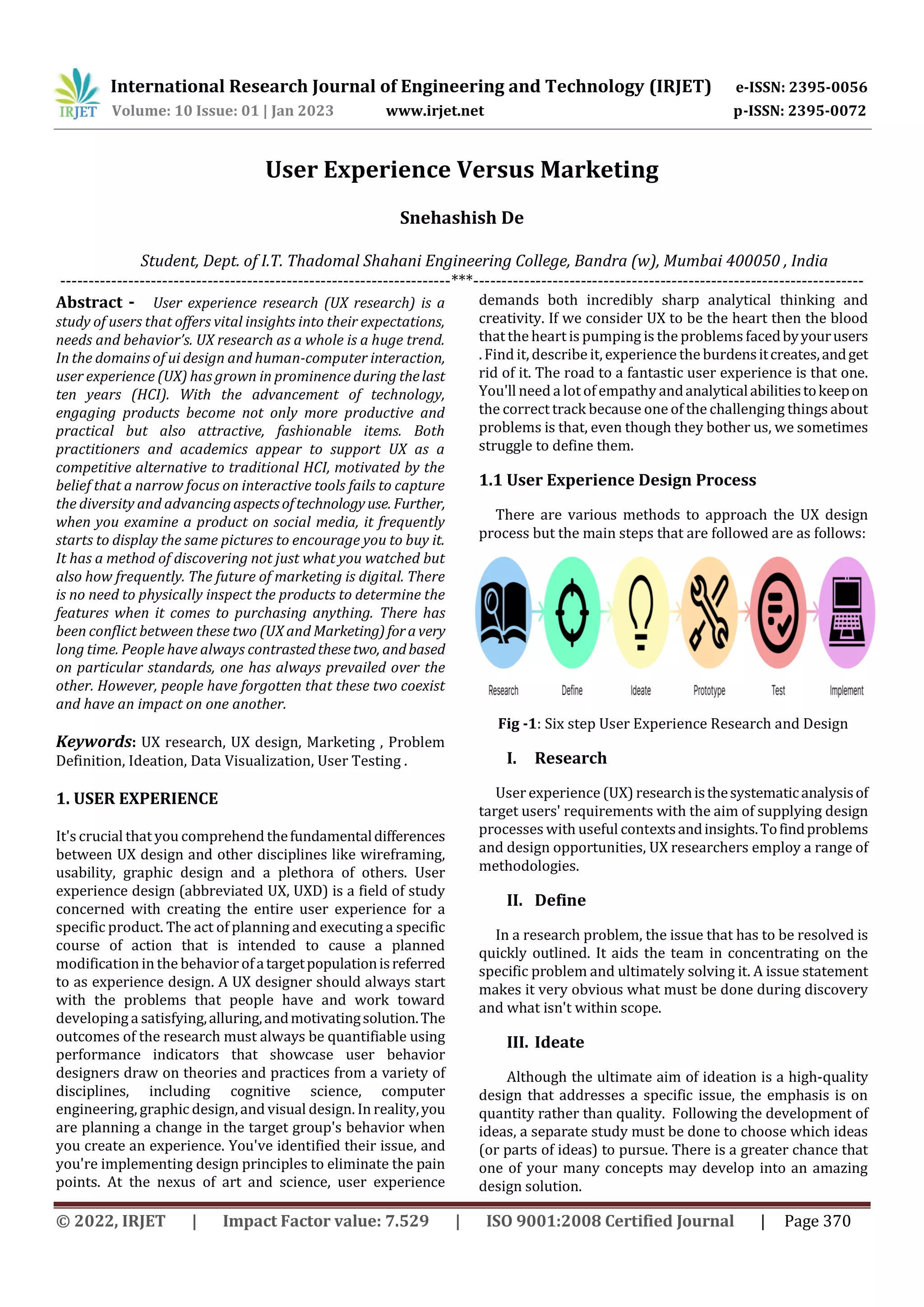
There are various methods to approach the UX design
process but the main steps that are followed are as follows:
Fig -1: Six step User Experience Research and Design
I. Research
User experience (UX) researchisthesystematicanalysisof
target users' requirements with the aim of supplying design
processes with useful contextsandinsights.Tofindproblems
and design opportunities, UX researchers employ a range of
methodologies.
II. Define
In a research problem, the issue that has to be resolved is
quickly outlined. It aids the team in concentrating on the
specific problem and ultimately solving it. A issue statement
makes it very obvious what must be done during discovery
and what isn't within scope.
III. Ideate
Although the ultimate aim of ideation is a high-quality
design that addresses a specific issue, the emphasis is on
quantity rather than quality. Following the development of
ideas, a separate study must be done to choose which ideas
(or parts of ideas) to pursue. There is a greater chance that
one of your many concepts may develop into an amazing
design solution.
International Research Journal of Engineering and Technology (IRJET) e-ISSN: 2395-0056
Volume: 10 Issue: 01 | Jan 2023 www.irjet.net p-ISSN: 2395-0072
© 2022, IRJET | Impact Factor value: 7.529 | ISO 9001:2008 Certified Journal | Page 371
IV. Prototype
Design professionals oftenevaluatenewideasbymaking
material or virtual mockups that can be actually felt. To
record design thoughts and carry out usability tests,
teams workonestablishingprototypeswithvarieddegreesof
complexity. You can improve and evaluate your ideas using
these models, allowing your company to offer the products
that adhere to the specifications.
V. Test
In the course of the design process, actual users are
surveyed to get data on usability and overalluserexperience.
Several user testing techniques, such as card sorting,
questionnaires, interviews, and observation are used to
accomplish this.
VI. Implement
Technical personnel can beginimplementationwhilethe
Design phase is still in progress because they are involved in
the early phases of the process. When the development team
receives the design artefacts, they connect the back-end
functionality with the user interface. It is preferable that the
design team participate in this stage to aid in the
development phase. It is feasible to identify the necessity for
slight design adjustments when implementing.
2. MARKETING
We consume various goods from various businesses,
nations, and regions of the world from dawn till night as a
result of meticulous planning of all marketing operations to
sell goods from sources of production (factories) to
consumption points.(Consumers).Accordingtothe"Survival
of the Fittest" theory put forward by Charles Darwin, the
strong will prevail while the weak will perish. This 19th-
century idea is still relevant today, as demonstrated by the
phrase "Survival of the Fittest Marketing Strategies," which
asserts that businesses with effective marketing plans will
thrive while those without them will perish because
marketing is crucial for creating, disseminating, and
delivering valuetoconsumersintheformofmarketofferings.
Therefore, it is possible to define marketing as the
exchanges, discussions, and interventions made to raise the
quality of products and services while also gaining some
benefits. As a result, "MARKETING" has evolved into the
fundamental requirement of today's business world since,
like oxygen, marketing is everything and the business world
cannot exist without it.
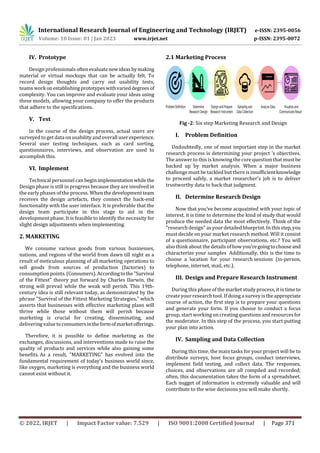
2.1 Marketing Process
Fig -2: Six step Marketing Research and Design
I. Problem Definition
Undoubtedly, one of most important step in the market
research process is determining your project ’s objectives.
The answer to this is knowing the core question that must be
backed up by market analysis. When a major business
challenge must be tackled but there is insufficientknowledge
to proceed safely, a market researcher's job is to deliver
trustworthy data to back that judgment.
II. Determine Research Design
Now that you've become acquainted with your topic of
interest, it is time to determine the kind of study that would
produce the needed data the most effectively. Think of the
"research design" as your detailed blueprint. In this step,you
must decide on your market research method. Will it consist
of a questionnaire, participant observations, etc.? You will
also thinkabout the details ofhowyou'regoingtochooseand
characterize your samples Additionally, this is the time to
choose a location for your research sessions (in-person,
telephone, internet, mail, etc.).
III. Design and Prepare Research Instrument
During this phase of the market study process, it is time to
createyour research tool. If doing a survey is theappropriate
course of action, the first step is to prepare your questions
and generate your form. If you choose to conduct a focus
group, start working on creating questions and resourcesfor
the moderator. In this step of the process, you start putting
your plan into action.
IV. Sampling and Data Collection
During this time, the main tasks for your project will be to
distribute surveys, host focus groups, conduct interviews,
implement field testing, and collect data. The responses,
choices, and observations are all compiled and recorded;
often, this documentation takes the form of a spreadsheet.
Each nugget of information is extremely valuable and will
contribute to the wise decisions you will make shortly.
International Research Journal of Engineering and Technology (IRJET) e-ISSN: 2395-0056
Volume: 10 Issue: 01 | Jan 2023 www.irjet.net p-ISSN: 2395-0072
© 2022, IRJET | Impact Factor value: 7.529 | ISO 9001:2008 Certified Journal | Page 372
V. Analyze Data
You currently have a lot of raw, unprocessed data. If it's
currently on scraps of paper, you must now obtain it in
spreadsheet or database so that you can further analyse it. If
the content is already in a spreadsheet, make sure it is
properly set up. Once it is done, the fun can begin. Create
graphs and tables, divide your data into groups that make
sense (such as age and gender), run summaries using the
software program's features and search forthemajortrends
in your data.
VI. Visualize and Communicate Results
Finally, you must arrange the most crucial information
into a report or presentation that is easy to comprehend.
When presenting the findings, the business problem and
study objectives that were decided upon earlier are a
fantastic starting point. Then, depending on the
specifications, present your suggestions for handling these
business queries. When presenting your findings, keep in
mind to include more than simply charts and tables. Add
observations,alternatives,andsuggestionsaswell.Whenever
you include a statistic in the report, consider what it
representsanditsimplications.Byincludingthisextracritical
thinking in your final report, you will make your study more
valuable and pertinent andyouwillbebetterabletoconvince
the stakeholders of your point of view.
3. SIMILARITY BETWEEN UX AND MARKETING
I. Based on research
Both marketers and UX designers play a significant part
in research because it serves as the basis for the following
steps. Both call for a thorough investigation of the
preferences of the final customer. Understanding user
preferences, behaviours, and current trends is the maingoal
of marketing. After making these observations, UX designs
are created in accordance with them.
II. Based on Psychology
Psychology is a significant factor in both areas. The goal
of marketing and user experience is to increase sales by
attracting new customers. While marketing focuses on
drawing customers to your product or service, user
experience (UX) is primarily concerned with engaging the
visitors in a way that makes them want to return to your
website repeatedly.
4. DIFFERENCES BETWEEN UX AND MARKETING
I. Focus
Gaining a broad perspective and learning about a
particular industry at a high level are the main goals of
market research. Market researchers mostly employ
quantitative techniques, or methods that emphasize
numbers. They conduct research on sizable representative
samples in order to extrapolate findings to the entire
population. Survey results, with a tolerable range of error,
accurately reflect the situation across the entire population.
We can be very certain abouttheaveragepotentialuser'sage,
income level, educational attainment, and other broad
attributes thanks to this. Market research frequently gives
attitudinal data—what people say about themselves or what
they would do—more weight than specific behaviors in a
given situation. They typically use the findings from market
research to guide their marketing choices.
User research uses a completely different approach. There is
no correlation between it and market size and share, trends,
market segments, demographics, or attitudinal responses.
Instead, it focuses on how people behave, deal with
difficulties in their daily lives, use products, etc. It deals with
very specialized, in-depth user insights rather than general
data. User research gives designers guidance on how to
develop a product and how well it satisfies user needs. We
don't need statistical precision for the outcomes; therefore,
we can utilize much smaller sample sizes. The goal of user
research is to elicit qualitative information about the
motivations underlying what individuals say. It focuses on
what they actually do while utilizing a product.
II. Purpose
The basic goal of marketing is to boost sales and thereby
the company's revenue. On the other side, UX Design tries to
offer a connection and captivating experiencefortheusers.It
does not guarantee that a user will make a purchase every
time he accesses the website, but rather that he will find the
interface interesting enough to return and advance in the
sales funnel. In order to achieve thepurposeofmarketing,UX
design forces a user to progress farther in their buyer's
journey. Customers are more likely to makeapurchasewhen
products are developed with exceptional UX Design in mind,
as has been observed in numerous instances.
III. Problem Solved
User experience research looks into how to make a
product or service more appealing to the target market that
market research identifies. Market researcherscanidentifya
market for a product by extensive study and secondary data
analysis, focusing a wide population into a certain
demographic (gender, age, economic position, region) thatis
most likely to buy or utilize it. A business can determine if a
product should be launchedbasedonthesizeandpurchasing
power of this segment. Additionally, they target that group
with the use of this informationinavarietyofways,including
messaging, advertising, and packaging design .
Research on user experiencefocusesontheuserbasealready
in use to find ways to make the product appealing to and
accommodating to people using it. Because of this, UX
International Research Journal of Engineering and Technology (IRJET) e-ISSN: 2395-0056
Volume: 10 Issue: 01 | Jan 2023 www.irjet.net p-ISSN: 2395-0072
© 2022, IRJET | Impact Factor value: 7.529 | ISO 9001:2008 Certified Journal | Page 373
research analyses the more in-depth and focused thoughts
and behaviors of those interacting with a product.
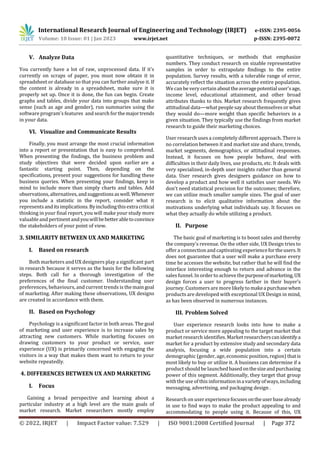
Fig -3: Summary of the main similarities and differences
between UX and Marketing
5. CONCLUSIONS
Most goods and services have a life cycle with predictable
sales and profitability. Pre-design (Introduction),
development (Growth), and post-development
(Maturity) are the three stages of product development
when research is conducted.
While UX research focuses on the users' observable
behavior, market research identifiescustomersegmentsand
customer opinions.
While marketing and UX have fundamentally
different values, they can be very effective tools for a
business if used properly together. Because theybothhavea
stake in understanding consumer behavior and fostering
brand loyalty, they will inevitably need to collaborate. The
responsibility of every business is to give customers a
fantastic experience and high levels ofcustomersatisfaction.
Before creating a product, it is important to consider the
preferences of the target market. Users' demands are
guaranteed, business conversion is increased, and you stay
one step ahead of the competition with a good customer-
centric UX design. Your customer will be delighted by an
exceptional UX design, and they will promote your goods.
Many companies place so much emphasis on generating
conversion that they pay no attentiontotheuserexperience.
Your clients would be satisfied and your product would
eventually be more marketable if you treated your website
and app as marketing tools and put effort into creating the
UX Design. Marketers should continually put in time and
effort to improve the UX design by offering specific and
accurate recommendations regarding client needs. Proper
marketing and user experience coordination will
undoubtedly increase sales and conversions.
REFERENCES
[1] M. Treder, “Ux Design for Startups,” p. 127, 2015.
[2] Hidayah, Nur Aeni & Zulfiandri, Zulfiandri & Rafiiuddin,
Ahmad & Durachman, Yusuf & Rustamaji, Eri. (2021).
User Experience Design AnalysisUsingLeanUXMethod.
1-6. 10.1109/CITSM52892.2021.9588905.
[3] Hassenzahl, Marc & Tractinsky, Noam. (2006). User
experience - A research agenda. Behaviour and
Information Technology. 25. 91 – 97.
10.1080/01449290500330331.
[4] Karapanos, E., Zimmerman, J., Forlizzi, J., & Martens, J.
(2009). User experience over time: an initial
framework. Proceedings of the SIGCHI Conference on
Human Factors in Computing Systems.
[5] Pachpande, Sandeep & Mathur, Dr & Singh, Prakash.
(2016). Basics of Marketing.
[6] Hyman, Michael & Sierra, Jeremy. (2015). Marketing
research process: Six stages. NMSU Business Outlook.
13.
[7] Iwu, Chux. (2009). What is Marketing?. Customer Think
[http://customerthink.com/209180/].
[8] https://designial.com/blogs/ux-research-and-market-
research-know-the-difference
[9] https://ogilvy.medium.com/market-research-or-ux-
research-8b0e992e916d
[10] https://uxplanet.org/ux-marketing-the-need-of-the-
hour-cf675de2c6ac
[11] https://www.mymarketresearchmethods.com/the-
market-research-process-6-steps-to-success/

User Experience Versus Marketing

  • 1.
    International Research Journalof Engineering and Technology (IRJET) e-ISSN: 2395-0056 Volume: 10 Issue: 01 | Jan 2023 www.irjet.net p-ISSN: 2395-0072 © 2022, IRJET | Impact Factor value: 7.529 | ISO 9001:2008 Certified Journal | Page 370 User Experience Versus Marketing Snehashish De Student, Dept. of I.T. Thadomal Shahani Engineering College, Bandra (w), Mumbai 400050 , India ---------------------------------------------------------------------***--------------------------------------------------------------------- Abstract - User experience research (UX research) is a study of users that offers vital insights into their expectations, needs and behavior’s. UX research as a whole is a huge trend. In the domains of ui design and human-computer interaction, user experience (UX) has grown in prominence during thelast ten years (HCI). With the advancement of technology, engaging products become not only more productive and practical but also attractive, fashionable items. Both practitioners and academics appear to support UX as a competitive alternative to traditional HCI, motivated by the belief that a narrow focus on interactive tools fails to capture the diversity and advancingaspectsoftechnologyuse. Further, when you examine a product on social media, it frequently starts to display the same pictures to encourage you to buy it. It has a method of discovering not just what you watched but also how frequently. The future of marketing is digital. There is no need to physically inspect the products to determine the features when it comes to purchasing anything. There has been conflict between these two (UX and Marketing) foravery long time. People have always contrastedthesetwo, andbased on particular standards, one has always prevailed over the other. However, people have forgotten that these two coexist and have an impact on one another. Keywords: UX research, UX design, Marketing , Problem Definition, Ideation, Data Visualization, User Testing . 1. USER EXPERIENCE It's crucial that you comprehend thefundamentaldifferences between UX design and other disciplines like wireframing, usability, graphic design and a plethora of others. User experience design (abbreviated UX, UXD) is a field of study concerned with creating the entire user experience for a specific product. The act of planning and executing a specific course of action that is intended to cause a planned modification in the behavior ofatargetpopulationisreferred to as experience design. A UX designer should always start with the problems that people have and work toward developing a satisfying,alluring,andmotivatingsolution.The outcomes of the research must always be quantifiable using performance indicators that showcase user behavior designers draw on theories and practices from a variety of disciplines, including cognitive science, computer engineering, graphic design,and visual design. In reality,you are planning a change in the target group's behavior when you create an experience. You've identified their issue, and you're implementing design principles to eliminate the pain points. At the nexus of art and science, user experience demands both incredibly sharp analytical thinking and creativity. If we consider UX to be the heart then the blood that the heart is pumping is the problems facedbyyourusers . Find it, describe it, experience the burdensitcreates,andget rid of it. The road to a fantastic user experience is that one. You'll need a lot of empathy andanalyticalabilitiestokeepon the correct track because one of the challenging things about problems is that, even though they bother us, we sometimes struggle to define them. 1.1 User Experience Design Process There are various methods to approach the UX design process but the main steps that are followed are as follows: Fig -1: Six step User Experience Research and Design I. Research User experience (UX) researchisthesystematicanalysisof target users' requirements with the aim of supplying design processes with useful contextsandinsights.Tofindproblems and design opportunities, UX researchers employ a range of methodologies. II. Define In a research problem, the issue that has to be resolved is quickly outlined. It aids the team in concentrating on the specific problem and ultimately solving it. A issue statement makes it very obvious what must be done during discovery and what isn't within scope. III. Ideate Although the ultimate aim of ideation is a high-quality design that addresses a specific issue, the emphasis is on quantity rather than quality. Following the development of ideas, a separate study must be done to choose which ideas (or parts of ideas) to pursue. There is a greater chance that one of your many concepts may develop into an amazing design solution.
  • 2.
    International Research Journalof Engineering and Technology (IRJET) e-ISSN: 2395-0056 Volume: 10 Issue: 01 | Jan 2023 www.irjet.net p-ISSN: 2395-0072 © 2022, IRJET | Impact Factor value: 7.529 | ISO 9001:2008 Certified Journal | Page 371 IV. Prototype Design professionals oftenevaluatenewideasbymaking material or virtual mockups that can be actually felt. To record design thoughts and carry out usability tests, teams workonestablishingprototypeswithvarieddegreesof complexity. You can improve and evaluate your ideas using these models, allowing your company to offer the products that adhere to the specifications. V. Test In the course of the design process, actual users are surveyed to get data on usability and overalluserexperience. Several user testing techniques, such as card sorting, questionnaires, interviews, and observation are used to accomplish this. VI. Implement Technical personnel can beginimplementationwhilethe Design phase is still in progress because they are involved in the early phases of the process. When the development team receives the design artefacts, they connect the back-end functionality with the user interface. It is preferable that the design team participate in this stage to aid in the development phase. It is feasible to identify the necessity for slight design adjustments when implementing. 2. MARKETING We consume various goods from various businesses, nations, and regions of the world from dawn till night as a result of meticulous planning of all marketing operations to sell goods from sources of production (factories) to consumption points.(Consumers).Accordingtothe"Survival of the Fittest" theory put forward by Charles Darwin, the strong will prevail while the weak will perish. This 19th- century idea is still relevant today, as demonstrated by the phrase "Survival of the Fittest Marketing Strategies," which asserts that businesses with effective marketing plans will thrive while those without them will perish because marketing is crucial for creating, disseminating, and delivering valuetoconsumersintheformofmarketofferings. Therefore, it is possible to define marketing as the exchanges, discussions, and interventions made to raise the quality of products and services while also gaining some benefits. As a result, "MARKETING" has evolved into the fundamental requirement of today's business world since, like oxygen, marketing is everything and the business world cannot exist without it. 2.1 Marketing Process Fig -2: Six step Marketing Research and Design I. Problem Definition Undoubtedly, one of most important step in the market research process is determining your project ’s objectives. The answer to this is knowing the core question that must be backed up by market analysis. When a major business challenge must be tackled but there is insufficientknowledge to proceed safely, a market researcher's job is to deliver trustworthy data to back that judgment. II. Determine Research Design Now that you've become acquainted with your topic of interest, it is time to determine the kind of study that would produce the needed data the most effectively. Think of the "research design" as your detailed blueprint. In this step,you must decide on your market research method. Will it consist of a questionnaire, participant observations, etc.? You will also thinkabout the details ofhowyou'regoingtochooseand characterize your samples Additionally, this is the time to choose a location for your research sessions (in-person, telephone, internet, mail, etc.). III. Design and Prepare Research Instrument During this phase of the market study process, it is time to createyour research tool. If doing a survey is theappropriate course of action, the first step is to prepare your questions and generate your form. If you choose to conduct a focus group, start working on creating questions and resourcesfor the moderator. In this step of the process, you start putting your plan into action. IV. Sampling and Data Collection During this time, the main tasks for your project will be to distribute surveys, host focus groups, conduct interviews, implement field testing, and collect data. The responses, choices, and observations are all compiled and recorded; often, this documentation takes the form of a spreadsheet. Each nugget of information is extremely valuable and will contribute to the wise decisions you will make shortly.
  • 3.
    International Research Journalof Engineering and Technology (IRJET) e-ISSN: 2395-0056 Volume: 10 Issue: 01 | Jan 2023 www.irjet.net p-ISSN: 2395-0072 © 2022, IRJET | Impact Factor value: 7.529 | ISO 9001:2008 Certified Journal | Page 372 V. Analyze Data You currently have a lot of raw, unprocessed data. If it's currently on scraps of paper, you must now obtain it in spreadsheet or database so that you can further analyse it. If the content is already in a spreadsheet, make sure it is properly set up. Once it is done, the fun can begin. Create graphs and tables, divide your data into groups that make sense (such as age and gender), run summaries using the software program's features and search forthemajortrends in your data. VI. Visualize and Communicate Results Finally, you must arrange the most crucial information into a report or presentation that is easy to comprehend. When presenting the findings, the business problem and study objectives that were decided upon earlier are a fantastic starting point. Then, depending on the specifications, present your suggestions for handling these business queries. When presenting your findings, keep in mind to include more than simply charts and tables. Add observations,alternatives,andsuggestionsaswell.Whenever you include a statistic in the report, consider what it representsanditsimplications.Byincludingthisextracritical thinking in your final report, you will make your study more valuable and pertinent andyouwillbebetterabletoconvince the stakeholders of your point of view. 3. SIMILARITY BETWEEN UX AND MARKETING I. Based on research Both marketers and UX designers play a significant part in research because it serves as the basis for the following steps. Both call for a thorough investigation of the preferences of the final customer. Understanding user preferences, behaviours, and current trends is the maingoal of marketing. After making these observations, UX designs are created in accordance with them. II. Based on Psychology Psychology is a significant factor in both areas. The goal of marketing and user experience is to increase sales by attracting new customers. While marketing focuses on drawing customers to your product or service, user experience (UX) is primarily concerned with engaging the visitors in a way that makes them want to return to your website repeatedly. 4. DIFFERENCES BETWEEN UX AND MARKETING I. Focus Gaining a broad perspective and learning about a particular industry at a high level are the main goals of market research. Market researchers mostly employ quantitative techniques, or methods that emphasize numbers. They conduct research on sizable representative samples in order to extrapolate findings to the entire population. Survey results, with a tolerable range of error, accurately reflect the situation across the entire population. We can be very certain abouttheaveragepotentialuser'sage, income level, educational attainment, and other broad attributes thanks to this. Market research frequently gives attitudinal data—what people say about themselves or what they would do—more weight than specific behaviors in a given situation. They typically use the findings from market research to guide their marketing choices. User research uses a completely different approach. There is no correlation between it and market size and share, trends, market segments, demographics, or attitudinal responses. Instead, it focuses on how people behave, deal with difficulties in their daily lives, use products, etc. It deals with very specialized, in-depth user insights rather than general data. User research gives designers guidance on how to develop a product and how well it satisfies user needs. We don't need statistical precision for the outcomes; therefore, we can utilize much smaller sample sizes. The goal of user research is to elicit qualitative information about the motivations underlying what individuals say. It focuses on what they actually do while utilizing a product. II. Purpose The basic goal of marketing is to boost sales and thereby the company's revenue. On the other side, UX Design tries to offer a connection and captivating experiencefortheusers.It does not guarantee that a user will make a purchase every time he accesses the website, but rather that he will find the interface interesting enough to return and advance in the sales funnel. In order to achieve thepurposeofmarketing,UX design forces a user to progress farther in their buyer's journey. Customers are more likely to makeapurchasewhen products are developed with exceptional UX Design in mind, as has been observed in numerous instances. III. Problem Solved User experience research looks into how to make a product or service more appealing to the target market that market research identifies. Market researcherscanidentifya market for a product by extensive study and secondary data analysis, focusing a wide population into a certain demographic (gender, age, economic position, region) thatis most likely to buy or utilize it. A business can determine if a product should be launchedbasedonthesizeandpurchasing power of this segment. Additionally, they target that group with the use of this informationinavarietyofways,including messaging, advertising, and packaging design . Research on user experiencefocusesontheuserbasealready in use to find ways to make the product appealing to and accommodating to people using it. Because of this, UX
  • 4.
    International Research Journalof Engineering and Technology (IRJET) e-ISSN: 2395-0056 Volume: 10 Issue: 01 | Jan 2023 www.irjet.net p-ISSN: 2395-0072 © 2022, IRJET | Impact Factor value: 7.529 | ISO 9001:2008 Certified Journal | Page 373 research analyses the more in-depth and focused thoughts and behaviors of those interacting with a product. Fig -3: Summary of the main similarities and differences between UX and Marketing 5. CONCLUSIONS Most goods and services have a life cycle with predictable sales and profitability. Pre-design (Introduction), development (Growth), and post-development (Maturity) are the three stages of product development when research is conducted. While UX research focuses on the users' observable behavior, market research identifiescustomersegmentsand customer opinions. While marketing and UX have fundamentally different values, they can be very effective tools for a business if used properly together. Because theybothhavea stake in understanding consumer behavior and fostering brand loyalty, they will inevitably need to collaborate. The responsibility of every business is to give customers a fantastic experience and high levels ofcustomersatisfaction. Before creating a product, it is important to consider the preferences of the target market. Users' demands are guaranteed, business conversion is increased, and you stay one step ahead of the competition with a good customer- centric UX design. Your customer will be delighted by an exceptional UX design, and they will promote your goods. Many companies place so much emphasis on generating conversion that they pay no attentiontotheuserexperience. Your clients would be satisfied and your product would eventually be more marketable if you treated your website and app as marketing tools and put effort into creating the UX Design. Marketers should continually put in time and effort to improve the UX design by offering specific and accurate recommendations regarding client needs. Proper marketing and user experience coordination will undoubtedly increase sales and conversions. REFERENCES [1] M. Treder, “Ux Design for Startups,” p. 127, 2015. [2] Hidayah, Nur Aeni & Zulfiandri, Zulfiandri & Rafiiuddin, Ahmad & Durachman, Yusuf & Rustamaji, Eri. (2021). User Experience Design AnalysisUsingLeanUXMethod. 1-6. 10.1109/CITSM52892.2021.9588905. [3] Hassenzahl, Marc & Tractinsky, Noam. (2006). User experience - A research agenda. Behaviour and Information Technology. 25. 91 – 97. 10.1080/01449290500330331. [4] Karapanos, E., Zimmerman, J., Forlizzi, J., & Martens, J. (2009). User experience over time: an initial framework. Proceedings of the SIGCHI Conference on Human Factors in Computing Systems. [5] Pachpande, Sandeep & Mathur, Dr & Singh, Prakash. (2016). Basics of Marketing. [6] Hyman, Michael & Sierra, Jeremy. (2015). Marketing research process: Six stages. NMSU Business Outlook. 13. [7] Iwu, Chux. (2009). What is Marketing?. Customer Think [http://customerthink.com/209180/]. [8] https://designial.com/blogs/ux-research-and-market- research-know-the-difference [9] https://ogilvy.medium.com/market-research-or-ux- research-8b0e992e916d [10] https://uxplanet.org/ux-marketing-the-need-of-the- hour-cf675de2c6ac [11] https://www.mymarketresearchmethods.com/the- market-research-process-6-steps-to-success/