
Center for Distance Learning


Curriculum & Instructional
         Design
    For CDL Courses


                   Nicola Martinez, Director

                       Faculty Orientation
                             July 2009
Curriculum Committee
The Curriculum Committee oversees the approval of
course proposals and development of policies and
procedures for Center for Distance Learning courses.

The committee provides leadership in identifying and
discussing curricular issues on the course and overall
curricular levels.

Committee Members represent each of the four area
of study subgroups.
Curriculum Committee Members
Phillip Ortiz, Chair and representative of the Science, Mathematics
and Technology subgroup

Carol Carnevale, Faculty Chair and representative of the Business,
Management and Economics subgroup
Eric Ball, Representative of the Cultural Studies subgroup
Julie Shaw, Representative of Human Development and Social
Science Research
Nicola Martinez, Co-Chair and Director of Curriculum and
Instructional Design
Valerie Chukhlomin, Representative of Marketing and
Management Studies subgroup

Laura Wait, Secretary to the Curriculum Committee
Curriculum Committee
Curriculum Committee Reviews are Required for:

• New courses - All proposals for new courses must be reviewed
  by the curriculum committee and receive committee approval
  prior to starting the full course development.

• Major revisions of existing courses - A major revision is
  defined as an existing course that needs to be changed in one
  of the following ways:

  1. major change in focus/purpose of the course
  2. major change in texts, necessitating a change in course
  focus/purpose
  3. change in level of course from lower < -- > advanced, in
  credit amount, in liberal vs. non-liberal designation
Curriculum Committee
Curriculum Committee Reviews are Not Required for:

•   Existing, previously-approved courses changing
    delivery methods – E.g., print-to-web conversions, enhanced
    learning contract-to-web conversions.

•   Minor revisions – A minor revision is defined as a change
    necessitated by a newer edition of the same text, the
    introduction of a synchronous component, testing of new
    software, revision of course title, etc., as long as these
    changes do not change the focus/purpose of the course.
•   Note: Your assistant area coordinator usually manages minor
    revisions for you.
Our curricular and instructional design goals :

 Promote deep learning through visual
  and multimedia approaches.

 Enhance collaborative learning –
  teams, group presentations, debates,
  students as facilitators.

 Integrate Case studies across the
  disciplines to promote learning
  transfer.

 Integrate library research and library
  based activities into every course.

 Integrate optimal technology tools for
  multiple pedagogical uses.

 Integrate work-based learning and
  connection with social problems.

 Build community beyond courses           Visual Approach to Mathematics
Curriculum and Instructional Design Group
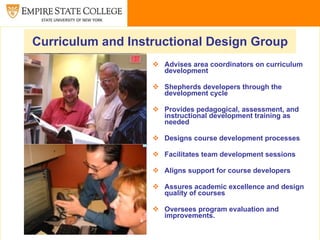
                    Advises area coordinators on curriculum
                     development

                    Shepherds developers through the
                     development cycle

                    Provides pedagogical, assessment, and
                     instructional development training as
                     needed

                    Designs course development processes

                    Facilitates team development sessions

                    Aligns support for course developers

                    Assures academic excellence and design
                     quality of courses

                    Oversees program evaluation and
                     improvements.
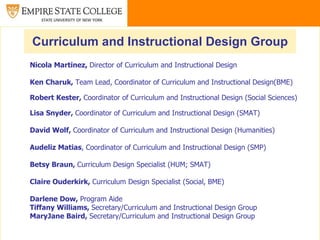
Curriculum and Instructional Design Group
Nicola Martinez, Director of Curriculum and Instructional Design

Ken Charuk, Team Lead, Coordinator of Curriculum and Instructional Design(BME)

Robert Kester, Coordinator of Curriculum and Instructional Design (Social Sciences)

Lisa Snyder, Coordinator of Curriculum and Instructional Design (SMAT)

David Wolf, Coordinator of Curriculum and Instructional Design (Humanities)

Audeliz Matias, Coordinator of Curriculum and Instructional Design (SMP)

Betsy Braun, Curriculum Design Specialist (HUM; SMAT)

Claire Ouderkirk, Curriculum Design Specialist (Social, BME)

Darlene Dow, Program Aide
Tiffany Williams, Secretary/Curriculum and Instructional Design Group
MaryJane Baird, Secretary/Curriculum and Instructional Design Group
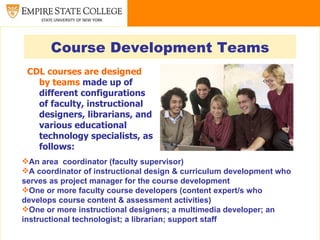
Course Development Teams
 CDL courses are designed
   by teams made up of
   different configurations
   of faculty, instructional
   designers, librarians, and
   various educational
   technology specialists, as
   follows:
An area coordinator (faculty supervisor)
A coordinator of instructional design & curriculum development who
serves as project manager for the course development
One or more faculty course developers (content expert/s who
develops course content & assessment activities)
One or more instructional designers; a multimedia developer; an
instructional technologist; a librarian; support staff
Course Approval Process


                                                   Coursetrak Screenshot
Course Concept Presented to All Faculty
        Discussion/feedback from Area Coordinators
Course Proposal Presented to Curricular Teams
        Open to Discussion/feedback
        from Area Coordinators and Course Development Teams
Course Proposal Review/Approval by Curriculum Committee
        With public feedback
Once Approved, course enters development cycle
        And is assigned a team
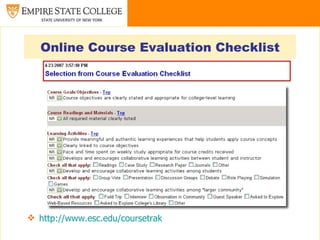
Once Completed, Course Review/Rating by Instructional Design Team
        using the course evaluation checklist
Coursetrak
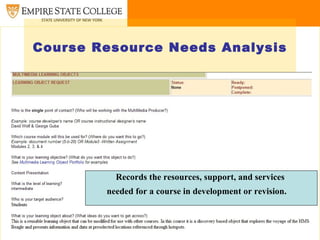
Course Resource Needs Analysis


          Records the resources, support, and services
        needed for a course in development or revision.
Library Resources
   Librarians recommend electronic resources from:
   subscription research databases and online services
   the public Internet for use as supplemental readings
    and related course materials (.edu; .gov; and .org)

                                        Arts Management Course


Sample Library Request
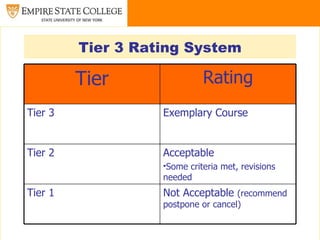
Tier 3 Rating System

         Tier                Rating
Tier 3             Exemplary Course


Tier 2             Acceptable
                   Some criteria met, revisions
                   needed
Tier 1             Not Acceptable (recommend
                   postpone or cancel)
Online Course Evaluation Checklist


 http://www.esc.edu/coursetrak
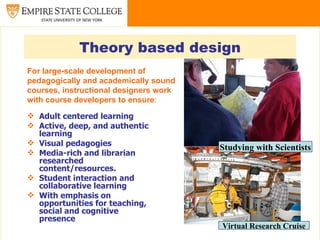
Theory based design
For large-scale development of
pedagogically and academically sound
courses, instructional designers work
with course developers to ensure:

 Adult centered learning
 Active, deep, and authentic
  learning
 Visual pedagogies
                                        Studying with Scientists
 Media-rich and librarian
  researched
  content/resources.
 Student interaction and
  collaborative learning
 With emphasis on
  opportunities for teaching,
  social and cognitive
  presence
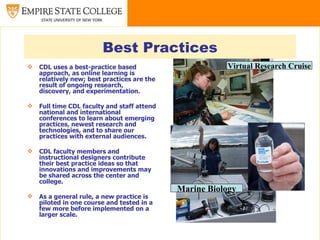
                                        Virtual Research Cruise
Best Practices
   CDL uses a best-practice based                      Virtual Research Cruise
    approach, as online learning is
    relatively new; best practices are the
    result of ongoing research,
    discovery, and experimentation.

   Full time CDL faculty and staff attend
    national and international
    conferences to learn about emerging
    practices, newest research and
    technologies, and to share our
    practices with external audiences.

   CDL faculty members and
    instructional designers contribute
    their best practice ideas so that
    innovations and improvements may
    be shared across the center and
    college.
                                             Marine Biology
   As a general rule, a new practice is
    piloted in one course and tested in a
    few more before implemented on a
    larger scale.
Some of our distance learning methodologies applied to the design
                      of instruction include:

                                   Visual Pedagogy
                                   Collaborative
                                    Learning
                                   Scientific Field
                                    Studies and Field
                                    Study Support
                                   Interactive Tools
                                   Visual Mathematics
                                   Research-Based
                                    Discussion
                                   Visual Case Studies
Quality Factors
•   The key differentiating factors of quality in
    CDL courses are:
     The teaching presence of instructor, e.g. through course
      description, statement of goals and objectives, module-at-
      a-glance and frequent feedback
     The internal consistency of the course, determined by
      congruence between components
     Use of cognitive enhancement strategies such as library
      review, problem solving, image and multimedia resources,
      and Web links
     Use of collaborative learning, e.g. through discussions,
      icebreaker and group projects
•   All of these factors are amply supported by research
    on online learning.
Contact Information

       Nicola Martinez
       Director of Curriculum and Instructional Design

       Center for Distance Learning
       111 West Avenue, Saratoga Springs, NY 12866
       518-587-2100, ext. 2276

       Nicola.Martinez@esc.edu

   •     Visit our web site at:
                                  http://www.esc.edu/cdl
CID New Faculty Orientation 2009

CID New Faculty Orientation 2009

  • 2.
    Center for DistanceLearning Curriculum & Instructional Design For CDL Courses Nicola Martinez, Director Faculty Orientation July 2009
  • 3.
    Curriculum Committee The CurriculumCommittee oversees the approval of course proposals and development of policies and procedures for Center for Distance Learning courses. The committee provides leadership in identifying and discussing curricular issues on the course and overall curricular levels. Committee Members represent each of the four area of study subgroups.
  • 4.
    Curriculum Committee Members PhillipOrtiz, Chair and representative of the Science, Mathematics and Technology subgroup Carol Carnevale, Faculty Chair and representative of the Business, Management and Economics subgroup Eric Ball, Representative of the Cultural Studies subgroup Julie Shaw, Representative of Human Development and Social Science Research Nicola Martinez, Co-Chair and Director of Curriculum and Instructional Design Valerie Chukhlomin, Representative of Marketing and Management Studies subgroup Laura Wait, Secretary to the Curriculum Committee
  • 5.
    Curriculum Committee Curriculum CommitteeReviews are Required for: • New courses - All proposals for new courses must be reviewed by the curriculum committee and receive committee approval prior to starting the full course development. • Major revisions of existing courses - A major revision is defined as an existing course that needs to be changed in one of the following ways: 1. major change in focus/purpose of the course 2. major change in texts, necessitating a change in course focus/purpose 3. change in level of course from lower < -- > advanced, in credit amount, in liberal vs. non-liberal designation
  • 6.
    Curriculum Committee Curriculum CommitteeReviews are Not Required for: • Existing, previously-approved courses changing delivery methods – E.g., print-to-web conversions, enhanced learning contract-to-web conversions. • Minor revisions – A minor revision is defined as a change necessitated by a newer edition of the same text, the introduction of a synchronous component, testing of new software, revision of course title, etc., as long as these changes do not change the focus/purpose of the course. • Note: Your assistant area coordinator usually manages minor revisions for you.
  • 7.
    Our curricular andinstructional design goals :  Promote deep learning through visual and multimedia approaches.  Enhance collaborative learning – teams, group presentations, debates, students as facilitators.  Integrate Case studies across the disciplines to promote learning transfer.  Integrate library research and library based activities into every course.  Integrate optimal technology tools for multiple pedagogical uses.  Integrate work-based learning and connection with social problems.  Build community beyond courses Visual Approach to Mathematics
  • 8.
    Curriculum and InstructionalDesign Group  Advises area coordinators on curriculum development  Shepherds developers through the development cycle  Provides pedagogical, assessment, and instructional development training as needed  Designs course development processes  Facilitates team development sessions  Aligns support for course developers  Assures academic excellence and design quality of courses  Oversees program evaluation and improvements.
  • 9.
    Curriculum and InstructionalDesign Group Nicola Martinez, Director of Curriculum and Instructional Design Ken Charuk, Team Lead, Coordinator of Curriculum and Instructional Design(BME) Robert Kester, Coordinator of Curriculum and Instructional Design (Social Sciences) Lisa Snyder, Coordinator of Curriculum and Instructional Design (SMAT) David Wolf, Coordinator of Curriculum and Instructional Design (Humanities) Audeliz Matias, Coordinator of Curriculum and Instructional Design (SMP) Betsy Braun, Curriculum Design Specialist (HUM; SMAT) Claire Ouderkirk, Curriculum Design Specialist (Social, BME) Darlene Dow, Program Aide Tiffany Williams, Secretary/Curriculum and Instructional Design Group MaryJane Baird, Secretary/Curriculum and Instructional Design Group
  • 10.
    Course Development Teams CDL courses are designed by teams made up of different configurations of faculty, instructional designers, librarians, and various educational technology specialists, as follows: An area coordinator (faculty supervisor) A coordinator of instructional design & curriculum development who serves as project manager for the course development One or more faculty course developers (content expert/s who develops course content & assessment activities) One or more instructional designers; a multimedia developer; an instructional technologist; a librarian; support staff
  • 11.
    Course Approval Process Coursetrak Screenshot Course Concept Presented to All Faculty  Discussion/feedback from Area Coordinators Course Proposal Presented to Curricular Teams  Open to Discussion/feedback  from Area Coordinators and Course Development Teams Course Proposal Review/Approval by Curriculum Committee  With public feedback Once Approved, course enters development cycle  And is assigned a team Once Completed, Course Review/Rating by Instructional Design Team  using the course evaluation checklist
  • 12.
  • 13.
    Course Resource NeedsAnalysis Records the resources, support, and services needed for a course in development or revision.
  • 14.
    Library Resources  Librarians recommend electronic resources from:  subscription research databases and online services  the public Internet for use as supplemental readings and related course materials (.edu; .gov; and .org) Arts Management Course Sample Library Request
  • 15.
    Tier 3 RatingSystem Tier Rating Tier 3 Exemplary Course Tier 2 Acceptable Some criteria met, revisions needed Tier 1 Not Acceptable (recommend postpone or cancel)
  • 16.
    Online Course EvaluationChecklist  http://www.esc.edu/coursetrak
  • 17.
    Theory based design Forlarge-scale development of pedagogically and academically sound courses, instructional designers work with course developers to ensure:  Adult centered learning  Active, deep, and authentic learning  Visual pedagogies Studying with Scientists  Media-rich and librarian researched content/resources.  Student interaction and collaborative learning  With emphasis on opportunities for teaching, social and cognitive presence Virtual Research Cruise
  • 18.
    Best Practices  CDL uses a best-practice based Virtual Research Cruise approach, as online learning is relatively new; best practices are the result of ongoing research, discovery, and experimentation.  Full time CDL faculty and staff attend national and international conferences to learn about emerging practices, newest research and technologies, and to share our practices with external audiences.  CDL faculty members and instructional designers contribute their best practice ideas so that innovations and improvements may be shared across the center and college. Marine Biology  As a general rule, a new practice is piloted in one course and tested in a few more before implemented on a larger scale.
  • 19.
    Some of ourdistance learning methodologies applied to the design of instruction include: Visual Pedagogy Collaborative Learning Scientific Field Studies and Field Study Support Interactive Tools Visual Mathematics Research-Based Discussion Visual Case Studies
  • 20.
    Quality Factors • The key differentiating factors of quality in CDL courses are:  The teaching presence of instructor, e.g. through course description, statement of goals and objectives, module-at- a-glance and frequent feedback  The internal consistency of the course, determined by congruence between components  Use of cognitive enhancement strategies such as library review, problem solving, image and multimedia resources, and Web links  Use of collaborative learning, e.g. through discussions, icebreaker and group projects • All of these factors are amply supported by research on online learning.
  • 21.
    Contact Information Nicola Martinez Director of Curriculum and Instructional Design Center for Distance Learning 111 West Avenue, Saratoga Springs, NY 12866 518-587-2100, ext. 2276 Nicola.Martinez@esc.edu • Visit our web site at: http://www.esc.edu/cdl