Beyond usability
Designing for pleasure
E11.1 – E11.7
 The “four pleasure framework” was identified by
Professor Lionel Tiger from Rutgers University in New
Jersey, US.
 a Four Pleasure model that categorises the four
broad types of pleasure enjoyed by people.
 It includes the four areas of physio-pleasure, psycho-
pleasure, socio-pleasure and ideo-pleasure.
 A framework for considering pleasure with products
The “four pleasure framework”
 Because you want to create products that people
love.
 The Four Pleasure model is a framework that can be
used to help evaluate how pleasurable a product will
be use and own. It can also be used to identify and
generate opportunities to enhance a product.
Importance/significance?
 Physio-pleasure is a sensual pleasure that is derived
from touching, smelling, hearing and tasting
something. It also conveyed by an objects
effectiveness in enabling an action to be performed.
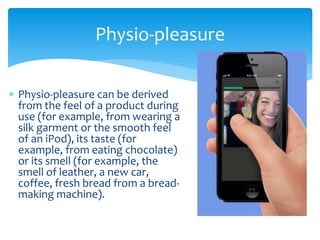
 Physio-pleasure can be derived
from the feel of a product during
use (for example, from wearing a
silk garment or the smooth feel
of an iPod), its taste (for
example, from eating chocolate)
or its smell (for example, the
smell of leather, a new car,
coffee, fresh bread from a bread-
making machine).
Physio-pleasure
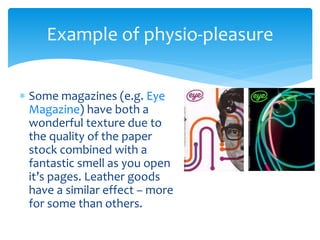
 Some magazines (e.g. Eye
Magazine) have both a
wonderful texture due to
the quality of the paper
stock combined with a
fantastic smell as you open
it’s pages. Leather goods
have a similar effect – more
for some than others.
Example of physio-pleasure
 Socio-pleasures, as the name suggests, are concerned with
pleasures derived from social signifiers of belonging, social-
enablers and other social self-identification factors.
Socio-pleasure
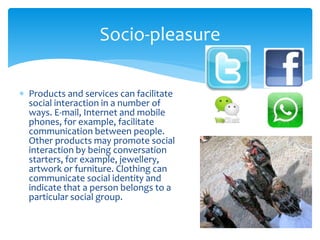
 Products and services can facilitate
social interaction in a number of
ways. E-mail, Internet and mobile
phones, for example, facilitate
communication between people.
Other products may promote social
interaction by being conversation
starters, for example, jewellery,
artwork or furniture. Clothing can
communicate social identity and
indicate that a person belongs to a
particular social group.
Socio-pleasure
 Facebook is a tool that enables people to
have a greater sense of community and
involvement with one another.
 Often geographically disparate friends can
still retain a foothold in one another’s lives.
Example of socio-pleasure
 Psycho-pleasures are pleasures that are derived from
cognition, discovery, knowledge, and other things that
satisfy the intellect.
psycho-pleasure
 In the case of products, this includes issues relating to the
cognitive demands of using the product or service and the
emotional reactions engendered through the experience of using
it.
 For example, it might be expected that a word processor that
facilitated quick and easy accomplishment of, say, formatting
tasks would provide a higher level of psycho-pleasure than one
with which the user was likely to make many errors.
 The former word processor should enable the user to complete
the task more easily than they would with the latter. The outcome
may also be more emotionally satisfying and less stressful.
psycho-pleasure
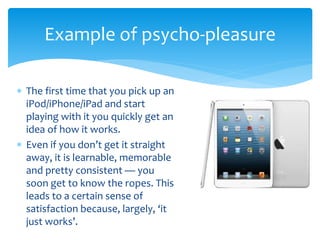
 The first time that you pick up an
iPod/iPhone/iPad and start
playing with it you quickly get an
idea of how it works.
 Even if you don’t get it straight
away, it is learnable, memorable
and pretty consistent — you
soon get to know the ropes. This
leads to a certain sense of
satisfaction because, largely, ‘it
just works’.
Example of psycho-pleasure
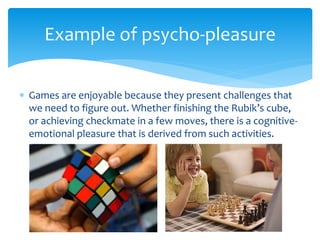
 Games are enjoyable because they present challenges that
we need to figure out. Whether finishing the Rubik’s cube,
or achieving checkmate in a few moves, there is a cognitive-
emotional pleasure that is derived from such activities.
Example of psycho-pleasure
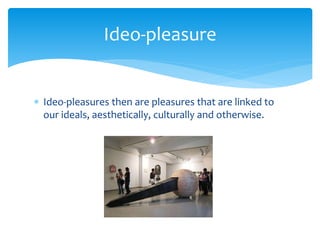
 Ideo-pleasures then are pleasures that are linked to
our ideals, aesthetically, culturally and otherwise.
Ideo-pleasure
 Products that are aesthetically pleasing
can be a source of ideo-pleasure through
appealing to the consumer’s tastes.
 Values could be philosophical or religious
or may relate to some particular issue such
as the environment or a political
movement.
 These values can be embodied in
products. For example, a product made
from biodegradable materials might be
seen as embodying the value of
environmental responsibility.
Ideo-pleasure
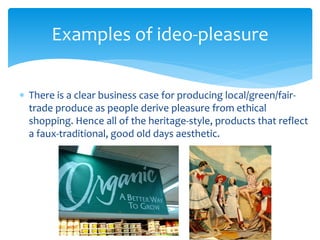
 There is a clear business case for producing local/green/fair-
trade produce as people derive pleasure from ethical
shopping. Hence all of the heritage-style, products that reflect
a faux-traditional, good old days aesthetic.
Examples of ideo-pleasure
 The “four pleasure framework” is a useful tool for
taking a structured approach to product design and
marketing.
 It can act as a practical tool.
 Using the framework can help to make us more
thorough and methodical in our approach than would
be the case if we tried to approach the whole thing in
an unstructured way.
How the “four pleasure framework” promotes a holistic
view of product design and marketing

Usability design for pleasure

  • 1.
    Beyond usability Designing forpleasure E11.1 – E11.7
  • 2.
     The “fourpleasure framework” was identified by Professor Lionel Tiger from Rutgers University in New Jersey, US.  a Four Pleasure model that categorises the four broad types of pleasure enjoyed by people.  It includes the four areas of physio-pleasure, psycho- pleasure, socio-pleasure and ideo-pleasure.  A framework for considering pleasure with products The “four pleasure framework”
  • 3.
     Because youwant to create products that people love.  The Four Pleasure model is a framework that can be used to help evaluate how pleasurable a product will be use and own. It can also be used to identify and generate opportunities to enhance a product. Importance/significance?
  • 4.
     Physio-pleasure isa sensual pleasure that is derived from touching, smelling, hearing and tasting something. It also conveyed by an objects effectiveness in enabling an action to be performed.
  • 5.
     Physio-pleasure canbe derived from the feel of a product during use (for example, from wearing a silk garment or the smooth feel of an iPod), its taste (for example, from eating chocolate) or its smell (for example, the smell of leather, a new car, coffee, fresh bread from a bread- making machine). Physio-pleasure
  • 6.
     Some magazines(e.g. Eye Magazine) have both a wonderful texture due to the quality of the paper stock combined with a fantastic smell as you open it’s pages. Leather goods have a similar effect – more for some than others. Example of physio-pleasure
  • 7.
     Socio-pleasures, asthe name suggests, are concerned with pleasures derived from social signifiers of belonging, social- enablers and other social self-identification factors. Socio-pleasure
  • 8.
     Products andservices can facilitate social interaction in a number of ways. E-mail, Internet and mobile phones, for example, facilitate communication between people. Other products may promote social interaction by being conversation starters, for example, jewellery, artwork or furniture. Clothing can communicate social identity and indicate that a person belongs to a particular social group. Socio-pleasure
  • 9.
     Facebook isa tool that enables people to have a greater sense of community and involvement with one another.  Often geographically disparate friends can still retain a foothold in one another’s lives. Example of socio-pleasure
  • 10.
     Psycho-pleasures arepleasures that are derived from cognition, discovery, knowledge, and other things that satisfy the intellect. psycho-pleasure
  • 11.
     In thecase of products, this includes issues relating to the cognitive demands of using the product or service and the emotional reactions engendered through the experience of using it.  For example, it might be expected that a word processor that facilitated quick and easy accomplishment of, say, formatting tasks would provide a higher level of psycho-pleasure than one with which the user was likely to make many errors.  The former word processor should enable the user to complete the task more easily than they would with the latter. The outcome may also be more emotionally satisfying and less stressful. psycho-pleasure
  • 12.
     The firsttime that you pick up an iPod/iPhone/iPad and start playing with it you quickly get an idea of how it works.  Even if you don’t get it straight away, it is learnable, memorable and pretty consistent — you soon get to know the ropes. This leads to a certain sense of satisfaction because, largely, ‘it just works’. Example of psycho-pleasure
  • 13.
     Games areenjoyable because they present challenges that we need to figure out. Whether finishing the Rubik’s cube, or achieving checkmate in a few moves, there is a cognitive- emotional pleasure that is derived from such activities. Example of psycho-pleasure
  • 14.
     Ideo-pleasures thenare pleasures that are linked to our ideals, aesthetically, culturally and otherwise. Ideo-pleasure
  • 15.
     Products thatare aesthetically pleasing can be a source of ideo-pleasure through appealing to the consumer’s tastes.  Values could be philosophical or religious or may relate to some particular issue such as the environment or a political movement.  These values can be embodied in products. For example, a product made from biodegradable materials might be seen as embodying the value of environmental responsibility. Ideo-pleasure
  • 16.
     There isa clear business case for producing local/green/fair- trade produce as people derive pleasure from ethical shopping. Hence all of the heritage-style, products that reflect a faux-traditional, good old days aesthetic. Examples of ideo-pleasure
  • 17.
     The “fourpleasure framework” is a useful tool for taking a structured approach to product design and marketing.  It can act as a practical tool.  Using the framework can help to make us more thorough and methodical in our approach than would be the case if we tried to approach the whole thing in an unstructured way. How the “four pleasure framework” promotes a holistic view of product design and marketing