2|Page


Submitted by:

   1.   ABHISHEK MISHRA
   2.   AJEET PANDEY
   3.   ANIKET RAVAL
   4.   ANKUR SHARMA
   5.   ANSHUL DIXIT


Submitted: Pro. Pabitra Ranjan Chakravorty


Disclaimer

This document describes work undertaken as part of a programmed of study at the
Indian Institute of Planning and Management for Consumer behavior Towards
Social Networking Site. All views and opinions are only the learning point of views
and collected through primary and secondary sources.


Indian Institute of Planning and Management, Ahmedabad

CONSUMER BEHAVIOR TOWARDS SOCIAL NETWORKING SITES                            Page 2
Abstract

The study of consumers helps firms and organizations improve their marketing
strategies by understanding issues such as how
       The psychology of how consumers think, feel, reason, and select between
       different alternatives (e.g., brands, products, and retailers);
       The psychology of how the consumer is influenced by his or her
       environment (e.g., culture, family, signs, media);

Social media has gone from being just a place to meet people and make new
friends to a virtual sales floor. Whether on Twitter, Facebook, MySpace or other
social networking site, you can find many businesses and sales-minded individuals
putting their product on display. They are not only selling themselves, like the rest
of us, but their brand. Because of the different type of appeal they wish to have,
there are certain rules they must abide by in order to achieve the social influence
they intend. It's very important to appeal to all in order to sell to the most. It is a
number game so with that in mind, business leaders and other entrepreneurs must
present a personality that will be liked by many.


Acknowledgment

The study has followed a long and winding path along which we meet many
people, this formal space to acknowledge their contributions is too less. Yet we
would say that the distribution of my gratitude to all these supporters from
different geographic coordinates is proportionate and equitable in Ahmedabad.
We would like to express our thanks to Pro. Pabitra Ranjan Chakravorty for
guiding us through the whole project.
We would also express thanks to all those people who help us to answers our
question and enhances our knowledge in the industry of Information and
Technology and in social networking sites.


3
INDEX

    Number     Topic Name                                   Page no.
      1.       Introduction                                 6
      2.       Consumer Behavior                            9
      3.       Consumer Behavioral Model                    9
      4.       Factor effecting Consumer Behavior           11
      5.       What is Internet                             14
      6.       Types of Sites                               15
      7.       What is Social Networking Sites?             16
      8.       Different types of Social Networking Sites   20
      9.       Advantages                                   22
      10.      Disadvantages                                22
      11.      Analysis View point                          22
      12.      Major Players                                23
      13.      Sources of Their Income                      23
      14.      About Face book                              24
      15.      Market Share                                 25
      16.      Strategies                                   26
      17.      Behavior of user                             26
      18.      Unique Selling proportion                    27
      19.      Primary Research
               1) Questionnaire                             28
                    a) Statistical Data
                    b) Analysis
               2) Ethnographic Research                     38
       20.     Recommendation                               39

        21.    Conclusion                                   39
        22.    Bibliography                                 40
    --------   Sample of Fair chart


4
List of CHARTS
         1) CONSUMER BEHAVIOR MODEL .........…9
         2) FACTOR AFFECTING CB………… ……...11
         3) MARKET SHARE ……………………….…25
         4) AGE…………………………………………29.
         5) GENDER…………………………………... 30.
         6) OCCUPATION……………………………...31
         7) EMAIL………………………………………32
         8) NETWORKING SITE……………………...33
         9) TIME ………………………………………..34
         10) FEATURES………………………………….35
         11) CHARGED………………………………….36
         12) PARENTS BEHAVIOR…………………….37


5
INTRODUCTION

The study of consumers helps firms and organizations improve their marketing
strategies by understanding issues such as how

      The psychology of how consumers think, feel, reason, and select between
      different alternatives (e.g., brands, products, and retailers);
      The psychology of how the consumer is influenced by his or her
      environment (e.g., culture, family, signs, media);
      The behavior of consumers while shopping or making other marketing
      decisions;
      Limitations in consumer knowledge or information processing abilities
      influence decisions and marketing outcome;
      How consumer motivation and decision strategies differ between products
      that differ in their level of importance or interest that they entail for the
      consumer; and
      How marketers can adapt and improve their marketing campaigns and
      marketing strategies to more effectively reach the consumer.

One "official" definition of consumer behavior is "The study of individuals,
groups, or organizations and the processes they use to select, secure, use, and
dispose of products, services, experiences, or ideas to satisfy needs and the impacts
that these processes have on the consumer and society." Although it is not
necessary to memorize this definition, it brings up some useful points:

      Behavior occurs either for the individual, or in the context of a group (e.g.,
      friends influence what kinds of clothes a person wears) or an organization
      (people on the job make decisions as to which products the firm should
      use).
      Consumer behavior involves the use and disposal of products as well as the
      study of how they are purchased. Product use is often of great interest to the
      marketer, because this may influence how a product is best positioned or
      how we can encourage increased consumption. Since many environmental
      problems result from product disposal (e.g., motor oil being sent into
      sewage systems to save the recycling fee, or garbage piling up at landfills)
      this is also an area of interest.
      Consumer behavior involves services and ideas as well as tangible products.
      The impact of consumer behavior on society is also of relevance. For
      example, aggressive marketing of high fat foods, or aggressive marketing of
6
easy credit, may have serious repercussions for the national health and
      economy.
There are four main applications of consumer behavior:
      The most obvious is for marketing strategy—i.e., for making better
      marketing campaigns. For example, by understanding that consumers are
      more receptive to food advertising when they are hungry, we learn to
      schedule snack advertisements late in the afternoon. By understanding that
      new products are usually initially adopted by a few consumers and only
      spread later, and then only gradually, to the rest of the population, we learn
      that (1) companies that introduce new products must be well financed so
      that they can stay afloat until their products become a commercial success
      and (2) it is important to please initial customers, since they will in turn
      influence many subsequent customers’ brand choices.
      A second application is public policy. In the 1980s, Acutance, a near miracle
      cure for acne, was introduced. Unfortunately, Acutance resulted in severe
      birth defects if taken by pregnant women. Although physicians were
      instructed to warn their female patients of this, a number still became
      pregnant while taking the drug. To get consumers’ attention, the Federal
      Drug Administration (FDA) took the step of requiring that very graphic
      pictures of deformed babies be shown on the medicine containers.
      Social marketing involves getting ideas across to consumers rather than
      selling something. Marty Fishbein, a marketing professor, went on sabbatical
      to work for the Centers for Disease Control trying to reduce the incidence
      of transmission of diseases through illegal drug use. The best solution,
      obviously, would be if we could get illegal drug users to stop. This, however,
      was deemed to be infeasible. It was also determined that the practice of
      sharing needles was too ingrained in the drug culture to be stopped. As a
      result, using knowledge of consumer attitudes, Dr. Fishbein created a
      campaign that encouraged the cleaning of needles in bleach before sharing
      them, a goal that was believed to be more realistic.
      As a final benefit, studying consumer behavior should make us better
      consumers. Common sense suggests, for example, that if you buy a 64 liquid
      ounce bottle of laundry detergent, you should pay less per ounce than if you
      bought two 32 ounce bottles. In practice, however, you often pay a size
      premium by buying the larger quantity. In other words, in this case, knowing
      this fact will sensitize you to the need to check the unit cost labels to
      determine if you are really getting a bargain.


7
There are several units in the market that can be analyzed. Our main thrust in this
course is the consumer. However, we will also need to analyze our own firm’s
strengths and weaknesses and those of competing firms. Suppose, for example,
that we make a product aimed at older consumers, a growing segment. A
competing firm that targets babies, a shrinking market, is likely to consider
repositioning toward our market. To assess a competing firm’s potential threat, we
need to examine its assets (e.g., technology, patents, market knowledge, and
awareness of its brands) against pressures it faces from the market. Finally, we
need to assess conditions (the marketing environment). For example, although we
may have developed a product that offers great appeal for consumers, a recession
may cut demand dramatically.


8
CONSUMER BEHAVIOR

DEFINITION:
The term consumer Behavior can be defined as the behavior of consumers display
in searching for purchasing, using, evaluating and disposing of products services
idea which they expect will satisfy their needs, want and demand. In other words we can
say that the behavior of customer are affected and influence by money, time and effort for the
maximum satisfaction.

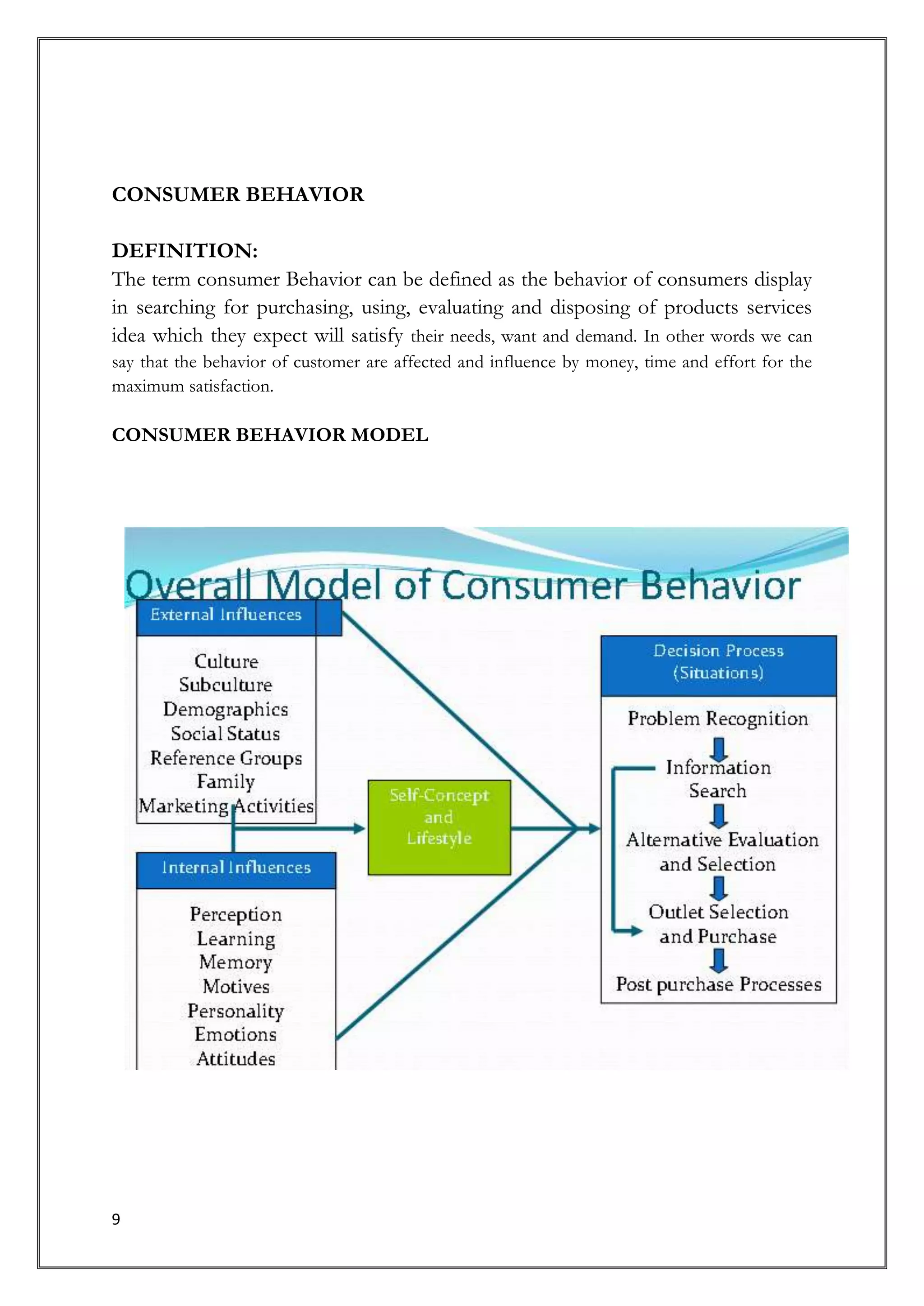
CONSUMER BEHAVIOR MODEL


9
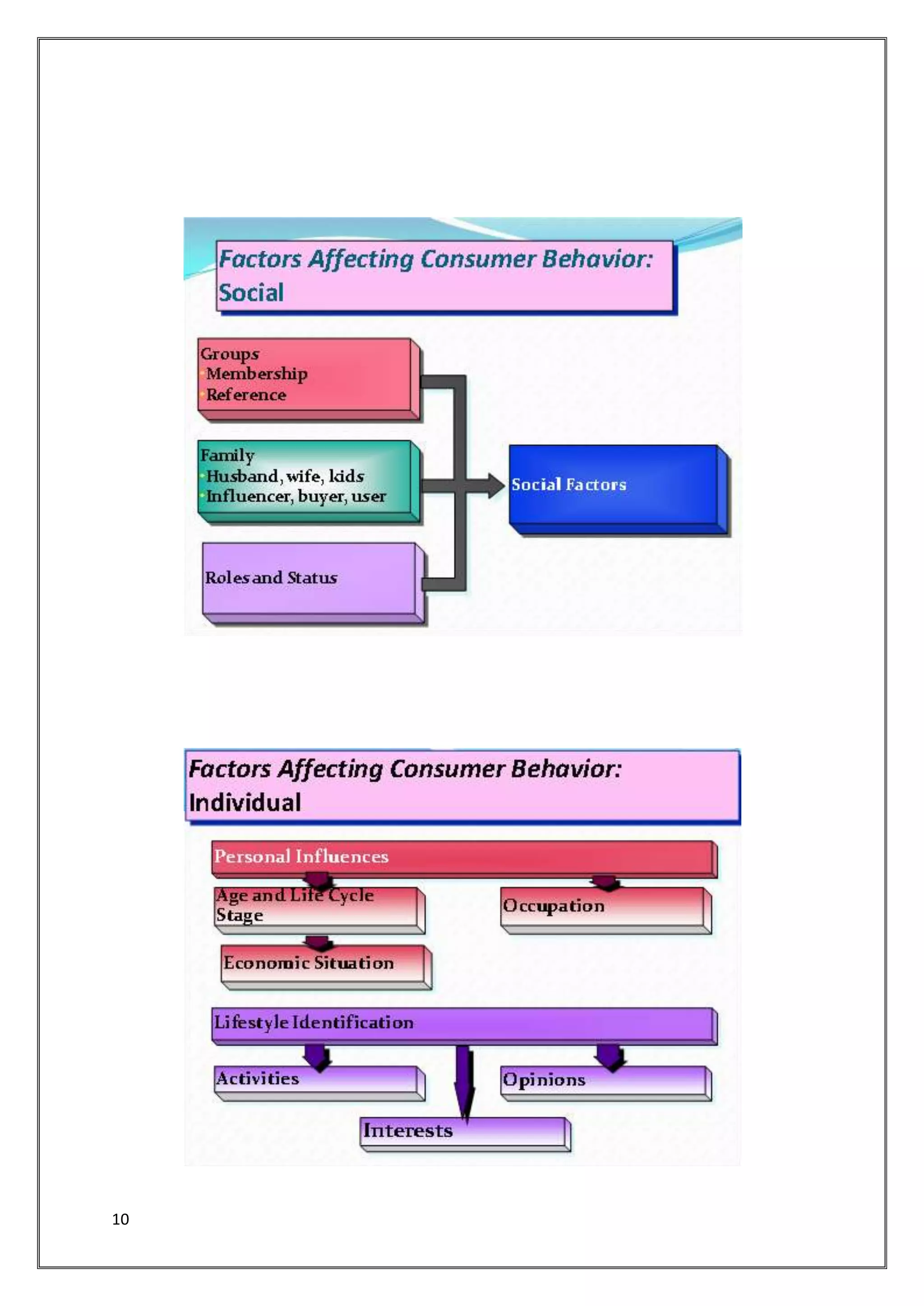
10
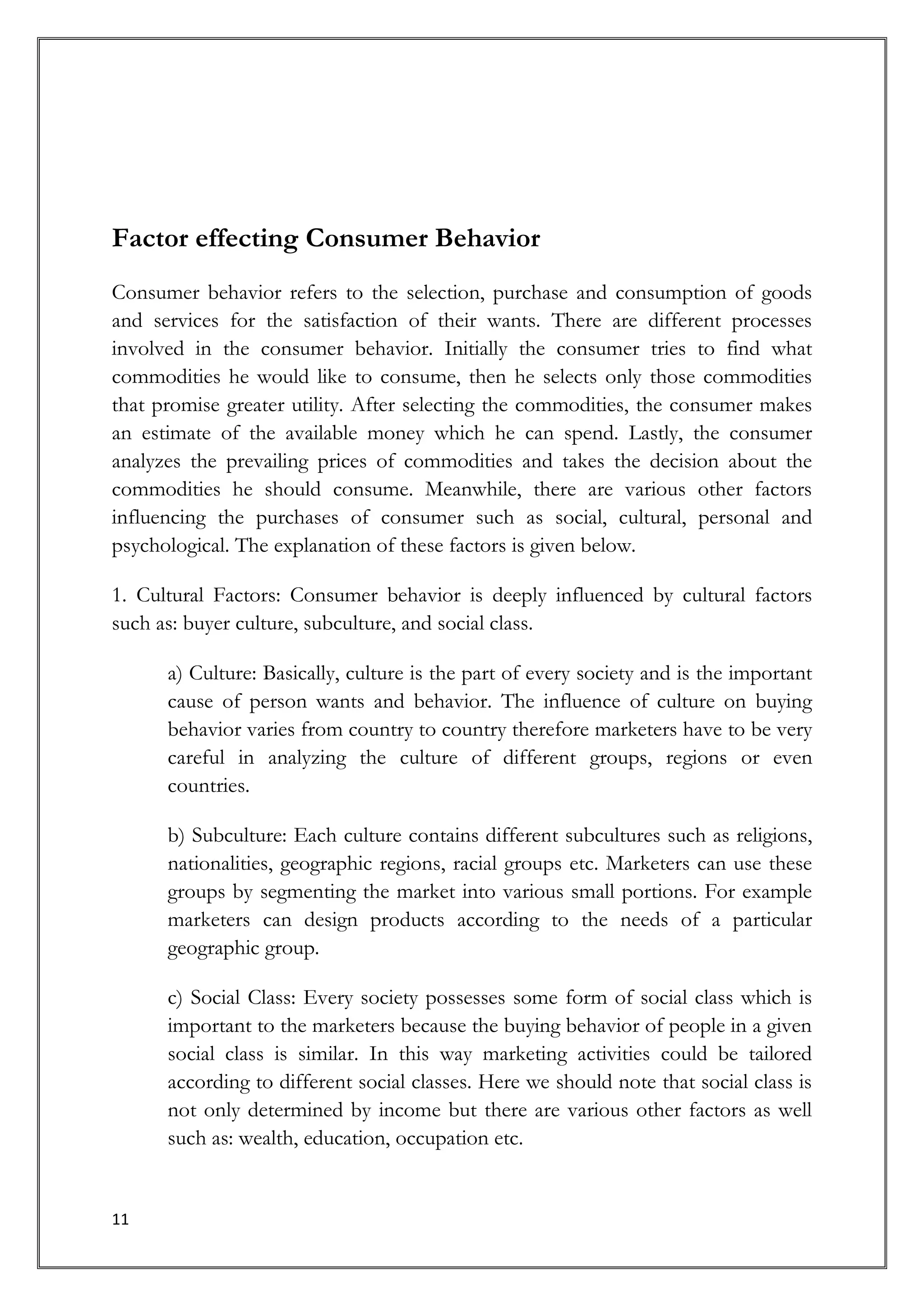
Factor effecting Consumer Behavior
Consumer behavior refers to the selection, purchase and consumption of goods
and services for the satisfaction of their wants. There are different processes
involved in the consumer behavior. Initially the consumer tries to find what
commodities he would like to consume, then he selects only those commodities
that promise greater utility. After selecting the commodities, the consumer makes
an estimate of the available money which he can spend. Lastly, the consumer
analyzes the prevailing prices of commodities and takes the decision about the
commodities he should consume. Meanwhile, there are various other factors
influencing the purchases of consumer such as social, cultural, personal and
psychological. The explanation of these factors is given below.

1. Cultural Factors: Consumer behavior is deeply influenced by cultural factors
such as: buyer culture, subculture, and social class.

      a) Culture: Basically, culture is the part of every society and is the important
      cause of person wants and behavior. The influence of culture on buying
      behavior varies from country to country therefore marketers have to be very
      careful in analyzing the culture of different groups, regions or even
      countries.

      b) Subculture: Each culture contains different subcultures such as religions,
      nationalities, geographic regions, racial groups etc. Marketers can use these
      groups by segmenting the market into various small portions. For example
      marketers can design products according to the needs of a particular
      geographic group.

      c) Social Class: Every society possesses some form of social class which is
      important to the marketers because the buying behavior of people in a given
      social class is similar. In this way marketing activities could be tailored
      according to different social classes. Here we should note that social class is
      not only determined by income but there are various other factors as well
      such as: wealth, education, occupation etc.


11
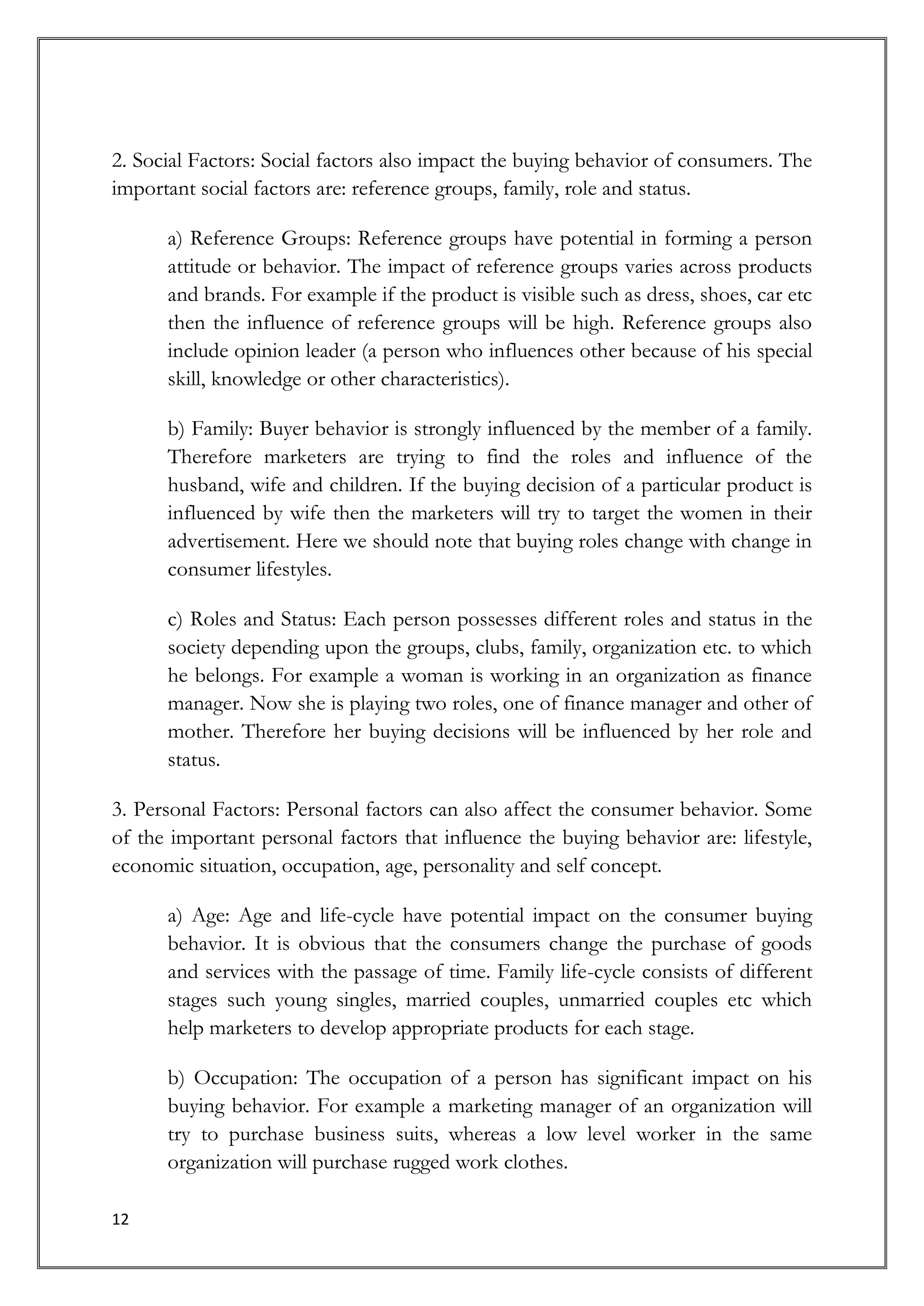
2. Social Factors: Social factors also impact the buying behavior of consumers. The
important social factors are: reference groups, family, role and status.

      a) Reference Groups: Reference groups have potential in forming a person
      attitude or behavior. The impact of reference groups varies across products
      and brands. For example if the product is visible such as dress, shoes, car etc
      then the influence of reference groups will be high. Reference groups also
      include opinion leader (a person who influences other because of his special
      skill, knowledge or other characteristics).

      b) Family: Buyer behavior is strongly influenced by the member of a family.
      Therefore marketers are trying to find the roles and influence of the
      husband, wife and children. If the buying decision of a particular product is
      influenced by wife then the marketers will try to target the women in their
      advertisement. Here we should note that buying roles change with change in
      consumer lifestyles.

      c) Roles and Status: Each person possesses different roles and status in the
      society depending upon the groups, clubs, family, organization etc. to which
      he belongs. For example a woman is working in an organization as finance
      manager. Now she is playing two roles, one of finance manager and other of
      mother. Therefore her buying decisions will be influenced by her role and
      status.

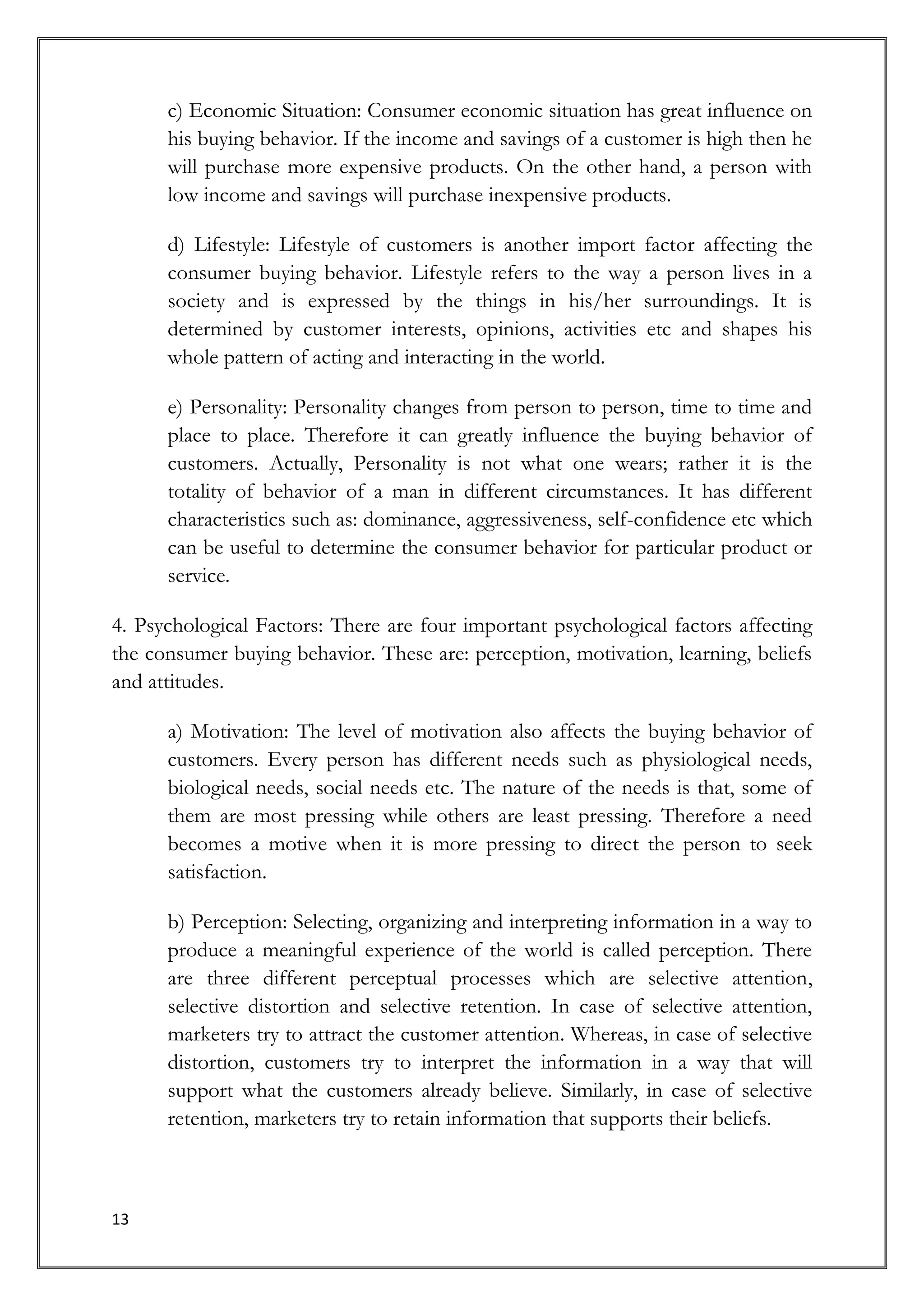
3. Personal Factors: Personal factors can also affect the consumer behavior. Some
of the important personal factors that influence the buying behavior are: lifestyle,
economic situation, occupation, age, personality and self concept.

      a) Age: Age and life-cycle have potential impact on the consumer buying
      behavior. It is obvious that the consumers change the purchase of goods
      and services with the passage of time. Family life-cycle consists of different
      stages such young singles, married couples, unmarried couples etc which
      help marketers to develop appropriate products for each stage.

      b) Occupation: The occupation of a person has significant impact on his
      buying behavior. For example a marketing manager of an organization will
      try to purchase business suits, whereas a low level worker in the same
      organization will purchase rugged work clothes.

12
c) Economic Situation: Consumer economic situation has great influence on
      his buying behavior. If the income and savings of a customer is high then he
      will purchase more expensive products. On the other hand, a person with
      low income and savings will purchase inexpensive products.

      d) Lifestyle: Lifestyle of customers is another import factor affecting the
      consumer buying behavior. Lifestyle refers to the way a person lives in a
      society and is expressed by the things in his/her surroundings. It is
      determined by customer interests, opinions, activities etc and shapes his
      whole pattern of acting and interacting in the world.

      e) Personality: Personality changes from person to person, time to time and
      place to place. Therefore it can greatly influence the buying behavior of
      customers. Actually, Personality is not what one wears; rather it is the
      totality of behavior of a man in different circumstances. It has different
      characteristics such as: dominance, aggressiveness, self-confidence etc which
      can be useful to determine the consumer behavior for particular product or
      service.

4. Psychological Factors: There are four important psychological factors affecting
the consumer buying behavior. These are: perception, motivation, learning, beliefs
and attitudes.

      a) Motivation: The level of motivation also affects the buying behavior of
      customers. Every person has different needs such as physiological needs,
      biological needs, social needs etc. The nature of the needs is that, some of
      them are most pressing while others are least pressing. Therefore a need
      becomes a motive when it is more pressing to direct the person to seek
      satisfaction.

      b) Perception: Selecting, organizing and interpreting information in a way to
      produce a meaningful experience of the world is called perception. There
      are three different perceptual processes which are selective attention,
      selective distortion and selective retention. In case of selective attention,
      marketers try to attract the customer attention. Whereas, in case of selective
      distortion, customers try to interpret the information in a way that will
      support what the customers already believe. Similarly, in case of selective
      retention, marketers try to retain information that supports their beliefs.


13
c) Beliefs and Attitudes: Customer possesses specific belief and attitude
     towards various products. Since such beliefs and attitudes make up brand
     image and affect consumer buying behavior therefore marketers are
     interested in them. Marketers can change the beliefs and attitudes of
     customers by launching special campaigns in this regard.


WHAT IS INTERNET?

     The Internet is a global system of interconnected computer networks that
     use the standard Internet Protocol Suite (TCP/IP) to serve billions of users
     worldwide


14
WHAT IS SOCIAL NETWORKING SITE?

A social network service is an online service, platform, or site that focuses on
building and reflecting of social networks or social relations among people, e.g.,
who share interests and/or activities. A social network service essentially consists
of a representation of each user (often a profile), his/her social links, and a variety
of additional services. Most social network services are web based and provide
means for users to interact over the internet, such as e-mail and instant messaging.
Although online community services are sometimes considered as a social network
service. In a broader sense, social network service usually means an individual-
centered service whereas online community services are group-centered. Social
networking sites allow users to share ideas, activities, events, and interests within
their individual networks.

The main types of social networking services are those which contain category
places (such as former school-year or classmates), means to connect with friends
(usually with self-description pages) and a recommendation system linked to trust.
Popular methods now combine many of these, with Facebook and Twitter widely
used worldwide; MySpace and LinkedIn being the most widely used in North
America; Nexopia (mostly in Canada); Bebo, Hi5, Hyves (mostly in The
Netherlands), StudiVZ (mostly in Germany), iWiW (mostly in Hungary), Tuenti
(mostly in Spain), Nasza-Klasa (mostly in Poland), Decayenne, Tagged, XING,
Badoo and Skyrock in parts of Europe; Orkut and Hi5 in South America, India
and Central America; and Friendster, Mixi, Multiply, Orkut, Wretch, renren and
Cyworld in Asia and the Pacific Islands and Twitter, Orkut and Facebook in India.

There have been attempts to standardize these services to avoid the need to
duplicate entries of friends and interests (see the FOAF standard and the Open
Source Initiative).

Although some of the largest social networks were founded on the notion of
digitizing real world connections, many networks focus on categories from books
and music to non-profit business to motherhood as ways to provide both services
and community to individuals with shared interests.


15
TYPE OF SITES

        1) A categorization based on content

     Web sites, like other "worldly" things, can be classified into various
     categories. This page has a list of the different types of web sites based on
     the content and features offered. However, content can be varied, and with
     this in mind, I have tried to make segregation as intuitive as possible. Please
     note that these categories of the web sites are not distinct and can overlap...
     sometimes to a large degree.
        2) Search engine, directories, yellow pages and portals

     These are some of the most popular types of web sites in the world. Some
     search engine companies, like Google or Gigablast, prefer to keep their
     homepage simple and stress on only one service, while Yahoo! and MSN
     have a more "portal" like look via which many services are pushed to the
     surfer like email, news etc.

     The portal look provides a broader platform for the company to promote
     their different services but it also fragments the visitors.

     Classified directories and yellow pages web sites list businesses (both online
     and offline) segregated into different categories or geographic locations.
     These may also include an internal search engine that helps users quickly
     locate information.

        3) Information web sites

     These are the types of web sites are dedicated to the purpose of providing
     information - whether free or paid. These information web sites might be
     catering to a niche industry or be wider in their scope because of which they
     can be labelled as "news portals". Information web site can also contain
     updated time tables, TV guides, reference material, sports data (like cricket
     scores), weather and stock data.

        4) Personal web sites

     With tons of tools and services available, creating a web site is no longer
     "rocket science" (actually, it never was; but for some...). The astronomical

16
number of personal web sites one finds on the web is mind-blowing!
     Personal web sites and blogs would probably be the fastest growing types of web
     site.

     Personal web sites can contain any kind of information and are usually
     administered by a single individual who can choose whatever to put online.

     Any one can now create a web site using online free hosting accounts that
     might also offer pre-made templates that are like ready-to-go web sites, or
     with free and commercial versions of WYSIWYG HTML editors like
     Frontpage, DreamWeaver etc.

        5) Blogs and online diaries

     Blogs are like online diaries (the irony is, though you keep your hardcopy
     diary under lock-and-key, you want more and more visitors to read the
     online one). Blogs can be created by anyone using free services like
     Blogger.com (Google) or Windows Live Spaces (Microsoft). You can also
     install blog software, like the free WordPress on your pre-existing web site
     and start putting your thoughts online in a matter of minutes!

     Because blogs are so easy to create, manage and even earn from (there are a
     lot of profitable blogs online, if you didn't know), the web has increased
     manifold. And it's all thanks to the many free blog services and a strong
     enthusiasm by the ever growing blogging community who keep maintaining
     and updating their web space regularly.

     From ramblings of a wandering mind to detailed and specific information
     on technical fields, the content of blog types of web site can vary widely.

        6) Company web sites

     Most company web sites have just a few pages of information on the
     business, its services and clients. These are more like "online brochures"

        7) Forums

     Forum types of web sites serve as platforms and promote interactions
     amongst the users. Unless specifically blocked and requiring a special
     invitation, you can join any forum on the web. Most forums cater to a
     specific industry or a field. So, for example, you will find forums on web

17
design and development, banking and finance, biotechnology... I even came
     across one to help people share their phobia of butterflies (take a look at
     IHateButterflies.com - yes, I am mortally scared of butterflies and moths.

     Forums on web sites, typically, contain categories that further narrow down
     the subject. Registered users can post questions or start a topic which other
     users can reply or add to. A lot of valuable information and knowledge
     exists in online forums and I urge you to join and actively participate in
     online discussions with people that share the same interests.

     Ready-to-use free software such as phpBB or SMF help you set up a forum
     web site in a matter of minutes. If you already have a web site, check with
     the hosting company; they would probably provide such forum software for
     free which you can install via the control panel.

        8) Online shops and auctions web sites

     Though the web is primarily used for communication (email!) and
     information search, many companies have set up shops online. In fact, some
     companies like the popular Amazon don't have brick-and-mortar shops -
     the entire buying and selling takes place online. Online shops are not restricted to
     selling tangible products; they can also provide services and a good example
     of this would be travel and matrimony web sites.

     If you are planning to sell your products (or services) online the tons of free
     and commercial ecommerce software, make will get you up and running in
     no time. Furthermore, you can integrate payment gateways, like Paypal.com
     and moneybookers.com, in your online shopping mall and process the
     orders and receive funds.

        9) Web2.0 web sites

     Web 2. is an amorphous concept and primarily encompasses web sites that
     offer a particular service. The purpose of these web sites can be varied -
     information storage, communication etc. Sites like Flickr.com, Google docs,
     del.icio.us fall into this category.

        10) Social networking

     The new mantra on the web is social networking. These web sites can be
     classified as Web 2.0 sites but their sheer number and popular demands we
18
have a separate category. Facebook, Orkut, LinkedIn, Twitter have been the
     rage past couple of years. From helping you locate schoolmates and past
     colleagues to "microblogging" (whatever that means), these web sites have a
     whole array of utilities and features with more being "invented" and added
     each day.

     Dating web sites have grown over the years and now offer services quite
     similar to those of social networking (the idea is basically the same) hence
     they are a good fit in this category.

        11) File sharing type of web sites

     As internet speeds have increased and more and more people are using
     broadband connections, the importance of file sharing types of web sites has
     grown. Megaupload,com and RapidShare.com are two prime examples of
     such kind of web sites. You can not only find images, but also music
     (sometimes even full albums) and video (entire movies). These web sites
     offer both free and paid memberships - the former is usually a cut down
     version of the latter.

     However, because of the huge number of files stored on these sites, it is
     almost impossible to find the file you are looking for unless you know the
     direct link. Web sites like loadingvault.com provide a decent enough search
     engine that helps you locate files based on your query.


19
WHAT IS SOCIAL NETWORKING SITES?
Social networking is the grouping of individuals into specific groups, like small
rural communities or a neighborhood subdivision, if you will. Although social
networking is possible in person, especially in the workplace, universities, and high
schools, it is most popular online. This is because unlike most high schools,
colleges, or workplaces, the internet is filled with millions of individuals who
are looking to meet other people, to gather and share first-hand information and
experiences           about           cooking,         golfing, gardening, developing
friendships or professional alliances, finding employment, business-to-
business marketing and even groups sharing information about the end of the
Mayan calendar and the Great Shift to arrive December 21-2012. The topics and
interests are as varied and rich as the story of our world.

When it comes to online social networking, websites are commonly used. These
websites are known as social sites. Social networking websites function like an
online community of internet users. Depending on the website in question, many
of these online community members share common interests in hobbies, religion,
or politics. Once you are granted access to a social networking website you can
begin to socialize. This socialization may include reading the profile pages of other
members and possibly even contacting them.

The friends that you can make are just one of the many benefits to social
networking online. Another one of those benefits includes diversity because the
internet gives individuals from all around the world access to social networking
sites. This means that although you are in the United States, you could develop an
online friendship with someone in Denmark or India. Not only will you make new
friends, but you just might learn a thing or two about new cultures or new
languages and learning is always a good thing.

As mentioned, social networking often involves grouping specific individuals or
organizations together. While there are a number of social networking websites
that focus on particular interests, there are others that do not. The websites
without a main focus are often referred to as "traditional" social networking
websites and usually have open memberships. This means that anyone can become
a member, no matter what their hobbies, beliefs, or views are. However, once you
are inside this online community, you can begin to create your own network of
friends and eliminate members that do not share common interests or goals.

20
As I'm sure you're aware, there are dangers associated with social networking
including data theft and viruses, which are on the rise. The most prevalent danger
though often involves online predators or individuals who claim to be someone
that they are not. Although danger does exist with networking online, it also exists
in the real world, too. Just like you're advised when meeting strangers at clubs and
bars, school, or work -- you are also advised to proceed with caution online.

By being aware of your cyber-surroundings and who you are talking to, you should
be able to safely enjoy social networking online. It will take many phone
conversations to get to know someone, but you really won't be able to make a clear
judgment until you can meet each other in person. Just use common sense and
listen to your inner voice; it will tell you when something doesn't feel right about
the online conversations taking place.


21
DIFFERENT TYPE OF SOCIAL NETWORKING SITES
        Forums
        Blogs
        Micro-Blogging
        Photo Sharing
        Video Sharing
        Professional
        Social
        Bookmarking

ADVANTAGES
      Connect with lost classmates, lost family members or lost loves on social
       networking websites.
      Career advantage.
      fun way to kick back and relax.
      Interaction on one-to-one basis.
      Overcome timidity.
      Promotion of business or site for free.
      Stay in touch anywhere
      Brings business and opportunities

DISADVANTAGES
        risk of identity theft and fraud.
        false information.
        online harassment and stalking.
        Safety and security issues.
         ANALYSIS VIEW POINT
        Some companies motivate to use Social Networking Sites
        It increase the knowledge sharing
        It help in understanding the behavior of Employee
        Act like news TV
        Fast information transformation


22
MAJOR PLAYER
        Facebook
        Hi5
        Friendster
        MySpace
        Orkut
        Twitter
        LinkedIn

         SOURCES OF THEIR INCOME

        Internet services (digital goods, game subscriptions, micro-transactions)
        Mobile Subscriptions
        Online Advertising
        App Store
        Trend analysis
        on-demand merchandise
        online music store


23
ABOUT FACEBOOK:
Facebook is a social network service and website launched in February 2004 that
is operated and privately owned by Facebook, Inc. As of January 2011, Facebook
has more than 600 million active users. Users may create a personal profile, add
other users as friends and exchange messages, including automatic notifications
when they update their profile. Additionally, users may join common interest user
groups, organized by workplace, school, or college, or other characteristics. The
name of the service stems from the colloquial name for the book given to students
at the start of the academic year by university administrations in the US with the
intention of helping students to get to know each other better. Facebook allows
anyone who declares them to be at least 13 years old to become a registered user of
the website.
Facebook was founded by Mark Zuckerberg with his college roommates and
fellow computer science students Eduardo Saverin, Dustin Moskovitz andChris
Hughes. The website's membership was initially limited by the founders
to Harvard students, but was expanded to other colleges in the Boston area,
the Ivy League, and Stanford University. It gradually added support for students at
various other universities before opening to high school students, and, finally, to
anyone aged 13 and over.
A January 2009 Compete.com study ranked Facebook as the most used social
network      service by   worldwide      monthly      active   users,  followed
byMySpace. Entertainment Weekly put it on its end-of-the-decade "best-of" list,
saying, "How on earth did we stalk our exes, remember our co-workers' birthdays,
bug our friends, and play a rousing game of Scrabulous before
Facebook?" Quantcast estimates Facebook has 135.1 million monthly unique U.S.
visitors in October 2010. According to Social Media Today as of April 2010, it is
estimated that 41.6% of the U.S. population has a Facebook account.
Some facts and figures about facebook:

        More than 175 million active users.
        Fastest growing demographic: 30 years old and older.
        More than 3 billion minutes spent on Facebook daily.
        More than 4 million users become fans of pages daily.
        More than 850 million photos uploaded monthly.
        More than 7 million videos uploaded monthly.


24
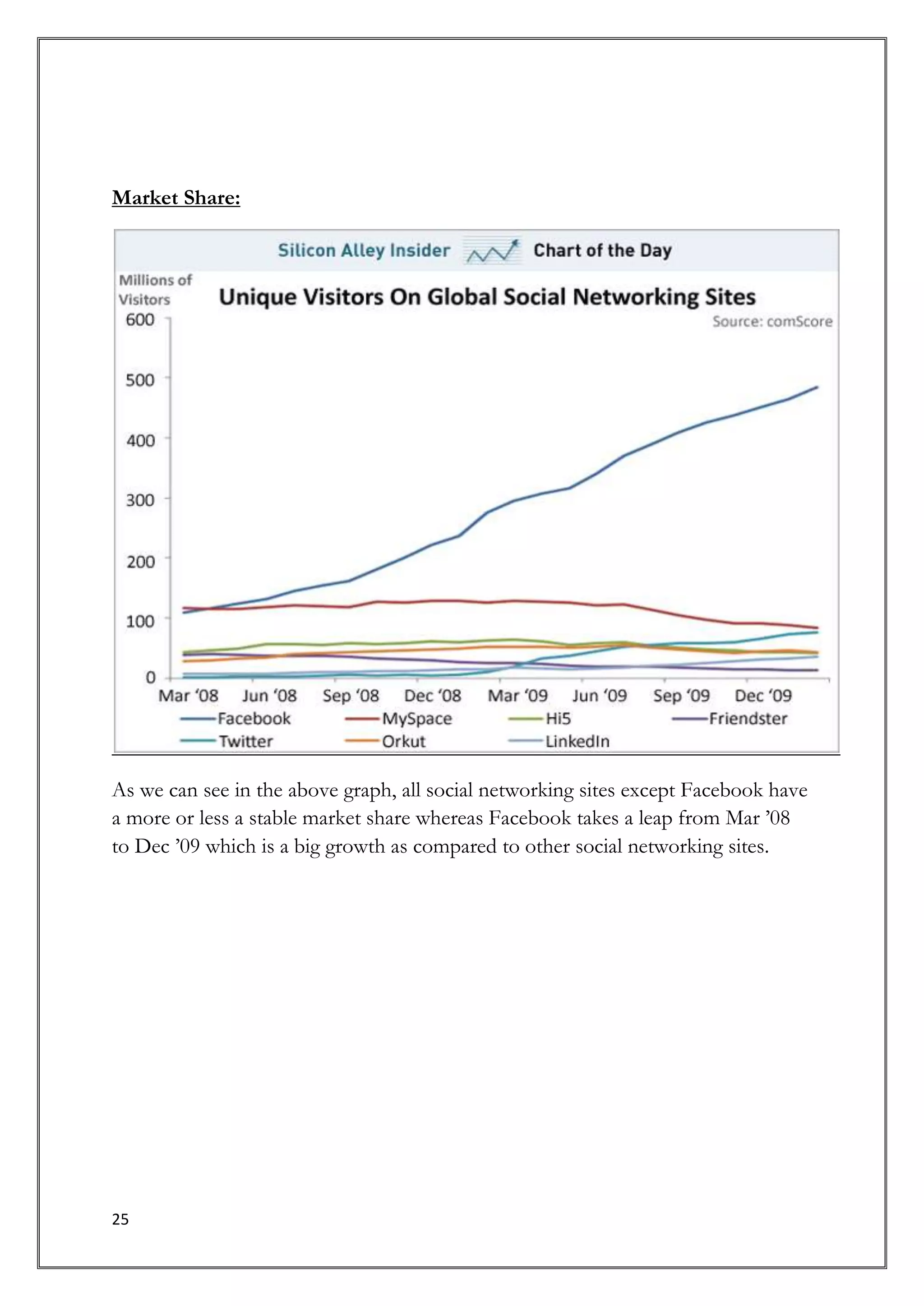
Market Share:


As we can see in the above graph, all social networking sites except Facebook have
a more or less a stable market share whereas Facebook takes a leap from Mar ’08
to Dec ’09 which is a big growth as compared to other social networking sites.


25
STRATEGIES OF FACEBOOK FOR THEIR PAGE MARKETING:
      Set community expectations.

      Provide Cohesive Branding.

      Be up to date.

      Live Authentic.

      Participate in Dialog.

      Enable peer-to-peer interactions.

      Foster Advocacy.


BEHAVIOR OF USER:
The average male Facebook user with 120 friends:

      Leaves comments on 7 friends’ photos, status updates, or wall

      Messages or chats with 4 friends

The average female Facebook user with 120 friends:

      Leaves comments on 10 friends’ photos, status updates, or wall

      Messages or chats with 6 friends

The average male Facebook user with 500 friends:

      Leaves comments on 17 friends’ photos, status updates, or wall

      Messages or chats with 10 friends

The average female Facebook user with 500 friends:

      Leaves comments on 26 friends’ photos, status updates, or wall

      Messages or chats with 16 friends

Addiction


26
UNIQUE SELLING PROPOSITION:
      Security.
      Extent amount of Involvement.

      Appearance.

      Speed.

      Regular Updates.
      Minimum Advertisement.

      Applications.


27
PRIMARY RESEARCH:
Our primary research was carried out by two methods namely,
     1. Questionnaires.
     2. Ethnographic Research.


QUESTIONNAIRES RESULT:
We have took 15 Questions and filled it with 100 respondant.
     1) Name
     2) Age
     3) Gender
     4) Occupation
     5) Email ID
     6) Which Social Networking Site used?
     7) Purpose
     8) Different Features
     9) Continue if Charged
     10) Is these site Beneficial
     11) Addiction?
     12) Time Spend
     13) Want to refer?
     14) Affect on productivity?
     15) Any Suggestion


     And with the help of these questions we try to analyze the behavior of
     consumer who uses these social networking sites.


28
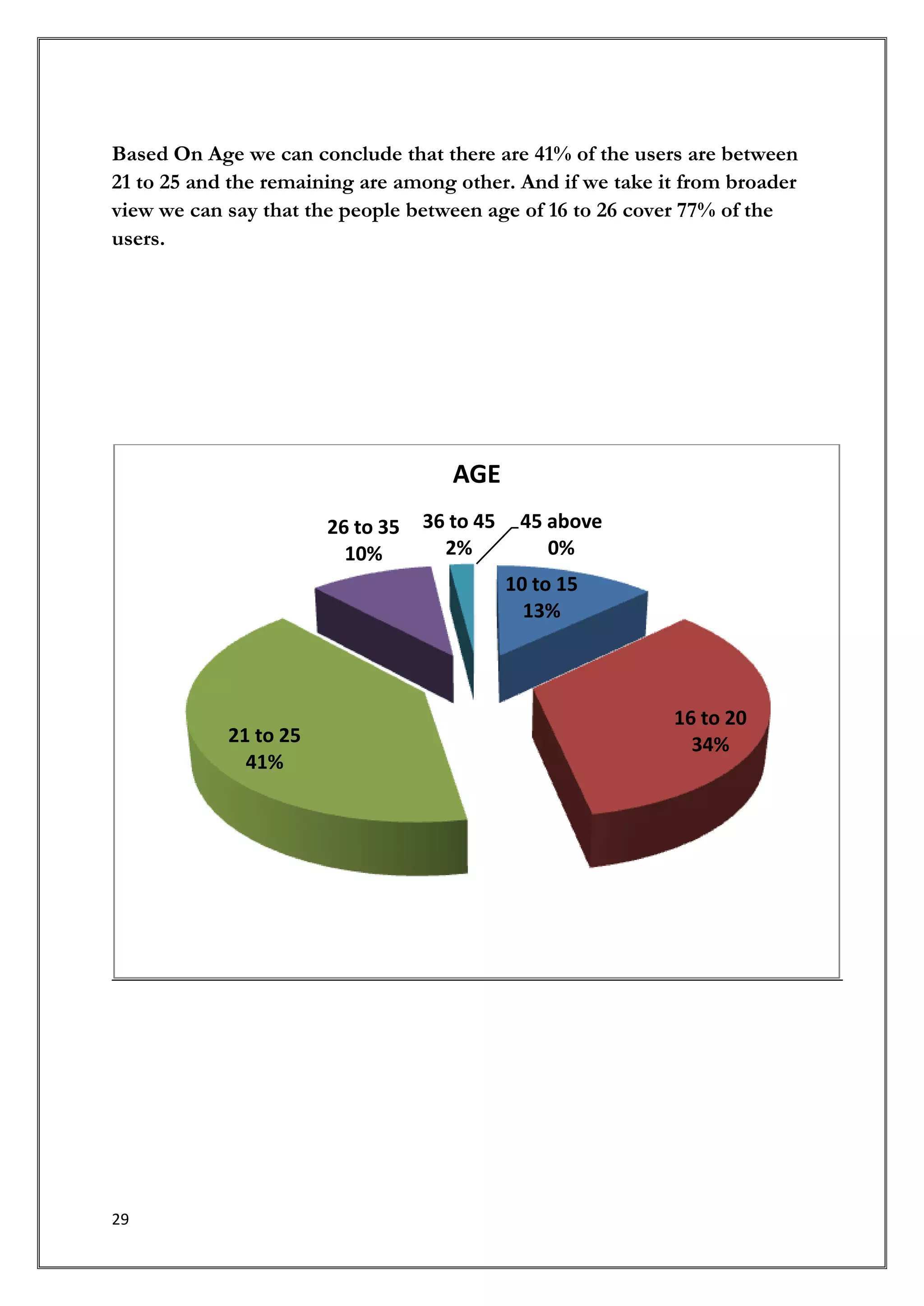
Based On Age we can conclude that there are 41% of the users are between
21 to 25 and the remaining are among other. And if we take it from broader
view we can say that the people between age of 16 to 26 cover 77% of the
users.


                                     AGE
                       26 to 35   36 to 45    45 above
                         10%        2%           0%
                                             10 to 15
                                               13%


                                                            16 to 20
            21 to 25                                          34%
              41%


29
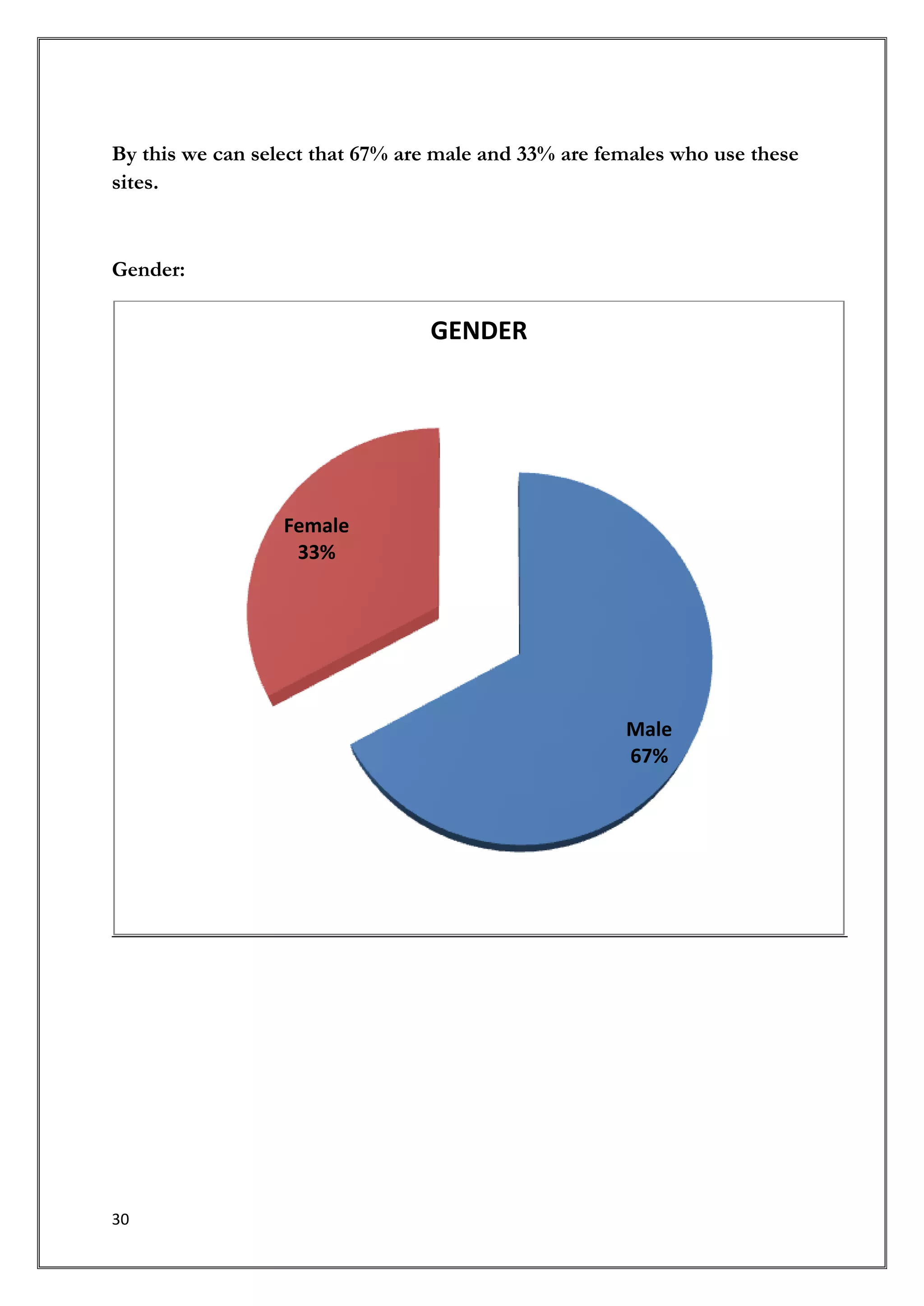
By this we can select that 67% are male and 33% are females who use these
sites.


Gender:

                                 GENDER


                  Female
                   33%


                                                      Male
                                                      67%


30
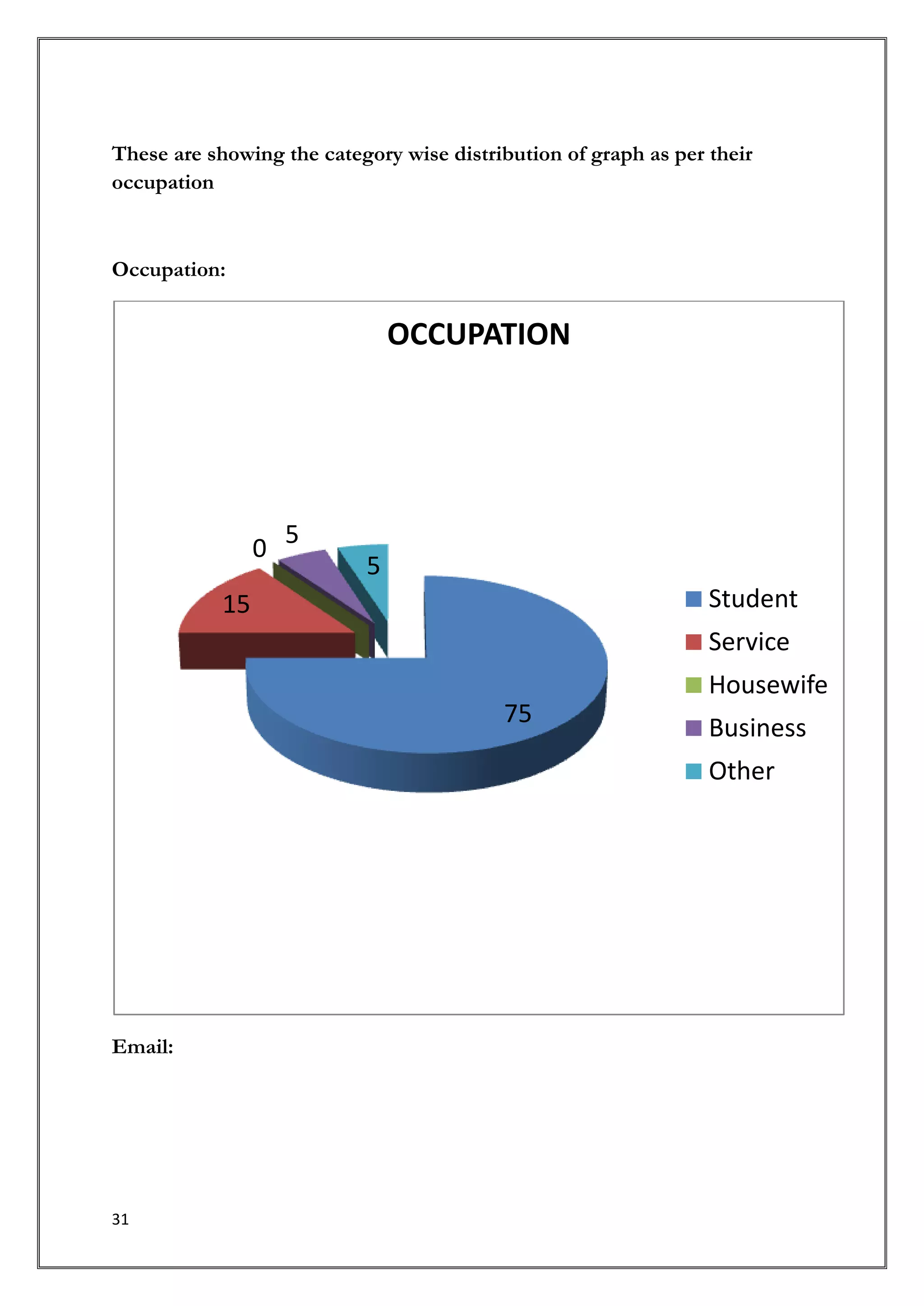
These are showing the category wise distribution of graph as per their
occupation


Occupation:


                               OCCUPATION


                 0 5
                           5
            15                                                   Student
                                                                 Service
                                                                 Housewife
                                          75
                                                                 Business
                                                                 Other


Email:


31
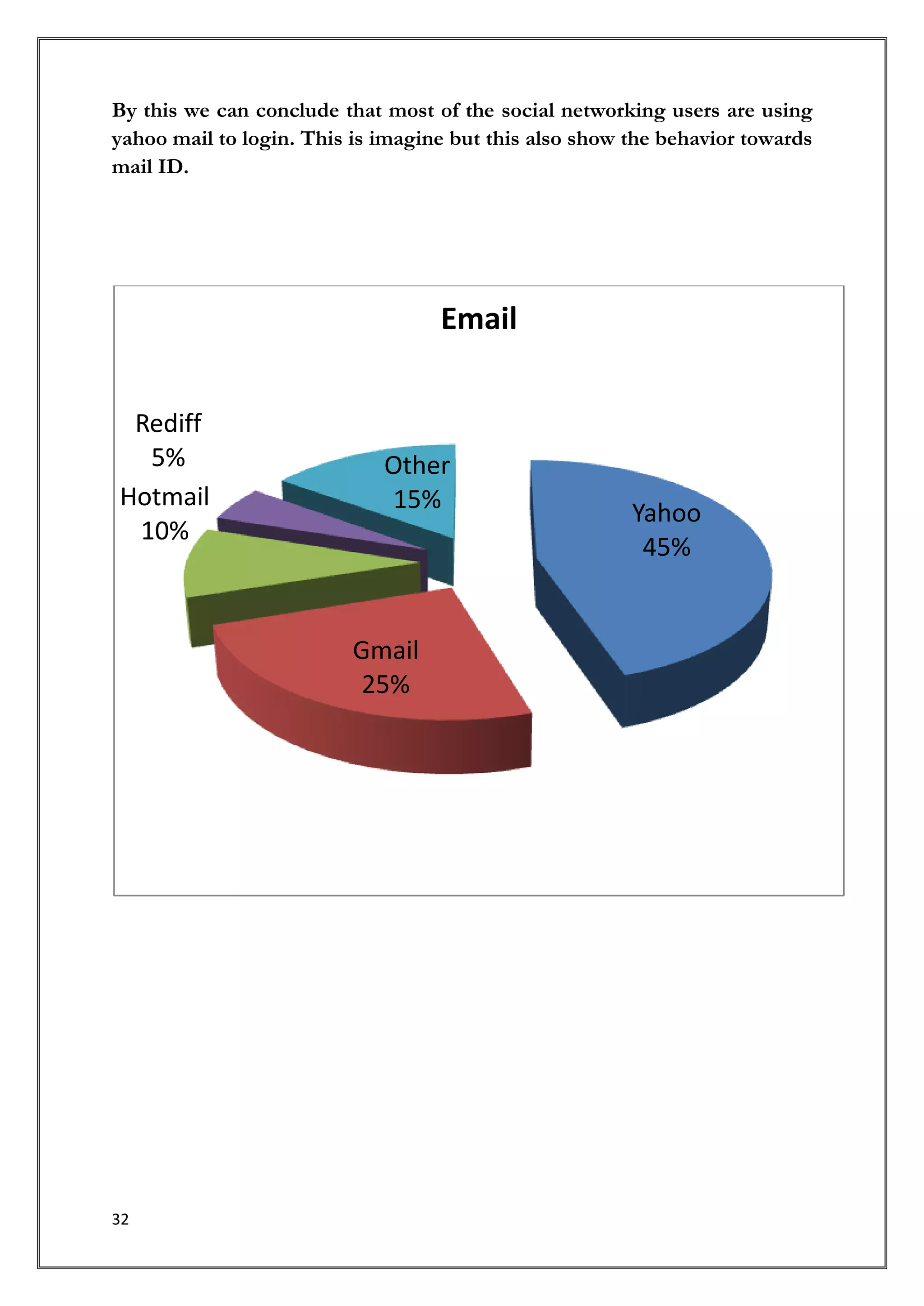
By this we can conclude that most of the social networking users are using
yahoo mail to login. This is imagine but this also show the behavior towards
mail ID.


                                   Email


 Rediff
  5%                         Other
Hotmail                      15%                        Yahoo
 10%
                                                         45%


                          Gmail
                           25%


32
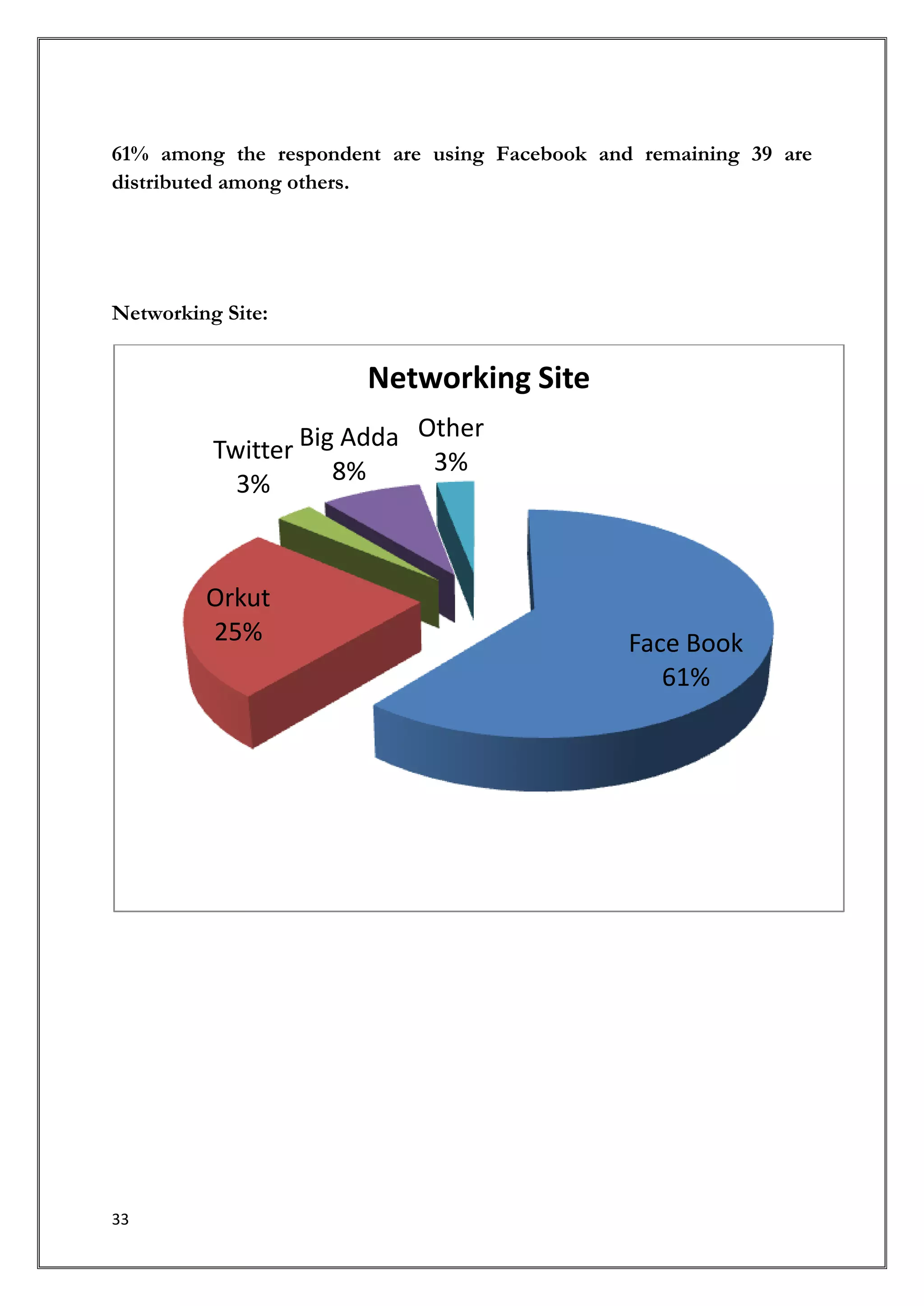
61% among the respondent are using Facebook and remaining 39 are
distributed among others.


Networking Site:


                       Networking Site
                             Other
          Twitter Big Adda    3%
            3%       8%


         Orkut
         25%                                   Face Book
                                                  61%


33
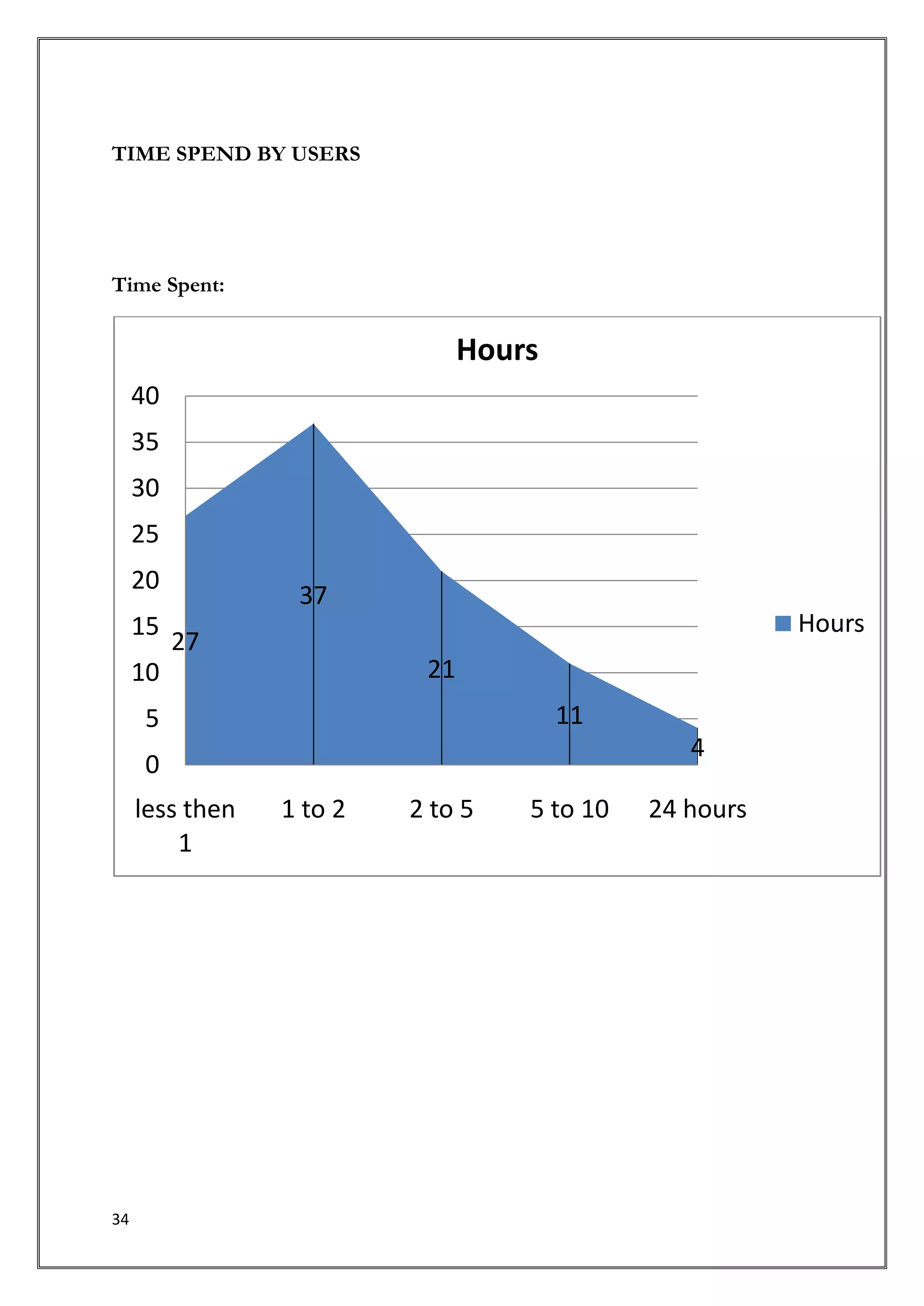
TIME SPEND BY USERS


Time Spent:


                                Hours
     40
     35
     30
     25
     20
                  37
     15                                                  Hours
          27
     10                    21
     5                                  11
                                                 4
     0
     less then   1 to 2   2 to 5    5 to 10   24 hours
         1


34
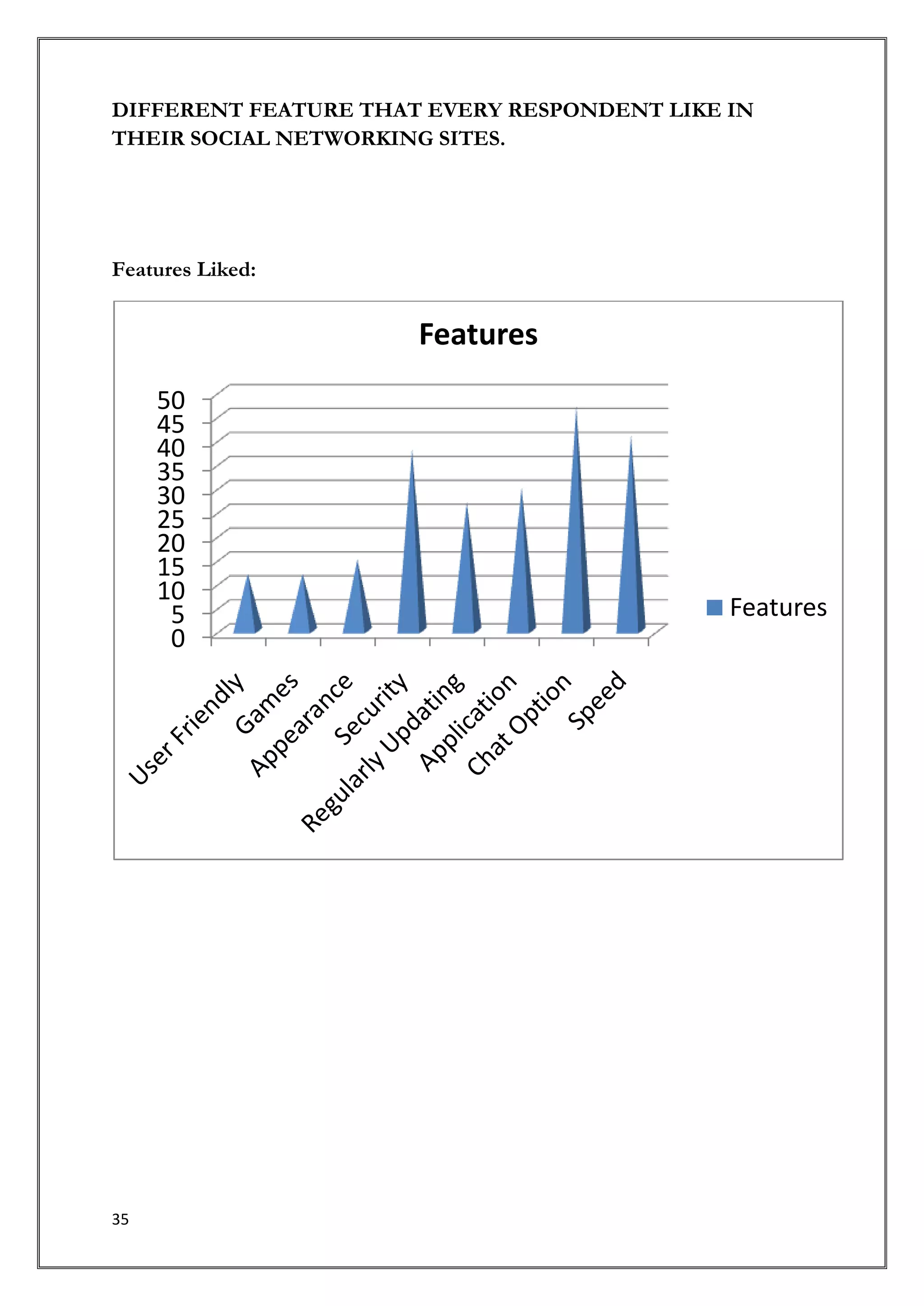
DIFFERENT FEATURE THAT EVERY RESPONDENT LIKE IN
THEIR SOCIAL NETWORKING SITES.


Features Liked:


                      Features
     50
     45
     40
     35
     30
     25
     20
     15
     10
      5                                      Features
      0


35
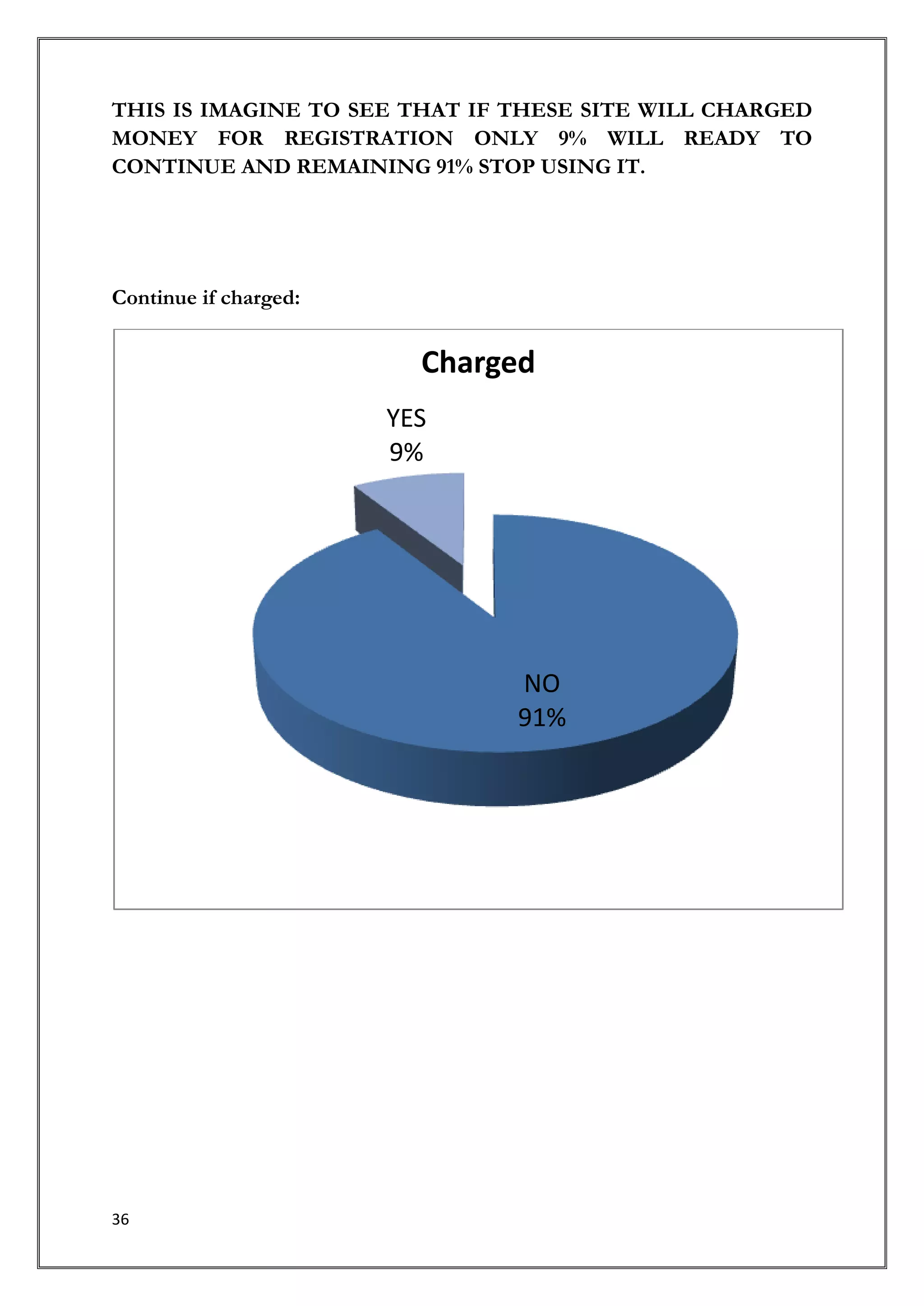
THIS IS IMAGINE TO SEE THAT IF THESE SITE WILL CHARGED
MONEY FOR REGISTRATION ONLY 9% WILL READY TO
CONTINUE AND REMAINING 91% STOP USING IT.


Continue if charged:


                         Charged
                       YES
                       9%


                               NO
                               91%


36
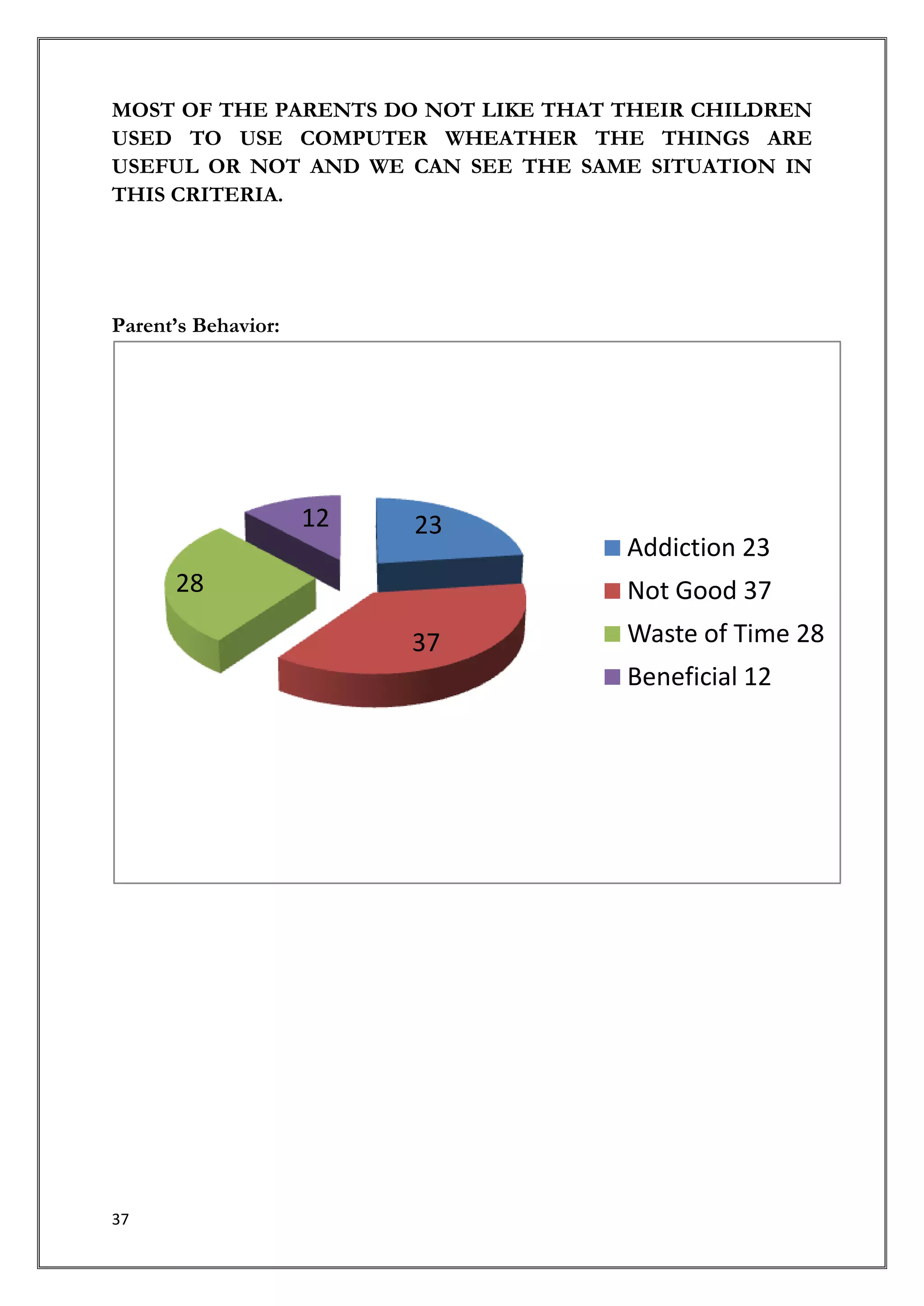
MOST OF THE PARENTS DO NOT LIKE THAT THEIR CHILDREN
USED TO USE COMPUTER WHEATHER THE THINGS ARE
USEFUL OR NOT AND WE CAN SEE THE SAME SITUATION IN
THIS CRITERIA.


Parent’s Behavior:


                     12   23
                                     Addiction 23
      28                             Not Good 37
                          37         Waste of Time 28
                                     Beneficial 12


37
ETHNOGRAPHIC RESEARCH’S RESULT:
Target Person 1: We targeted a single person who uses Facebook more than 5
hrs. a day and the behavior analysis of that person is given below:
Behavior Analysis:-
      More Productive: The person is now so productive not with the product
        quality but with the product quantity.
      Now not aggressive: If we consider the same person before using these sites
        and after that, the person is totally different guy if we consider his
        aggressiveness. Now he is more calm and cool nature.
      Conservative in nature: All this show the positive things but there is also
        some disadvantages of these site on the person. The person is now
        conservative in nature; he used to share his ideas, problem, feeling etc
        through these sites only.
      Not roaming: Whenever the person get time he used to login into these
        sites.
      Not speaking very much: He speaks very less or vice versa.


38
Conclusion:

      Part of Day to Day Life.
      Beneficial for some.

      Can be addictive.

      Change in Behavior.

      Used Mostly by Students and Youngsters.

      Status increases with increase in number of friends.

      Everything depends on how you use.


Recommendation:

      Can put some knowledge based books, Video and Audio.

      Can put options like Wikipedia.

      Include Search Engines.
      Option to change themes.

      They can introduce their own mails like Zapak.


THANKING YOU


39
Bibliography
     1) Source:http//www.wikipedia.org/marketshare/socialnetworki
        ngsites.php
     2) http://tutor2u.net/business/presentations/marketing/consum
        erbehaviour/default.html
     3) http://www.marketingprofessor.com/social-
        marketing/facebook-for-business-3-useful-applications/
     4) http://ezinearticles.com/?Influencing-Consumer-Behavior-
        Through-Social-Networking&id=5680660


40

CONSUMER BEHAVIOR TOWARD SOCIAL NETWORKING SITE

  • 1.
    2|Page Submitted by: 1. ABHISHEK MISHRA 2. AJEET PANDEY 3. ANIKET RAVAL 4. ANKUR SHARMA 5. ANSHUL DIXIT Submitted: Pro. Pabitra Ranjan Chakravorty Disclaimer This document describes work undertaken as part of a programmed of study at the Indian Institute of Planning and Management for Consumer behavior Towards Social Networking Site. All views and opinions are only the learning point of views and collected through primary and secondary sources. Indian Institute of Planning and Management, Ahmedabad CONSUMER BEHAVIOR TOWARDS SOCIAL NETWORKING SITES Page 2
  • 2.
    Abstract The study ofconsumers helps firms and organizations improve their marketing strategies by understanding issues such as how The psychology of how consumers think, feel, reason, and select between different alternatives (e.g., brands, products, and retailers); The psychology of how the consumer is influenced by his or her environment (e.g., culture, family, signs, media); Social media has gone from being just a place to meet people and make new friends to a virtual sales floor. Whether on Twitter, Facebook, MySpace or other social networking site, you can find many businesses and sales-minded individuals putting their product on display. They are not only selling themselves, like the rest of us, but their brand. Because of the different type of appeal they wish to have, there are certain rules they must abide by in order to achieve the social influence they intend. It's very important to appeal to all in order to sell to the most. It is a number game so with that in mind, business leaders and other entrepreneurs must present a personality that will be liked by many. Acknowledgment The study has followed a long and winding path along which we meet many people, this formal space to acknowledge their contributions is too less. Yet we would say that the distribution of my gratitude to all these supporters from different geographic coordinates is proportionate and equitable in Ahmedabad. We would like to express our thanks to Pro. Pabitra Ranjan Chakravorty for guiding us through the whole project. We would also express thanks to all those people who help us to answers our question and enhances our knowledge in the industry of Information and Technology and in social networking sites. 3
  • 3.
    INDEX Number Topic Name Page no. 1. Introduction 6 2. Consumer Behavior 9 3. Consumer Behavioral Model 9 4. Factor effecting Consumer Behavior 11 5. What is Internet 14 6. Types of Sites 15 7. What is Social Networking Sites? 16 8. Different types of Social Networking Sites 20 9. Advantages 22 10. Disadvantages 22 11. Analysis View point 22 12. Major Players 23 13. Sources of Their Income 23 14. About Face book 24 15. Market Share 25 16. Strategies 26 17. Behavior of user 26 18. Unique Selling proportion 27 19. Primary Research 1) Questionnaire 28 a) Statistical Data b) Analysis 2) Ethnographic Research 38 20. Recommendation 39 21. Conclusion 39 22. Bibliography 40 -------- Sample of Fair chart 4
  • 4.
    List of CHARTS 1) CONSUMER BEHAVIOR MODEL .........…9 2) FACTOR AFFECTING CB………… ……...11 3) MARKET SHARE ……………………….…25 4) AGE…………………………………………29. 5) GENDER…………………………………... 30. 6) OCCUPATION……………………………...31 7) EMAIL………………………………………32 8) NETWORKING SITE……………………...33 9) TIME ………………………………………..34 10) FEATURES………………………………….35 11) CHARGED………………………………….36 12) PARENTS BEHAVIOR…………………….37 5
  • 5.
    INTRODUCTION The study ofconsumers helps firms and organizations improve their marketing strategies by understanding issues such as how The psychology of how consumers think, feel, reason, and select between different alternatives (e.g., brands, products, and retailers); The psychology of how the consumer is influenced by his or her environment (e.g., culture, family, signs, media); The behavior of consumers while shopping or making other marketing decisions; Limitations in consumer knowledge or information processing abilities influence decisions and marketing outcome; How consumer motivation and decision strategies differ between products that differ in their level of importance or interest that they entail for the consumer; and How marketers can adapt and improve their marketing campaigns and marketing strategies to more effectively reach the consumer. One "official" definition of consumer behavior is "The study of individuals, groups, or organizations and the processes they use to select, secure, use, and dispose of products, services, experiences, or ideas to satisfy needs and the impacts that these processes have on the consumer and society." Although it is not necessary to memorize this definition, it brings up some useful points: Behavior occurs either for the individual, or in the context of a group (e.g., friends influence what kinds of clothes a person wears) or an organization (people on the job make decisions as to which products the firm should use). Consumer behavior involves the use and disposal of products as well as the study of how they are purchased. Product use is often of great interest to the marketer, because this may influence how a product is best positioned or how we can encourage increased consumption. Since many environmental problems result from product disposal (e.g., motor oil being sent into sewage systems to save the recycling fee, or garbage piling up at landfills) this is also an area of interest. Consumer behavior involves services and ideas as well as tangible products. The impact of consumer behavior on society is also of relevance. For example, aggressive marketing of high fat foods, or aggressive marketing of 6
  • 6.
    easy credit, mayhave serious repercussions for the national health and economy. There are four main applications of consumer behavior: The most obvious is for marketing strategy—i.e., for making better marketing campaigns. For example, by understanding that consumers are more receptive to food advertising when they are hungry, we learn to schedule snack advertisements late in the afternoon. By understanding that new products are usually initially adopted by a few consumers and only spread later, and then only gradually, to the rest of the population, we learn that (1) companies that introduce new products must be well financed so that they can stay afloat until their products become a commercial success and (2) it is important to please initial customers, since they will in turn influence many subsequent customers’ brand choices. A second application is public policy. In the 1980s, Acutance, a near miracle cure for acne, was introduced. Unfortunately, Acutance resulted in severe birth defects if taken by pregnant women. Although physicians were instructed to warn their female patients of this, a number still became pregnant while taking the drug. To get consumers’ attention, the Federal Drug Administration (FDA) took the step of requiring that very graphic pictures of deformed babies be shown on the medicine containers. Social marketing involves getting ideas across to consumers rather than selling something. Marty Fishbein, a marketing professor, went on sabbatical to work for the Centers for Disease Control trying to reduce the incidence of transmission of diseases through illegal drug use. The best solution, obviously, would be if we could get illegal drug users to stop. This, however, was deemed to be infeasible. It was also determined that the practice of sharing needles was too ingrained in the drug culture to be stopped. As a result, using knowledge of consumer attitudes, Dr. Fishbein created a campaign that encouraged the cleaning of needles in bleach before sharing them, a goal that was believed to be more realistic. As a final benefit, studying consumer behavior should make us better consumers. Common sense suggests, for example, that if you buy a 64 liquid ounce bottle of laundry detergent, you should pay less per ounce than if you bought two 32 ounce bottles. In practice, however, you often pay a size premium by buying the larger quantity. In other words, in this case, knowing this fact will sensitize you to the need to check the unit cost labels to determine if you are really getting a bargain. 7
  • 7.
    There are severalunits in the market that can be analyzed. Our main thrust in this course is the consumer. However, we will also need to analyze our own firm’s strengths and weaknesses and those of competing firms. Suppose, for example, that we make a product aimed at older consumers, a growing segment. A competing firm that targets babies, a shrinking market, is likely to consider repositioning toward our market. To assess a competing firm’s potential threat, we need to examine its assets (e.g., technology, patents, market knowledge, and awareness of its brands) against pressures it faces from the market. Finally, we need to assess conditions (the marketing environment). For example, although we may have developed a product that offers great appeal for consumers, a recession may cut demand dramatically. 8
  • 8.
    CONSUMER BEHAVIOR DEFINITION: The termconsumer Behavior can be defined as the behavior of consumers display in searching for purchasing, using, evaluating and disposing of products services idea which they expect will satisfy their needs, want and demand. In other words we can say that the behavior of customer are affected and influence by money, time and effort for the maximum satisfaction. CONSUMER BEHAVIOR MODEL 9
  • 9.
  • 10.
    Factor effecting ConsumerBehavior Consumer behavior refers to the selection, purchase and consumption of goods and services for the satisfaction of their wants. There are different processes involved in the consumer behavior. Initially the consumer tries to find what commodities he would like to consume, then he selects only those commodities that promise greater utility. After selecting the commodities, the consumer makes an estimate of the available money which he can spend. Lastly, the consumer analyzes the prevailing prices of commodities and takes the decision about the commodities he should consume. Meanwhile, there are various other factors influencing the purchases of consumer such as social, cultural, personal and psychological. The explanation of these factors is given below. 1. Cultural Factors: Consumer behavior is deeply influenced by cultural factors such as: buyer culture, subculture, and social class. a) Culture: Basically, culture is the part of every society and is the important cause of person wants and behavior. The influence of culture on buying behavior varies from country to country therefore marketers have to be very careful in analyzing the culture of different groups, regions or even countries. b) Subculture: Each culture contains different subcultures such as religions, nationalities, geographic regions, racial groups etc. Marketers can use these groups by segmenting the market into various small portions. For example marketers can design products according to the needs of a particular geographic group. c) Social Class: Every society possesses some form of social class which is important to the marketers because the buying behavior of people in a given social class is similar. In this way marketing activities could be tailored according to different social classes. Here we should note that social class is not only determined by income but there are various other factors as well such as: wealth, education, occupation etc. 11
  • 11.
    2. Social Factors:Social factors also impact the buying behavior of consumers. The important social factors are: reference groups, family, role and status. a) Reference Groups: Reference groups have potential in forming a person attitude or behavior. The impact of reference groups varies across products and brands. For example if the product is visible such as dress, shoes, car etc then the influence of reference groups will be high. Reference groups also include opinion leader (a person who influences other because of his special skill, knowledge or other characteristics). b) Family: Buyer behavior is strongly influenced by the member of a family. Therefore marketers are trying to find the roles and influence of the husband, wife and children. If the buying decision of a particular product is influenced by wife then the marketers will try to target the women in their advertisement. Here we should note that buying roles change with change in consumer lifestyles. c) Roles and Status: Each person possesses different roles and status in the society depending upon the groups, clubs, family, organization etc. to which he belongs. For example a woman is working in an organization as finance manager. Now she is playing two roles, one of finance manager and other of mother. Therefore her buying decisions will be influenced by her role and status. 3. Personal Factors: Personal factors can also affect the consumer behavior. Some of the important personal factors that influence the buying behavior are: lifestyle, economic situation, occupation, age, personality and self concept. a) Age: Age and life-cycle have potential impact on the consumer buying behavior. It is obvious that the consumers change the purchase of goods and services with the passage of time. Family life-cycle consists of different stages such young singles, married couples, unmarried couples etc which help marketers to develop appropriate products for each stage. b) Occupation: The occupation of a person has significant impact on his buying behavior. For example a marketing manager of an organization will try to purchase business suits, whereas a low level worker in the same organization will purchase rugged work clothes. 12
  • 12.
    c) Economic Situation:Consumer economic situation has great influence on his buying behavior. If the income and savings of a customer is high then he will purchase more expensive products. On the other hand, a person with low income and savings will purchase inexpensive products. d) Lifestyle: Lifestyle of customers is another import factor affecting the consumer buying behavior. Lifestyle refers to the way a person lives in a society and is expressed by the things in his/her surroundings. It is determined by customer interests, opinions, activities etc and shapes his whole pattern of acting and interacting in the world. e) Personality: Personality changes from person to person, time to time and place to place. Therefore it can greatly influence the buying behavior of customers. Actually, Personality is not what one wears; rather it is the totality of behavior of a man in different circumstances. It has different characteristics such as: dominance, aggressiveness, self-confidence etc which can be useful to determine the consumer behavior for particular product or service. 4. Psychological Factors: There are four important psychological factors affecting the consumer buying behavior. These are: perception, motivation, learning, beliefs and attitudes. a) Motivation: The level of motivation also affects the buying behavior of customers. Every person has different needs such as physiological needs, biological needs, social needs etc. The nature of the needs is that, some of them are most pressing while others are least pressing. Therefore a need becomes a motive when it is more pressing to direct the person to seek satisfaction. b) Perception: Selecting, organizing and interpreting information in a way to produce a meaningful experience of the world is called perception. There are three different perceptual processes which are selective attention, selective distortion and selective retention. In case of selective attention, marketers try to attract the customer attention. Whereas, in case of selective distortion, customers try to interpret the information in a way that will support what the customers already believe. Similarly, in case of selective retention, marketers try to retain information that supports their beliefs. 13
  • 13.
    c) Beliefs andAttitudes: Customer possesses specific belief and attitude towards various products. Since such beliefs and attitudes make up brand image and affect consumer buying behavior therefore marketers are interested in them. Marketers can change the beliefs and attitudes of customers by launching special campaigns in this regard. WHAT IS INTERNET? The Internet is a global system of interconnected computer networks that use the standard Internet Protocol Suite (TCP/IP) to serve billions of users worldwide 14
  • 14.
    WHAT IS SOCIALNETWORKING SITE? A social network service is an online service, platform, or site that focuses on building and reflecting of social networks or social relations among people, e.g., who share interests and/or activities. A social network service essentially consists of a representation of each user (often a profile), his/her social links, and a variety of additional services. Most social network services are web based and provide means for users to interact over the internet, such as e-mail and instant messaging. Although online community services are sometimes considered as a social network service. In a broader sense, social network service usually means an individual- centered service whereas online community services are group-centered. Social networking sites allow users to share ideas, activities, events, and interests within their individual networks. The main types of social networking services are those which contain category places (such as former school-year or classmates), means to connect with friends (usually with self-description pages) and a recommendation system linked to trust. Popular methods now combine many of these, with Facebook and Twitter widely used worldwide; MySpace and LinkedIn being the most widely used in North America; Nexopia (mostly in Canada); Bebo, Hi5, Hyves (mostly in The Netherlands), StudiVZ (mostly in Germany), iWiW (mostly in Hungary), Tuenti (mostly in Spain), Nasza-Klasa (mostly in Poland), Decayenne, Tagged, XING, Badoo and Skyrock in parts of Europe; Orkut and Hi5 in South America, India and Central America; and Friendster, Mixi, Multiply, Orkut, Wretch, renren and Cyworld in Asia and the Pacific Islands and Twitter, Orkut and Facebook in India. There have been attempts to standardize these services to avoid the need to duplicate entries of friends and interests (see the FOAF standard and the Open Source Initiative). Although some of the largest social networks were founded on the notion of digitizing real world connections, many networks focus on categories from books and music to non-profit business to motherhood as ways to provide both services and community to individuals with shared interests. 15
  • 15.
    TYPE OF SITES 1) A categorization based on content Web sites, like other "worldly" things, can be classified into various categories. This page has a list of the different types of web sites based on the content and features offered. However, content can be varied, and with this in mind, I have tried to make segregation as intuitive as possible. Please note that these categories of the web sites are not distinct and can overlap... sometimes to a large degree. 2) Search engine, directories, yellow pages and portals These are some of the most popular types of web sites in the world. Some search engine companies, like Google or Gigablast, prefer to keep their homepage simple and stress on only one service, while Yahoo! and MSN have a more "portal" like look via which many services are pushed to the surfer like email, news etc. The portal look provides a broader platform for the company to promote their different services but it also fragments the visitors. Classified directories and yellow pages web sites list businesses (both online and offline) segregated into different categories or geographic locations. These may also include an internal search engine that helps users quickly locate information. 3) Information web sites These are the types of web sites are dedicated to the purpose of providing information - whether free or paid. These information web sites might be catering to a niche industry or be wider in their scope because of which they can be labelled as "news portals". Information web site can also contain updated time tables, TV guides, reference material, sports data (like cricket scores), weather and stock data. 4) Personal web sites With tons of tools and services available, creating a web site is no longer "rocket science" (actually, it never was; but for some...). The astronomical 16
  • 16.
    number of personalweb sites one finds on the web is mind-blowing! Personal web sites and blogs would probably be the fastest growing types of web site. Personal web sites can contain any kind of information and are usually administered by a single individual who can choose whatever to put online. Any one can now create a web site using online free hosting accounts that might also offer pre-made templates that are like ready-to-go web sites, or with free and commercial versions of WYSIWYG HTML editors like Frontpage, DreamWeaver etc. 5) Blogs and online diaries Blogs are like online diaries (the irony is, though you keep your hardcopy diary under lock-and-key, you want more and more visitors to read the online one). Blogs can be created by anyone using free services like Blogger.com (Google) or Windows Live Spaces (Microsoft). You can also install blog software, like the free WordPress on your pre-existing web site and start putting your thoughts online in a matter of minutes! Because blogs are so easy to create, manage and even earn from (there are a lot of profitable blogs online, if you didn't know), the web has increased manifold. And it's all thanks to the many free blog services and a strong enthusiasm by the ever growing blogging community who keep maintaining and updating their web space regularly. From ramblings of a wandering mind to detailed and specific information on technical fields, the content of blog types of web site can vary widely. 6) Company web sites Most company web sites have just a few pages of information on the business, its services and clients. These are more like "online brochures" 7) Forums Forum types of web sites serve as platforms and promote interactions amongst the users. Unless specifically blocked and requiring a special invitation, you can join any forum on the web. Most forums cater to a specific industry or a field. So, for example, you will find forums on web 17
  • 17.
    design and development,banking and finance, biotechnology... I even came across one to help people share their phobia of butterflies (take a look at IHateButterflies.com - yes, I am mortally scared of butterflies and moths. Forums on web sites, typically, contain categories that further narrow down the subject. Registered users can post questions or start a topic which other users can reply or add to. A lot of valuable information and knowledge exists in online forums and I urge you to join and actively participate in online discussions with people that share the same interests. Ready-to-use free software such as phpBB or SMF help you set up a forum web site in a matter of minutes. If you already have a web site, check with the hosting company; they would probably provide such forum software for free which you can install via the control panel. 8) Online shops and auctions web sites Though the web is primarily used for communication (email!) and information search, many companies have set up shops online. In fact, some companies like the popular Amazon don't have brick-and-mortar shops - the entire buying and selling takes place online. Online shops are not restricted to selling tangible products; they can also provide services and a good example of this would be travel and matrimony web sites. If you are planning to sell your products (or services) online the tons of free and commercial ecommerce software, make will get you up and running in no time. Furthermore, you can integrate payment gateways, like Paypal.com and moneybookers.com, in your online shopping mall and process the orders and receive funds. 9) Web2.0 web sites Web 2. is an amorphous concept and primarily encompasses web sites that offer a particular service. The purpose of these web sites can be varied - information storage, communication etc. Sites like Flickr.com, Google docs, del.icio.us fall into this category. 10) Social networking The new mantra on the web is social networking. These web sites can be classified as Web 2.0 sites but their sheer number and popular demands we 18
  • 18.
    have a separatecategory. Facebook, Orkut, LinkedIn, Twitter have been the rage past couple of years. From helping you locate schoolmates and past colleagues to "microblogging" (whatever that means), these web sites have a whole array of utilities and features with more being "invented" and added each day. Dating web sites have grown over the years and now offer services quite similar to those of social networking (the idea is basically the same) hence they are a good fit in this category. 11) File sharing type of web sites As internet speeds have increased and more and more people are using broadband connections, the importance of file sharing types of web sites has grown. Megaupload,com and RapidShare.com are two prime examples of such kind of web sites. You can not only find images, but also music (sometimes even full albums) and video (entire movies). These web sites offer both free and paid memberships - the former is usually a cut down version of the latter. However, because of the huge number of files stored on these sites, it is almost impossible to find the file you are looking for unless you know the direct link. Web sites like loadingvault.com provide a decent enough search engine that helps you locate files based on your query. 19
  • 19.
    WHAT IS SOCIALNETWORKING SITES? Social networking is the grouping of individuals into specific groups, like small rural communities or a neighborhood subdivision, if you will. Although social networking is possible in person, especially in the workplace, universities, and high schools, it is most popular online. This is because unlike most high schools, colleges, or workplaces, the internet is filled with millions of individuals who are looking to meet other people, to gather and share first-hand information and experiences about cooking, golfing, gardening, developing friendships or professional alliances, finding employment, business-to- business marketing and even groups sharing information about the end of the Mayan calendar and the Great Shift to arrive December 21-2012. The topics and interests are as varied and rich as the story of our world. When it comes to online social networking, websites are commonly used. These websites are known as social sites. Social networking websites function like an online community of internet users. Depending on the website in question, many of these online community members share common interests in hobbies, religion, or politics. Once you are granted access to a social networking website you can begin to socialize. This socialization may include reading the profile pages of other members and possibly even contacting them. The friends that you can make are just one of the many benefits to social networking online. Another one of those benefits includes diversity because the internet gives individuals from all around the world access to social networking sites. This means that although you are in the United States, you could develop an online friendship with someone in Denmark or India. Not only will you make new friends, but you just might learn a thing or two about new cultures or new languages and learning is always a good thing. As mentioned, social networking often involves grouping specific individuals or organizations together. While there are a number of social networking websites that focus on particular interests, there are others that do not. The websites without a main focus are often referred to as "traditional" social networking websites and usually have open memberships. This means that anyone can become a member, no matter what their hobbies, beliefs, or views are. However, once you are inside this online community, you can begin to create your own network of friends and eliminate members that do not share common interests or goals. 20
  • 20.
    As I'm sureyou're aware, there are dangers associated with social networking including data theft and viruses, which are on the rise. The most prevalent danger though often involves online predators or individuals who claim to be someone that they are not. Although danger does exist with networking online, it also exists in the real world, too. Just like you're advised when meeting strangers at clubs and bars, school, or work -- you are also advised to proceed with caution online. By being aware of your cyber-surroundings and who you are talking to, you should be able to safely enjoy social networking online. It will take many phone conversations to get to know someone, but you really won't be able to make a clear judgment until you can meet each other in person. Just use common sense and listen to your inner voice; it will tell you when something doesn't feel right about the online conversations taking place. 21
  • 21.
    DIFFERENT TYPE OFSOCIAL NETWORKING SITES  Forums  Blogs  Micro-Blogging  Photo Sharing  Video Sharing  Professional  Social  Bookmarking ADVANTAGES  Connect with lost classmates, lost family members or lost loves on social networking websites.  Career advantage.  fun way to kick back and relax.  Interaction on one-to-one basis.  Overcome timidity.  Promotion of business or site for free.  Stay in touch anywhere  Brings business and opportunities DISADVANTAGES  risk of identity theft and fraud.  false information.  online harassment and stalking.  Safety and security issues. ANALYSIS VIEW POINT  Some companies motivate to use Social Networking Sites  It increase the knowledge sharing  It help in understanding the behavior of Employee  Act like news TV  Fast information transformation 22
  • 22.
    MAJOR PLAYER  Facebook  Hi5  Friendster  MySpace  Orkut  Twitter  LinkedIn SOURCES OF THEIR INCOME  Internet services (digital goods, game subscriptions, micro-transactions)  Mobile Subscriptions  Online Advertising  App Store  Trend analysis  on-demand merchandise  online music store 23
  • 23.
    ABOUT FACEBOOK: Facebook isa social network service and website launched in February 2004 that is operated and privately owned by Facebook, Inc. As of January 2011, Facebook has more than 600 million active users. Users may create a personal profile, add other users as friends and exchange messages, including automatic notifications when they update their profile. Additionally, users may join common interest user groups, organized by workplace, school, or college, or other characteristics. The name of the service stems from the colloquial name for the book given to students at the start of the academic year by university administrations in the US with the intention of helping students to get to know each other better. Facebook allows anyone who declares them to be at least 13 years old to become a registered user of the website. Facebook was founded by Mark Zuckerberg with his college roommates and fellow computer science students Eduardo Saverin, Dustin Moskovitz andChris Hughes. The website's membership was initially limited by the founders to Harvard students, but was expanded to other colleges in the Boston area, the Ivy League, and Stanford University. It gradually added support for students at various other universities before opening to high school students, and, finally, to anyone aged 13 and over. A January 2009 Compete.com study ranked Facebook as the most used social network service by worldwide monthly active users, followed byMySpace. Entertainment Weekly put it on its end-of-the-decade "best-of" list, saying, "How on earth did we stalk our exes, remember our co-workers' birthdays, bug our friends, and play a rousing game of Scrabulous before Facebook?" Quantcast estimates Facebook has 135.1 million monthly unique U.S. visitors in October 2010. According to Social Media Today as of April 2010, it is estimated that 41.6% of the U.S. population has a Facebook account. Some facts and figures about facebook:  More than 175 million active users.  Fastest growing demographic: 30 years old and older.  More than 3 billion minutes spent on Facebook daily.  More than 4 million users become fans of pages daily.  More than 850 million photos uploaded monthly.  More than 7 million videos uploaded monthly. 24
  • 24.
    Market Share: As wecan see in the above graph, all social networking sites except Facebook have a more or less a stable market share whereas Facebook takes a leap from Mar ’08 to Dec ’09 which is a big growth as compared to other social networking sites. 25
  • 25.
    STRATEGIES OF FACEBOOKFOR THEIR PAGE MARKETING:  Set community expectations.  Provide Cohesive Branding.  Be up to date.  Live Authentic.  Participate in Dialog.  Enable peer-to-peer interactions.  Foster Advocacy. BEHAVIOR OF USER: The average male Facebook user with 120 friends:  Leaves comments on 7 friends’ photos, status updates, or wall  Messages or chats with 4 friends The average female Facebook user with 120 friends:  Leaves comments on 10 friends’ photos, status updates, or wall  Messages or chats with 6 friends The average male Facebook user with 500 friends:  Leaves comments on 17 friends’ photos, status updates, or wall  Messages or chats with 10 friends The average female Facebook user with 500 friends:  Leaves comments on 26 friends’ photos, status updates, or wall  Messages or chats with 16 friends Addiction 26
  • 26.
    UNIQUE SELLING PROPOSITION:  Security.  Extent amount of Involvement.  Appearance.  Speed.  Regular Updates.  Minimum Advertisement.  Applications. 27
  • 27.
    PRIMARY RESEARCH: Our primaryresearch was carried out by two methods namely, 1. Questionnaires. 2. Ethnographic Research. QUESTIONNAIRES RESULT: We have took 15 Questions and filled it with 100 respondant. 1) Name 2) Age 3) Gender 4) Occupation 5) Email ID 6) Which Social Networking Site used? 7) Purpose 8) Different Features 9) Continue if Charged 10) Is these site Beneficial 11) Addiction? 12) Time Spend 13) Want to refer? 14) Affect on productivity? 15) Any Suggestion And with the help of these questions we try to analyze the behavior of consumer who uses these social networking sites. 28
  • 28.
    Based On Agewe can conclude that there are 41% of the users are between 21 to 25 and the remaining are among other. And if we take it from broader view we can say that the people between age of 16 to 26 cover 77% of the users. AGE 26 to 35 36 to 45 45 above 10% 2% 0% 10 to 15 13% 16 to 20 21 to 25 34% 41% 29
  • 29.
    By this wecan select that 67% are male and 33% are females who use these sites. Gender: GENDER Female 33% Male 67% 30
  • 30.
    These are showingthe category wise distribution of graph as per their occupation Occupation: OCCUPATION 0 5 5 15 Student Service Housewife 75 Business Other Email: 31
  • 31.
    By this wecan conclude that most of the social networking users are using yahoo mail to login. This is imagine but this also show the behavior towards mail ID. Email Rediff 5% Other Hotmail 15% Yahoo 10% 45% Gmail 25% 32
  • 32.
    61% among therespondent are using Facebook and remaining 39 are distributed among others. Networking Site: Networking Site Other Twitter Big Adda 3% 3% 8% Orkut 25% Face Book 61% 33
  • 33.
    TIME SPEND BYUSERS Time Spent: Hours 40 35 30 25 20 37 15 Hours 27 10 21 5 11 4 0 less then 1 to 2 2 to 5 5 to 10 24 hours 1 34
  • 34.
    DIFFERENT FEATURE THATEVERY RESPONDENT LIKE IN THEIR SOCIAL NETWORKING SITES. Features Liked: Features 50 45 40 35 30 25 20 15 10 5 Features 0 35
  • 35.
    THIS IS IMAGINETO SEE THAT IF THESE SITE WILL CHARGED MONEY FOR REGISTRATION ONLY 9% WILL READY TO CONTINUE AND REMAINING 91% STOP USING IT. Continue if charged: Charged YES 9% NO 91% 36
  • 36.
    MOST OF THEPARENTS DO NOT LIKE THAT THEIR CHILDREN USED TO USE COMPUTER WHEATHER THE THINGS ARE USEFUL OR NOT AND WE CAN SEE THE SAME SITUATION IN THIS CRITERIA. Parent’s Behavior: 12 23 Addiction 23 28 Not Good 37 37 Waste of Time 28 Beneficial 12 37
  • 37.
    ETHNOGRAPHIC RESEARCH’S RESULT: TargetPerson 1: We targeted a single person who uses Facebook more than 5 hrs. a day and the behavior analysis of that person is given below: Behavior Analysis:-  More Productive: The person is now so productive not with the product quality but with the product quantity.  Now not aggressive: If we consider the same person before using these sites and after that, the person is totally different guy if we consider his aggressiveness. Now he is more calm and cool nature.  Conservative in nature: All this show the positive things but there is also some disadvantages of these site on the person. The person is now conservative in nature; he used to share his ideas, problem, feeling etc through these sites only.  Not roaming: Whenever the person get time he used to login into these sites.  Not speaking very much: He speaks very less or vice versa. 38
  • 38.
    Conclusion:  Part of Day to Day Life.  Beneficial for some.  Can be addictive.  Change in Behavior.  Used Mostly by Students and Youngsters.  Status increases with increase in number of friends.  Everything depends on how you use. Recommendation:  Can put some knowledge based books, Video and Audio.  Can put options like Wikipedia.  Include Search Engines.  Option to change themes.  They can introduce their own mails like Zapak. THANKING YOU 39
  • 39.
    Bibliography 1) Source:http//www.wikipedia.org/marketshare/socialnetworki ngsites.php 2) http://tutor2u.net/business/presentations/marketing/consum erbehaviour/default.html 3) http://www.marketingprofessor.com/social- marketing/facebook-for-business-3-useful-applications/ 4) http://ezinearticles.com/?Influencing-Consumer-Behavior- Through-Social-Networking&id=5680660 40