

















New Tools to Map and Manage Innovation Networks John Steen Tim Kastelle
What is Network Analysis Analytical tool for measuring network structure consisting of actors (people, firms, etc.) and the connections between them (social, financial exchange, technical collaboration, etc.) Draws from Social Network Analysis (sociology, psychology) and Complex Network Analysis (physics, economics) Theoretical justification in evolutionary economics
Formal Structure
Actual Structure
Network Issues Up to a point, the more connections you have, the better flows are (of information, for example) However, connections are expensive to maintain So managing a network involves trading off the cost of building links against performance Most network analyses focus on structure rather than quality of ties
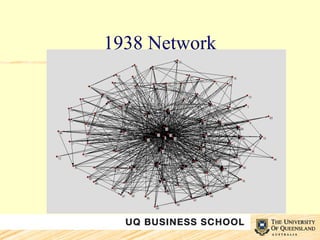
Example – International Trade Network Data taken from my PhD research Analysing changes in the International Trade Network from 1938 to 2003 Looking for evidence of globalisation
1938 Network
1968 Network
1998 Network
Network Metrics In the same way that a normal distribution is characterised by its mean and standard deviation, a network is characterised by four  primary measures: Degree distribution Density Clustering Average Path Length
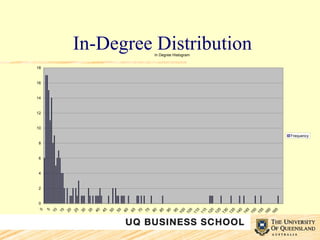
Degree Distribution The  degree  of a node is the number of edges that connect to it.  An important characteristic of most graphs is the  mean degree   k , the average number of connections per node.  The  degree distribution  of a graph is the measure of degree frequencies, in other words, it is a count of how many nodes have degree =  k  for each possible value of  k .
Degree David, degree = 7 Sarah, degree = 1
In-Degree Distribution
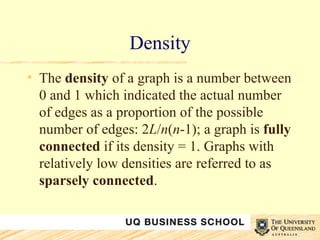
Density The  density  of a graph is a number between 0 and 1 which indicated the actual number of edges as a proportion of the possible number of edges: 2 L / n ( n -1); a graph is  fully connected  if its density = 1. Graphs with relatively low densities are referred to as  sparsely connected .
Density 15 people 15x14 = 210 possible connections 41 actual connections 41/210 = density = 19%
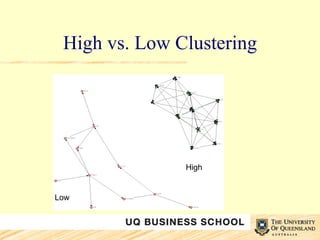
Clustering The  clustering coefficient  CC is a number between 0 and 1, which expresses the likelihood that two nodes which are both connected to node  i  will also be connected to each other.
High vs. Low Clustering High Low
Path Length A  geodesic path  is the shortest path through the network which connects two nodes.  The  mean   path length  of a graph is the average geodesic length between all pairs of nodes.
High Average Path vs Low High Low
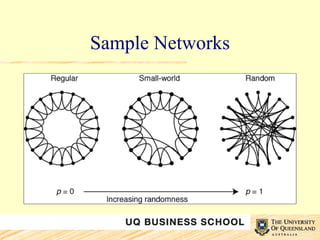
Sample Networks
Clustering and average path Random – clustering low, average path low Regular – clustering high, average path high Small-world – clustering high, average path low Many well functioning real-world networks are small worlds
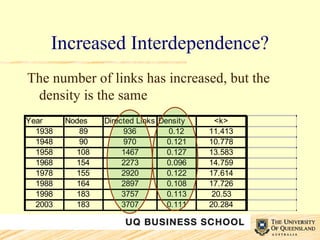
Increased Interdependence? The number of links has increased, but the density is the same
Implication The increased number of connections and average degree supports the idea that the international economy is more interconnected However, the stability of the density measure suggests that this more due to growth in the size of the network than to substantially higher numbers of connections
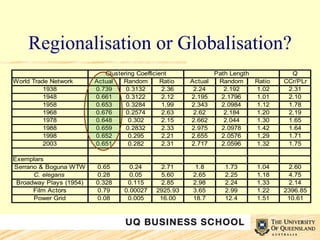
Regionalisation or Globalisation?
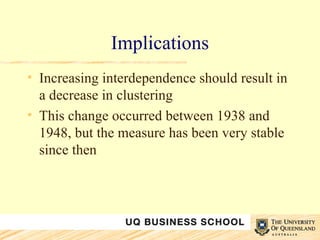
Implications Increasing interdependence should result in a decrease in clustering This change occurred between 1938 and 1948, but the measure has been very stable since then
Fundamental Change in Structure?
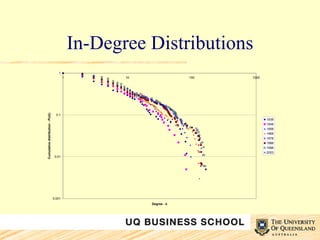
In-Degree Distributions
Implication The overall structure of the network has been remarkably stable over the 65 year period The power law distribution demonstrates that the decision making of the agents is highly interconnected
New Analytical Tools Hypothesis testing with PNet Simulates random graphs with similar statistics to determine whether certain structures could occur by chance Longitudinal analysis with SIENA Measures the contribution of network and actor attributes to the formation of new ties
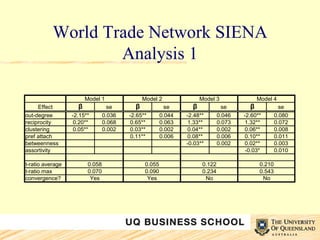
SIENA Analysis Tracking changes from 1998 to 2003 looking for generative mechanisms Tie statistics: No Tie both times: 26642 No Tie (1998) -> Tie (2003): 881 Tie (1998) -> No Tie (2003): 917 Tie both times: 1798
World Trade Network SIENA Analysis 1
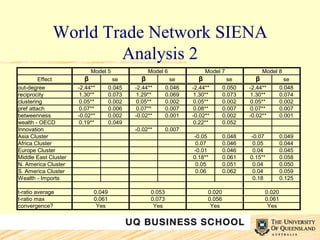
World Trade Network SIENA Analysis 2
Interpretation Wealth effect:  Although this is a very restricted version of the wealth effect demonstrated in [8], it is still both relatively large and statistically significant.  This suggests that at least at the OECD level, the wealth of the countries involved has a strong impact on the formation of new ties. Innovation effect:  While the overall fit of Model 6 is good, it is not significantly better than that of the baseline Model 2.  Furthermore, the relative size of  β  for the innovation variable is small.  This shows that adding the innovation variable to the model does not improve it sufficiently to justify its inclusion.
More Interpretation Regional effect:  The two models that include the regional clustering variables have the best goodness-of-fit out of all of those estimated, which suggests that the regional clustering effect is in fact quite important in the formation of new ties.  The only region to have a statistically significant  β  is the Middle East, the rest of the  β s are relatively small.  Nevertheless, the extremely good fit of the models including clustering shows that this does in fact have an important impact on the evolution of the WTW. Gravity effect:  The main difference between Models 7 and 8 is that they use different variables to account for wealth.  Model 7 controls for the propensity of the OECD countries to trade with each other, while Model 8 uses the multiplication of economic variables suggested by the Gravity Model.  The goodness-of-fit is better for Model 7, which suggests that OECD wealth effect is stronger than the gravitational effect of the sizes of the trading partners.
Firm Level Analysis
Collaborative Networks Schilling and Phelps study 11 collaborative R&D networks Collaborative networks with a small world structure are more innovative (both in terms of number of innovations and success of new innovations)
Implications The high level of clustering (densely connected local networks) leads to high levels of trust, which encourages innovation A small number of links outside of this dense cluster leads to the acquisition of new ideas and knowledge
New innovation models and competitive strategy The shift towards open innovation Changing of mindset about ‘innovative’ and ‘non-innovative’ industries (e.g. CSL vs. Rio Tinto).  What’s the value of SNA for developing leading indicators for open innovation?
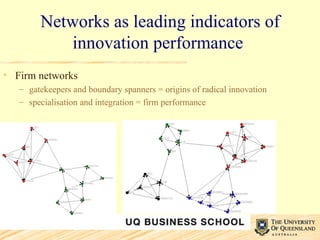
Networks as leading indicators of innovation performance  Firm networks gatekeepers and boundary spanners = origins of radical innovation specialisation and integration = firm performance
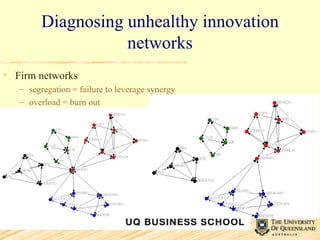
Diagnosing unhealthy innovation networks Firm networks segregation = failure to leverage  synergy overload = burn out
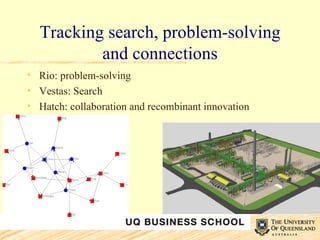
Tracking search, problem-solving and connections Rio: problem-solving Vestas: Search Hatch: collaboration and recombinant innovation

UQBS Seminar - Innovation Networks

  • 1.
    New Tools toMap and Manage Innovation Networks John Steen Tim Kastelle
  • 2.
    What is NetworkAnalysis Analytical tool for measuring network structure consisting of actors (people, firms, etc.) and the connections between them (social, financial exchange, technical collaboration, etc.) Draws from Social Network Analysis (sociology, psychology) and Complex Network Analysis (physics, economics) Theoretical justification in evolutionary economics
  • 3.
  • 4.
  • 5.
    Network Issues Upto a point, the more connections you have, the better flows are (of information, for example) However, connections are expensive to maintain So managing a network involves trading off the cost of building links against performance Most network analyses focus on structure rather than quality of ties
  • 6.
    Example – InternationalTrade Network Data taken from my PhD research Analysing changes in the International Trade Network from 1938 to 2003 Looking for evidence of globalisation
  • 7.
  • 8.
  • 9.
  • 10.
    Network Metrics Inthe same way that a normal distribution is characterised by its mean and standard deviation, a network is characterised by four primary measures: Degree distribution Density Clustering Average Path Length
  • 11.
    Degree Distribution The degree of a node is the number of edges that connect to it. An important characteristic of most graphs is the mean degree k , the average number of connections per node. The degree distribution of a graph is the measure of degree frequencies, in other words, it is a count of how many nodes have degree = k for each possible value of k .
  • 12.
    Degree David, degree= 7 Sarah, degree = 1
  • 13.
  • 14.
    Density The density of a graph is a number between 0 and 1 which indicated the actual number of edges as a proportion of the possible number of edges: 2 L / n ( n -1); a graph is fully connected if its density = 1. Graphs with relatively low densities are referred to as sparsely connected .
  • 15.
    Density 15 people15x14 = 210 possible connections 41 actual connections 41/210 = density = 19%
  • 16.
    Clustering The clustering coefficient CC is a number between 0 and 1, which expresses the likelihood that two nodes which are both connected to node i will also be connected to each other.
  • 17.
    High vs. LowClustering High Low
  • 18.
    Path Length A geodesic path is the shortest path through the network which connects two nodes. The mean path length of a graph is the average geodesic length between all pairs of nodes.
  • 19.
    High Average Pathvs Low High Low
  • 20.
  • 21.
    Clustering and averagepath Random – clustering low, average path low Regular – clustering high, average path high Small-world – clustering high, average path low Many well functioning real-world networks are small worlds
  • 22.
    Increased Interdependence? Thenumber of links has increased, but the density is the same
  • 23.
    Implication The increasednumber of connections and average degree supports the idea that the international economy is more interconnected However, the stability of the density measure suggests that this more due to growth in the size of the network than to substantially higher numbers of connections
  • 24.
  • 25.
    Implications Increasing interdependenceshould result in a decrease in clustering This change occurred between 1938 and 1948, but the measure has been very stable since then
  • 26.
  • 27.
  • 28.
    Implication The overallstructure of the network has been remarkably stable over the 65 year period The power law distribution demonstrates that the decision making of the agents is highly interconnected
  • 29.
    New Analytical ToolsHypothesis testing with PNet Simulates random graphs with similar statistics to determine whether certain structures could occur by chance Longitudinal analysis with SIENA Measures the contribution of network and actor attributes to the formation of new ties
  • 30.
    SIENA Analysis Trackingchanges from 1998 to 2003 looking for generative mechanisms Tie statistics: No Tie both times: 26642 No Tie (1998) -> Tie (2003): 881 Tie (1998) -> No Tie (2003): 917 Tie both times: 1798
  • 31.
    World Trade NetworkSIENA Analysis 1
  • 32.
    World Trade NetworkSIENA Analysis 2
  • 33.
    Interpretation Wealth effect: Although this is a very restricted version of the wealth effect demonstrated in [8], it is still both relatively large and statistically significant. This suggests that at least at the OECD level, the wealth of the countries involved has a strong impact on the formation of new ties. Innovation effect: While the overall fit of Model 6 is good, it is not significantly better than that of the baseline Model 2. Furthermore, the relative size of β for the innovation variable is small. This shows that adding the innovation variable to the model does not improve it sufficiently to justify its inclusion.
  • 34.
    More Interpretation Regionaleffect: The two models that include the regional clustering variables have the best goodness-of-fit out of all of those estimated, which suggests that the regional clustering effect is in fact quite important in the formation of new ties. The only region to have a statistically significant β is the Middle East, the rest of the β s are relatively small. Nevertheless, the extremely good fit of the models including clustering shows that this does in fact have an important impact on the evolution of the WTW. Gravity effect: The main difference between Models 7 and 8 is that they use different variables to account for wealth. Model 7 controls for the propensity of the OECD countries to trade with each other, while Model 8 uses the multiplication of economic variables suggested by the Gravity Model. The goodness-of-fit is better for Model 7, which suggests that OECD wealth effect is stronger than the gravitational effect of the sizes of the trading partners.
  • 35.
  • 36.
    Collaborative Networks Schillingand Phelps study 11 collaborative R&D networks Collaborative networks with a small world structure are more innovative (both in terms of number of innovations and success of new innovations)
  • 37.
    Implications The highlevel of clustering (densely connected local networks) leads to high levels of trust, which encourages innovation A small number of links outside of this dense cluster leads to the acquisition of new ideas and knowledge
  • 38.
    New innovation modelsand competitive strategy The shift towards open innovation Changing of mindset about ‘innovative’ and ‘non-innovative’ industries (e.g. CSL vs. Rio Tinto). What’s the value of SNA for developing leading indicators for open innovation?
  • 39.
    Networks as leadingindicators of innovation performance Firm networks gatekeepers and boundary spanners = origins of radical innovation specialisation and integration = firm performance
  • 40.
    Diagnosing unhealthy innovationnetworks Firm networks segregation = failure to leverage synergy overload = burn out
  • 41.
    Tracking search, problem-solvingand connections Rio: problem-solving Vestas: Search Hatch: collaboration and recombinant innovation