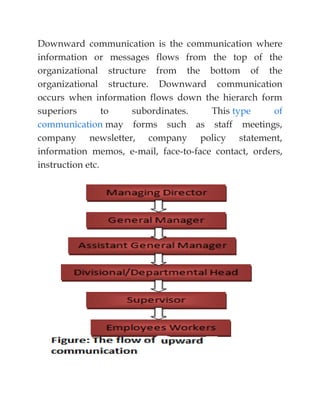
Downward communication is the communication where
information or messages flows from the top of the
organizational structure from the bottom of the
organizational structure. Downward communication
occurs when information flows down the hierarch form
superiors to subordinates. This type of
communication may forms such as staff meetings,
company newsletter, company policy statement,
information memos, e-mail, face-to-face contact, orders,
instruction etc.
What is horizontal communication?
Horizontal communication (sometimes called ‘lateral
communication’) is the communication that occurs
between people at the same level in an organization.
When businesses are small, and you’re all sat in the same
room, this communication is essentially the only form of
communication. But, as businesses grow and teams spread
out - horizontal communication isn’t done in person
anymore, it’s done over email or phone.
As an example, let’s take an account manager and a sales
executive. The sales executive wants to hand off over a
new customer to their account manager. The problem is,
they’re based in different offices. They need a way to
exchange this information - they need to communicate
horizontally - and usually use email or phone to do this.
What Is Grapevine Communication?
Grapevine communication is informal workplace dialogue in
its purest form: it is characterized by conversations between
employees and superiors that do not follow any prescribed
structure or rule-based system.
Grapevine communication spreads rapidly and likely touches
each person throughout the organization. The social and
personal interactions of employees determine the frequency and
reach of grapevine communication. It is an inevitable byproduct
of workplace communications. Human beings have a desire to
communicate with one another, and this will not always come
in a form that is approved by senior management. Grapevine
communication is so complicated that various categories define
it. There is a single-strain chain where information travels
straight from person A to person D. The Gossip Chain sees one
person spread the news to as many people as they can while the
Probability Chain disperses information randomly and in turn,
others do the same. Lastly, the Cluster Chain reveals one person
telling a selected group of people who also spread the news to
another cluster. These are all various ways that company
information can informally travel throughout the organization.
1. The first step in managing the grapevine is understanding that
it is not something that can be abolished entirely.
— Some managers may think they can completely eradicate
informal communications, and as a result, they can come across
as controlling and stifling.
— Managers need to know that grapevine communication is not
going away, and they would do better to try to work together
with employees.
2. Recognize Where Informal Communications Are Likely Happening
3. Is there always a group at the water cooler?
— Is the breakroom a common meeting group for
whispered messages?
Taking notice of where these conversations are taking
place will help leaders to understand who some of the
major players are and why they are happening.
4. Develop More Natural Systems for Workers to
Communicate
— Leaders can show that they are open to employees
communicating with each other by giving them more mediums
to talk such as collaboration tools, intranets, and lunch socials.
— This will confirm that management is not against workers
communicating and collaborating with one another.
— It will also create opportunities for management also to be
involved in communications to increase employee trust.
5. Preempt Times of Uncertainty
— It makes perfect sense that in times of uncertainty workers
would begin to send more messages through the grapevine.
— Managers can get ahead of this by including as much
information as they can through formal means: emails, memos,
and company-wide meetings.
— Employees do not like to be left in the dark.
— If management has come across a situation they are not sure
about; they should be open about the fact that they do not
know.
— This will ease worries and decrease the need to spread
potential misinformation.
6. Create an Open-Door Policy
— Leaders can indirectly let employees know that they are
always welcome to come to the source.
— If senior leaders have open door policies where employees
can stop by to ask questions, then they might not feel the need
to get information elsewhere.
— For this to work, leaders have to be transparent.
— Leaders should let employees know the boundaries of what
they can and cannot answer and the reasons why.
— If it is sensitive information at the time, leaders can tell
employees why they cannot explain it at that time and inform
them of when they might be able to.

upward Communication.docx

  • 1.
    Downward communication isthe communication where information or messages flows from the top of the organizational structure from the bottom of the organizational structure. Downward communication occurs when information flows down the hierarch form superiors to subordinates. This type of communication may forms such as staff meetings, company newsletter, company policy statement, information memos, e-mail, face-to-face contact, orders, instruction etc.
  • 2.
    What is horizontalcommunication? Horizontal communication (sometimes called ‘lateral communication’) is the communication that occurs between people at the same level in an organization. When businesses are small, and you’re all sat in the same room, this communication is essentially the only form of communication. But, as businesses grow and teams spread out - horizontal communication isn’t done in person anymore, it’s done over email or phone. As an example, let’s take an account manager and a sales executive. The sales executive wants to hand off over a new customer to their account manager. The problem is, they’re based in different offices. They need a way to exchange this information - they need to communicate horizontally - and usually use email or phone to do this. What Is Grapevine Communication? Grapevine communication is informal workplace dialogue in its purest form: it is characterized by conversations between employees and superiors that do not follow any prescribed structure or rule-based system.
  • 3.
    Grapevine communication spreadsrapidly and likely touches each person throughout the organization. The social and personal interactions of employees determine the frequency and reach of grapevine communication. It is an inevitable byproduct of workplace communications. Human beings have a desire to communicate with one another, and this will not always come in a form that is approved by senior management. Grapevine communication is so complicated that various categories define it. There is a single-strain chain where information travels straight from person A to person D. The Gossip Chain sees one person spread the news to as many people as they can while the Probability Chain disperses information randomly and in turn, others do the same. Lastly, the Cluster Chain reveals one person telling a selected group of people who also spread the news to another cluster. These are all various ways that company information can informally travel throughout the organization. 1. The first step in managing the grapevine is understanding that it is not something that can be abolished entirely. — Some managers may think they can completely eradicate informal communications, and as a result, they can come across as controlling and stifling. — Managers need to know that grapevine communication is not going away, and they would do better to try to work together with employees. 2. Recognize Where Informal Communications Are Likely Happening 3. Is there always a group at the water cooler?
  • 4.
    — Is thebreakroom a common meeting group for whispered messages? Taking notice of where these conversations are taking place will help leaders to understand who some of the major players are and why they are happening. 4. Develop More Natural Systems for Workers to Communicate — Leaders can show that they are open to employees communicating with each other by giving them more mediums to talk such as collaboration tools, intranets, and lunch socials. — This will confirm that management is not against workers communicating and collaborating with one another. — It will also create opportunities for management also to be involved in communications to increase employee trust. 5. Preempt Times of Uncertainty — It makes perfect sense that in times of uncertainty workers would begin to send more messages through the grapevine. — Managers can get ahead of this by including as much information as they can through formal means: emails, memos, and company-wide meetings. — Employees do not like to be left in the dark. — If management has come across a situation they are not sure about; they should be open about the fact that they do not know. — This will ease worries and decrease the need to spread potential misinformation.
  • 5.
    6. Create anOpen-Door Policy — Leaders can indirectly let employees know that they are always welcome to come to the source. — If senior leaders have open door policies where employees can stop by to ask questions, then they might not feel the need to get information elsewhere. — For this to work, leaders have to be transparent. — Leaders should let employees know the boundaries of what they can and cannot answer and the reasons why. — If it is sensitive information at the time, leaders can tell employees why they cannot explain it at that time and inform them of when they might be able to.