UPPER GASTROINTESTINAL
BLEEDING
OVERVIEW
•Introduction
•Etiology
•Symptom assessment
•Clinical assessment
•Features suggesting severe bleeding
•Modified Blatchford score
•Diagnosis
•Management of non variceal bleeding
•variceal bleeding and it’s management
INTRODUCTION
• Medical emergency.
• Bleeding proximal to duodeno- jejunal junction
( Ligament of treitz).
• Presents with hematemesis,melena or both.
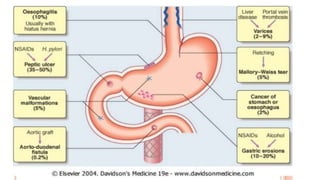
ETIOLOGY
1. Esophageal causes
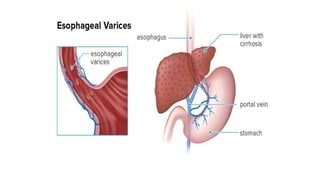
Esophageal varices
Esophagitis ,pill esophagitis
Esophageal carcinoma
2. Esophago gastric junction
Mallory Weiss tear
3.Gastroduodenal causes
Erosive gastritis, chronic peptic ulcer
Stress ulcers
Gastric carcinoma
4.Other causes
Rupture of aortic aneurysm
Aorto- enteric fistula
Vascular malformations of stomach & duodenum
Coagulation defects, gastric polyps, leiomyomas
Lymphomas,blood dyscrasias
SOURCES OF BLEEDING
SYMPTOM ASSESSMENT
• Peptic ulcer – Upper abdominal pain.
• Esophageal ulcer – Odynophagia,
gastro esophageal reflux, dysphagia.
• Mallory - weiss tear - Emesis,retching or coughing
prior to hematemesis.
• Variceal hemorrhage or portal hypertensive
gastropathy - jaundice, abdominal distension.
• Malignancy - dysphagia,early satiety,
involuntary weight loss, cachexia.
CLINICAL ASSESSMENT
• Mild blood loss ( <15%)-Resting tachycardia.
• Syncope .
• Orthostatic hypotension, tachycardia .
• Supine hypotension – blood volume loss of atleast 40% .
• Shock supervenes if bleeding continues or recur.
FEATURES SUGGESTING SEVERE BLEEDING
• Presence of clots in vomitus.
• Fresh blood in the nasogastric aspirate.
• Hematochezia.
• Hypotension and tachycardia.
• A fall in systolic BP>10 mmHg and rise in a pulse rate
of>20/min on changing from lying to sitting posture.
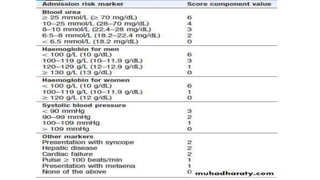
MODIFIED BLATCHFORD SCORE
• Risk scoring system.
• To stratify the risk of needing endoscopic therapy or
of having poor outcome.
• Advantage – Used before endoscopy to to predict the
need for intervention to treat bleeding.
• Low score -> low risk of adverse outcome.
DIAGNOSIS
1. History of peptic ulcer.
2. History of alcohol or NSAID ingestion.
3. History of jaundice, pedal edema,abdominal
distension,splenomegaly & other features of liver cell
failure – Variceal bleeding.
4. Hematemesis preceded by retching and blood free
vomitus – Mallory-Wiess tear.
5. History of dysphagia and weight loss prior to bleed
- Malignancy.
MANAGEMENT OF NON-VARICEAL BLEEDING
1. INTRAVENOUS ACCESS
Using one large- bore cannula.
2. INITIAL CLINICAL ASSESSMENT
Define circulatory status – severe bleeding >
tachycardia, hypotension,oliguria.
Seek evidence of liver disease – decompensated
cirrhosis> jaundice,hepatosplenomegaly,ascites.
Identify comorbidity –
cardiorespiratory,cerebrovascular and renal diseases.
3.BASIC INVESTIGATIONS
Full blood count –
Chronic or subacute bleeding- anemia.
Hypersplenism – thrombocytopenia.
Urea and electrolytes – Evidence of renal failure.
Severe bleeding – elevated blood urea with normal
creatinine clearance.
Liver function tests – evidence of chronic liver disease.
Prothrombin time.
Cross- matching.
4.RESUSCITATION
Intravenous crystalloid fluid – to raise BP
Blood transfusion – If BP is low& patient is
actively bleeding.
Broad spectrum antibiotics – suspected
chronic liver disease.
Management of comorbidities.
5.GASTRIC LAVAGE.
• Introduce nasogastric tube & aspirate.
• Perform gastric lavage by instilling 500 ml of ice cold water
every 30- 60 min.
• Do not apply vigorous suction.
• Nasogastric tube to be kept for 24 hours after cessation of
the bleed to facilitate detection of fresh blood.
• Gastric aspiration helps to:
✓ to assess the rate of bleeding.
✓clear the stomach prior to endoscopy.
✓dilute acid – pepsin in stomach there by reducing
bleeding from erosion.
6.OXYGEN - to all patients in shock .
7.ENDOSCOPY
✓ Carried out after adequate resuscitation
within 24 hours.
✓ Injection of dilute adrenaline to the bleeding point.
✓Thermal modality treatment by heat probe,
electrocoagulation.
8.MONITORING
Pulse,Blood pressure and urine output.
9.SURGERY
Indications:
✓ Endoscopic hemostasis fails to stop active
bleeding
✓Rebleeding occurs in an elderly or frail patient
or twice in a young patients.
Choice of operation depends on the site and diagnosis of
bleeding lesion.
.
•Gastric ulcer biopsy should be taken.
•Local excision.
•Partial gastrectomy.
10.ERADICATION OF H.PYLORI
. Proton pump inhibitors taken simultaneously with
two antibiotics: Amoxicillin,Clarithromycin
Metronidazole. For atleast 7 days.
OTHER MANAGEMENT STRATEGIES
• ✓ H2- blockers and proton pump inhibitors.
• ✓Ranitidine 50 mg IV eighth hourly.
• ✓ Pantoprazole 40 mg IV stat followed by 8mg/ hr
infusion.
VARICEAL BLEEDING
• The most important consequence of
portal hypertension.
• Esophageal varices > within 3- 5 cm of
gastro esophageal junction.
Predisposing factors :
• Large varices.
• High portal venous pressure.
• Salicylates & NSAID’s – mucosal erosion.
• Cherry red spots and stripes on endoscopy.
CLINICAL FEATURES
✓Painless massive haematemesis with or without
malena.
✓Mild postural tachycardia to profound shock
depending on the extent of blood loss.
✓ Associated features of liver cell failure, ascites and
Portal hypertension.
DIAGNOSIS
• Fibreoptic endoscopy – shows varices& bleeding site.
Done within 8 hours of bleed.
• USG – to confirm patency of portal vein.
• A wedged hepatic venous pressure 25mmHg above
that in IVC support variceal bleeding.
MANAGEMENT OF VARICEAL BLEEDING
1.Primary prevention of variceal bleeding.
2.Management of acute variceal bleeding.
3.Secondary prevention of variceal bleeding.
PRIMARY PREVENTION OF VARICEAL BLEEDING
If non bleeding varices are identified at endoscopy
Beta blocker therapy – propranolol ( 80- 160 mg/d)
nadolol( 40- 240mg/ d)
Carvedilol(6.25 to 12.5mg/d).
MANAGEMENT OF ACUTE VARICEAL BLEEDING
Management of acute variceal bleeding:
1. pharmacological reduction of portal venous pressure.
2. Endoscopic variceal band ligation.
3. Endoscopic sclerotherapy.
4. Balloon tamponade.
5. TIPSS.
6. portosystemic shunt surgery.
7. Esophageal transection.
PHARMACOLOGICAL REDUCTION OF PORTAL VENOUS
PRESSURE
• Terlipressin – synthetic vasopressin analogue.
Reduces portal blood flow and/ or
intrahepatic resistance & hence
brings down portal pressure.
Dose: 2mg IV 4times daily until bleeding
stops,and then 1mg 4 times
daily for upto 72 hours.
• Octreotide - Somatostatin analogue.
Initial bolus dose is 50 mcg followed by
continuous infusion at a rate
of 50 mcg/ hour.
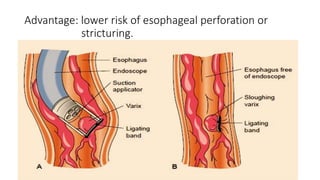
ENDOSCOPIC VARICEAL BAND LIGATION
• Varices sucked into a cap placed on the end of the
endoscope,occluded with a tight rubber band.
• Occluded varix sloughs with variceal obliteration.
• Repeated every 2- 4 weeks until all varices are
obliterated.
• Regular follow up endoscopy required.
• Prophylactic acid suppression with proton pump
inhibitors.
Advantage: lower risk of esophageal perforation or
stricturing.
ENDOSCOPIC SCLEROTHERAPY
BALLOON TAMPONADE
Sengstaken- Blakemore tube.
- Tube introduced into stomach through mouth.
- Has 2 balloons that exert pressure in the fundus
of stomach and in the lower esophagus.
- Gastic balloon is inflated with 200-250 ml air.
- If bleeding does not stop esophageal balloon is
inflated.
- It should be deflated for about 10 min in every 3
hours to avoid esophageal mucosal damage.
Sengstaken- Blakemore tube
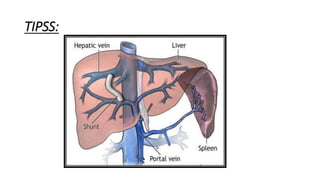
TRANSJUGULAR INTRAHEPATIC PORTOSYSTEMIC STENT
SHUNT ( TIPSS)
•A shunt placed between portal vein and hepatic vein
to provide a portosystemic shunt ->
reduce portal pressure.
•Carried out under radiological control via
the internal jugular vein.
•Effective treatment for both esophageal and
gastric varices.
TIPSS:
PORTOSYSTEMIC SHUNT SURGERY
✓ Prevents recurrent bleeding.
✓ Disadvantages: High mortality rate
Leads to encephalopathy.
ESOPHAGEAL TRANSECTION
✓ As a last resort when bleeding cannot be controlled by
other means.
SECONDARY PREVENTION OF VARICEAL BLEEDING
• Bleeding recurs in 65% patients within 1 year after
initial bleed.
• Beta- blockers : Propranolol 80- 60 mg/ day.
• Endoscopic variceal band ligation/ sclerotherapy.
• TIPSS
Upper_GI_bleeding.pptx

Upper_GI_bleeding.pptx

  • 1.
  • 2.
    OVERVIEW •Introduction •Etiology •Symptom assessment •Clinical assessment •Featuressuggesting severe bleeding •Modified Blatchford score •Diagnosis •Management of non variceal bleeding •variceal bleeding and it’s management
  • 3.
    INTRODUCTION • Medical emergency. •Bleeding proximal to duodeno- jejunal junction ( Ligament of treitz). • Presents with hematemesis,melena or both.
  • 5.
    ETIOLOGY 1. Esophageal causes Esophagealvarices Esophagitis ,pill esophagitis Esophageal carcinoma 2. Esophago gastric junction Mallory Weiss tear
  • 6.
    3.Gastroduodenal causes Erosive gastritis,chronic peptic ulcer Stress ulcers Gastric carcinoma 4.Other causes Rupture of aortic aneurysm Aorto- enteric fistula Vascular malformations of stomach & duodenum Coagulation defects, gastric polyps, leiomyomas Lymphomas,blood dyscrasias
  • 10.
  • 11.
    SYMPTOM ASSESSMENT • Pepticulcer – Upper abdominal pain. • Esophageal ulcer – Odynophagia, gastro esophageal reflux, dysphagia. • Mallory - weiss tear - Emesis,retching or coughing prior to hematemesis. • Variceal hemorrhage or portal hypertensive gastropathy - jaundice, abdominal distension. • Malignancy - dysphagia,early satiety, involuntary weight loss, cachexia.
  • 12.
    CLINICAL ASSESSMENT • Mildblood loss ( <15%)-Resting tachycardia. • Syncope . • Orthostatic hypotension, tachycardia . • Supine hypotension – blood volume loss of atleast 40% . • Shock supervenes if bleeding continues or recur.
  • 13.
    FEATURES SUGGESTING SEVEREBLEEDING • Presence of clots in vomitus. • Fresh blood in the nasogastric aspirate. • Hematochezia. • Hypotension and tachycardia. • A fall in systolic BP>10 mmHg and rise in a pulse rate of>20/min on changing from lying to sitting posture.
  • 14.
    MODIFIED BLATCHFORD SCORE •Risk scoring system. • To stratify the risk of needing endoscopic therapy or of having poor outcome. • Advantage – Used before endoscopy to to predict the need for intervention to treat bleeding. • Low score -> low risk of adverse outcome.
  • 16.
    DIAGNOSIS 1. History ofpeptic ulcer. 2. History of alcohol or NSAID ingestion. 3. History of jaundice, pedal edema,abdominal distension,splenomegaly & other features of liver cell failure – Variceal bleeding. 4. Hematemesis preceded by retching and blood free vomitus – Mallory-Wiess tear. 5. History of dysphagia and weight loss prior to bleed - Malignancy.
  • 17.
    MANAGEMENT OF NON-VARICEALBLEEDING 1. INTRAVENOUS ACCESS Using one large- bore cannula. 2. INITIAL CLINICAL ASSESSMENT Define circulatory status – severe bleeding > tachycardia, hypotension,oliguria. Seek evidence of liver disease – decompensated cirrhosis> jaundice,hepatosplenomegaly,ascites. Identify comorbidity – cardiorespiratory,cerebrovascular and renal diseases.
  • 18.
    3.BASIC INVESTIGATIONS Full bloodcount – Chronic or subacute bleeding- anemia. Hypersplenism – thrombocytopenia. Urea and electrolytes – Evidence of renal failure. Severe bleeding – elevated blood urea with normal creatinine clearance. Liver function tests – evidence of chronic liver disease. Prothrombin time. Cross- matching.
  • 19.
    4.RESUSCITATION Intravenous crystalloid fluid– to raise BP Blood transfusion – If BP is low& patient is actively bleeding. Broad spectrum antibiotics – suspected chronic liver disease. Management of comorbidities.
  • 20.
    5.GASTRIC LAVAGE. • Introducenasogastric tube & aspirate. • Perform gastric lavage by instilling 500 ml of ice cold water every 30- 60 min. • Do not apply vigorous suction. • Nasogastric tube to be kept for 24 hours after cessation of the bleed to facilitate detection of fresh blood. • Gastric aspiration helps to: ✓ to assess the rate of bleeding. ✓clear the stomach prior to endoscopy. ✓dilute acid – pepsin in stomach there by reducing bleeding from erosion.
  • 21.
    6.OXYGEN - toall patients in shock . 7.ENDOSCOPY ✓ Carried out after adequate resuscitation within 24 hours. ✓ Injection of dilute adrenaline to the bleeding point. ✓Thermal modality treatment by heat probe, electrocoagulation.
  • 22.
    8.MONITORING Pulse,Blood pressure andurine output. 9.SURGERY Indications: ✓ Endoscopic hemostasis fails to stop active bleeding ✓Rebleeding occurs in an elderly or frail patient or twice in a young patients. Choice of operation depends on the site and diagnosis of bleeding lesion.
  • 23.
    . •Gastric ulcer biopsyshould be taken. •Local excision. •Partial gastrectomy. 10.ERADICATION OF H.PYLORI . Proton pump inhibitors taken simultaneously with two antibiotics: Amoxicillin,Clarithromycin Metronidazole. For atleast 7 days.
  • 24.
    OTHER MANAGEMENT STRATEGIES •✓ H2- blockers and proton pump inhibitors. • ✓Ranitidine 50 mg IV eighth hourly. • ✓ Pantoprazole 40 mg IV stat followed by 8mg/ hr infusion.
  • 25.
    VARICEAL BLEEDING • Themost important consequence of portal hypertension. • Esophageal varices > within 3- 5 cm of gastro esophageal junction.
  • 26.
    Predisposing factors : •Large varices. • High portal venous pressure. • Salicylates & NSAID’s – mucosal erosion. • Cherry red spots and stripes on endoscopy.
  • 27.
    CLINICAL FEATURES ✓Painless massivehaematemesis with or without malena. ✓Mild postural tachycardia to profound shock depending on the extent of blood loss. ✓ Associated features of liver cell failure, ascites and Portal hypertension.
  • 28.
    DIAGNOSIS • Fibreoptic endoscopy– shows varices& bleeding site. Done within 8 hours of bleed. • USG – to confirm patency of portal vein. • A wedged hepatic venous pressure 25mmHg above that in IVC support variceal bleeding.
  • 29.
    MANAGEMENT OF VARICEALBLEEDING 1.Primary prevention of variceal bleeding. 2.Management of acute variceal bleeding. 3.Secondary prevention of variceal bleeding.
  • 30.
    PRIMARY PREVENTION OFVARICEAL BLEEDING If non bleeding varices are identified at endoscopy Beta blocker therapy – propranolol ( 80- 160 mg/d) nadolol( 40- 240mg/ d) Carvedilol(6.25 to 12.5mg/d).
  • 31.
    MANAGEMENT OF ACUTEVARICEAL BLEEDING
  • 32.
    Management of acutevariceal bleeding: 1. pharmacological reduction of portal venous pressure. 2. Endoscopic variceal band ligation. 3. Endoscopic sclerotherapy. 4. Balloon tamponade. 5. TIPSS. 6. portosystemic shunt surgery. 7. Esophageal transection.
  • 33.
    PHARMACOLOGICAL REDUCTION OFPORTAL VENOUS PRESSURE • Terlipressin – synthetic vasopressin analogue. Reduces portal blood flow and/ or intrahepatic resistance & hence brings down portal pressure. Dose: 2mg IV 4times daily until bleeding stops,and then 1mg 4 times daily for upto 72 hours. • Octreotide - Somatostatin analogue. Initial bolus dose is 50 mcg followed by continuous infusion at a rate of 50 mcg/ hour.
  • 34.
    ENDOSCOPIC VARICEAL BANDLIGATION • Varices sucked into a cap placed on the end of the endoscope,occluded with a tight rubber band. • Occluded varix sloughs with variceal obliteration. • Repeated every 2- 4 weeks until all varices are obliterated. • Regular follow up endoscopy required. • Prophylactic acid suppression with proton pump inhibitors.
  • 35.
    Advantage: lower riskof esophageal perforation or stricturing.
  • 36.
  • 37.
    BALLOON TAMPONADE Sengstaken- Blakemoretube. - Tube introduced into stomach through mouth. - Has 2 balloons that exert pressure in the fundus of stomach and in the lower esophagus. - Gastic balloon is inflated with 200-250 ml air. - If bleeding does not stop esophageal balloon is inflated. - It should be deflated for about 10 min in every 3 hours to avoid esophageal mucosal damage.
  • 38.
  • 39.
    TRANSJUGULAR INTRAHEPATIC PORTOSYSTEMICSTENT SHUNT ( TIPSS) •A shunt placed between portal vein and hepatic vein to provide a portosystemic shunt -> reduce portal pressure. •Carried out under radiological control via the internal jugular vein. •Effective treatment for both esophageal and gastric varices.
  • 40.
  • 41.
    PORTOSYSTEMIC SHUNT SURGERY ✓Prevents recurrent bleeding. ✓ Disadvantages: High mortality rate Leads to encephalopathy. ESOPHAGEAL TRANSECTION ✓ As a last resort when bleeding cannot be controlled by other means.
  • 43.
    SECONDARY PREVENTION OFVARICEAL BLEEDING • Bleeding recurs in 65% patients within 1 year after initial bleed. • Beta- blockers : Propranolol 80- 60 mg/ day. • Endoscopic variceal band ligation/ sclerotherapy. • TIPSS