GiG connection Horticulture education program  for the Kuntaur region April 2010 Remko Strik [email_address]
In December 2009, in the Kuntaur region five communities were visited by Tiasnimbas Parttime MBA group 6. During these visits a special focus was given to the community gardens. In these gardens vegetables were grown. These vegetables are used for own consumption. Overproduction is sold to the local market. Minimal requirements for gardens are a well and a fence. The fence is needed to protect to garden for animals such as goats during the dry season. The visit of the Tiasnimbas students had the goal to contribute in a sustainable way to the Kuntaur region. After spending three days in the Kuntaur region, the Tiasnimbas group made a short list of contributions which could be made.  A selected project was a trainings program for the five communities. With more and better training, the communities could increase productivity in their community gardens.  Introduction
Goal of the project Train 5 communities from the Kuntaur region on the cultivation of vegetables. By training the workers, vegetable production in the communities can be increased which would benefit their food consumption. The sales of the overproduction can generate an additional income. Format The growers will be trained by Gambia is Good (GiG). GiG is a Gambian organisation who trains growers in the cultivation of vegetables. 5 farms are given the opportunity to select 2 employees who can enter the trainings program: 3 trainings of 2 days in the trainings facility of GiG 2 trainings of 2 days at the farms  Total project investment 110.378 dalasi ( ± 3.154 euro).  Project overview
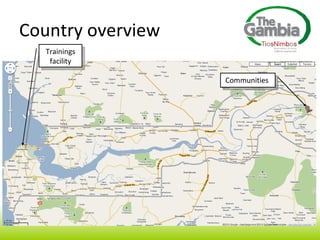
Country overview Communities  Trainings facility
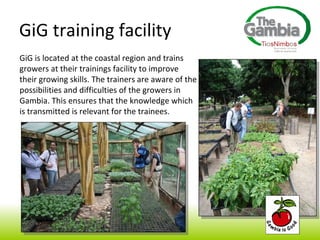
GiG training facility GiG is located at the coastal region and trains growers at their trainings facility to improve their growing skills. The trainers are aware of the possibilities and difficulties of the growers in Gambia. This ensures that the knowledge which is transmitted is relevant for the trainees.
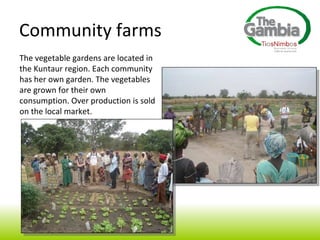
Community farms The vegetable gardens are located in the Kuntaur region. Each community has her own garden. The vegetables are grown for their own consumption. Over production is sold on the local market.
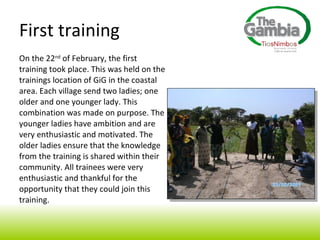
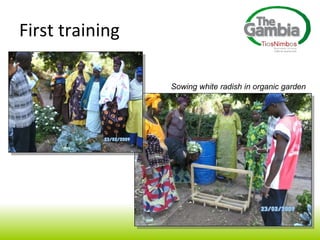
On the 22 nd  of February, the first training took place. This was held on the trainings location of GiG in the coastal area. Each village send two ladies; one older and one younger lady. This combination was made on purpose. The younger ladies have ambition and are very enthusiastic and motivated. The older ladies ensure that the knowledge from the training is shared within their  community. All trainees were very enthusiastic and thankful for the opportunity that they could join this training.  First training
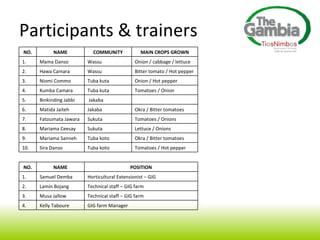
Participants & trainers Tomatoes / Hot pepper Tuba koto Sira Danso 10. Okra / Bitter tomatoes Tuba koto Mariama Sanneh 9. Lettuce / Onions Sukuta Mariama Ceesay 8. Tomatoes / Onions Sukuta Fatoumata Jawara 7. Okra / Bitter tomatoes Jakaba Matida Jaiteh 6. Jakaba Binkinding Jabbi 5. Tomatoes / Onion Tuba kuta Kumba Camara 4. Onion / Hot pepper Tuba kuta Niomi Commo 3. Bitter tomato / Hot pepper Wassu Hawa Camara 2. Onion / cabbage / lettuce Wassu Mama Danso 1. MAIN CROPS GROWN COMMUNITY NAME NO. GIG farm Manager Kelly Taboure 4. Technical staff – GIG farm Musa Jallow 3. Technical staff – GIG farm Lamin Bojang 2. Horticultural Extensionist – GIG  Samuel Demba 1. POSITION NAME NO.
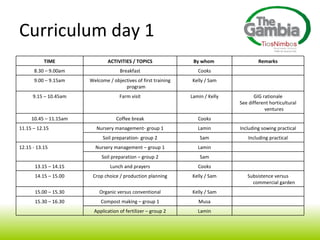
Curriculum day 1 Lamin Application of fertilizer – group 2 Musa Compost making – group 1 15.30 – 16.30 Kelly / Sam Organic versus conventional 15.00 – 15.30 Subsistence versus commercial garden Kelly / Sam Crop choice / production planning 14.15 – 15.00 Cooks Lunch and prayers 13.15 – 14.15 Sam Soil preparation – group 2 Lamin Nursery management – group 1 12.15 - 13.15 Including practical Sam Soil preparation- group 2 Including sowing practical Lamin Nursery management- group 1 11.15 – 12.15 Cooks Coffee break 10.45 – 11.15am GIG rationale See different horticultural ventures Lamin / Kelly Farm visit 9.15 – 10.45am Kelly / Sam Welcome / objectives of first training program 9.00 – 9.15am Cooks Breakfast 8.30 – 9.00am Remarks By whom  ACTIVITIES / TOPICS TIME
First training Sowing white radish in organic garden
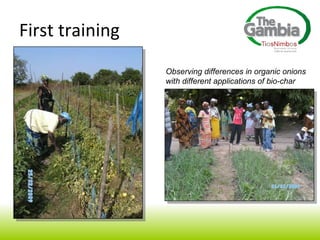
First training Observing differences in organic onions with different applications of bio-char
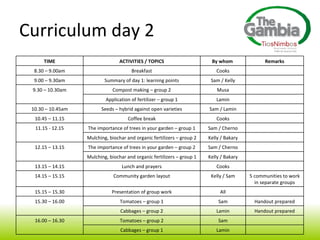
Curriculum day 2 Lamin Cabbages – group 1 Sam Tomatoes – group 2 16.00 – 16.30 Handout prepared Lamin Cabbages – group 2 Handout prepared Sam Tomatoes – group 1 15.30 – 16.00 All Presentation of group work 15.15 – 15.30 5 communities to work in separate groups Kelly / Sam Community garden layout 14.15 – 15.15 Cooks Lunch and prayers 13.15 – 14.15 Kelly / Bakary Mulching, biochar and organic fertilizers – group 1 Sam / Cherno The importance of trees in your garden – group 2 12.15 – 13.15 Kelly / Bakary Mulching, biochar and organic fertilizers – group 2 Sam / Cherno The importance of trees in your garden – group 1 11.15 - 12.15 Cooks Coffee break 10.45 – 11.15 Sam / Lamin Seeds – hybrid against open varieties 10.30 – 10.45am Lamin Application of fertilizer – group 1 Musa Compost making – group 2 9.30 – 10.30am Sam / Kelly Summary of day 1: learning points 9.00 – 9.30am Cooks Breakfast 8.30 – 9.00am Remarks By whom  ACTIVITIES / TOPICS TIME
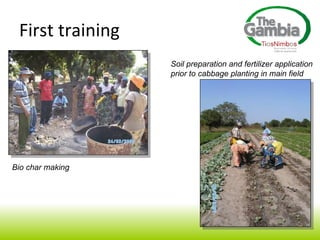
First training Bio char making   Soil preparation and fertilizer application prior to cabbage planting in main field
The training was a very practical one which enabled the women to experience the different level of horticultural production as demonstrated at the GIG farm yard. The focus was on the organic and local way of production as we are not trying to promote the use of chemical inputs. The participants all seems to have a good basic understanding of proper organic techniques – sharing ideas of natural pest control measures and different ways of compost making.  Every village was given some bitter tomato seeds, tomatoes and eggplant for trial planting at their community. Also handouts on the production of tomatoes and cabbages have been provided in a file for each community. More documents will be made available during follow up trainings. It was felt that a good foundation was laid and next training could be more detailed and focussed. Though the women were tired from the far travel they were very cooperative and worked hard in their practical and give a good traditional closing ceremony with typical Mandinka dance! First training conclusion
The second training was held in the Kuntaur region at the community garden on 5 th  and 6 th  of April. During the two days training, the representative of GIG, Bintou Jaiteh, visited Kuntaur. In the two days all the five communitygardens are visited. It was very useful for Bintou to visit the farms. In this way she could see with her own eyes the situation of the farms. The situations per farm differ. In size, possibilities and quality level. Bintou gave a lot of advice and tips to the women. By receiving these tips in their own garden has a positive impact on the learning experience. Here advice was quite necessary and more than welcome. Bintou also got in contact with the local personnel of the Ministry of Agriculture.  Also this training (on the job) was very useful and the trainees would like to express again their thanks for giving them the opportunity of this learning experience. Second training

Update 2 ptmba6_project_gig_connection

  • 1.
    GiG connection Horticultureeducation program for the Kuntaur region April 2010 Remko Strik [email_address]
  • 2.
    In December 2009,in the Kuntaur region five communities were visited by Tiasnimbas Parttime MBA group 6. During these visits a special focus was given to the community gardens. In these gardens vegetables were grown. These vegetables are used for own consumption. Overproduction is sold to the local market. Minimal requirements for gardens are a well and a fence. The fence is needed to protect to garden for animals such as goats during the dry season. The visit of the Tiasnimbas students had the goal to contribute in a sustainable way to the Kuntaur region. After spending three days in the Kuntaur region, the Tiasnimbas group made a short list of contributions which could be made. A selected project was a trainings program for the five communities. With more and better training, the communities could increase productivity in their community gardens. Introduction
  • 3.
    Goal of theproject Train 5 communities from the Kuntaur region on the cultivation of vegetables. By training the workers, vegetable production in the communities can be increased which would benefit their food consumption. The sales of the overproduction can generate an additional income. Format The growers will be trained by Gambia is Good (GiG). GiG is a Gambian organisation who trains growers in the cultivation of vegetables. 5 farms are given the opportunity to select 2 employees who can enter the trainings program: 3 trainings of 2 days in the trainings facility of GiG 2 trainings of 2 days at the farms Total project investment 110.378 dalasi ( ± 3.154 euro). Project overview
  • 4.
    Country overview Communities Trainings facility
  • 5.
    GiG training facilityGiG is located at the coastal region and trains growers at their trainings facility to improve their growing skills. The trainers are aware of the possibilities and difficulties of the growers in Gambia. This ensures that the knowledge which is transmitted is relevant for the trainees.
  • 6.
    Community farms Thevegetable gardens are located in the Kuntaur region. Each community has her own garden. The vegetables are grown for their own consumption. Over production is sold on the local market.
  • 7.
    On the 22nd of February, the first training took place. This was held on the trainings location of GiG in the coastal area. Each village send two ladies; one older and one younger lady. This combination was made on purpose. The younger ladies have ambition and are very enthusiastic and motivated. The older ladies ensure that the knowledge from the training is shared within their community. All trainees were very enthusiastic and thankful for the opportunity that they could join this training. First training
  • 8.
    Participants & trainersTomatoes / Hot pepper Tuba koto Sira Danso 10. Okra / Bitter tomatoes Tuba koto Mariama Sanneh 9. Lettuce / Onions Sukuta Mariama Ceesay 8. Tomatoes / Onions Sukuta Fatoumata Jawara 7. Okra / Bitter tomatoes Jakaba Matida Jaiteh 6. Jakaba Binkinding Jabbi 5. Tomatoes / Onion Tuba kuta Kumba Camara 4. Onion / Hot pepper Tuba kuta Niomi Commo 3. Bitter tomato / Hot pepper Wassu Hawa Camara 2. Onion / cabbage / lettuce Wassu Mama Danso 1. MAIN CROPS GROWN COMMUNITY NAME NO. GIG farm Manager Kelly Taboure 4. Technical staff – GIG farm Musa Jallow 3. Technical staff – GIG farm Lamin Bojang 2. Horticultural Extensionist – GIG Samuel Demba 1. POSITION NAME NO.
  • 9.
    Curriculum day 1Lamin Application of fertilizer – group 2 Musa Compost making – group 1 15.30 – 16.30 Kelly / Sam Organic versus conventional 15.00 – 15.30 Subsistence versus commercial garden Kelly / Sam Crop choice / production planning 14.15 – 15.00 Cooks Lunch and prayers 13.15 – 14.15 Sam Soil preparation – group 2 Lamin Nursery management – group 1 12.15 - 13.15 Including practical Sam Soil preparation- group 2 Including sowing practical Lamin Nursery management- group 1 11.15 – 12.15 Cooks Coffee break 10.45 – 11.15am GIG rationale See different horticultural ventures Lamin / Kelly Farm visit 9.15 – 10.45am Kelly / Sam Welcome / objectives of first training program 9.00 – 9.15am Cooks Breakfast 8.30 – 9.00am Remarks By whom ACTIVITIES / TOPICS TIME
  • 10.
    First training Sowingwhite radish in organic garden
  • 11.
    First training Observingdifferences in organic onions with different applications of bio-char
  • 12.
    Curriculum day 2Lamin Cabbages – group 1 Sam Tomatoes – group 2 16.00 – 16.30 Handout prepared Lamin Cabbages – group 2 Handout prepared Sam Tomatoes – group 1 15.30 – 16.00 All Presentation of group work 15.15 – 15.30 5 communities to work in separate groups Kelly / Sam Community garden layout 14.15 – 15.15 Cooks Lunch and prayers 13.15 – 14.15 Kelly / Bakary Mulching, biochar and organic fertilizers – group 1 Sam / Cherno The importance of trees in your garden – group 2 12.15 – 13.15 Kelly / Bakary Mulching, biochar and organic fertilizers – group 2 Sam / Cherno The importance of trees in your garden – group 1 11.15 - 12.15 Cooks Coffee break 10.45 – 11.15 Sam / Lamin Seeds – hybrid against open varieties 10.30 – 10.45am Lamin Application of fertilizer – group 1 Musa Compost making – group 2 9.30 – 10.30am Sam / Kelly Summary of day 1: learning points 9.00 – 9.30am Cooks Breakfast 8.30 – 9.00am Remarks By whom ACTIVITIES / TOPICS TIME
  • 13.
    First training Biochar making Soil preparation and fertilizer application prior to cabbage planting in main field
  • 14.
    The training wasa very practical one which enabled the women to experience the different level of horticultural production as demonstrated at the GIG farm yard. The focus was on the organic and local way of production as we are not trying to promote the use of chemical inputs. The participants all seems to have a good basic understanding of proper organic techniques – sharing ideas of natural pest control measures and different ways of compost making. Every village was given some bitter tomato seeds, tomatoes and eggplant for trial planting at their community. Also handouts on the production of tomatoes and cabbages have been provided in a file for each community. More documents will be made available during follow up trainings. It was felt that a good foundation was laid and next training could be more detailed and focussed. Though the women were tired from the far travel they were very cooperative and worked hard in their practical and give a good traditional closing ceremony with typical Mandinka dance! First training conclusion
  • 15.
    The second trainingwas held in the Kuntaur region at the community garden on 5 th and 6 th of April. During the two days training, the representative of GIG, Bintou Jaiteh, visited Kuntaur. In the two days all the five communitygardens are visited. It was very useful for Bintou to visit the farms. In this way she could see with her own eyes the situation of the farms. The situations per farm differ. In size, possibilities and quality level. Bintou gave a lot of advice and tips to the women. By receiving these tips in their own garden has a positive impact on the learning experience. Here advice was quite necessary and more than welcome. Bintou also got in contact with the local personnel of the Ministry of Agriculture. Also this training (on the job) was very useful and the trainees would like to express again their thanks for giving them the opportunity of this learning experience. Second training