Organic gardens bring hope
Nearly one million people live in the
townships to the north-east of Cape Town,
mostly in shacks and matchbox houses.
Approximately 40 per cent of them are
unemployed. The majority speak Xhosa
and are recent arrivals from the Eastern
Cape – the former apartheid homelands of
Transkei and Ciskei. Abalimi’s aim is to
assist these people to grow food
sustainably, using organic methods, at
home and in community gardens and,
secondly, to plant water-wise indigenous
trees and flora in schools and streets, in
order to transform the dune-sands of the
Cape Flats into a sustainable water-wise
urban environment.
Abalimi provides support services like
low-cost bulk compost, seed, seedlings,
information, training and on-site project
extension. Every year, nearly 3000
subsistence gardeners and 200 community
agriculture and greening projects are
supplied with inputs from Abalimi’s two
non-profit People’s Garden Centres.
The economic potential is big, as there
is a high and ever growing demand for
organic vegetables in Cape Town. Organic
markets and retailers large and small are
always undersupplied. The organic
movement is alive and well, led mainly by
civil society. There is now an increasingly
organised community-based “organic-
friendly” farming and gardening movement,
led by associations such as the Vukuzenzela
Urban Farmers Association (VUFA),
which is supported by Abalimi.
Training
Abalimi runs several training courses to cater
for people’s varying level of expertise. All
courses involve active participation and are
very practical:
The basic three-day course on organic
gardening provides participants (many of
whom are semi-literate or illiterate) with the
basic knowledge and skills to begin their own
vegetable gardens. The courses are followed
up with additional on-site training and
support. A one-day school caretakers’ training
module trains participants in mulching,
water-wise gardening and gardening
maintenance. The workshops also provide a
good opportunity for caretakers to gather
together to share problems, ideas and
information.
3 4 T H E P R O F E S S I O N A L G A R D E N E R N o . 1 1 6 J U L Y 2 0 0 7
Organic gardens bring hope to poor urban communities
Rob Small
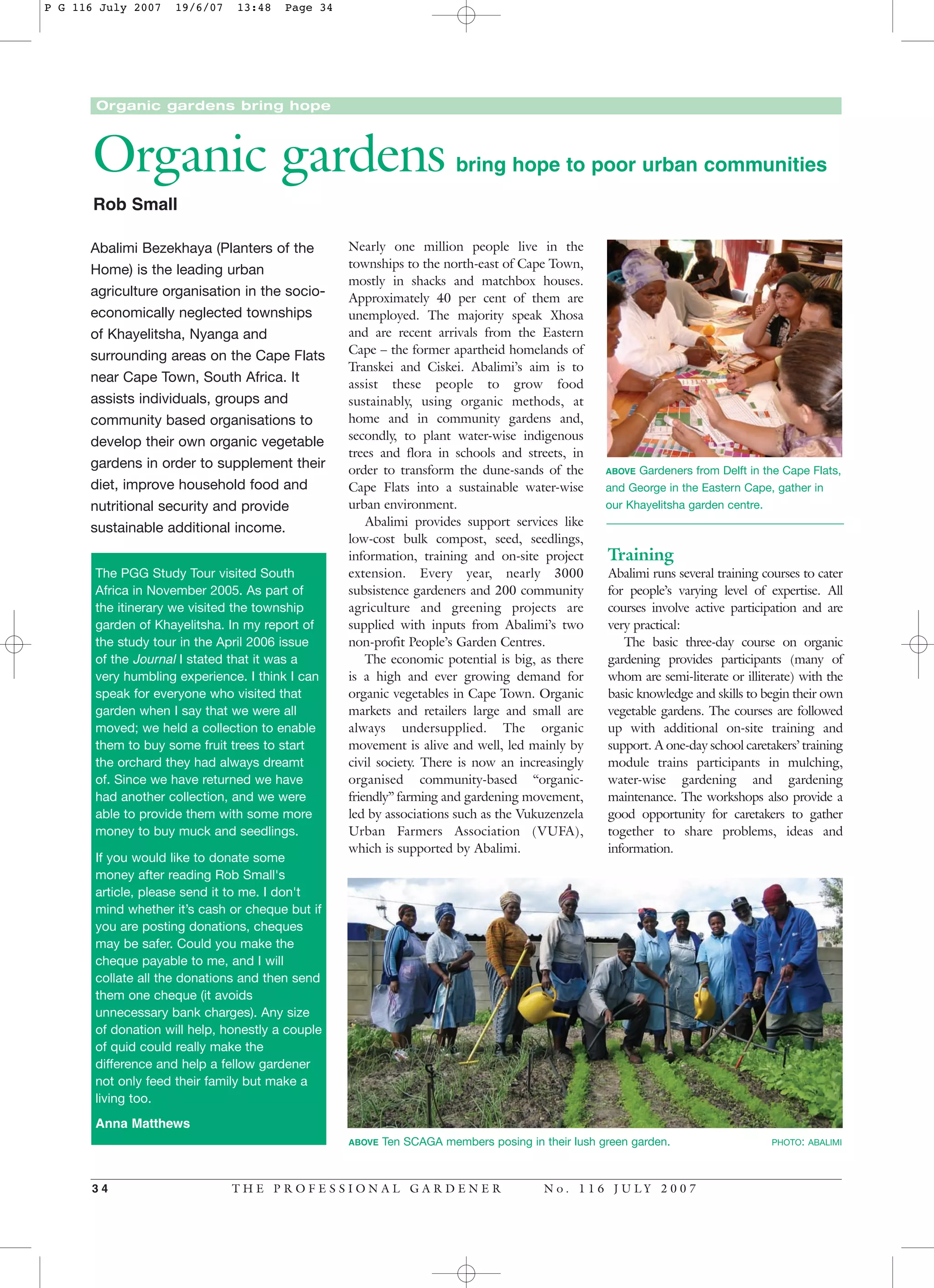
ABOVE Ten SCAGA members posing in their lush green garden. PHOTO: ABALIMI
The PGG Study Tour visited South
Africa in November 2005. As part of
the itinerary we visited the township
garden of Khayelitsha. In my report of
the study tour in the April 2006 issue
of the Journal I stated that it was a
very humbling experience. I think I can
speak for everyone who visited that
garden when I say that we were all
moved; we held a collection to enable
them to buy some fruit trees to start
the orchard they had always dreamt
of. Since we have returned we have
had another collection, and we were
able to provide them with some more
money to buy muck and seedlings.
If you would like to donate some
money after reading Rob Small's
article, please send it to me. I don't
mind whether it’s cash or cheque but if
you are posting donations, cheques
may be safer. Could you make the
cheque payable to me, and I will
collate all the donations and then send
them one cheque (it avoids
unnecessary bank charges). Any size
of donation will help, honestly a couple
of quid could really make the
difference and help a fellow gardener
not only feed their family but make a
living too.
Anna Matthews
ABOVE Gardeners from Delft in the Cape Flats,
and George in the Eastern Cape, gather in
our Khayelitsha garden centre.
Abalimi Bezekhaya (Planters of the
Home) is the leading urban
agriculture organisation in the socio-
economically neglected townships
of Khayelitsha, Nyanga and
surrounding areas on the Cape Flats
near Cape Town, South Africa. It
assists individuals, groups and
community based organisations to
develop their own organic vegetable
gardens in order to supplement their
diet, improve household food and
nutritional security and provide
sustainable additional income.
P G 116 July 2007 19/6/07 13:48 Page 34
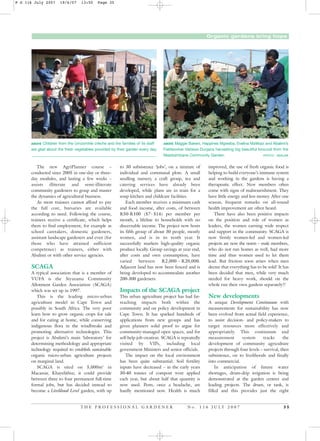
ABOVE Maggie Bakeni, Happines Mgweba, Evelina Mzilikazi and Abalimi’s
Fieldworker Vatiswa Dunjana harvesting big beautiful broccoli from the
Masibambane Community Garden. PHOTO: ABALIMI
Organic gardens bring hope
The new AgriPlanner course –
conducted since 2005 in one-day or three-
day modules, and lasting a few weeks –
assists illiterate and semi-illiterate
community gardeners to grasp and master
the dynamics of agricultural business.
As most trainees cannot afford to pay
the full cost, bursaries are available
according to need. Following the course,
trainees receive a certificate, which helps
them to find employment, for example as
school caretakers, domestic gardeners,
assistant landscape gardeners and even (for
those who have attained sufficient
competence) as trainers, either with
Abalimi or with other service agencies.
SCAGA
A typical association that is a member of
VUFA is the Siyazama Community
Allotment Garden Association (SCAGA)
which was set up in 1997.
This is the leading micro-urban
agriculture model in Cape Town and
possibly in South Africa. The very poor
learn how to grow organic crops for sale
and for eating at home, while conserving
indigenous flora in the windbreaks and
promoting alternative technologies. This
project is Abalimi’s main ‘laboratory’ for
determining methodology and appropriate
technology required to establish sustainable
organic micro-urban agriculture projects
on marginal land.
SCAGA is sited on 5,000m2
in
Macassar, Khayelithsa; it could provide
between three to four permanent full-time
formal jobs, but has decided instead to
become a Livelihood Level garden, with up
to 30 subsistence ‘jobs’, on a mixture of
individual and communal plots. A small
seedling nursery, a craft group, tea and
catering services have already been
developed, while plans are in train for a
soup kitchen and childcare facilities.
Each member receives a minimum cash
and food income, after costs, of between
R50-R100 ($7- $14) per member per
month, a lifeline to households with no
discernable income. The project now hosts
its fifth group of about 30 people, mostly
women, and is in its tenth year. It
successfully markets high-quality organic
produce locally. Group savings at year end,
after costs and own consumption, have
varied between R2,000 – R20,000.
Adjacent land has now been fenced and is
being developed to accommodate another
200-300 gardeners.
Impacts of the SCAGA project
This urban agriculture project has had far-
reaching impacts both within the
community and on policy development in
Cape Town. It has sparked hundreds of
applications from new groups and has
given planners solid proof to argue for
community-managed open spaces, and for
self-help job creation. SCAGA is repeatedly
visited by VIPs, including local
government Ministers and senior officials.
The impact on the local environment
has been quite substantial. Soil fertility
inputs have decreased – in the early years
30-40 tonnes of compost were applied
each year, but about half that quantity is
now used. Pests, once a headache, are
hardly mentioned now. Health is much
improved, the use of fresh organic food is
helping to build everyone’s immune system
and working in the gardens is having a
therapeutic effect. New members often
come with signs of malnourishment. They
have little energy and less money. After one
season, frequent remarks on all-round
health improvement are often heard.
There have also been positive impacts
on the position and role of women as
leaders, the women earning wide respect
and support in the community. SCAGA is
now firmly women-led and women-led
projects are now the norm – male members,
who do not run homes as well, had more
time and thus women used to let them
lead. But friction soon arises when men
decree that everything has to be sold! It has
been decided that men, while very much
needed for heavy work, should on the
whole run their own gardens separately!!
New developments
A unique Development Continuum with
measurements for sustainability has now
been evolved from actual field experience,
to assist decision- and policy-makers to
target resources more effectively and
appropriately. This continuum and
measurement system tracks the
development of community agriculture
projects through four levels – survival, then
subsistence, on to livelihoods and finally
into commercial.
In anticipation of future water
shortages, drum-drip irrigation is being
demonstrated at the garden centres and
leading projects. The drum, or tank, is
filled and this provides just the right
T H E P R O F E S S I O N A L G A R D E N E R N o . 1 1 6 J U L Y 2 0 0 7 3 5
ABOVE Children from the Umzomhle crèche and the families of its staff
are glad about the fresh vegetables provided by their garden every day.
P G 116 July 2007 19/6/07 13:50 Page 35
Organic gardens bring hope • Photo competition
amount of water pressure into the drip-
lines, giving exact control over the amount
of water delivered. This is critical in
summer (our dry season), when there is a
tendency to over-water using other systems
– over-watering leaches nutrients out of the
topsoil, leading to higher fertilisation costs,
because more compost is then needed to
feed the crops. This system is ideal for our
conditions as it reduces water loss through
wind and evaporation, applying water
directly to the plants so there is little
wastage. It is simple to operate and repair
and is relatively inexpensive. Abalimi aims
to install drum-drip systems at every
community garden project in future.
Increasing livelihoods
The livelihood garden is a subsistence level
garden with a commercial component that
serves as the anchor for a number of other
social and economic initiatives, identified
by gardeners. These can include crafts and
refreshments for visitors and tourists,
childcare and soup kitchens (part-funded
by government grants) for the sick and
needy, nurseries for seedlings for own use
and for sale to others. In this way, the
gardens become multi-functional
entrepreneurial and community support
initiatives. The livelihood garden can also
incorporate part-time and non-gardeners
who wish to benefit from the gardening
activity while also doing something they
like better.
Since 2000, Abalimi has developed an
Organisation Building arm, using tried and
tested interventions to build farmer &
gardener skills and organisations.
Horizontal learning (farmer to farmer)
exchange, action learning and savings
mobilisation are key activities here.
Cheap micro-credit to groups with
consistent savings records will be available
(via partners) in future for projects which
are entering the livelihood and commercial
levels.
Periodic farmers’ markets, tunnels, cold-
storage rooms and value-adding packing
sheds will follow in the next years,
supplying a wide range of produce for
cooperative marketing and creating
unlimited new livelihood and job
opportunities for the poor.
Organic certification is now being
prepared, whereby Abalimi and VUFA will
obtain “bulk certification”. Thus
association members can obtain
certification more cheaply and increase
external marketability of their products.
Abalimi is determined to ensure that
certification will not act as a gatekeeper to
keep emerging players out.
Abalimi – in partnership with the South
African Institute for Entrepreneurship – is
developing a Master Gardeners training
which will become accredited and will be
able to enable illiterate gardeners and
farmers to move from survival into
subsistence level, thence to livelihood and
on into commercial level. This will also
form the basis of a capacity-building
programme, enabling genuine organic
farmers to return to abandoned Eastern
Cape lands.
This social impulse, combined with
relative economic success, provides the first
examples in South Africa of sustainable
urban community organic gardens as a new
lifestyle choice. There is no limit to what
can be achieved once people have found a
way to work again in trust and goodwill on
the land.
For more information contact
Rob Small, Abalimi Bezekhaya,
PO Box 44, Observatory,
Cape Town, 7935, South Africa.
Tel/fax: +27 (21) 371 1653;
Email: rsmall@xsinet.co.za and
info@abalimi.org.za
This article was first published in ‘Appropriate
Technology’, Vol.34, No.1, March 2007.
Web site: www.appropriate-technology.org
3 6 T H E P R O F E S S I O N A L G A R D E N E R N o . 1 1 6 J U L Y 2 0 0 7
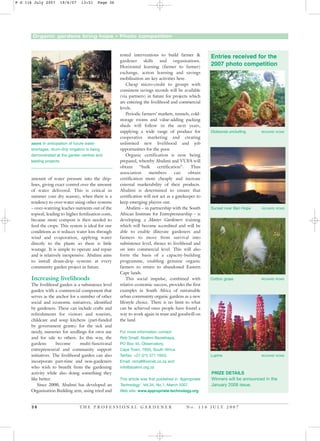
ABOVE In anticipation of future water
shortages, drum-drip irrigation is being
demonstrated at the garden centres and
leading projects.
Entries received for the
2007 photo competition
PRIZE DETAILS
Winners will be announced in the
January 2008 issue.
Dicksonia unclurling RICHARD ROWE
Sunset over Ben Hope RICHARD ROWE
Cotton grass RICHARD ROWE
Lupins RICHARD ROWE
P G 116 July 2007 19/6/07 13:51 Page 36

Organic gardensbringhopejuly07

  • 1.
    Organic gardens bringhope Nearly one million people live in the townships to the north-east of Cape Town, mostly in shacks and matchbox houses. Approximately 40 per cent of them are unemployed. The majority speak Xhosa and are recent arrivals from the Eastern Cape – the former apartheid homelands of Transkei and Ciskei. Abalimi’s aim is to assist these people to grow food sustainably, using organic methods, at home and in community gardens and, secondly, to plant water-wise indigenous trees and flora in schools and streets, in order to transform the dune-sands of the Cape Flats into a sustainable water-wise urban environment. Abalimi provides support services like low-cost bulk compost, seed, seedlings, information, training and on-site project extension. Every year, nearly 3000 subsistence gardeners and 200 community agriculture and greening projects are supplied with inputs from Abalimi’s two non-profit People’s Garden Centres. The economic potential is big, as there is a high and ever growing demand for organic vegetables in Cape Town. Organic markets and retailers large and small are always undersupplied. The organic movement is alive and well, led mainly by civil society. There is now an increasingly organised community-based “organic- friendly” farming and gardening movement, led by associations such as the Vukuzenzela Urban Farmers Association (VUFA), which is supported by Abalimi. Training Abalimi runs several training courses to cater for people’s varying level of expertise. All courses involve active participation and are very practical: The basic three-day course on organic gardening provides participants (many of whom are semi-literate or illiterate) with the basic knowledge and skills to begin their own vegetable gardens. The courses are followed up with additional on-site training and support. A one-day school caretakers’ training module trains participants in mulching, water-wise gardening and gardening maintenance. The workshops also provide a good opportunity for caretakers to gather together to share problems, ideas and information. 3 4 T H E P R O F E S S I O N A L G A R D E N E R N o . 1 1 6 J U L Y 2 0 0 7 Organic gardens bring hope to poor urban communities Rob Small ABOVE Ten SCAGA members posing in their lush green garden. PHOTO: ABALIMI The PGG Study Tour visited South Africa in November 2005. As part of the itinerary we visited the township garden of Khayelitsha. In my report of the study tour in the April 2006 issue of the Journal I stated that it was a very humbling experience. I think I can speak for everyone who visited that garden when I say that we were all moved; we held a collection to enable them to buy some fruit trees to start the orchard they had always dreamt of. Since we have returned we have had another collection, and we were able to provide them with some more money to buy muck and seedlings. If you would like to donate some money after reading Rob Small's article, please send it to me. I don't mind whether it’s cash or cheque but if you are posting donations, cheques may be safer. Could you make the cheque payable to me, and I will collate all the donations and then send them one cheque (it avoids unnecessary bank charges). Any size of donation will help, honestly a couple of quid could really make the difference and help a fellow gardener not only feed their family but make a living too. Anna Matthews ABOVE Gardeners from Delft in the Cape Flats, and George in the Eastern Cape, gather in our Khayelitsha garden centre. Abalimi Bezekhaya (Planters of the Home) is the leading urban agriculture organisation in the socio- economically neglected townships of Khayelitsha, Nyanga and surrounding areas on the Cape Flats near Cape Town, South Africa. It assists individuals, groups and community based organisations to develop their own organic vegetable gardens in order to supplement their diet, improve household food and nutritional security and provide sustainable additional income. P G 116 July 2007 19/6/07 13:48 Page 34
  • 2.
    ABOVE Maggie Bakeni,Happines Mgweba, Evelina Mzilikazi and Abalimi’s Fieldworker Vatiswa Dunjana harvesting big beautiful broccoli from the Masibambane Community Garden. PHOTO: ABALIMI Organic gardens bring hope The new AgriPlanner course – conducted since 2005 in one-day or three- day modules, and lasting a few weeks – assists illiterate and semi-illiterate community gardeners to grasp and master the dynamics of agricultural business. As most trainees cannot afford to pay the full cost, bursaries are available according to need. Following the course, trainees receive a certificate, which helps them to find employment, for example as school caretakers, domestic gardeners, assistant landscape gardeners and even (for those who have attained sufficient competence) as trainers, either with Abalimi or with other service agencies. SCAGA A typical association that is a member of VUFA is the Siyazama Community Allotment Garden Association (SCAGA) which was set up in 1997. This is the leading micro-urban agriculture model in Cape Town and possibly in South Africa. The very poor learn how to grow organic crops for sale and for eating at home, while conserving indigenous flora in the windbreaks and promoting alternative technologies. This project is Abalimi’s main ‘laboratory’ for determining methodology and appropriate technology required to establish sustainable organic micro-urban agriculture projects on marginal land. SCAGA is sited on 5,000m2 in Macassar, Khayelithsa; it could provide between three to four permanent full-time formal jobs, but has decided instead to become a Livelihood Level garden, with up to 30 subsistence ‘jobs’, on a mixture of individual and communal plots. A small seedling nursery, a craft group, tea and catering services have already been developed, while plans are in train for a soup kitchen and childcare facilities. Each member receives a minimum cash and food income, after costs, of between R50-R100 ($7- $14) per member per month, a lifeline to households with no discernable income. The project now hosts its fifth group of about 30 people, mostly women, and is in its tenth year. It successfully markets high-quality organic produce locally. Group savings at year end, after costs and own consumption, have varied between R2,000 – R20,000. Adjacent land has now been fenced and is being developed to accommodate another 200-300 gardeners. Impacts of the SCAGA project This urban agriculture project has had far- reaching impacts both within the community and on policy development in Cape Town. It has sparked hundreds of applications from new groups and has given planners solid proof to argue for community-managed open spaces, and for self-help job creation. SCAGA is repeatedly visited by VIPs, including local government Ministers and senior officials. The impact on the local environment has been quite substantial. Soil fertility inputs have decreased – in the early years 30-40 tonnes of compost were applied each year, but about half that quantity is now used. Pests, once a headache, are hardly mentioned now. Health is much improved, the use of fresh organic food is helping to build everyone’s immune system and working in the gardens is having a therapeutic effect. New members often come with signs of malnourishment. They have little energy and less money. After one season, frequent remarks on all-round health improvement are often heard. There have also been positive impacts on the position and role of women as leaders, the women earning wide respect and support in the community. SCAGA is now firmly women-led and women-led projects are now the norm – male members, who do not run homes as well, had more time and thus women used to let them lead. But friction soon arises when men decree that everything has to be sold! It has been decided that men, while very much needed for heavy work, should on the whole run their own gardens separately!! New developments A unique Development Continuum with measurements for sustainability has now been evolved from actual field experience, to assist decision- and policy-makers to target resources more effectively and appropriately. This continuum and measurement system tracks the development of community agriculture projects through four levels – survival, then subsistence, on to livelihoods and finally into commercial. In anticipation of future water shortages, drum-drip irrigation is being demonstrated at the garden centres and leading projects. The drum, or tank, is filled and this provides just the right T H E P R O F E S S I O N A L G A R D E N E R N o . 1 1 6 J U L Y 2 0 0 7 3 5 ABOVE Children from the Umzomhle crèche and the families of its staff are glad about the fresh vegetables provided by their garden every day. P G 116 July 2007 19/6/07 13:50 Page 35
  • 3.
    Organic gardens bringhope • Photo competition amount of water pressure into the drip- lines, giving exact control over the amount of water delivered. This is critical in summer (our dry season), when there is a tendency to over-water using other systems – over-watering leaches nutrients out of the topsoil, leading to higher fertilisation costs, because more compost is then needed to feed the crops. This system is ideal for our conditions as it reduces water loss through wind and evaporation, applying water directly to the plants so there is little wastage. It is simple to operate and repair and is relatively inexpensive. Abalimi aims to install drum-drip systems at every community garden project in future. Increasing livelihoods The livelihood garden is a subsistence level garden with a commercial component that serves as the anchor for a number of other social and economic initiatives, identified by gardeners. These can include crafts and refreshments for visitors and tourists, childcare and soup kitchens (part-funded by government grants) for the sick and needy, nurseries for seedlings for own use and for sale to others. In this way, the gardens become multi-functional entrepreneurial and community support initiatives. The livelihood garden can also incorporate part-time and non-gardeners who wish to benefit from the gardening activity while also doing something they like better. Since 2000, Abalimi has developed an Organisation Building arm, using tried and tested interventions to build farmer & gardener skills and organisations. Horizontal learning (farmer to farmer) exchange, action learning and savings mobilisation are key activities here. Cheap micro-credit to groups with consistent savings records will be available (via partners) in future for projects which are entering the livelihood and commercial levels. Periodic farmers’ markets, tunnels, cold- storage rooms and value-adding packing sheds will follow in the next years, supplying a wide range of produce for cooperative marketing and creating unlimited new livelihood and job opportunities for the poor. Organic certification is now being prepared, whereby Abalimi and VUFA will obtain “bulk certification”. Thus association members can obtain certification more cheaply and increase external marketability of their products. Abalimi is determined to ensure that certification will not act as a gatekeeper to keep emerging players out. Abalimi – in partnership with the South African Institute for Entrepreneurship – is developing a Master Gardeners training which will become accredited and will be able to enable illiterate gardeners and farmers to move from survival into subsistence level, thence to livelihood and on into commercial level. This will also form the basis of a capacity-building programme, enabling genuine organic farmers to return to abandoned Eastern Cape lands. This social impulse, combined with relative economic success, provides the first examples in South Africa of sustainable urban community organic gardens as a new lifestyle choice. There is no limit to what can be achieved once people have found a way to work again in trust and goodwill on the land. For more information contact Rob Small, Abalimi Bezekhaya, PO Box 44, Observatory, Cape Town, 7935, South Africa. Tel/fax: +27 (21) 371 1653; Email: rsmall@xsinet.co.za and info@abalimi.org.za This article was first published in ‘Appropriate Technology’, Vol.34, No.1, March 2007. Web site: www.appropriate-technology.org 3 6 T H E P R O F E S S I O N A L G A R D E N E R N o . 1 1 6 J U L Y 2 0 0 7 ABOVE In anticipation of future water shortages, drum-drip irrigation is being demonstrated at the garden centres and leading projects. Entries received for the 2007 photo competition PRIZE DETAILS Winners will be announced in the January 2008 issue. Dicksonia unclurling RICHARD ROWE Sunset over Ben Hope RICHARD ROWE Cotton grass RICHARD ROWE Lupins RICHARD ROWE P G 116 July 2007 19/6/07 13:51 Page 36