Unlocking FME Flow’s
Potential:
Architecture Design for
Modern Enterprises
The Peak of Data
and AI 2025
2025
The
Peak
of
Data
and
AI
Théo Drogo
GIS Strategic Advisor
Jean-Nicholas Lanoue
GIS Strategic Advisor
2025
The
Peak
of
Data
and
AI
Unlock the full potential of
FME Flow by making the
right architectural decisions,
whether you're deploying it for
the first time or scaling it
across the enterprise.
2025
The
Peak
of
Data
and
AI
In Scope (We will cover…)
●Architecture Fundamentals
●Express, Distributed or Fault-Tolerant?
●Focus on Engines
●Key architecture decision points
●Real-world architecture examples
Out of Scope (20 minutes only 😉)
● FME Flow Hosted
● Infrastructure As Code
● FME Flow Administration concepts
● Containerization
● Licensing models
● And everything you won’t see in the next slides 👀
2025
The
Peak
of
Data
and
AI
Architecture Fundamentals
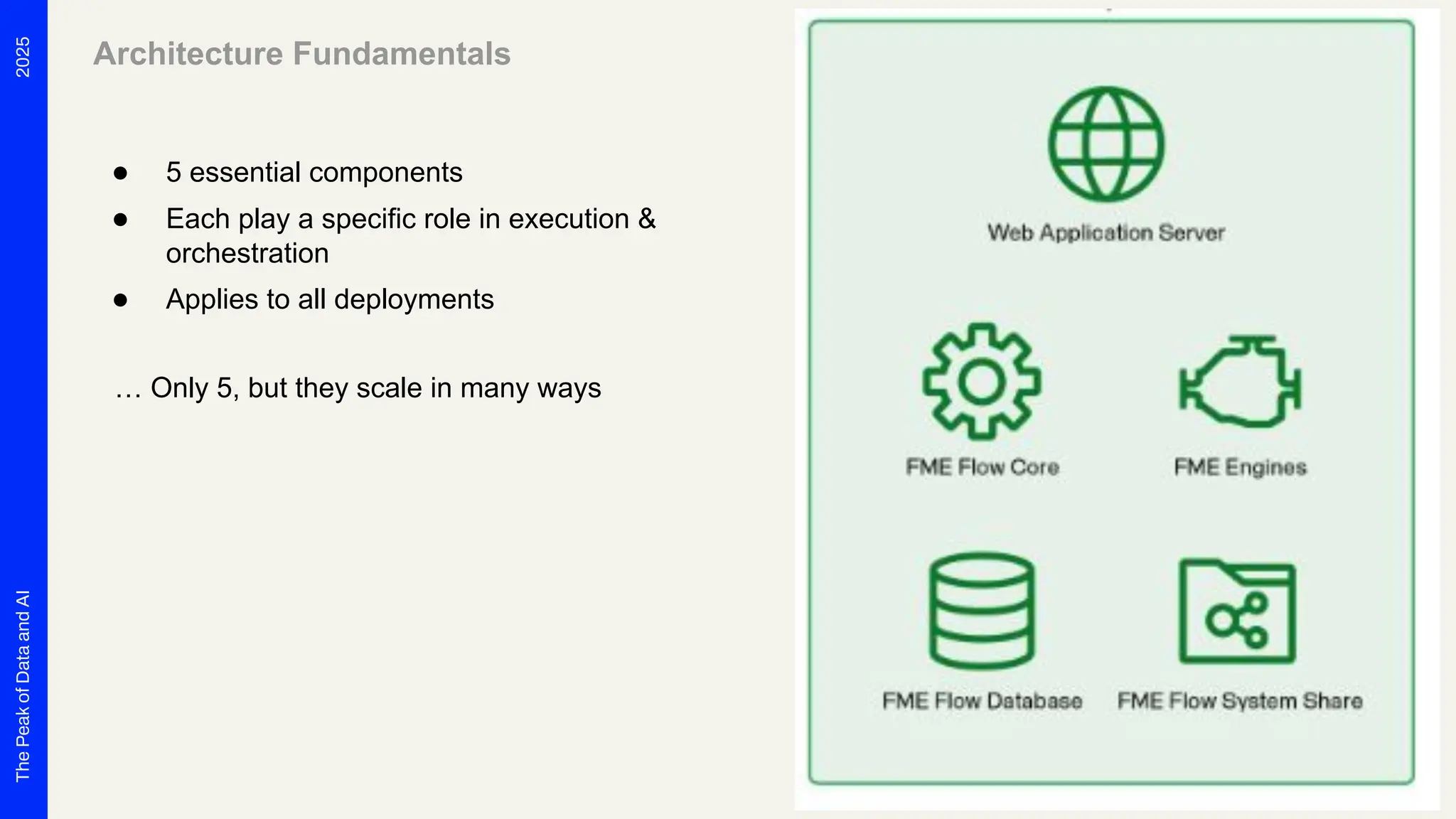
● 5 essential components
● Each play a specific role in execution &
orchestration
● Applies to all deployments
… Only 5, but they scale in many ways
2025
The
Peak
of
Data
and
AI
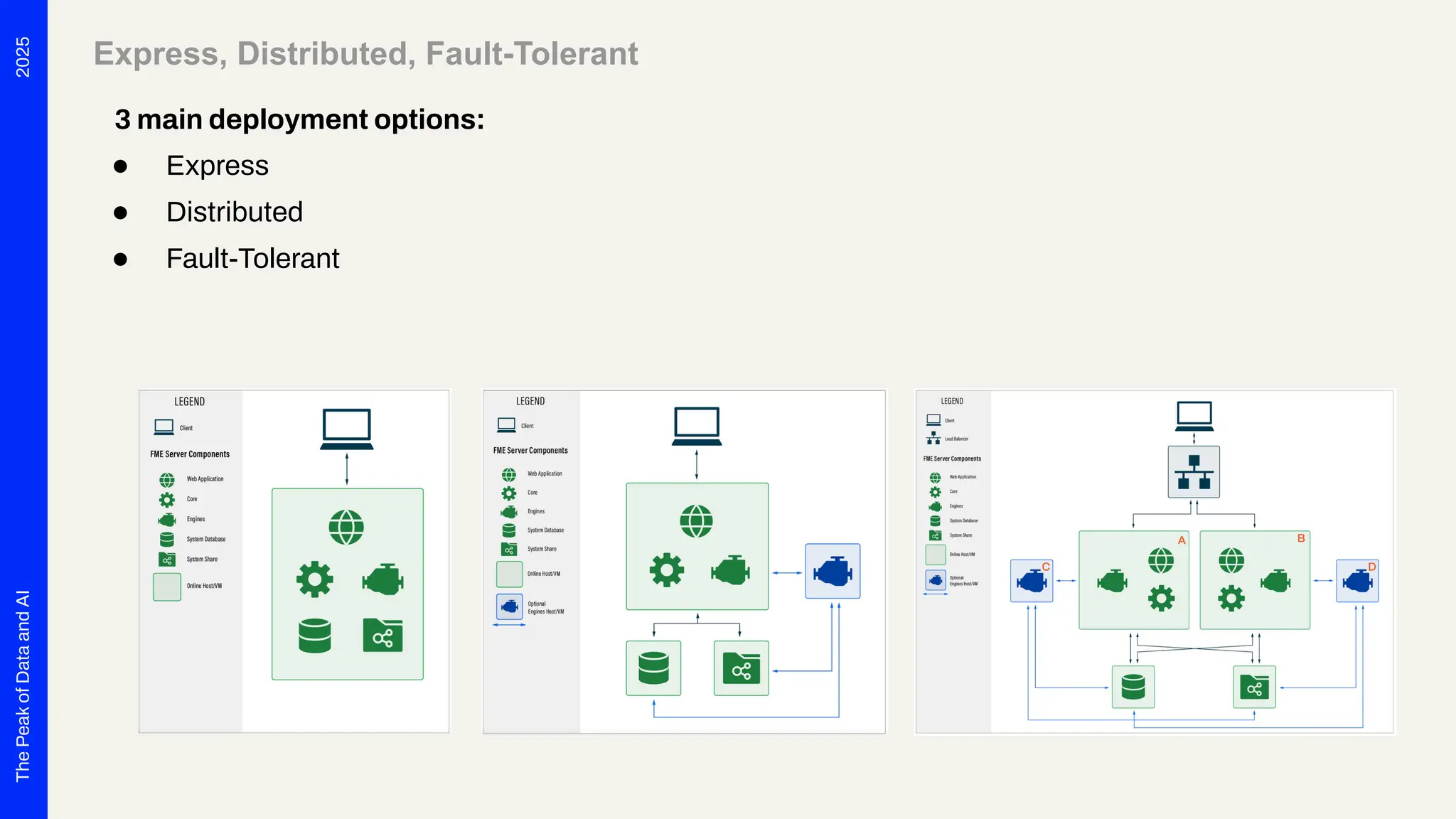
3 main deployment options:
● Express
● Distributed
● Fault-Tolerant
Express, Distributed, Fault-Tolerant
2025
The
Peak
of
Data
and
AI
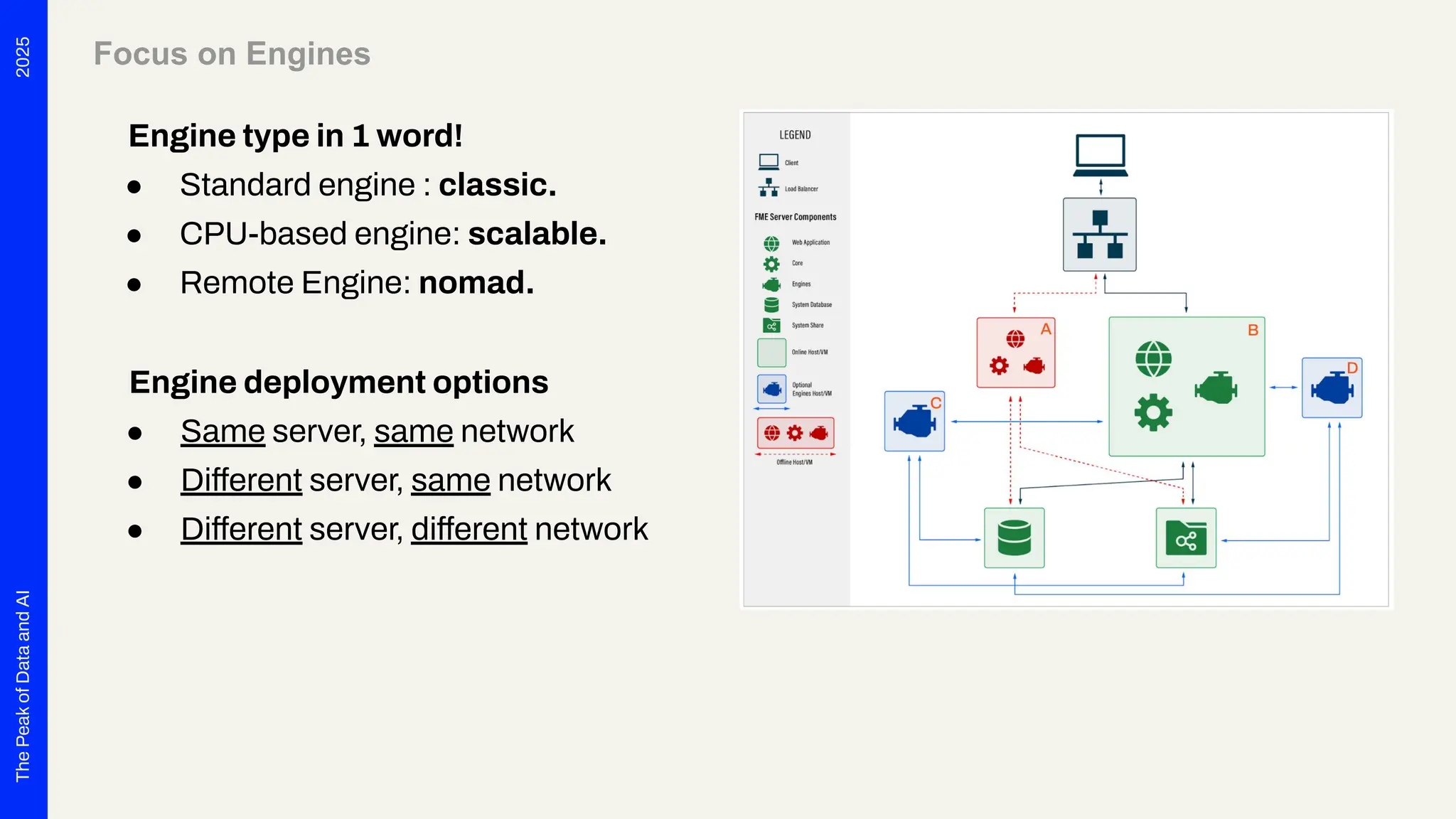
Engine deployment options
● Same server, same network
● Different server, same network
● Different server, different network
Engine type in 1 word!
● Standard engine : classic.
● CPU-based engine: scalable.
● Remote Engine: nomad.
Focus on Engines
2025
The
Peak
of
Data
and
AI
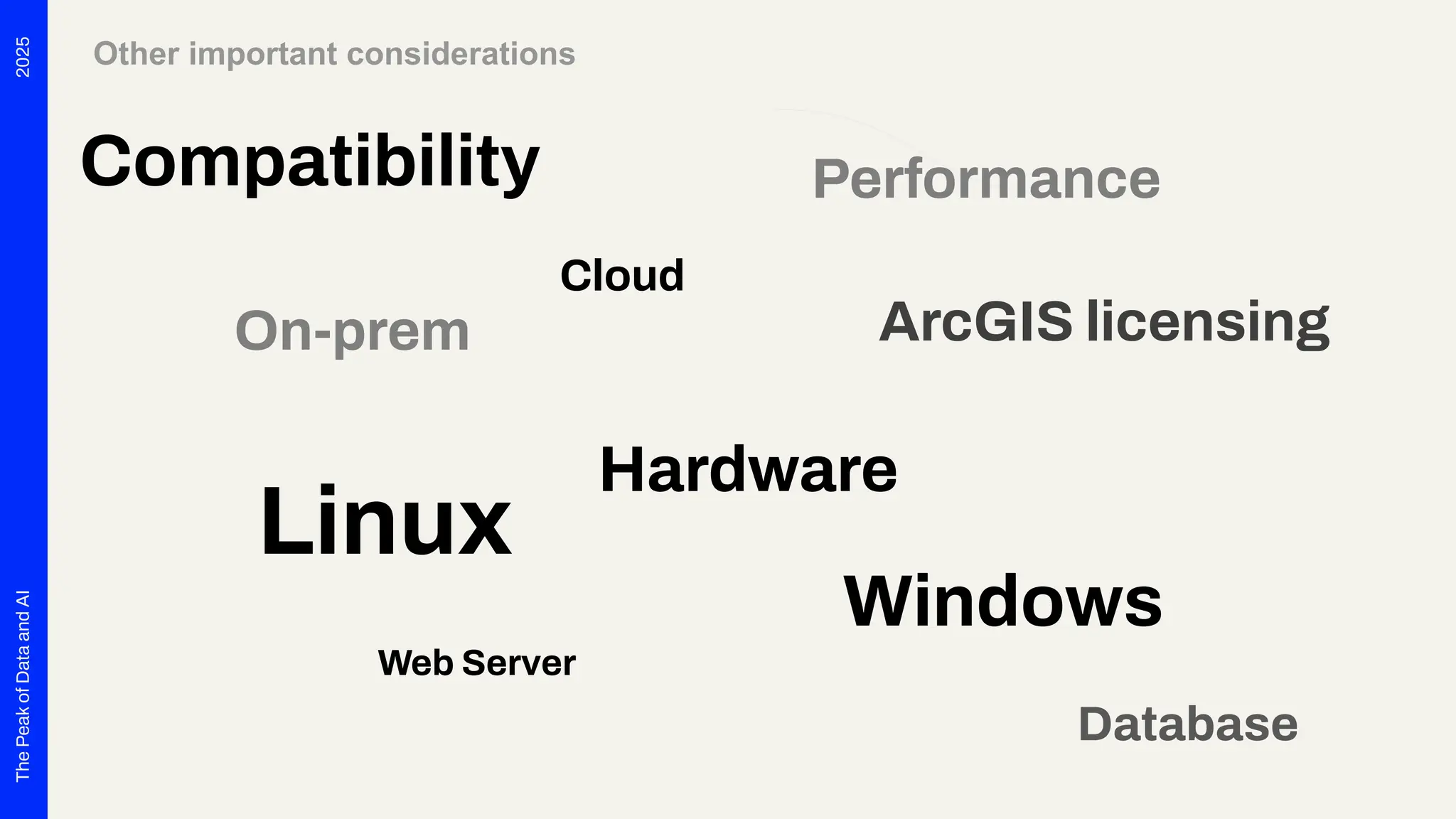
Cloud
On-prem
Database
Linux
Windows
Hardware
ArcGIS licensing
Web Server
Compatibility Performance
Other important considerations
2025
The
Peak
of
Data
and
AI
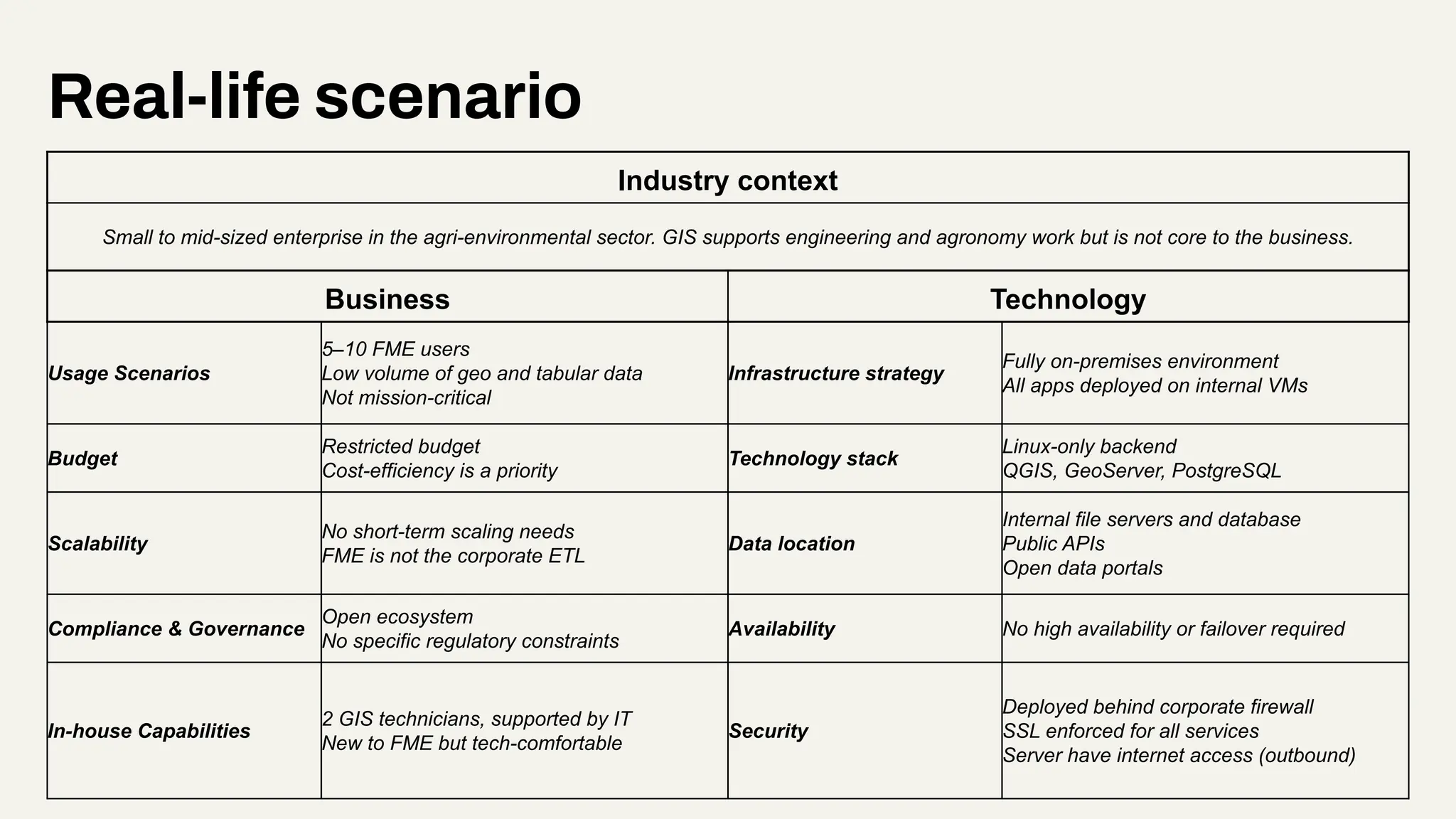
Industry context
Small to mid-sized enterprise in the agri-environmental sector. GIS supports engineering and agronomy work but is not core to the business.
Business Technology
Usage Scenarios
5–10 FME users
Low volume of geo and tabular data
Not mission-critical
Infrastructure strategy
Fully on-premises environment
All apps deployed on internal VMs
Budget
Restricted budget
Cost-efficiency is a priority
Technology stack
Linux-only backend
QGIS, GeoServer, PostgreSQL
Scalability
No short-term scaling needs
FME is not the corporate ETL
Data location
Internal file servers and database
Public APIs
Open data portals
Compliance & Governance
Open ecosystem
No specific regulatory constraints
Availability No high availability or failover required
In-house Capabilities
2 GIS technicians, supported by IT
New to FME but tech-comfortable
Security
Deployed behind corporate firewall
SSL enforced for all services
Server have internet access (outbound)
Real-life scenario
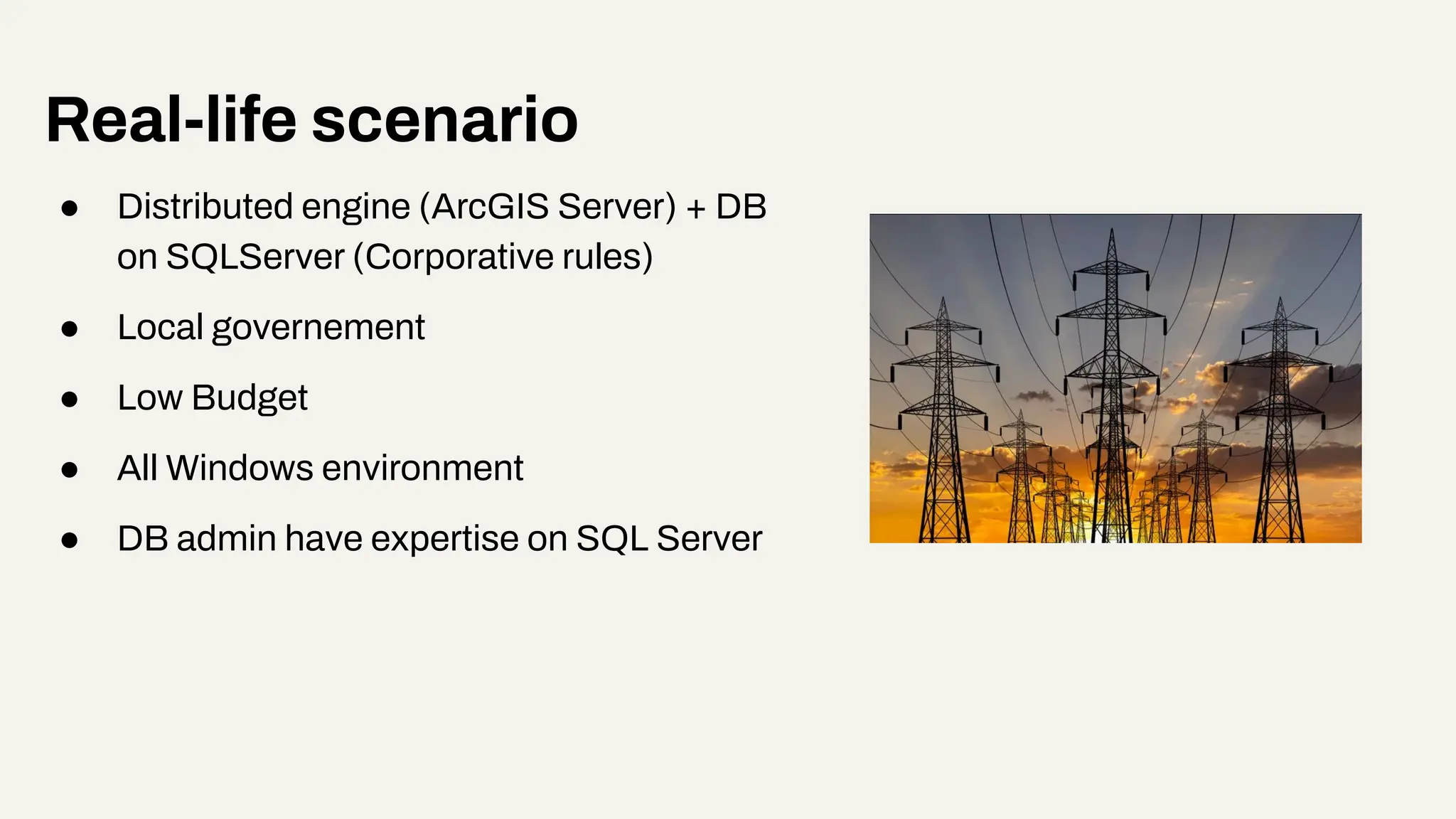
● Distributed engine (ArcGIS Server) + DB
on SQLServer (Corporative rules)
● Local governement
● Low Budget
● All Windows environment
● DB admin have expertise on SQL Server
Real-life scenario
Real-life scenario
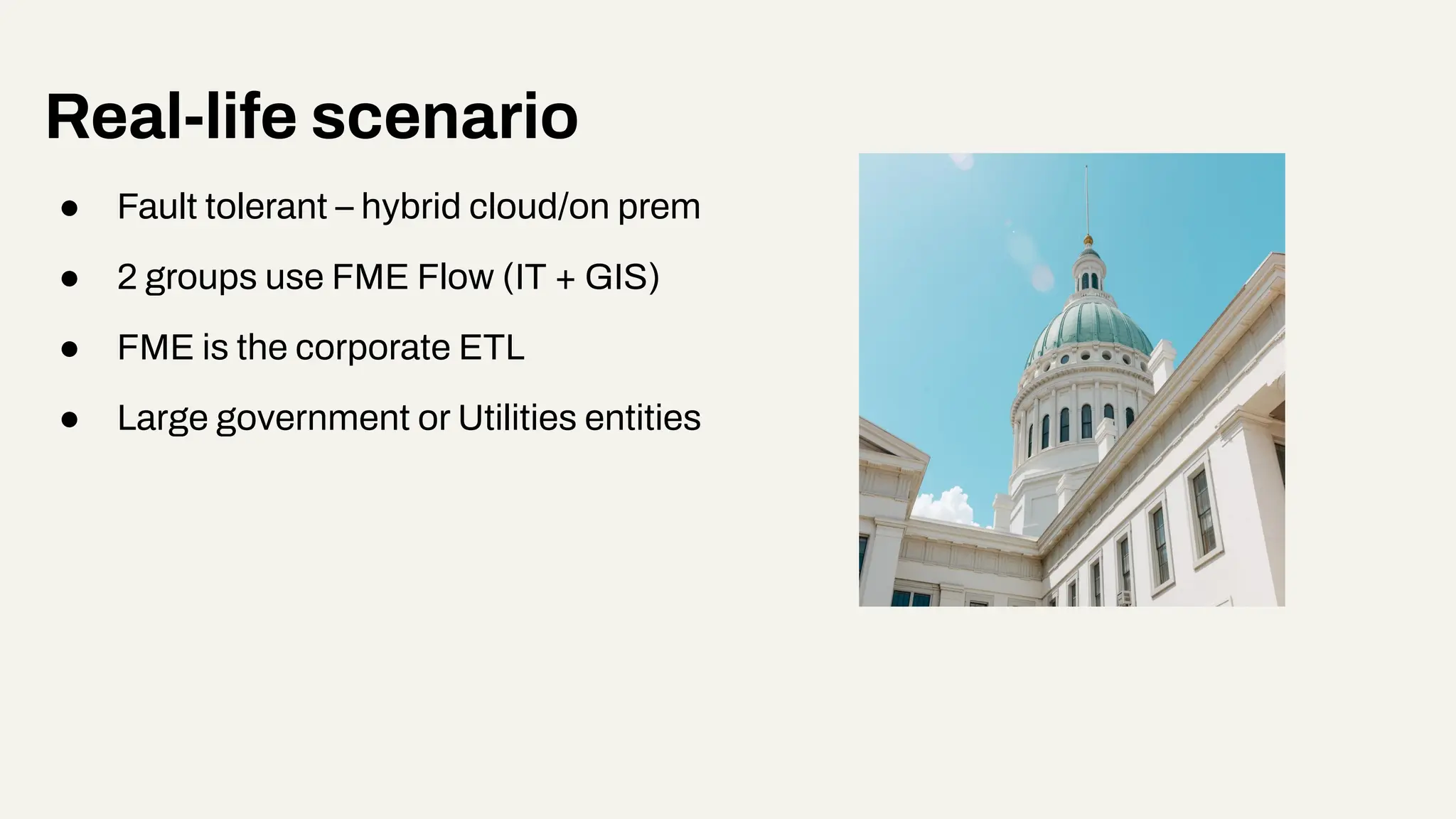
● Fault tolerant – hybrid cloud/on prem
● 2 groups use FME Flow (IT + GIS)
● FME is the corporate ETL
● Large government or Utilities entities
Conclusion
Quizz
2025
The
Peak
of
Data
and
AI
“Why use one engine when you can
deploy five… in three networks… and
regret it later.”
— ChatGPT 4o on a Tuesday PM
2025
The
Peak
of
Data
and
AI
ThankYou

Unlocking FME Flow’s Potential: Architecture Design for Modern Enterprises