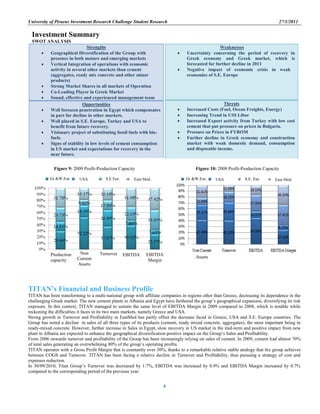
Figure 3: TITAN‟s Stock Prices and Volumes period 4/1/2010 – 27/1/2011
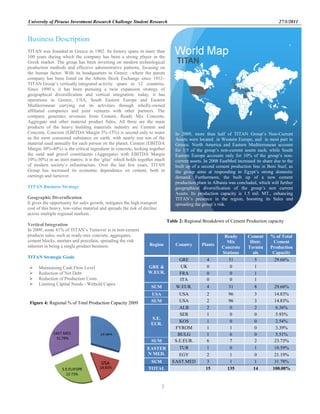
Figure 2: TITAN‟s Market Share in Greece
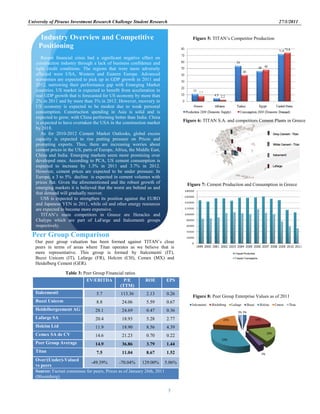
Table 1: Fundamental Data and Valuation Ratios
Highlights:
1. We recommend TITAN stock as a “Buy” on the grounds that current
domestic market conditions in Greece rendered it as an undervalued asset
by a percentage of 15% (as of 27/1/2011).
2. TITAN Group has been transformed to a truly Multinational Company
over the last years, expanding its activities to markets other than Greece.
Being present in both emerging and mature markets, it has offset negative
impacts in regions that have been affected adversely by recent financial
crisis, such as Greece, reducing its dependence on them.
3. EASTMED: it is the strongest growing region of the Group over the last
two years, offsetting, to a great extent, decline in other regions, driving the
group‟s profitability and representing the company‟s cash flow steam
engine. Prospects are extremely positive due to Egypt‟s strong domestic
demand that is hardly accommodated in full by domestic supply and the
new plant that became operational in 2009.
4. USA: construction market presents signs of stabilizing in historical low
levels anticipating that TITAN has passed through the worse. US economy
is expected to bounce up in the following two years, with construction
market following suit, once surpluses in housing market are reduced. In the
long term, extremely positive demographic trends enhance construction
market growth predictions.
5. S.E. EUROPE: TITAN has expanded its activities in Albania and Kosovo.
The start of production activity in 03/2010 of the newly built cement plant
in Albania has already affected positively the group‟s results. Positive
future economic prospects coupled with the need for fundamental
infrastructure in the region leave plenty of room for business growth in the
near future.
6. Cash Flow Generator: TITAN has been generating positive free cash
flows, even during the financially turbulent recent years.
7. Net Debt Exposure Reduction: TITAN has focused in reducing its Net
Debt exposure. Since 2008 year end a decrease of €241 mil. has been
achieved (30/09/2010 latest figures).
Still being a TITAN
University of Piraeus Student Research
This report is published for educational purposes only
by students competing in the
Hellenic CFA Society Investment Research Challenge
TITAN Cement S.A.
27th
of January 2011
TITAN Cement S.A.
January 2011
Company Stock Data
Reuters Code TTNr.AT
Bloomberg code TITK:GA
Market Cap 1344.75 as of
the 27th
of
January 2011
No Shares outstand. 84,576m
1m 6m 12m
Absolute
Performance
-1.42% -2.98% -22.54%
Relative
Performance
8.65% 4.95% 1.85%
Rating: Buy
Target Price: € 19.6
Current Price: € 15.9
ROE: 7.5%
Free float: 73%
Constructing
& Building Materials
Share Price Performance
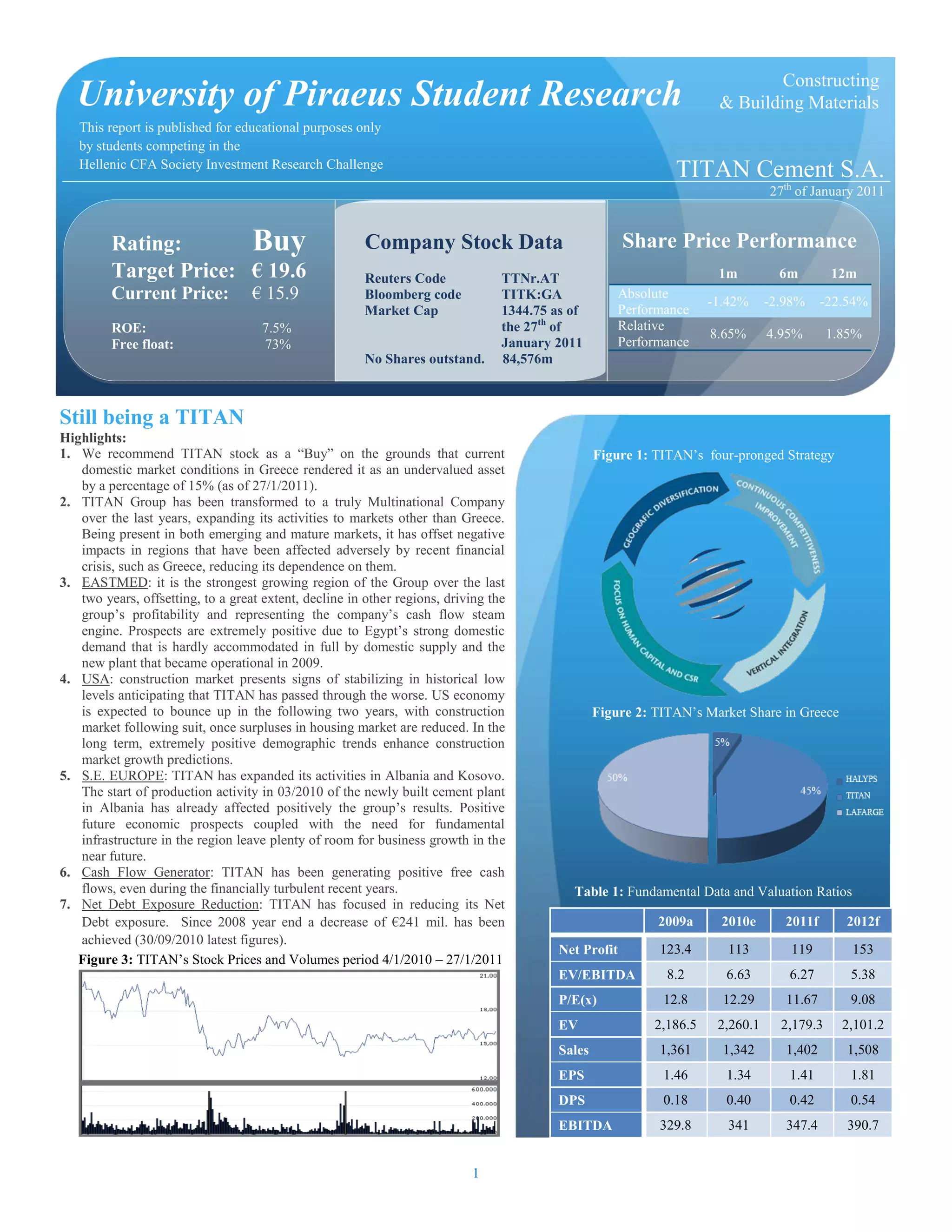
Figure 1: TITAN‟s four-pronged Strategy
2009a 2010e 2011f 2012f
Net Profit 123.4 113 119 153
EV/EBITDA 8.2 6.63 6.27 5.38
P/E(x) 12.8 12.29 11.67 9.08
EV 2,186.5 2,260.1 2,179.3 2,101.2
Sales 1,361 1,342 1,402 1,508
EPS 1.46 1.34 1.41 1.81
DPS 0.18 0.40 0.42 0.54
EBITDA 329.8 341 347.4 390.7
1
University of Piraeus Investment Research Challenge Student Research 27/1/2011
2
Business Description
TITAN was founded in Greece in 1902. Its history spans in more than
100 years during which the company has been a strong player in the
Greek market. The group has been investing on modern technological
production methods and effective administrative patterns, focusing on
the human factor. With its headquarters in Greece –where the parent
company has been listed on the Athens Stock Exchange since 1912–
TITAN Group‟s vertically integrated activity spans in 12 countries.
Since 1990‟s, it has been pursuing a twin expansion strategy of
geographical diversification and vertical integration; today, it has
operations in Greece, USA, South Eastern Europe and Eastern
Mediterranean carrying out its activities through wholly-owned
affiliated companies and joint ventures with other partners. The
company generates revenues from Cement, Ready Mix Concrete,
Aggregate and other material product Sales. All three are the main
products of the heavy building materials industry are Cement and
Concrete. Concrete (EBITDA Margin 5%-15%) is second only to water
as the most consumed substance on earth, with nearly one ton of the
material used annually for each person on the planet. Cement (EBITDA
Margin 30%-40%) is the critical ingredient in concrete, locking together
the sand and gravel constituents (Aggregates with EBITDA Margin
10%-30%) in an inert matrix; it is the „glue‟ which holds together much
of modern society‟s infrastructure. Over the last few years, TITAN
Group has increased its economic dependence on cement, both in
earnings and turnover.
TITAN Business Strategy
Geographic Diversification
It gives the opportunity for sales growth, mitigates the high transport
cost of this heavy, low-value material and spreads the risk of decline
across multiple regional markets.
Vertical Integration
In 2009, some 41% of TITAN‟s Turnover is in non-cement
products sales, such as ready-mix concrete, aggregates,
cement blocks, mortars and porcelain, spreading the risk
inherent in being a single product business.
TITAN Strategic Goals
 Maintaining Cash Flow Level
 Reduction of Net Debt
 Reduction of Production Costs
 Limiting Capital Needs - Withold Capex
Region Country Plants
Ready
Mix
Concrete
Stations
Cement
Distr.
Termin
als
% of Total
Cement
Production
Capacity
GRE &
W.EUR.
GRE 4 31 5 29.66%
UK 0 0 1
FRA 0 0 1
ITA 0 0 1
SUM W.EUR. 4 31 8 29.66%
USA USA 2 96 3 14.83%
SUM USA 2 96 3 14.83%
S.E.
EUR.
ALB 2 0 2 6.36%
SER 1 0 0 5.93%
KOS 1 0 0 2.54%
FYROM 1 1 0 3.39%
BULG 1 6 0 5.51%
SUM S.E.EUR. 6 7 2 23.73%
EASTER
N MED.
TUR 1 0 1 10.59%
EGY 2 1 0 21.19%
SUM EAST.MED 3 1 1 31.78%
TOTAL 15 135 14 100.00%
Figure 4: Regional % of Total Production Capacity 2009
Table 2: Regional Breakdown of Cement Production capacity
USA
In 2009, more than half of TITAN Group‟s Non-Current
Assets were located in Western Europe, and in most part in
Greece. North America and Eastern Mediterranean account
for 1/5 of the group‟s non-current assets each, while South
Eastern Europe accounts only for 10% of the group‟s non-
current assets. In 2008 EastMed increased its share due to the
built up of a second cement production line in Beni Suef, as
the group aims at responding to Egypt‟s strong domestic
demand. Furthermore, the built up of a new cement
production plant in Albania was concluded, which will further
geographical diversification of the group‟s non current
Assets. Its production capacity is 1.5 mil. MT., enhancing
TITAN‟s presence in the region, boosting its Sales and
spreading the group‟s risk.
In 2009, more than half of TITAN Group‟s Non-Current
Assets were located in Western Europe, and in most part in
Greece. North America and Eastern Mediterranean account
for 1/5 of the group‟s non-current assets each, while South
Eastern Europe accounts only for 10% of the group‟s non-
current assets. In 2008 we note a significant increase in
Eastern Mediterranean‟s share due to the built up of a second
cement production line in Beni Suef, as the group aims at
responding to Egypt‟s strong domestic demand. Furthermore,
the built up of a new cement production plant in Albania was
concluded, which will rise the share of South Eastern Europe
in the group‟s non current Assets. Its production capacity is
1.5 mil. MT., enhancing TITAN‟s presence in the region and
boosting its Sales.
2
University of Piraeus Investment Research Challenge Student Research 27/1/2011
3
Industry Overview and Competitive
Positioning
Recent financial crisis had a significant negative effect on
construction industry through a lack of business confidence and
tight credit conditions. The regions that were more adversely
affected were USA, Western and Eastern Europe. Advanced
economies are expected to pick up in GDP growth in 2011 and
2012, narrowing their performance gap with Emerging Market
countries. US market is expected to benefit from acceleration in
real GDP growth that is forecasted for US economy by more than
2% in 2011 and by more than 3% in 2012. However, recovery in
US economy is expected to be modest due to weak personal
consumption. Construction spending in Asia is solid and is
expected to grow, with China performing better than India. China
is expected to have overtaken the USA in the construction market
by 2018.
As for 2010-2012 Cement Market Outlooks, global excess
capacity is expected to rise putting pressure on Prices and
prompting exports. Thus, there are increasing worries about
cement prices in the US, parts of Europe, Africa, the Middle East,
China and India. Emerging markets seem more promising over
developed ones. According to PCA, US cement consumption is
expected to increase by 1.3% in 2011 and 3.7% in 2012.
However, cement prices are expected to be under pressure. In
Europe, a 3 to 5% decline is expected in cement volumes with
prices flat. Given the aforementioned and the robust growth of
emerging markets it is believed that the worst are behind us and
that demand will gradually recover.
US$ is expected to strengthen its position against the EURO
and Japanese YEN in 2011, while oil and other energy resources
are expected to become more expensive.
TITAN‟s main competitors in Greece are Heracles and
Chalyps which are part of LaFarge and Italcementi groups
respectively.
Our peer group valuation has been formed against TITAN‟s close
peers in terms of areas where Titan operates as we believe that is
more representative. This group is formed by Italcementi (IT),
Buzzi Unicem (IT), Lafarge (FR), Holcim (CH), Cemex (MX) and
Heidelberg Cement (GER).
EV/EBITDA P/E
(TTM)
ROE EPS
Italcementi 5.7 113.36 2.13 0.26
Buzzi Unicem 8.8 24.06 5.59 0.67
Heidelbergcement AG 28.1 24.69 0.47 0.36
Lafarge SA 20.4 18.93 5.28 2.77
Holcim Ltd 11.9 18.90 8.56 4.39
Cemex SA de CV 14.6 21.23 0.70 0.22
Peer Group Average 14.9 36.86 3.79 1.44
Titan 7.5 11.04 8.67 1.52
Over/(Under)-Valued
vs peers
-49.39% -70.04% 129.00% 5.06%
Source: Factset consensus for peers, Prices as of January 26th, 2011
(Bloomberg)
Figure 5: TITAN‟s Competitor Production plants in Greece
Figure 5
Figure 8: Peer Group Enterprise Values as of 2011
Table 3: Peer Group Financial ratios
Peer Group Comparison
Figure 6: TITAN S.A. and competitors Cement Plants in Greece
plants in Greece
Figure 7: Cement Production and Consumption in Greece
plants in Greece
3
University of Piraeus Investment Research Challenge Student Research 27/1/2011
4
TITAN’s Financial and Business Profile
TITAN has been transforming to a multi-national group with affiliate companies in regions other than Greece, decreasing its dependence in the
challenging Greek market. The new cement plants in Albania and Egypt have furthered the group‟s geographical expansion, diversifying its risk
exposure. In this context, TITAN managed to sustain the same level of EBITDA Margin in 2009 compared to 2008, which is notable while
reckoning the difficulties it faces in its two main markets, namely Greece and USA.
Strong growth in Turnover and Profitability in EastMed has partly offset the decrease faced in Greece, USA and S.E. Europe countries. The
Group has noted a decline in sales of all three types of its products (cement, ready mixed concrete, aggregates), the most important being in
ready-mixed concrete. However, further increase in Sales in Egypt, slow recovery in US market in the mid-term and positive impact from new
plant in Albania are expected to enhance the geographical diversification positive impact on the Group‟s Sales and Profitability.
From 2006 onwards turnover and profitability of the Group has been increasingly relying on sales of cement. In 2009, cement had almost 70%
of total sales generating an overwhelming 80% of the group‟s operating profits.
TITAN operates with a Gross Profit Margin that is constantly over 30%, thanks to a remarkable relative stable analogy that the group achieves
between COGS and Turnover. TITAN has been facing a relative decline in Turnover and Profitability, thus pursuing a strategy of cost and
expenses reduction.
In 30/09/2010, Titan Group‟s Turnover was decreased by 1.7%, EBITDA was increased by 0.9% and EBITDA Margin increased by 0.7%
compared to the corresponding period of the previous year.
Investment Summary
SWOT ANALYSIS
Strengths
 Geographical Diversification of the Group with
presence in both mature and emerging markets
 Vertical Integration of operations with economic
activity in several other markets than cement
(aggregates, ready mix concrete and other minor
products)
 Strong Market Shares in all markets of Operation
 Co-Leading Player in Greek Market
 Sound, effective and experienced management team
Opportunities
 Well foreseen penetration in Egypt which compensates
in part for decline in other markets.
 Well placed in S.E. Europe, Turkey and USA to
benefit from future recovery.
 Visionary project of substituting fossil fuels with bio-
fuels.
 Signs of stability in low levels of cement consumption
in US market and expectations for recovery in the
near future.
Figure 9: 2009 Profit-Production Capacity Figure 10: 2008 Profit-Production Capacity
AssetsProduction
capacity
Non
Current
Assets
Turnover EBITDA EBITDA
Margin
Greece GreeceUSA USAS.E Eur.
Eur.Euro
pe
S.E. Eur. East Med.East Med.
Weaknesses
 Uncertainty concerning the period of recovery in
Greek economy and Greek market, which is
forecasted for further decline in 2011
 Negative impact of economic crisis in weak
economies of S.E. Europe
Threats
 Increased Costs (Fuel, Ocean Freights, Energy)
 Increasing Trend in US$ Libor
 Increased Export activity from Turkey with low cost
cement that put pressure on prices in Bulgaria.
 Pressure on Prices in FYROM
 Further decline in Greek economy and construction
market with weak domestic demand, consumption
and disposable income.
Gr &W.Eur.Gr &W.Eur.
University of Piraeus Investment Research Challenge Student Research 27/1/2011
5
Table 5: Debt Structure
2009 % 2008 % 2007 % 2006 %
Short Term
Loans
261,835 26.51% 263,145 21.78% 146,405 19.89% 139,045 29.90%
Long Term
Loans
725,665 73.49% 945,193 78.22% 589,833 80.11% 326,040 70.10%
Total Loans 987,500 100.00% 1,208,338 100.00% 736,238 100.00% 465,085 100.00%
Table 6: Debt Maturity (excluding leasing)
Table 4: Net Debt / EBITDA
2010
Q3
2010
Q2
2010
Q1
2009 2008 2007 2006
Net Debt /
EBITDA
2.94 2.93 1.33 0.68
Net Debt
(mil. €)
873 917 988 971 1,114 569 327
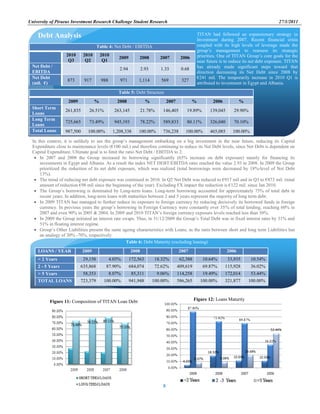
Debt Analysis
In this context, it is unlikely to see the group‟s management embarking on a big investment in the near future, reducing its Capital
Expenditure close to maintenance levels (€100 mil.) and therefore continuing to reduce its Net Debt levels, since Net Debt is dependent on
Capital Expenditure. Ultimate goal is to limit the ratio Net Debt / EBITDA to 2.
 In 2007 and 2008 the Group increased its borrowing significantly (65% increase on debt exposure) mainly for financing its
investments in Egypt and Albania. As a result the index NET DEBT/EBITDA ratio reached the value 2.93 in 2008. In 2009 the Group
prioritized the reduction of its net debt exposure, which was realized (total borrowings were decreased by 18%-level of Net Debt
13%).
 The trend of reducing net debt exposure was continued in 2010. In Q2 Net Debt was reduced to €917 mil and in Q3 to €873 mil. (total
amount of reduction €98 mil since the beginning of the year). Excluding FX impact the reduction is €122 mil. since Jan 2010.
 The Group‟s borrowing is dominated by Long-term loans. Long-term borrowing accounted for approximately 75% of total debt in
recent years. In addition, long-term loans with maturities between 2 and 5 years represent the majority of long term debt.
 In 2009 TITAN has managed to further reduce its exposure to foreign currency by reducing decisively its borrowed funds in foreign
currency. In previous years the group‟s borrowing in Foreign Currency were constantly over 35% of total lending, reaching 60% in
2007 and even 90% in 2005 & 2004. In 2009 and 2010 TITAN‟s foreign currency exposure levels reached less than 30%.
 In 2009 the Group initiated an interest rate swaps. Thus, in 31/12/2009 the Group‟s Total Debt was in fixed interest rates by 31% and
51% in floating interest regime.
 Group‟s Other Liabilities present the same ageing characteristics with Loans, as the ratio between short and long term Liabilities has
an analogy of 30% -70%, respectively.
LOANS / YEAR 2009 2008 2007 2006
< 2 Years 29,158 4.03% 172,563 18.32% 62,388 10.64% 33,935 10.54%
2 - 5 Years 635,868 87.90% 684,074 72.62% 409,619 69.87% 115,928 36.02%
> 5 Years 58,353 8.07% 85,311 9.06% 114,258 19.49% 172,014 53.44%
TOTAL LOANS 723,379 100.00% 941,948 100.00% 586,265 100.00% 321,877 100.00%
TITAN had followed an expansionary strategy in
Investment during 2007. Recent financial crisis
coupled with its high levels of leverage made the
group‟s management to reassess its strategic
priorities. One of TITAN Group‟s core goals for the
near future is to reduce its net debt exposure. TITAN
has already made significant steps toward that
direction decreasing its Net Debt since 2008 by
€241 mil. The temporarily increase in 2010 Q1 is
attributed to investment in Egypt and Albania.
Figure 11: Composition of TITAN Loan Debt Figure 12: Loans Maturity
University of Piraeus Investment Research Challenge Student Research 27/1/2011
6
WACC 9,0%
PV of Cash Flows 1,168.250
Residual Value 1,388.655
Firm Value 2,556.905
Less: Net Debt end 2010E 876.472
Less: Minority rights 20,830
Equity Value 1,659.603
Number of shares (in million) 84,576
Per share Year End 2011 19.6
Assumptions for Constant Growth Period
13 - '20
Expected growth in EBIT 4.0%
Return on capital 14.6%
Reinvestment rate 27.4%
(In mill except
stock price and
ratio)
Explicit
Estimates
Terminal
Value
2011 2012 2013 2014 2015 2016 2017 2018 2019 2020
Risk Free rate 6.5% 6.5% 6.5% 6.5% 6.5% 6.5% 6.5% 6.5% 6.5% 6.5%
Risk premium 3.5% 3.5% 3.5% 3.5% 3.5% 3.5% 3.5% 3.5% 3.5% 3.5%
Market return 10.1% 10.1% 10.1% 10.1% 10.1% 10.1% 10.1% 10.1% 10.1% 10.1%
Beta 0.97 0.97 0.97 0.97 0.97 0.97 0.97 0.97 0.97 0.97
Rate on Debt 7.4% 7.4% 7.4% 7.4% 7.4% 7.4% 7.4% 7.4% 7.4% 7.4%
Debt/(Debt+Market
Value)
38.0% 38.0% 38.0% 38.0% 38.0% 38.0% 38.0% 38.0% 38.0% 38.0%
Ke=Rf+B(Rm-Rf) 10.0% 10.0% 10.0% 10.0% 10.0% 10,0% 10,0% 10,0% 10.0% 10.0%
WACC= 9.0% 9.0% 9.0% 9.0% 9.0% 9.0% 9.0% 9.0% 9.0% 9.0%
Discounting Factor 0.92 0.84 0.77 0.71 0.65 0.60 0.55 0.50 0.46 0.42
EBIT 225.301 267.994 278.714 289.862 301.457 313.515 326.056 339.098 352.662 366.768 381.439
Less: Tax 39.026 50.179 63.937 66.494 69.154 71.920 74.797 77.789 80.901 84.137 87.502
After tax EBIT 186.275 217.815 214.777 223.368 232.303 241.595 251.258 261.309 271.761 282.632 293.937
Less: Working
Capital additions
12.772 43.584 45.327 47.140 49.026 50.987 53.027 55.148 57.354 59.648 0.000
Plus: depreciation 122.100 122.711 127.619 132.724 138.033 143.554 149.296 155.268 161.479 167.938 0.000
Less: Cap ex 105.280 95.320 85.190 88.598 92.142 95.827 99.660 103.647 107.793 112.104 0.000
Free Cash Flow 190.323 201.621 155.979 162.218 168.707 175.455 182.473 189.772 197.363 205.258 293.937
Discounted Free
Cash Flows
174.660 169.801 120.551 115.056 109.810 104.804 100.026 95.466 91.114 86.960
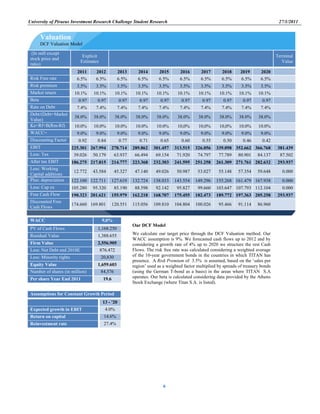
We calculate our target price through the DCF Valuation method. Our
WACC assumption is 9%. We forecasted cash flows up to 2012 and by
considering a growth rate of 4% up to 2020 we structure the rest Cash
Flows. The risk free rate was calculated considering a weighted average
of the 10-year government bonds in the countries in which TITAN has
presence. A Risk Premium of 3.5% is assumed, based on the „sales per
region‟ used as a weighted factor multiplied by spreads of treasury bonds
(using the German T-bond as a basis) in the areas where TITAN S.A
operates. Our beta is calculated considering data provided by the Athens
Stock Exchange (where Titan S.A. is listed).
Our DCF Model
Valuation
DCF Valuation Model
University of Piraeus Investment Research Challenge Student Research 27/1/2011
7
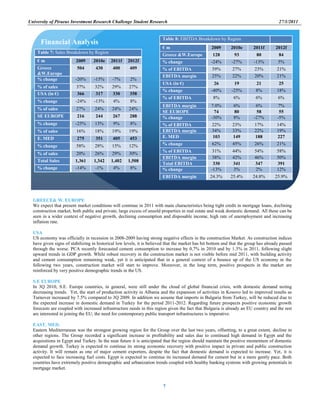
Table 7: Sales Breakdown by Region
€ m 2009 2010e 2011f 2012f
Greece
&W.Europe
504 430 400 409
% change -20% -15% -7% 2%
% of sales 37% 32% 29% 27%
USA (in €) 366 317 330 358
% change -24% -13% 4% 8%
% of sales 27% 24% 24% 24%
SE EUROPE 216 244 267 288
% change -25% 13% 9% 8%
% of sales 16% 18% 19% 19%
E. MED 275 351 405 453
% change 58% 28% 15% 12%
% of sales 20% 26% 29% 30%
Total Sales 1,361 1,342 1,402 1,508
% change -14% -1% 4% 8%
Titan 6.63 11.042 8.674 1.517
Over/(Under)-Valued vs peers -25.14% -70.04% 129.00% 5.06%
Source: Factset consensus for peers, Prices as at January 20, 2011
Table 8: EBITDA Breakdown by Region
€ m 2009 2010e 2011f 2012f
Greece &W.Europe 128 93 80 84
% change -24% -27% -13% 5%
% of EBITDA 39% 27% 23% 21%
EBITDA margin 25% 22% 20% 21%
USA (in €) 26 19 21 25
% change -40% -25% 8% 18%
% of EBITDA 8% 6% 6% 6%
EBITDA margin 7.0% 6% 6% 7%
SE EUROPE 74 80 58 55
% change -30% 8% -27% -5%
% of EBITDA 22% 23% 17% 14%
EBITDA margin 34% 33% 22% 19%
E. MED 103 149 188 227
% change 62% 45% 26% 21%
% of EBITDA 31% 44% 54% 58%
EBITDA margin 38% 42% 46% 50%
Total EBITDA 330 341 347 391
% change -13% 3% 2% 12%
EBITDA margin 24.3% 25.4% 24.8% 25.9%
Financial Analysis
GREECE& W. EUROPE
We expect that present market conditions will continue in 2011 with main characteristics being tight credit in mortgage loans, declining
construction market, both public and private, large excess of unsold properties in real estate and weak domestic demand. All these can be
seen in a wider context of negative growth, declining consumption and disposable income, high rate of unemployment and increasing
inflation rate.
USA
US economy was officially in recession in 2008-2009 having strong negative effects in the construction Market. As construction indices
have given signs of stabilizing in historical low levels, it is believed that the market has hit bottom and that the group has already passed
through the worse. PCA recently forecasted cement consumption to increase by 0,7% in 2010 and by 1.3% in 2011, following slight
upward trends in GDP growth. While robust recovery in the construction market is not visible before mid 2011, with building activity
and cement consumption remaining weak, yet it is anticipated that in a general context of a bounce up of the US economy in the
following two years, construction market will start to improve. Moreover, in the long term, positive prospects in the market are
reinforced by very positive demographic trends in the US.
S.E EUROPE
In 3Q 2010, S.E. Europe countries, in general, were still under the cloud of global financial crisis, with domestic demand noting
decreasing trends. Yet, the start of production activity in Albania and the expansion of activities in Kosovo led to improved results as
Turnover increased by 7.5% compared to 3Q 2009. In addition we assume that imports in Bulgaria from Turkey, will be reduced due to
the expected increase in domestic demand in Turkey for the period 2011-2012. Regarding future prospects positive economic growth
forecasts are coupled with increased infrastructure needs in this region given the fact that Bulgaria is already an EU country and the rest
are interested in joining the EU; the need for contemporary public transport infrastructures is imperative.
EAST. MED.
Eastern Mediterranean was the strongest growing region for the Group over the last two years, offsetting, to a great extent, decline in
other regions. The Group recorded a significant increase in profitability and sales due to continued high demand in Egypt and the
acquisitions in Egypt and Turkey. In the near future it is anticipated that the region should maintain the positive momentum of domestic
demand growth. Turkey is expected to continue its strong economic recovery with positive impact in private and public construction
activity. It will remain as one of major cement exporters, despite the fact that domestic demand is expected to increase. Yet, it is
expected to face increasing fuel costs. Egypt is expected to continue its increased demand for cement but in a more gently pace. Both
countries have extremely positive demographic and urbanization trends coupled with healthy banking systems with growing potentials in
mortgage market.
University of Piraeus Investment Research Challenge Student Research 27/1/2011
8
Table 9: Balance Sheet 2009 2010E 2011F 2012F
Net fixed assets 1,915 1,916 1,919 1,942
Current Assets 510 548 573 637
Cash & cash equivalent 16 55 58 62
TOTAL ASSETS 3,006 3,045 3,073 3,160
Net debt position 970 876 791 713
Shareholders' equity 1,449 1,576 1,661 1,779
Non Current liabilities 1,019 1,079 995 910
Long-term Debt 726 792 708 623
Current liabilities 527 364 378 416
Liabilities to banks 262 139 142 153
TOTAL EQUITY & LIABILITIES 3,006 3,045 3,073 3,160
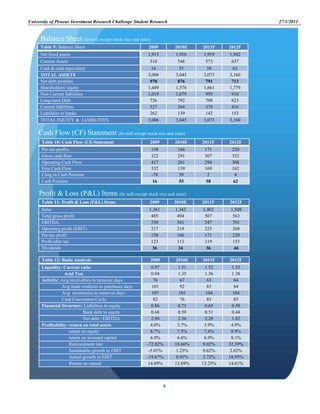
Balance Sheet (In mill except stock rice and ratio)
Table 10: Cash Flow (Cf) Statement 2009 2010E 2011F 2012F
Pre-tax profits 158 166 171 220
Gross cash flow 322 291 307 352
Operating Cash Flow 417 261 294 308
Free Cash Flow 332 139 169 162
Chng in Cash Position -78 39 2 4
Cash Position 16 55 58 62
Cash Flow (CF) Statement (In mill except stock rice and ratio)
Table 11: Profit & Loss (P&L) Items 2009 2010E 2011F 2012F
Sales 1,361 1,342 1,402 1,508
Total gross profit 485 494 507 563
EBITDA 330 341 347 391
Operating profit (EBIT) 217 219 225 268
Pre-tax profit 158 166 171 220
Profit after tax 123 113 119 153
Dividends 36 34 36 46
Profit & Loss (P&L) Items (In mill except stock rice and ratio)
Table 12: Ratio Analysis 2009 2010E 2011F 2012F
Liquidity: Current ratio 0.97 1.51 1.52 1.53
Acid Test 0.94 1.35 1.36 1.38
Activity: Avg receivables to turnover days 76 67 63 64
Avg trade creditors to purchases days 101 92 83 84
Avg inventories to turnover days 107 101 104 104
Cash Conversion Cycle 82 76 83 85
Financial Structure: Liabilities to equity 0.86 0.73 0.65 0.58
Bank debt to equity 0.68 0.59 0.51 0.44
Net debt / EBITDA 2.94 2.56 2.28 1.82
Profitability: return on total assets 4.0% 3.7% 3.9% 4.9%
return on equity 8.7% 7.5% 7.4% 8.9%
return on invested capital 6.9% 6.6% 6.9% 8.1%
Reinvestment rate -72.82% 18.66% 9.02% 32.39%
Sustainable growth in EBIT -5.01% 1.23% 0.62% 2.62%
Actual growth in EBIT -19.67% 0.91% 2.72% 18.95%
Return on capital 14.89% 13.69% 13.25% 14.61%
University of Piraeus Investment Research Challenge Student Research 27/1/2011
9
Risk Assessment
WACC
19,6 -1,0% -0,5% 0,0% 0,5% 1,0% 1,5% 2,0% 2,5% 3,0% 3,5% 4,0% 4,5% 5,0% 5,5%
7,0% 22,8 23,4 24,0 24,7 25,3 26,0 26,7 27,4 28,2 28,9 29,7 30,6 31,4 32,3
7,5% 20,7 21,2 21,7 22,3 22,8 23,4 24,0 24,7 25,3 26,0 26,6 27,3 28,1 28,8
8,0% 18,8 19,2 19,7 20,2 20,7 21,2 21,7 22,2 22,8 23,4 23,9 24,5 25,2 25,8
8,5% 17,1 17,5 17,9 18,3 18,7 19,2 19,6 20,1 20,6 21,1 21,6 22,1 22,6 23,2
9,0% 15,6 15,9 16,3 16,7 17,0 17,4 17,8 18,2 18,6 19,1 19,5 19,9 20,4 20,9
9,5% 14,3 14,6 14,9 15,2 15,5 15,8 16,2 16,5 16,9 17,3 17,6 18,0 18,4 18,9
10,0% 13,1 13,3 13,6 13,9 14,1 14,4 14,7 15,0 15,3 15,7 16,0 16,3 16,7 17,0
10,5% 12,0 12,2 12,4 12,7 12,9 13,2 13,4 13,7 13,9 14,2 14,5 14,8 15,1 15,4
11,0% 11,0 11,2 11,4 11,6 11,8 12,0 12,2 12,5 12,7 12,9 13,2 13,4 13,7 13,9
11,5% 10,1 10,2 10,4 10,6 10,8 11,0 11,1 11,3 11,5 11,7 11,9 12,2 12,4 12,6
12,0% 9,2 9,4 9,5 9,7 9,8 10,0 10,2 10,3 10,5 10,7 10,8 11,0 11,2 11,4
12,5% 8,4 8,6 8,7 8,8 9,0 9,1 9,3 9,4 9,5 9,7 9,8 10,0 10,1 10,3
13,0% 7,7 7,8 8,0 8,1 8,2 8,3 8,4 8,5 8,7 8,8 8,9 9,0 9,2 9,3
13,5% 7,1 7,2 7,3 7,4 7,5 7,6 7,7 7,8 7,9 8,0 8,1 8,2 8,3 8,4
14,0% 6,5 6,5 6,6 6,7 6,8 6,9 6,9 7,0 7,1 7,2 7,3 7,4 7,4 7,5
14,5% 5,9 6,0 6,0 6,1 6,2 6,2 6,3 6,4 6,4 6,5 6,6 6,6 6,7 6,8
15,0% 5,3 5,4 5,5 5,5 5,6 5,6 5,7 5,7 5,8 5,8 5,9 5,9 6,0 6,0
Expected growth in EBIT
Risk
Risk Assessment
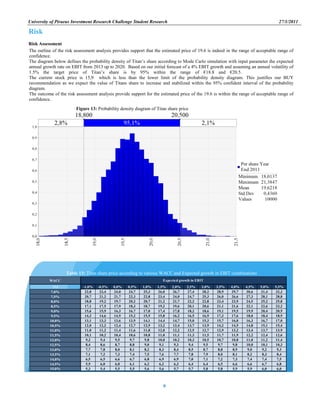
Figure 13: Probability density diagram of Titan share price
The outline of the risk assessment analysis provides support that the estimated price of 19.6 is indeed in the range of acceptable range of
confidence.
The diagram below defines the probability density of Titan‟s share according to Mode Carlo simulation with input parameter the expected
annual growth rate on EBIT from 2013 up to 2020. Based on our initial forecast of a 4% EBIT growth and assuming an annual volatility of
1.5% the target price of Titan‟s share is by 95% within the range of €18.8 and €20.5. …………………………
The current stock price is 15,9 which is less than the lower limit of the probability density diagram. This justifies our BUY
recommendation as we expect the value of Titans share to increase and stabilized within the 95% confident interval of the probability
diagram.
The outcome of the risk assessment analysis provide support for the estimated price of the 19.6 is within the range of acceptable range of
confidence.
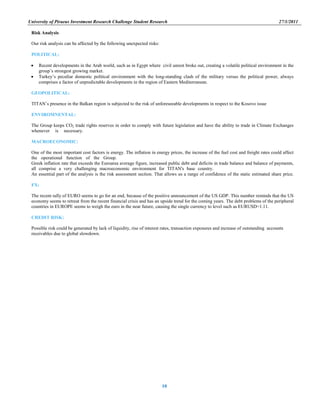
Table 13: Titan share price according to various WACC and Expected growth in EBIT combinations
University of Piraeus Investment Research Challenge Student Research 27/1/2011
10
Risk Analysis
Our risk analysis can be affected by the following unexpected risks:
POLITICAL:
 Recent developments in the Arab world, such as in Egypt where civil unrest broke out, creating a volatile political environment in the
group‟s strongest growing market.
 Turkey‟s peculiar domestic political environment with the long-standing clash of the military versus the political power, always
comprises a factor of unpredictable developments in the region of Eastern Mediterranean.
GEOPOLITICAL:
TITAN‟s presence in the Balkan region is subjected to the risk of unforeseeable developments in respect to the Kosovo issue
ENVIROMNENTAL:
The Group keeps CO2 trade rights reserves in order to comply with future legislation and have the ability to trade in Climate Exchanges
whenever is necessary. …………………………………………………………………………………………………………………..
MACROECONOMIC:
One of the most important cost factors is energy. The inflation in energy prices, the increase of the fuel cost and freight rates could affect
the operational function of the Group. Mm mmmmmmmmmmmmmmmmmmmmmmmmmmmmmmmmmmmmmmmmmmmm
Greek inflation rate that exceeds the Euroarea average figure, increased public debt and deficits in trade balance and balance of payments,
all comprise a very challenging macroeconomic environment for TITAN's base country.……………………………………………
An essential part of the analysis is the risk assessment section. That allows us a range of confidence of the static estimated share price.
FX:
The recent rally of EURO seems to go for an end, because of the positive announcement of the US GDP. This number reminds that the US
economy seems to retreat from the recent financial crisis and has an upside trend for the coming years. The debt problems of the peripheral
countries in EUROPE seems to weigh the euro in the near future, causing the single currency to level such as EURUSD=1.11.
CREDIT RISK:
Possible risk could be generated by lack of liquidity, rise of interest rates, transaction exposures and increase of outstanding accounts
receivables due to global slowdown.
University of Piraeus Investment Research Challenge Student Research 27/1/2011
11
BALANCE SHEET 2009 2010E 2011F 2012F
Tangible assets 2,664 2,786 2,911 3,057
Accumulated depreciation 749 870 992 1,115
Net fixed assets 1,915 1,916 1,919 1,942
Intangible assets 543 549 549 549
LT receivables/deferred tax assets 37 32 32 32
Current Assets 510 548 573 637
Accounts receivable 254 235 245 285
Inventories 239 256 268 288
Cash & cash equivalent 16 55 58 62
Other cash equivalents (for balancing) 0 0 0 0
Trading and other investments 1 1 1 1
TOTAL ASSETS 3,006 3,045 3,073 3,160
Net debt position 970 871 791 713
Shareholders' equity 1,449 1,576 1,661 1,779
Capital 275 278 278 278
Reserves & retained earnings 1,174 1,298 1,383 1,501
Minority interest on share capital 11 26 39 56
Non Current liabilities 1,019 1,079 995 910
Long-term Debt 726 792 708 623
Deferred tax liabilties 197 182 182 182
Retirement and termination benefit
obligations
42 40 40 40
Provisions / other LT liabilties 54 65 65 65
Current liabilities 527 364 378 416
Accounts payable 243 206 215 231
Liabilities for taxes 20 14 12 23
Liabilities to banks 262 139 142 153
Other short-term liabilities 3 5 8 8
TOTAL EQUITY & LIABILITIES 3,006 3,045 3,073 3,160
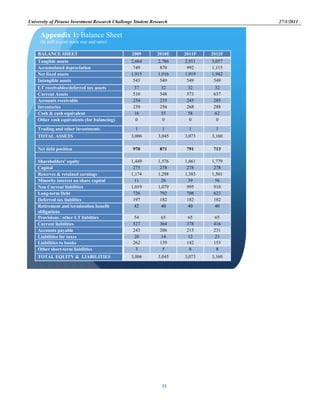
Appendix 1: Balance Sheet
(In mill except stock rice and ratio)
University of Piraeus Investment Research Challenge Student Research 27/1/2011
12
Table 13
2009 2010E 2011F 2012F
PRE-TAX PROFITS 158 166 171 220
Plus: Depreciation & amortization 112 121 122 123
Plus: Non-cash items -8 -14 0 0
Plus: Net interest expenses 60 54 55 48
Less: Taxation paid 0 36 41 39
GROSS CASH FLOW 322 291 307 352
Plus: Chng in accounts payable -12 -37 9 16
Plus: Chng in other current
liabilities
-1 5 0 0
Less: Chng in accounts receivable -59 -19 11 40
Less: Chng in inventories -49 18 11 20
Working capital chng -95 30 13 44
Working capital 247 278 290 334
% of sales 18.2% 20.7% 20.7% 22.2%
OPERATING CASH FLOW 417 261 294 308
Less: Purchases of fixed assets 85 122 125 146
Less: Chng in investments 0 0 0 0
% of sales (cap ex only) 6.3% 9.1% 8.9% 9.7%
FREE CASH FLOW 332 139 169 162
Less: Dividends paid 63 36 34 36
Less: Interest expenses 60 66 69 62
Plus: Interest received 9 20 21 22
Plus: Equity chng 0 0 0 0
Plus: Debt chng -221 -59 -78 -74
Plus: Grants 0 0 -2 0
Plus: Other -75 41 -5 -9
Chng in Cash Position -78 39 2 4
Cash Position 16 55 58 62
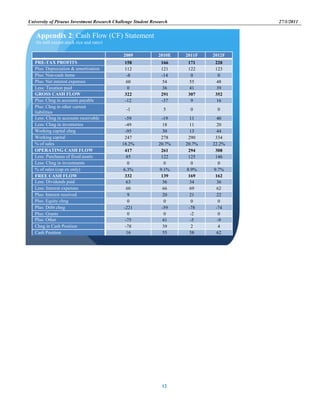
Appendix 2: Cash Flow (CF) Statement
(In mill except stock rice and ratio)
University of Piraeus Investment Research Challenge Student Research 27/1/2011
13
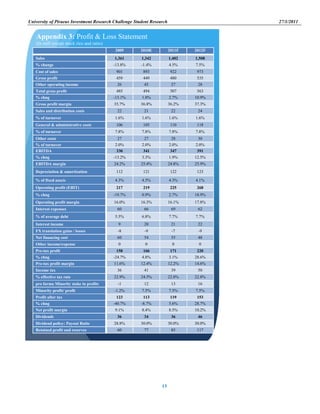
Appendix 3: Profit & Loss Statement
(In mill except stock rice and ratio)
2009 2010E 2011F 2012F
Sales 1,361 1,342 1,402 1,508
% change -13.8% -1.4% 4.5% 7.5%
Cost of sales 901 893 922 973
Gross profit 459 449 480 535
Other operating income 26 45 27 28
Total gross profit 485 494 507 563
% chng -13.1% 1.8% 2.7% 10.9%
Gross profit margin 35.7% 36.8% 36.2% 37.3%
Sales and distribution costs 22 21 22 24
% of turnover 1.6% 1.6% 1.6% 1.6%
General & administrative costs 106 105 110 118
% of turnover 7.8% 7.8% 7.8% 7.8%
Other costs 27 27 28 30
% of turnover 2.0% 2.0% 2.0% 2.0%
EBITDA 330 341 347 391
% chng -13.2% 3.3% 1.9% 12.5%
EBITDA margin 24.2% 25.4% 24.8% 25.9%
Depreciation & amortization 112 121 122 123
% of fixed assets 4.3% 4.5% 4.3% 4.1%
Operating profit (EBIT) 217 219 225 268
% chng -19.7% 0.9% 2.7% 18.9%
Operating profit margin 16.0% 16.3% 16.1% 17.8%
Interest expenses 60 66 69 62
% of average debt 5.5% 6.8% 7.7% 7.7%
Interest income 9 20 21 22
FX translation gains / losses -8 -9 -7 -9
Net financing cost 60 54 55 48
Other income/expense 0 0 0 0
Pre-tax profit 158 166 171 220
% chng -24.7% 4.8% 3.1% 28.6%
Pre-tax profit margin 11.6% 12.4% 12.2% 14.6%
Income tax 36 41 39 50
% effective tax rate 22.9% 24.5% 22.8% 22.8%
pro forma Minority stake in profits -1 12 13 16
Minority profit/ profit -1.2% 7.5% 7.5% 7.5%
Profit after tax 123 113 119 153
% chng -40.7% -8.7% 5.6% 28.7%
Net profit margin 9.1% 8.4% 8.5% 10.2%
Dividends 36 34 36 46
Dividend policy: Payout Ratio 28.8% 30.0% 30.0% 30.0%
Retained profit and reserves 60 77 85 117
University of Piraeus Investment Research Challenge Student Research 27/1/2011
14
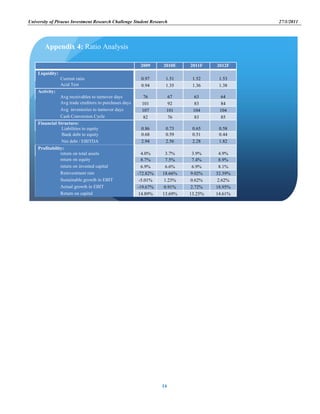
2009 2010E 2011F 2012F
Liquidity:
Current ratio 0.97 1.51 1.52 1.53
Acid Test 0.94 1.35 1.36 1.38
Activity:
Avg receivables to turnover days 76 67 63 64
Avg trade creditors to purchases days 101 92 83 84
Avg inventories to turnover days 107 101 104 104
Cash Conversion Cycle 82 76 83 85
Financial Structure:
Liabilities to equity 0.86 0.73 0.65 0.58
Bank debt to equity 0.68 0.59 0.51 0.44
Net debt / EBITDA 2.94 2.56 2.28 1.82
Profitability:
return on total assets 4.0% 3.7% 3.9% 4.9%
return on equity 8.7% 7.5% 7.4% 8.9%
return on invested capital 6.9% 6.6% 6.9% 8.1%
Reinvestment rate -72.82% 18.66% 9.02% 32.39%
Sustainable growth in EBIT -5.01% 1.23% 0.62% 2.62%
Actual growth in EBIT -19.67% 0.91% 2.72% 18.95%
Return on capital 14.89% 13.69% 13.25% 14.61%
HELP ROWS
Appendix 4: Ratio Analysis

University_of_Piraeus_CFA_Challenge_Correct

  • 1.
    Figure 3: TITAN‟sStock Prices and Volumes period 4/1/2010 – 27/1/2011 Figure 2: TITAN‟s Market Share in Greece Table 1: Fundamental Data and Valuation Ratios Highlights: 1. We recommend TITAN stock as a “Buy” on the grounds that current domestic market conditions in Greece rendered it as an undervalued asset by a percentage of 15% (as of 27/1/2011). 2. TITAN Group has been transformed to a truly Multinational Company over the last years, expanding its activities to markets other than Greece. Being present in both emerging and mature markets, it has offset negative impacts in regions that have been affected adversely by recent financial crisis, such as Greece, reducing its dependence on them. 3. EASTMED: it is the strongest growing region of the Group over the last two years, offsetting, to a great extent, decline in other regions, driving the group‟s profitability and representing the company‟s cash flow steam engine. Prospects are extremely positive due to Egypt‟s strong domestic demand that is hardly accommodated in full by domestic supply and the new plant that became operational in 2009. 4. USA: construction market presents signs of stabilizing in historical low levels anticipating that TITAN has passed through the worse. US economy is expected to bounce up in the following two years, with construction market following suit, once surpluses in housing market are reduced. In the long term, extremely positive demographic trends enhance construction market growth predictions. 5. S.E. EUROPE: TITAN has expanded its activities in Albania and Kosovo. The start of production activity in 03/2010 of the newly built cement plant in Albania has already affected positively the group‟s results. Positive future economic prospects coupled with the need for fundamental infrastructure in the region leave plenty of room for business growth in the near future. 6. Cash Flow Generator: TITAN has been generating positive free cash flows, even during the financially turbulent recent years. 7. Net Debt Exposure Reduction: TITAN has focused in reducing its Net Debt exposure. Since 2008 year end a decrease of €241 mil. has been achieved (30/09/2010 latest figures). Still being a TITAN University of Piraeus Student Research This report is published for educational purposes only by students competing in the Hellenic CFA Society Investment Research Challenge TITAN Cement S.A. 27th of January 2011 TITAN Cement S.A. January 2011 Company Stock Data Reuters Code TTNr.AT Bloomberg code TITK:GA Market Cap 1344.75 as of the 27th of January 2011 No Shares outstand. 84,576m 1m 6m 12m Absolute Performance -1.42% -2.98% -22.54% Relative Performance 8.65% 4.95% 1.85% Rating: Buy Target Price: € 19.6 Current Price: € 15.9 ROE: 7.5% Free float: 73% Constructing & Building Materials Share Price Performance Share Price Performance Figure 1: TITAN‟s four-pronged Strategy 2009a 2010e 2011f 2012f Net Profit 123.4 113 119 153 EV/EBITDA 8.2 6.63 6.27 5.38 P/E(x) 12.8 12.29 11.67 9.08 EV 2,186.5 2,260.1 2,179.3 2,101.2 Sales 1,361 1,342 1,402 1,508 EPS 1.46 1.34 1.41 1.81 DPS 0.18 0.40 0.42 0.54 EBITDA 329.8 341 347.4 390.7 1
  • 2.
    University of PiraeusInvestment Research Challenge Student Research 27/1/2011 2 Business Description TITAN was founded in Greece in 1902. Its history spans in more than 100 years during which the company has been a strong player in the Greek market. The group has been investing on modern technological production methods and effective administrative patterns, focusing on the human factor. With its headquarters in Greece –where the parent company has been listed on the Athens Stock Exchange since 1912– TITAN Group‟s vertically integrated activity spans in 12 countries. Since 1990‟s, it has been pursuing a twin expansion strategy of geographical diversification and vertical integration; today, it has operations in Greece, USA, South Eastern Europe and Eastern Mediterranean carrying out its activities through wholly-owned affiliated companies and joint ventures with other partners. The company generates revenues from Cement, Ready Mix Concrete, Aggregate and other material product Sales. All three are the main products of the heavy building materials industry are Cement and Concrete. Concrete (EBITDA Margin 5%-15%) is second only to water as the most consumed substance on earth, with nearly one ton of the material used annually for each person on the planet. Cement (EBITDA Margin 30%-40%) is the critical ingredient in concrete, locking together the sand and gravel constituents (Aggregates with EBITDA Margin 10%-30%) in an inert matrix; it is the „glue‟ which holds together much of modern society‟s infrastructure. Over the last few years, TITAN Group has increased its economic dependence on cement, both in earnings and turnover. TITAN Business Strategy Geographic Diversification It gives the opportunity for sales growth, mitigates the high transport cost of this heavy, low-value material and spreads the risk of decline across multiple regional markets. Vertical Integration In 2009, some 41% of TITAN‟s Turnover is in non-cement products sales, such as ready-mix concrete, aggregates, cement blocks, mortars and porcelain, spreading the risk inherent in being a single product business. TITAN Strategic Goals  Maintaining Cash Flow Level  Reduction of Net Debt  Reduction of Production Costs  Limiting Capital Needs - Withold Capex Region Country Plants Ready Mix Concrete Stations Cement Distr. Termin als % of Total Cement Production Capacity GRE & W.EUR. GRE 4 31 5 29.66% UK 0 0 1 FRA 0 0 1 ITA 0 0 1 SUM W.EUR. 4 31 8 29.66% USA USA 2 96 3 14.83% SUM USA 2 96 3 14.83% S.E. EUR. ALB 2 0 2 6.36% SER 1 0 0 5.93% KOS 1 0 0 2.54% FYROM 1 1 0 3.39% BULG 1 6 0 5.51% SUM S.E.EUR. 6 7 2 23.73% EASTER N MED. TUR 1 0 1 10.59% EGY 2 1 0 21.19% SUM EAST.MED 3 1 1 31.78% TOTAL 15 135 14 100.00% Figure 4: Regional % of Total Production Capacity 2009 Table 2: Regional Breakdown of Cement Production capacity USA In 2009, more than half of TITAN Group‟s Non-Current Assets were located in Western Europe, and in most part in Greece. North America and Eastern Mediterranean account for 1/5 of the group‟s non-current assets each, while South Eastern Europe accounts only for 10% of the group‟s non- current assets. In 2008 EastMed increased its share due to the built up of a second cement production line in Beni Suef, as the group aims at responding to Egypt‟s strong domestic demand. Furthermore, the built up of a new cement production plant in Albania was concluded, which will further geographical diversification of the group‟s non current Assets. Its production capacity is 1.5 mil. MT., enhancing TITAN‟s presence in the region, boosting its Sales and spreading the group‟s risk. In 2009, more than half of TITAN Group‟s Non-Current Assets were located in Western Europe, and in most part in Greece. North America and Eastern Mediterranean account for 1/5 of the group‟s non-current assets each, while South Eastern Europe accounts only for 10% of the group‟s non- current assets. In 2008 we note a significant increase in Eastern Mediterranean‟s share due to the built up of a second cement production line in Beni Suef, as the group aims at responding to Egypt‟s strong domestic demand. Furthermore, the built up of a new cement production plant in Albania was concluded, which will rise the share of South Eastern Europe in the group‟s non current Assets. Its production capacity is 1.5 mil. MT., enhancing TITAN‟s presence in the region and boosting its Sales. 2
  • 3.
    University of PiraeusInvestment Research Challenge Student Research 27/1/2011 3 Industry Overview and Competitive Positioning Recent financial crisis had a significant negative effect on construction industry through a lack of business confidence and tight credit conditions. The regions that were more adversely affected were USA, Western and Eastern Europe. Advanced economies are expected to pick up in GDP growth in 2011 and 2012, narrowing their performance gap with Emerging Market countries. US market is expected to benefit from acceleration in real GDP growth that is forecasted for US economy by more than 2% in 2011 and by more than 3% in 2012. However, recovery in US economy is expected to be modest due to weak personal consumption. Construction spending in Asia is solid and is expected to grow, with China performing better than India. China is expected to have overtaken the USA in the construction market by 2018. As for 2010-2012 Cement Market Outlooks, global excess capacity is expected to rise putting pressure on Prices and prompting exports. Thus, there are increasing worries about cement prices in the US, parts of Europe, Africa, the Middle East, China and India. Emerging markets seem more promising over developed ones. According to PCA, US cement consumption is expected to increase by 1.3% in 2011 and 3.7% in 2012. However, cement prices are expected to be under pressure. In Europe, a 3 to 5% decline is expected in cement volumes with prices flat. Given the aforementioned and the robust growth of emerging markets it is believed that the worst are behind us and that demand will gradually recover. US$ is expected to strengthen its position against the EURO and Japanese YEN in 2011, while oil and other energy resources are expected to become more expensive. TITAN‟s main competitors in Greece are Heracles and Chalyps which are part of LaFarge and Italcementi groups respectively. Our peer group valuation has been formed against TITAN‟s close peers in terms of areas where Titan operates as we believe that is more representative. This group is formed by Italcementi (IT), Buzzi Unicem (IT), Lafarge (FR), Holcim (CH), Cemex (MX) and Heidelberg Cement (GER). EV/EBITDA P/E (TTM) ROE EPS Italcementi 5.7 113.36 2.13 0.26 Buzzi Unicem 8.8 24.06 5.59 0.67 Heidelbergcement AG 28.1 24.69 0.47 0.36 Lafarge SA 20.4 18.93 5.28 2.77 Holcim Ltd 11.9 18.90 8.56 4.39 Cemex SA de CV 14.6 21.23 0.70 0.22 Peer Group Average 14.9 36.86 3.79 1.44 Titan 7.5 11.04 8.67 1.52 Over/(Under)-Valued vs peers -49.39% -70.04% 129.00% 5.06% Source: Factset consensus for peers, Prices as of January 26th, 2011 (Bloomberg) Figure 5: TITAN‟s Competitor Production plants in Greece Figure 5 Figure 8: Peer Group Enterprise Values as of 2011 Table 3: Peer Group Financial ratios Peer Group Comparison Figure 6: TITAN S.A. and competitors Cement Plants in Greece plants in Greece Figure 7: Cement Production and Consumption in Greece plants in Greece 3
  • 4.
    University of PiraeusInvestment Research Challenge Student Research 27/1/2011 4 TITAN’s Financial and Business Profile TITAN has been transforming to a multi-national group with affiliate companies in regions other than Greece, decreasing its dependence in the challenging Greek market. The new cement plants in Albania and Egypt have furthered the group‟s geographical expansion, diversifying its risk exposure. In this context, TITAN managed to sustain the same level of EBITDA Margin in 2009 compared to 2008, which is notable while reckoning the difficulties it faces in its two main markets, namely Greece and USA. Strong growth in Turnover and Profitability in EastMed has partly offset the decrease faced in Greece, USA and S.E. Europe countries. The Group has noted a decline in sales of all three types of its products (cement, ready mixed concrete, aggregates), the most important being in ready-mixed concrete. However, further increase in Sales in Egypt, slow recovery in US market in the mid-term and positive impact from new plant in Albania are expected to enhance the geographical diversification positive impact on the Group‟s Sales and Profitability. From 2006 onwards turnover and profitability of the Group has been increasingly relying on sales of cement. In 2009, cement had almost 70% of total sales generating an overwhelming 80% of the group‟s operating profits. TITAN operates with a Gross Profit Margin that is constantly over 30%, thanks to a remarkable relative stable analogy that the group achieves between COGS and Turnover. TITAN has been facing a relative decline in Turnover and Profitability, thus pursuing a strategy of cost and expenses reduction. In 30/09/2010, Titan Group‟s Turnover was decreased by 1.7%, EBITDA was increased by 0.9% and EBITDA Margin increased by 0.7% compared to the corresponding period of the previous year. Investment Summary SWOT ANALYSIS Strengths  Geographical Diversification of the Group with presence in both mature and emerging markets  Vertical Integration of operations with economic activity in several other markets than cement (aggregates, ready mix concrete and other minor products)  Strong Market Shares in all markets of Operation  Co-Leading Player in Greek Market  Sound, effective and experienced management team Opportunities  Well foreseen penetration in Egypt which compensates in part for decline in other markets.  Well placed in S.E. Europe, Turkey and USA to benefit from future recovery.  Visionary project of substituting fossil fuels with bio- fuels.  Signs of stability in low levels of cement consumption in US market and expectations for recovery in the near future. Figure 9: 2009 Profit-Production Capacity Figure 10: 2008 Profit-Production Capacity AssetsProduction capacity Non Current Assets Turnover EBITDA EBITDA Margin Greece GreeceUSA USAS.E Eur. Eur.Euro pe S.E. Eur. East Med.East Med. Weaknesses  Uncertainty concerning the period of recovery in Greek economy and Greek market, which is forecasted for further decline in 2011  Negative impact of economic crisis in weak economies of S.E. Europe Threats  Increased Costs (Fuel, Ocean Freights, Energy)  Increasing Trend in US$ Libor  Increased Export activity from Turkey with low cost cement that put pressure on prices in Bulgaria.  Pressure on Prices in FYROM  Further decline in Greek economy and construction market with weak domestic demand, consumption and disposable income. Gr &W.Eur.Gr &W.Eur.
  • 5.
    University of PiraeusInvestment Research Challenge Student Research 27/1/2011 5 Table 5: Debt Structure 2009 % 2008 % 2007 % 2006 % Short Term Loans 261,835 26.51% 263,145 21.78% 146,405 19.89% 139,045 29.90% Long Term Loans 725,665 73.49% 945,193 78.22% 589,833 80.11% 326,040 70.10% Total Loans 987,500 100.00% 1,208,338 100.00% 736,238 100.00% 465,085 100.00% Table 6: Debt Maturity (excluding leasing) Table 4: Net Debt / EBITDA 2010 Q3 2010 Q2 2010 Q1 2009 2008 2007 2006 Net Debt / EBITDA 2.94 2.93 1.33 0.68 Net Debt (mil. €) 873 917 988 971 1,114 569 327 Debt Analysis In this context, it is unlikely to see the group‟s management embarking on a big investment in the near future, reducing its Capital Expenditure close to maintenance levels (€100 mil.) and therefore continuing to reduce its Net Debt levels, since Net Debt is dependent on Capital Expenditure. Ultimate goal is to limit the ratio Net Debt / EBITDA to 2.  In 2007 and 2008 the Group increased its borrowing significantly (65% increase on debt exposure) mainly for financing its investments in Egypt and Albania. As a result the index NET DEBT/EBITDA ratio reached the value 2.93 in 2008. In 2009 the Group prioritized the reduction of its net debt exposure, which was realized (total borrowings were decreased by 18%-level of Net Debt 13%).  The trend of reducing net debt exposure was continued in 2010. In Q2 Net Debt was reduced to €917 mil and in Q3 to €873 mil. (total amount of reduction €98 mil since the beginning of the year). Excluding FX impact the reduction is €122 mil. since Jan 2010.  The Group‟s borrowing is dominated by Long-term loans. Long-term borrowing accounted for approximately 75% of total debt in recent years. In addition, long-term loans with maturities between 2 and 5 years represent the majority of long term debt.  In 2009 TITAN has managed to further reduce its exposure to foreign currency by reducing decisively its borrowed funds in foreign currency. In previous years the group‟s borrowing in Foreign Currency were constantly over 35% of total lending, reaching 60% in 2007 and even 90% in 2005 & 2004. In 2009 and 2010 TITAN‟s foreign currency exposure levels reached less than 30%.  In 2009 the Group initiated an interest rate swaps. Thus, in 31/12/2009 the Group‟s Total Debt was in fixed interest rates by 31% and 51% in floating interest regime.  Group‟s Other Liabilities present the same ageing characteristics with Loans, as the ratio between short and long term Liabilities has an analogy of 30% -70%, respectively. LOANS / YEAR 2009 2008 2007 2006 < 2 Years 29,158 4.03% 172,563 18.32% 62,388 10.64% 33,935 10.54% 2 - 5 Years 635,868 87.90% 684,074 72.62% 409,619 69.87% 115,928 36.02% > 5 Years 58,353 8.07% 85,311 9.06% 114,258 19.49% 172,014 53.44% TOTAL LOANS 723,379 100.00% 941,948 100.00% 586,265 100.00% 321,877 100.00% TITAN had followed an expansionary strategy in Investment during 2007. Recent financial crisis coupled with its high levels of leverage made the group‟s management to reassess its strategic priorities. One of TITAN Group‟s core goals for the near future is to reduce its net debt exposure. TITAN has already made significant steps toward that direction decreasing its Net Debt since 2008 by €241 mil. The temporarily increase in 2010 Q1 is attributed to investment in Egypt and Albania. Figure 11: Composition of TITAN Loan Debt Figure 12: Loans Maturity
  • 6.
    University of PiraeusInvestment Research Challenge Student Research 27/1/2011 6 WACC 9,0% PV of Cash Flows 1,168.250 Residual Value 1,388.655 Firm Value 2,556.905 Less: Net Debt end 2010E 876.472 Less: Minority rights 20,830 Equity Value 1,659.603 Number of shares (in million) 84,576 Per share Year End 2011 19.6 Assumptions for Constant Growth Period 13 - '20 Expected growth in EBIT 4.0% Return on capital 14.6% Reinvestment rate 27.4% (In mill except stock price and ratio) Explicit Estimates Terminal Value 2011 2012 2013 2014 2015 2016 2017 2018 2019 2020 Risk Free rate 6.5% 6.5% 6.5% 6.5% 6.5% 6.5% 6.5% 6.5% 6.5% 6.5% Risk premium 3.5% 3.5% 3.5% 3.5% 3.5% 3.5% 3.5% 3.5% 3.5% 3.5% Market return 10.1% 10.1% 10.1% 10.1% 10.1% 10.1% 10.1% 10.1% 10.1% 10.1% Beta 0.97 0.97 0.97 0.97 0.97 0.97 0.97 0.97 0.97 0.97 Rate on Debt 7.4% 7.4% 7.4% 7.4% 7.4% 7.4% 7.4% 7.4% 7.4% 7.4% Debt/(Debt+Market Value) 38.0% 38.0% 38.0% 38.0% 38.0% 38.0% 38.0% 38.0% 38.0% 38.0% Ke=Rf+B(Rm-Rf) 10.0% 10.0% 10.0% 10.0% 10.0% 10,0% 10,0% 10,0% 10.0% 10.0% WACC= 9.0% 9.0% 9.0% 9.0% 9.0% 9.0% 9.0% 9.0% 9.0% 9.0% Discounting Factor 0.92 0.84 0.77 0.71 0.65 0.60 0.55 0.50 0.46 0.42 EBIT 225.301 267.994 278.714 289.862 301.457 313.515 326.056 339.098 352.662 366.768 381.439 Less: Tax 39.026 50.179 63.937 66.494 69.154 71.920 74.797 77.789 80.901 84.137 87.502 After tax EBIT 186.275 217.815 214.777 223.368 232.303 241.595 251.258 261.309 271.761 282.632 293.937 Less: Working Capital additions 12.772 43.584 45.327 47.140 49.026 50.987 53.027 55.148 57.354 59.648 0.000 Plus: depreciation 122.100 122.711 127.619 132.724 138.033 143.554 149.296 155.268 161.479 167.938 0.000 Less: Cap ex 105.280 95.320 85.190 88.598 92.142 95.827 99.660 103.647 107.793 112.104 0.000 Free Cash Flow 190.323 201.621 155.979 162.218 168.707 175.455 182.473 189.772 197.363 205.258 293.937 Discounted Free Cash Flows 174.660 169.801 120.551 115.056 109.810 104.804 100.026 95.466 91.114 86.960 We calculate our target price through the DCF Valuation method. Our WACC assumption is 9%. We forecasted cash flows up to 2012 and by considering a growth rate of 4% up to 2020 we structure the rest Cash Flows. The risk free rate was calculated considering a weighted average of the 10-year government bonds in the countries in which TITAN has presence. A Risk Premium of 3.5% is assumed, based on the „sales per region‟ used as a weighted factor multiplied by spreads of treasury bonds (using the German T-bond as a basis) in the areas where TITAN S.A operates. Our beta is calculated considering data provided by the Athens Stock Exchange (where Titan S.A. is listed). Our DCF Model Valuation DCF Valuation Model
  • 7.
    University of PiraeusInvestment Research Challenge Student Research 27/1/2011 7 Table 7: Sales Breakdown by Region € m 2009 2010e 2011f 2012f Greece &W.Europe 504 430 400 409 % change -20% -15% -7% 2% % of sales 37% 32% 29% 27% USA (in €) 366 317 330 358 % change -24% -13% 4% 8% % of sales 27% 24% 24% 24% SE EUROPE 216 244 267 288 % change -25% 13% 9% 8% % of sales 16% 18% 19% 19% E. MED 275 351 405 453 % change 58% 28% 15% 12% % of sales 20% 26% 29% 30% Total Sales 1,361 1,342 1,402 1,508 % change -14% -1% 4% 8% Titan 6.63 11.042 8.674 1.517 Over/(Under)-Valued vs peers -25.14% -70.04% 129.00% 5.06% Source: Factset consensus for peers, Prices as at January 20, 2011 Table 8: EBITDA Breakdown by Region € m 2009 2010e 2011f 2012f Greece &W.Europe 128 93 80 84 % change -24% -27% -13% 5% % of EBITDA 39% 27% 23% 21% EBITDA margin 25% 22% 20% 21% USA (in €) 26 19 21 25 % change -40% -25% 8% 18% % of EBITDA 8% 6% 6% 6% EBITDA margin 7.0% 6% 6% 7% SE EUROPE 74 80 58 55 % change -30% 8% -27% -5% % of EBITDA 22% 23% 17% 14% EBITDA margin 34% 33% 22% 19% E. MED 103 149 188 227 % change 62% 45% 26% 21% % of EBITDA 31% 44% 54% 58% EBITDA margin 38% 42% 46% 50% Total EBITDA 330 341 347 391 % change -13% 3% 2% 12% EBITDA margin 24.3% 25.4% 24.8% 25.9% Financial Analysis GREECE& W. EUROPE We expect that present market conditions will continue in 2011 with main characteristics being tight credit in mortgage loans, declining construction market, both public and private, large excess of unsold properties in real estate and weak domestic demand. All these can be seen in a wider context of negative growth, declining consumption and disposable income, high rate of unemployment and increasing inflation rate. USA US economy was officially in recession in 2008-2009 having strong negative effects in the construction Market. As construction indices have given signs of stabilizing in historical low levels, it is believed that the market has hit bottom and that the group has already passed through the worse. PCA recently forecasted cement consumption to increase by 0,7% in 2010 and by 1.3% in 2011, following slight upward trends in GDP growth. While robust recovery in the construction market is not visible before mid 2011, with building activity and cement consumption remaining weak, yet it is anticipated that in a general context of a bounce up of the US economy in the following two years, construction market will start to improve. Moreover, in the long term, positive prospects in the market are reinforced by very positive demographic trends in the US. S.E EUROPE In 3Q 2010, S.E. Europe countries, in general, were still under the cloud of global financial crisis, with domestic demand noting decreasing trends. Yet, the start of production activity in Albania and the expansion of activities in Kosovo led to improved results as Turnover increased by 7.5% compared to 3Q 2009. In addition we assume that imports in Bulgaria from Turkey, will be reduced due to the expected increase in domestic demand in Turkey for the period 2011-2012. Regarding future prospects positive economic growth forecasts are coupled with increased infrastructure needs in this region given the fact that Bulgaria is already an EU country and the rest are interested in joining the EU; the need for contemporary public transport infrastructures is imperative. EAST. MED. Eastern Mediterranean was the strongest growing region for the Group over the last two years, offsetting, to a great extent, decline in other regions. The Group recorded a significant increase in profitability and sales due to continued high demand in Egypt and the acquisitions in Egypt and Turkey. In the near future it is anticipated that the region should maintain the positive momentum of domestic demand growth. Turkey is expected to continue its strong economic recovery with positive impact in private and public construction activity. It will remain as one of major cement exporters, despite the fact that domestic demand is expected to increase. Yet, it is expected to face increasing fuel costs. Egypt is expected to continue its increased demand for cement but in a more gently pace. Both countries have extremely positive demographic and urbanization trends coupled with healthy banking systems with growing potentials in mortgage market.
  • 8.
    University of PiraeusInvestment Research Challenge Student Research 27/1/2011 8 Table 9: Balance Sheet 2009 2010E 2011F 2012F Net fixed assets 1,915 1,916 1,919 1,942 Current Assets 510 548 573 637 Cash & cash equivalent 16 55 58 62 TOTAL ASSETS 3,006 3,045 3,073 3,160 Net debt position 970 876 791 713 Shareholders' equity 1,449 1,576 1,661 1,779 Non Current liabilities 1,019 1,079 995 910 Long-term Debt 726 792 708 623 Current liabilities 527 364 378 416 Liabilities to banks 262 139 142 153 TOTAL EQUITY & LIABILITIES 3,006 3,045 3,073 3,160 Balance Sheet (In mill except stock rice and ratio) Table 10: Cash Flow (Cf) Statement 2009 2010E 2011F 2012F Pre-tax profits 158 166 171 220 Gross cash flow 322 291 307 352 Operating Cash Flow 417 261 294 308 Free Cash Flow 332 139 169 162 Chng in Cash Position -78 39 2 4 Cash Position 16 55 58 62 Cash Flow (CF) Statement (In mill except stock rice and ratio) Table 11: Profit & Loss (P&L) Items 2009 2010E 2011F 2012F Sales 1,361 1,342 1,402 1,508 Total gross profit 485 494 507 563 EBITDA 330 341 347 391 Operating profit (EBIT) 217 219 225 268 Pre-tax profit 158 166 171 220 Profit after tax 123 113 119 153 Dividends 36 34 36 46 Profit & Loss (P&L) Items (In mill except stock rice and ratio) Table 12: Ratio Analysis 2009 2010E 2011F 2012F Liquidity: Current ratio 0.97 1.51 1.52 1.53 Acid Test 0.94 1.35 1.36 1.38 Activity: Avg receivables to turnover days 76 67 63 64 Avg trade creditors to purchases days 101 92 83 84 Avg inventories to turnover days 107 101 104 104 Cash Conversion Cycle 82 76 83 85 Financial Structure: Liabilities to equity 0.86 0.73 0.65 0.58 Bank debt to equity 0.68 0.59 0.51 0.44 Net debt / EBITDA 2.94 2.56 2.28 1.82 Profitability: return on total assets 4.0% 3.7% 3.9% 4.9% return on equity 8.7% 7.5% 7.4% 8.9% return on invested capital 6.9% 6.6% 6.9% 8.1% Reinvestment rate -72.82% 18.66% 9.02% 32.39% Sustainable growth in EBIT -5.01% 1.23% 0.62% 2.62% Actual growth in EBIT -19.67% 0.91% 2.72% 18.95% Return on capital 14.89% 13.69% 13.25% 14.61%
  • 9.
    University of PiraeusInvestment Research Challenge Student Research 27/1/2011 9 Risk Assessment WACC 19,6 -1,0% -0,5% 0,0% 0,5% 1,0% 1,5% 2,0% 2,5% 3,0% 3,5% 4,0% 4,5% 5,0% 5,5% 7,0% 22,8 23,4 24,0 24,7 25,3 26,0 26,7 27,4 28,2 28,9 29,7 30,6 31,4 32,3 7,5% 20,7 21,2 21,7 22,3 22,8 23,4 24,0 24,7 25,3 26,0 26,6 27,3 28,1 28,8 8,0% 18,8 19,2 19,7 20,2 20,7 21,2 21,7 22,2 22,8 23,4 23,9 24,5 25,2 25,8 8,5% 17,1 17,5 17,9 18,3 18,7 19,2 19,6 20,1 20,6 21,1 21,6 22,1 22,6 23,2 9,0% 15,6 15,9 16,3 16,7 17,0 17,4 17,8 18,2 18,6 19,1 19,5 19,9 20,4 20,9 9,5% 14,3 14,6 14,9 15,2 15,5 15,8 16,2 16,5 16,9 17,3 17,6 18,0 18,4 18,9 10,0% 13,1 13,3 13,6 13,9 14,1 14,4 14,7 15,0 15,3 15,7 16,0 16,3 16,7 17,0 10,5% 12,0 12,2 12,4 12,7 12,9 13,2 13,4 13,7 13,9 14,2 14,5 14,8 15,1 15,4 11,0% 11,0 11,2 11,4 11,6 11,8 12,0 12,2 12,5 12,7 12,9 13,2 13,4 13,7 13,9 11,5% 10,1 10,2 10,4 10,6 10,8 11,0 11,1 11,3 11,5 11,7 11,9 12,2 12,4 12,6 12,0% 9,2 9,4 9,5 9,7 9,8 10,0 10,2 10,3 10,5 10,7 10,8 11,0 11,2 11,4 12,5% 8,4 8,6 8,7 8,8 9,0 9,1 9,3 9,4 9,5 9,7 9,8 10,0 10,1 10,3 13,0% 7,7 7,8 8,0 8,1 8,2 8,3 8,4 8,5 8,7 8,8 8,9 9,0 9,2 9,3 13,5% 7,1 7,2 7,3 7,4 7,5 7,6 7,7 7,8 7,9 8,0 8,1 8,2 8,3 8,4 14,0% 6,5 6,5 6,6 6,7 6,8 6,9 6,9 7,0 7,1 7,2 7,3 7,4 7,4 7,5 14,5% 5,9 6,0 6,0 6,1 6,2 6,2 6,3 6,4 6,4 6,5 6,6 6,6 6,7 6,8 15,0% 5,3 5,4 5,5 5,5 5,6 5,6 5,7 5,7 5,8 5,8 5,9 5,9 6,0 6,0 Expected growth in EBIT Risk Risk Assessment Figure 13: Probability density diagram of Titan share price The outline of the risk assessment analysis provides support that the estimated price of 19.6 is indeed in the range of acceptable range of confidence. The diagram below defines the probability density of Titan‟s share according to Mode Carlo simulation with input parameter the expected annual growth rate on EBIT from 2013 up to 2020. Based on our initial forecast of a 4% EBIT growth and assuming an annual volatility of 1.5% the target price of Titan‟s share is by 95% within the range of €18.8 and €20.5. ………………………… The current stock price is 15,9 which is less than the lower limit of the probability density diagram. This justifies our BUY recommendation as we expect the value of Titans share to increase and stabilized within the 95% confident interval of the probability diagram. The outcome of the risk assessment analysis provide support for the estimated price of the 19.6 is within the range of acceptable range of confidence. Table 13: Titan share price according to various WACC and Expected growth in EBIT combinations
  • 10.
    University of PiraeusInvestment Research Challenge Student Research 27/1/2011 10 Risk Analysis Our risk analysis can be affected by the following unexpected risks: POLITICAL:  Recent developments in the Arab world, such as in Egypt where civil unrest broke out, creating a volatile political environment in the group‟s strongest growing market.  Turkey‟s peculiar domestic political environment with the long-standing clash of the military versus the political power, always comprises a factor of unpredictable developments in the region of Eastern Mediterranean. GEOPOLITICAL: TITAN‟s presence in the Balkan region is subjected to the risk of unforeseeable developments in respect to the Kosovo issue ENVIROMNENTAL: The Group keeps CO2 trade rights reserves in order to comply with future legislation and have the ability to trade in Climate Exchanges whenever is necessary. ………………………………………………………………………………………………………………….. MACROECONOMIC: One of the most important cost factors is energy. The inflation in energy prices, the increase of the fuel cost and freight rates could affect the operational function of the Group. Mm mmmmmmmmmmmmmmmmmmmmmmmmmmmmmmmmmmmmmmmmmmmm Greek inflation rate that exceeds the Euroarea average figure, increased public debt and deficits in trade balance and balance of payments, all comprise a very challenging macroeconomic environment for TITAN's base country.…………………………………………… An essential part of the analysis is the risk assessment section. That allows us a range of confidence of the static estimated share price. FX: The recent rally of EURO seems to go for an end, because of the positive announcement of the US GDP. This number reminds that the US economy seems to retreat from the recent financial crisis and has an upside trend for the coming years. The debt problems of the peripheral countries in EUROPE seems to weigh the euro in the near future, causing the single currency to level such as EURUSD=1.11. CREDIT RISK: Possible risk could be generated by lack of liquidity, rise of interest rates, transaction exposures and increase of outstanding accounts receivables due to global slowdown.
  • 11.
    University of PiraeusInvestment Research Challenge Student Research 27/1/2011 11 BALANCE SHEET 2009 2010E 2011F 2012F Tangible assets 2,664 2,786 2,911 3,057 Accumulated depreciation 749 870 992 1,115 Net fixed assets 1,915 1,916 1,919 1,942 Intangible assets 543 549 549 549 LT receivables/deferred tax assets 37 32 32 32 Current Assets 510 548 573 637 Accounts receivable 254 235 245 285 Inventories 239 256 268 288 Cash & cash equivalent 16 55 58 62 Other cash equivalents (for balancing) 0 0 0 0 Trading and other investments 1 1 1 1 TOTAL ASSETS 3,006 3,045 3,073 3,160 Net debt position 970 871 791 713 Shareholders' equity 1,449 1,576 1,661 1,779 Capital 275 278 278 278 Reserves & retained earnings 1,174 1,298 1,383 1,501 Minority interest on share capital 11 26 39 56 Non Current liabilities 1,019 1,079 995 910 Long-term Debt 726 792 708 623 Deferred tax liabilties 197 182 182 182 Retirement and termination benefit obligations 42 40 40 40 Provisions / other LT liabilties 54 65 65 65 Current liabilities 527 364 378 416 Accounts payable 243 206 215 231 Liabilities for taxes 20 14 12 23 Liabilities to banks 262 139 142 153 Other short-term liabilities 3 5 8 8 TOTAL EQUITY & LIABILITIES 3,006 3,045 3,073 3,160 Appendix 1: Balance Sheet (In mill except stock rice and ratio)
  • 12.
    University of PiraeusInvestment Research Challenge Student Research 27/1/2011 12 Table 13 2009 2010E 2011F 2012F PRE-TAX PROFITS 158 166 171 220 Plus: Depreciation & amortization 112 121 122 123 Plus: Non-cash items -8 -14 0 0 Plus: Net interest expenses 60 54 55 48 Less: Taxation paid 0 36 41 39 GROSS CASH FLOW 322 291 307 352 Plus: Chng in accounts payable -12 -37 9 16 Plus: Chng in other current liabilities -1 5 0 0 Less: Chng in accounts receivable -59 -19 11 40 Less: Chng in inventories -49 18 11 20 Working capital chng -95 30 13 44 Working capital 247 278 290 334 % of sales 18.2% 20.7% 20.7% 22.2% OPERATING CASH FLOW 417 261 294 308 Less: Purchases of fixed assets 85 122 125 146 Less: Chng in investments 0 0 0 0 % of sales (cap ex only) 6.3% 9.1% 8.9% 9.7% FREE CASH FLOW 332 139 169 162 Less: Dividends paid 63 36 34 36 Less: Interest expenses 60 66 69 62 Plus: Interest received 9 20 21 22 Plus: Equity chng 0 0 0 0 Plus: Debt chng -221 -59 -78 -74 Plus: Grants 0 0 -2 0 Plus: Other -75 41 -5 -9 Chng in Cash Position -78 39 2 4 Cash Position 16 55 58 62 Appendix 2: Cash Flow (CF) Statement (In mill except stock rice and ratio)
  • 13.
    University of PiraeusInvestment Research Challenge Student Research 27/1/2011 13 Appendix 3: Profit & Loss Statement (In mill except stock rice and ratio) 2009 2010E 2011F 2012F Sales 1,361 1,342 1,402 1,508 % change -13.8% -1.4% 4.5% 7.5% Cost of sales 901 893 922 973 Gross profit 459 449 480 535 Other operating income 26 45 27 28 Total gross profit 485 494 507 563 % chng -13.1% 1.8% 2.7% 10.9% Gross profit margin 35.7% 36.8% 36.2% 37.3% Sales and distribution costs 22 21 22 24 % of turnover 1.6% 1.6% 1.6% 1.6% General & administrative costs 106 105 110 118 % of turnover 7.8% 7.8% 7.8% 7.8% Other costs 27 27 28 30 % of turnover 2.0% 2.0% 2.0% 2.0% EBITDA 330 341 347 391 % chng -13.2% 3.3% 1.9% 12.5% EBITDA margin 24.2% 25.4% 24.8% 25.9% Depreciation & amortization 112 121 122 123 % of fixed assets 4.3% 4.5% 4.3% 4.1% Operating profit (EBIT) 217 219 225 268 % chng -19.7% 0.9% 2.7% 18.9% Operating profit margin 16.0% 16.3% 16.1% 17.8% Interest expenses 60 66 69 62 % of average debt 5.5% 6.8% 7.7% 7.7% Interest income 9 20 21 22 FX translation gains / losses -8 -9 -7 -9 Net financing cost 60 54 55 48 Other income/expense 0 0 0 0 Pre-tax profit 158 166 171 220 % chng -24.7% 4.8% 3.1% 28.6% Pre-tax profit margin 11.6% 12.4% 12.2% 14.6% Income tax 36 41 39 50 % effective tax rate 22.9% 24.5% 22.8% 22.8% pro forma Minority stake in profits -1 12 13 16 Minority profit/ profit -1.2% 7.5% 7.5% 7.5% Profit after tax 123 113 119 153 % chng -40.7% -8.7% 5.6% 28.7% Net profit margin 9.1% 8.4% 8.5% 10.2% Dividends 36 34 36 46 Dividend policy: Payout Ratio 28.8% 30.0% 30.0% 30.0% Retained profit and reserves 60 77 85 117
  • 14.
    University of PiraeusInvestment Research Challenge Student Research 27/1/2011 14 2009 2010E 2011F 2012F Liquidity: Current ratio 0.97 1.51 1.52 1.53 Acid Test 0.94 1.35 1.36 1.38 Activity: Avg receivables to turnover days 76 67 63 64 Avg trade creditors to purchases days 101 92 83 84 Avg inventories to turnover days 107 101 104 104 Cash Conversion Cycle 82 76 83 85 Financial Structure: Liabilities to equity 0.86 0.73 0.65 0.58 Bank debt to equity 0.68 0.59 0.51 0.44 Net debt / EBITDA 2.94 2.56 2.28 1.82 Profitability: return on total assets 4.0% 3.7% 3.9% 4.9% return on equity 8.7% 7.5% 7.4% 8.9% return on invested capital 6.9% 6.6% 6.9% 8.1% Reinvestment rate -72.82% 18.66% 9.02% 32.39% Sustainable growth in EBIT -5.01% 1.23% 0.62% 2.62% Actual growth in EBIT -19.67% 0.91% 2.72% 18.95% Return on capital 14.89% 13.69% 13.25% 14.61% HELP ROWS Appendix 4: Ratio Analysis