University Focus on
Co-ops and Internships:
The Importance of Liaisons and
Campus Buy-In

Andrea Domachowski, Assistant Director
Andrea Gutierrez, Assistant Director
Micheline Krise, Coordinator of Coop Ed & Internship Program
Lesa Shouse, Assistant Director
Jessica Turos, Associate Director
Susan Young, Assistant Director
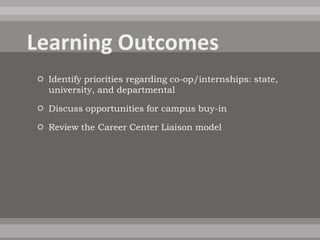
 Identify priorities regarding co-op/internships: state,
  university, and departmental

 Discuss opportunities for campus buy-in

 Review the Career Center Liaison model
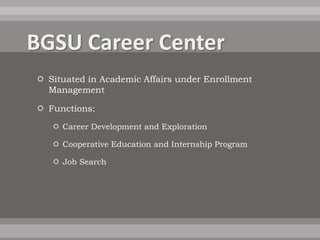
 Situated in Academic Affairs under Enrollment
  Management

 Functions:

    Career Development and Exploration

    Cooperative Education and Internship Program

    Job Search
 Ohio Innovation Partnership

 Regent’s Co-op & Internship Program

 General Education – applied learning

 Co-op & Internship Task Force

 Enrollment Management
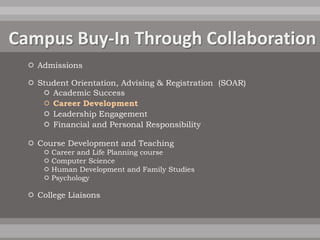
 Admissions

 Student Orientation, Advising & Registration (SOAR)
    Academic Success
    Career Development
    Leadership Engagement
    Financial and Personal Responsibility

 Course Development and Teaching
    Career and Life Planning course
    Computer Science
    Human Development and Family Studies
    Psychology

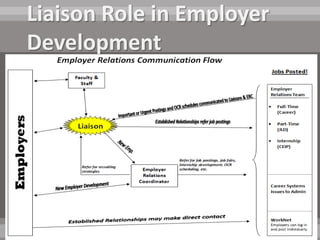
 College Liaisons
 Develop and maintain relationships with:
    Students

    College Faculty/Staff

    Employers/Recruiters

 Serve as career development resource in college

 Create specialized programming to meet students’
  needs
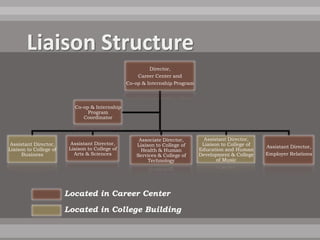
Director,
                                                    Career Center and
                                                Co-op & Internship Program


                          Co-op & Internship
                               Program
                             Coordinator


                                                    Associate Director,        Assistant Director,
 Assistant Director,     Assistant Director,       Liaison to College of      Liaison to College of
                        Liaison to College of                                                         Assistant Director,
Liaison to College of                                Health & Human          Education and Human
      Business            Arts & Sciences          Services & College of     Development & College    Employer Relations
                                                        Technology                  of Music


                        Located in Career Center

                        Located in College Building
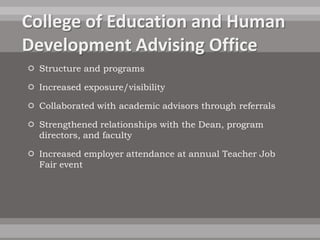
 Structure and programs

 Increased exposure/visibility

 Collaborated with academic advisors through referrals

 Strengthened relationships with the Dean, program
  directors, and faculty

 Increased employer attendance at annual Teacher Job
  Fair event
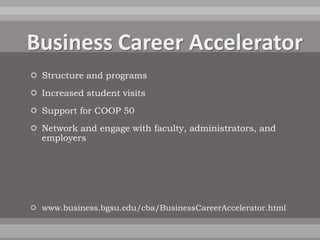
 Structure and programs
 Increased student visits
 Support for COOP 50
 Network and engage with faculty, administrators, and
  employers


 www.business.bgsu.edu/cba/BusinessCareerAccelerator.html
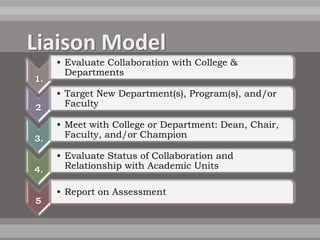
• Evaluate Collaboration with College &
       Departments
1.
     • Target New Department(s), Program(s), and/or
2.     Faculty

     • Meet with College or Department: Dean, Chair,
3.     Faculty, and/or Champion

     • Evaluate Status of Collaboration and
4.     Relationship with Academic Units

     • Report on Assessment
5.
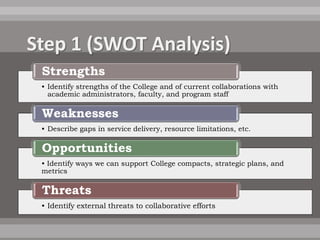
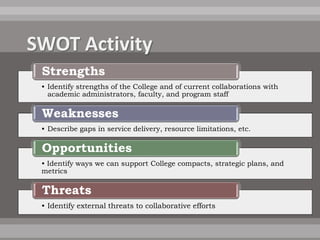
Strengths
• Identify strengths of the College and of current collaborations with
  academic administrators, faculty, and program staff

Weaknesses
• Describe gaps in service delivery, resource limitations, etc.

Opportunities
• Identify ways we can support College compacts, strategic plans, and
metrics

Threats
• Identify external threats to collaborative efforts
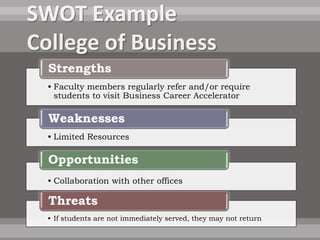
Strengths
• Faculty members regularly refer and/or require
  students to visit Business Career Accelerator

Weaknesses
• Limited Resources

Opportunities
• Collaboration with other offices

Threats
• If students are not immediately served, they may not return
Strengths
• Identify strengths of the College and of current collaborations with
  academic administrators, faculty, and program staff

Weaknesses
• Describe gaps in service delivery, resource limitations, etc.

Opportunities
• Identify ways we can support College compacts, strategic plans, and
metrics

Threats
• Identify external threats to collaborative efforts
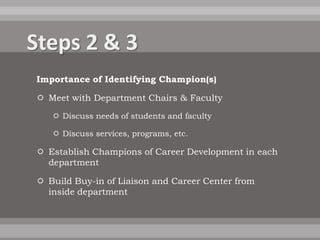
Importance of Identifying Champion(s)

 Meet with Department Chairs & Faculty

    Discuss needs of students and faculty

    Discuss services, programs, etc.

 Establish Champions of Career Development in each
  department

 Build Buy-in of Liaison and Career Center from
  inside department
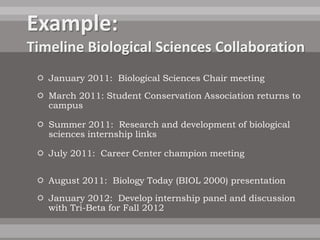
 January 2011: Biological Sciences Chair meeting
 March 2011: Student Conservation Association returns to
  campus

 Summer 2011: Research and development of biological
  sciences internship links

 July 2011: Career Center champion meeting


 August 2011: Biology Today (BIOL 2000) presentation
 January 2012: Develop internship panel and discussion
  with Tri-Beta for Fall 2012
 Determine a centralized location to post
  science related internships
 Interfaced with faculty through classroom
  presentations and projects
 Develop relationships with student
  organization leaders and advisors
 Discuss progress towards goals

 Update SWOT analysis

 Identify joint goals and strategies

 Select target department(s) and develop plan to meet
  priorities
4
        2
            1


    3
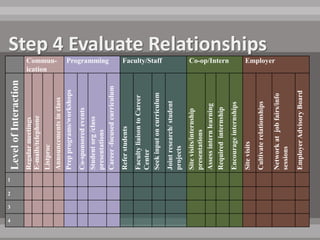
                Level of Interaction
                Regular meetings
                E-mails/telephone


                                             ication
                Listproc
                Announcements in class       Commun-
                Prep programs/workshops
                Co-sponsored events
                Student org /class
                presentations
                                                 Programming


                Career -focused curriculum
                Refer students
                Faculty liaison to Career
                Center
                Seek input on curriculum
                                                 Faculty/Staff


                Joint research/ student
                projects
                Site visits/internship
                presentations
                Assess intern learning
                Required internship
                                                 Co-op/Intern


                Encourage internships
                Site visits
                Cultivate relationships
                                                 Employer


                Network at job fairs/info
                sessions

                Employer Advisory Board
 Customizable College Liaison Report

 Validate Accountability Measures

 Programs Completed

 Students Served
Contact us at:
      careerservices@bgsu.edu
                       or
                                419-372-2356
Download our presentation at:
http://www.slideshare.net/BGSUCareerCenter

University Focus On Co-ops and Internships

  • 1.
    University Focus on Co-opsand Internships: The Importance of Liaisons and Campus Buy-In Andrea Domachowski, Assistant Director Andrea Gutierrez, Assistant Director Micheline Krise, Coordinator of Coop Ed & Internship Program Lesa Shouse, Assistant Director Jessica Turos, Associate Director Susan Young, Assistant Director
  • 2.
     Identify prioritiesregarding co-op/internships: state, university, and departmental  Discuss opportunities for campus buy-in  Review the Career Center Liaison model
  • 3.
     Situated inAcademic Affairs under Enrollment Management  Functions:  Career Development and Exploration  Cooperative Education and Internship Program  Job Search
  • 4.
     Ohio InnovationPartnership  Regent’s Co-op & Internship Program  General Education – applied learning  Co-op & Internship Task Force  Enrollment Management
  • 5.
     Admissions  StudentOrientation, Advising & Registration (SOAR)  Academic Success  Career Development  Leadership Engagement  Financial and Personal Responsibility  Course Development and Teaching  Career and Life Planning course  Computer Science  Human Development and Family Studies  Psychology  College Liaisons
  • 6.
     Develop andmaintain relationships with:  Students  College Faculty/Staff  Employers/Recruiters  Serve as career development resource in college  Create specialized programming to meet students’ needs
  • 7.
    Director, Career Center and Co-op & Internship Program Co-op & Internship Program Coordinator Associate Director, Assistant Director, Assistant Director, Assistant Director, Liaison to College of Liaison to College of Liaison to College of Assistant Director, Liaison to College of Health & Human Education and Human Business Arts & Sciences Services & College of Development & College Employer Relations Technology of Music Located in Career Center Located in College Building
  • 8.
     Structure andprograms  Increased exposure/visibility  Collaborated with academic advisors through referrals  Strengthened relationships with the Dean, program directors, and faculty  Increased employer attendance at annual Teacher Job Fair event
  • 9.
     Structure andprograms  Increased student visits  Support for COOP 50  Network and engage with faculty, administrators, and employers  www.business.bgsu.edu/cba/BusinessCareerAccelerator.html
  • 10.
    • Evaluate Collaborationwith College & Departments 1. • Target New Department(s), Program(s), and/or 2. Faculty • Meet with College or Department: Dean, Chair, 3. Faculty, and/or Champion • Evaluate Status of Collaboration and 4. Relationship with Academic Units • Report on Assessment 5.
  • 11.
    Strengths • Identify strengthsof the College and of current collaborations with academic administrators, faculty, and program staff Weaknesses • Describe gaps in service delivery, resource limitations, etc. Opportunities • Identify ways we can support College compacts, strategic plans, and metrics Threats • Identify external threats to collaborative efforts
  • 12.
    Strengths • Faculty membersregularly refer and/or require students to visit Business Career Accelerator Weaknesses • Limited Resources Opportunities • Collaboration with other offices Threats • If students are not immediately served, they may not return
  • 13.
    Strengths • Identify strengthsof the College and of current collaborations with academic administrators, faculty, and program staff Weaknesses • Describe gaps in service delivery, resource limitations, etc. Opportunities • Identify ways we can support College compacts, strategic plans, and metrics Threats • Identify external threats to collaborative efforts
  • 14.
    Importance of IdentifyingChampion(s)  Meet with Department Chairs & Faculty  Discuss needs of students and faculty  Discuss services, programs, etc.  Establish Champions of Career Development in each department  Build Buy-in of Liaison and Career Center from inside department
  • 15.
     January 2011:Biological Sciences Chair meeting  March 2011: Student Conservation Association returns to campus  Summer 2011: Research and development of biological sciences internship links  July 2011: Career Center champion meeting  August 2011: Biology Today (BIOL 2000) presentation  January 2012: Develop internship panel and discussion with Tri-Beta for Fall 2012
  • 16.
     Determine acentralized location to post science related internships  Interfaced with faculty through classroom presentations and projects  Develop relationships with student organization leaders and advisors
  • 17.
     Discuss progresstowards goals  Update SWOT analysis  Identify joint goals and strategies  Select target department(s) and develop plan to meet priorities
  • 18.
    4 2 1 3 Level of Interaction Regular meetings E-mails/telephone ication Listproc Announcements in class Commun- Prep programs/workshops Co-sponsored events Student org /class presentations Programming Career -focused curriculum Refer students Faculty liaison to Career Center Seek input on curriculum Faculty/Staff Joint research/ student projects Site visits/internship presentations Assess intern learning Required internship Co-op/Intern Encourage internships Site visits Cultivate relationships Employer Network at job fairs/info sessions Employer Advisory Board
  • 19.
     Customizable CollegeLiaison Report  Validate Accountability Measures  Programs Completed  Students Served
  • 21.
    Contact us at: careerservices@bgsu.edu or 419-372-2356 Download our presentation at: http://www.slideshare.net/BGSUCareerCenter

Editor's Notes

  • #2 MK
  • #3 MK
  • #4 MK
  • #5 JTRetentionSue’s suggested note:The Governor and State Legislature approved $12 Million for the Regent’s Co-op & Internship Program. RFP to be released this summer
  • #6 JT
  • #7 JTPriority connect back to internships - hire additional 4 GA’s
  • #8 AG3 modelsStand alone office – Business Career AcceleratorWithin advising - EducationIn Career Center – Arts & Sciences, Health & Human Services, Technology, MusicStandardizing and implementing best practices
  • #9 AGIncreased exposure/visibility of Career Center services as a whole by being housed in the College’s Advising OfficeIncreased collaboration with academic advisors due to referrals (contributes to higher retention rates in the College)Increased relationships with the Dean, program directors and faculty due to expanding career services in-house (Examples: Capstone Day, senior seminar presentations, job fair preparation, professional development series for SM & HDFS majors)Increased recruiter attendance at  annual Teacher Job Fair event48% of all registered co-ops and internships are under College of Education
  • #10 Another model for the liaison office is the stand alone modelStand Alone office in College of Business – reports to associate dean and gets support from office of student development (advising)2 Internship Coordinators assist with running programs – resume workshop, speed interviewsCoordinate Business Career Day, offer Don’t Cancel Class program to facultySince moving to the COB visits increased more than 80%Support COOP 50 by communicating benefits of registration to students and faculty – provide paperwork and registration helpNetwork by attending college events – all college meetings, receptions, Engage with students through Video Log – idea of marketing professor and internship coordinator – could be used for students out on co-opNote:Total Students served by Year (Appts & Drop-ins)2009-2010: 2882010-2011: 3942011-2012: 519
  • #11 LSDoes not have to be in this order
  • #12 LSStep 1 = Evaluate Collaboration with College & DepartmentsThe way we have chosen to evaluate collaborations with colleges is through a SWOT Analysis. Identifying the Strengths, Weaknesses, Opportunities and Threats of the collaboration. Discuss each in detail.Strengths – Who are our champions, where are there deeply developed relationships? What are the strong academic programs in the department?Weaknesses – Student population attributes? (i.e. not interested in moving or relocating)Opportunities – What departments have expressed interest? Where are there holes to fill quickly and easily and other that take time?Threat – What is blocking collaboration? Who/What could hurt current relationships? Funding? Staffing? etc.
  • #13 LSMicro level
  • #14 LSStep 1 = Evaluate Collaboration with College & DepartmentsThe way we have chosen to evaluate collaborations with colleges is through a SWOT Analysis. Identifying the Strengths, Weaknesses, Opportunities and Threats of the collaboration. Discuss each in detail.Strengths – Who are our champions, where are there deeply developed relationships? What are the strong academic programs in the department?Weaknesses – Student population attributes? (i.e. not interested in moving or relocating)Opportunities – What departments have expressed interest? Where are there holes to fill quickly and easily and other that take time?Threat – What is blocking collaboration? Who/What could hurt current relationships? Funding? Staffing? etc.
  • #15 Define Champion: Faculty or staff member who believes in the Career Center message and mission. Target New Department(s) /Program(s) /Faculty –based on Ohio Board of Regents, interest in Ohio Centers for ExcellenceIn my meeting, it was the Chair of the Department that targeted a faculty member to act as a liaison to the Career Center. Meet with College or Department: Dean / Chair / Faculty / ChampionAs mentioned previously, I am Andrea D., Liaison to the College of Arts and Sciences. Lesa provided an example of a SWOT, by utilizing STEP 1. I will demonstrate STEPS 2 and 3 of the liaison model. Again, these are fluid and can be utilized in different order. In my example, I was strategic in identifying the Biological Sciences Department for three reasons: 1) large academic unit—housed in College of arts and sciences, which houses over 5300 students with 46 majors. Approximately 500 biological sciences majors, three specializations. Within the Biological Sciences/Environmental Sciences area, they have Board of Trustees approval and are recognized by the Ohio Board of Regents as one of the Centers of Excellence within the Advanced Energy. Looked at STEM as an area of employer growth within NW Ohio. Other Centers: More than 50 Centers of Excellence have been established, with additional proposals being evaluated. The Center of Excellence categories represent key industrial areas in which future job growth can be expected::Advanced EnergyBiomedicine & Health CareAgriculture, Food Production & BioproductsAdvanced Transportation & AerospaceEnabling Technologies: Advanced Materials & SensorsCultural & Societal TransformationIN my meeting with the Chair of the department, we identified outcomes and next steps, but he also helped me identify a champion I can lean on for assistance. This faculty member was critical. She was the instructor of the Biology Today Class—a class requirement of all first year biological sciences majors. Seminar on contemporary research and overview of career paths in the biological sciences. Class size averages around 75-100 students.
  • #16 Pivotal points to mentionSCA- increase in the number of applicants from January 2010-presentImportance of Tamara Wales as a Career Center ChampionBIOL 2000 presentation: importance of career development, knowing your interests, skills, values and the opportunities outside of medical school; mentioned internships and showed websiteJan 2011-established outcomes: increase the number of internships offerings to biological sciences students. Promotion of a centralized location to post internship opportunities. 2 ways we would accomplish this goal. 1) add opportunities to WorkNet, 2) create a clearinghouse of links categorized by the specializations within the Biological sciences major. March 2011- saw an increase in the number of views on our WorkNet system. SCA: Expense paid internships, living stipend, housing, round trip travel. 3-12 month experiences locations range from Alaska, Arizona, East coast, Ohio, etc… working in environmental education, wildlife management, forestry, wetland restoration, etc…June 2008 posted on WorkNet, 21 student viewsMarch 2011 posted on WorkNet, 50 student views58% increase in the number of studentsSummer 2011: developed internship links based on biological sciences specializations. Promoted in BIO Today class, linked to Biological Sciences webpage. July 2011: Met with CC Champion. Created goals and tasks to complete. Provided outline of presentation to BIOL 2000 class to crate seamless connection with department. August 2011: following presentation, saw an increase in the number of student appointments in biological sciences. 25 TO 40 studentsJanuary 2012: Looking at next steps…development of an internship panel/collaboration with tri beta in the fall, 2012.
  • #17 UtilizedWorkNet to track the number of openings and the number of “hits” on positionsSCAJune 2008 posted on WorkNet, 21 student viewsMarch 2011 posted on WorkNet, 50 student viewsWebsite hits-views on Biological Sciences website:Number of STEM internships (June 2008-January 2011)*94 internship opportunities45 companies offering internshipsNumber of STEM internships (January 2011-May 2012)*126 internship opportunities56 companies offering internshipsResult of Liaison Collaboration:Increase of 34% in internship offeringsIncrease of 24% in companies offering internships
  • #18 SYDiscuss progress of Dean/Directors/Chairs toward goals and the successes of the Career Center re: faculty /staff relationships, job development, student engagement and programmingUpdate SWOT analysisIdentify joint goals and strategies Select target department(s) and develop plan to meet prioritiesRelationship - mutually beneficial
  • #19 SYRelationship - mutually beneficial
  • #20 SYClose Assessment LoopIdentify and use outcome measures: BGSU learning, accountability measures, Institutional Research reports, national benchmark studies, University System of Ohio Accountability Measures, Student Achievement Assessment Committee (SAAC), and College annual reports  Distribute Co-op & Internship learning outcome assessments, co-op and internship assignments, and statistical reports  Discuss feedback and next steps   
  • #21 SYOne-Stop Shopping for Employers: Target/referral, service, assessment Successes with co- targeted employers (academic unit & Career Center)e.g. internship hiring outcomes, regular engagement & posting of positions, engage fully with the University