Understanding the Structure of the Universe based on SB Canto5
Part1: Description of “Bhü-maëòala” - ‘Horizontal Structure of the Universe’
&
Part2: Fourteen Planetary Systems - ‘Vertical Structure of the Universe'
Abstract
Çukadeva Gosvämé said: "My dear King, there is no limit to the expansion of the Supreme Personality of Godhead's
material energy. This material world is a transformation of the material qualities..., yet no one could possibly
explain it perfectly, even in a lifetime as long as that of Brahmä" (SB 5.16.4). In this assignment we will describe the
structure of this universe, or brahmäëòa, as described in the Çrémad-Bhägavatam. Our aim is to show the Vedic
picture of the universe in an appealing way to our experience. In doing this, we will draw information from the
following sources: (1) The writings of Çréla Prabhupäda, including his translation, with commentary, of the Çrémad-
Bhägavatam, (2) The commentary of Çréla Visvanätha Chakravarti on the Çrémad-Bhägavatam, (3) other writings in
the Vedic tradition, including the Sürya-siddhänta and Bhugola varnana, and (4) modern Western science.
Our strategy is to present the simplest possible world-picture that will harmonize (1) and (4), given the assumption
that the Bhägavatam gives a direct and valid account of the universe. This will help us to appreciate the descriptions
given in the revealed scriptures are not mythical but factual with true substance.
Introduction
This is our humble attempt to understand the descriptions of the Structure of the Universe or the cosmology
presented in the Fifth Canto of the Çrémad-Bhägavatam. We have begun this work with an intention to come up
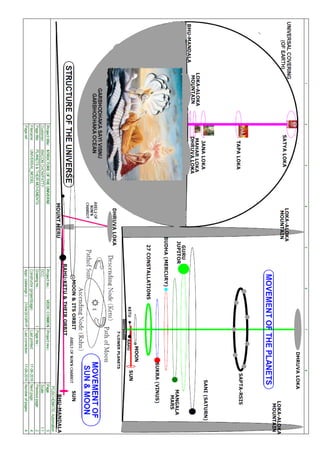
with a 3-D working model, which presents the Structure of the Universe and the movement of various planets, such
as Sun and Moon, in an understandable and simple way. Development of this kind of simple models is in line with
Çréla Prabhupäda’s desire to explain the complex descriptions of the Fifth Canto of the Çrémad-Bhägavatam. This is
evident from Çréla Prabhupäda’s letter given below.
"Now our Ph.D.'s must collaborate and study the Fifth Canto to make a model for building the Vedic Planetarium.
My final decision is that the universe is just like a tree, with root upwards. Just as a tree has branches and leaves, so
the universe is also composed of planets which are fixed up in the tree like the leaves, flowers, fruits, etc....So now
all you Ph.D.'s must carefully study the details of the Fifth Canto and make a working model of the universe. If we
can explain the passing seasons, eclipses, phases of the moon, passing of day and night, etc., then it will be very
powerful propaganda" (letter from Çréla Prabhupäda to Svarüpa Dämodara däsa, April 27, 1976).
There are evidently serious disagreements between the cosmological system of the Puräëas and the world models
that human observers tend to arrive at using their reasoning powers and their ordinary senses. The cause of these
difficulties is not only due to the rise of modern Western science and also due to the contradiction and complexities
within the Vedic tradition itself.
Modern Western science is based on the idea that nature can be fully described by a single, rational world-model.
However, the Çrémad-Bhägavatam points out that no person of this world is capable of fully describing the material
universe "even in a lifetime as long as that of Brahmä" (SB 5.16.4). Thus the Vedic approach to the description of
nature is based on the strategy of presenting many mutually compatible aspects of one humanly indescribable
complete whole. This is the approach used in SB while explaining the details of the cosmology.
The universe described in the Vedic literature is of higher-dimensional, thus it cannot be fully represented within
three-dimensional space. This requires the understanding of the higher dimentional representation. Though we
tried to present this model as per our limited understanding capabilities as a service to Guru and Krsna.
The material presented in this report constitutes a preliminary study of Vedic cosmology as described in the Fifth
Canto of the Çrémad-Bhägavatam. To properly answer the many questions that arise, much further research will
have to be done. This will include (1) study of cosmology in SB, (2) study of the movements of Sun, Moon and
other planets, (3) study of the divisions of Bhu-mandala, (4) description of the model, (5) details of the model
design and calculations. It is our hope that this material and the 3-D model can enable us effectively present Kåñëa
consciousness in the context of Vedic cosmology. This, of course, was Çréla Prabhupäda's plan for the Temple of
Vedic Planetarium (TOVP) in Çrédhäma Mäyäpura.
Technical Terms and Definitions
SB – Çrémad-Bhägavatam
DS – Devotional Service
SPOG – Supreme Personality of Godhead
VCT – Visvanatha Chakravarti Takura
SL – Supreme Lord
TOVP - Temple of Vedic Planetarium
MY – Million Yojanas
LxWxH – Length x Width x Hight
Contents
Abstract............................................................................................................................................................................... 2
Introduction........................................................................................................................................................................ 2
Technical Terms and Definitions....................................................................................................................................... 2
Spiritual significance of knowing about the Universal Structure:.................................................................................... 4
Part I: Description of “Bhü-maëòala - Horizontal Structure of the Universe”................................................................... 5
The Creation................................................................................................................................................................... 5
Maharaja Priyavrata divides the one Bhü-maëòala into seven islands & seven oceans ............................................. 6
Descendents of Priyavrata Maharaja:............................................................................................................................. 7
Further Descendents of Priyavrata Maharaja (SB 5.2-15):........................................................................................... 7
Description of Jambüdvépa, the First and innermost Island ........................................................................................ 8
Description of the Divisions of Jambüdvépa.................................................................................................................. 8
Description of Ilävåta-varña:......................................................................................................................................... 10
The Descent and the Flow of the River Ganges in Jambu-dvipa................................................................................ 12
Description of 8 Heavenly Varsas (Bharata-Varsa Vs Other Varsas) ......................................................................... 13
The Residents of different Varñas of Jambüdvépa, their Rulers and Preciding Deities.............................................. 13
Description and the Divisions of Bhärata-varña:......................................................................................................... 15
Glories of Bhärata-Varña:.............................................................................................................................................. 16
Depiction of Bhärata-varña........................................................................................................................................... 17
Sankalpa mantra and its meaning (Just to show the connection of the above descriptions): .................................. 18
Description of the other 6 islands of Bhü-maëòala with their mountains and rivers:.............................................. 19
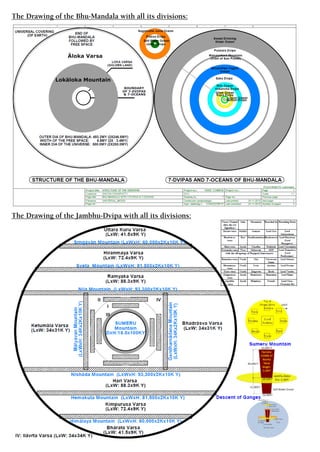
The Drawing of the Bhu-Mandala with all its divisions: ............................................................................................ 22
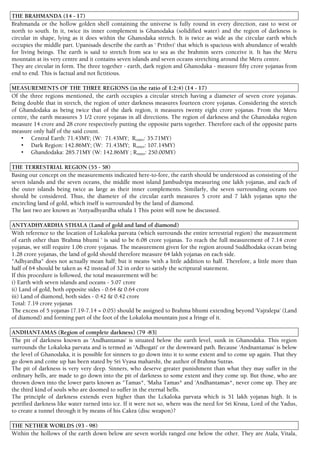
The Drawing of the Jambhu-Dvipa with all its divisions: .......................................................................................... 22
The Structure of the Universe As per Srila Vädiraja Tirta’s “BHÜGOLA VARNANAM”.......................................... 23
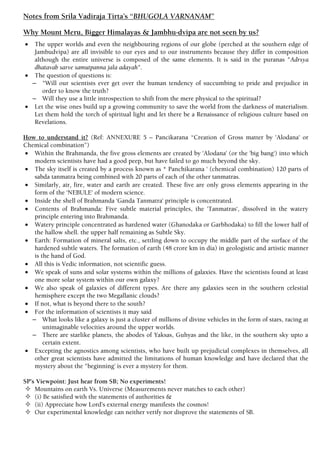
Why Mount Meru, Bigger Himalayas & Jambhu-dvipa are not seen by us?............................................................. 31
Part2: Fourteen Planetary Systems ‘Vertical Structure of the Universe’ ........................................................................ 33
The Movements of the Sun, Moon and Other Planets................................................................................................ 33
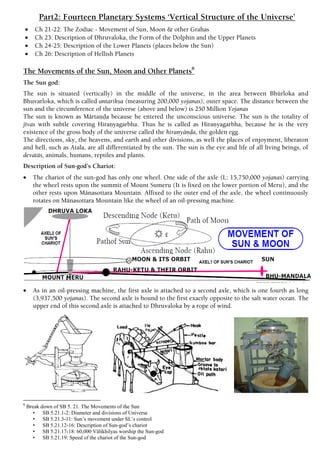
The Sun god:............................................................................................................................................................. 33
Description of Sun-god’s Chariot:............................................................................................................................ 33
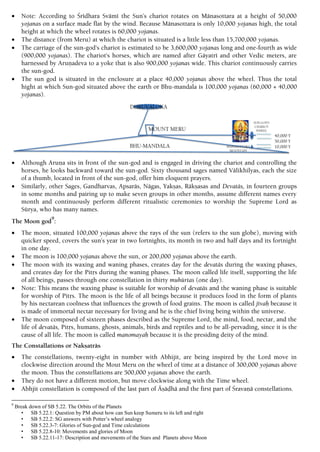
The Moon god:.......................................................................................................................................................... 34
The Constallations or Nakñaträs.............................................................................................................................. 34
The Orbits of the Other Planets:.................................................................................................................................. 35
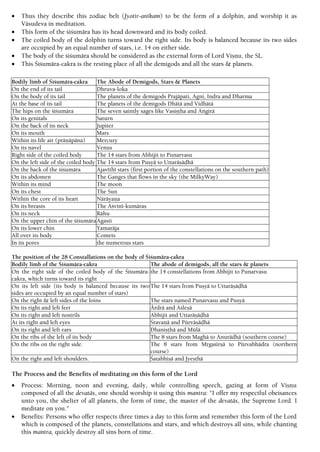
The Çiçumära Planetary Systems:................................................................................................................................. 35
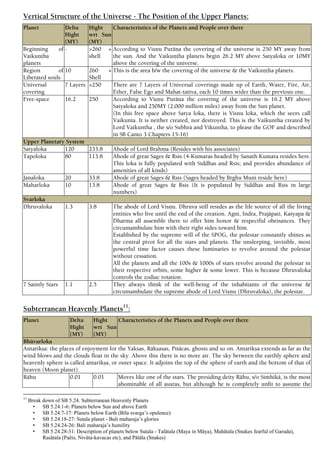
Vertical Structure of the Universe - The Position of the Upper Planets: ................................................................... 37
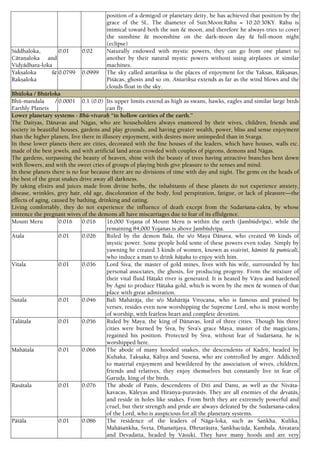
Subterranean Heavenly Planets:................................................................................................................................... 37
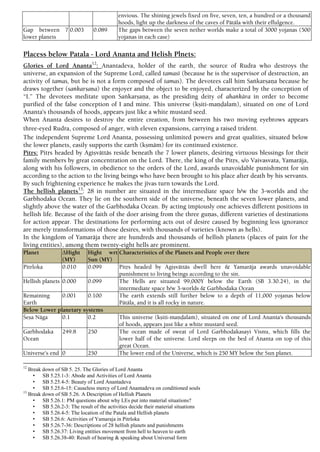
Placess below Patala - Lord Ananta and Helish Plnets: .............................................................................................. 39
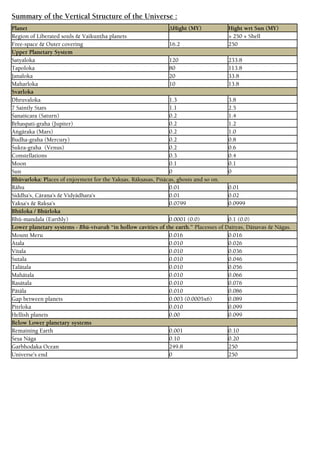
Summary of the Vertical Structure of the Universe :.................................................................................................. 40
Part3: The Movement of the Planets ............................................................................................................................... 42
The Movements of the Sun, Moon and Other Planets.................................................................................................... 42
The Orbits of the Upper, Middle and Lower Planets:............................................................................................. 42
Zodiac Belt (kälacakra-gata):................................................................................................................................... 42
The Constellations or Nakñaträs (SB 5.21-22):....................................................................................................... 42
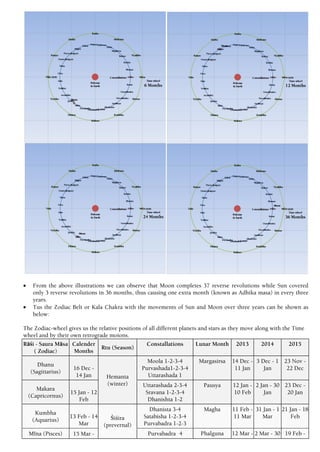
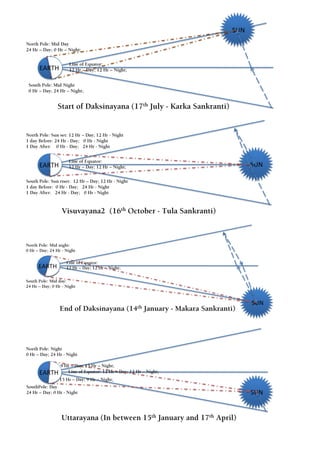
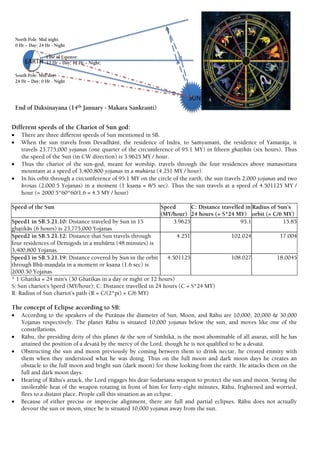
SB 5.21.3-11: The movement of sun through the zodiac signs, its rising, setting and its speed:......................... 44
SB 5.21.7-12: Understanding the movement of Sun:.............................................................................................. 44
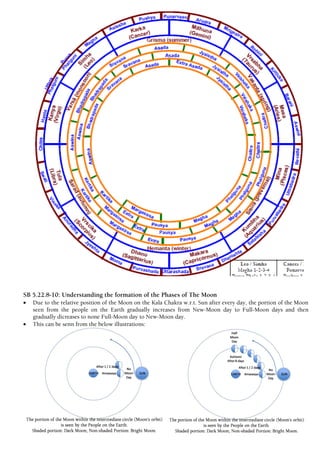
SB 5.22.1-2: Understanding the movement of Sun w.r.t. the Time-wheel............................................................ 45
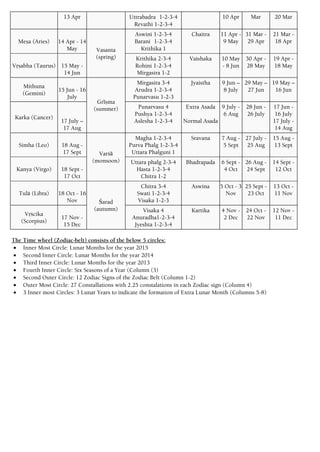
SB 5.22.5-7: Calculation of Day-Night, Months, Seasons and Years ..................................................................... 47
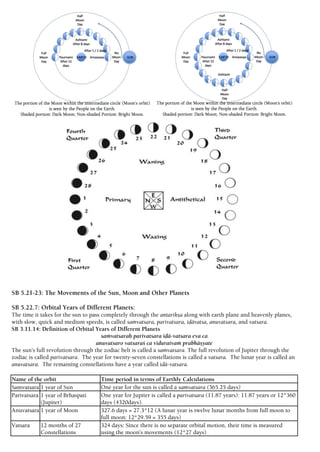
SB 5.22.8-10: Understanding the formation of the Phases of The Moon .............................................................. 51
SB 5.21-23: The Movements of the Sun, Moon and Other Planets........................................................................ 52
SB 5.22.7: Orbital Years of Different Planets:.......................................................................................................... 52
SB 5.22.11-17: Movements of the Stars & Other Planets above the Moon ........................................................... 53
Different speeds of the Chariot of Sun god:............................................................................................................ 58
The concept of Eclipse according to SB: ................................................................................................................. 58
Benefits of Hearing about the Universal Structure: ................................................................................................ 60
SB 5.26.38: Result of hearing and speaking about Universal form:....................................................................... 60
Critical Observation of the Study of the Structure of the Universe:...................................................................... 60
Conclusion................................................................................................................................................................ 60
References................................................................................................................................................................. 60
Spiritual significance of knowing about the Universal Structure:
 When the mind is fixed upon the SPOG in His external feature made of the material modes of nature
(the gross universal form) it is brought to the platform of pure goodness.
 In that transcendental position, one can understand the SPOG, Väsudeva, who in His subtler form is
self-effulgent and beyond the modes of nature.
 The universal form is certainly material, but because everything is an expansion of the energy of the
SPOG, ultimately nothing is material.
 Therefore although Mahäräja Parékñit might not have had any reason to be concerned with detailed
information of the universe, but by thinking of it in relationship with the Supreme Lord such
geographical knowledge is no more material but transcendental.
 The limits of the expansions of Govinda, the SPOG, cannot be estimated by anyone, even a person as
perfect as Brahmä, not to speak of tiny scientists whose senses and instruments are all imperfect and
who cannot give us information of even this one universe.
 We should therefore be satisfied with the information obtainable from the Vedic sources as spoken by
authorities like Çukadeva Gosvämé.
 Çukadeva Gosvämé’s purpose in describing the details of the structure of the universes is to show us
that how the residents of different planets are primarily engaged in the worship of the SPOG and to
inspire us to take up the same.
 Canto 5 of SB gives an overview of the geographical locations of different planetary system but not the
accurate details, because the intention is to increase our appreciation for the Supreme Lord’s
wonderful Creation.
Division of SB Canto 5 - STHÄNA
SB Canto 5 describes STHÄNA, one of the 10 subject matters of SB.
Definition: Sthitir vaikuëöha-vijayaù - The right situation for the living entities is to obey the laws of the
Lord.
 Sthänam refers to the Lord protecting his devotee. This shows the excellence of the Lord.
 Sthitiù refers to the condition of the jévas & vaikuëöha-vijayaù means that the Lord destroys their
suffering.
 Sthäna: The geography of the universe, where the demigods, men and demons reside and its protection
by the demigods.
 The maintenance of the inhabitants of the Bhüloka, Pätala and heavenly planets, who are situated
there with their rules.
A brief over view of SB Canto 5 is given below:
Part1: Description of “Bhü-maëòala - Horizontal Structure of the Universe”
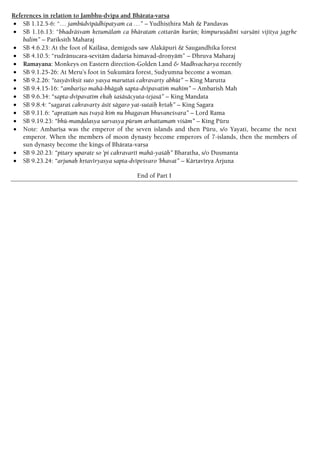
• Ch 1: Priyavrata divides the Bhü-maëòala into 7 Dvipas & 7 Oceans
• Ch 1-15: Description of the descendents of Priyavrata Maharaja - Visarga
• Ch 16-19: Description of Jambudvépa, its mountains and trees
– Ch 16-17: Jambüdvépa, Its Divisions & Path of Ganges
– Ch 17–19: Prayers offered by the Residents of 9 Varsas of Jambüdvépa
– Ch 19: Glories of Bhärata Varsa
• Ch 20: Description of the other 6 islands of Bhü-maëòala with their mountains and rivers
Part2: Fourteen Planetary Systems - ‘Vertical Structure of the Universe’ & The Movement of the Planets
• Ch 21-22: The Zodiac - Movement of Sun, Moon & other Grahas
• Ch 23: Description of Dhruvaloka, the Form of the Dolphin and the Upper Planets
• Ch 24-25: Description of the Lower Planets (places below the Sun)
• Ch 26: Description of Hellish Planets
Part I: Description of “Bhü-maëòala - Horizontal Structure of the Universe”
The Creation
Çrémad-Bhägavatam Canto Two to Four eloberately describes the Creation (Sarga) and Sub-creation (Visarga) of
this Material Universe by Lord Näräyana and then by Lord Brahmä respectively. A brief overview of the same is
given below:
 Out of His causeless mercy, the compassionate Lord felt imperfect without His plenary and separated parts and
parcels.
 Thus to begin the material creation He impregnats the living entities into material nature and by the influence
of eternal time all the living entities appear.
 First Käraëärëavaçäyé Viñëu impregnates material nature of 3-modes with living entities. Then under
interaction of eternal time Mahat-tattva manifests.
 Then mahat-tattva differentiated itself into many different forms as the reservoir of the would-be entities.
 It transforms into false ego, which manifests in three phases - Cause, effect and doer
 False ego in different modes generates Mind and demigods (in MOG), senses, speculative knowledge & fruitive
activities (in MOP), 5 sense objects and 5 gross material elements (in MOI).
 By the influence of Lords external energy all the elements are mixed and formed into a Gigantic universal form
(Hiranmaya).

Thus the elements transformed into a gigantic form, in which all the planetary systems and all movable and
immovable creations rest.
 Viräö-puruña (Hiranmaya) lived for 1000 celestial years on waters of universe, lying with all the living entities
lying down till Brahmä is born
 After 1000 years of inactivity, Garbhodakasayi Vishnu enters the universe and activates it as the Supersoul.
 Garbhodakaçäyé Viñëu resting during the night of Brahmä. Then at the end of the night, Lord’s glance agitates
the material elements with rajas, along with subtle bodies of living entities within Himself.
 Agitated material elements push through the navel, as a lotus bud. As Lord personally entered into the Lotus
stem as the Supersoul and impregnates it with all the modes of MN and then Brahmä was generated on the lotus
bud.
 Brahmä remained bewildered for one millennium for he could not perfectly understand the creation, the lotus
or himself. He was failed in finding out his identity. Giving up all pride and personal endeavor, Brahmä began
to meditate on Lord.
 By long penance and mature knowledge and by Lord’s mercy he was empowered to continue the subsequent
creation. Brahma decides to create the universe from that lotus. He enters the lotus and first divides it into 3 and
then 14 divisions
 Brahma first creates 5-varieties of Ignorences, which cover a jiva’s real identity. Then he created various living
entities, moving and non-moving, to populate the entire Universe according to their desire.
 To increase the population on the Earthly planets Lord Brahma created 2 beings, a male Svayambhuva Manu
and the female Satarupa.
 Brahma then instucts him to a) beget children similar to him in quality, b) to rule the earth religiously, and c) to
worship the Lord through sacrifices. For by thus protecting the population he will please both Brahma and the
Lord.
 According to Brahma’s order Manu became the ruler of the Bhu-mnadala and subsequently handed over the
rulership to his sons and grand sons.
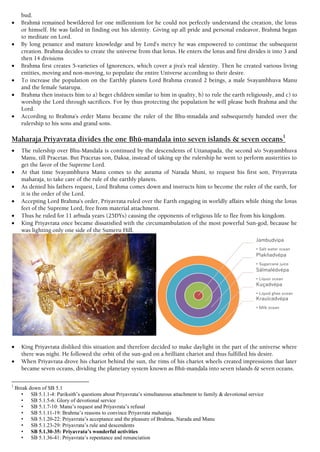
Maharaja Priyavrata divides the one Bhü-maëòala into seven islands & seven oceans1
 The rulership over Bhu-Mandala is continued by the descendents of Uttanapada, the second s/o Svayambhuva
Manu, till Pracetas. But Pracetas son, Daksa, instead of taking up the rulership he went to perform austerities to
get the favor of the Supreme Lord.
 At that time Svayambhuva Manu comes to the asrama of Narada Muni, to request his first son, Priyavrata
maharaja, to take care of the rule of the earthly planets.
 As denied his fathers request, Lord Brahma comes down and instructs him to become the ruler of the earth, for
it is the order of the Lord.
 Accepting Lord Brahma’s order, Priyavrata ruled over the Earth engaging in worldly affairs while thing the lotus
feet of the Supreme Lord, free from material attachment.
 Thus he ruled for 11 arbuda years (25DYs) causing the opponents of religious life to flee from his kingdom.
 King Priyavrata once became dissatisfied with the circumambulation of the most powerful Sun-god, because he
was lighting only one side of the Sumeru Hill.
 King Priyavrata disliked this situation and therefore decided to make daylight in the part of the universe where
there was night. He followed the orbit of the sun-god on a brilliant chariot and thus fulfilled his desire.
 When Priyavrata drove his chariot behind the sun, the rims of his chariot wheels created impressions that later
became seven oceans, dividing the planetary system known as Bhü-maëòala into seven islands & seven oceans.
1
Break down of SB 5.1
• SB 5.1.1-4: Pariksith’s questions about Priyavrata’s simultaneous attachment to family & devotional service
• SB 5.1.5-6: Glory of devotional service
• SB 5.1.7-10: Manu’s request and Priyavrata’s refusal
• SB 5.1.11-19: Brahma’s reasons to convince Priyavrata maharaja
• SB 5.1.20-22: Priyavrata’s acceptance and the pleasure of Brahma, Narada and Manu
• SB 5.1.23-29: Priyavrata’s rule and descendents
• SB 5.1.30-35: Priyavrata’s wonderful activities
• SB 5.1.36-41: Priyavrata’s repentance and renunciation
 Each island is twice as large as the one preceding it, and each is surrounded by a liquid substance, beyond
which is the next island.
 All the islands are completely surrounded by these oceans, and each ocean is equal in breadth to the island it
surrounds.
 Mahäräja Priyavrata, husband of Queen Barhiñmaté, gave sovereignty over these seven islands to his seven sons
respectively.
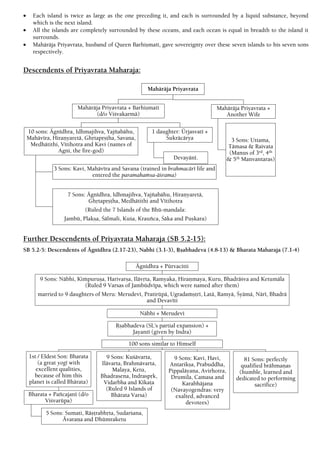
Descendents of Priyavrata Maharaja:
Further Descendents of Priyavrata Maharaja (SB 5.2-15):
SB 5.2-5: Descendents of Ägnédhra (2.17-23), Nabhi (3.1-3), Åñabhadeva (4.8-13) & Bharata Maharaja (7.1-4)
Mahäräja Priyavrata
Mahäräja Priyavrata + Barhiñmaté
(d/o Viçvakarmä)
10 sons: Ägnédhra, Idhmajihva, Yajïabähu,
Mahävéra, Hiraëyaretä, Ghåtapåñöha, Savana,
Medhätithi, Vétihotra and Kavi (names of
Agni, the fire-god)
3 Sons: Kavi, Mahävéra and Savana (trained in brahmacäré life and
entered the paramahaàsa-äçrama)
7 Sons: Ägnédhra, Idhmajihva, Yajïabähu, Hiraëyaretä,
Ghåtapåñöha, Medhätithi and Vétihotra
(Ruled the 7 Islands of the Bhü-mandala:
Jambü, Plakña, Çälmali, Kuça, Krauïca, Çäka and Puñkara)
1 daughter: Ürjasvaté +
Çukräcärya
Devayäné.
Mahäräja Priyavrata +
Another Wife
3 Sons: Uttama,
Tämasa & Raivata
(Manus of 3rd, 4th
& 5th Manvantaras)
Ägnédhra + Pürvacitti
9 Sons: Näbhi, Kiàpuruña, Harivarña, Ilävåta, Ramyaka, Hiraëmaya, Kuru, Bhadräçva and Ketumäla
(Ruled 9 Varsas of Jambüdvépa, which were named after them)
married to 9 daughters of Meru: Merudevé, Pratirüpä, Ugradaàñöré, Latä, Ramyä, Çyämä, Näré, Bhadrä
and Devavéti
Näbhi + Merudevé
Åñabhadeva (SL’s partial expansion) +
Jayanté (given by Indra)
100 sons similar to Himself
1st / Eldest Son: Bharata
(a great yogé with
excellent qualities,
because of him this
planet is called Bhärata)
Bharata + Païcajané (d/o
Viçvarüpa)
5 Sons: Sumati, Räñörabhåta, Sudarçana,
Ävaraëa and Dhümraketu
9 Sons: Kuçävarta,
Ilävarta, Brahmävarta,
Malaya, Ketu,
Bhadrasena, Indraspåk,
Vidarbha and Kékaöa
(Ruled 9 Islands of
Bhärata Varsa)
9 Sons: Kavi, Havi,
Antarikña, Prabuddha,
Pippaläyana, Avirhotra,
Drumila, Camasa and
Karabhäjana
(Navayogendras: very
exalted, advanced
devotees)
81 Sons: perfectly
qualified brähmaëas
(humble, learned and
dedicated to performing
sacrifice)
Distribution of the 7 Dvipas among his 7 sons:
N Island Size Ocean Size King (Son of Priyavrata)
1 Jambü dvépa X Salt water X Ägnédhra
2 Plakña dvépa 2X Sugarcane juice 2X Idhmajihva
3 Çälmali dvépa 4X Liquor 4X Yajïabähu
4 Kuça dvépa 8X Clarified butter 8X Hiraëyaretä
5 Krauïca dvépa 16X Milk 16X Ghåtapåñöha
6 Çäka dvépa 32X Emulsified yogurt 32X Medhätithi
7 Puñkara dvépa 64X Sweet drinking water 64X Vétihotra
 The breadth of the first island is (X=) 0.1 MY. This is also confirmed by Véraräghava Äcärya.
 According to scientists the sun light is received from a distance of 93,000,000 miles (11.625 MY). Therefore it
can be concluded that the radius of Bhu mandala is 11.625 MY.
 Therefore the radius of the Seven Dvipas with 7-Oceans of the Bhu mandala can be calculated as:
 RBhumandala = 0.5X+X+2*(2X+4X+8X+16X+32X+64X) = 1.5X+2*126*X = 253.5X = 25.35 MY
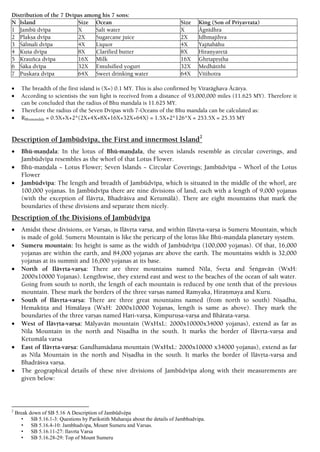
Description of Jambüdvépa, the First and innermost Island2
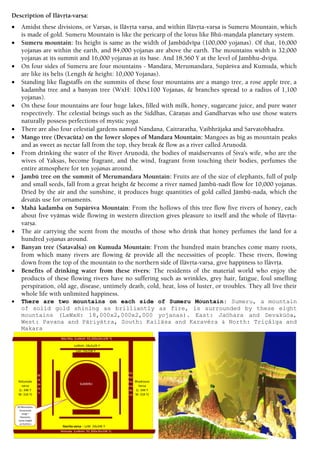
 Bhü-maëòala: In the lotus of Bhü-maëòala, the seven islands resemble as circular coverings, and
Jambüdvépa resembles as the whorl of that Lotus Flower.
 Bhü-maëòala ~ Lotus Flower; Seven Islands ~ Circular Coverings; Jambüdvépa ~ Whorl of the Lotus
Flower
 Jambüdvépa: The length and breadth of Jambüdvépa, which is situated in the middle of the whorl, are
100,000 yojanas. In Jambüdvépa there are nine divisions of land, each with a length of 9,000 yojanas
(with the exception of Ilävåta, Bhadräçva and Ketumälä). There are eight mountains that mark the
boundaries of these divisions and separate them nicely.
Description of the Divisions of Jambüdvépa
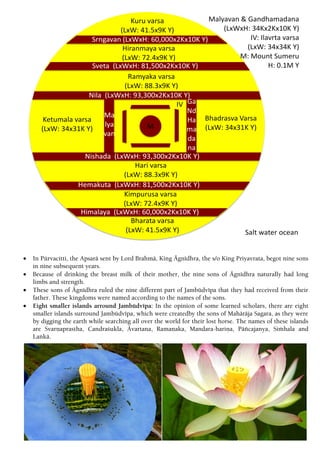
 Amidst these divisions, or Varñas, is Ilävåta varña, and within Ilävåta-varña is Sumeru Mountain, which
is made of gold. Sumeru Mountain is like the pericarp of the lotus like Bhü-maëòala planetary system.
 Sumeru mountain: Its height is same as the width of Jambüdvépa (100,000 yojanas). Of that, 16,000
yojanas are within the earth, and 84,000 yojanas are above the earth. The mountains width is 32,000
yojanas at its summit and 16,000 yojanas at its base.
 North of Ilävåta-varña: There are three mountains named Néla, Çveta and Çåìgavän (WxH:
2000x10000 Yojanas). Lengthwise, they extend east and west to the beaches of the ocean of salt water.
Going from south to north, the length of each mountain is reduced by one tenth that of the previous
mountain. These mark the borders of the three varñas named Ramyaka, Hiraëmaya and Kuru.
 South of Ilävåta-varña: There are three great mountains named (from north to south) Niñadha,
Hemaküöa and Himälaya (WxH: 2000x10000 Yojanas, length is same as above). They mark the
boundaries of the three varñas named Hari-varña, Kimpuruña-varña and Bhärata-varña.
 West of Ilävåta-varña: Mälyavän mountain (WxHxL: 2000x10000x34000 yojanas), extend as far as
Néla Mountain in the north and Niñadha in the south. It marks the border of Ilävåta-varña and
Ketumäla varsa
 East of Ilävåta-varña: Gandhamädana mountain (WxHxL: 2000x10000 x34000 yojanas), extend as far
as Néla Mountain in the north and Niñadha in the south. It marks the border of Ilävåta-varña and
Bhadräçva varña.
 The geographical details of these nive divisions of Jambüdvépa along with their measurements are
given below:
2
Break down of SB 5.16 A Description of Jambüdvépa
• SB 5.16.1-3: Questions by Parikstith Maharaja about the details of Jambhudvipa.
• SB 5.16.4-10: Jambhudvipa, Mount Sumeru and Varsas.
• SB 5.16.11-27: Ilavrta Varsa
• SB 5.16.28-29: Top of Mount Sumeru
 In Pürvacitti, the Apsarä sent by Lord Brahmä, King Ägnédhra, the s/o King Priyavrata, begot nine sons
in nine subsequent years.
 Because of drinking the breast milk of their mother, the nine sons of Ägnédhra naturally had long
limbs and strength.
 These sons of Ägnédhra ruled the nine different part of Jambüdvépa that they had received from their
father. These kingdoms were named according to the names of the sons.
 Eight smaller islands arround Jambüdvépa: In the opinion of some learned scholars, there are eight
smaller islands surround Jambüdvépa, which were createdby the sons of Mahäräja Sagara, as they were
by digging the earth while searching all over the world for their lost horse. The names of these islands
are Svarëaprastha, Candraçukla, Ävartana, Ramaëaka, Mandara-hariëa, Päïcajanya, Siàhala and
Laìkä.
Description of Ilävåta-varña:
 Amidst these divisions, or Varñas, is Ilävåta varña, and within Ilävåta-varña is Sumeru Mountain, which
is made of gold. Sumeru Mountain is like the pericarp of the lotus like Bhü-maëòala planetary system.
 Sumeru mountain: Its height is same as the width of Jambüdvépa (100,000 yojanas). Of that, 16,000
yojanas are within the earth, and 84,000 yojanas are above the earth. The mountains width is 32,000
yojanas at its summit and 16,000 yojanas at its base. And 18,560 Y at the level of Jambhu-dvipa.
 On four sides of Sumeru are four mountains - Mandara, Merumandara, Supärçva and Kumuda, which
are like its belts (Length & height: 10,000 Yojanas).
 Standing like flagstaffs on the summits of these four mountains are a mango tree, a rose apple tree, a
kadamba tree and a banyan tree (WxH: 100x1100 Yojanas, & branches spread to a radius of 1,100
yojanas).
 On these four mountains are four huge lakes, filled with milk, honey, sugarcane juice, and pure water
respectively. The celestial beings such as the Siddhas, Cäraëas and Gandharvas who use those waters
naturally possess perfections of mystic yoga.
 There are also four celestial gardens named Nandana, Caitraratha, Vaibhräjaka and Sarvatobhadra.
 Mango tree (Devacüta) on the lower slopes of Mandara Mountain: Mangoes as big as mountain peaks
and as sweet as nectar fall from the top, they break & flow as a river called Aruëodä.
 From drinking the water of the River Aruëodä, the bodies of maidservants of Çiva’s wife, who are the
wives of Yakñas, become fragrant, and the wind, fragrant from touching their bodies, perfumes the
entire atmosphere for ten yojanas around.
 Jambü tree on the summit of Merumandara Mountain: Fruits are of the size of elephants, full of pulp
and small seeds, fall from a great height & become a river named Jambü-nadé flow for 10,000 yojanas.
Dried by the air and the sunshine, it produces huge quantities of gold called Jämbü-nada, which the
devatäs use for ornaments.
 Mahä kadamba on Supärçva Mountain: From the hollows of this tree flow five rivers of honey, each
about five vyämas wide flowing in western direction gives pleasure to itself and the whole of Ilävåta-
varña.
 The air carrying the scent from the mouths of those who drink that honey perfumes the land for a
hundred yojanas around.
 Banyan tree (Çatavalça) on Kumuda Mountain: From the hundred main branches come many roots,
from which many rivers are flowing & provide all the necessities of people. These rivers, flowing
down from the top of the mountain to the northern side of Ilävåta-varña, give happiness to Ilävröa.
 Benefits of drinking water from these rivers: The residents of the material world who enjoy the
products of these flowing rivers have no suffering such as wrinkles, grey hair, fatigue, foul smelling
perspiration, old age, disease, untimely death, cold, heat, loss of luster, or troubles. They all live their
whole life with unlimited happiness.
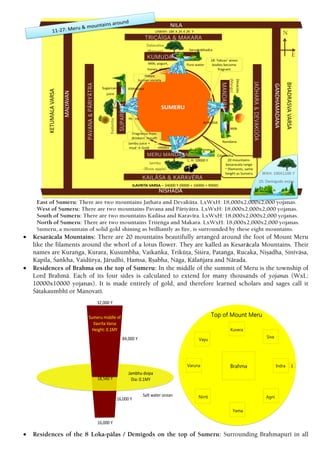
 There are two mountains on each side of Sumeru Mountain: Sumeru, a mountain
of solid gold shining as brilliantly as fire, is surrounded by these eight
mountains (LxWxH: 18,000x2,000x2,000 yojanas). East: Jaöhara and Devaküöa,
West: Pavana and Päriyätra, South: Kailäsa and Karavéra & North: Triçåìga and
Makara
 Kesaräcala Mountains: There are 20 mountains beautifully arranged around the foot of Mount Meru
like the filaments around the whorl of a lotus flower. They are kalled as Kesaräcala Mountains. Their
names are Kuraìga, Kurara, Kusumbha, Vaikaìka, Triküöa, Çiçira, Pataìga, Rucaka, Niñadha, Sinéväsa,
Kapila, Çaìkha, Vaidürya, Järudhi, Haàsa, Åñabha, Näga, Kälaïjara and Närada.
 Residences of Brahma on the top of Sumeru: In the middle of the summit of Meru is the township of
Lord Brahmä. Each of its four sides is calculated to extend for many thousands of yojanas (WxL:
10000x10000 yojanas). It is made entirely of gold, and therefore learned scholars and sages call it
Çätakaumbhé or Manovaté.
 Residences of the 8 Loka-pälas / Demigods on the top of Sumeru: Surrounding Brahmapuré in all
directions are the residences of the eight principal governors of the directions, beginning with King
Indra. These abodes are similar to Brahmapuré but are one fourth the size (WxL: 2500x2500 yojanas).
 Brahmä's township is known as Manovaté, and those of his assistants such as Indra, Agni, Yama, Niråti,
Varuëa, Väyu, Kubera, Çiva are known as Amarävaté, Tejovaté, Saàyamané, Kåñëäìganä, Çraddhävaté,
Gandhavaté, Mahodayä and Yaçovaté. Brahmapuré is situated in the middle, and the other eight purés
surround it in all 8 directions.
The Descent and the Flow of the River Ganges in Jambu-dvipa3
 When Vämanadeva extended His left foot to the end of the universe and pierced a hole in its covering
with the nail of His big toe, through the hole, the pure water of the Causal Ocean entered this universe
as the Ganges River.
 Having washed the lotus feet of the Lord, which are covered with reddish powder, the water of the
Ganges acquired a very beautiful pink color & she is known as Viñëupadé, Jähnavé and Bhägérathé.
 After one thousand millenniums, the water of the Ganges descended on Dhruvaloka (Viñëupada), the
topmost planet in this universe.
 The seven great sages [Maréci, Vasiñöha, Atri and so on] reside on planets beneath Dhruvaloka being
aware of the influence of the water of the Ganges, to this day they keep Ganges water on the tufts of
hair on their heads.
 Ganges water is carried through the space ways of the demigods in billions of celestial airplanes. Then
it inundates the moon [Candraloka] and finally reaches Lord Brahmä's abode atop Mount Meru.
 On top of Mount Meru, the Ganges divides into four branches, each of which gushes in a different
direction [east, south, west, & north]. These branches, known by the names Sétä, Alakanandä, Cakñu
and Bhadrä, flow down to the salt water ocean.
o Sétä: Brahmapuré -> peaks of the Kesaräcala Mountains -> Peak of Gandhamädana Mountain ->
Bhadräçva-varña -> ocean of salt water in the East.
o Cakñu: Brahmapuré -> peaks of the Kesaräcala Mountains -> Peak of Mälyavän Mountain ->
Ketumäla-varña-> ocean of salt water in the West.
o Bhadrä: Mount Meru -> Kumuda Mountain -> Mount Néla -> Çveta Mountain -> Çåìgavän
3
Break down of SB 5.17. The Descent of the River Ganges
• SB 5.17.1-10: Descent, glories and Path of Ganga
• SB 5.17.11-15: Description of 8 heavenly varsas
• SB 5.17.16-24: Lord Siva’s meditation of Lord Sankarshana
Mountain -> Kuru -> saltwater ocean in the north.
o Alakanandä: Brahmapuré [Brahma-sadana] -> peaks of Hemaküöa -> Himaküöa -> Bhärata-varña ->
ocean of salt water in the south. It is known as Jähnavé & Bhägérathé.
Benefits of Bathing in Ganges: Persons who come to bathe in this river are fortunate. It is not very difficult for
them to achieve with every step the results of performing great sacrifices like the Räjasüya and Açvamedha yajïas.
Description of 8 Heavenly Varsas (Bharata-Varsa Vs Other Varsas)
 Among the nine varñas, the tract of land known as Bhärata-varña is understood to be the field of karma
and the other eight varñas are known as “heaven on earth,” places to enjoy the remainder of pious acts
after leaving Svarga.
 Other eight Varñas according to the learned scholars and saintly persons declare to be meant for very
highly elevated pious persons. After returning from the heavenly planets, they enjoy the remaining
results of their pious activities in these 8 earthly varñas. They are known as heavenly places on earth
(bhauma-svarga-pada-ni).
Characteristics of the people in those eight Varsas:
 In these eight varñas, human beings like devatäs live ten thousand years according to earthly
calculations. They have the bodily strength of ten thousand elephants. They have wives who conceive
once in the last year of their lives. There the happiness is like that of Treta-yuga.
 Gardens filled with seasonal flowers and fruits
 Beautifully decorated hermitages.
 Enormous lakes with flowers & birds, between mountains
 DG leaders & their wives – enjoy in gardens; many servants.
 SP: Heavenly residents enjoy superior SG, but never forget their positions as eternal servants of SL, but
humans forget.
The Residents of different Varñas of Jambüdvépa, their Rulers and Preciding Deities
 To show mercy to his devotees in each of these nine tracts of land, the great Lord known as Näräyaëa
remains near his devotees in various forms.
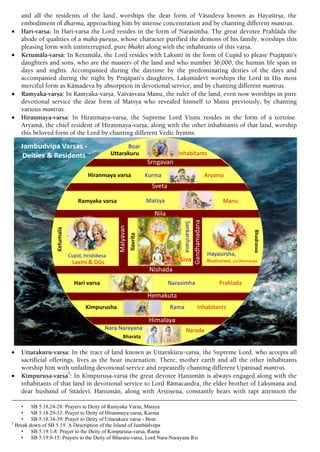
 Ilävåta-varña: In this land the only male person is Lord Çiva. Due to Durgä Devi’s curse no other male
exists there. In Ilävåta-varña, Lord Çiva is always encircled by ten billion maidservants of goddess
Durgä. Uttering different mantras in meditation, Lord Çiva worships Saìkarñaëa, his source, the
spiritual form in charge of ignorance, among the four forms of the Lord.
 Bhadräçva-varña4
: In Bhadräçva, Bhadraçravä, the son of Dharmaräja, accompanied by his descendants
4
Break down of SB 5.18. The Prayers Offered to the Lord by the Residents of Jambüdvépa
• SB 5.18.1-6: Prayer to Hayaçérña, deity of Bhadräçva varsa
• SB 5.18.7-14: Prayers to Deity of Hari-varsha, Narasimha
• SB 5.18.15-23: Prayer to the Deity of Ketumala, Kamadeva/ Pradyumna
and all the residents of the land, worships the dear form of Väsudeva known as Hayaçérña, the
embodiment of dharma, approaching him by intense concentration and by chanting different mantras.
 Hari-varña: In Hari-varña the Lord resides in the form of Narasiàha. The great devotee Prahläda the
abode of qualities of a mahä-puruña, whose character purified the demons of his family, worships this
pleasing form with uninterrupted, pure bhakti along with the inhabitants of this varña.
 Ketumäla-varña: In Ketumäla, the Lord resides with Lakñmé in the form of Cupid to please Prajäpati’s
daughters and sons, who are the masters of the land and who number 36,000, the human life span in
days and nights. Accompanied during the daytime by the predominating deities of the days and
accompanied during the night by Prajäpati’s daughters, Lakñmédevé worships the Lord in His most
merciful form as Kämadeva by absorption in devotional service, and by chanting different mantras.
 Ramyaka-varña: In Ramyaka-varña, Vaivasvata Manu, the ruler of the land, even now worships in pure
devotional service the dear form of Matsya who revealed himself to Manu previously, by chanting
various mantras.
 Hiraëmaya-varña: In Hiraëmaya-varña, the Supreme Lord Viñëu resides in the form of a tortoise.
Aryamä, the chief resident of Hiraëmaya-varña, along with the other inhabitants of that land, worship
this beloved form of the Lord by chanting different Vedic hymns.
 Uttarakuru-varña: In the tract of land known as Uttarakuru-varña, the Supreme Lord, who accepts all
sacrificial offerings, lives as the boar incarnation. There, mother earth and all the other inhabitants
worship him with unfailing devotional service and repeatedly chanting different Upaniñad mantras.
 Kimpuruña-varña5
: In Kimpuruña-varña the great devotee Hanumän is always engaged along with the
inhabitants of that land in devotional service to Lord Rämacandra, the elder brother of Lakñmaëa and
dear husband of Sétädevé. Hanumän, along with Arñöiñeëa, constantly hears with rapt attention the
• SB 5.18.24-28: Prayers to Deity of Ramyaka Varsa, Matsya
• SB 5.18.29-33: Prayer to Deity of Hiranmaya varsa, Kurma
• SB 5.18.34-39: Prayer to Deity of Uttarakuru varsa - Boar
5
Break down of SB 5.19. A Description of the Island of Jambüdvépa
• SB 5.19.1-8: Prayer to the Deity of Kimpurusa-varsa, Rama
• SB 5.19.9-15: Prayers to the Deity of Bharata-varsa, Lord Nara-Narayana Rsi
most auspicious glories of his master, sung by Gandharvas. Hanumän along with others worships the
Lord by canting various mantras.
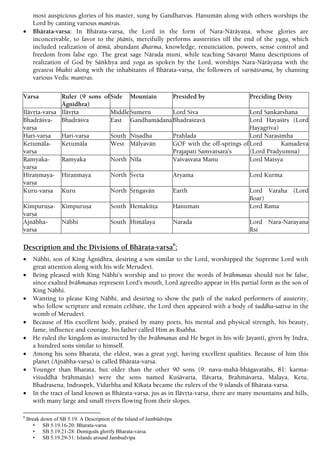
 Bhärata-varña: In Bhärata-varña, the Lord in the form of Nara-Näräyaëa, whose glories are
inconceivable, to favor to the jïänés, mercifully performs austerities till the end of the yuga, which
included realization of ätmä, abundant dharma, knowledge, renunciation, powers, sense control and
freedom from false ego. The great sage Närada muni, while teaching Sävarëé Manu descriptions of
realization of God by Säìkhya and yoga as spoken by the Lord, worships Nara-Näräyaëa with the
greatest bhakti along with the inhabitants of Bhärata-varña, the followers of varëäçrama, by chanting
various Vedic mantras.
Varsa Ruler (9 sons of
Ägnédhra)
Side Mountain Presided by Preciding Deity
Ilävåta-varña Ilävåta MiddleSumeru Lord Siva Lord Sankarshana
Bhadräçva-
varña
Bhadräçva East GandhamädanaBhadraçravä Lord Hayaçérñ (Lord
Hayagriva)
Hari-varña Hari-varña South Niñadha Prahlada Lord Narasimha
Ketumäla-
varña
Ketumäla West Mälyavän GOF with the off-springs of
Prajapati Samvatsara’s
Lord Kamadeva
(Lord Pradyumna)
Ramyaka-
varña
Ramyaka North Néla Vaivasvata Manu Lord Matsya
Hiraëmaya-
varña
Hiraëmaya North Çveta Aryama Lord Kurma
Kuru-varña Kuru North Çåìgavän Earth Lord Varaha (Lord
Boar)
Kimpuruña-
varña
Kimpuruña South Hemaküöa Hanuman Lord Rama
Ajnäbha-
varsa
Näbhi South Himälaya Narada Lord Nara-Narayana
Rsi
Description and the Divisions of Bhärata-varña6
:
 Näbhi, son of King Ägnédhra, desiring a son similar to the Lord, worshipped the Supreme Lord with
great attention along with his wife Merudevé.
 Being pleased with King Näbhi’s worship and to prove the words of brähmaëas should not be false,
since exalted brähmaëas represent Lord’s mouth, Lord agreedto appear in His partial form as the son of
King Näbhi.
 Wanting to please King Näbhi, and desiring to show the path of the naked performers of austerity,
who follow scripture and remain celibate, the Lord then appeared with a body of çuddha-sattva in the
womb of Merudevé.
 Because of His excellent body, praised by many poets, his mental and physical strength, his beauty,
fame, influence and courage, his father called Him as Åñabha.
 He ruled the kingdom as instructed by the brähmaëas and He begot in his wife Jayanté, given by Indra,
a hundred sons similar to himself.
 Among his sons Bharata, the eldest, was a great yogé, having excellent qualities. Because of him this
planet (Ajnäbha-varña) is called Bhärata-varña.
 Younger than Bharata, but older than the other 90 sons (9: nava-mahä-bhägavatäùs, 81: karma-
viçuddhä brähmaëäs) were the sons named Kuçävarta, Ilävarta, Brahmävarta, Malaya, Ketu,
Bhadrasena, Indraspåk, Vidarbha and Kékaöa became the rulers of the 9 islands of Bhärata-varña.
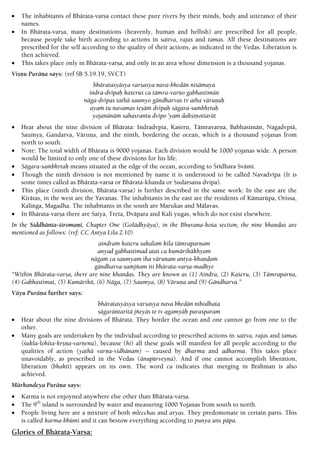
 In the tract of land known as Bhärata-varña, jus as in Ilävåta-varña, there are many mountains and hills,
with many large and small rivers flowing from their slopes.
6
Break down of SB 5.19. A Description of the Island of Jambüdvépa
• SB 5.19.16-20: Bharata-varsa
• SB 5.19.21-28: Demigods glorify Bharata-varsa
• SB 5.19.29-31: Islands around Jambudvipa
 The inhabitants of Bhärata-varña contact these pure rivers by their minds, body and utterance of their
names.
 In Bhärata-varña, many destinations (heavenly, human and hellish) are prescribed for all people,
because people take birth according to actions in sattva, rajas and tamas. All these destinations are
prescribed for the self according to the quality of their actions, as indicated in the Vedas. Liberation is
then achieved.
 This takes place only in Bhärata-varña, and only in an area whose dimension is a thousand yojanas.
Viñëu Puräëa says: (ref SB 5.19.19, SVCT)
bhäratasyäsya varñasya nava-bhedän niçämaya
indra-dvépaù kaçeruç ca tämra-varëo gabhastimän
näga-dvépas tathä saumyo gändharvas tv atha väruëaù
ayaà tu navamas teñäà dvépaù sägara-saàbhåtaù
yojanänäà sahasrantu dvépo ’yaà dakñiëottarät
 Hear about the nine division of Bhärata: Indradvpia, Kaçeru, Tämravarëa, Babhasimän, Nagadvpiä,
Saumya, Gandarva, Väruëa, and the ninth, bordering the ocean, which is a thousand yojanas from
north to south.
 Note: The total width of Bhärata is 9000 yojanas. Each division would be 1000 yojanas wide. A person
would be limited to only one of these divisions for his life.
 Sägara-saàbhåtaù means situated at the edge of the ocean, according to Çrédhara Svämé.
 Though the ninth division is not mentioned by name it is understood to be called Navadvépa (It is
some times called as Bhärata-varsa or Bhärata-khanda or Sudarsana dvipa).
 This place (ninth division, Bhärata-varña) is further described in the same work: In the east are the
Kirätas, in the west are the Yavanas. The inhabitants in the east are the residents of Kämarüpa, Orissa,
Kaliìga, Magadha. The inhabitants in the south are Marukas and Mälavas.
 In Bhärata-varña there are Satya, Treta, Dväpara and Kali yugas, which do not exist elsewhere.
In the Siddhänta-çiromaëi, Chapter One (Golädhyäya), in the Bhuvana-koça section, the nine khaëòas are
mentioned as follows: (ref: CC Antya Lila 2.10)
aindraà kaçeru sakalaà kila tämraparëam
anyad gabhastimad ataç ca kumärikäkhyam
nägaà ca saumyam iha väruëam antya-khaëòaà
gändharva-saàjïam iti bhärata-varña-madhye
“Within Bhärata-varña, there are nine khaëòas. They are known as (1) Aindra, (2) Kaçeru, (3) Tämraparëa,
(4) Gabhastimat, (5) Kumärikä, (6) Näga, (7) Saumya, (8) Väruëa and (9) Gändharva.”
Väyu Puräëa further says:
bhäratasyäsya varñasya nava bhedän nibodhata
sägaräntaritä jïeyäs te tv agamyäù parasparam
 Hear about the nine divisions of Bhärata. They border the ocean and one cannot go from one to the
other.
 Many goals are undertaken by the individual according to prescribed actions in sattva, rajas and tamas
(çukla-lohita-kåñëa-varëena), because (hi) all these goals will manifest for all people according to the
qualities of action (yathä varëa-vidhänam) -- caused by dharma and adharma. This takes place
unavoidably, as prescribed in the Vedas (änupürveyëa). And if one cannot accomplish liberation,
liberation (bhakti) appears on its own. The word ca indicates that merging in Brahman is also
achieved.
Märkandeya Puräëa says:
 Karma is not enjoyned anywhere else other than Bhärata-varña.
 The 9th
island is surrounded by water and measuring 1000 Yojanas from south to north.
 People living here are a mixture of both mlecchas and aryas. They predomonate in certain parts. This
is called karma-bhümi and it can bestow everything according to punya ans päpa.
Glories of Bhärata-Varña:
 That liberation, whose essential nature is unmotivated bhakti-yoga to the Lord full of qualities, takes
place by destruction of the knot of ignorance which causes various material goals, when there is
association with devotees of the Lord.
 The devatäs glorify the land of Bhärata-varña, because attaining birth there is suitable for service to
Mukunda. And the devatäs whant to know the kind of pious acts these residents perform or weather
the Lord simply pleased with them, by which they attaind birth there, whereas the devatäs can only
desire this, but not attain it?
 The devatäs further say: What is the use of our performing difficult sacrifices, vows of austerity and
acts of charity on earth, or attaining transient residence in heaven, where there is no remembrance of
the lotus feet of Näräyaëa or where the memory is carried away by excessive enjoyment of the senses?
 A moment’s stay in Bhärata is better than living for a kalpa on Brahmaloka, since on Brahmaloka one
must take birth again. Those who fix their minds on the Lord in Bhärata in a body subject to death, on
giving up all pious and impious acts, attain Vaikuëöha.
 Even Brahmaloka should not be accepted as a residence if there are no rivers of sweet topics about the
Lord, no devotees who take shelter of those topics, and no great festivals or sacrifices of chanting the
name of the Lord.
 Those who attain birth as humans in Bhärata, who are fully endowed with proper sense devatäs,
senses, and sense objects, but who do not endeavor for bhakti-yoga are again bound up, like birds
trapped by a hunter.
 The Lord is one only, but called by different names. Though complete in himself, he is the master of
blessings, and thus he happily accepts the pure offering of sacrifice along with materials, methods and
mantras which are offered to various devatäs¸ because of the bhakti.
 The Lord certainly gives desired objects to devotees who request them, but he does not give those
objects in such a way that the devotee will ask again after finishing his enjoyment. In other words, he
gives his lotus feet, which include all desirables, to those worshippers who do not even desire them.
 If we have pious credits remaining from performing sacrifices, chanting the Vedas, or performing
charitable acts, may those credits give us birth with remembrance of the Lord in Bhärata, since the
Lord distributes happiness to his devotees.
Depiction of Bhärata-varña
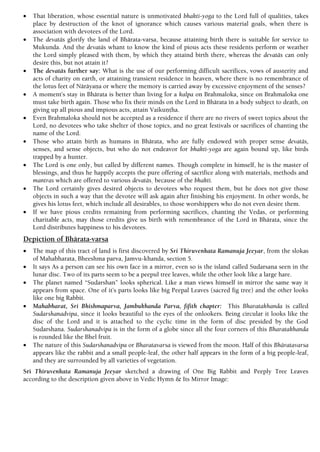
 The map of this tract of land is first discovered by Sri Thiruvenkata Ramanuja Jeeyar, from the slokas
of Mahabharata, Bheeshma parva, Jamvu-khanda, section 5.
 It says As a person can see his own face in a mirror, even so is the island called Sudarsana seen in the
lunar disc. Two of its parts seem to be a peepul tree leaves, while the other look like a large hare.
 The planet named “Sudarshan” looks spherical. Like a man views himself in mirror the same way it
appears from space. One of it’s parts looks like big Peepal Leaves (sacred fig tree) and the other looks
like one big Rabbit.
 Mahabharat, Sri Bhishmaparva, Jambukhanda Parva, fifith chapter: This Bharatakhanda is called
Sudarshanadvipa, since it looks beautiful to the eyes of the onlookers. Being circular it looks like the
disc of the Lord and it is attached to the cyclic time in the form of disc presided by the God
Sudarshana. Sudarshanadvipa is in the form of a globe since all the four corners of this Bharatakhanda
is rounded like the Bhel fruit.
 The nature of this Sudarshanadvipa or Bharatavarsa is viewed from the moon. Half of this Bhäratavarsa
appears like the rabbit and a small people-leaf, the other half appears in the form of a big people-leaf,
and they are surrounded by all varieties of vegetation.
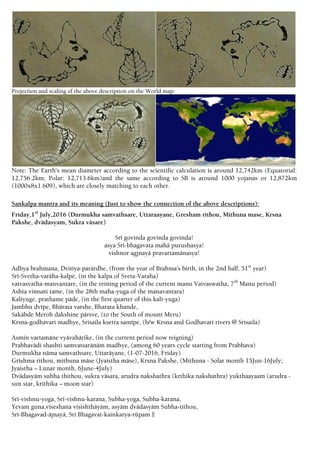
Sri Thiruvenkata Ramanuja Jeeyar sketched a drawing of One Big Rabbit and Peeply Tree Leaves
according to the description given above in Vedic Hymn & Its Mirror Image:
Projection and scaling of the above description on the World map:
Note: The Earth’s mean diameter according to the scientific calculation is around 12,742km (Equatorial:
12,756.2km; Polar: 12,713.6km)and the same according to SB is around 1000 yojanas or 12,872km
(1000x8x1.609), which are closely matching to each other.
Sankalpa mantra and its meaning (Just to show the connection of the above descriptions):
Friday,1st
July,2016 (Durmukha samvathsare, Uttaraayane, Gresham rithou, Mithuna mase, Krsna
Pakshe, dvädasyam, Sukra väsare)
Sré govinda govinda govinda!
asya Sré-bhagavata mahä purushasya!
vishnor agjnayä pravartamänasya!
Adhya brahmana, Dvitéya-parärdhe, (from the year of Brahma’s birth, in the 2nd half, 51st
year)
Sré-Svetha-varäha-kalpe, (in the kalpa of Sveta-Varaha)
vaivasvatha-manvantare, (in the reining period of the current manu Vaivaswatha, 7th
Manu period)
Ashta vimsati tame, (in the 28th maha-yuga of the manavantara)
Kaliyuge, prathame päde, (in the first quarter of this kali-yuga)
Jambhu dvépe, Bhärata varshe, Bharata khande,
Sakäbde Meroh dakshine pärsve, (to the South of mount Meru)
Krsna-godhavari madhye, Srisaila ksetra samépe, (b/w Krsna and Godhavari rivers @ Srisaila)
Asmin vartamäne vyävahärike, (in the current period now reigning)
Prabhavädi shashti samvatsaränäm madhye, (among 60 years cycle starting from Prabhava)
Durmukha näma samvathsare, Uttaräyane, (1-07-2016, Friday)
Gréshma rithou, mithuna mäse (Jyaistha mäse), Krsna Pakshe, (Mithuna - Solar month 15Jun-16July;
Jyaistha – Lunar month, 6June-4July)
Dvädasyäm subha thithou, sukra väsara, arudra nakshathra (krthika nakshathra) yukthaayaam (arudra -
sun star, krithika – moon star)
Sré-vishnu-yoga, Sré-vishnu-karana, Subha-yoga, Subha-karana,
Yevam guna,viseshana viñishthäyäm, asyäm dvädasyäm Subha-tithou,
Sré-Bhagavad-äjnayä, Sri Bhagavat-kainkarya-rüpam ||
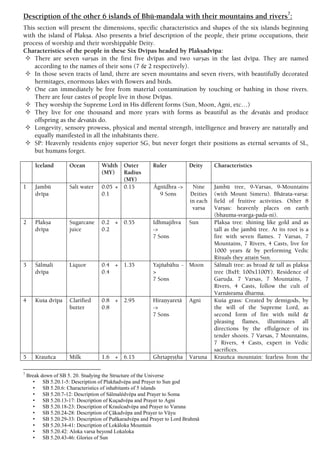
Description of the other 6 islands of Bhü-maëòala with their mountains and rivers7
:
This section will present the dimensions, specific characteristics and shapes of the six islands beginning
with the island of Plakña. Also presents a brief description of the people, their prime occupations, their
process of worship and their worshippable Deity.
Characteristics of the people in these Six Dvépas headed by Plakñadvépa:
 There are seven varñas in the first five dvépas and two varñas in the last dvépa. They are named
according to the names of their sons (7 & 2 respectively).
 In those seven tracts of land, there are seven mountains and seven rivers, with beautifully decorated
hermitages, enormous lakes with flowers and birds.
 One can immediately be free from material contamination by touching or bathing in those rivers.
There are four castes of people live in those Dvépas.
 They worship the Supreme Lord in His different forms (Sun, Moon, Agni, etc…)
 They live for one thousand and more years with forms as beautiful as the devatäs and produce
offspring as the devatäs do.
 Longevity, sensory prowess, physical and mental strength, intelligence and bravery are naturally and
equally manifested in all the inhabitants there.
 SP: Heavenly residents enjoy superior SG, but never forget their positions as eternal servants of SL,
but humans forget.
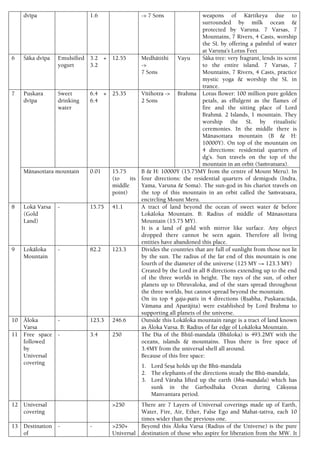
Iceland Ocean Width
(MY)
Outer
Radius
(MY)
Ruler Deity Characteristics
1 Jambü
dvépa
Salt water 0.05 +
0.1
0.15 Ägnédhra ->
9 Sons
Nine
Deities
in each
varsa
Jambü tree, 9-Varsas, 9-Mountains
(with Mount Simeru). Bhärata-varña:
field of fruitive activities. Other 8
Varñas: heavenly places on earth
(bhauma-svarga-pada-ni).
2 Plakña
dvépa
Sugarcane
juice
0.2 +
0.2
0.55 Idhmajihva
->
7 Sons
Sun Plakña tree: shining like gold and as
tall as the jambü tree. At its root is a
fire with seven flames. 7 Varsas, 7
Mountains, 7 Rivers, 4 Casts, live for
1000 years & by performing Vedic
Rituals they attain Sun.
3 Çälmali
dvépa
Liquor 0.4 +
0.4
1.35 Yajïabähu -
>
7 Sons
Moon Çälmalé tree: as broad & tall as plakña
tree (BxH: 100x1100Y). Residence of
Garuòa. 7 Varsas, 7 Mountains, 7
Rivers, 4 Casts, follow the cult of
Varnäsrama dharma.
4 Kuça dvépa Clarified
butter
0.8 +
0.8
2.95 Hiraëyaretä
->
7 Sons
Agni Kuça grass: Created by demigods, by
the will of the Supreme Lord, as
second form of fire with mild &
pleasing flames, illuminates all
directions by the effulgence of its
tender shoots. 7 Varsas, 7 Mountains,
7 Rivers, 4 Casts, expert in Vedic
sacrifices.
5 Krauïca Milk 1.6 + 6.15 Ghåtapåñöha Varuna Krauïca mountain: fearless from the
7
Break down of SB 5. 20. Studying the Structure of the Universe
• SB 5.20.1-5: Description of Plakñadvépa and Prayer to Sun god
• SB 5.20.6: Characteristics of inhabitants of 5 islands
• SB 5.20.7-12: Description of Sälmalédvépa and Prayer to Soma
• SB 5.20.13-17: Description of Kuçadvépa and Prayer to Agni
• SB 5.20.18-23: Description of Krauïcadvépa and Prayer to Varuna
• SB 5.20.24-28: Description of Çäkadvépa and Prayer to Väyu
• SB 5.20.29-33: Description of Puñkaradvépa and Prayer to Lord Brahmä
• SB 5.20.34-41: Description of Lokäloka Mountain
• SB 5.20.42: Aloka varsa beyond Lokaloka
• SB 5.20.43-46: Glories of Sun
dvépa 1.6 -> 7 Sons weapons of Kärtikeya due to
surrounded by milk ocean &
protected by Varuna. 7 Varsas, 7
Mountains, 7 Rivers, 4 Casts, worship
the SL by offering a palmful of water
at Varuëa’s Lotus Feet
6 Çäka dvépa Emulsified
yogurt
3.2 +
3.2
12.55 Medhätithi
->
7 Sons
Vayu Çäka tree: very fragrant, lends its scent
to the entire island. 7 Varsas, 7
Mountains, 7 Rivers, 4 Casts, practice
mystic yoga & worship the SL in
trance.
7 Puñkara
dvépa
Sweet
drinking
water
6.4 +
6.4
25.35 Vétihotra ->
2 Sons
Brahma Lotus flower: 100 million pure golden
petals, as effulgent as the flames of
fire and the sitting place of Lord
Brahmä. 2 Islands, 1 mountain. They
worship the SL by ritualistic
ceremonies. In the middle there is
Mänasottara mountain (B & H:
10000Y). On top of the mountain on
4 directions: residential quarters of
dg’s. Sun travels on the top of the
mountain in an orbit (Saàvatsara).
Mänasottara mountain 0.01 15.75
(to its
middle
point)
B & H: 10000Y (15.75MY from the centre of Mount Meru). In
four directions: the residential quarters of demigods (Indra,
Yama, Varuna & Soma). The sun-god in his chariot travels on
the top of this mountain in an orbit called the Saàvatsara,
encircling Mount Meru.
8 Lokä Varsa
(Gold
Land)
- 15.75 41.1 A tract of land beyond the ocean of sweet water & before
Lokäloka Mountain. B: Radius of middle of Mänasottara
Mountain (15.75 MY).
It is a land of gold with mirror like surface. Any object
dropped there cannot be seen again. Therefore all living
entities have abandoned this place.
9 Lokäloka
Mountain
- 82.2 123.3 Divides the countries that are full of sunlight from those not lit
by the sun. The radius of the far end of this mountain is one
fourth of the diameter of the universe (125 MY ~= 123.3 MY)
Created by the Lord in all 8 directions extending up to the end
of the three worlds in height. The rays of the sun, of other
planets up to Dhruvaloka, and of the stars spread throughout
the three worlds, but cannot spread beyond the mountain.
On its top 4 gaja-patis in 4 directions (Åñabha, Puñkaracüòa,
Vämana and Aparäjita) were established by Lord Brahma to
supporting all planets of the universe.
10 Äloka
Varsa
- 123.3 246.6 Outside this Lokäloka mountain range is a tract of land known
as Äloka Varsa. B: Radius of far edge of Lokäloka Mountain.
11 Free space
followed
by
Universal
covering
- 3.4 250 The Dia of the Bhül-mandala (Bhüloka) is 493.2MY with the
oceans, islands & mountains. Thus there is free space of
3.4MY from the universal shell all around.
Because of this free space:
1. Lord Çeña holds up the Bhü-mandala
2. The elephants of the directions steady the Bhü-mandala,
3. Lord Väraha lifted up the earth (bhü-maëòala) which has
sunk in the Garbodhaka Ocean during Cäkñuña
Manvantara period.
12 Universal
covering
>250 There are 7 Layers of Universal coverings made up of Earth,
Water, Fire, Air, Ether, False Ego and Mahat-tattva, each 10
times wider than the previous one.
13 Destination
of
- - >250+
Universal
Beyond this Äloka Varsa (Radius of the Universe) is the pure
destination of those who aspire for liberation from the MW. It
puresouls covering is beyond the jurisdiction of the modes of MN, and therefore it
is completely pure. Lord Kåñëa took Arjuna through this place
to bring back the sons of the brähmaëa.
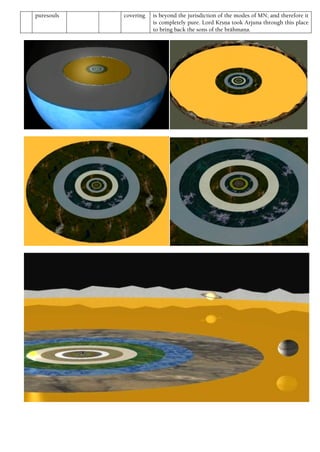
The Drawing of the Bhu-Mandala with all its divisions:
The Drawing of the Jambhu-Dvipa with all its divisions:
Some basic Calculations:
 Distance b/w the orbit of Sun & Mount Meru: 15.75 MY (Radius of middle of Mänasottara Mountain).
 The distance b/w middle of Sumeru & beginning of Lokäloka mountain: (15.75 + 9.6 + 15.75 =) 41.1
MY.
 Width of Lokäloka mountain: Diameter within the mountain range: 2x41.1 MY = 82.2 MY.
 Radius of far end of Lokäloka mountain: 1/4th
of the Dia of the Universe: 125MY (1 billion miles) ~=
123.3MY (= 41.1 + 82.2 MY)
 The diameter of the Bhü-mandala (Bhüloka) is 493.2 MY (R = 123.3 + 123.3 = 246.6 MY) with the
oceans, islands and mountains. There is thus a space of 3.4MY from the universal shell all around.
 Sun is situated [vertically] in the area b/w Bhürloka & Bhuvarloka (antarikña / outer space).
 Distance b/w Sun & the circumference of the universe on either side (above & below): 250 MY (2
billion miles)
The Structure of the Universe As per Srila Vädiraja Tirta’s “BHÜGOLA VARNANAM”
Identity (1480-1600): An Acarya in the Line of Madhva (1238–1317 CE):
 Among souls of divine inclination, there are several grades such as the best of humans, sages,
demigods, Sankara, Garuda and Sesa.
 There is a class of souls, higher than Garuda and Sesa; they only are eligible to occupy the post of
Caturmukha Brahma.
 During every Brahma Kalpa period of creation and sustenance, there will be two hundred such souls,
the one who has completed his training during 199 previous Brahma Kalpas, now occupying the seat
of Brahma.
 Next in the order of gradation, downward, are Vayu, Latavya, Gavya, Vaktavya, Jnatavya, and so on.
(Ref: Vamana purana).
 Saint Sri Vadiraja is the 198th, 'Latavya', in the upward scale of gradation. He is almost as good as the
199th
, Vayu, and during this (probation period ), he engages himself in the activities of Brahma and
Vayu, with their co-operation.
 The activities of these three souls are universal. They are everywhere and in everything living or non-
living, doing their jobs for them. Lord Sri Lakshmi-Narayana, the Supreme Being, is their Master.
 We are more likely to believe in autobiographies than in biographies penned by adorers. Saint Sri
Vadiraja has given us his autobiography in his text “Vrndavana Akhyanam”, containing 22 chapters.
 The wondrous part of it is that he was just known generally as a great saint and the greatest scholar of
Madhva sastra during his life time; but, sometime after he entered his Samadhi at the ripest age of
120, he entered the body of a born-dumb brahmin with his spiritual part, and dictated his
autobiography such that people might believe his words.
 This is history of the period of the famous Krishnadevaraya of Vijaya-nagar. There is monumental
evidence for all this if one cares to inspect.
 Saint Sri Vadiraja had the ability to go anywhere in the fourteen worlds and that he was honoured by
the Gods to whichever upper world he went and that he was fortunate enough to go to the Abode of
Sriman Narayana in “Sweta Dvipa”, where he was blessed by the fond embrace of the Supreme Lord.
 These details go to show that his 'Bhugola Varnanam' is not just a concept formed by the study of
puranas. He has given us first-hand knowledge of all the regions of the universe, which he visited and
saw actually.
 Knowledge of truth published by the sästras is tested with reference to visual perception, logic and
the Vedic literature (Pratyaksa, Anumäna and Ägama).
 To these is added what is known as ‘Äpta Väkya’ words spoken by reliable persons. Who else could be
a greater ‘Äpta’ or more reliable person than Saint Sri Vädiraja, saint of the highest order, the most
profound scholar, and one who had full mastery over spiritual powers?
 ‘Äpta Väkya', the word of a reliable person one who is well informed, discerning and has no intention
to cheat others. Therefore, Saint Sri Vadiraja's “Bhugola Varnanam” is ‘Apta Väkya’ for us. It is not
only reliable; it can stand the test of modern science by all counts.
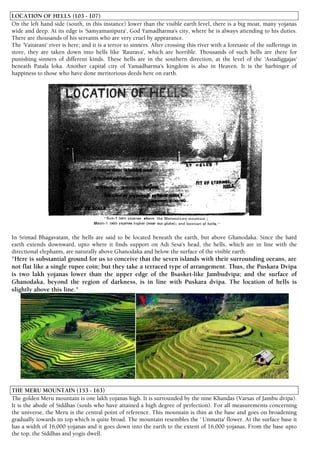
THE BRAHMANDA (14 - 17)
Brahmanda or the hollow golden shell containing the universe is fully round in every direction, east to west or
north to south. In it, twice its inner complement is Ghanodaka (solidified water) and the region of darkness is
circular in shape, lying as it does within the Ghanodaka stretch. It is twice as wide as the circular earth which
occupies the middle part. Upanisads describe the earth as ' Prithvi' that which is spacious with abundance of wealth
for living beings. The earth is said to stretch from sea to sea as the brahmin seers conceive it. It has the Meru
mountain at its very centre and it contains seven islands and seven oceans stretching around the Meru centre.
They are circular in form. The three together - earth, dark region and Ghanodaka - measure fifty crore yojanas from
end to end. This is factual and not fictitious.
MEASUREMENTS OF THE THREE REGIONS (in the ratio of 1:2:4) (14 - 17)
Of the three regions mentioned, the earth occupies a circular stretch having a diameter of seven crore yojanas.
Being double that in stretch, the region of utter darkness measures fourteen crore yojanas. Considering the stretch
of Ghandodaka as being twice that of the dark region, it measures twenty eight crore yojanas. From the Meru
centre, the earth measures 3 1/2 crore yojanas in all directions. The region of darkness and the Ghanodaka region
measure 14 crore and 28 crore respectively putting the opposite parts together. Therefore each of the opposite parts
measure only half of the said count.
• Central Earth: 71.43MY; (W: 71.43MY; Router: 35.71MY)
• Dark Region: 142.86MY; (W: 71.43MY; Router: 107.14MY)
• Ghandodaka: 285.71MY (W: 142.86MY ; Router: 250.00MY)
THE TERRESTRIAL REGION (55 - 58)
Basing our concept on the measurements indicated here-to-fore, the earth should be understood as consisting of the
seven islands and the seven oceans, the middle most island Jambudvipa measuring one lakh yojanas, and each of
the outer islands being twice as large as their inner complements. Similarly, the seven surrounding oceans too
should be considered. Thus, the diameter of the circular earth measures 5 crore and 7 lakh yojanas upto the
encircling land of gold, which itself is surrounded by the land of diamond.
The last two are known as 'Antyadhyardha sthala 1 This point will now be discussed.
ANTYADHYARDHA STHALA (Land of gold and land of diamond)
With reference to the location of Lokaloka parvata (which surrounds the entire terrestrial region) the measurement
of earth other than 'Brahma bhumi ' is said to be 6.08 crore yojanas. To reach the full measurement of 7.14 crore
yojanas, we still require 1.06 crore yojanas. The measurement given for the region around Suddhodaka ocean being
1.28 crore yojanas, the land of gold should therefore measure 64 lakh yojanas on each side.
"Adhyardha" does not actually mean half; but it means 'with a little addition to half. Therefore, a little more than
half of 64 should be taken as 42 instead of 32 in order to satisfy the scriptural statement.
If this procedure is followed, the total measurement will be:
i) Earth with seven islands and oceans - 5.07 crore
ii) Land of gold, both opposite sides - 0.64 & 0.64 crore
iii) Land of diamond, both sides - 0.42 & 0.42 crore
Total: 7.19 crore yojanas
The excess of 5 yojanas {7.19-7.14 = 0.05) should be assigned to Brahma bhumi extending beyond 'Vajralepa' (Land
of diamond) and forming part of the foot of the Lokaloka mountain just a fringe of it.
ANDHANTAMAS (Region of complete darkness) (79 -83}
The pit of darkness known as 'Andhantamas' is situated below the earth level, sunk in Ghanodaka. This region
surrounds the Lokaloka parvata and is termed as 'Adhogati' or the downward path. Because 'Andnantamas' is below
the level of Ghanodaka, it is possible for sinners to go down into it to some extent and to come up again. That they
go down and come up has been stated by Sri Vyasa maharshi, the author of Brahma Sutras.
The pit of darkness is very very deep. Sinners, who deserve greater punishment than what they may suffer in the
ordinary hells, are made to go down into the pit of darkness to some extent and they come up. But those, who are
thrown down into the lower parts known as "Tamas*, 'Maha Tamas* and 'Andhantamas*, never come up. They are
the third kind of souls who are doomed to suffer in the eternal hells.
The principle of darkness extends even higher than the Lckaloka parvata which is 51 lakh yojanas high. It is
petrified darkness like water turned into ice. If it were not so, where was the need for Sri Krsna, Lord of the Yadus,
to create a tunnel through it by means of his Cakra (disc weapon)?
THE NETHER WORLDS (93 - 98)
Within the hollows of the earth down below are seven worlds ranged one below the other. They are Atala, Vitala,
Sutala, Talatala, Mahatala Rasatala and Patala. Each of these is 10,000 yojanas in extent (width and height). Thus
they occupy a total area of 70,000 yojanas. The Meru mountain has its base into the earth to the extent of 16,000
yojanas. The gaps between the seven nether worlds make a total of 3000 yojanas (500 yojanas in each case). The
earth extends still further below to a depth of 11 thousand yojanas, it is all rocky in nature. (16+70+3+11 = 100
thousand yojanas)
[In Srimad Bhagavatam, the eight directional elephants (Asta diggajas) are said to be standing beneath Patalaloka,
supporting the worlds above them. Evidently, their location should be within the range of the last mentioned
11,000 yojanas.]
ADI SESA (99 - 102)
Adisesa is worshipped by all the serpents of Patala loka. He has his situation in the Ghanodaka down below; and he
is immortal. He finds himself supported by 'Vayu Kurma' Mukhya Prana in tortoise form; Adi Sesa's tail rests
thereon. He is quite strong. Lifting one of his thousand hoods, he supports the worlds above him so that the earth
does not sink into Ghanodaka. Hence he is hailed as "Sarva loka dhurandharah".
The earth is not just a globe of 8000 miles in diameter, going round the sun. In fact, it does not move at all. It has a
stretch of 30 crore miles (50MY - 7 Dvipas & 7-Oceans), with the Meru mountain at the centre and the nether
worlds beneath. The gravitational force is towards 'Visnu Kurma' who supports the Brahmanda with the whole
universe within it. Gravitational force is nothing but the will of the Omnipotent Lord working through material
bodies. God's ways are wonderful, not easily understood just by human intellect. He has huge forms as well as
forms which are more minute than the minutest. The "Visnu Kurma' form enters into the various 'Vayu Kurma'
forms giving gravitational forces to all things big and small, according to their masses.
Adi Sesa by himself, is not competent to support the worlds. His strength is derived from the Supreme Lord
Samkarsana, whom he worships in his heart. The space occupied by Adi 'Sesa on Ghanodaka is 99,000 yojanas.
[In fact, the Serpent form supporting the worlds is Lord Samkarsana Himself; and He is known as 'Ananta'. Adi Sesa
is only like a tool in the hands of a master.]
LOCATION OF HELLS {103 - 107)
On the left hand side (south, in this instance) lower than the visible earth level, there is a big moat, many yojanas
wide and deep. At its edge is 'Samyamanipura', God Yamadharma's city, where he is always attending to his duties.
There are thousands of his servants who are very cruel by appearance.
The 'Vaitarani' river is here; and it is a terror to sinners. After crossing this river with a foretaste of the sufferings in
store, they are taken down into hells like 'Raurava', which are horrible. Thousands of such hells are there for
punishing sinners of different kinds. These hells are in the southern direction, at the level of the 'Astadiggajas'
beneath Patala loka. Another capital city of Yamadharma's kingdom is also in Heaven. It is the harbinger of
happiness to those who have done meritorious deeds here on earth.
In Srimad Bhagavatam, the hells are said to be located beneath the earth, but above Ghanodaka. Since the hard
earth extends downward, upto where it finds support on Adi Sesa's head, the hells, which are in line with the
directional elephants, are naturally above Ghanodaka and below the surface of the visible earth.
"Here is substantial ground for us to conceive that the seven islands with their surrounding oceans, are
not flat like a single rupee coin; but they take a terraced type of arrangement. Thus, the Puskara Dvipa
is two lakh yojanas lower than the upper edge of the Bsasket-like Jambudvipa; and the surface of
Ghanodaka, beyond the region of darkness, is in line with Puskara dvipa. The location of hells is
slightly above this line."
THE MERU MOUNTAIN (153 - 163)
The golden Meru mountain is one lakh yojanas high. It is surrounded by the nine Khandas (Varsas of Jambu dvipa).
It is the abode of Siddhas (souls who have attained a high degree of perfection). For all measurements concerning
the universe, the Meru is the central point of reference. This mountain is thin at the base and goes on broadening
gradually towards its top which is quite broad. The mountain resembles the ' Unmatta' flower. At the surface base it
has a width of 16,000 yojanas and it goes down into the earth to the extent of 16,000 yojanas. From the base upto
the top, the Siddhas and yogis dwell.
Meru Mountain " with Brahma's abode at the top
At the top, the mountain has a width of 32,000 yojanas. It is round at the top and three sided at its base (like the
cornered base of a nail). From the base to the top the mountain measures 84,000 yojanas. The circumference at the
top is 96,000 yojanas (in round figures). There, in the middle, is the city of Brahma, known as 'Stakaumbhi'. Its
palatial mansions are beautified with rare gems. The city is 10,000 yojanas long and equally broad.
There, the Gandharva chiefs, the prominent ones among the Siddhas, sages like Vasista and gods headed by Indra
worship Brahma seated on the throne of gems. At the edges of the Meru top there are eight cities of the directional
gods, one in each of the eight directions. The Meru mountain supports them all.
THE RIVER GANGA (164 - 171)
River Ganga pours down constantly in the open courtyard of Brahma's palace such that he might use the waters for
his 'Sandhya vandana' (worshipping Surya Narayana thrice a day morning, afternoon and evening). The other gods
there, also use it. By Brahma's behest the river Ganga takes four courses to come down to earth from the Meru top
and to purify the denizens here. Even now we can see it. The branch ' Sita' joins the sea (Lavana Samudra) on the
east. "Alakananda" pours into the southern sea and is quite famous as the purifier of the world. The branch 'Caksu'
reaches the western sea and 'Bhadra' joins the northern sea. This river purifies those who use its waters in
worshipful manner where ever they be in the four quarters (of Jambudvlpa). The river was again brought to our
earth in another form by the efforts of Bhaglratha. This river is called 'Mandakini' in the Himalayas. When it began
to pour down in the Himalayan region, Siva locked it up in the meshes of his knotted hair. (This was to mitigate the
force with which Ganga came down; hence the name 'Mandakini'). Being let down from the knotted hair and
following Bhaglratha the fresh flow of waters joined the original course of the river; and after crossing the point at
'Devaprayaga', the river went down into the bowels of the earth to reach 'Kapila asrama' in the nether world to
sanctify the ashes of the 60,000 sons of Sagara cakravarti, burnt down by the angry look of Sage Kapila.
[The GangS river flows in visible and invisible forms (Rupantarena vahati), it is also in the form of the stars of the
Milky Way ('Aka'sa Ganga')].
ILAVRTA KHANDA (171 - 183)
This Khanda (Varsa) spreads around the Meru base which measures 9000 yojanas from its centre, in every
direction. There are four supporting mountains on each of the four sides around the base. These mountains are
each 2000 yojanas wide and 10,000 yojanas high. Beyond these mountains there is a stretch of 5000 yojanas, and
this makes up the 9000 yojanas from the Meru base.
The four supporting mountains are Mandara, Merumandara, Kumuda and Suparsva, in the four directions
commencing from the east. There are four gigantic trees on the four mountains Cuta (mango), Jambu (rose apple
tree), Plaksa (indian fig) and Nyagrodha (banyan) respectively. Each of these trees is 100 yojanas high and the
spread of the branches is to the extent of 1100 yojanas. The fruits of the trees resemblemountain peaks.
The Meru at the centre and the nine Varshas. lllavnta (Middle) Bhadrasva (east) Ketumala (West) Ramyaka,
Hiranmaya and Uttara Kuru (north); Hanvarsha, Kimpurasha Varsha and Bharatha Varsha (South).
The ripe jambu fruits of the tree upon Merumandara (south) drop down and the juice flows as the Jambu river. The
juice spreading on its banks, when dried up, becomes the finest gold which is known as 'Jambunada'. The divine
beings, who visit this region, drink the juice and make different kinds of ornaments for themselves out of
'Jambunada' (gold).
[Taking into account half of the Meru base and adding the width of the supporting mountain on any of the four
sides, the total will be 10000 and there should remain another 7000 yojanas, not 5000, because the Ilavrta Khanda
measures 34,000 yojanas from end to end. Perhaps, we have to allow a gap of 2000 yojanas between the Meru base
and the supporting mountains (Kiladris). We should, however, make provision for another round of mountains,
not mentioned in this text. According to Srimad Bhagavatam, there are eight mountains, each 9000 yojanas long;
and two of them placed on each side. Since they are compared to the 'Kusa' grass bundles put around the sacrifical
altar, each of the two mountains should be in a continuous line, with' some gap or no gap between them. Evidently
their location is within the range of 5000 yojanas indicated above. Srlmad Bhagavatam is the authoritative text
which tells us about Cosmography; and information gathered from any other source should be in accordance with
it. That is what Acarya Madhva says:
"Yatha bhagavatetu uktam bhauvanam ktfsa laksanam, Tasya avirodhato yojyam anya granthantare sthitam"]
BHADRASVA KHANDA (183 - 193)
The eastern part of Jambudvipa is occupied by only one Varsa, the Bhadrasva. There are two other boundary
mountains within the Khanda, Jatara and Devakuta, to the east of Gandhamadana. The two mountains extend
between Nila and Nisadha, each being 2000 yojanas wide. Barring the space occupied by the three mountain ranges
(Gandhamadana, Jatara and Devakuta) the Bhadrasva Varsa measures 27 thousand yojanas from west to east.
Although Bhadrasva is a single Varsa, the two extra mountain barriers mentioned, have been created by the
Omnicient Lord to maintain symmetry on all the four sides. A similar arrangement is there in the western Varsa.
With the two additional mountain ranges the Bhadrasva Khanda is divided into three stretches, each nine thousand
yojanas in width. It should be thus construed because it is said in the texts that each of the nine Khandas of
Jambudvipa is 9000 yojanas in width. Symmetry is thus maintained.
KETUMALA VARSA (208 -213)
On the western part of Jambu dvlpa there only one varsa, the Ketumala {resembling the Bhadrasva on the east).
This extends upto the sea on its west. Here too, as in Bhadrasva Varsa, there are two extra mountains in proper
positions, maintaining the 9000 yojanas measure regarding the widths of the Varsas. Pavana and Pariyatra are the
two mountains. Lord Sri Hari has created them to make the island look symmetrically beautiful.
[The last sentence of the above Paragraph speaks of the artistic sense of Saint Sri Vadiraja; and it also pays a humble
tribute to Sri Maha Visnu, the Artist of artists.]
"Ground plan of Jambudvip"
THE THREE SOUTHERN VARSAS (193 - 208)
To the south of the mighty Nisadha mountain lies the Hari Varsa Khanda. Its boundary mountain on the south is
Hemakuta, 2000 yojanas wide and 10,000 yojanas high. (Its length is 10% less than that of Nisadha. Therefore, it is
90,000 yojanas in length). To the south is Kimpurusa Varsa, 9000 yojanas in width. It is bounded on its south by
the Himavan mountain, similar to Hemakuta in breadth and height. The length is less by 10,000 yojanas (in round
figures) on account of the circular shape of Jambudvipa and the ocean surrounding it. Then comes Bharata Varsa
(to the south of the Himavan mountain), having the same width as that of the neighbouring Varsa. It stretches upto
the ocean on the southern side. This is the Varsa that provides opportunities for human beings to earn merit.
On a peak of the Himavan mountain, the sacred 'Badarikasrama' is situated. Here, Narayana with Nara (Lord Nara-
Narayana) is worshipped by expert yogis. Sage Narada and the seven rsis too worship Nara-Narayana, day after day.
It is here too that the Lord in the form of Vedavyasa is served by Acarya Sri Madhva, the third 'avatara' of Sri
Vayudeva. There are many other 'munis' following his example.
[The Himavan mountain referred to is the boundary mountain between Kimpurusa Varsa and Bharata Varsa - 2000
yojanas wide, 10,000 yojanas high and 80,000 yojanas long. But, the Himalaya mountain with which we are familiar
is only 50 yojanas (300 miles) wide, 1 yojana (5.5 miles, wrt sea level) high, and 330 yojanas (2000 miles) long. Its
location is in 'Dandakaranya' of Bharata Khanda (our globe), which forms just a big lump at the sourthern edge of
Bharata Varsa, which has a width of 9000 yojanas (60000 miles in round figures). The Badarikasrama and the Kilas
in our Himalaya are only mini prototypes. Then, when it is said that Acarya Sri Madhva flew off from Anu Badari to
Maha Badari, it means that he took a jump from our Himalaya to the bigger Himalaya covering a distance of 96,000
km (10,000Y in height, this is the height of bigger Himalayas). This is nothing to be marvelled at in the case of our
Acarya who is the avatar of Vayudeva, who enters into every one of the activities of this universe.]
LAVANA SAMUDRA (227-229)
The Jambudvipa is vast containing as it does the nine varsas. Having the golden Meru mountain at its centre, it is
the midmost island, with a diameter of one lakh yojanas. It is surrounded by the 'Lavana Sarnudra' (Ocean of
blackish water), the width of which is also one lakh yojanas (six lakh miles in round figures,)
[Before proceeding further to learn about the other six islands surrounding Jambudvipa, it is necessary to have a
clear concept of Bharata Varsa and Bharata Khanda which form parts of that island. We know that Bharata Varsa is
the southernmost division with the bigger Himalaya as its northern boundary and having a width of 9000 yojanas
(55,000 miles).
"Jambudvipa should be considered as being basketlike in shape for obvious reasons. It has an altitude
of one lakh yojanas."
This statement may be supported by the following argument:
The island is circular. The orbits of the sun and the moon are almost in line with the Equator of
Bharata Khanda, our globe. This is corroborated by the words of Srimad Bhagavatam which speaks of
the sun's 'Udagayana' (northern course), Daksinayana (southern course) and 'Vaisuvadayana' (course
corresponding to the celestial equator). The orbit of Rahu is said to be 10,000 yojanas (60,000 miles)
lower than that of the sun. Birds like garuda (white-breasted eagle) and swan and syena (hawk) are
said to fly in regions still farther down below. All these are not possible if the entire earth, 300 million
miles (50MY - 7Ocens & 7Dvipas) wide, should be entirely flat. It must therefore have higher and
lower parts, Jambudvipa being at the highest level. Our globe, Bharata Khanda, is percked at the
southern edge of the basket-like Jambudvipa. It is not a planet going round the sun. This concept is
substantiated by the statement of one, Sri Anantharamu of Bangalore, who had joined the crew of the
first Indian Antarctic expedition. He says that the south pole region projects downwards like a cone.
He also says that this region has not been properly surveyed. Therefore it is indeed a fiat lie to say that
the south pole region is slightly flat like north pole region.]
Bharatavarsha with Bharatha Khanda at the Edge & Bharata Khanda - Oblique directions of Satellites
THE OTHER SIX ISLANDS (230 -241)
Surrounding the Lavana Samudra there is the 'Plaksa' island (which is so called because it abounds with Plaksa trees
indian fig trees of gigantic size). It is double the width of the ocean of brackish waters (two lakh yojanas). Of
similar width is the 'Iksu Samudra' (ocean of waters with the taste of sugarcane juice) around Plaksadvlpa. It is
populated by Siddhas (the highly qualified souls).
Around it is the "Salmala dvipa, four lakh yojanas in width and the 'Sura Samudra' (of wine-like waters), of the
same width, spreads around it. After that is ' Kusadvlpa' (where Kusa grass clusters grow very very tall like blazing
pillars). It has double the width of 'Salmala dvipa'. It is surrounded by 'Sarpi Samudra' (ocean of waters with the
qualities of ghee) having the same width. Then we have 'Krauncha dvipa' (which derives its name from the
mountain of the same name). This island and the 'Dadhi Samudra' (with waters of yogurt quality) have double the
widths of their inner complements. Each of these is 16 lakh yojanas wide. The next is ''Saka dvipa' surrounded by
'Ksira Samudra' (ocean of milk-like waters), each 32 lakh yojanas in width. The last of the seven islands is 'Puskara
dvipa' (island of huge lotus flowers of gold), 64 lakh yojanas wide. It is surrounded by the ocean of pure waters
'Subhodaka Samudra' having the same width. The entire earth is surrounded by the land of gold 'Hema bhumi',
along with the adjoining land of diamond 'Vajralepa'.
"Seven Islands and Sevan Oceans, Surrounded by Loka-aloka Parvata"
The Lokaloka Mountain goes round the whole stretch of earth described so far. The limit of the earth is marked by
this mountain ring. In this way the earth spreads round the Meru centre on all sides and it is there to provide all the
needs of living beings including the divine class, the sages, the manes, the sovereigns as well as human beings. This
earth provides happy conditions to one and all. The presiding goddess, 'Bhudevi' is most dear to Lord Sri Narayana.
The earth is plentiful with all kinds of plant life and holy forests, crowded with the hermitages of 'munis' (sages).
Rivers with holy waters are also there. Mother earth keeps its living beings happy and contented. There are rich
mines containing precious and useful metals and the rarest gems. It is for this reason that the earth gets its name
'Vasundhara'. She is indeed the mother of the world displaying proverbial quality of forbearance. Being seated on
the lap of Lord Varaha, she looks quite pretty.
[Saint Sri Vadiraja has given a breif but precise description of the features of Brahmanda, not with a view
to duplicate the details found elsewhere; but it is to say things without leaving room for doubts regarding
locations, measurements and such other things. The way in whick the text is prepared indicates that there
must have been a good deal of confusion in the minds of the learned men of his days. He has removed
misapprehensions in the clearest manner. In a concluding verse he himself says that it is so:
"Vakyartha kathana vyifja't bhugolam iti varnitam".]
Notes from Srila Vadiraja Tirta’s “BHUGOLA VARNANAM”
Why Mount Meru, Bigger Himalayas & Jambhu-dvipa are not seen by us?
 The upper worlds and even the neighbouring regions of our globe (perched at the southern edge of
Jambudvipa) are all invisible to our eyes and to our instruments because they differ in composition
although the entire universe is composed of the same elements. It is said in the puranas "Adrsya
dhatavab sarve samutpanna jala adayah".
 The question of questions is:
– "Will our scientists ever get over the human tendency of succumbing to pride and prejudice in
order to know the truth?
– Will they use a little introspection to shift from the mere physical to the spiritual?
 Let the wise ones build up a growing community to save the world from the darkness of materialism.
Let them hold the torch of spiritual light and let there be a Renaissance of religious culture based on
Revelations.
How to understand it? (Ref: ANNEXURE 5 – Pancikarana “Creation of Gross matter by 'Alodana' or
Chemical combination”)
 Within the Brahmanda, the five gross elements are created by 'Alodana' (or the 'big bang‘) into which
modern scientists have had a good peep, but have failed to go much beyond the sky.
 The sky itself is created by a process known as * Panchikarana ' (chemical combination) 120 parts of
sabda tanmatra being combined with 20 parts of each of the other tanmatras.
 Similarly, air, fire, water and earth are created. These five are only gross elements appearing in the
form of the ‘NEBULE' of modern science.
 Inside the shell of Brahmanda ‘Ganda Tanmatra' principle is concentrated.
 Contents of Brahmanda: Five subtle material principles, the 'Tanmatras‘, dissolved in the watery
principle entering into Brahmanda.
 Watery principle concentrated as hardened water (Ghanodaka or Garbhodaka) to fill the lower half of
the hallow shell. the upper half remaining as Subtle Sky.
 Earth: Formation of mineral salts, etc., settling down to occupy the middle part of the surface of the
hardened subtle waters. The formation of earth (48 crore km in dia) in geologistic and artistic manner
is the hand of God.
 All this is Vedic information, not scientific guess.
 We speak of suns and solar systems within the millions of galaxies. Have the scientists found at least
one more solar system within our own galaxy?
 We also speak of galaxies of different types. Are there any galaxies seen in the southern celestial
hemisphere except the two Megallanic clouds?
 If not, what is beyond there to the south?
 For the information of scientists it may said
– What looks like a galaxy is just a cluster of millions of divine vehicles in the form of stars, racing at
unimaginable velocities around the upper worlds.
– There are starlike planets, the abodes of Yaksas, Guhyas and the like, in the southern sky upto a
certain extent.
 Excepting the agnostics among scientists, who have built up prejudicial complexes in themselves, all
other great scientists have admitted the limitations of human knowledge and have declared that the
mystery about the "beginning' is ever a mystery for them.
SP’s Viewpoint: Just hear from SB; No experiments!
 Mountains on earth Vs. Universe (Measurements never matches to each other)
 (i) Be satisfied with the statements of authorities &
 (ii) Appreciate how Lord’s external energy manifests the cosmos!
 Our experimental knowledge can neither verify nor disprove the statements of SB.
References in relation to Jambhu-dvipa and Bhärata-varña
 SB 1.12.5-6: “… jambüdvépädhipatyaà ca …” – Yudhiñöhira Mah & Pandavas
 SB 1.16.13: “bhadräçvaà ketumälaà ca bhärataà cottarän kurün; kimpuruñädéni varñäëi vijitya jagåhe
balim” – Pariksith Maharaj
 SB 4.6.23: At the foot of Kailäsa, demigods saw Alakäpuri & Saugandhika forest
 SB 4.10.5: “rudränucara-sevitäm dadarça himavad-droëyäà” – Dhruva Maharaj
 Ramayana: Monkeys on Eastern direction-Golden Land & Madhvacharya recently
 SB 9.1.25-26: At Meru’s foot in Sukumära forest, Sudyumna become a woman.
 SB 9.2.26: “tasyävékñit suto yasya maruttaç cakravarty abhüt” – King Marutta
 SB 9.4.15-16: “ambaréño mahä-bhägaù sapta-dvépavatéà mahém” – Ambarish Mah
 SB 9.6.34: “sapta-dvépavatém ekaù çaçäsäcyuta-tejasä” – King Mandata
 SB 9.8.4: “sagaraç cakravarty äsét sägaro yat-sutaiù kåtaù” – King Sagara
 SB 9.11.6: “aprattaà nas tvayä kià nu bhagavan bhuvaneçvara” – Lord Rama
 SB 9.19.23: “bhü-maëòalasya sarvasya pürum arhattamaà viçäm” – King Püru
 Note: Ambaréña was the emperor of the seven islands and then Püru, s/o Yayati, became the next
emperor. When the members of moon dynasty become emperors of 7-islands, then the members of
sun dynasty become the kings of Bhärata-varña
 SB 9.20.23: “pitary uparate so 'pi cakravarté mahä-yaçäù” Bharatha, s/o Duñmanta
 SB 9.23.24: “arjunaù kåtavéryasya sapta-dvépeçvaro 'bhavat” – Kärtavérya Arjuna
End of Part I
Part2: Fourteen Planetary Systems ‘Vertical Structure of the Universe’
 Ch 21-22: The Zodiac - Movement of Sun, Moon & other Grahas
 Ch 23: Description of Dhruvaloka, the Form of the Dolphin and the Upper Planets
 Ch 24-25: Description of the Lower Planets (places below the Sun)
 Ch 26: Description of Hellish Planets
The Movements of the Sun, Moon and Other Planets8
The Sun god:
The sun is situated (vertically) in the middle of the universe, in the area between Bhürloka and
Bhuvarloka, which is called antarikña (measuring 200,000 yojanas), outer space. The distance between the
sun and the circumference of the universe (above and below) is 250 Million Yojanas
The sun is known as Märtaëòa because he entered the unconscious universe. The sun is the totality of
jévas with subtle covering Hiraëyagarbha. Thus he is called as Hiraëyagarbha, because he is the very
existence of the gross body of the universe called the hiraëyäëòa, the golden egg.
The directions, sky, the heavens, and earth and other divisions, as well the places of enjoyment, liberaton
and hell, such as Atala, are all differentiated by the sun. The sun is the eye and life of all living beings, of
devatäs, animals, humans, reptiles and plants.
Description of Sun-god’s Chariot:
 The chariot of the sun-god has only one wheel. One side of the axle (L: 15,750,000 yojanas) carrying
the wheel rests upon the summit of Mount Sumeru (It is fixed on the lower portion of Meru), and the
other rests upon Mänasottara Mountain. Affixed to the outer end of the axle, the wheel continuously
rotates on Mänasottara Mountain like the wheel of an oil-pressing machine.
 As in an oil-pressing machine, the first axle is attached to a second axle, which is one fourth as long
(3,937,500 yojanas). The second axle is bound to the first exactly opposite to the salt water ocean. The
upper end of this second axle is attached to Dhruvaloka by a rope of wind.
8
Break down of SB 5. 21. The Movements of the Sun
• SB 5.21.1-2: Diameter and divisions of Universe
• SB 5.21.3-11: Sun’s movement under SL’s control
• SB 5.21.12-16: Description of Sun-god’s chariot
• SB 5.21.17-18: 60,000 Välikhilyas worship the Sun-god
• SB 5.21.19: Speed of the chariot of the Sun-god
 Note: According to Çrédhara Svämé the Sun’s chariot rotates on Mänasottara at a height of 50,000
yojanas on a surface made flat by the wind. Because Mänasottara is only 10,000 yojanas high, the total
height at which the wheel rotates is 60,000 yojanas.
 The distance (from Meru) at which the chariot is situated is a little less than 15,700,000 yojanas.
 The carriage of the sun-god's chariot is estimated to be 3,600,000 yojanas long and one-fourth as wide
(900,000 yojanas). The chariot's horses, which are named after Gäyatré and other Vedic meters, are
harnessed by Aruëadeva to a yoke that is also 900,000 yojanas wide. This chariot continuously carries
the sun-god.
 The sun god is situated in the enclosure at a place 40,000 yojanas above the wheel. Thus the total
hight at which Sun-god situated above the earth or Bhu-mandala is 100,000 yojanas (60,000 + 40,000
yojanas).
 Although Aruëa sits in front of the sun-god and is engaged in driving the chariot and controlling the
horses, he looks backward toward the sun-god. Sixty thousand sages named Välikhilyas, each the size
of a thumb, located in front of the sun-god, offer him eloquent prayers.
 Similarly, other Sages, Gandharvas, Apsaräs, Nägas, Yakñas, Räkñasas and Devatäs, in fourteen groups
in some months and pairing up to make seven groups in other months, assume different names every
month and continuously perform different ritualistic ceremonies to worship the Supreme Lord as
Sürya, who has many names.
The Moon god
9
:
 The moon, situated 100,000 yojanas above the rays of the sun (refers to the sun globe), moving with
quicker speed, covers the sun’s year in two fortnights, its month in two and half days and its fortnight
in one day.
 The moon is 100,000 yojanas above the sun, or 200,000 yojanas above the earth.
 The moon with its waxing and waning phases, creates day for the devatäs during the waxing phases,
and creates day for the Pitås during the waning phases. The moon called life itself, supporting the life
of all beings, passes through one constellation in thirty muhürtas (one day).
 Note: This means the waxing phase is suitable for worship of devatäs and the waning phase is suitable
for worship of Pitås. The moon is the life of all beings because it produces food in the form of plants
by his nectarean coolness that influences the growth of food grains. The moon is called jévaù because it
is made of immortal nectar necessary for living and he is the chief living being within the universe.
 The moon composed of sixteen phases described as the Supreme Lord, the mind, food, nectar, and the
life of devatäs, Pitås, humans, ghosts, animals, birds and reptiles and to be all-pervading, since it is the
cause of all life. The moon is called manomayaù because it is the presiding deity of the mind.
The Constallations or Nakñaträs
 The constellations, twenty-eight in number with Abhijit, are being inspired by the Lord move in
clockwise direction around the Mout Meru on the wheel of time at a distance of 300,000 yojanas above
the moon. Thus the constellations are 500,000 yojanas above the earth.
 They do not have a different motion, but move clockwise along with the Time wheel.
 Abhjit constellation is composed of the last part of Äñäòhä and the first part of Çravaëä constellations.
9
Break down of SB 5.22. The Orbits of the Planets
• SB 5.22.1: Question by PM about how can Sun keep Sumeru to its left and right
• SB 5.22.2: SG answers with Potter’s wheel analogy
• SB 5.22.3-7: Glories of Sun-god and Time calculations
• SB 5.22.8-10: Movements and glories of Moon
• SB 5.22.11-17: Description and movements of the Stars and Planets above Moon
 Each constellation is consisting of four daëòas or four padas.
The Orbits of the Other Planets:
Planet Delta
Hight
(MY)
Hight
wrt Sun
(MY)
Characteristics of the Planets and People over there
Çanaiçcara
(Saturn)
0.2 1.4 Passes through one sign of the zodiac in 30 months and covers the entire
zodiac circle in 30 Anuvatsaras (30 solar or lunar years). This planet is
always very inauspicious for the universal situation.
Båhaspati-graha
(Jupiter)
0.2 1.2 Jupiter moves through each sign in one prativatsara or in 360 days
(11.87 years / ~12 years), if not traveling retrograde. It is generally
auspicious for the brähmaëas.
Aìgäraka (Mars) 0.2 1 If not traveling retrograde, it passes through one of the twelve zodiac
sign every three fortnights (1.5 years). Generally it is inauspicious,
indicating grief.
Budha (s/o
Moon)
(Mercury)
0.2 0.8 It moves in a similar fashion as sun (1 year). It is generally auspicious.
When it moves away from the sun then it produces a fearful situation
with drought, cyclones, and continual clouds.
Çukra-graha
(Venus)
0.2 0.6 It moves like the sun, with fast, slow & medium speed, sometimes
behind and sometimes in front of the sun (1 year). It is always
considered favorable for all people, generally causing rain by its
movements and removing evil influence of other planets which are
obstacles to rain.
Constellations 0.3 0.4 27 Constellations (28 with Abhijit) move clockwise around Meru on the
wheel of time.
Moon 0.1 0.1 The moon passes through one constellation in thirty muhürtas or in one
day (30 days or 1 month).
Sun 0 0 The sun is situated [vertically] in the middle of the universe, in the area
between Bhürloka and Bhuvarloka (antarikña / outer space). The Sun
covers the complete Zodiac belt in 12 months (1 year or 365.25 days)
The Çiçumära Planetary Systems10
:
The great machine, consisting of the stars and planets, resembles the form of a çiçumära [dolphin] in the
water. It is sometimes considered an incarnation of Kåñëa, Väsudeva. Therefore some yogés contemplate
this imaginary çiçumära to be swimming in the sky the way a dolphin swims in water. They meditate upon
it as the viräö-rüpa, the gigantic form of the SPOG, because it is actually visible.
10
Break down of SB 5.23. The Çiçumära Planetary Systems
• SB 5.23.1-3: Glories of Dhruva planet (Polestar)
• SB 5.23.4-7: Description of body of Çiçumära (Machine of stars, planets ~ Dolphin)
• SB 5.23.8-9: Mantra to worship Sisumara and the Result
 Thus they describe this zodiac belt (Jyotir-anékam) to be the form of a dolphin, and worship it as
Väsudeva in meditation.
 This form of the çiçumära has its head downward and its body coiled.
 The coiled body of the dolphin turns toward the right side. Its body is balanced because its two sides
are occupied by an equal number of stars, i.e. 14 on either side.
 The body of the çiçumära should be considered as the external form of Lord Viñëu, the SL.
 This Çiçumära-cakra is the resting place of all the demigods and all the stars & planets.
Bodily limb of Çiçumära-cakra The Abode of Demigods, Stars & Planets
On the end of its tail Dhruva-loka
On the body of its tail The planets of the demigods Prajäpati, Agni, Indra and Dharma
At the base of its tail The planets of the demigods Dhätä and Vidhätä
The hips on the çiçumära The seven saintly sages like Vasiñöha and Aìgirä
On its genitals Saturn
On the back of its neck Jupiter
On its mouth Mars
Within its life air (präëäpäna) Mercury
On its navel Venus
Right side of the coiled body The 14 stars from Abhijit to Punarvasu
On the left side of the coiled body The 14 stars from Puñyä to Uttaräñäòhä
On the back of the çiçumära Ajavéthé stars (first portion of the constellations on the southern path)
On its abdomen The Ganges that flows in the sky (the MilkyWay)
Within its mind The moon
On its chest The Sun
Within the core of its heart Näräyaëa
On its breasts The Açviné-kumäras
On its neck Rähu
On the upper chin of the çiçumäraAgasti
On its lower chin Yamaräja
All over its body Comets
In its pores the numerous stars
The position of the 28 Constallations on the body of Çiçumära-cakra
Bodily limb of the Çiçumära-cakra The abode of demigods, all the stars & planets
On the right side of the coiled body of the Çiçumära-
cakra, which turns toward its right
the 14 constellations from Abhijit to Punarvasu
On its left side (its body is balanced because its two
sides are occupied by an equal number of stars)
The 14 stars from Puñyä to Uttaräñäòhä
On the right & left sides of the loins The stars named Punarvasu and Puñyä
On its right and left feet Ärdrä and Açleñä
On its right and left nostrils Abhijit and Uttaräñäòhä
At its right and left eyes Çravaëä and Pürväñäòhä
On its right and left ears Dhaniñöhä and Mülä
On the ribs of the left of its body The 8 stars from Maghä to Anurädhä (southern course)
On the ribs on the right side. The 8 stars from Mågaçérñä to Pürvabhädra (northern
course)
On the right and left shoulders. Çatabhiñä and Jyeñöhä
The Process and the Benefits of meditating on this form of the Lord
 Process: Morning, noon and evening, daily, while controlling speech, gazing at form of Viñëu
composed of all the devatäs, one should worship it using this mantra: "I offer my respectful obeisances
unto you, the shelter of all planets, the form of time, the master of the devatäs, the Supreme Lord. I
meditate on you."
 Benefits: Persons who offer respects three times a day to this form and remember this form of the Lord
which is composed of the planets, constellations and stars, and which destroys all sins, while chanting
this mantra, quickly destroy all sins born of time.
Vertical Structure of the Universe - The Position of the Upper Planets:
Planet Delta
Hight
(MY)
Hight
wrt Sun
(MY)
Characteristics of the Planets and People over there
Beginning of
Vaikuëöha
planets
- >260 +
shell
According to Viñëu Puräëa the covering of the universe is 250 MY away from
the sun. And the Vaikuëöha planets begin 26.2 MY above Satyaloka or 10MY
above the covering of the universe.
Region of
Liberated souls
10 260 +
Shell
This is the area b/w the covering of the universe & the Vaikuëöha planets.
Universal
covering
7 Layers >250 There are 7 Layers of Universal coverings made up of Earth, Water, Fire, Air,
Ether, False Ego and Mahat-tattva, each 10 times wider than the previous one.
Free-space 16.2 250 According to Viñëu Puräëa the covering of the universe is 16.2 MY above
Satyaloka and 250MY (2,000 million miles) away from the Sun planet.
(In this free space above Satya loka, there is Visnu loka, which the seers call
Vaikunta. It is neither created, nor destroyed. This is the Vaikuntha created by
Lord Vaikuntha , the s/o Subhra and Vikuntha, to please the GOF and described
in SB Canto 3 Chapters 15-16)
Upper Planetary System
Satyaloka 120 233.8 Abode of Lord Brahma (Resides with his associates)
Tapoloka 80 113.8 Abode of great Sages & Rsis (4-Kumaras headed by Sanath Kumara resides here.
This loka is fully populated with Siddhas and Rsis; and provides abundance of
amenities of all kinds)
Janaloka 20 33.8 Abode of great Sages & Rsis (Sages headed by Brghu Muni reside here)
Maharloka 10 13.8 Abode of great Sages & Rsis (It is populated by Siddhas and Rsis in large
numbers)
Svarloka
Dhruvaloka 1.3 3.8 The abode of Lord Viñëu. Dhruva still resides as the life source of all the living
entities who live until the end of the creation. Agni, Indra, Prajäpati, Kaçyapa &
Dharma all assemble there to offer him honor & respectful obeisances. They
circumambulate him with their right sides toward him.
Established by the supreme will of the SPOG, the polestar constantly shines as
the central pivot for all the stars and planets. The unsleeping, invisible, most
powerful time factor causes these luminaries to revolve around the polestar
without cessation.
All the planets and all the 100s & 1000s of stars revolve around the polestar in
their respective orbits, some higher & some lower. This is because Dhruvaloka
controls the zodiac rotation.
7 Saintly Stars 1.1 2.5 They always think of the well-being of the inhabitants of the universe &
circumambulate the supreme abode of Lord Viñëu (Dhruvaloka), the polestar.
Subterranean Heavenly Planets11
:
Planet Delta
Hight
(MY)
Hight
wrt Sun
(MY)
Characteristics of the Planets and People over there
Bhüvarloka
Antarikña: the places of enjoyment for the Yakñas, Räkñasas, Piçäcas, ghosts and so on. Antarikña extends as far as the
wind blows and the clouds float in the sky. Above this there is no more air. The sky between the earthly sphere and
heavenly sphere is called antarikña, or outer space. It adjoins the top of the sphere of earth and the bottom of that of
heaven (Moon planet).
Rähu 0.01 0.01 Moves like one of the stars. The presiding deity Rähu, s/o Siàhikä, is the most
abominable of all asuras, but although he is completely unfit to assume the
11
Break down of SB 5.24. Subterranean Heavenly Planets
• SB 5.24.1-6: Planets below Sun and above Earth
• SB 5.24.7-17: Planets below Earth (Bila svarga’s opulence)
• SB 5.24.18-27: Sutala planet - Bali maharaja’s glories
• SB 5.24.24-26: Bali maharaja’s humility
• SB 5.24.28-31: Description of planets below Sutala - Talätala (Maya in Mäya), Mahätala (Snakes fearful of Garuda),
Rasätala (Paëis, Niväta-kavacas etc), and Pätäla (Snakes)
position of a demigod or planetary deity, he has achieved that position by the
grace of the SL. The diameter of Sun:Moon:Rähu = 10:20:30KY. Rähu is
inimical toward both the sun & moon, and therefore he always tries to cover
the sunshine & moonshine on the dark-moon day & full-moon night
(eclipse)
Siddhaloka,
Cäraëaloka and
Vidyädhara-loka
0.01 0.02 Naturally endowed with mystic powers, they can go from one planet to
another by their natural mystic powers without using airplanes or similar
machines.
Yakñaloka &
Rakñaloka
0.0799 0.0999 The sky called antarikña is the places of enjoyment for the Yakñas, Räkñasas,
Piçäcas, ghosts and so on. Antarikña extends as far as the wind blows and the
clouds float in the sky.
Bhüloka / Bhürloka
Bhü-mandala /
Earthly Planets
0.0001 0.1 (0.0) Its upper limits extend as high as swans, hawks, eagles and similar large birds
can fly.
Lower planetary systems - Bhü-vivaraù “in hollow cavities of the earth.”
The Daityas, Dänavas and Nägas, who are householders always enamored by their wives, children, friends and
society in beautiful houses, gardens and play grounds, and having greater wealth, power, bliss and sense enjoyment
than the higher planets, live there in illusory enjoyment, with desires more unimpeded than in Svarga.
In these lower planets there are cities, decorated with the fine houses of the leaders, which have houses, walls etc.
made of the best jewels, and with artificial land areas crowded with couples of pigeons, demons and Nägas.
The gardens, surpassing the beauty of heaven, shine with the beauty of trees having attractive branches bent down
with flowers, and with the sweet cries of groups of playing birds give pleasure to the senses and mind.
In these planets there is no fear because there are no divisions of time with day and night. The gems on the heads of
the best of the great snakes drive away all darkness.
By taking elixirs and juices made from divine herbs, the inhabitants of these planets do not experience anxiety,
disease, wrinkles, grey hair, old age, discoloration of the body, foul perspiration, fatigue, or lack of pleasure—the
effects of aging, caused by bathing, drinking and eating.
Living comfortably, they do not experience the influence of death except from the Sudarçana-cakra, by whose
entrence the pregnant wives of the demons all have miscarriages due to fear of its effulgence.
Mount Meru 0.016 0.016 16,000 Yojana of Mount Meru is within the earth (Jambüdvépa), while the
remaining 84,000 Yojanas is above Jambüdvépa.
Atala 0.01 0.026 Ruled by the demon Bala, the s/o Maya Dänava, who created 96 kinds of
mystic power. Some people hold some of these powers even today. Simply by
yawning he created 3 kinds of women, known as svairiëé, kämiëé & puàçcalé,
who induce a man to drink häöaka to enjoy with him.
Vitala 0.01 0.036 Lord Çiva, the master of gold mines, lives with his wife, surrounded by his
personal associates, the ghosts, for producing progeny. From the mixture of
their vital fluid Häöaké river is generated. It is heated by Väyu and hardened
by Agni to produce Häöaka gold, which is worn by the men & women of that
place with great admiration.
Sutala 0.01 0.046 Bali Mahäräja, the s/o Mahäräja Virocana, who is famous and praised by
verses, resides even now worshipping the Supreme Lord, who is most worthy
of worship, with fearless heart and complete devotion.
Talätala 0.01 0.056 Ruled by Maya, the king of Dänavas, lord of three cities. Though his three
cities were burned by Çiva, by Çiva’s grace Maya, master of the magicians,
regained his position. Protected by Çiva, without fear of Sudarçana, he is
worshipped here.
Mahätala 0.01 0.066 The abode of many hooded snakes, the descendents of Kadrü, headed by
Kuhaka, Takñaka, Käliya and Suseëa, who are controlled by anger. Addicted
to material enjoyment and bewildered by the association of wives, children,
friends and relatives, they enjoy themselves but constantly live in fear of
Garuòa, king of the birds.
Rasätala 0.01 0.076 The abode of Paëis, descendents of Diti and Danu, as well as the Niväta-
kavacas, Käleyas and Hiraëya-puraväsés. They are all enemies of the devatäs,
and reside in holes like snakes. From birth they are extremely powerful and
cruel, but their strength and pride are always defeated by the Sudarçana-cakra
of the Lord, who is auspicious for all the planetary systems.
Pätäla 0.01 0.086 The residence of the leaders of Näga-loka, such as Çaìkha, Kulika,
Mahäçaìkha, Çveta, Dhanaïjaya, Dhåtaräñöra, Çaìkhacüòa, Kambala, Açvatara
and Devadatta, headed by Väsuki. They have many hoods and are very
envious. The shining jewels fixed on five, seven, ten, a hundred or a thousand
hoods, light up the darkness of the caves of Pätäla with their effulgence.
Gap between 7
lower planets
0.003 0.089 The gaps between the seven nether worlds make a total of 3000 yojanas (500
yojanas in each case)
Placess below Patala - Lord Ananta and Helish Plnets:
Glories of Lord Ananta12
: Anantadeva, holder of the earth, the source of Rudra who destroys the
universe, an expansion of the Supreme Lord, called tamasé (because he is the supervisor of destruction, an
activity of tamas, but he is not a form composed of tamas). The devotees call him Saìkarñaëa because he
draws together (saìkaåñaëa) the enjoyer and the object to be enjoyed, characterized by the conception of
“I.” The devotees meditate upon Saìkarñaëa, as the presiding deity of ahaìkära in order to become
purified of the false conception of I and mine. This universe (kñiti-maëòalaà), situated on one of Lord
Ananta's thousands of hoods, appears just like a white mustard seed.
When Ananta desires to destroy the entire creation, from between his two moving eyebrows appears
three-eyed Rudra, composed of anger, with eleven expansions, carrying a raised trident.
The independent Supreme Lord Ananta, possessing unlimited powers and great qualities, situated below
the lower planets, easily supports the earth (kñmäm) for its continued existence.
Pitås: Pitås headed by Agiñvättäs reside beneath the 7 lower planets, desiring virtuous blessings for their
family members by great concentration on the Lord. There, the king of the Pitås, s/o Vaivasvata, Yamaräja,
along with his followers, in obedience to the orders of the Lord, awards unavoidable punishment for sin
according to the action to the living beings who have been brought to his place after death by his servants.
By such frightening experience he makes the jévas turn towards the Lord.
The hellish planets13
: 28 in number are situated in the intermediate space b/w the 3-worlds and the
Garbhodaka Ocean. They lie on the southern side of the universe, beneath the seven lower planets, and
slightly above the water of the Garbhodaka Ocean. By acting impiously one achieves different positions in
hellish life. Because of the faith of the doer arising from the three guëas, different varieties of destinations
for action appear. The destinations for performing acts out of desire caused by beginning less ignorance
are merely transformations of those desires, with thousands of varieties (known as hells).
In the kingdom of Yamaräja there are hundreds and thousands of hellish planets (places of pain for the
living entities), among them twenty-eight hells are prominent.
Planet ∆Hight
(MY)
Hight wrt
Sun (MY)
Characteristics of the Planets and People over there
Pitrloka 0.010 0.099 Pitås headed by Agiñvättäs dwell here & Yamaräja awards unavoidable
punishment to living beings according to the sin.
Hellish planets 0.000 0.099 The Hells are situated 99,000Y below the Earth (SB 3.30.24), in the
intermediate space b/w 3-worlds & Garbhodaka Ocean
Remaining
Earth
0.001 0.100 The earth extends still further below to a depth of 11,000 yojanas below
Pätäla, and it is all rocky in nature.
Below Lower planetary systems
Çeña Näga 0.1 0.2 This universe (kñiti-maëòalaà), situated on one of Lord Ananta's thousands
of hoods, appears just like a white mustard seed.
Garbhodaka
Ocean
249.8 250 The ocean made of sweat of Lord Garbhodakasayi Visnu, which fills the
lower half of the universe. Lord sleeps on the bed of Ananta on top of this
great Ocean.
Universe’s end 0 250 The lower end of the Universe, which is 250 MY below the Sun planet.
12
Break down of SB 5. 25. The Glories of Lord Ananta
• SB 5.25.1-3: Abode and Activities of Lord Ananta
• SB 5.25.4-5: Beauty of Lord Anantadeva
• SB 5.25.6-15: Causeless mercy of Lord Anantadeva on conditioned souls
13
Break down of SB 5.26. A Description of Hellish Planets
• SB 5.26.1: PM questions about why LEs put into material situations?
• SB 5.26.2-3: The result of the activities decide their material situations
• SB 5.26.4-5: The location of the Patala and Hellish planets
• SB 5.26.6: Activities of Yamaraja in Pitrloka
• SB 5.26.7-36: Descriptions of 28 hellish planets and punishments
• SB 5.26.37: Living entities movement from hell to heaven to earth
• SB 5.26.38-40: Result of hearing & speaking about Universal form
Summary of the Vertical Structure of the Universe :
Planet ∆Hight (MY) Hight wrt Sun (MY)
Region of Liberated souls & Vaikuëöha planets > 250 + Shell
Free-space & Outer covering 16.2 250
Upper Planetary System
Satyaloka 120 233.8
Tapoloka 80 113.8
Janaloka 20 33.8
Maharloka 10 13.8
Svarloka
Dhruvaloka 1.3 3.8
7 Saintly Stars 1.1 2.5
Çanaiçcara (Saturn) 0.2 1.4
Båhaspati-graha (Jupiter) 0.2 1.2
Aìgäraka (Mars) 0.2 1.0
Budha-graha (Mercury) 0.2 0.8
Çukra-graha (Venus) 0.2 0.6
Constellations 0.3 0.4
Moon 0.1 0.1
Sun 0 0
Bhüvarloka: Places of enjoyment for the Yakñas, Räkñasas, Piçäcas, ghosts and so on.
Rähu 0.01 0.01
Siddha’s, Cäraëa’s & Vidyädhara’s 0.01 0.02
Yakña’s & Rakña’s 0.0799 0.0999
Bhüloka / Bhürloka
Bhü-mandala (Earthly) 0.0001 (0.0) 0.1 (0.0)
Lower planetary systems - Bhü-vivaraù “in hollow cavities of the earth.” Placesses of Daityas, Dänavas & Nägas.
Mount Meru 0.016 0.016
Atala 0.010 0.026
Vitala 0.010 0.036
Sutala 0.010 0.046
Talätala 0.010 0.056
Mahätala 0.010 0.066
Rasätala 0.010 0.076
Pätäla 0.010 0.086
Gap between planets 0.003 (0.0005x6) 0.089
Pitrloka 0.010 0.099
Hellish planets 0.00 0.099
Below Lower planetary systems
Remaining Earth 0.001 0.10
Çeña Näga 0.10 0.20
Garbhodaka Ocean 249.8 250
Universe’s end 0 250
Part3: The Movement of the Planets
The Movements of the Sun, Moon and Other Planets
The Orbits of the Upper, Middle and Lower Planets:
SB 5.23.2-3: Just as bulls yoked together and tied to a central post to thresh rice tread around that pivot without
deviating from their proper positions, so all the planets and luminaries, fixed in the zodiac, revolve around the
polestar in their respective orbits, some higher and some lower, till the end of the kalpa, propelled by wind
(dakñiëävarta praväha or wind).
 Just as clouds or eagles, controlled by the wind, pushed by karma, move about in the sky, so the planets,
supported by matter and the Lord, and moving by their past karmas, do not fall to the ground.
 The planets are fixed at lower and higher (antar-bahir-yogena) positions in the zodiac belt and move in
clockwise direction keeping Mount Meru and Polestar to their right, being turned by the parvartaka-pravaha
wind.
 “Why do they not fall from the sky?” Just as clouds float in the sky, the planets also float in the sky being
assisted by karma (Karma-särathayaù).
 The Polestar, established by the Lord, which is the pivot of all the luminaries, planets and constellations, which
are made to rotate constantly around it by the inconceivable force of the Lord’s time energy, shines constantly,
without being moved by the wheel of time (zodiac).
Zodiac Belt (kälacakra-gata):
SB 5.22.3-5: The original cause of the cosmic manifestation, the Supreme Lord, Näräyaëa, divided Himself into
twelve forms and six seasons for purifying the activities of the people, and he arranged the qualities of the seasons
for enjoyment according to their karma.
 This form of the Lord is known as kälacakra-gata or Time-wheel, in which the Chariot of Sun travels in a orbit
known as samvatsara.
 This wheel has twelve spokes, six rims, and three hubs.
 The twelve spokes are 12 months, the six rims are 6 seasons & the three hubs are the 3 sets of four months or
the seasons corresponding to Uttaräyana, Visuväyana and Daksinäyana.
 The sun, soul of worlds, situated in the zodiac belt in the antarikña between heaven and earth, enjoys twelve
months, indicated by the names of zodiac signs, which are limbs of the year.
 This means through time the Supreme Lord regulates our actions and the experience of different seasons.
The Constellations or Nakñaträs (SB 5.21-22):
 The constellations, twenty-eight in number with Abhijit, are being inspired by the Lord move in Clockwise
direction around Mout Meru on the wheel of time at a distance of 0.3MY above the moon.
 They do not have a different motion, but move clockwise along with the Time wheel.
 Abhijit constellation is composed of the last part of Äñäòhä and the first part of Çravaëä constellations.
 Each constellation is consisting of four daëòas or four padas.
 A brief description of the 27 / 28 Constallations in the Zodiac Belt and their position in the Çiçumära Planetary
Systems is given below:
 A brief description of the 27 / 28 Constallations in the Zodiac Belt and their position in the Çiçumära Planetary
Systems:
Leo / Simha
Magha 1-2-3-4
Purva Phalg 1-2-3-4
Uttara Phalguni 1
Cancer / Karka
Aslesha 1-2-3-4
Pushya 1-2-3-4
Punarvasu 4
Gemini / Mithuna
Mirgasira 3-4
Arudra 1-2-3-4
Punarvasu 1-2-3
Taurus / Rishabha
Mirgasira 1-2
Rohini 1-2-3-4
Krithika 2-3-4
Virgo / Kanya
Uttara phalg 2-3-4
Hasta 1-2-3-4
Chitra 1-2
Numbers (1-2-3-4) are pada or part.
Each part is 3 1/3 degree
Each Constallatiom is 13 1/3 degree
Each Zodiac sizn has 2.25 Constallations
Each Zodiac sizn has 9 padas of 3 constalltions
Aries / Mesha
Krithika 1
Barani 1-2-3-4
Aswini 1-2-3-4
Libra / Tula
Chitra 3-4
Swati 1-2-3-4
Visaka 1-2-3
Pisces / Meena
Revathi 1-2-3-4
Uttrabadra 1-2-3-4
Purvabadra 4
Scorpio / Rischika
Visaka 4
Anuradha1-2-3-4
Jyeshta 1-2-3-4
Sagittarius / Dhanu
Uttarashada 1
Purvashada1-2-3-4
Moola 1-2-3-4
Capricorn / Makara
Uttarashada 2-3-4
Sravana 1-2-3-4
Dhanishta 1-2
Aquarius / Kumbha
Purvabadra 1-2-3
Satabisha 1-2-3-4
Dhanista 3-4
SB 5.21.3-11: The movement of sun through the zodiac signs, its rising, setting and its speed:
 Situated in the middle of the antarékña, the sun, master of heat, heats up and lights up the three worlds by its
light.
 The circumference of the Mänasottara Mountain on which the Sun revolves is about 95.1 million yojanas (2*
pi*R ~= 2*3*15.85 MY = 95.1 MY).
 Note: The distance from Mount Meru to Mänasottara Mountain (Radius of Mänasottara) is 15.75MY. The path
of the sun’s chariot is 0.2MY wide. Thus the radius till the middle of Sun’s path is 15.85MY
SB 5.21.7-12: Understanding the movement of Sun:
 On the path of the Sun, i.e. on the Mänasottara Mountain, there are 4 established cities known as Devadhäné,
Saàyamané, Nimlocané, & Vibhävaré situated on the four directions (E-S-W-N) of Mount Meru belonging to
Indra, Yamaräja, Varuëa & Soma Respectively.
 With this arrangement the experts teach us about the sunrise, noon and sunset and midnight in these cities for
the purpose of engaging and disengaging people in work according to particular times. They also teach us about
the four directions of Meru.
 From Devadhäné, the residence of Indra, in the east, the sun travels to Saàyamané, the residence of Yamaräja,
(south) then to Nimlocané, the residence of Varuëa (west), from there to Vibhävaré, the residence of the moon-
god (north), and from there again to the residence of Indra (East).
 In a similar way, the moon, along with the other stars and planets, becomes visible in the zodiac belt and then
sets.
 The chariot of the sun-god, meant for worship, travels through the four residences in his orbit through a
circumference of 95.1MY on the circle of the earth above Mänasottara Mountain continuously.
 When the Sun is in the Eastern direction of Meru, then those who reside on the south of Meru perceive sunrise,
on west midnight, on the East midday and on north sunset.
 When it rises (First sight of the sun) in one city, it sets at the city diametrically opposite.
 When it shines with perspiration at noon, it is midnight at the city diametrically opposite.
 Those who see the sun set and rise do not see where it has gone in the interim.
 Amongst the four directions around Meru, wherever the sun is seen to rise, it is noon in the varña to the east,
midnight to the varña in the west, and sunset in the varña to the north. And when it is noon in southern varña, it
is sunset in the eastern varña, sunrise in the western varña and midnight in the northern varña.
 When the Sun is situated in the eastern varña at noon, there is sunrise in the southern varña, sunset in the
northern varña and midnight in the western varña.
 For the people on top of the Meru, the sun give heat at all times (around 6 months), being situated at midday.
SB 5.22.1-2: Understanding the movement of Sun w.r.t. the Time-wheel
 The sun-god proceeds with Sumeru and Dhruvaloka on both his left and right simultaneously: How?
 Just as the motion of ants on a potter’s wheel moving in the opposite direction from the rotation of the wheel is
different from that of the wheel
 The motion of the planets and sun moving with Time-wheel (in CWD) around Meru and Dhruva as seen by the
stars is different from the movement of the wheel of time, since they can be observed moving in different
constellations and zodiac signs (in the opposite direction).
 Though the sun keeps Meru on its left (savyena) with relation to the moving constellations, being turned by the
parvartaka-pravaha wind, he keeps Meru to his right on a daily basis, under the control of zodiac belt.
 Being forced by wind blowing to the right (from purva to daksina), the sun moves to the right (SB 5.21.8-9).
Understanding through the analogy of Boys moving around a Play ground:
 When 3 boys running in a play ground with different speeds in CWD, after one round we see their positions are
much different than the initial position. After second round they are entirely in a different position.
 For example if Boy2 is moving with 1% lessor than the speed of Boy1, then after every round he lags behind by
1% of total distance w.r.t the Boy1. Then after 10 rounds he is behind by 10% and after 100 rounds he meets
Boy1 at the starting point with the complition of 99 rounds.
 Similarly the Boy3 is moving with 10% lessor than the speed of Boy1. Then after every round the Boy3 lags
behind by 10% of total distance w.r.t the Boy1. Then after 10 rounds he meets Boy1 at the starting point with
the complition of 9 rounds and after 100 rounds he meets Boy1 with the complition of 90 rounds.
 Thus we can see that when Boy1 completes 100 rounds Boy2 completes 99 rounds and Boy3 completes 90
rounds only.
 Similarly we can see different speed among Timewheel, Sun and Moon as per the above illustration when we
compare with Boy1, Boy2 and Boy3 respectively.
 SB 5.21.8-9: Though the sun moves from east to west in the sky from our point of view, in relation to the
zodiac and other stars, the sun appears to move from Aries to Taurus, & to other signs in the opposite
direction. Thus the sun can be said to moving CCW as well as CW.
Actual Movement of Sun and Moon Wrt the Timewheel:
 The Sun's chariot covers a distance of 23.775MY in in 15 ghatikās (6 hours), this being its velocity day after
day. In this way, the total distance covered by Sun by the time the Kala cakra comes to its original point (i.e.
95.1MY of total circumferance) will be 94.84MY (to the nearest thousand).
 However, this still falls short of the distance covered by the supporting wheel of the Kala Cakra, which is
95.1MY. This falls short by 259,836 yojanas. But the position of the sun with reference to the constellations and
Kala Cakra will be just 1 degree behind (0.9836 degree).
 The Kala Cakra will have gone 1 degree further than its starting point along with the constellations when the
sun reaches the starting point in 24 hours.
 Thus moving around like this for 366 revolutions of Kala chakra, the chariot of Sun meets Kala chakra at the
starting point with completion of 365 revolutions, i.e 1 reverse revolution covering all the Zodiac signs (12 in
No) and Constallations (27 in No) on the Time wheel.
 The sun's chariot, along with Aruna and the seven horses, is at an altitude of one lakh yojanas above the earth.
Moving slower than the Kala Cakra, the sun touches the constellations & Zodiac Signs behind, gradually, one
after the other.
 The constellations move faster, almost with the same velocity as that of the Kala Cakra (Zodiac Signs). They too
lag to a slight extent, but the sun's lagging is perceivably more. This is known as 'Vamagati' (retrograde
motion).
 The sun takes one month to cover each Zodiac Sign and 13 to 14 days to cover each constellation by the
retrogression, as it were.
 The moon's motion being much slower than that of the sun, it remains far behind the sun every day by 12
degrees and Time wheel by 13 degrees;.
 Thus by its quick retrogression every Zodiac Sign is covered just in 2 1/2 days. The velocity of the moon's
chariot, therefore, exceeds that of the sun to far as retrograde motion is concerned.
SB 5.22.5-7: Calculation of Day-Night, Months, Seasons and Years
 One month is two fortnights by lunar calculation, which is a day and night for the Pitås (27 to 29.5 days), or the
time it takes the sun to pass through one Zodiac sign or two and a quarter constellations (29 to 31 days).
 Passing two months Sun enjoys a season. Similarly passing through 12 months the sun enjoys 6 seasons / 1 year
 The time to move over half the zodiac belt is called an ayana (a period of six months).
 Thus being situated in the zodiac belt (käla-cakra-gataù) between heaven and earth in the antarikña (nabho-
valayasya) the Sun enjoys months and seasons.
 The moon, situated 100,000 yojanas above the rays of the sun, moving with quicker speed, covers the sun’s year
in two fortnights, its month in two and half days and its fortnight in one day. The Moon is composed of sixteen
phases in total.
 The movements of Sun and Moon can be seen on the Kalachakra over 3 years through the illustrations below:
 From the above illustrations we can observe that Moon completes 37 reverse revolutions while Sun covered
only 3 reverse revolutions in 36 months, thus causing one extra month (known as Adhika masa) in every three
years.
 Tus the Zodiac Belt or Kala Chakra with the movements of Sun and Moon over three years can be shown as
below:
The Zodiac-wheel gives us the relative positions of all different planets and stars as they move along with the Time
wheel and by their own retrograde moions.
Rāśi - Saura Māsa
( Zodiac)
Calender
Months
Rtu (Season)
Constallations Lunar Month 2013 2014 2015
Dhanu
(Sagittarius)
16 Dec -
14 Jan Hemanta
(winter)
Moola 1-2-3-4
Purvashada1-2-3-4
Uttarashada 1
Margasirsa 14 Dec -
11 Jan
3 Dec - 1
Jan
23 Nov -
22 Dec
Makara
(Capricornus)
15 Jan - 12
Feb
Uttarashada 2-3-4
Sravana 1-2-3-4
Dhanishta 1-2
Pausya 12 Jan -
10 Feb
2 Jan - 30
Jan
23 Dec -
20 Jan
Kumbha
(Aquarius)
13 Feb - 14
Mar
Śiśira
(prevernal)
Dhanista 3-4
Satabisha 1-2-3-4
Purvabadra 1-2-3
Magha 11 Feb -
11 Mar
31 Jan - 1
Mar
21 Jan - 18
Feb
Mīna (Pisces) 15 Mar - Purvabadra 4 Phalguna 12 Mar - 2 Mar - 30 19 Feb -
13 Apr Uttrabadra 1-2-3-4
Revathi 1-2-3-4
10 Apr Mar 20 Mar
Meña (Aries) 14 Apr - 14
May Vasanta
(spring)
Aswini 1-2-3-4
Barani 1-2-3-4
Krithika 1
Chaitra 11 Apr -
9 May
31 Mar -
29 Apr
21 Mar -
18 Apr
Våñabha (Taurus) 15 May -
14 Jun
Krithika 2-3-4
Rohini 1-2-3-4
Mirgasira 1-2
Vaishaka 10 May
- 8 Jun
30 Apr -
28 May
19 Apr -
18 May
Mithuna
(Gemini)
15 Jun - 16
July
Grīñma
(summer)
Mirgasira 3-4
Arudra 1-2-3-4
Punarvasu 1-2-3
Jyaistha 9 Jun –
8 July
29 May –
27 Jun
19 May –
16 Jun
Karka (Cancer)
17 July –
17 Aug
Punarvasu 4
Pushya 1-2-3-4
Aslesha 1-2-3-4
Extra Asada
Normal Asada
9 July -
6 Aug
28 Jun -
26 July
17 Jun -
16 July
17 July -
14 Aug
Simha (Leo) 18 Aug -
17 Sept Varçā
(monsoon)
Magha 1-2-3-4
Purva Phalg 1-2-3-4
Uttara Phalguni 1
Sravana 7 Aug -
5 Sept
27 July -
25 Aug
15 Aug -
13 Sept
Kanya (Virgo) 18 Sept -
17 Oct
Uttara phalg 2-3-4
Hasta 1-2-3-4
Chitra 1-2
Bhadrapada 6 Sept -
4 Oct
26 Aug -
24 Sept
14 Sept -
12 Oct
Tulä (Libra) 18 Oct - 16
Nov Śarad
(autumn)
Chitra 3-4
Swati 1-2-3-4
Visaka 1-2-3
Aswina 5 Oct - 3
Nov
25 Sept -
23 Oct
13 Oct -
11 Nov
Våçcika
(Scorpius)
17 Nov -
15 Dec
Visaka 4
Anuradha1-2-3-4
Jyeshta 1-2-3-4
Kartika 4 Nov -
2 Dec
24 Oct -
22 Nov
12 Nov -
11 Dec
The Time wheel (Zodiac-belt) consists of the below 5 circles:
 Inner Most Circle: Lunar Months for the year 2015
 Second Inner Circle: Lunar Months for the year 2014
 Third Inner Circle: Lunar Months for the year 2013
 Fourth Inner Circle: Six Seasons of a Year (Column (3)
 Second Outer Circle: 12 Zodiac Signs of the Zodiac Belt (Column 1-2)
 Outer Most Circle: 27 Constallations with 2.25 constalations in each Zodiac sign (Column 4)
 3 Inner most Circles: 3 Lunar Years to indicate the formation of Extra Lunar Month (Columns 5-8)
SB 5.22.8-10: Understanding the formation of the Phases of The Moon
 Due to the relative position of the Moon on the Kala Chakra w.r.t. Sun after every day, the portion of the Moon
seen from the people on the Earth gradually increases from New-Moon day to Full-Moon days and then
gradually dicreases to none Full-Moon day to New-Moon day.
 This can be senn from the below illustrations:
SB 5.21-23: The Movements of the Sun, Moon and Other Planets
SB 5.22.7: Orbital Years of Different Planets:
The time it takes for the sun to pass completely through the antarikña along with earth plane and heavenly planes,
with slow, quick and medium speeds, is called saàvatsara, parivatsara, iòävatsa, anuvatsara, and vatsara.
SB 3.11.14: Definition of Orbital Years of Different Planets
saàvatsaraù parivatsara iòä-vatsara eva ca
anuvatsaro vatsaraç ca viduraivaà prabhäñyate
The sun’s full revolution through the zodiac belt is called a saàvatsara. The full revolution of Jupiter through the
zodiac is called parivatsara. The year for twenty-seven constellations is called a vatsara. The lunar year is called an
anuvatsara. The remaining constellations have a year called idä-vatsara.
Name of the orbit Time period in terms of Earthly Calculations
Samvatsara 1 year of Sun One year for the sun is called a saàvatsara (365.25 days)
Parivatsara 1 year of Brhaspati
(Jupiter)
One year for Jupiter is called a parivatsara (11.87 years): 11.87 years or 12*360
days (4320days).
Anuvatsara 1 year of Moon 327.6 days = 27.3*12 (A lunar year is twelve lunar months from full moon to
full moon: 12*29.59 = 355 days)
Vatsara 12 months of 27
Constellations
324 days: Since there is no separate orbital motion, their time is measured
using the moon’s movements (12*27 days)
Idä-vatsara 1 year of Stars or Other
Constellations
Because of there is no measuring system in relation to the remaining
constellations, they have a year called idä-vatsara with solar months of thirty
days (total of 12*30 = 360 days)
SB 5.22.11-17: Movements of the Stars & Other Planets above the Moon
 All the planets and all the hundreds and thousands of stars are driven around the polestar in CW direction by
the wind and will continue to be so until the end of creation.
 These planets and stars float in the air within the vast sky being connected to Pole Star with the ropes of wind.
 The below Table gives the details of the Angular Speeds and the time to complete the Zodiac-belt of all the Nine
Planets on the Zodiac Belt in CCW direction.
Nava-Grahas Angular Speed
(degree/day)
Ratio
wrt Sun
Time to complete
all Zodiac
Time for one
Zodiac
Remarks
Shani - Saturn 1/30 0.0333 10800 days
(30 years)
900 days
(2.5 years)
Slowest moving of the 9 planets
Guru - Jupiter 1/12 0.0833 4320 days
(12 years)
360 days
(1 year)
Mangala - Mars 2/3 0.667 540 days
(1.5 years)
45 days
(1.5 month)
Budha - Mercury1 1 360 days (1 year) 30 days
(1 month)
Always with in 27 degrees from sun
Shukra - Venus 1 1 360 days (1 year) 30 days
(1 month)
Always within 48 degrees of the sun
Chandra - Moon 13 13 27 days 2.25 days Fastest moving of the 9 planets
Surya - Sun 1 1 1 year 1 month
Rahu - Dragon
Head
1/18 0.0556 6480 days
(18 years)
540 days
(1.5 years)
North Node or Dragons Head
Ketu - Dragon
Tail
1/18 0.0556 6480 days
(18 years)
540 days
(1.5 years)
Ketu is always in the opposite sign to
Rahu (South Node or Dragons Tail)
 In addition to the above 9 planets, who move in CW direction by the force of dakñiëävarta praväha or wind
(Wheel of Time) and in CCW direction on the Zodiac-belt, the Constallations, Sapta Rsis and the various
Heavenly Planets revolve around the Pole star in CW direction at the same speed of the Weel of Time.
Understanding of Uttarayana, Daksinayana and Eclipses:
 SB 5.24.2: The sun globe, which is a source of heat, extends for 10,000 yojanas. The moon extends for 20,000
yojanas, and Rahu extends for 30,000 yojanas.
 This extension of sun globe by 10,000 yojanas causes uttarayana, daksinayana and visuvayana (line of equator).
 SB 5.24.1-3: Formerly, when nectar was being distributed, Rahu tried to create dissension between the sun and
moon by interposing himself between them.
 SB 5.24.1-3: Rahu is inimical toward both the sun and the moon, and therefore he always tries to cover the
sunshine and moonshine on the dark-moon day and full-moon night. This is called as Eclipse.
Notes from Srila Vädiraja Tirta’s “BHUGOLA VARNANAM”
KALA CAKRA - THE TIME WHEEL (242 - 256)
 SB clearly points out how the Time Wheel is lifted and lowered when it speaks of ‘Udagayana, Daksinayana &
Vaisuvadayana’. Vishuvad rekha means the Equator. This also suggests that Bharata Khanda is indeed globular
in shape.
 The same SB Canto 5 tells us about the extensions of 'Candra mandala' and 'Rahu mandala' saying that the
extension in the case of the Sun, Moon & rahu are 10,000, 20,000 & 30,000 yojanas respectively.
 The extension of the sun's course is 5000 yojanas to the north of the celestial Equator and 5000 yojanas to the
south of it. Hence the extension of 'Surya mandala' is said to be 10,000 yojanas.
 Similarly, to keep pace with the sun in the northern and the southern courses, the extension of the moon's
course is 10,000 yojanas up and 10,000 yojanas down, and the extension of Rahu's course is 15,000 north and
15,000 south. (Some say it is 20,000 and 20,000 - 'dviguna').
 Apart from the annual northern and southern courses, the moon has also northern and southern courses every
fortnight. This may be seen by any one by observing the moon's position in the sky night after night.
Understanding the Concept of Uttarayana & Daksinayana from SB and other
References:
SB 5.1.31PP SVCT: Troughs created by Priyavrata’s chariot wheels produced seven oceans, from which seven
continents were formed
 He had seven chariots each with one wheel, by the power of his yoga.
 He made larger and larger chariots in succession, each one twice the size of the previous one, traveling higher
and higher so that the inhabitants of his city in Äryävarta could see his chariot even at a great distance.
 Because the wheels of each chariot were broader than the previous ones, the oceans were successively broader.
 He rode in each of these seven chariots for 25 days and 45.5 ghaöikas each (totaling half a year: 26.517*7 =
185.6), starting with the summer equinox, with the sun gradually descending until Pauña month.
 Then again starting from the winter equinox, he would travel until the cycle was completed, with the same
number of days fixed, but with the opposite order of chariots, with the sun gradually ascending until Añaòha
month.
 As the sun traveled around Meru clockwise along with the dependent zodiac, it gradually increased in speed,
and thus the days after the summer equinox become shorter each month, and from the winter equinox the sun
gradually slowed down and the days become longer.
 “Seven times” in the previous verse means that he traveled in seven chariots in the manner described above.
References From Puranic cosmology
Linga Purana - Chapter 2 (Adhyaya 54), text 12-14
 As the Sun’s chariot moves in orbits, during Daksinayana, the two ropes held by Dhruva are loosened and they
become longer. During Uttarayana, Dhruva pulls the ropes up and they become shorter. Thus the chariot is
dragged into the inner tracks.
 There are 180 circles between the two extreme ends (between the north and south).
 Uttarayana:- Radious: Decreases; Circumference (2πr): Decreases; Sped: Decreases;
 Daksinayana:- Radious: Increases; Circumference (2πr): Increases; Sped: Increases;
Vishnu Purana – Chapter 9 (Amsa 2; Adhyaya 10), text 1 & PP by Sridhara Svami
 There are 180 circular paths the Sun traverses in a year between the two directions.
 There are 180 orbits b/w the north and the south which the Sun covers during a year by his elevated and
inclined rate of movement.
 When Dhruva pulls the two ropes tied to the end of the yoke during Uttarayana, every day the Sun moves
toward the inner orbit which is elevated more than the previous one.
 During Daksinayana, when Dhruva loosens the two ropes, every day the sun slips into the outer orbit which is
inclined to the previous orbit. This is stated in the Matsya Purana.
 Uttarayana: Track radius gradually decreases daily -> chariot's speed decreases daily
 Daksinayana: Track radius gradually increases daily -> chariot's speed increases daily
Vayu Purana – Chapter 16 (Adhyaya 50), text 122-140
 As the Sun reaches the end of southern course (far end of Daksinayana) by the month of Magha, he covers
94.5MY during a Day. Then the diameter of his orbit is 31.5MY
 When he starts his northern course and comes to Vishuva (the equinox points), he moves in the north side of
the milk ocean, in a circle of diameter equal to 38.1MY
 When he reaches the maximum point in the north during his stay in Sravana, he will be moving in the northern
regions of the sixth island Sakadvipa. Then the diameter of his orbit is 23.8MY
 The distance b/w the tracks (180) to the extreme north and extreme south is 0.343MY
 The distance b/w the extreme points and lekhas both in the south and north is 7.175MY
 Surya always moves in the inner circles during Uttarayana and outer circles during Daksinayana, with a
magnitude of 21,221 yojanas each in diameter.
 189-194: The Sun will be on the Vishuvata peak on the day of equinoxes, thus rendering both day and night
equal.
 195-197: On the day of equinoxes, at the end of Mesa and Tula months, both the day and night will be 15
muhurtas each. When Surya is in the 1st
quarter of Krttika, Chandra will be in the last quarter of Vishaka. When
Surya is in Vishaka, 3rd
quarter, Chandra will be in the 4th
quarter of Krttika.
 201-202: Uttarayana: Magha – Ashada; Dakshinayana: Shravana – Pusha.
 203-204: The Vishuva is common to all the places, islands and varsas.
SB 5.21.3-6: Movement of sun through uttaräyaëa & dakñiëäyana
 During uttaräyaëa, by slow speed while ascending in the sky and passing time, the sun moves through six
zodiac signs starting from Capricorn, making the days gradually longer and the nights shorter.
 Uttrayana: Capricorn (Makara) to Gemini (Mithuna) - the duration of the days increases every month
 During dakñiëäyana, moving with quick speed and descending, the sun moves through six zodiac signs starting
from Cancer, making the days shorter and the nights longer.
 Daksinayana: Cancer (Karkataka) to Sagittarius (Dhanur) - the duration of the days decreases every month
 By moving at medium speed during the equinox periods, neither between ascending and descending, with days
and nights equal, the sun moves through Aries and Libra.
 When the sun is Aries and Libra, the days and nights are equal. Because there is no extreme difference in the
day and night during this time, it is called equal. Complete equality will only take place on one day & night of a
year.
 When the sun moves in Taurus and the 5 following signs, the days increase in length (Taurus, Gemini, &
Cancer) and then decrease every month (Leo, Virgo, & Libra) by a ghaöikä (24 minutes)
 While passing through 5 signs beginning with Scorpio, the duration of the days decreases until Capricorn
(Scorpio, Sagittarious & Capricorn), and then gradually increases (Acquarious, Pisces, & Aries) until day &
night become equal in Aries
 Note: The statement that the days increase by ghaöikä each month is a general statement, since the increase and
decrease is different each month.
 Until the sun travels on the southern course (Capricorn, Acquarious, Pisces, Aries, Taurus, Gemini) the days
grow longer
 Until it travels to the northern course (Cancer, Leo, Virgo, Libra, Scorpio, Sagittarious), the nights grow longer.
All the above theoritical information can be clearly dipicted through the illustrations below:
Different speeds of the Chariot of Sun god:
 There are three different speeds of Sun mentioned in SB.
 When the sun travels from Devadhäné, the residence of Indra, to Saàyamané, the residence of Yamaräja, it
travels 23,775,000 yojanas (one quarter of the circumference of 95.1 MY) in fifteen ghaöikäs (six hours). Thus
the speed of the Sun (in CW direction) is 3.9625 MY / hour.
 Thus the chariot of the sun-god, meant for worship, travels through the four residences above manasottara
mountain at a speed of 3,400,800 yojanas in a muhürta (4.251 MY / hour).
 In his orbit through a circumference of 95.1 MY on the circle of the earth, the sun travels 2,000 yojanas and two
kroças (2,000.5 Yojanas) in a moment (1 kñaëa = 8/5 sec). Thus the sun travels at a speed of 4.501125 MY /
hour (= 2000.5*60*60/1.6 = 4.5 MY / hour)
Speed of the Sun Speed
(MY/hour)
C: Distance travelled in
24 hours (= S*24 MY)
Radius of Sun’s
orbit (= C/6 MY)
Speed1 in SB.5.21.10: Distance traveled by Sun in 15
ghatikās (6 hours) is 23,775,000 Yojanas
3.9625 95.1 15.85
Speed2 in SB.5.21.12: Distance that Sun travels through
four residences of Demigods in a muhūrta (48 minutes) is
3,400,800 Yojanas.
4.251 102.024 17.004
Speed3 in SB.5.21.19: Distance covered by Sun in the orbit
through Bhū-mandala in a moment or kñaëa (1.6 sec) is
2000.50 Yojanas
4.501125 108.027 18.0045
* 1 Ghatika = 24 min's (30 Ghatikas in a day or night or 12 hours)
S: Sun chariot’s Speed (MY/hour); C: Distance travelled in 24 hours (C = S*24 MY)
R: Radius of Sun chariot’s path (R = C/(2*pi) = C/6 MY)
The concept of Eclipse according to SB:
 According to the speakers of the Puräëas the diameter of Sun, Moon, and Rähu are 10,000, 20,000 & 30,000
Yojanas respectively. The planet Rähu is situated 10,000 yojanas below the sun, and moves like one of the
constellations.
 Rähu, the presiding deity of this planet & the son of Siàhikä, is the most abominable of all asuras, still he has
attained the position of a devatä by the mercy of the Lord, though he is not qualified to be a devatä.
 Obstructing the sun and moon previously by coming between them to drink nectar, he created enmity with
them when they understood what he was doing. Thus on the full moon and dark moon days he creates an
obstacle to the full moon and bright sun (dark moon) for those looking from the earth. He attacks them on the
full and dark moon days.
 Hearing of Rähu’s attack, the Lord engages his dear Sudarçana weapon to protect the sun and moon. Seeing the
intolerable heat of the weapon rotating in front of him for forty-eight minutes, Rähu, frightened and worried,
flees to a distant place. People call this situation as an eclipse.
 Because of either precise or imprecise alignment, there are full and partial eclipses. Rähu does not actually
devour the sun or moon, since he is situated 10,000 yojanas away from the sun.
Notes from Srila Vädiraja Tirta’s “BHUGOLA VARNANAM”
PLANETS RAHD AND KETD (309 - 320):
Rahu is a black planet below the level of our pact of the earth. Ketu is dark-brown in colour. Their path is 10,000
yojanas lower than the path of the sun; not exactly down below the sun. Similarly the moon is one lakh yojanas
higher; but not right above the sun.
 According to the Puranas, the moon's path lies above the 'Lavana Samudra' surrounding Jambudvlpa. Since
Rahu and Ketu pester the moon also by cutting off the moon's rays coming to us, their planet should be nearer
to our earth than the moon.
 We may thus note how the Puranas have located the Sun and the Moon at distances of 9,30,00000 miles and
2,50,000 miles away from our globe respectively.
 Although all scientific guesses may not be correct as in the case of stellar distances, we should attempt to
harmonise rational findings with puranic faces. For example, the distance between our earth and the sun is said
to be 950 lakh miles (approximately) both in the puranas and in our geography texts.
 Coming to the occurance of eclipses, we have to disagree entirely with the views of modern astronomers. Rahu
and Ketu are the slowest in motion taking aboout 1.5 years to cover each Zodiac Sign (18 years to cover 12
Zodiac signs) by retrogression while moving also forward along with the Time Wheel.
 Therefore, they often meet the sun or the moon at the same longitudes. They are not merely nodes or crossing
points of the paths of the sun and the moon. The planet of Rahu and Ketu is actually there.
 Modern astronomers have not turned their telescopes towards that planet; or perhaps, it is not recognisable,
being dark in colour.
 To say that the earth covers the moon or that the moon covers the sun during eclipses, is but a convenient
guess. The three planets are never in the same straight line. If this argument is put forth, the scientists readily
take shelter under parallax effect.
 But that is no excuse. The fact is different. The planets being at different altitudes, there is no question of their
coming together in a straight line, Rahu, when at the same longitudes, sends out a black jet and cuts off the rays
of the sun or the moon as the case may be. This is known as 'Graha' or swallowing.
 If it is the turn of Ketu, he sends up dark brown rays and consumes the rays of the sun or the moon.
 Any one can verify this statement during lunar eclipses, finding black or dark brown shadow upon the moon's
orb black when it is the turn of Rahu and brown when it is the turn of Ketu. Actually, there will be no shadow
upon the sun or the moon. To us it looks like that since the rays are cut off from our view partially or fully.
Benefits of Hearing about the Universal Structure:
In the beginning, the Second and Third Cantos of Çrémad-Bhägavatam described about how one can progress on the
path of liberation.
vaiçvänaraà yäti vihäyasä gataù suñumëayä brahma-pathena çociñä
vidhüta-kalko 'tha harer udastät prayäti cakraà nåpa çaiçumäram
 Translation: O King! The yogé, having gone by the path of Brahma-loka, goes to Vaiçvänara by means of the
ether, through the luminaries of the suñumna-näòé. Being free of all desires, he then approaches the Çiçumära
constellation above, which is related to the Lord. SB 2.2.24
 In the Puräëas the universe divided into fourteen parts is described as the gross body of the Supreme Lord
Näräyaëa, made of his material mäyä.
SB 5.26.38: Result of hearing and speaking about Universal form:
 If one reads the description of this external form of the Lord with great faith, or if one hears about it or explains
it to others, and develops faith, bhakti, and pure intelligence, he will understand the topic of the Supreme Lord,
which is like an Upaniñad, difficult to understand. Because this amazing gross body of the Lord is the shelter of
all the jévas.
 Although developing this consciousness is very difficult, by this process one can purify himself and gradually
come to an awareness of the Supreme Absolute Truth.
 One should hear of the universal position of the viräö form of the Lord as described in Çrémad-Bhägavatam. That
will help one save himself from material conditional life and gradually elevate him to the path of liberation so
that he can go back home, back to Godhead.
 After hearing of the gross and subtle forms of the Lord, the renunciate, just as he leads the controlled mind by
the intelligence to the gross form of the Lord, leads the mind to subtle form of the Lord.
 This amazing gross body of the Lord, consisting earth, islands, varñas, rivers, mountains, sky and oceans, the
lower planetary systems, the directions, the hellish planetary systems and the luminaries, is the shelter of all
the living entities.
Critical Observation of the Study of the Structure of the Universe:
SB 5.26.37: Living entities movement from hell to heaven to earth:-
 The impious people must enter into various hellish planets according to the degree of their sin.
 The pious enter into Svarga according to the degree of their piety.
 But both the pious and impious are again brought to earth (Bhärata-varña), by the remaining results of dharma
and adharma.
 Again they come to earth, since this is the place where dharma and adharma accrue and Liberation is achieved.
Conclusion
In the end we come back to the observation made by Çukadeva Gosvämé in the beginning of his description of the
universe: “My dear King, there is no limit to the expansion of the Supreme Personality of Godhead's material
energy. This material world is a transformation of the material qualities,... yet no one could possibly explain it
perfectly, even in a lifetime as long as that of Brahmä. No one in the material world is perfect, and an imperfect
person could not describe this material universe accurately, even after continued speculation [SB 5.16.4].” Thus
what ever we have tried to present in this document is as per our limited understanding. There is lot of scope for
further refinement and improvements in our understanding and presentation. Keeping this as the end note of our
report we conclude here.
References
BG: Bhagavad-gétä As It Is – Commentaries by Srila Prabhupada
CC: Çré Caitanya-caritämrta – Commentaries by Srila Prabhupada
SB: Çrémad-Bhägavatam – Commentaries by Srila Prabhupada and Srila Visvanatha Cakravarti Thakura
Vedic Cosmology & Puranic Cosmology by H.H. Danavir Gosvami Maharaja
Vedic Cosmography and Astronomy by Richard L. Thompson (H.G. Sadaputa Prabhu)

Universal structure presentation_notes

  • 1.
    Understanding the Structureof the Universe based on SB Canto5 Part1: Description of “Bhü-maëòala” - ‘Horizontal Structure of the Universe’ & Part2: Fourteen Planetary Systems - ‘Vertical Structure of the Universe'
  • 2.
    Abstract Çukadeva Gosvämé said:"My dear King, there is no limit to the expansion of the Supreme Personality of Godhead's material energy. This material world is a transformation of the material qualities..., yet no one could possibly explain it perfectly, even in a lifetime as long as that of Brahmä" (SB 5.16.4). In this assignment we will describe the structure of this universe, or brahmäëòa, as described in the Çrémad-Bhägavatam. Our aim is to show the Vedic picture of the universe in an appealing way to our experience. In doing this, we will draw information from the following sources: (1) The writings of Çréla Prabhupäda, including his translation, with commentary, of the Çrémad- Bhägavatam, (2) The commentary of Çréla Visvanätha Chakravarti on the Çrémad-Bhägavatam, (3) other writings in the Vedic tradition, including the Sürya-siddhänta and Bhugola varnana, and (4) modern Western science. Our strategy is to present the simplest possible world-picture that will harmonize (1) and (4), given the assumption that the Bhägavatam gives a direct and valid account of the universe. This will help us to appreciate the descriptions given in the revealed scriptures are not mythical but factual with true substance. Introduction This is our humble attempt to understand the descriptions of the Structure of the Universe or the cosmology presented in the Fifth Canto of the Çrémad-Bhägavatam. We have begun this work with an intention to come up with a 3-D working model, which presents the Structure of the Universe and the movement of various planets, such as Sun and Moon, in an understandable and simple way. Development of this kind of simple models is in line with Çréla Prabhupäda’s desire to explain the complex descriptions of the Fifth Canto of the Çrémad-Bhägavatam. This is evident from Çréla Prabhupäda’s letter given below. "Now our Ph.D.'s must collaborate and study the Fifth Canto to make a model for building the Vedic Planetarium. My final decision is that the universe is just like a tree, with root upwards. Just as a tree has branches and leaves, so the universe is also composed of planets which are fixed up in the tree like the leaves, flowers, fruits, etc....So now all you Ph.D.'s must carefully study the details of the Fifth Canto and make a working model of the universe. If we can explain the passing seasons, eclipses, phases of the moon, passing of day and night, etc., then it will be very powerful propaganda" (letter from Çréla Prabhupäda to Svarüpa Dämodara däsa, April 27, 1976). There are evidently serious disagreements between the cosmological system of the Puräëas and the world models that human observers tend to arrive at using their reasoning powers and their ordinary senses. The cause of these difficulties is not only due to the rise of modern Western science and also due to the contradiction and complexities within the Vedic tradition itself. Modern Western science is based on the idea that nature can be fully described by a single, rational world-model. However, the Çrémad-Bhägavatam points out that no person of this world is capable of fully describing the material universe "even in a lifetime as long as that of Brahmä" (SB 5.16.4). Thus the Vedic approach to the description of nature is based on the strategy of presenting many mutually compatible aspects of one humanly indescribable complete whole. This is the approach used in SB while explaining the details of the cosmology. The universe described in the Vedic literature is of higher-dimensional, thus it cannot be fully represented within three-dimensional space. This requires the understanding of the higher dimentional representation. Though we tried to present this model as per our limited understanding capabilities as a service to Guru and Krsna. The material presented in this report constitutes a preliminary study of Vedic cosmology as described in the Fifth Canto of the Çrémad-Bhägavatam. To properly answer the many questions that arise, much further research will have to be done. This will include (1) study of cosmology in SB, (2) study of the movements of Sun, Moon and other planets, (3) study of the divisions of Bhu-mandala, (4) description of the model, (5) details of the model design and calculations. It is our hope that this material and the 3-D model can enable us effectively present Kåñëa consciousness in the context of Vedic cosmology. This, of course, was Çréla Prabhupäda's plan for the Temple of Vedic Planetarium (TOVP) in Çrédhäma Mäyäpura. Technical Terms and Definitions SB – Çrémad-Bhägavatam DS – Devotional Service SPOG – Supreme Personality of Godhead VCT – Visvanatha Chakravarti Takura SL – Supreme Lord TOVP - Temple of Vedic Planetarium MY – Million Yojanas LxWxH – Length x Width x Hight
  • 3.
    Contents Abstract............................................................................................................................................................................... 2 Introduction........................................................................................................................................................................ 2 TechnicalTerms and Definitions....................................................................................................................................... 2 Spiritual significance of knowing about the Universal Structure:.................................................................................... 4 Part I: Description of “Bhü-maëòala - Horizontal Structure of the Universe”................................................................... 5 The Creation................................................................................................................................................................... 5 Maharaja Priyavrata divides the one Bhü-maëòala into seven islands & seven oceans ............................................. 6 Descendents of Priyavrata Maharaja:............................................................................................................................. 7 Further Descendents of Priyavrata Maharaja (SB 5.2-15):........................................................................................... 7 Description of Jambüdvépa, the First and innermost Island ........................................................................................ 8 Description of the Divisions of Jambüdvépa.................................................................................................................. 8 Description of Ilävåta-varña:......................................................................................................................................... 10 The Descent and the Flow of the River Ganges in Jambu-dvipa................................................................................ 12 Description of 8 Heavenly Varsas (Bharata-Varsa Vs Other Varsas) ......................................................................... 13 The Residents of different Varñas of Jambüdvépa, their Rulers and Preciding Deities.............................................. 13 Description and the Divisions of Bhärata-varña:......................................................................................................... 15 Glories of Bhärata-Varña:.............................................................................................................................................. 16 Depiction of Bhärata-varña........................................................................................................................................... 17 Sankalpa mantra and its meaning (Just to show the connection of the above descriptions): .................................. 18 Description of the other 6 islands of Bhü-maëòala with their mountains and rivers:.............................................. 19 The Drawing of the Bhu-Mandala with all its divisions: ............................................................................................ 22 The Drawing of the Jambhu-Dvipa with all its divisions: .......................................................................................... 22 The Structure of the Universe As per Srila Vädiraja Tirta’s “BHÜGOLA VARNANAM”.......................................... 23 Why Mount Meru, Bigger Himalayas & Jambhu-dvipa are not seen by us?............................................................. 31 Part2: Fourteen Planetary Systems ‘Vertical Structure of the Universe’ ........................................................................ 33 The Movements of the Sun, Moon and Other Planets................................................................................................ 33 The Sun god:............................................................................................................................................................. 33 Description of Sun-god’s Chariot:............................................................................................................................ 33 The Moon god:.......................................................................................................................................................... 34 The Constallations or Nakñaträs.............................................................................................................................. 34 The Orbits of the Other Planets:.................................................................................................................................. 35 The Çiçumära Planetary Systems:................................................................................................................................. 35 Vertical Structure of the Universe - The Position of the Upper Planets: ................................................................... 37 Subterranean Heavenly Planets:................................................................................................................................... 37 Placess below Patala - Lord Ananta and Helish Plnets: .............................................................................................. 39 Summary of the Vertical Structure of the Universe :.................................................................................................. 40 Part3: The Movement of the Planets ............................................................................................................................... 42 The Movements of the Sun, Moon and Other Planets.................................................................................................... 42
  • 4.
    The Orbits ofthe Upper, Middle and Lower Planets:............................................................................................. 42 Zodiac Belt (kälacakra-gata):................................................................................................................................... 42 The Constellations or Nakñaträs (SB 5.21-22):....................................................................................................... 42 SB 5.21.3-11: The movement of sun through the zodiac signs, its rising, setting and its speed:......................... 44 SB 5.21.7-12: Understanding the movement of Sun:.............................................................................................. 44 SB 5.22.1-2: Understanding the movement of Sun w.r.t. the Time-wheel............................................................ 45 SB 5.22.5-7: Calculation of Day-Night, Months, Seasons and Years ..................................................................... 47 SB 5.22.8-10: Understanding the formation of the Phases of The Moon .............................................................. 51 SB 5.21-23: The Movements of the Sun, Moon and Other Planets........................................................................ 52 SB 5.22.7: Orbital Years of Different Planets:.......................................................................................................... 52 SB 5.22.11-17: Movements of the Stars & Other Planets above the Moon ........................................................... 53 Different speeds of the Chariot of Sun god:............................................................................................................ 58 The concept of Eclipse according to SB: ................................................................................................................. 58 Benefits of Hearing about the Universal Structure: ................................................................................................ 60 SB 5.26.38: Result of hearing and speaking about Universal form:....................................................................... 60 Critical Observation of the Study of the Structure of the Universe:...................................................................... 60 Conclusion................................................................................................................................................................ 60 References................................................................................................................................................................. 60 Spiritual significance of knowing about the Universal Structure:  When the mind is fixed upon the SPOG in His external feature made of the material modes of nature (the gross universal form) it is brought to the platform of pure goodness.  In that transcendental position, one can understand the SPOG, Väsudeva, who in His subtler form is self-effulgent and beyond the modes of nature.  The universal form is certainly material, but because everything is an expansion of the energy of the SPOG, ultimately nothing is material.  Therefore although Mahäräja Parékñit might not have had any reason to be concerned with detailed information of the universe, but by thinking of it in relationship with the Supreme Lord such geographical knowledge is no more material but transcendental.  The limits of the expansions of Govinda, the SPOG, cannot be estimated by anyone, even a person as perfect as Brahmä, not to speak of tiny scientists whose senses and instruments are all imperfect and who cannot give us information of even this one universe.  We should therefore be satisfied with the information obtainable from the Vedic sources as spoken by authorities like Çukadeva Gosvämé.  Çukadeva Gosvämé’s purpose in describing the details of the structure of the universes is to show us that how the residents of different planets are primarily engaged in the worship of the SPOG and to inspire us to take up the same.  Canto 5 of SB gives an overview of the geographical locations of different planetary system but not the accurate details, because the intention is to increase our appreciation for the Supreme Lord’s wonderful Creation.
  • 5.
    Division of SBCanto 5 - STHÄNA SB Canto 5 describes STHÄNA, one of the 10 subject matters of SB. Definition: Sthitir vaikuëöha-vijayaù - The right situation for the living entities is to obey the laws of the Lord.  Sthänam refers to the Lord protecting his devotee. This shows the excellence of the Lord.  Sthitiù refers to the condition of the jévas & vaikuëöha-vijayaù means that the Lord destroys their suffering.  Sthäna: The geography of the universe, where the demigods, men and demons reside and its protection by the demigods.  The maintenance of the inhabitants of the Bhüloka, Pätala and heavenly planets, who are situated there with their rules. A brief over view of SB Canto 5 is given below: Part1: Description of “Bhü-maëòala - Horizontal Structure of the Universe” • Ch 1: Priyavrata divides the Bhü-maëòala into 7 Dvipas & 7 Oceans • Ch 1-15: Description of the descendents of Priyavrata Maharaja - Visarga • Ch 16-19: Description of Jambudvépa, its mountains and trees – Ch 16-17: Jambüdvépa, Its Divisions & Path of Ganges – Ch 17–19: Prayers offered by the Residents of 9 Varsas of Jambüdvépa – Ch 19: Glories of Bhärata Varsa • Ch 20: Description of the other 6 islands of Bhü-maëòala with their mountains and rivers Part2: Fourteen Planetary Systems - ‘Vertical Structure of the Universe’ & The Movement of the Planets • Ch 21-22: The Zodiac - Movement of Sun, Moon & other Grahas • Ch 23: Description of Dhruvaloka, the Form of the Dolphin and the Upper Planets • Ch 24-25: Description of the Lower Planets (places below the Sun) • Ch 26: Description of Hellish Planets Part I: Description of “Bhü-maëòala - Horizontal Structure of the Universe” The Creation Çrémad-Bhägavatam Canto Two to Four eloberately describes the Creation (Sarga) and Sub-creation (Visarga) of this Material Universe by Lord Näräyana and then by Lord Brahmä respectively. A brief overview of the same is given below:  Out of His causeless mercy, the compassionate Lord felt imperfect without His plenary and separated parts and parcels.  Thus to begin the material creation He impregnats the living entities into material nature and by the influence of eternal time all the living entities appear.  First Käraëärëavaçäyé Viñëu impregnates material nature of 3-modes with living entities. Then under interaction of eternal time Mahat-tattva manifests.  Then mahat-tattva differentiated itself into many different forms as the reservoir of the would-be entities.  It transforms into false ego, which manifests in three phases - Cause, effect and doer  False ego in different modes generates Mind and demigods (in MOG), senses, speculative knowledge & fruitive activities (in MOP), 5 sense objects and 5 gross material elements (in MOI).  By the influence of Lords external energy all the elements are mixed and formed into a Gigantic universal form (Hiranmaya).  Thus the elements transformed into a gigantic form, in which all the planetary systems and all movable and immovable creations rest.  Viräö-puruña (Hiranmaya) lived for 1000 celestial years on waters of universe, lying with all the living entities lying down till Brahmä is born  After 1000 years of inactivity, Garbhodakasayi Vishnu enters the universe and activates it as the Supersoul.  Garbhodakaçäyé Viñëu resting during the night of Brahmä. Then at the end of the night, Lord’s glance agitates the material elements with rajas, along with subtle bodies of living entities within Himself.  Agitated material elements push through the navel, as a lotus bud. As Lord personally entered into the Lotus stem as the Supersoul and impregnates it with all the modes of MN and then Brahmä was generated on the lotus
  • 6.
    bud.  Brahmä remainedbewildered for one millennium for he could not perfectly understand the creation, the lotus or himself. He was failed in finding out his identity. Giving up all pride and personal endeavor, Brahmä began to meditate on Lord.  By long penance and mature knowledge and by Lord’s mercy he was empowered to continue the subsequent creation. Brahma decides to create the universe from that lotus. He enters the lotus and first divides it into 3 and then 14 divisions  Brahma first creates 5-varieties of Ignorences, which cover a jiva’s real identity. Then he created various living entities, moving and non-moving, to populate the entire Universe according to their desire.  To increase the population on the Earthly planets Lord Brahma created 2 beings, a male Svayambhuva Manu and the female Satarupa.  Brahma then instucts him to a) beget children similar to him in quality, b) to rule the earth religiously, and c) to worship the Lord through sacrifices. For by thus protecting the population he will please both Brahma and the Lord.  According to Brahma’s order Manu became the ruler of the Bhu-mnadala and subsequently handed over the rulership to his sons and grand sons. Maharaja Priyavrata divides the one Bhü-maëòala into seven islands & seven oceans1  The rulership over Bhu-Mandala is continued by the descendents of Uttanapada, the second s/o Svayambhuva Manu, till Pracetas. But Pracetas son, Daksa, instead of taking up the rulership he went to perform austerities to get the favor of the Supreme Lord.  At that time Svayambhuva Manu comes to the asrama of Narada Muni, to request his first son, Priyavrata maharaja, to take care of the rule of the earthly planets.  As denied his fathers request, Lord Brahma comes down and instructs him to become the ruler of the earth, for it is the order of the Lord.  Accepting Lord Brahma’s order, Priyavrata ruled over the Earth engaging in worldly affairs while thing the lotus feet of the Supreme Lord, free from material attachment.  Thus he ruled for 11 arbuda years (25DYs) causing the opponents of religious life to flee from his kingdom.  King Priyavrata once became dissatisfied with the circumambulation of the most powerful Sun-god, because he was lighting only one side of the Sumeru Hill.  King Priyavrata disliked this situation and therefore decided to make daylight in the part of the universe where there was night. He followed the orbit of the sun-god on a brilliant chariot and thus fulfilled his desire.  When Priyavrata drove his chariot behind the sun, the rims of his chariot wheels created impressions that later became seven oceans, dividing the planetary system known as Bhü-maëòala into seven islands & seven oceans. 1 Break down of SB 5.1 • SB 5.1.1-4: Pariksith’s questions about Priyavrata’s simultaneous attachment to family & devotional service • SB 5.1.5-6: Glory of devotional service • SB 5.1.7-10: Manu’s request and Priyavrata’s refusal • SB 5.1.11-19: Brahma’s reasons to convince Priyavrata maharaja • SB 5.1.20-22: Priyavrata’s acceptance and the pleasure of Brahma, Narada and Manu • SB 5.1.23-29: Priyavrata’s rule and descendents • SB 5.1.30-35: Priyavrata’s wonderful activities • SB 5.1.36-41: Priyavrata’s repentance and renunciation
  • 7.
     Each islandis twice as large as the one preceding it, and each is surrounded by a liquid substance, beyond which is the next island.  All the islands are completely surrounded by these oceans, and each ocean is equal in breadth to the island it surrounds.  Mahäräja Priyavrata, husband of Queen Barhiñmaté, gave sovereignty over these seven islands to his seven sons respectively. Descendents of Priyavrata Maharaja: Further Descendents of Priyavrata Maharaja (SB 5.2-15): SB 5.2-5: Descendents of Ägnédhra (2.17-23), Nabhi (3.1-3), Åñabhadeva (4.8-13) & Bharata Maharaja (7.1-4) Mahäräja Priyavrata Mahäräja Priyavrata + Barhiñmaté (d/o Viçvakarmä) 10 sons: Ägnédhra, Idhmajihva, Yajïabähu, Mahävéra, Hiraëyaretä, Ghåtapåñöha, Savana, Medhätithi, Vétihotra and Kavi (names of Agni, the fire-god) 3 Sons: Kavi, Mahävéra and Savana (trained in brahmacäré life and entered the paramahaàsa-äçrama) 7 Sons: Ägnédhra, Idhmajihva, Yajïabähu, Hiraëyaretä, Ghåtapåñöha, Medhätithi and Vétihotra (Ruled the 7 Islands of the Bhü-mandala: Jambü, Plakña, Çälmali, Kuça, Krauïca, Çäka and Puñkara) 1 daughter: Ürjasvaté + Çukräcärya Devayäné. Mahäräja Priyavrata + Another Wife 3 Sons: Uttama, Tämasa & Raivata (Manus of 3rd, 4th & 5th Manvantaras) Ägnédhra + Pürvacitti 9 Sons: Näbhi, Kiàpuruña, Harivarña, Ilävåta, Ramyaka, Hiraëmaya, Kuru, Bhadräçva and Ketumäla (Ruled 9 Varsas of Jambüdvépa, which were named after them) married to 9 daughters of Meru: Merudevé, Pratirüpä, Ugradaàñöré, Latä, Ramyä, Çyämä, Näré, Bhadrä and Devavéti Näbhi + Merudevé Åñabhadeva (SL’s partial expansion) + Jayanté (given by Indra) 100 sons similar to Himself 1st / Eldest Son: Bharata (a great yogé with excellent qualities, because of him this planet is called Bhärata) Bharata + Païcajané (d/o Viçvarüpa) 5 Sons: Sumati, Räñörabhåta, Sudarçana, Ävaraëa and Dhümraketu 9 Sons: Kuçävarta, Ilävarta, Brahmävarta, Malaya, Ketu, Bhadrasena, Indraspåk, Vidarbha and Kékaöa (Ruled 9 Islands of Bhärata Varsa) 9 Sons: Kavi, Havi, Antarikña, Prabuddha, Pippaläyana, Avirhotra, Drumila, Camasa and Karabhäjana (Navayogendras: very exalted, advanced devotees) 81 Sons: perfectly qualified brähmaëas (humble, learned and dedicated to performing sacrifice)
  • 8.
    Distribution of the7 Dvipas among his 7 sons: N Island Size Ocean Size King (Son of Priyavrata) 1 Jambü dvépa X Salt water X Ägnédhra 2 Plakña dvépa 2X Sugarcane juice 2X Idhmajihva 3 Çälmali dvépa 4X Liquor 4X Yajïabähu 4 Kuça dvépa 8X Clarified butter 8X Hiraëyaretä 5 Krauïca dvépa 16X Milk 16X Ghåtapåñöha 6 Çäka dvépa 32X Emulsified yogurt 32X Medhätithi 7 Puñkara dvépa 64X Sweet drinking water 64X Vétihotra  The breadth of the first island is (X=) 0.1 MY. This is also confirmed by Véraräghava Äcärya.  According to scientists the sun light is received from a distance of 93,000,000 miles (11.625 MY). Therefore it can be concluded that the radius of Bhu mandala is 11.625 MY.  Therefore the radius of the Seven Dvipas with 7-Oceans of the Bhu mandala can be calculated as:  RBhumandala = 0.5X+X+2*(2X+4X+8X+16X+32X+64X) = 1.5X+2*126*X = 253.5X = 25.35 MY Description of Jambüdvépa, the First and innermost Island2  Bhü-maëòala: In the lotus of Bhü-maëòala, the seven islands resemble as circular coverings, and Jambüdvépa resembles as the whorl of that Lotus Flower.  Bhü-maëòala ~ Lotus Flower; Seven Islands ~ Circular Coverings; Jambüdvépa ~ Whorl of the Lotus Flower  Jambüdvépa: The length and breadth of Jambüdvépa, which is situated in the middle of the whorl, are 100,000 yojanas. In Jambüdvépa there are nine divisions of land, each with a length of 9,000 yojanas (with the exception of Ilävåta, Bhadräçva and Ketumälä). There are eight mountains that mark the boundaries of these divisions and separate them nicely. Description of the Divisions of Jambüdvépa  Amidst these divisions, or Varñas, is Ilävåta varña, and within Ilävåta-varña is Sumeru Mountain, which is made of gold. Sumeru Mountain is like the pericarp of the lotus like Bhü-maëòala planetary system.  Sumeru mountain: Its height is same as the width of Jambüdvépa (100,000 yojanas). Of that, 16,000 yojanas are within the earth, and 84,000 yojanas are above the earth. The mountains width is 32,000 yojanas at its summit and 16,000 yojanas at its base.  North of Ilävåta-varña: There are three mountains named Néla, Çveta and Çåìgavän (WxH: 2000x10000 Yojanas). Lengthwise, they extend east and west to the beaches of the ocean of salt water. Going from south to north, the length of each mountain is reduced by one tenth that of the previous mountain. These mark the borders of the three varñas named Ramyaka, Hiraëmaya and Kuru.  South of Ilävåta-varña: There are three great mountains named (from north to south) Niñadha, Hemaküöa and Himälaya (WxH: 2000x10000 Yojanas, length is same as above). They mark the boundaries of the three varñas named Hari-varña, Kimpuruña-varña and Bhärata-varña.  West of Ilävåta-varña: Mälyavän mountain (WxHxL: 2000x10000x34000 yojanas), extend as far as Néla Mountain in the north and Niñadha in the south. It marks the border of Ilävåta-varña and Ketumäla varsa  East of Ilävåta-varña: Gandhamädana mountain (WxHxL: 2000x10000 x34000 yojanas), extend as far as Néla Mountain in the north and Niñadha in the south. It marks the border of Ilävåta-varña and Bhadräçva varña.  The geographical details of these nive divisions of Jambüdvépa along with their measurements are given below: 2 Break down of SB 5.16 A Description of Jambüdvépa • SB 5.16.1-3: Questions by Parikstith Maharaja about the details of Jambhudvipa. • SB 5.16.4-10: Jambhudvipa, Mount Sumeru and Varsas. • SB 5.16.11-27: Ilavrta Varsa • SB 5.16.28-29: Top of Mount Sumeru
  • 9.
     In Pürvacitti,the Apsarä sent by Lord Brahmä, King Ägnédhra, the s/o King Priyavrata, begot nine sons in nine subsequent years.  Because of drinking the breast milk of their mother, the nine sons of Ägnédhra naturally had long limbs and strength.  These sons of Ägnédhra ruled the nine different part of Jambüdvépa that they had received from their father. These kingdoms were named according to the names of the sons.  Eight smaller islands arround Jambüdvépa: In the opinion of some learned scholars, there are eight smaller islands surround Jambüdvépa, which were createdby the sons of Mahäräja Sagara, as they were by digging the earth while searching all over the world for their lost horse. The names of these islands are Svarëaprastha, Candraçukla, Ävartana, Ramaëaka, Mandara-hariëa, Päïcajanya, Siàhala and Laìkä.
  • 10.
    Description of Ilävåta-varña: Amidst these divisions, or Varñas, is Ilävåta varña, and within Ilävåta-varña is Sumeru Mountain, which is made of gold. Sumeru Mountain is like the pericarp of the lotus like Bhü-maëòala planetary system.  Sumeru mountain: Its height is same as the width of Jambüdvépa (100,000 yojanas). Of that, 16,000 yojanas are within the earth, and 84,000 yojanas are above the earth. The mountains width is 32,000 yojanas at its summit and 16,000 yojanas at its base. And 18,560 Y at the level of Jambhu-dvipa.  On four sides of Sumeru are four mountains - Mandara, Merumandara, Supärçva and Kumuda, which are like its belts (Length & height: 10,000 Yojanas).  Standing like flagstaffs on the summits of these four mountains are a mango tree, a rose apple tree, a kadamba tree and a banyan tree (WxH: 100x1100 Yojanas, & branches spread to a radius of 1,100 yojanas).  On these four mountains are four huge lakes, filled with milk, honey, sugarcane juice, and pure water respectively. The celestial beings such as the Siddhas, Cäraëas and Gandharvas who use those waters naturally possess perfections of mystic yoga.  There are also four celestial gardens named Nandana, Caitraratha, Vaibhräjaka and Sarvatobhadra.  Mango tree (Devacüta) on the lower slopes of Mandara Mountain: Mangoes as big as mountain peaks and as sweet as nectar fall from the top, they break & flow as a river called Aruëodä.  From drinking the water of the River Aruëodä, the bodies of maidservants of Çiva’s wife, who are the wives of Yakñas, become fragrant, and the wind, fragrant from touching their bodies, perfumes the entire atmosphere for ten yojanas around.  Jambü tree on the summit of Merumandara Mountain: Fruits are of the size of elephants, full of pulp and small seeds, fall from a great height & become a river named Jambü-nadé flow for 10,000 yojanas. Dried by the air and the sunshine, it produces huge quantities of gold called Jämbü-nada, which the devatäs use for ornaments.  Mahä kadamba on Supärçva Mountain: From the hollows of this tree flow five rivers of honey, each about five vyämas wide flowing in western direction gives pleasure to itself and the whole of Ilävåta- varña.  The air carrying the scent from the mouths of those who drink that honey perfumes the land for a hundred yojanas around.  Banyan tree (Çatavalça) on Kumuda Mountain: From the hundred main branches come many roots, from which many rivers are flowing & provide all the necessities of people. These rivers, flowing down from the top of the mountain to the northern side of Ilävåta-varña, give happiness to Ilävröa.  Benefits of drinking water from these rivers: The residents of the material world who enjoy the products of these flowing rivers have no suffering such as wrinkles, grey hair, fatigue, foul smelling perspiration, old age, disease, untimely death, cold, heat, loss of luster, or troubles. They all live their whole life with unlimited happiness.  There are two mountains on each side of Sumeru Mountain: Sumeru, a mountain of solid gold shining as brilliantly as fire, is surrounded by these eight mountains (LxWxH: 18,000x2,000x2,000 yojanas). East: Jaöhara and Devaküöa, West: Pavana and Päriyätra, South: Kailäsa and Karavéra & North: Triçåìga and Makara
  • 11.
     Kesaräcala Mountains:There are 20 mountains beautifully arranged around the foot of Mount Meru like the filaments around the whorl of a lotus flower. They are kalled as Kesaräcala Mountains. Their names are Kuraìga, Kurara, Kusumbha, Vaikaìka, Triküöa, Çiçira, Pataìga, Rucaka, Niñadha, Sinéväsa, Kapila, Çaìkha, Vaidürya, Järudhi, Haàsa, Åñabha, Näga, Kälaïjara and Närada.  Residences of Brahma on the top of Sumeru: In the middle of the summit of Meru is the township of Lord Brahmä. Each of its four sides is calculated to extend for many thousands of yojanas (WxL: 10000x10000 yojanas). It is made entirely of gold, and therefore learned scholars and sages call it Çätakaumbhé or Manovaté.  Residences of the 8 Loka-pälas / Demigods on the top of Sumeru: Surrounding Brahmapuré in all
  • 12.
    directions are theresidences of the eight principal governors of the directions, beginning with King Indra. These abodes are similar to Brahmapuré but are one fourth the size (WxL: 2500x2500 yojanas).  Brahmä's township is known as Manovaté, and those of his assistants such as Indra, Agni, Yama, Niråti, Varuëa, Väyu, Kubera, Çiva are known as Amarävaté, Tejovaté, Saàyamané, Kåñëäìganä, Çraddhävaté, Gandhavaté, Mahodayä and Yaçovaté. Brahmapuré is situated in the middle, and the other eight purés surround it in all 8 directions. The Descent and the Flow of the River Ganges in Jambu-dvipa3  When Vämanadeva extended His left foot to the end of the universe and pierced a hole in its covering with the nail of His big toe, through the hole, the pure water of the Causal Ocean entered this universe as the Ganges River.  Having washed the lotus feet of the Lord, which are covered with reddish powder, the water of the Ganges acquired a very beautiful pink color & she is known as Viñëupadé, Jähnavé and Bhägérathé.  After one thousand millenniums, the water of the Ganges descended on Dhruvaloka (Viñëupada), the topmost planet in this universe.  The seven great sages [Maréci, Vasiñöha, Atri and so on] reside on planets beneath Dhruvaloka being aware of the influence of the water of the Ganges, to this day they keep Ganges water on the tufts of hair on their heads.  Ganges water is carried through the space ways of the demigods in billions of celestial airplanes. Then it inundates the moon [Candraloka] and finally reaches Lord Brahmä's abode atop Mount Meru.  On top of Mount Meru, the Ganges divides into four branches, each of which gushes in a different direction [east, south, west, & north]. These branches, known by the names Sétä, Alakanandä, Cakñu and Bhadrä, flow down to the salt water ocean. o Sétä: Brahmapuré -> peaks of the Kesaräcala Mountains -> Peak of Gandhamädana Mountain -> Bhadräçva-varña -> ocean of salt water in the East. o Cakñu: Brahmapuré -> peaks of the Kesaräcala Mountains -> Peak of Mälyavän Mountain -> Ketumäla-varña-> ocean of salt water in the West. o Bhadrä: Mount Meru -> Kumuda Mountain -> Mount Néla -> Çveta Mountain -> Çåìgavän 3 Break down of SB 5.17. The Descent of the River Ganges • SB 5.17.1-10: Descent, glories and Path of Ganga • SB 5.17.11-15: Description of 8 heavenly varsas • SB 5.17.16-24: Lord Siva’s meditation of Lord Sankarshana
  • 13.
    Mountain -> Kuru-> saltwater ocean in the north. o Alakanandä: Brahmapuré [Brahma-sadana] -> peaks of Hemaküöa -> Himaküöa -> Bhärata-varña -> ocean of salt water in the south. It is known as Jähnavé & Bhägérathé. Benefits of Bathing in Ganges: Persons who come to bathe in this river are fortunate. It is not very difficult for them to achieve with every step the results of performing great sacrifices like the Räjasüya and Açvamedha yajïas. Description of 8 Heavenly Varsas (Bharata-Varsa Vs Other Varsas)  Among the nine varñas, the tract of land known as Bhärata-varña is understood to be the field of karma and the other eight varñas are known as “heaven on earth,” places to enjoy the remainder of pious acts after leaving Svarga.  Other eight Varñas according to the learned scholars and saintly persons declare to be meant for very highly elevated pious persons. After returning from the heavenly planets, they enjoy the remaining results of their pious activities in these 8 earthly varñas. They are known as heavenly places on earth (bhauma-svarga-pada-ni). Characteristics of the people in those eight Varsas:  In these eight varñas, human beings like devatäs live ten thousand years according to earthly calculations. They have the bodily strength of ten thousand elephants. They have wives who conceive once in the last year of their lives. There the happiness is like that of Treta-yuga.  Gardens filled with seasonal flowers and fruits  Beautifully decorated hermitages.  Enormous lakes with flowers & birds, between mountains  DG leaders & their wives – enjoy in gardens; many servants.  SP: Heavenly residents enjoy superior SG, but never forget their positions as eternal servants of SL, but humans forget. The Residents of different Varñas of Jambüdvépa, their Rulers and Preciding Deities  To show mercy to his devotees in each of these nine tracts of land, the great Lord known as Näräyaëa remains near his devotees in various forms.  Ilävåta-varña: In this land the only male person is Lord Çiva. Due to Durgä Devi’s curse no other male exists there. In Ilävåta-varña, Lord Çiva is always encircled by ten billion maidservants of goddess Durgä. Uttering different mantras in meditation, Lord Çiva worships Saìkarñaëa, his source, the spiritual form in charge of ignorance, among the four forms of the Lord.  Bhadräçva-varña4 : In Bhadräçva, Bhadraçravä, the son of Dharmaräja, accompanied by his descendants 4 Break down of SB 5.18. The Prayers Offered to the Lord by the Residents of Jambüdvépa • SB 5.18.1-6: Prayer to Hayaçérña, deity of Bhadräçva varsa • SB 5.18.7-14: Prayers to Deity of Hari-varsha, Narasimha • SB 5.18.15-23: Prayer to the Deity of Ketumala, Kamadeva/ Pradyumna
  • 14.
    and all theresidents of the land, worships the dear form of Väsudeva known as Hayaçérña, the embodiment of dharma, approaching him by intense concentration and by chanting different mantras.  Hari-varña: In Hari-varña the Lord resides in the form of Narasiàha. The great devotee Prahläda the abode of qualities of a mahä-puruña, whose character purified the demons of his family, worships this pleasing form with uninterrupted, pure bhakti along with the inhabitants of this varña.  Ketumäla-varña: In Ketumäla, the Lord resides with Lakñmé in the form of Cupid to please Prajäpati’s daughters and sons, who are the masters of the land and who number 36,000, the human life span in days and nights. Accompanied during the daytime by the predominating deities of the days and accompanied during the night by Prajäpati’s daughters, Lakñmédevé worships the Lord in His most merciful form as Kämadeva by absorption in devotional service, and by chanting different mantras.  Ramyaka-varña: In Ramyaka-varña, Vaivasvata Manu, the ruler of the land, even now worships in pure devotional service the dear form of Matsya who revealed himself to Manu previously, by chanting various mantras.  Hiraëmaya-varña: In Hiraëmaya-varña, the Supreme Lord Viñëu resides in the form of a tortoise. Aryamä, the chief resident of Hiraëmaya-varña, along with the other inhabitants of that land, worship this beloved form of the Lord by chanting different Vedic hymns.  Uttarakuru-varña: In the tract of land known as Uttarakuru-varña, the Supreme Lord, who accepts all sacrificial offerings, lives as the boar incarnation. There, mother earth and all the other inhabitants worship him with unfailing devotional service and repeatedly chanting different Upaniñad mantras.  Kimpuruña-varña5 : In Kimpuruña-varña the great devotee Hanumän is always engaged along with the inhabitants of that land in devotional service to Lord Rämacandra, the elder brother of Lakñmaëa and dear husband of Sétädevé. Hanumän, along with Arñöiñeëa, constantly hears with rapt attention the • SB 5.18.24-28: Prayers to Deity of Ramyaka Varsa, Matsya • SB 5.18.29-33: Prayer to Deity of Hiranmaya varsa, Kurma • SB 5.18.34-39: Prayer to Deity of Uttarakuru varsa - Boar 5 Break down of SB 5.19. A Description of the Island of Jambüdvépa • SB 5.19.1-8: Prayer to the Deity of Kimpurusa-varsa, Rama • SB 5.19.9-15: Prayers to the Deity of Bharata-varsa, Lord Nara-Narayana Rsi
  • 15.
    most auspicious gloriesof his master, sung by Gandharvas. Hanumän along with others worships the Lord by canting various mantras.  Bhärata-varña: In Bhärata-varña, the Lord in the form of Nara-Näräyaëa, whose glories are inconceivable, to favor to the jïänés, mercifully performs austerities till the end of the yuga, which included realization of ätmä, abundant dharma, knowledge, renunciation, powers, sense control and freedom from false ego. The great sage Närada muni, while teaching Sävarëé Manu descriptions of realization of God by Säìkhya and yoga as spoken by the Lord, worships Nara-Näräyaëa with the greatest bhakti along with the inhabitants of Bhärata-varña, the followers of varëäçrama, by chanting various Vedic mantras. Varsa Ruler (9 sons of Ägnédhra) Side Mountain Presided by Preciding Deity Ilävåta-varña Ilävåta MiddleSumeru Lord Siva Lord Sankarshana Bhadräçva- varña Bhadräçva East GandhamädanaBhadraçravä Lord Hayaçérñ (Lord Hayagriva) Hari-varña Hari-varña South Niñadha Prahlada Lord Narasimha Ketumäla- varña Ketumäla West Mälyavän GOF with the off-springs of Prajapati Samvatsara’s Lord Kamadeva (Lord Pradyumna) Ramyaka- varña Ramyaka North Néla Vaivasvata Manu Lord Matsya Hiraëmaya- varña Hiraëmaya North Çveta Aryama Lord Kurma Kuru-varña Kuru North Çåìgavän Earth Lord Varaha (Lord Boar) Kimpuruña- varña Kimpuruña South Hemaküöa Hanuman Lord Rama Ajnäbha- varsa Näbhi South Himälaya Narada Lord Nara-Narayana Rsi Description and the Divisions of Bhärata-varña6 :  Näbhi, son of King Ägnédhra, desiring a son similar to the Lord, worshipped the Supreme Lord with great attention along with his wife Merudevé.  Being pleased with King Näbhi’s worship and to prove the words of brähmaëas should not be false, since exalted brähmaëas represent Lord’s mouth, Lord agreedto appear in His partial form as the son of King Näbhi.  Wanting to please King Näbhi, and desiring to show the path of the naked performers of austerity, who follow scripture and remain celibate, the Lord then appeared with a body of çuddha-sattva in the womb of Merudevé.  Because of His excellent body, praised by many poets, his mental and physical strength, his beauty, fame, influence and courage, his father called Him as Åñabha.  He ruled the kingdom as instructed by the brähmaëas and He begot in his wife Jayanté, given by Indra, a hundred sons similar to himself.  Among his sons Bharata, the eldest, was a great yogé, having excellent qualities. Because of him this planet (Ajnäbha-varña) is called Bhärata-varña.  Younger than Bharata, but older than the other 90 sons (9: nava-mahä-bhägavatäùs, 81: karma- viçuddhä brähmaëäs) were the sons named Kuçävarta, Ilävarta, Brahmävarta, Malaya, Ketu, Bhadrasena, Indraspåk, Vidarbha and Kékaöa became the rulers of the 9 islands of Bhärata-varña.  In the tract of land known as Bhärata-varña, jus as in Ilävåta-varña, there are many mountains and hills, with many large and small rivers flowing from their slopes. 6 Break down of SB 5.19. A Description of the Island of Jambüdvépa • SB 5.19.16-20: Bharata-varsa • SB 5.19.21-28: Demigods glorify Bharata-varsa • SB 5.19.29-31: Islands around Jambudvipa
  • 16.
     The inhabitantsof Bhärata-varña contact these pure rivers by their minds, body and utterance of their names.  In Bhärata-varña, many destinations (heavenly, human and hellish) are prescribed for all people, because people take birth according to actions in sattva, rajas and tamas. All these destinations are prescribed for the self according to the quality of their actions, as indicated in the Vedas. Liberation is then achieved.  This takes place only in Bhärata-varña, and only in an area whose dimension is a thousand yojanas. Viñëu Puräëa says: (ref SB 5.19.19, SVCT) bhäratasyäsya varñasya nava-bhedän niçämaya indra-dvépaù kaçeruç ca tämra-varëo gabhastimän näga-dvépas tathä saumyo gändharvas tv atha väruëaù ayaà tu navamas teñäà dvépaù sägara-saàbhåtaù yojanänäà sahasrantu dvépo ’yaà dakñiëottarät  Hear about the nine division of Bhärata: Indradvpia, Kaçeru, Tämravarëa, Babhasimän, Nagadvpiä, Saumya, Gandarva, Väruëa, and the ninth, bordering the ocean, which is a thousand yojanas from north to south.  Note: The total width of Bhärata is 9000 yojanas. Each division would be 1000 yojanas wide. A person would be limited to only one of these divisions for his life.  Sägara-saàbhåtaù means situated at the edge of the ocean, according to Çrédhara Svämé.  Though the ninth division is not mentioned by name it is understood to be called Navadvépa (It is some times called as Bhärata-varsa or Bhärata-khanda or Sudarsana dvipa).  This place (ninth division, Bhärata-varña) is further described in the same work: In the east are the Kirätas, in the west are the Yavanas. The inhabitants in the east are the residents of Kämarüpa, Orissa, Kaliìga, Magadha. The inhabitants in the south are Marukas and Mälavas.  In Bhärata-varña there are Satya, Treta, Dväpara and Kali yugas, which do not exist elsewhere. In the Siddhänta-çiromaëi, Chapter One (Golädhyäya), in the Bhuvana-koça section, the nine khaëòas are mentioned as follows: (ref: CC Antya Lila 2.10) aindraà kaçeru sakalaà kila tämraparëam anyad gabhastimad ataç ca kumärikäkhyam nägaà ca saumyam iha väruëam antya-khaëòaà gändharva-saàjïam iti bhärata-varña-madhye “Within Bhärata-varña, there are nine khaëòas. They are known as (1) Aindra, (2) Kaçeru, (3) Tämraparëa, (4) Gabhastimat, (5) Kumärikä, (6) Näga, (7) Saumya, (8) Väruëa and (9) Gändharva.” Väyu Puräëa further says: bhäratasyäsya varñasya nava bhedän nibodhata sägaräntaritä jïeyäs te tv agamyäù parasparam  Hear about the nine divisions of Bhärata. They border the ocean and one cannot go from one to the other.  Many goals are undertaken by the individual according to prescribed actions in sattva, rajas and tamas (çukla-lohita-kåñëa-varëena), because (hi) all these goals will manifest for all people according to the qualities of action (yathä varëa-vidhänam) -- caused by dharma and adharma. This takes place unavoidably, as prescribed in the Vedas (änupürveyëa). And if one cannot accomplish liberation, liberation (bhakti) appears on its own. The word ca indicates that merging in Brahman is also achieved. Märkandeya Puräëa says:  Karma is not enjoyned anywhere else other than Bhärata-varña.  The 9th island is surrounded by water and measuring 1000 Yojanas from south to north.  People living here are a mixture of both mlecchas and aryas. They predomonate in certain parts. This is called karma-bhümi and it can bestow everything according to punya ans päpa. Glories of Bhärata-Varña:
  • 17.
     That liberation,whose essential nature is unmotivated bhakti-yoga to the Lord full of qualities, takes place by destruction of the knot of ignorance which causes various material goals, when there is association with devotees of the Lord.  The devatäs glorify the land of Bhärata-varña, because attaining birth there is suitable for service to Mukunda. And the devatäs whant to know the kind of pious acts these residents perform or weather the Lord simply pleased with them, by which they attaind birth there, whereas the devatäs can only desire this, but not attain it?  The devatäs further say: What is the use of our performing difficult sacrifices, vows of austerity and acts of charity on earth, or attaining transient residence in heaven, where there is no remembrance of the lotus feet of Näräyaëa or where the memory is carried away by excessive enjoyment of the senses?  A moment’s stay in Bhärata is better than living for a kalpa on Brahmaloka, since on Brahmaloka one must take birth again. Those who fix their minds on the Lord in Bhärata in a body subject to death, on giving up all pious and impious acts, attain Vaikuëöha.  Even Brahmaloka should not be accepted as a residence if there are no rivers of sweet topics about the Lord, no devotees who take shelter of those topics, and no great festivals or sacrifices of chanting the name of the Lord.  Those who attain birth as humans in Bhärata, who are fully endowed with proper sense devatäs, senses, and sense objects, but who do not endeavor for bhakti-yoga are again bound up, like birds trapped by a hunter.  The Lord is one only, but called by different names. Though complete in himself, he is the master of blessings, and thus he happily accepts the pure offering of sacrifice along with materials, methods and mantras which are offered to various devatäs¸ because of the bhakti.  The Lord certainly gives desired objects to devotees who request them, but he does not give those objects in such a way that the devotee will ask again after finishing his enjoyment. In other words, he gives his lotus feet, which include all desirables, to those worshippers who do not even desire them.  If we have pious credits remaining from performing sacrifices, chanting the Vedas, or performing charitable acts, may those credits give us birth with remembrance of the Lord in Bhärata, since the Lord distributes happiness to his devotees. Depiction of Bhärata-varña  The map of this tract of land is first discovered by Sri Thiruvenkata Ramanuja Jeeyar, from the slokas of Mahabharata, Bheeshma parva, Jamvu-khanda, section 5.  It says As a person can see his own face in a mirror, even so is the island called Sudarsana seen in the lunar disc. Two of its parts seem to be a peepul tree leaves, while the other look like a large hare.  The planet named “Sudarshan” looks spherical. Like a man views himself in mirror the same way it appears from space. One of it’s parts looks like big Peepal Leaves (sacred fig tree) and the other looks like one big Rabbit.  Mahabharat, Sri Bhishmaparva, Jambukhanda Parva, fifith chapter: This Bharatakhanda is called Sudarshanadvipa, since it looks beautiful to the eyes of the onlookers. Being circular it looks like the disc of the Lord and it is attached to the cyclic time in the form of disc presided by the God Sudarshana. Sudarshanadvipa is in the form of a globe since all the four corners of this Bharatakhanda is rounded like the Bhel fruit.  The nature of this Sudarshanadvipa or Bharatavarsa is viewed from the moon. Half of this Bhäratavarsa appears like the rabbit and a small people-leaf, the other half appears in the form of a big people-leaf, and they are surrounded by all varieties of vegetation. Sri Thiruvenkata Ramanuja Jeeyar sketched a drawing of One Big Rabbit and Peeply Tree Leaves according to the description given above in Vedic Hymn & Its Mirror Image:
  • 18.
    Projection and scalingof the above description on the World map: Note: The Earth’s mean diameter according to the scientific calculation is around 12,742km (Equatorial: 12,756.2km; Polar: 12,713.6km)and the same according to SB is around 1000 yojanas or 12,872km (1000x8x1.609), which are closely matching to each other. Sankalpa mantra and its meaning (Just to show the connection of the above descriptions): Friday,1st July,2016 (Durmukha samvathsare, Uttaraayane, Gresham rithou, Mithuna mase, Krsna Pakshe, dvädasyam, Sukra väsare) Sré govinda govinda govinda! asya Sré-bhagavata mahä purushasya! vishnor agjnayä pravartamänasya! Adhya brahmana, Dvitéya-parärdhe, (from the year of Brahma’s birth, in the 2nd half, 51st year) Sré-Svetha-varäha-kalpe, (in the kalpa of Sveta-Varaha) vaivasvatha-manvantare, (in the reining period of the current manu Vaivaswatha, 7th Manu period) Ashta vimsati tame, (in the 28th maha-yuga of the manavantara) Kaliyuge, prathame päde, (in the first quarter of this kali-yuga) Jambhu dvépe, Bhärata varshe, Bharata khande, Sakäbde Meroh dakshine pärsve, (to the South of mount Meru) Krsna-godhavari madhye, Srisaila ksetra samépe, (b/w Krsna and Godhavari rivers @ Srisaila) Asmin vartamäne vyävahärike, (in the current period now reigning) Prabhavädi shashti samvatsaränäm madhye, (among 60 years cycle starting from Prabhava) Durmukha näma samvathsare, Uttaräyane, (1-07-2016, Friday) Gréshma rithou, mithuna mäse (Jyaistha mäse), Krsna Pakshe, (Mithuna - Solar month 15Jun-16July; Jyaistha – Lunar month, 6June-4July) Dvädasyäm subha thithou, sukra väsara, arudra nakshathra (krthika nakshathra) yukthaayaam (arudra - sun star, krithika – moon star) Sré-vishnu-yoga, Sré-vishnu-karana, Subha-yoga, Subha-karana, Yevam guna,viseshana viñishthäyäm, asyäm dvädasyäm Subha-tithou, Sré-Bhagavad-äjnayä, Sri Bhagavat-kainkarya-rüpam ||
  • 19.
    Description of theother 6 islands of Bhü-maëòala with their mountains and rivers7 : This section will present the dimensions, specific characteristics and shapes of the six islands beginning with the island of Plakña. Also presents a brief description of the people, their prime occupations, their process of worship and their worshippable Deity. Characteristics of the people in these Six Dvépas headed by Plakñadvépa:  There are seven varñas in the first five dvépas and two varñas in the last dvépa. They are named according to the names of their sons (7 & 2 respectively).  In those seven tracts of land, there are seven mountains and seven rivers, with beautifully decorated hermitages, enormous lakes with flowers and birds.  One can immediately be free from material contamination by touching or bathing in those rivers. There are four castes of people live in those Dvépas.  They worship the Supreme Lord in His different forms (Sun, Moon, Agni, etc…)  They live for one thousand and more years with forms as beautiful as the devatäs and produce offspring as the devatäs do.  Longevity, sensory prowess, physical and mental strength, intelligence and bravery are naturally and equally manifested in all the inhabitants there.  SP: Heavenly residents enjoy superior SG, but never forget their positions as eternal servants of SL, but humans forget. Iceland Ocean Width (MY) Outer Radius (MY) Ruler Deity Characteristics 1 Jambü dvépa Salt water 0.05 + 0.1 0.15 Ägnédhra -> 9 Sons Nine Deities in each varsa Jambü tree, 9-Varsas, 9-Mountains (with Mount Simeru). Bhärata-varña: field of fruitive activities. Other 8 Varñas: heavenly places on earth (bhauma-svarga-pada-ni). 2 Plakña dvépa Sugarcane juice 0.2 + 0.2 0.55 Idhmajihva -> 7 Sons Sun Plakña tree: shining like gold and as tall as the jambü tree. At its root is a fire with seven flames. 7 Varsas, 7 Mountains, 7 Rivers, 4 Casts, live for 1000 years & by performing Vedic Rituals they attain Sun. 3 Çälmali dvépa Liquor 0.4 + 0.4 1.35 Yajïabähu - > 7 Sons Moon Çälmalé tree: as broad & tall as plakña tree (BxH: 100x1100Y). Residence of Garuòa. 7 Varsas, 7 Mountains, 7 Rivers, 4 Casts, follow the cult of Varnäsrama dharma. 4 Kuça dvépa Clarified butter 0.8 + 0.8 2.95 Hiraëyaretä -> 7 Sons Agni Kuça grass: Created by demigods, by the will of the Supreme Lord, as second form of fire with mild & pleasing flames, illuminates all directions by the effulgence of its tender shoots. 7 Varsas, 7 Mountains, 7 Rivers, 4 Casts, expert in Vedic sacrifices. 5 Krauïca Milk 1.6 + 6.15 Ghåtapåñöha Varuna Krauïca mountain: fearless from the 7 Break down of SB 5. 20. Studying the Structure of the Universe • SB 5.20.1-5: Description of Plakñadvépa and Prayer to Sun god • SB 5.20.6: Characteristics of inhabitants of 5 islands • SB 5.20.7-12: Description of Sälmalédvépa and Prayer to Soma • SB 5.20.13-17: Description of Kuçadvépa and Prayer to Agni • SB 5.20.18-23: Description of Krauïcadvépa and Prayer to Varuna • SB 5.20.24-28: Description of Çäkadvépa and Prayer to Väyu • SB 5.20.29-33: Description of Puñkaradvépa and Prayer to Lord Brahmä • SB 5.20.34-41: Description of Lokäloka Mountain • SB 5.20.42: Aloka varsa beyond Lokaloka • SB 5.20.43-46: Glories of Sun
  • 20.
    dvépa 1.6 ->7 Sons weapons of Kärtikeya due to surrounded by milk ocean & protected by Varuna. 7 Varsas, 7 Mountains, 7 Rivers, 4 Casts, worship the SL by offering a palmful of water at Varuëa’s Lotus Feet 6 Çäka dvépa Emulsified yogurt 3.2 + 3.2 12.55 Medhätithi -> 7 Sons Vayu Çäka tree: very fragrant, lends its scent to the entire island. 7 Varsas, 7 Mountains, 7 Rivers, 4 Casts, practice mystic yoga & worship the SL in trance. 7 Puñkara dvépa Sweet drinking water 6.4 + 6.4 25.35 Vétihotra -> 2 Sons Brahma Lotus flower: 100 million pure golden petals, as effulgent as the flames of fire and the sitting place of Lord Brahmä. 2 Islands, 1 mountain. They worship the SL by ritualistic ceremonies. In the middle there is Mänasottara mountain (B & H: 10000Y). On top of the mountain on 4 directions: residential quarters of dg’s. Sun travels on the top of the mountain in an orbit (Saàvatsara). Mänasottara mountain 0.01 15.75 (to its middle point) B & H: 10000Y (15.75MY from the centre of Mount Meru). In four directions: the residential quarters of demigods (Indra, Yama, Varuna & Soma). The sun-god in his chariot travels on the top of this mountain in an orbit called the Saàvatsara, encircling Mount Meru. 8 Lokä Varsa (Gold Land) - 15.75 41.1 A tract of land beyond the ocean of sweet water & before Lokäloka Mountain. B: Radius of middle of Mänasottara Mountain (15.75 MY). It is a land of gold with mirror like surface. Any object dropped there cannot be seen again. Therefore all living entities have abandoned this place. 9 Lokäloka Mountain - 82.2 123.3 Divides the countries that are full of sunlight from those not lit by the sun. The radius of the far end of this mountain is one fourth of the diameter of the universe (125 MY ~= 123.3 MY) Created by the Lord in all 8 directions extending up to the end of the three worlds in height. The rays of the sun, of other planets up to Dhruvaloka, and of the stars spread throughout the three worlds, but cannot spread beyond the mountain. On its top 4 gaja-patis in 4 directions (Åñabha, Puñkaracüòa, Vämana and Aparäjita) were established by Lord Brahma to supporting all planets of the universe. 10 Äloka Varsa - 123.3 246.6 Outside this Lokäloka mountain range is a tract of land known as Äloka Varsa. B: Radius of far edge of Lokäloka Mountain. 11 Free space followed by Universal covering - 3.4 250 The Dia of the Bhül-mandala (Bhüloka) is 493.2MY with the oceans, islands & mountains. Thus there is free space of 3.4MY from the universal shell all around. Because of this free space: 1. Lord Çeña holds up the Bhü-mandala 2. The elephants of the directions steady the Bhü-mandala, 3. Lord Väraha lifted up the earth (bhü-maëòala) which has sunk in the Garbodhaka Ocean during Cäkñuña Manvantara period. 12 Universal covering >250 There are 7 Layers of Universal coverings made up of Earth, Water, Fire, Air, Ether, False Ego and Mahat-tattva, each 10 times wider than the previous one. 13 Destination of - - >250+ Universal Beyond this Äloka Varsa (Radius of the Universe) is the pure destination of those who aspire for liberation from the MW. It
  • 21.
    puresouls covering isbeyond the jurisdiction of the modes of MN, and therefore it is completely pure. Lord Kåñëa took Arjuna through this place to bring back the sons of the brähmaëa.
  • 22.
    The Drawing ofthe Bhu-Mandala with all its divisions: The Drawing of the Jambhu-Dvipa with all its divisions:
  • 23.
    Some basic Calculations: Distance b/w the orbit of Sun & Mount Meru: 15.75 MY (Radius of middle of Mänasottara Mountain).  The distance b/w middle of Sumeru & beginning of Lokäloka mountain: (15.75 + 9.6 + 15.75 =) 41.1 MY.  Width of Lokäloka mountain: Diameter within the mountain range: 2x41.1 MY = 82.2 MY.  Radius of far end of Lokäloka mountain: 1/4th of the Dia of the Universe: 125MY (1 billion miles) ~= 123.3MY (= 41.1 + 82.2 MY)  The diameter of the Bhü-mandala (Bhüloka) is 493.2 MY (R = 123.3 + 123.3 = 246.6 MY) with the oceans, islands and mountains. There is thus a space of 3.4MY from the universal shell all around.  Sun is situated [vertically] in the area b/w Bhürloka & Bhuvarloka (antarikña / outer space).  Distance b/w Sun & the circumference of the universe on either side (above & below): 250 MY (2 billion miles) The Structure of the Universe As per Srila Vädiraja Tirta’s “BHÜGOLA VARNANAM” Identity (1480-1600): An Acarya in the Line of Madhva (1238–1317 CE):  Among souls of divine inclination, there are several grades such as the best of humans, sages, demigods, Sankara, Garuda and Sesa.  There is a class of souls, higher than Garuda and Sesa; they only are eligible to occupy the post of Caturmukha Brahma.  During every Brahma Kalpa period of creation and sustenance, there will be two hundred such souls, the one who has completed his training during 199 previous Brahma Kalpas, now occupying the seat of Brahma.  Next in the order of gradation, downward, are Vayu, Latavya, Gavya, Vaktavya, Jnatavya, and so on. (Ref: Vamana purana).  Saint Sri Vadiraja is the 198th, 'Latavya', in the upward scale of gradation. He is almost as good as the 199th , Vayu, and during this (probation period ), he engages himself in the activities of Brahma and Vayu, with their co-operation.  The activities of these three souls are universal. They are everywhere and in everything living or non- living, doing their jobs for them. Lord Sri Lakshmi-Narayana, the Supreme Being, is their Master.  We are more likely to believe in autobiographies than in biographies penned by adorers. Saint Sri Vadiraja has given us his autobiography in his text “Vrndavana Akhyanam”, containing 22 chapters.  The wondrous part of it is that he was just known generally as a great saint and the greatest scholar of Madhva sastra during his life time; but, sometime after he entered his Samadhi at the ripest age of 120, he entered the body of a born-dumb brahmin with his spiritual part, and dictated his autobiography such that people might believe his words.  This is history of the period of the famous Krishnadevaraya of Vijaya-nagar. There is monumental evidence for all this if one cares to inspect.  Saint Sri Vadiraja had the ability to go anywhere in the fourteen worlds and that he was honoured by the Gods to whichever upper world he went and that he was fortunate enough to go to the Abode of Sriman Narayana in “Sweta Dvipa”, where he was blessed by the fond embrace of the Supreme Lord.  These details go to show that his 'Bhugola Varnanam' is not just a concept formed by the study of puranas. He has given us first-hand knowledge of all the regions of the universe, which he visited and saw actually.  Knowledge of truth published by the sästras is tested with reference to visual perception, logic and the Vedic literature (Pratyaksa, Anumäna and Ägama).  To these is added what is known as ‘Äpta Väkya’ words spoken by reliable persons. Who else could be a greater ‘Äpta’ or more reliable person than Saint Sri Vädiraja, saint of the highest order, the most profound scholar, and one who had full mastery over spiritual powers?  ‘Äpta Väkya', the word of a reliable person one who is well informed, discerning and has no intention to cheat others. Therefore, Saint Sri Vadiraja's “Bhugola Varnanam” is ‘Apta Väkya’ for us. It is not only reliable; it can stand the test of modern science by all counts.
  • 24.
    THE BRAHMANDA (14- 17) Brahmanda or the hollow golden shell containing the universe is fully round in every direction, east to west or north to south. In it, twice its inner complement is Ghanodaka (solidified water) and the region of darkness is circular in shape, lying as it does within the Ghanodaka stretch. It is twice as wide as the circular earth which occupies the middle part. Upanisads describe the earth as ' Prithvi' that which is spacious with abundance of wealth for living beings. The earth is said to stretch from sea to sea as the brahmin seers conceive it. It has the Meru mountain at its very centre and it contains seven islands and seven oceans stretching around the Meru centre. They are circular in form. The three together - earth, dark region and Ghanodaka - measure fifty crore yojanas from end to end. This is factual and not fictitious. MEASUREMENTS OF THE THREE REGIONS (in the ratio of 1:2:4) (14 - 17) Of the three regions mentioned, the earth occupies a circular stretch having a diameter of seven crore yojanas. Being double that in stretch, the region of utter darkness measures fourteen crore yojanas. Considering the stretch of Ghandodaka as being twice that of the dark region, it measures twenty eight crore yojanas. From the Meru centre, the earth measures 3 1/2 crore yojanas in all directions. The region of darkness and the Ghanodaka region measure 14 crore and 28 crore respectively putting the opposite parts together. Therefore each of the opposite parts measure only half of the said count. • Central Earth: 71.43MY; (W: 71.43MY; Router: 35.71MY) • Dark Region: 142.86MY; (W: 71.43MY; Router: 107.14MY) • Ghandodaka: 285.71MY (W: 142.86MY ; Router: 250.00MY) THE TERRESTRIAL REGION (55 - 58) Basing our concept on the measurements indicated here-to-fore, the earth should be understood as consisting of the seven islands and the seven oceans, the middle most island Jambudvipa measuring one lakh yojanas, and each of the outer islands being twice as large as their inner complements. Similarly, the seven surrounding oceans too should be considered. Thus, the diameter of the circular earth measures 5 crore and 7 lakh yojanas upto the encircling land of gold, which itself is surrounded by the land of diamond. The last two are known as 'Antyadhyardha sthala 1 This point will now be discussed. ANTYADHYARDHA STHALA (Land of gold and land of diamond) With reference to the location of Lokaloka parvata (which surrounds the entire terrestrial region) the measurement of earth other than 'Brahma bhumi ' is said to be 6.08 crore yojanas. To reach the full measurement of 7.14 crore yojanas, we still require 1.06 crore yojanas. The measurement given for the region around Suddhodaka ocean being 1.28 crore yojanas, the land of gold should therefore measure 64 lakh yojanas on each side. "Adhyardha" does not actually mean half; but it means 'with a little addition to half. Therefore, a little more than half of 64 should be taken as 42 instead of 32 in order to satisfy the scriptural statement. If this procedure is followed, the total measurement will be: i) Earth with seven islands and oceans - 5.07 crore ii) Land of gold, both opposite sides - 0.64 & 0.64 crore iii) Land of diamond, both sides - 0.42 & 0.42 crore Total: 7.19 crore yojanas The excess of 5 yojanas {7.19-7.14 = 0.05) should be assigned to Brahma bhumi extending beyond 'Vajralepa' (Land of diamond) and forming part of the foot of the Lokaloka mountain just a fringe of it. ANDHANTAMAS (Region of complete darkness) (79 -83} The pit of darkness known as 'Andhantamas' is situated below the earth level, sunk in Ghanodaka. This region surrounds the Lokaloka parvata and is termed as 'Adhogati' or the downward path. Because 'Andnantamas' is below the level of Ghanodaka, it is possible for sinners to go down into it to some extent and to come up again. That they go down and come up has been stated by Sri Vyasa maharshi, the author of Brahma Sutras. The pit of darkness is very very deep. Sinners, who deserve greater punishment than what they may suffer in the ordinary hells, are made to go down into the pit of darkness to some extent and they come up. But those, who are thrown down into the lower parts known as "Tamas*, 'Maha Tamas* and 'Andhantamas*, never come up. They are the third kind of souls who are doomed to suffer in the eternal hells. The principle of darkness extends even higher than the Lckaloka parvata which is 51 lakh yojanas high. It is petrified darkness like water turned into ice. If it were not so, where was the need for Sri Krsna, Lord of the Yadus, to create a tunnel through it by means of his Cakra (disc weapon)? THE NETHER WORLDS (93 - 98) Within the hollows of the earth down below are seven worlds ranged one below the other. They are Atala, Vitala,
  • 25.
    Sutala, Talatala, MahatalaRasatala and Patala. Each of these is 10,000 yojanas in extent (width and height). Thus they occupy a total area of 70,000 yojanas. The Meru mountain has its base into the earth to the extent of 16,000 yojanas. The gaps between the seven nether worlds make a total of 3000 yojanas (500 yojanas in each case). The earth extends still further below to a depth of 11 thousand yojanas, it is all rocky in nature. (16+70+3+11 = 100 thousand yojanas) [In Srimad Bhagavatam, the eight directional elephants (Asta diggajas) are said to be standing beneath Patalaloka, supporting the worlds above them. Evidently, their location should be within the range of the last mentioned 11,000 yojanas.] ADI SESA (99 - 102) Adisesa is worshipped by all the serpents of Patala loka. He has his situation in the Ghanodaka down below; and he is immortal. He finds himself supported by 'Vayu Kurma' Mukhya Prana in tortoise form; Adi Sesa's tail rests thereon. He is quite strong. Lifting one of his thousand hoods, he supports the worlds above him so that the earth does not sink into Ghanodaka. Hence he is hailed as "Sarva loka dhurandharah". The earth is not just a globe of 8000 miles in diameter, going round the sun. In fact, it does not move at all. It has a stretch of 30 crore miles (50MY - 7 Dvipas & 7-Oceans), with the Meru mountain at the centre and the nether worlds beneath. The gravitational force is towards 'Visnu Kurma' who supports the Brahmanda with the whole universe within it. Gravitational force is nothing but the will of the Omnipotent Lord working through material bodies. God's ways are wonderful, not easily understood just by human intellect. He has huge forms as well as forms which are more minute than the minutest. The "Visnu Kurma' form enters into the various 'Vayu Kurma' forms giving gravitational forces to all things big and small, according to their masses. Adi Sesa by himself, is not competent to support the worlds. His strength is derived from the Supreme Lord Samkarsana, whom he worships in his heart. The space occupied by Adi 'Sesa on Ghanodaka is 99,000 yojanas. [In fact, the Serpent form supporting the worlds is Lord Samkarsana Himself; and He is known as 'Ananta'. Adi Sesa is only like a tool in the hands of a master.]
  • 26.
    LOCATION OF HELLS{103 - 107) On the left hand side (south, in this instance) lower than the visible earth level, there is a big moat, many yojanas wide and deep. At its edge is 'Samyamanipura', God Yamadharma's city, where he is always attending to his duties. There are thousands of his servants who are very cruel by appearance. The 'Vaitarani' river is here; and it is a terror to sinners. After crossing this river with a foretaste of the sufferings in store, they are taken down into hells like 'Raurava', which are horrible. Thousands of such hells are there for punishing sinners of different kinds. These hells are in the southern direction, at the level of the 'Astadiggajas' beneath Patala loka. Another capital city of Yamadharma's kingdom is also in Heaven. It is the harbinger of happiness to those who have done meritorious deeds here on earth. In Srimad Bhagavatam, the hells are said to be located beneath the earth, but above Ghanodaka. Since the hard earth extends downward, upto where it finds support on Adi Sesa's head, the hells, which are in line with the directional elephants, are naturally above Ghanodaka and below the surface of the visible earth. "Here is substantial ground for us to conceive that the seven islands with their surrounding oceans, are not flat like a single rupee coin; but they take a terraced type of arrangement. Thus, the Puskara Dvipa is two lakh yojanas lower than the upper edge of the Bsasket-like Jambudvipa; and the surface of Ghanodaka, beyond the region of darkness, is in line with Puskara dvipa. The location of hells is slightly above this line." THE MERU MOUNTAIN (153 - 163) The golden Meru mountain is one lakh yojanas high. It is surrounded by the nine Khandas (Varsas of Jambu dvipa). It is the abode of Siddhas (souls who have attained a high degree of perfection). For all measurements concerning the universe, the Meru is the central point of reference. This mountain is thin at the base and goes on broadening gradually towards its top which is quite broad. The mountain resembles the ' Unmatta' flower. At the surface base it has a width of 16,000 yojanas and it goes down into the earth to the extent of 16,000 yojanas. From the base upto the top, the Siddhas and yogis dwell.
  • 27.
    Meru Mountain "with Brahma's abode at the top At the top, the mountain has a width of 32,000 yojanas. It is round at the top and three sided at its base (like the cornered base of a nail). From the base to the top the mountain measures 84,000 yojanas. The circumference at the top is 96,000 yojanas (in round figures). There, in the middle, is the city of Brahma, known as 'Stakaumbhi'. Its palatial mansions are beautified with rare gems. The city is 10,000 yojanas long and equally broad. There, the Gandharva chiefs, the prominent ones among the Siddhas, sages like Vasista and gods headed by Indra worship Brahma seated on the throne of gems. At the edges of the Meru top there are eight cities of the directional gods, one in each of the eight directions. The Meru mountain supports them all. THE RIVER GANGA (164 - 171) River Ganga pours down constantly in the open courtyard of Brahma's palace such that he might use the waters for his 'Sandhya vandana' (worshipping Surya Narayana thrice a day morning, afternoon and evening). The other gods there, also use it. By Brahma's behest the river Ganga takes four courses to come down to earth from the Meru top and to purify the denizens here. Even now we can see it. The branch ' Sita' joins the sea (Lavana Samudra) on the east. "Alakananda" pours into the southern sea and is quite famous as the purifier of the world. The branch 'Caksu' reaches the western sea and 'Bhadra' joins the northern sea. This river purifies those who use its waters in worshipful manner where ever they be in the four quarters (of Jambudvlpa). The river was again brought to our earth in another form by the efforts of Bhaglratha. This river is called 'Mandakini' in the Himalayas. When it began to pour down in the Himalayan region, Siva locked it up in the meshes of his knotted hair. (This was to mitigate the force with which Ganga came down; hence the name 'Mandakini'). Being let down from the knotted hair and following Bhaglratha the fresh flow of waters joined the original course of the river; and after crossing the point at 'Devaprayaga', the river went down into the bowels of the earth to reach 'Kapila asrama' in the nether world to sanctify the ashes of the 60,000 sons of Sagara cakravarti, burnt down by the angry look of Sage Kapila. [The GangS river flows in visible and invisible forms (Rupantarena vahati), it is also in the form of the stars of the Milky Way ('Aka'sa Ganga')]. ILAVRTA KHANDA (171 - 183) This Khanda (Varsa) spreads around the Meru base which measures 9000 yojanas from its centre, in every direction. There are four supporting mountains on each of the four sides around the base. These mountains are each 2000 yojanas wide and 10,000 yojanas high. Beyond these mountains there is a stretch of 5000 yojanas, and this makes up the 9000 yojanas from the Meru base. The four supporting mountains are Mandara, Merumandara, Kumuda and Suparsva, in the four directions commencing from the east. There are four gigantic trees on the four mountains Cuta (mango), Jambu (rose apple tree), Plaksa (indian fig) and Nyagrodha (banyan) respectively. Each of these trees is 100 yojanas high and the spread of the branches is to the extent of 1100 yojanas. The fruits of the trees resemblemountain peaks. The Meru at the centre and the nine Varshas. lllavnta (Middle) Bhadrasva (east) Ketumala (West) Ramyaka, Hiranmaya and Uttara Kuru (north); Hanvarsha, Kimpurasha Varsha and Bharatha Varsha (South). The ripe jambu fruits of the tree upon Merumandara (south) drop down and the juice flows as the Jambu river. The
  • 28.
    juice spreading onits banks, when dried up, becomes the finest gold which is known as 'Jambunada'. The divine beings, who visit this region, drink the juice and make different kinds of ornaments for themselves out of 'Jambunada' (gold). [Taking into account half of the Meru base and adding the width of the supporting mountain on any of the four sides, the total will be 10000 and there should remain another 7000 yojanas, not 5000, because the Ilavrta Khanda measures 34,000 yojanas from end to end. Perhaps, we have to allow a gap of 2000 yojanas between the Meru base and the supporting mountains (Kiladris). We should, however, make provision for another round of mountains, not mentioned in this text. According to Srimad Bhagavatam, there are eight mountains, each 9000 yojanas long; and two of them placed on each side. Since they are compared to the 'Kusa' grass bundles put around the sacrifical altar, each of the two mountains should be in a continuous line, with' some gap or no gap between them. Evidently their location is within the range of 5000 yojanas indicated above. Srlmad Bhagavatam is the authoritative text which tells us about Cosmography; and information gathered from any other source should be in accordance with it. That is what Acarya Madhva says: "Yatha bhagavatetu uktam bhauvanam ktfsa laksanam, Tasya avirodhato yojyam anya granthantare sthitam"] BHADRASVA KHANDA (183 - 193) The eastern part of Jambudvipa is occupied by only one Varsa, the Bhadrasva. There are two other boundary mountains within the Khanda, Jatara and Devakuta, to the east of Gandhamadana. The two mountains extend between Nila and Nisadha, each being 2000 yojanas wide. Barring the space occupied by the three mountain ranges (Gandhamadana, Jatara and Devakuta) the Bhadrasva Varsa measures 27 thousand yojanas from west to east. Although Bhadrasva is a single Varsa, the two extra mountain barriers mentioned, have been created by the Omnicient Lord to maintain symmetry on all the four sides. A similar arrangement is there in the western Varsa. With the two additional mountain ranges the Bhadrasva Khanda is divided into three stretches, each nine thousand yojanas in width. It should be thus construed because it is said in the texts that each of the nine Khandas of Jambudvipa is 9000 yojanas in width. Symmetry is thus maintained. KETUMALA VARSA (208 -213) On the western part of Jambu dvlpa there only one varsa, the Ketumala {resembling the Bhadrasva on the east). This extends upto the sea on its west. Here too, as in Bhadrasva Varsa, there are two extra mountains in proper positions, maintaining the 9000 yojanas measure regarding the widths of the Varsas. Pavana and Pariyatra are the two mountains. Lord Sri Hari has created them to make the island look symmetrically beautiful. [The last sentence of the above Paragraph speaks of the artistic sense of Saint Sri Vadiraja; and it also pays a humble tribute to Sri Maha Visnu, the Artist of artists.] "Ground plan of Jambudvip" THE THREE SOUTHERN VARSAS (193 - 208) To the south of the mighty Nisadha mountain lies the Hari Varsa Khanda. Its boundary mountain on the south is Hemakuta, 2000 yojanas wide and 10,000 yojanas high. (Its length is 10% less than that of Nisadha. Therefore, it is 90,000 yojanas in length). To the south is Kimpurusa Varsa, 9000 yojanas in width. It is bounded on its south by the Himavan mountain, similar to Hemakuta in breadth and height. The length is less by 10,000 yojanas (in round figures) on account of the circular shape of Jambudvipa and the ocean surrounding it. Then comes Bharata Varsa (to the south of the Himavan mountain), having the same width as that of the neighbouring Varsa. It stretches upto
  • 29.
    the ocean onthe southern side. This is the Varsa that provides opportunities for human beings to earn merit. On a peak of the Himavan mountain, the sacred 'Badarikasrama' is situated. Here, Narayana with Nara (Lord Nara- Narayana) is worshipped by expert yogis. Sage Narada and the seven rsis too worship Nara-Narayana, day after day. It is here too that the Lord in the form of Vedavyasa is served by Acarya Sri Madhva, the third 'avatara' of Sri Vayudeva. There are many other 'munis' following his example. [The Himavan mountain referred to is the boundary mountain between Kimpurusa Varsa and Bharata Varsa - 2000 yojanas wide, 10,000 yojanas high and 80,000 yojanas long. But, the Himalaya mountain with which we are familiar is only 50 yojanas (300 miles) wide, 1 yojana (5.5 miles, wrt sea level) high, and 330 yojanas (2000 miles) long. Its location is in 'Dandakaranya' of Bharata Khanda (our globe), which forms just a big lump at the sourthern edge of Bharata Varsa, which has a width of 9000 yojanas (60000 miles in round figures). The Badarikasrama and the Kilas in our Himalaya are only mini prototypes. Then, when it is said that Acarya Sri Madhva flew off from Anu Badari to Maha Badari, it means that he took a jump from our Himalaya to the bigger Himalaya covering a distance of 96,000 km (10,000Y in height, this is the height of bigger Himalayas). This is nothing to be marvelled at in the case of our Acarya who is the avatar of Vayudeva, who enters into every one of the activities of this universe.] LAVANA SAMUDRA (227-229) The Jambudvipa is vast containing as it does the nine varsas. Having the golden Meru mountain at its centre, it is the midmost island, with a diameter of one lakh yojanas. It is surrounded by the 'Lavana Sarnudra' (Ocean of blackish water), the width of which is also one lakh yojanas (six lakh miles in round figures,) [Before proceeding further to learn about the other six islands surrounding Jambudvipa, it is necessary to have a clear concept of Bharata Varsa and Bharata Khanda which form parts of that island. We know that Bharata Varsa is the southernmost division with the bigger Himalaya as its northern boundary and having a width of 9000 yojanas (55,000 miles). "Jambudvipa should be considered as being basketlike in shape for obvious reasons. It has an altitude of one lakh yojanas." This statement may be supported by the following argument: The island is circular. The orbits of the sun and the moon are almost in line with the Equator of Bharata Khanda, our globe. This is corroborated by the words of Srimad Bhagavatam which speaks of the sun's 'Udagayana' (northern course), Daksinayana (southern course) and 'Vaisuvadayana' (course corresponding to the celestial equator). The orbit of Rahu is said to be 10,000 yojanas (60,000 miles) lower than that of the sun. Birds like garuda (white-breasted eagle) and swan and syena (hawk) are said to fly in regions still farther down below. All these are not possible if the entire earth, 300 million miles (50MY - 7Ocens & 7Dvipas) wide, should be entirely flat. It must therefore have higher and lower parts, Jambudvipa being at the highest level. Our globe, Bharata Khanda, is percked at the southern edge of the basket-like Jambudvipa. It is not a planet going round the sun. This concept is substantiated by the statement of one, Sri Anantharamu of Bangalore, who had joined the crew of the first Indian Antarctic expedition. He says that the south pole region projects downwards like a cone. He also says that this region has not been properly surveyed. Therefore it is indeed a fiat lie to say that the south pole region is slightly flat like north pole region.] Bharatavarsha with Bharatha Khanda at the Edge & Bharata Khanda - Oblique directions of Satellites
  • 30.
    THE OTHER SIXISLANDS (230 -241) Surrounding the Lavana Samudra there is the 'Plaksa' island (which is so called because it abounds with Plaksa trees indian fig trees of gigantic size). It is double the width of the ocean of brackish waters (two lakh yojanas). Of similar width is the 'Iksu Samudra' (ocean of waters with the taste of sugarcane juice) around Plaksadvlpa. It is populated by Siddhas (the highly qualified souls). Around it is the "Salmala dvipa, four lakh yojanas in width and the 'Sura Samudra' (of wine-like waters), of the same width, spreads around it. After that is ' Kusadvlpa' (where Kusa grass clusters grow very very tall like blazing pillars). It has double the width of 'Salmala dvipa'. It is surrounded by 'Sarpi Samudra' (ocean of waters with the qualities of ghee) having the same width. Then we have 'Krauncha dvipa' (which derives its name from the mountain of the same name). This island and the 'Dadhi Samudra' (with waters of yogurt quality) have double the widths of their inner complements. Each of these is 16 lakh yojanas wide. The next is ''Saka dvipa' surrounded by 'Ksira Samudra' (ocean of milk-like waters), each 32 lakh yojanas in width. The last of the seven islands is 'Puskara dvipa' (island of huge lotus flowers of gold), 64 lakh yojanas wide. It is surrounded by the ocean of pure waters 'Subhodaka Samudra' having the same width. The entire earth is surrounded by the land of gold 'Hema bhumi', along with the adjoining land of diamond 'Vajralepa'. "Seven Islands and Sevan Oceans, Surrounded by Loka-aloka Parvata" The Lokaloka Mountain goes round the whole stretch of earth described so far. The limit of the earth is marked by this mountain ring. In this way the earth spreads round the Meru centre on all sides and it is there to provide all the needs of living beings including the divine class, the sages, the manes, the sovereigns as well as human beings. This earth provides happy conditions to one and all. The presiding goddess, 'Bhudevi' is most dear to Lord Sri Narayana. The earth is plentiful with all kinds of plant life and holy forests, crowded with the hermitages of 'munis' (sages). Rivers with holy waters are also there. Mother earth keeps its living beings happy and contented. There are rich mines containing precious and useful metals and the rarest gems. It is for this reason that the earth gets its name 'Vasundhara'. She is indeed the mother of the world displaying proverbial quality of forbearance. Being seated on the lap of Lord Varaha, she looks quite pretty. [Saint Sri Vadiraja has given a breif but precise description of the features of Brahmanda, not with a view to duplicate the details found elsewhere; but it is to say things without leaving room for doubts regarding locations, measurements and such other things. The way in whick the text is prepared indicates that there must have been a good deal of confusion in the minds of the learned men of his days. He has removed misapprehensions in the clearest manner. In a concluding verse he himself says that it is so: "Vakyartha kathana vyifja't bhugolam iti varnitam".]
  • 31.
    Notes from SrilaVadiraja Tirta’s “BHUGOLA VARNANAM” Why Mount Meru, Bigger Himalayas & Jambhu-dvipa are not seen by us?  The upper worlds and even the neighbouring regions of our globe (perched at the southern edge of Jambudvipa) are all invisible to our eyes and to our instruments because they differ in composition although the entire universe is composed of the same elements. It is said in the puranas "Adrsya dhatavab sarve samutpanna jala adayah".  The question of questions is: – "Will our scientists ever get over the human tendency of succumbing to pride and prejudice in order to know the truth? – Will they use a little introspection to shift from the mere physical to the spiritual?  Let the wise ones build up a growing community to save the world from the darkness of materialism. Let them hold the torch of spiritual light and let there be a Renaissance of religious culture based on Revelations. How to understand it? (Ref: ANNEXURE 5 – Pancikarana “Creation of Gross matter by 'Alodana' or Chemical combination”)  Within the Brahmanda, the five gross elements are created by 'Alodana' (or the 'big bang‘) into which modern scientists have had a good peep, but have failed to go much beyond the sky.  The sky itself is created by a process known as * Panchikarana ' (chemical combination) 120 parts of sabda tanmatra being combined with 20 parts of each of the other tanmatras.  Similarly, air, fire, water and earth are created. These five are only gross elements appearing in the form of the ‘NEBULE' of modern science.  Inside the shell of Brahmanda ‘Ganda Tanmatra' principle is concentrated.  Contents of Brahmanda: Five subtle material principles, the 'Tanmatras‘, dissolved in the watery principle entering into Brahmanda.  Watery principle concentrated as hardened water (Ghanodaka or Garbhodaka) to fill the lower half of the hallow shell. the upper half remaining as Subtle Sky.  Earth: Formation of mineral salts, etc., settling down to occupy the middle part of the surface of the hardened subtle waters. The formation of earth (48 crore km in dia) in geologistic and artistic manner is the hand of God.  All this is Vedic information, not scientific guess.  We speak of suns and solar systems within the millions of galaxies. Have the scientists found at least one more solar system within our own galaxy?  We also speak of galaxies of different types. Are there any galaxies seen in the southern celestial hemisphere except the two Megallanic clouds?  If not, what is beyond there to the south?  For the information of scientists it may said – What looks like a galaxy is just a cluster of millions of divine vehicles in the form of stars, racing at unimaginable velocities around the upper worlds. – There are starlike planets, the abodes of Yaksas, Guhyas and the like, in the southern sky upto a certain extent.  Excepting the agnostics among scientists, who have built up prejudicial complexes in themselves, all other great scientists have admitted the limitations of human knowledge and have declared that the mystery about the "beginning' is ever a mystery for them. SP’s Viewpoint: Just hear from SB; No experiments!  Mountains on earth Vs. Universe (Measurements never matches to each other)  (i) Be satisfied with the statements of authorities &  (ii) Appreciate how Lord’s external energy manifests the cosmos!  Our experimental knowledge can neither verify nor disprove the statements of SB.
  • 32.
    References in relationto Jambhu-dvipa and Bhärata-varña  SB 1.12.5-6: “… jambüdvépädhipatyaà ca …” – Yudhiñöhira Mah & Pandavas  SB 1.16.13: “bhadräçvaà ketumälaà ca bhärataà cottarän kurün; kimpuruñädéni varñäëi vijitya jagåhe balim” – Pariksith Maharaj  SB 4.6.23: At the foot of Kailäsa, demigods saw Alakäpuri & Saugandhika forest  SB 4.10.5: “rudränucara-sevitäm dadarça himavad-droëyäà” – Dhruva Maharaj  Ramayana: Monkeys on Eastern direction-Golden Land & Madhvacharya recently  SB 9.1.25-26: At Meru’s foot in Sukumära forest, Sudyumna become a woman.  SB 9.2.26: “tasyävékñit suto yasya maruttaç cakravarty abhüt” – King Marutta  SB 9.4.15-16: “ambaréño mahä-bhägaù sapta-dvépavatéà mahém” – Ambarish Mah  SB 9.6.34: “sapta-dvépavatém ekaù çaçäsäcyuta-tejasä” – King Mandata  SB 9.8.4: “sagaraç cakravarty äsét sägaro yat-sutaiù kåtaù” – King Sagara  SB 9.11.6: “aprattaà nas tvayä kià nu bhagavan bhuvaneçvara” – Lord Rama  SB 9.19.23: “bhü-maëòalasya sarvasya pürum arhattamaà viçäm” – King Püru  Note: Ambaréña was the emperor of the seven islands and then Püru, s/o Yayati, became the next emperor. When the members of moon dynasty become emperors of 7-islands, then the members of sun dynasty become the kings of Bhärata-varña  SB 9.20.23: “pitary uparate so 'pi cakravarté mahä-yaçäù” Bharatha, s/o Duñmanta  SB 9.23.24: “arjunaù kåtavéryasya sapta-dvépeçvaro 'bhavat” – Kärtavérya Arjuna End of Part I
  • 33.
    Part2: Fourteen PlanetarySystems ‘Vertical Structure of the Universe’  Ch 21-22: The Zodiac - Movement of Sun, Moon & other Grahas  Ch 23: Description of Dhruvaloka, the Form of the Dolphin and the Upper Planets  Ch 24-25: Description of the Lower Planets (places below the Sun)  Ch 26: Description of Hellish Planets The Movements of the Sun, Moon and Other Planets8 The Sun god: The sun is situated (vertically) in the middle of the universe, in the area between Bhürloka and Bhuvarloka, which is called antarikña (measuring 200,000 yojanas), outer space. The distance between the sun and the circumference of the universe (above and below) is 250 Million Yojanas The sun is known as Märtaëòa because he entered the unconscious universe. The sun is the totality of jévas with subtle covering Hiraëyagarbha. Thus he is called as Hiraëyagarbha, because he is the very existence of the gross body of the universe called the hiraëyäëòa, the golden egg. The directions, sky, the heavens, and earth and other divisions, as well the places of enjoyment, liberaton and hell, such as Atala, are all differentiated by the sun. The sun is the eye and life of all living beings, of devatäs, animals, humans, reptiles and plants. Description of Sun-god’s Chariot:  The chariot of the sun-god has only one wheel. One side of the axle (L: 15,750,000 yojanas) carrying the wheel rests upon the summit of Mount Sumeru (It is fixed on the lower portion of Meru), and the other rests upon Mänasottara Mountain. Affixed to the outer end of the axle, the wheel continuously rotates on Mänasottara Mountain like the wheel of an oil-pressing machine.  As in an oil-pressing machine, the first axle is attached to a second axle, which is one fourth as long (3,937,500 yojanas). The second axle is bound to the first exactly opposite to the salt water ocean. The upper end of this second axle is attached to Dhruvaloka by a rope of wind. 8 Break down of SB 5. 21. The Movements of the Sun • SB 5.21.1-2: Diameter and divisions of Universe • SB 5.21.3-11: Sun’s movement under SL’s control • SB 5.21.12-16: Description of Sun-god’s chariot • SB 5.21.17-18: 60,000 Välikhilyas worship the Sun-god • SB 5.21.19: Speed of the chariot of the Sun-god
  • 34.
     Note: Accordingto Çrédhara Svämé the Sun’s chariot rotates on Mänasottara at a height of 50,000 yojanas on a surface made flat by the wind. Because Mänasottara is only 10,000 yojanas high, the total height at which the wheel rotates is 60,000 yojanas.  The distance (from Meru) at which the chariot is situated is a little less than 15,700,000 yojanas.  The carriage of the sun-god's chariot is estimated to be 3,600,000 yojanas long and one-fourth as wide (900,000 yojanas). The chariot's horses, which are named after Gäyatré and other Vedic meters, are harnessed by Aruëadeva to a yoke that is also 900,000 yojanas wide. This chariot continuously carries the sun-god.  The sun god is situated in the enclosure at a place 40,000 yojanas above the wheel. Thus the total hight at which Sun-god situated above the earth or Bhu-mandala is 100,000 yojanas (60,000 + 40,000 yojanas).  Although Aruëa sits in front of the sun-god and is engaged in driving the chariot and controlling the horses, he looks backward toward the sun-god. Sixty thousand sages named Välikhilyas, each the size of a thumb, located in front of the sun-god, offer him eloquent prayers.  Similarly, other Sages, Gandharvas, Apsaräs, Nägas, Yakñas, Räkñasas and Devatäs, in fourteen groups in some months and pairing up to make seven groups in other months, assume different names every month and continuously perform different ritualistic ceremonies to worship the Supreme Lord as Sürya, who has many names. The Moon god 9 :  The moon, situated 100,000 yojanas above the rays of the sun (refers to the sun globe), moving with quicker speed, covers the sun’s year in two fortnights, its month in two and half days and its fortnight in one day.  The moon is 100,000 yojanas above the sun, or 200,000 yojanas above the earth.  The moon with its waxing and waning phases, creates day for the devatäs during the waxing phases, and creates day for the Pitås during the waning phases. The moon called life itself, supporting the life of all beings, passes through one constellation in thirty muhürtas (one day).  Note: This means the waxing phase is suitable for worship of devatäs and the waning phase is suitable for worship of Pitås. The moon is the life of all beings because it produces food in the form of plants by his nectarean coolness that influences the growth of food grains. The moon is called jévaù because it is made of immortal nectar necessary for living and he is the chief living being within the universe.  The moon composed of sixteen phases described as the Supreme Lord, the mind, food, nectar, and the life of devatäs, Pitås, humans, ghosts, animals, birds and reptiles and to be all-pervading, since it is the cause of all life. The moon is called manomayaù because it is the presiding deity of the mind. The Constallations or Nakñaträs  The constellations, twenty-eight in number with Abhijit, are being inspired by the Lord move in clockwise direction around the Mout Meru on the wheel of time at a distance of 300,000 yojanas above the moon. Thus the constellations are 500,000 yojanas above the earth.  They do not have a different motion, but move clockwise along with the Time wheel.  Abhjit constellation is composed of the last part of Äñäòhä and the first part of Çravaëä constellations. 9 Break down of SB 5.22. The Orbits of the Planets • SB 5.22.1: Question by PM about how can Sun keep Sumeru to its left and right • SB 5.22.2: SG answers with Potter’s wheel analogy • SB 5.22.3-7: Glories of Sun-god and Time calculations • SB 5.22.8-10: Movements and glories of Moon • SB 5.22.11-17: Description and movements of the Stars and Planets above Moon
  • 35.
     Each constellationis consisting of four daëòas or four padas. The Orbits of the Other Planets: Planet Delta Hight (MY) Hight wrt Sun (MY) Characteristics of the Planets and People over there Çanaiçcara (Saturn) 0.2 1.4 Passes through one sign of the zodiac in 30 months and covers the entire zodiac circle in 30 Anuvatsaras (30 solar or lunar years). This planet is always very inauspicious for the universal situation. Båhaspati-graha (Jupiter) 0.2 1.2 Jupiter moves through each sign in one prativatsara or in 360 days (11.87 years / ~12 years), if not traveling retrograde. It is generally auspicious for the brähmaëas. Aìgäraka (Mars) 0.2 1 If not traveling retrograde, it passes through one of the twelve zodiac sign every three fortnights (1.5 years). Generally it is inauspicious, indicating grief. Budha (s/o Moon) (Mercury) 0.2 0.8 It moves in a similar fashion as sun (1 year). It is generally auspicious. When it moves away from the sun then it produces a fearful situation with drought, cyclones, and continual clouds. Çukra-graha (Venus) 0.2 0.6 It moves like the sun, with fast, slow & medium speed, sometimes behind and sometimes in front of the sun (1 year). It is always considered favorable for all people, generally causing rain by its movements and removing evil influence of other planets which are obstacles to rain. Constellations 0.3 0.4 27 Constellations (28 with Abhijit) move clockwise around Meru on the wheel of time. Moon 0.1 0.1 The moon passes through one constellation in thirty muhürtas or in one day (30 days or 1 month). Sun 0 0 The sun is situated [vertically] in the middle of the universe, in the area between Bhürloka and Bhuvarloka (antarikña / outer space). The Sun covers the complete Zodiac belt in 12 months (1 year or 365.25 days) The Çiçumära Planetary Systems10 : The great machine, consisting of the stars and planets, resembles the form of a çiçumära [dolphin] in the water. It is sometimes considered an incarnation of Kåñëa, Väsudeva. Therefore some yogés contemplate this imaginary çiçumära to be swimming in the sky the way a dolphin swims in water. They meditate upon it as the viräö-rüpa, the gigantic form of the SPOG, because it is actually visible. 10 Break down of SB 5.23. The Çiçumära Planetary Systems • SB 5.23.1-3: Glories of Dhruva planet (Polestar) • SB 5.23.4-7: Description of body of Çiçumära (Machine of stars, planets ~ Dolphin) • SB 5.23.8-9: Mantra to worship Sisumara and the Result
  • 36.
     Thus theydescribe this zodiac belt (Jyotir-anékam) to be the form of a dolphin, and worship it as Väsudeva in meditation.  This form of the çiçumära has its head downward and its body coiled.  The coiled body of the dolphin turns toward the right side. Its body is balanced because its two sides are occupied by an equal number of stars, i.e. 14 on either side.  The body of the çiçumära should be considered as the external form of Lord Viñëu, the SL.  This Çiçumära-cakra is the resting place of all the demigods and all the stars & planets. Bodily limb of Çiçumära-cakra The Abode of Demigods, Stars & Planets On the end of its tail Dhruva-loka On the body of its tail The planets of the demigods Prajäpati, Agni, Indra and Dharma At the base of its tail The planets of the demigods Dhätä and Vidhätä The hips on the çiçumära The seven saintly sages like Vasiñöha and Aìgirä On its genitals Saturn On the back of its neck Jupiter On its mouth Mars Within its life air (präëäpäna) Mercury On its navel Venus Right side of the coiled body The 14 stars from Abhijit to Punarvasu On the left side of the coiled body The 14 stars from Puñyä to Uttaräñäòhä On the back of the çiçumära Ajavéthé stars (first portion of the constellations on the southern path) On its abdomen The Ganges that flows in the sky (the MilkyWay) Within its mind The moon On its chest The Sun Within the core of its heart Näräyaëa On its breasts The Açviné-kumäras On its neck Rähu On the upper chin of the çiçumäraAgasti On its lower chin Yamaräja All over its body Comets In its pores the numerous stars The position of the 28 Constallations on the body of Çiçumära-cakra Bodily limb of the Çiçumära-cakra The abode of demigods, all the stars & planets On the right side of the coiled body of the Çiçumära- cakra, which turns toward its right the 14 constellations from Abhijit to Punarvasu On its left side (its body is balanced because its two sides are occupied by an equal number of stars) The 14 stars from Puñyä to Uttaräñäòhä On the right & left sides of the loins The stars named Punarvasu and Puñyä On its right and left feet Ärdrä and Açleñä On its right and left nostrils Abhijit and Uttaräñäòhä At its right and left eyes Çravaëä and Pürväñäòhä On its right and left ears Dhaniñöhä and Mülä On the ribs of the left of its body The 8 stars from Maghä to Anurädhä (southern course) On the ribs on the right side. The 8 stars from Mågaçérñä to Pürvabhädra (northern course) On the right and left shoulders. Çatabhiñä and Jyeñöhä The Process and the Benefits of meditating on this form of the Lord  Process: Morning, noon and evening, daily, while controlling speech, gazing at form of Viñëu composed of all the devatäs, one should worship it using this mantra: "I offer my respectful obeisances unto you, the shelter of all planets, the form of time, the master of the devatäs, the Supreme Lord. I meditate on you."  Benefits: Persons who offer respects three times a day to this form and remember this form of the Lord which is composed of the planets, constellations and stars, and which destroys all sins, while chanting this mantra, quickly destroy all sins born of time.
  • 37.
    Vertical Structure ofthe Universe - The Position of the Upper Planets: Planet Delta Hight (MY) Hight wrt Sun (MY) Characteristics of the Planets and People over there Beginning of Vaikuëöha planets - >260 + shell According to Viñëu Puräëa the covering of the universe is 250 MY away from the sun. And the Vaikuëöha planets begin 26.2 MY above Satyaloka or 10MY above the covering of the universe. Region of Liberated souls 10 260 + Shell This is the area b/w the covering of the universe & the Vaikuëöha planets. Universal covering 7 Layers >250 There are 7 Layers of Universal coverings made up of Earth, Water, Fire, Air, Ether, False Ego and Mahat-tattva, each 10 times wider than the previous one. Free-space 16.2 250 According to Viñëu Puräëa the covering of the universe is 16.2 MY above Satyaloka and 250MY (2,000 million miles) away from the Sun planet. (In this free space above Satya loka, there is Visnu loka, which the seers call Vaikunta. It is neither created, nor destroyed. This is the Vaikuntha created by Lord Vaikuntha , the s/o Subhra and Vikuntha, to please the GOF and described in SB Canto 3 Chapters 15-16) Upper Planetary System Satyaloka 120 233.8 Abode of Lord Brahma (Resides with his associates) Tapoloka 80 113.8 Abode of great Sages & Rsis (4-Kumaras headed by Sanath Kumara resides here. This loka is fully populated with Siddhas and Rsis; and provides abundance of amenities of all kinds) Janaloka 20 33.8 Abode of great Sages & Rsis (Sages headed by Brghu Muni reside here) Maharloka 10 13.8 Abode of great Sages & Rsis (It is populated by Siddhas and Rsis in large numbers) Svarloka Dhruvaloka 1.3 3.8 The abode of Lord Viñëu. Dhruva still resides as the life source of all the living entities who live until the end of the creation. Agni, Indra, Prajäpati, Kaçyapa & Dharma all assemble there to offer him honor & respectful obeisances. They circumambulate him with their right sides toward him. Established by the supreme will of the SPOG, the polestar constantly shines as the central pivot for all the stars and planets. The unsleeping, invisible, most powerful time factor causes these luminaries to revolve around the polestar without cessation. All the planets and all the 100s & 1000s of stars revolve around the polestar in their respective orbits, some higher & some lower. This is because Dhruvaloka controls the zodiac rotation. 7 Saintly Stars 1.1 2.5 They always think of the well-being of the inhabitants of the universe & circumambulate the supreme abode of Lord Viñëu (Dhruvaloka), the polestar. Subterranean Heavenly Planets11 : Planet Delta Hight (MY) Hight wrt Sun (MY) Characteristics of the Planets and People over there Bhüvarloka Antarikña: the places of enjoyment for the Yakñas, Räkñasas, Piçäcas, ghosts and so on. Antarikña extends as far as the wind blows and the clouds float in the sky. Above this there is no more air. The sky between the earthly sphere and heavenly sphere is called antarikña, or outer space. It adjoins the top of the sphere of earth and the bottom of that of heaven (Moon planet). Rähu 0.01 0.01 Moves like one of the stars. The presiding deity Rähu, s/o Siàhikä, is the most abominable of all asuras, but although he is completely unfit to assume the 11 Break down of SB 5.24. Subterranean Heavenly Planets • SB 5.24.1-6: Planets below Sun and above Earth • SB 5.24.7-17: Planets below Earth (Bila svarga’s opulence) • SB 5.24.18-27: Sutala planet - Bali maharaja’s glories • SB 5.24.24-26: Bali maharaja’s humility • SB 5.24.28-31: Description of planets below Sutala - Talätala (Maya in Mäya), Mahätala (Snakes fearful of Garuda), Rasätala (Paëis, Niväta-kavacas etc), and Pätäla (Snakes)
  • 38.
    position of ademigod or planetary deity, he has achieved that position by the grace of the SL. The diameter of Sun:Moon:Rähu = 10:20:30KY. Rähu is inimical toward both the sun & moon, and therefore he always tries to cover the sunshine & moonshine on the dark-moon day & full-moon night (eclipse) Siddhaloka, Cäraëaloka and Vidyädhara-loka 0.01 0.02 Naturally endowed with mystic powers, they can go from one planet to another by their natural mystic powers without using airplanes or similar machines. Yakñaloka & Rakñaloka 0.0799 0.0999 The sky called antarikña is the places of enjoyment for the Yakñas, Räkñasas, Piçäcas, ghosts and so on. Antarikña extends as far as the wind blows and the clouds float in the sky. Bhüloka / Bhürloka Bhü-mandala / Earthly Planets 0.0001 0.1 (0.0) Its upper limits extend as high as swans, hawks, eagles and similar large birds can fly. Lower planetary systems - Bhü-vivaraù “in hollow cavities of the earth.” The Daityas, Dänavas and Nägas, who are householders always enamored by their wives, children, friends and society in beautiful houses, gardens and play grounds, and having greater wealth, power, bliss and sense enjoyment than the higher planets, live there in illusory enjoyment, with desires more unimpeded than in Svarga. In these lower planets there are cities, decorated with the fine houses of the leaders, which have houses, walls etc. made of the best jewels, and with artificial land areas crowded with couples of pigeons, demons and Nägas. The gardens, surpassing the beauty of heaven, shine with the beauty of trees having attractive branches bent down with flowers, and with the sweet cries of groups of playing birds give pleasure to the senses and mind. In these planets there is no fear because there are no divisions of time with day and night. The gems on the heads of the best of the great snakes drive away all darkness. By taking elixirs and juices made from divine herbs, the inhabitants of these planets do not experience anxiety, disease, wrinkles, grey hair, old age, discoloration of the body, foul perspiration, fatigue, or lack of pleasure—the effects of aging, caused by bathing, drinking and eating. Living comfortably, they do not experience the influence of death except from the Sudarçana-cakra, by whose entrence the pregnant wives of the demons all have miscarriages due to fear of its effulgence. Mount Meru 0.016 0.016 16,000 Yojana of Mount Meru is within the earth (Jambüdvépa), while the remaining 84,000 Yojanas is above Jambüdvépa. Atala 0.01 0.026 Ruled by the demon Bala, the s/o Maya Dänava, who created 96 kinds of mystic power. Some people hold some of these powers even today. Simply by yawning he created 3 kinds of women, known as svairiëé, kämiëé & puàçcalé, who induce a man to drink häöaka to enjoy with him. Vitala 0.01 0.036 Lord Çiva, the master of gold mines, lives with his wife, surrounded by his personal associates, the ghosts, for producing progeny. From the mixture of their vital fluid Häöaké river is generated. It is heated by Väyu and hardened by Agni to produce Häöaka gold, which is worn by the men & women of that place with great admiration. Sutala 0.01 0.046 Bali Mahäräja, the s/o Mahäräja Virocana, who is famous and praised by verses, resides even now worshipping the Supreme Lord, who is most worthy of worship, with fearless heart and complete devotion. Talätala 0.01 0.056 Ruled by Maya, the king of Dänavas, lord of three cities. Though his three cities were burned by Çiva, by Çiva’s grace Maya, master of the magicians, regained his position. Protected by Çiva, without fear of Sudarçana, he is worshipped here. Mahätala 0.01 0.066 The abode of many hooded snakes, the descendents of Kadrü, headed by Kuhaka, Takñaka, Käliya and Suseëa, who are controlled by anger. Addicted to material enjoyment and bewildered by the association of wives, children, friends and relatives, they enjoy themselves but constantly live in fear of Garuòa, king of the birds. Rasätala 0.01 0.076 The abode of Paëis, descendents of Diti and Danu, as well as the Niväta- kavacas, Käleyas and Hiraëya-puraväsés. They are all enemies of the devatäs, and reside in holes like snakes. From birth they are extremely powerful and cruel, but their strength and pride are always defeated by the Sudarçana-cakra of the Lord, who is auspicious for all the planetary systems. Pätäla 0.01 0.086 The residence of the leaders of Näga-loka, such as Çaìkha, Kulika, Mahäçaìkha, Çveta, Dhanaïjaya, Dhåtaräñöra, Çaìkhacüòa, Kambala, Açvatara and Devadatta, headed by Väsuki. They have many hoods and are very
  • 39.
    envious. The shiningjewels fixed on five, seven, ten, a hundred or a thousand hoods, light up the darkness of the caves of Pätäla with their effulgence. Gap between 7 lower planets 0.003 0.089 The gaps between the seven nether worlds make a total of 3000 yojanas (500 yojanas in each case) Placess below Patala - Lord Ananta and Helish Plnets: Glories of Lord Ananta12 : Anantadeva, holder of the earth, the source of Rudra who destroys the universe, an expansion of the Supreme Lord, called tamasé (because he is the supervisor of destruction, an activity of tamas, but he is not a form composed of tamas). The devotees call him Saìkarñaëa because he draws together (saìkaåñaëa) the enjoyer and the object to be enjoyed, characterized by the conception of “I.” The devotees meditate upon Saìkarñaëa, as the presiding deity of ahaìkära in order to become purified of the false conception of I and mine. This universe (kñiti-maëòalaà), situated on one of Lord Ananta's thousands of hoods, appears just like a white mustard seed. When Ananta desires to destroy the entire creation, from between his two moving eyebrows appears three-eyed Rudra, composed of anger, with eleven expansions, carrying a raised trident. The independent Supreme Lord Ananta, possessing unlimited powers and great qualities, situated below the lower planets, easily supports the earth (kñmäm) for its continued existence. Pitås: Pitås headed by Agiñvättäs reside beneath the 7 lower planets, desiring virtuous blessings for their family members by great concentration on the Lord. There, the king of the Pitås, s/o Vaivasvata, Yamaräja, along with his followers, in obedience to the orders of the Lord, awards unavoidable punishment for sin according to the action to the living beings who have been brought to his place after death by his servants. By such frightening experience he makes the jévas turn towards the Lord. The hellish planets13 : 28 in number are situated in the intermediate space b/w the 3-worlds and the Garbhodaka Ocean. They lie on the southern side of the universe, beneath the seven lower planets, and slightly above the water of the Garbhodaka Ocean. By acting impiously one achieves different positions in hellish life. Because of the faith of the doer arising from the three guëas, different varieties of destinations for action appear. The destinations for performing acts out of desire caused by beginning less ignorance are merely transformations of those desires, with thousands of varieties (known as hells). In the kingdom of Yamaräja there are hundreds and thousands of hellish planets (places of pain for the living entities), among them twenty-eight hells are prominent. Planet ∆Hight (MY) Hight wrt Sun (MY) Characteristics of the Planets and People over there Pitrloka 0.010 0.099 Pitås headed by Agiñvättäs dwell here & Yamaräja awards unavoidable punishment to living beings according to the sin. Hellish planets 0.000 0.099 The Hells are situated 99,000Y below the Earth (SB 3.30.24), in the intermediate space b/w 3-worlds & Garbhodaka Ocean Remaining Earth 0.001 0.100 The earth extends still further below to a depth of 11,000 yojanas below Pätäla, and it is all rocky in nature. Below Lower planetary systems Çeña Näga 0.1 0.2 This universe (kñiti-maëòalaà), situated on one of Lord Ananta's thousands of hoods, appears just like a white mustard seed. Garbhodaka Ocean 249.8 250 The ocean made of sweat of Lord Garbhodakasayi Visnu, which fills the lower half of the universe. Lord sleeps on the bed of Ananta on top of this great Ocean. Universe’s end 0 250 The lower end of the Universe, which is 250 MY below the Sun planet. 12 Break down of SB 5. 25. The Glories of Lord Ananta • SB 5.25.1-3: Abode and Activities of Lord Ananta • SB 5.25.4-5: Beauty of Lord Anantadeva • SB 5.25.6-15: Causeless mercy of Lord Anantadeva on conditioned souls 13 Break down of SB 5.26. A Description of Hellish Planets • SB 5.26.1: PM questions about why LEs put into material situations? • SB 5.26.2-3: The result of the activities decide their material situations • SB 5.26.4-5: The location of the Patala and Hellish planets • SB 5.26.6: Activities of Yamaraja in Pitrloka • SB 5.26.7-36: Descriptions of 28 hellish planets and punishments • SB 5.26.37: Living entities movement from hell to heaven to earth • SB 5.26.38-40: Result of hearing & speaking about Universal form
  • 40.
    Summary of theVertical Structure of the Universe : Planet ∆Hight (MY) Hight wrt Sun (MY) Region of Liberated souls & Vaikuëöha planets > 250 + Shell Free-space & Outer covering 16.2 250 Upper Planetary System Satyaloka 120 233.8 Tapoloka 80 113.8 Janaloka 20 33.8 Maharloka 10 13.8 Svarloka Dhruvaloka 1.3 3.8 7 Saintly Stars 1.1 2.5 Çanaiçcara (Saturn) 0.2 1.4 Båhaspati-graha (Jupiter) 0.2 1.2 Aìgäraka (Mars) 0.2 1.0 Budha-graha (Mercury) 0.2 0.8 Çukra-graha (Venus) 0.2 0.6 Constellations 0.3 0.4 Moon 0.1 0.1 Sun 0 0 Bhüvarloka: Places of enjoyment for the Yakñas, Räkñasas, Piçäcas, ghosts and so on. Rähu 0.01 0.01 Siddha’s, Cäraëa’s & Vidyädhara’s 0.01 0.02 Yakña’s & Rakña’s 0.0799 0.0999 Bhüloka / Bhürloka Bhü-mandala (Earthly) 0.0001 (0.0) 0.1 (0.0) Lower planetary systems - Bhü-vivaraù “in hollow cavities of the earth.” Placesses of Daityas, Dänavas & Nägas. Mount Meru 0.016 0.016 Atala 0.010 0.026 Vitala 0.010 0.036 Sutala 0.010 0.046 Talätala 0.010 0.056 Mahätala 0.010 0.066 Rasätala 0.010 0.076 Pätäla 0.010 0.086 Gap between planets 0.003 (0.0005x6) 0.089 Pitrloka 0.010 0.099 Hellish planets 0.00 0.099 Below Lower planetary systems Remaining Earth 0.001 0.10 Çeña Näga 0.10 0.20 Garbhodaka Ocean 249.8 250 Universe’s end 0 250
  • 42.
    Part3: The Movementof the Planets The Movements of the Sun, Moon and Other Planets The Orbits of the Upper, Middle and Lower Planets: SB 5.23.2-3: Just as bulls yoked together and tied to a central post to thresh rice tread around that pivot without deviating from their proper positions, so all the planets and luminaries, fixed in the zodiac, revolve around the polestar in their respective orbits, some higher and some lower, till the end of the kalpa, propelled by wind (dakñiëävarta praväha or wind).  Just as clouds or eagles, controlled by the wind, pushed by karma, move about in the sky, so the planets, supported by matter and the Lord, and moving by their past karmas, do not fall to the ground.  The planets are fixed at lower and higher (antar-bahir-yogena) positions in the zodiac belt and move in clockwise direction keeping Mount Meru and Polestar to their right, being turned by the parvartaka-pravaha wind.  “Why do they not fall from the sky?” Just as clouds float in the sky, the planets also float in the sky being assisted by karma (Karma-särathayaù).  The Polestar, established by the Lord, which is the pivot of all the luminaries, planets and constellations, which are made to rotate constantly around it by the inconceivable force of the Lord’s time energy, shines constantly, without being moved by the wheel of time (zodiac). Zodiac Belt (kälacakra-gata): SB 5.22.3-5: The original cause of the cosmic manifestation, the Supreme Lord, Näräyaëa, divided Himself into twelve forms and six seasons for purifying the activities of the people, and he arranged the qualities of the seasons for enjoyment according to their karma.  This form of the Lord is known as kälacakra-gata or Time-wheel, in which the Chariot of Sun travels in a orbit known as samvatsara.  This wheel has twelve spokes, six rims, and three hubs.  The twelve spokes are 12 months, the six rims are 6 seasons & the three hubs are the 3 sets of four months or the seasons corresponding to Uttaräyana, Visuväyana and Daksinäyana.  The sun, soul of worlds, situated in the zodiac belt in the antarikña between heaven and earth, enjoys twelve months, indicated by the names of zodiac signs, which are limbs of the year.  This means through time the Supreme Lord regulates our actions and the experience of different seasons. The Constellations or Nakñaträs (SB 5.21-22):  The constellations, twenty-eight in number with Abhijit, are being inspired by the Lord move in Clockwise direction around Mout Meru on the wheel of time at a distance of 0.3MY above the moon.  They do not have a different motion, but move clockwise along with the Time wheel.
  • 43.
     Abhijit constellationis composed of the last part of Äñäòhä and the first part of Çravaëä constellations.  Each constellation is consisting of four daëòas or four padas.  A brief description of the 27 / 28 Constallations in the Zodiac Belt and their position in the Çiçumära Planetary Systems is given below:  A brief description of the 27 / 28 Constallations in the Zodiac Belt and their position in the Çiçumära Planetary Systems: Leo / Simha Magha 1-2-3-4 Purva Phalg 1-2-3-4 Uttara Phalguni 1 Cancer / Karka Aslesha 1-2-3-4 Pushya 1-2-3-4 Punarvasu 4 Gemini / Mithuna Mirgasira 3-4 Arudra 1-2-3-4 Punarvasu 1-2-3 Taurus / Rishabha Mirgasira 1-2 Rohini 1-2-3-4 Krithika 2-3-4 Virgo / Kanya Uttara phalg 2-3-4 Hasta 1-2-3-4 Chitra 1-2 Numbers (1-2-3-4) are pada or part. Each part is 3 1/3 degree Each Constallatiom is 13 1/3 degree Each Zodiac sizn has 2.25 Constallations Each Zodiac sizn has 9 padas of 3 constalltions Aries / Mesha Krithika 1 Barani 1-2-3-4 Aswini 1-2-3-4 Libra / Tula Chitra 3-4 Swati 1-2-3-4 Visaka 1-2-3 Pisces / Meena Revathi 1-2-3-4 Uttrabadra 1-2-3-4 Purvabadra 4 Scorpio / Rischika Visaka 4 Anuradha1-2-3-4 Jyeshta 1-2-3-4 Sagittarius / Dhanu Uttarashada 1 Purvashada1-2-3-4 Moola 1-2-3-4 Capricorn / Makara Uttarashada 2-3-4 Sravana 1-2-3-4 Dhanishta 1-2 Aquarius / Kumbha Purvabadra 1-2-3 Satabisha 1-2-3-4 Dhanista 3-4
  • 44.
    SB 5.21.3-11: Themovement of sun through the zodiac signs, its rising, setting and its speed:  Situated in the middle of the antarékña, the sun, master of heat, heats up and lights up the three worlds by its light.  The circumference of the Mänasottara Mountain on which the Sun revolves is about 95.1 million yojanas (2* pi*R ~= 2*3*15.85 MY = 95.1 MY).  Note: The distance from Mount Meru to Mänasottara Mountain (Radius of Mänasottara) is 15.75MY. The path of the sun’s chariot is 0.2MY wide. Thus the radius till the middle of Sun’s path is 15.85MY SB 5.21.7-12: Understanding the movement of Sun:  On the path of the Sun, i.e. on the Mänasottara Mountain, there are 4 established cities known as Devadhäné, Saàyamané, Nimlocané, & Vibhävaré situated on the four directions (E-S-W-N) of Mount Meru belonging to Indra, Yamaräja, Varuëa & Soma Respectively.  With this arrangement the experts teach us about the sunrise, noon and sunset and midnight in these cities for the purpose of engaging and disengaging people in work according to particular times. They also teach us about the four directions of Meru.  From Devadhäné, the residence of Indra, in the east, the sun travels to Saàyamané, the residence of Yamaräja, (south) then to Nimlocané, the residence of Varuëa (west), from there to Vibhävaré, the residence of the moon- god (north), and from there again to the residence of Indra (East).  In a similar way, the moon, along with the other stars and planets, becomes visible in the zodiac belt and then sets.  The chariot of the sun-god, meant for worship, travels through the four residences in his orbit through a circumference of 95.1MY on the circle of the earth above Mänasottara Mountain continuously.  When the Sun is in the Eastern direction of Meru, then those who reside on the south of Meru perceive sunrise, on west midnight, on the East midday and on north sunset.  When it rises (First sight of the sun) in one city, it sets at the city diametrically opposite.  When it shines with perspiration at noon, it is midnight at the city diametrically opposite.  Those who see the sun set and rise do not see where it has gone in the interim.  Amongst the four directions around Meru, wherever the sun is seen to rise, it is noon in the varña to the east, midnight to the varña in the west, and sunset in the varña to the north. And when it is noon in southern varña, it is sunset in the eastern varña, sunrise in the western varña and midnight in the northern varña.  When the Sun is situated in the eastern varña at noon, there is sunrise in the southern varña, sunset in the northern varña and midnight in the western varña.  For the people on top of the Meru, the sun give heat at all times (around 6 months), being situated at midday.
  • 45.
    SB 5.22.1-2: Understandingthe movement of Sun w.r.t. the Time-wheel  The sun-god proceeds with Sumeru and Dhruvaloka on both his left and right simultaneously: How?  Just as the motion of ants on a potter’s wheel moving in the opposite direction from the rotation of the wheel is different from that of the wheel  The motion of the planets and sun moving with Time-wheel (in CWD) around Meru and Dhruva as seen by the stars is different from the movement of the wheel of time, since they can be observed moving in different constellations and zodiac signs (in the opposite direction).  Though the sun keeps Meru on its left (savyena) with relation to the moving constellations, being turned by the parvartaka-pravaha wind, he keeps Meru to his right on a daily basis, under the control of zodiac belt.  Being forced by wind blowing to the right (from purva to daksina), the sun moves to the right (SB 5.21.8-9). Understanding through the analogy of Boys moving around a Play ground:  When 3 boys running in a play ground with different speeds in CWD, after one round we see their positions are much different than the initial position. After second round they are entirely in a different position.  For example if Boy2 is moving with 1% lessor than the speed of Boy1, then after every round he lags behind by 1% of total distance w.r.t the Boy1. Then after 10 rounds he is behind by 10% and after 100 rounds he meets Boy1 at the starting point with the complition of 99 rounds.  Similarly the Boy3 is moving with 10% lessor than the speed of Boy1. Then after every round the Boy3 lags behind by 10% of total distance w.r.t the Boy1. Then after 10 rounds he meets Boy1 at the starting point with the complition of 9 rounds and after 100 rounds he meets Boy1 with the complition of 90 rounds.  Thus we can see that when Boy1 completes 100 rounds Boy2 completes 99 rounds and Boy3 completes 90 rounds only.
  • 46.
     Similarly wecan see different speed among Timewheel, Sun and Moon as per the above illustration when we compare with Boy1, Boy2 and Boy3 respectively.  SB 5.21.8-9: Though the sun moves from east to west in the sky from our point of view, in relation to the zodiac and other stars, the sun appears to move from Aries to Taurus, & to other signs in the opposite direction. Thus the sun can be said to moving CCW as well as CW.
  • 47.
    Actual Movement ofSun and Moon Wrt the Timewheel:  The Sun's chariot covers a distance of 23.775MY in in 15 ghatikās (6 hours), this being its velocity day after day. In this way, the total distance covered by Sun by the time the Kala cakra comes to its original point (i.e. 95.1MY of total circumferance) will be 94.84MY (to the nearest thousand).  However, this still falls short of the distance covered by the supporting wheel of the Kala Cakra, which is 95.1MY. This falls short by 259,836 yojanas. But the position of the sun with reference to the constellations and Kala Cakra will be just 1 degree behind (0.9836 degree).  The Kala Cakra will have gone 1 degree further than its starting point along with the constellations when the sun reaches the starting point in 24 hours.  Thus moving around like this for 366 revolutions of Kala chakra, the chariot of Sun meets Kala chakra at the starting point with completion of 365 revolutions, i.e 1 reverse revolution covering all the Zodiac signs (12 in No) and Constallations (27 in No) on the Time wheel.  The sun's chariot, along with Aruna and the seven horses, is at an altitude of one lakh yojanas above the earth. Moving slower than the Kala Cakra, the sun touches the constellations & Zodiac Signs behind, gradually, one after the other.  The constellations move faster, almost with the same velocity as that of the Kala Cakra (Zodiac Signs). They too lag to a slight extent, but the sun's lagging is perceivably more. This is known as 'Vamagati' (retrograde motion).  The sun takes one month to cover each Zodiac Sign and 13 to 14 days to cover each constellation by the retrogression, as it were.  The moon's motion being much slower than that of the sun, it remains far behind the sun every day by 12 degrees and Time wheel by 13 degrees;.  Thus by its quick retrogression every Zodiac Sign is covered just in 2 1/2 days. The velocity of the moon's chariot, therefore, exceeds that of the sun to far as retrograde motion is concerned. SB 5.22.5-7: Calculation of Day-Night, Months, Seasons and Years  One month is two fortnights by lunar calculation, which is a day and night for the Pitås (27 to 29.5 days), or the time it takes the sun to pass through one Zodiac sign or two and a quarter constellations (29 to 31 days).  Passing two months Sun enjoys a season. Similarly passing through 12 months the sun enjoys 6 seasons / 1 year  The time to move over half the zodiac belt is called an ayana (a period of six months).  Thus being situated in the zodiac belt (käla-cakra-gataù) between heaven and earth in the antarikña (nabho- valayasya) the Sun enjoys months and seasons.  The moon, situated 100,000 yojanas above the rays of the sun, moving with quicker speed, covers the sun’s year in two fortnights, its month in two and half days and its fortnight in one day. The Moon is composed of sixteen phases in total.  The movements of Sun and Moon can be seen on the Kalachakra over 3 years through the illustrations below:
  • 49.
     From theabove illustrations we can observe that Moon completes 37 reverse revolutions while Sun covered only 3 reverse revolutions in 36 months, thus causing one extra month (known as Adhika masa) in every three years.  Tus the Zodiac Belt or Kala Chakra with the movements of Sun and Moon over three years can be shown as below: The Zodiac-wheel gives us the relative positions of all different planets and stars as they move along with the Time wheel and by their own retrograde moions. Rāśi - Saura Māsa ( Zodiac) Calender Months Rtu (Season) Constallations Lunar Month 2013 2014 2015 Dhanu (Sagittarius) 16 Dec - 14 Jan Hemanta (winter) Moola 1-2-3-4 Purvashada1-2-3-4 Uttarashada 1 Margasirsa 14 Dec - 11 Jan 3 Dec - 1 Jan 23 Nov - 22 Dec Makara (Capricornus) 15 Jan - 12 Feb Uttarashada 2-3-4 Sravana 1-2-3-4 Dhanishta 1-2 Pausya 12 Jan - 10 Feb 2 Jan - 30 Jan 23 Dec - 20 Jan Kumbha (Aquarius) 13 Feb - 14 Mar Śiśira (prevernal) Dhanista 3-4 Satabisha 1-2-3-4 Purvabadra 1-2-3 Magha 11 Feb - 11 Mar 31 Jan - 1 Mar 21 Jan - 18 Feb Mīna (Pisces) 15 Mar - Purvabadra 4 Phalguna 12 Mar - 2 Mar - 30 19 Feb -
  • 50.
    13 Apr Uttrabadra1-2-3-4 Revathi 1-2-3-4 10 Apr Mar 20 Mar Meña (Aries) 14 Apr - 14 May Vasanta (spring) Aswini 1-2-3-4 Barani 1-2-3-4 Krithika 1 Chaitra 11 Apr - 9 May 31 Mar - 29 Apr 21 Mar - 18 Apr Våñabha (Taurus) 15 May - 14 Jun Krithika 2-3-4 Rohini 1-2-3-4 Mirgasira 1-2 Vaishaka 10 May - 8 Jun 30 Apr - 28 May 19 Apr - 18 May Mithuna (Gemini) 15 Jun - 16 July Grīñma (summer) Mirgasira 3-4 Arudra 1-2-3-4 Punarvasu 1-2-3 Jyaistha 9 Jun – 8 July 29 May – 27 Jun 19 May – 16 Jun Karka (Cancer) 17 July – 17 Aug Punarvasu 4 Pushya 1-2-3-4 Aslesha 1-2-3-4 Extra Asada Normal Asada 9 July - 6 Aug 28 Jun - 26 July 17 Jun - 16 July 17 July - 14 Aug Simha (Leo) 18 Aug - 17 Sept Varçā (monsoon) Magha 1-2-3-4 Purva Phalg 1-2-3-4 Uttara Phalguni 1 Sravana 7 Aug - 5 Sept 27 July - 25 Aug 15 Aug - 13 Sept Kanya (Virgo) 18 Sept - 17 Oct Uttara phalg 2-3-4 Hasta 1-2-3-4 Chitra 1-2 Bhadrapada 6 Sept - 4 Oct 26 Aug - 24 Sept 14 Sept - 12 Oct Tulä (Libra) 18 Oct - 16 Nov Śarad (autumn) Chitra 3-4 Swati 1-2-3-4 Visaka 1-2-3 Aswina 5 Oct - 3 Nov 25 Sept - 23 Oct 13 Oct - 11 Nov Våçcika (Scorpius) 17 Nov - 15 Dec Visaka 4 Anuradha1-2-3-4 Jyeshta 1-2-3-4 Kartika 4 Nov - 2 Dec 24 Oct - 22 Nov 12 Nov - 11 Dec The Time wheel (Zodiac-belt) consists of the below 5 circles:  Inner Most Circle: Lunar Months for the year 2015  Second Inner Circle: Lunar Months for the year 2014  Third Inner Circle: Lunar Months for the year 2013  Fourth Inner Circle: Six Seasons of a Year (Column (3)  Second Outer Circle: 12 Zodiac Signs of the Zodiac Belt (Column 1-2)  Outer Most Circle: 27 Constallations with 2.25 constalations in each Zodiac sign (Column 4)  3 Inner most Circles: 3 Lunar Years to indicate the formation of Extra Lunar Month (Columns 5-8)
  • 51.
    SB 5.22.8-10: Understandingthe formation of the Phases of The Moon  Due to the relative position of the Moon on the Kala Chakra w.r.t. Sun after every day, the portion of the Moon seen from the people on the Earth gradually increases from New-Moon day to Full-Moon days and then gradually dicreases to none Full-Moon day to New-Moon day.  This can be senn from the below illustrations:
  • 52.
    SB 5.21-23: TheMovements of the Sun, Moon and Other Planets SB 5.22.7: Orbital Years of Different Planets: The time it takes for the sun to pass completely through the antarikña along with earth plane and heavenly planes, with slow, quick and medium speeds, is called saàvatsara, parivatsara, iòävatsa, anuvatsara, and vatsara. SB 3.11.14: Definition of Orbital Years of Different Planets saàvatsaraù parivatsara iòä-vatsara eva ca anuvatsaro vatsaraç ca viduraivaà prabhäñyate The sun’s full revolution through the zodiac belt is called a saàvatsara. The full revolution of Jupiter through the zodiac is called parivatsara. The year for twenty-seven constellations is called a vatsara. The lunar year is called an anuvatsara. The remaining constellations have a year called idä-vatsara. Name of the orbit Time period in terms of Earthly Calculations Samvatsara 1 year of Sun One year for the sun is called a saàvatsara (365.25 days) Parivatsara 1 year of Brhaspati (Jupiter) One year for Jupiter is called a parivatsara (11.87 years): 11.87 years or 12*360 days (4320days). Anuvatsara 1 year of Moon 327.6 days = 27.3*12 (A lunar year is twelve lunar months from full moon to full moon: 12*29.59 = 355 days) Vatsara 12 months of 27 Constellations 324 days: Since there is no separate orbital motion, their time is measured using the moon’s movements (12*27 days)
  • 53.
    Idä-vatsara 1 yearof Stars or Other Constellations Because of there is no measuring system in relation to the remaining constellations, they have a year called idä-vatsara with solar months of thirty days (total of 12*30 = 360 days) SB 5.22.11-17: Movements of the Stars & Other Planets above the Moon  All the planets and all the hundreds and thousands of stars are driven around the polestar in CW direction by the wind and will continue to be so until the end of creation.  These planets and stars float in the air within the vast sky being connected to Pole Star with the ropes of wind.  The below Table gives the details of the Angular Speeds and the time to complete the Zodiac-belt of all the Nine Planets on the Zodiac Belt in CCW direction. Nava-Grahas Angular Speed (degree/day) Ratio wrt Sun Time to complete all Zodiac Time for one Zodiac Remarks Shani - Saturn 1/30 0.0333 10800 days (30 years) 900 days (2.5 years) Slowest moving of the 9 planets Guru - Jupiter 1/12 0.0833 4320 days (12 years) 360 days (1 year) Mangala - Mars 2/3 0.667 540 days (1.5 years) 45 days (1.5 month) Budha - Mercury1 1 360 days (1 year) 30 days (1 month) Always with in 27 degrees from sun Shukra - Venus 1 1 360 days (1 year) 30 days (1 month) Always within 48 degrees of the sun Chandra - Moon 13 13 27 days 2.25 days Fastest moving of the 9 planets Surya - Sun 1 1 1 year 1 month Rahu - Dragon Head 1/18 0.0556 6480 days (18 years) 540 days (1.5 years) North Node or Dragons Head Ketu - Dragon Tail 1/18 0.0556 6480 days (18 years) 540 days (1.5 years) Ketu is always in the opposite sign to Rahu (South Node or Dragons Tail)
  • 54.
     In additionto the above 9 planets, who move in CW direction by the force of dakñiëävarta praväha or wind (Wheel of Time) and in CCW direction on the Zodiac-belt, the Constallations, Sapta Rsis and the various Heavenly Planets revolve around the Pole star in CW direction at the same speed of the Weel of Time. Understanding of Uttarayana, Daksinayana and Eclipses:  SB 5.24.2: The sun globe, which is a source of heat, extends for 10,000 yojanas. The moon extends for 20,000 yojanas, and Rahu extends for 30,000 yojanas.  This extension of sun globe by 10,000 yojanas causes uttarayana, daksinayana and visuvayana (line of equator).  SB 5.24.1-3: Formerly, when nectar was being distributed, Rahu tried to create dissension between the sun and moon by interposing himself between them.  SB 5.24.1-3: Rahu is inimical toward both the sun and the moon, and therefore he always tries to cover the sunshine and moonshine on the dark-moon day and full-moon night. This is called as Eclipse. Notes from Srila Vädiraja Tirta’s “BHUGOLA VARNANAM” KALA CAKRA - THE TIME WHEEL (242 - 256)  SB clearly points out how the Time Wheel is lifted and lowered when it speaks of ‘Udagayana, Daksinayana & Vaisuvadayana’. Vishuvad rekha means the Equator. This also suggests that Bharata Khanda is indeed globular in shape.  The same SB Canto 5 tells us about the extensions of 'Candra mandala' and 'Rahu mandala' saying that the extension in the case of the Sun, Moon & rahu are 10,000, 20,000 & 30,000 yojanas respectively.  The extension of the sun's course is 5000 yojanas to the north of the celestial Equator and 5000 yojanas to the south of it. Hence the extension of 'Surya mandala' is said to be 10,000 yojanas.  Similarly, to keep pace with the sun in the northern and the southern courses, the extension of the moon's course is 10,000 yojanas up and 10,000 yojanas down, and the extension of Rahu's course is 15,000 north and 15,000 south. (Some say it is 20,000 and 20,000 - 'dviguna').  Apart from the annual northern and southern courses, the moon has also northern and southern courses every fortnight. This may be seen by any one by observing the moon's position in the sky night after night.
  • 55.
    Understanding the Conceptof Uttarayana & Daksinayana from SB and other References: SB 5.1.31PP SVCT: Troughs created by Priyavrata’s chariot wheels produced seven oceans, from which seven continents were formed  He had seven chariots each with one wheel, by the power of his yoga.  He made larger and larger chariots in succession, each one twice the size of the previous one, traveling higher and higher so that the inhabitants of his city in Äryävarta could see his chariot even at a great distance.  Because the wheels of each chariot were broader than the previous ones, the oceans were successively broader.  He rode in each of these seven chariots for 25 days and 45.5 ghaöikas each (totaling half a year: 26.517*7 = 185.6), starting with the summer equinox, with the sun gradually descending until Pauña month.  Then again starting from the winter equinox, he would travel until the cycle was completed, with the same number of days fixed, but with the opposite order of chariots, with the sun gradually ascending until Añaòha month.  As the sun traveled around Meru clockwise along with the dependent zodiac, it gradually increased in speed, and thus the days after the summer equinox become shorter each month, and from the winter equinox the sun gradually slowed down and the days become longer.  “Seven times” in the previous verse means that he traveled in seven chariots in the manner described above. References From Puranic cosmology Linga Purana - Chapter 2 (Adhyaya 54), text 12-14  As the Sun’s chariot moves in orbits, during Daksinayana, the two ropes held by Dhruva are loosened and they become longer. During Uttarayana, Dhruva pulls the ropes up and they become shorter. Thus the chariot is dragged into the inner tracks.  There are 180 circles between the two extreme ends (between the north and south).  Uttarayana:- Radious: Decreases; Circumference (2πr): Decreases; Sped: Decreases;  Daksinayana:- Radious: Increases; Circumference (2πr): Increases; Sped: Increases; Vishnu Purana – Chapter 9 (Amsa 2; Adhyaya 10), text 1 & PP by Sridhara Svami  There are 180 circular paths the Sun traverses in a year between the two directions.  There are 180 orbits b/w the north and the south which the Sun covers during a year by his elevated and inclined rate of movement.  When Dhruva pulls the two ropes tied to the end of the yoke during Uttarayana, every day the Sun moves toward the inner orbit which is elevated more than the previous one.  During Daksinayana, when Dhruva loosens the two ropes, every day the sun slips into the outer orbit which is inclined to the previous orbit. This is stated in the Matsya Purana.  Uttarayana: Track radius gradually decreases daily -> chariot's speed decreases daily  Daksinayana: Track radius gradually increases daily -> chariot's speed increases daily Vayu Purana – Chapter 16 (Adhyaya 50), text 122-140  As the Sun reaches the end of southern course (far end of Daksinayana) by the month of Magha, he covers 94.5MY during a Day. Then the diameter of his orbit is 31.5MY  When he starts his northern course and comes to Vishuva (the equinox points), he moves in the north side of the milk ocean, in a circle of diameter equal to 38.1MY  When he reaches the maximum point in the north during his stay in Sravana, he will be moving in the northern regions of the sixth island Sakadvipa. Then the diameter of his orbit is 23.8MY  The distance b/w the tracks (180) to the extreme north and extreme south is 0.343MY  The distance b/w the extreme points and lekhas both in the south and north is 7.175MY  Surya always moves in the inner circles during Uttarayana and outer circles during Daksinayana, with a magnitude of 21,221 yojanas each in diameter.  189-194: The Sun will be on the Vishuvata peak on the day of equinoxes, thus rendering both day and night equal.  195-197: On the day of equinoxes, at the end of Mesa and Tula months, both the day and night will be 15 muhurtas each. When Surya is in the 1st quarter of Krttika, Chandra will be in the last quarter of Vishaka. When Surya is in Vishaka, 3rd quarter, Chandra will be in the 4th quarter of Krttika.  201-202: Uttarayana: Magha – Ashada; Dakshinayana: Shravana – Pusha.  203-204: The Vishuva is common to all the places, islands and varsas.
  • 56.
    SB 5.21.3-6: Movementof sun through uttaräyaëa & dakñiëäyana  During uttaräyaëa, by slow speed while ascending in the sky and passing time, the sun moves through six zodiac signs starting from Capricorn, making the days gradually longer and the nights shorter.  Uttrayana: Capricorn (Makara) to Gemini (Mithuna) - the duration of the days increases every month  During dakñiëäyana, moving with quick speed and descending, the sun moves through six zodiac signs starting from Cancer, making the days shorter and the nights longer.  Daksinayana: Cancer (Karkataka) to Sagittarius (Dhanur) - the duration of the days decreases every month  By moving at medium speed during the equinox periods, neither between ascending and descending, with days and nights equal, the sun moves through Aries and Libra.  When the sun is Aries and Libra, the days and nights are equal. Because there is no extreme difference in the day and night during this time, it is called equal. Complete equality will only take place on one day & night of a year.  When the sun moves in Taurus and the 5 following signs, the days increase in length (Taurus, Gemini, & Cancer) and then decrease every month (Leo, Virgo, & Libra) by a ghaöikä (24 minutes)  While passing through 5 signs beginning with Scorpio, the duration of the days decreases until Capricorn (Scorpio, Sagittarious & Capricorn), and then gradually increases (Acquarious, Pisces, & Aries) until day & night become equal in Aries  Note: The statement that the days increase by ghaöikä each month is a general statement, since the increase and decrease is different each month.  Until the sun travels on the southern course (Capricorn, Acquarious, Pisces, Aries, Taurus, Gemini) the days grow longer  Until it travels to the northern course (Cancer, Leo, Virgo, Libra, Scorpio, Sagittarious), the nights grow longer. All the above theoritical information can be clearly dipicted through the illustrations below:
  • 58.
    Different speeds ofthe Chariot of Sun god:  There are three different speeds of Sun mentioned in SB.  When the sun travels from Devadhäné, the residence of Indra, to Saàyamané, the residence of Yamaräja, it travels 23,775,000 yojanas (one quarter of the circumference of 95.1 MY) in fifteen ghaöikäs (six hours). Thus the speed of the Sun (in CW direction) is 3.9625 MY / hour.  Thus the chariot of the sun-god, meant for worship, travels through the four residences above manasottara mountain at a speed of 3,400,800 yojanas in a muhürta (4.251 MY / hour).  In his orbit through a circumference of 95.1 MY on the circle of the earth, the sun travels 2,000 yojanas and two kroças (2,000.5 Yojanas) in a moment (1 kñaëa = 8/5 sec). Thus the sun travels at a speed of 4.501125 MY / hour (= 2000.5*60*60/1.6 = 4.5 MY / hour) Speed of the Sun Speed (MY/hour) C: Distance travelled in 24 hours (= S*24 MY) Radius of Sun’s orbit (= C/6 MY) Speed1 in SB.5.21.10: Distance traveled by Sun in 15 ghatikās (6 hours) is 23,775,000 Yojanas 3.9625 95.1 15.85 Speed2 in SB.5.21.12: Distance that Sun travels through four residences of Demigods in a muhūrta (48 minutes) is 3,400,800 Yojanas. 4.251 102.024 17.004 Speed3 in SB.5.21.19: Distance covered by Sun in the orbit through Bhū-mandala in a moment or kñaëa (1.6 sec) is 2000.50 Yojanas 4.501125 108.027 18.0045 * 1 Ghatika = 24 min's (30 Ghatikas in a day or night or 12 hours) S: Sun chariot’s Speed (MY/hour); C: Distance travelled in 24 hours (C = S*24 MY) R: Radius of Sun chariot’s path (R = C/(2*pi) = C/6 MY) The concept of Eclipse according to SB:  According to the speakers of the Puräëas the diameter of Sun, Moon, and Rähu are 10,000, 20,000 & 30,000 Yojanas respectively. The planet Rähu is situated 10,000 yojanas below the sun, and moves like one of the constellations.  Rähu, the presiding deity of this planet & the son of Siàhikä, is the most abominable of all asuras, still he has attained the position of a devatä by the mercy of the Lord, though he is not qualified to be a devatä.  Obstructing the sun and moon previously by coming between them to drink nectar, he created enmity with them when they understood what he was doing. Thus on the full moon and dark moon days he creates an obstacle to the full moon and bright sun (dark moon) for those looking from the earth. He attacks them on the full and dark moon days.  Hearing of Rähu’s attack, the Lord engages his dear Sudarçana weapon to protect the sun and moon. Seeing the intolerable heat of the weapon rotating in front of him for forty-eight minutes, Rähu, frightened and worried, flees to a distant place. People call this situation as an eclipse.  Because of either precise or imprecise alignment, there are full and partial eclipses. Rähu does not actually devour the sun or moon, since he is situated 10,000 yojanas away from the sun.
  • 59.
    Notes from SrilaVädiraja Tirta’s “BHUGOLA VARNANAM” PLANETS RAHD AND KETD (309 - 320): Rahu is a black planet below the level of our pact of the earth. Ketu is dark-brown in colour. Their path is 10,000 yojanas lower than the path of the sun; not exactly down below the sun. Similarly the moon is one lakh yojanas higher; but not right above the sun.  According to the Puranas, the moon's path lies above the 'Lavana Samudra' surrounding Jambudvlpa. Since Rahu and Ketu pester the moon also by cutting off the moon's rays coming to us, their planet should be nearer to our earth than the moon.  We may thus note how the Puranas have located the Sun and the Moon at distances of 9,30,00000 miles and 2,50,000 miles away from our globe respectively.  Although all scientific guesses may not be correct as in the case of stellar distances, we should attempt to harmonise rational findings with puranic faces. For example, the distance between our earth and the sun is said to be 950 lakh miles (approximately) both in the puranas and in our geography texts.  Coming to the occurance of eclipses, we have to disagree entirely with the views of modern astronomers. Rahu and Ketu are the slowest in motion taking aboout 1.5 years to cover each Zodiac Sign (18 years to cover 12 Zodiac signs) by retrogression while moving also forward along with the Time Wheel.  Therefore, they often meet the sun or the moon at the same longitudes. They are not merely nodes or crossing points of the paths of the sun and the moon. The planet of Rahu and Ketu is actually there.  Modern astronomers have not turned their telescopes towards that planet; or perhaps, it is not recognisable, being dark in colour.  To say that the earth covers the moon or that the moon covers the sun during eclipses, is but a convenient guess. The three planets are never in the same straight line. If this argument is put forth, the scientists readily take shelter under parallax effect.  But that is no excuse. The fact is different. The planets being at different altitudes, there is no question of their coming together in a straight line, Rahu, when at the same longitudes, sends out a black jet and cuts off the rays of the sun or the moon as the case may be. This is known as 'Graha' or swallowing.  If it is the turn of Ketu, he sends up dark brown rays and consumes the rays of the sun or the moon.  Any one can verify this statement during lunar eclipses, finding black or dark brown shadow upon the moon's orb black when it is the turn of Rahu and brown when it is the turn of Ketu. Actually, there will be no shadow upon the sun or the moon. To us it looks like that since the rays are cut off from our view partially or fully.
  • 60.
    Benefits of Hearingabout the Universal Structure: In the beginning, the Second and Third Cantos of Çrémad-Bhägavatam described about how one can progress on the path of liberation. vaiçvänaraà yäti vihäyasä gataù suñumëayä brahma-pathena çociñä vidhüta-kalko 'tha harer udastät prayäti cakraà nåpa çaiçumäram  Translation: O King! The yogé, having gone by the path of Brahma-loka, goes to Vaiçvänara by means of the ether, through the luminaries of the suñumna-näòé. Being free of all desires, he then approaches the Çiçumära constellation above, which is related to the Lord. SB 2.2.24  In the Puräëas the universe divided into fourteen parts is described as the gross body of the Supreme Lord Näräyaëa, made of his material mäyä. SB 5.26.38: Result of hearing and speaking about Universal form:  If one reads the description of this external form of the Lord with great faith, or if one hears about it or explains it to others, and develops faith, bhakti, and pure intelligence, he will understand the topic of the Supreme Lord, which is like an Upaniñad, difficult to understand. Because this amazing gross body of the Lord is the shelter of all the jévas.  Although developing this consciousness is very difficult, by this process one can purify himself and gradually come to an awareness of the Supreme Absolute Truth.  One should hear of the universal position of the viräö form of the Lord as described in Çrémad-Bhägavatam. That will help one save himself from material conditional life and gradually elevate him to the path of liberation so that he can go back home, back to Godhead.  After hearing of the gross and subtle forms of the Lord, the renunciate, just as he leads the controlled mind by the intelligence to the gross form of the Lord, leads the mind to subtle form of the Lord.  This amazing gross body of the Lord, consisting earth, islands, varñas, rivers, mountains, sky and oceans, the lower planetary systems, the directions, the hellish planetary systems and the luminaries, is the shelter of all the living entities. Critical Observation of the Study of the Structure of the Universe: SB 5.26.37: Living entities movement from hell to heaven to earth:-  The impious people must enter into various hellish planets according to the degree of their sin.  The pious enter into Svarga according to the degree of their piety.  But both the pious and impious are again brought to earth (Bhärata-varña), by the remaining results of dharma and adharma.  Again they come to earth, since this is the place where dharma and adharma accrue and Liberation is achieved. Conclusion In the end we come back to the observation made by Çukadeva Gosvämé in the beginning of his description of the universe: “My dear King, there is no limit to the expansion of the Supreme Personality of Godhead's material energy. This material world is a transformation of the material qualities,... yet no one could possibly explain it perfectly, even in a lifetime as long as that of Brahmä. No one in the material world is perfect, and an imperfect person could not describe this material universe accurately, even after continued speculation [SB 5.16.4].” Thus what ever we have tried to present in this document is as per our limited understanding. There is lot of scope for further refinement and improvements in our understanding and presentation. Keeping this as the end note of our report we conclude here. References BG: Bhagavad-gétä As It Is – Commentaries by Srila Prabhupada CC: Çré Caitanya-caritämrta – Commentaries by Srila Prabhupada SB: Çrémad-Bhägavatam – Commentaries by Srila Prabhupada and Srila Visvanatha Cakravarti Thakura Vedic Cosmology & Puranic Cosmology by H.H. Danavir Gosvami Maharaja Vedic Cosmography and Astronomy by Richard L. Thompson (H.G. Sadaputa Prabhu)