1-1
Marketing
Advertising and Public RelationsAdvertising and Public RelationsAdvertising and Public RelationsAdvertising and Public Relations
1-2
 Understand the characteristics,
functions, and types of advertising.
 Realize how people process
advertising information and how it
affects buyer behavior.
 Discuss approaches to developing
advertising campaigns.
After Reading this Presentation
you should be able to:
1-3
 Describe different advertising objectives
and the message strategies used to
achieve them.
 Understand the decisions involved in
selecting media and scheduling
advertising.
 Explain how marketers assess
advertising effectiveness.
 Appreciate the roles of public relations
and publicity in marketing.
After Reading this Presentation
you should be able to:
1-4
The Nature of Advertising
 Advertising:
A marketing communications element that
is persuasive, non-personal, paid for by an
identified sponsor, and disseminated
through mass channels of communication
to promote the adoption of goods, services,
persons, or ideas.
1-5
Advertising and the Marketing
Concept
Advertising and the Marketing
Concept
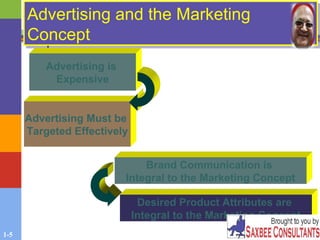
Advertising is
Expensive
Advertising Must be
Targeted Effectively
Desired Product Attributes are
Integral to the Marketing Concept
Brand Communication is
Integral to the Marketing Concept
1-6
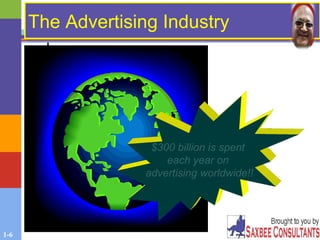
The Advertising IndustryThe Advertising Industry
$300 billion is spent
each year on
advertising worldwide!!
1-7
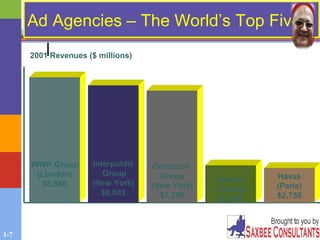
Ad Agencies – The World’s Top FiveAd Agencies – The World’s Top Five
WWP Group
(London)
$8,580
Interpublic
Group
(New York)
$8,003
Omnicron
Group
(New York)
$7,300
Dentsu
(Tokyo)
$2,794
Havas
(Paris)
$2,750
2001 Revenues ($ millions)
1-8
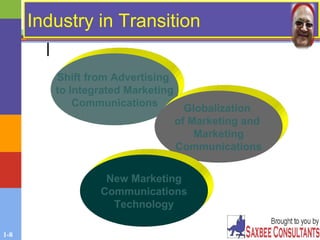
Industry in TransitionIndustry in Transition
Shift from Advertising
to Integrated Marketing
Communications
Globalization
of Marketing and
Marketing
Communications
New Marketing
Communications
Technology
1-9
Internet AdvertisingInternet Advertising
Predicted to Reach
$15.9 Million by 2007
1-10
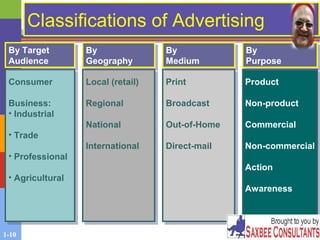
Classifications of AdvertisingClassifications of Advertising
Consumer
Business:
• Industrial
• Trade
• Professional
• Agricultural
Consumer
Business:
• Industrial
• Trade
• Professional
• Agricultural
Local (retail)
Regional
National
International
Local (retail)
Regional
National
International
Print
Broadcast
Out-of-Home
Direct-mail
Print
Broadcast
Out-of-Home
Direct-mail
Product
Non-product
Commercial
Non-commercial
Action
Awareness
Product
Non-product
Commercial
Non-commercial
Action
Awareness
By Target
Audience
By Target
Audience
By
Geography
By
Geography
By
Medium
By
Medium
By
Purpose
By
Purpose
1-11
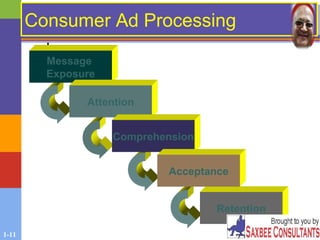
Consumer Ad ProcessingConsumer Ad Processing
Retention
Message
Exposure
Attention
Comprehension
Acceptance
1-12
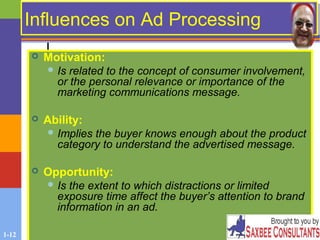
Influences on Ad ProcessingInfluences on Ad Processing
 Motivation:
 Is related to the concept of consumer involvement,
or the personal relevance or importance of the
marketing communications message.
 Ability:
 Implies the buyer knows enough about the product
category to understand the advertised message.
 Opportunity:
 Is the extent to which distractions or limited
exposure time affect the buyer’s attention to brand
information in an ad.
1-13
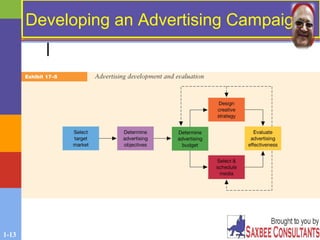
Developing an Advertising CampaignDeveloping an Advertising Campaign
1-14
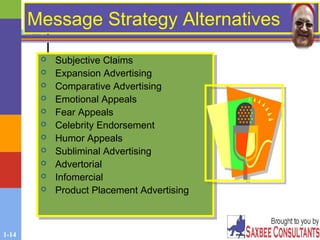
Message Strategy AlternativesMessage Strategy Alternatives
 Subjective Claims
 Expansion Advertising
 Comparative Advertising
 Emotional Appeals
 Fear Appeals
 Celebrity Endorsement
 Humor Appeals
 Subliminal Advertising
 Advertorial
 Infomercial
 Product Placement Advertising
 Subjective Claims
 Expansion Advertising
 Comparative Advertising
 Emotional Appeals
 Fear Appeals
 Celebrity Endorsement
 Humor Appeals
 Subliminal Advertising
 Advertorial
 Infomercial
 Product Placement Advertising
1-15
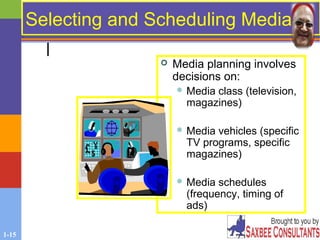
Selecting and Scheduling MediaSelecting and Scheduling Media
 Media planning involves
decisions on:
 Media class (television,
magazines)
 Media vehicles (specific
TV programs, specific
magazines)
 Media schedules
(frequency, timing of
ads)
1-16
Media ClassesMedia Classes
1. Television
2. Magazines
3. Newspapers
4. Radio
5. Outdoor
6. Transit
7. Direct Mail
1-17
Media VehiclesMedia Vehicles
 Media selection depends on the cost-
effectiveness of a particular outlet for
reaching desired market audiences.
 Factors Include:
1.Audience size
2.Composition
3.The cost of running the ad
1-18
Cost per Thousand (CPM):
CPM = [(magazine page cost x
1,000)/circulation]
Media Vehicle EvaluatonMedia Vehicle Evaluaton
1-19
Media SchedulesMedia Schedules
Reach:
The number of different people or households
exposed to an ad or campaign over a
specified time period (usually four weeks).
Frequency:
The number of times a person or household
is exposed to a communications vehicle.
1-20
Evaluating Advertising EffectivenessEvaluating Advertising Effectiveness
 Pre-testing
 Post-testing
 Unaided recall tests
 Aided recall tests
 Inquiry evaluation
 Sales Effectiveness Evaluations
1-21
Ethical and Legal Issues in
Advertising
Ethical and Legal Issues in
Advertising
 Is advertising manipulative?
 Is advertising deceptive or
misleading?
 How does advertising affect
children?
 Is advertising intrusive?
 Cause-related advertising
 Advertising harmful products
 Is advertising manipulative?
 Is advertising deceptive or
misleading?
 How does advertising affect
children?
 Is advertising intrusive?
 Cause-related advertising
 Advertising harmful products
1-22
Public RelationsPublic Relations
 Public Relations (PR):
 Often used as a complement to support advertising,
personal selling, and sales promotion for
disseminating marketing communications.
1-23
Public RelationsPublic Relations
 PR is an attempt to improve a company’s
relationship with its publics:
 Customers
 Employees
 Stockholders
 Community Members
 News Media
 Government
 PR is an attempt to improve a company’s
relationship with its publics:
 Customers
 Employees
 Stockholders
 Community Members
 News Media
 Government
1-24
Public Relations FunctionsPublic Relations Functions
 Public Relations Functions Include:
 Press relations.
 Product promotions.
 Internal and external corporate communications.
 Lobbying to promote, defeat, or circumvent
legislation and regulations.
 Advising management about public issues and
company positions and image.
1-25
Proactive and Reactive Marketing
Public Relations
Proactive and Reactive Marketing
Public Relations
• Product release
announcements,
statements,
sponsorship, articles.
• Enhancing corporate,
goodwill, advocacy.
• Cause-related marketing
• Response to negative
events and damaging
publicity.
• Negative information from
external sources.
• Align firm’s interests with
public interests.
Proactive Marketing PR Reactive Marketing PR
1-26
PublicityPublicity
 Publicity:
 The generation of
information by a
company to the news
media; has a narrower
focus than public
relations.
 The Primary Publicity
Techniques Are:
 News Releases
 Press Conferences
 Feature Articles in the
Business Press
1-27
Parveen Kumar Chadha… THINK TANK
(Founder and C.E.O of Saxbee Consultants & Other-Mother )
Email :-saxbeeconsultants@gmail.com
Mobile No. +91-9818308353
Address:-First Floor G-20(A), Kirti Nagar, New Delhi India Postal Code-
110015

Marketing tips

  • 1.
    1-1 Marketing Advertising and PublicRelationsAdvertising and Public RelationsAdvertising and Public RelationsAdvertising and Public Relations
  • 2.
    1-2  Understand thecharacteristics, functions, and types of advertising.  Realize how people process advertising information and how it affects buyer behavior.  Discuss approaches to developing advertising campaigns. After Reading this Presentation you should be able to:
  • 3.
    1-3  Describe differentadvertising objectives and the message strategies used to achieve them.  Understand the decisions involved in selecting media and scheduling advertising.  Explain how marketers assess advertising effectiveness.  Appreciate the roles of public relations and publicity in marketing. After Reading this Presentation you should be able to:
  • 4.
    1-4 The Nature ofAdvertising  Advertising: A marketing communications element that is persuasive, non-personal, paid for by an identified sponsor, and disseminated through mass channels of communication to promote the adoption of goods, services, persons, or ideas.
  • 5.
    1-5 Advertising and theMarketing Concept Advertising and the Marketing Concept Advertising is Expensive Advertising Must be Targeted Effectively Desired Product Attributes are Integral to the Marketing Concept Brand Communication is Integral to the Marketing Concept
  • 6.
    1-6 The Advertising IndustryTheAdvertising Industry $300 billion is spent each year on advertising worldwide!!
  • 7.
    1-7 Ad Agencies –The World’s Top FiveAd Agencies – The World’s Top Five WWP Group (London) $8,580 Interpublic Group (New York) $8,003 Omnicron Group (New York) $7,300 Dentsu (Tokyo) $2,794 Havas (Paris) $2,750 2001 Revenues ($ millions)
  • 8.
    1-8 Industry in TransitionIndustryin Transition Shift from Advertising to Integrated Marketing Communications Globalization of Marketing and Marketing Communications New Marketing Communications Technology
  • 9.
  • 10.
    1-10 Classifications of AdvertisingClassificationsof Advertising Consumer Business: • Industrial • Trade • Professional • Agricultural Consumer Business: • Industrial • Trade • Professional • Agricultural Local (retail) Regional National International Local (retail) Regional National International Print Broadcast Out-of-Home Direct-mail Print Broadcast Out-of-Home Direct-mail Product Non-product Commercial Non-commercial Action Awareness Product Non-product Commercial Non-commercial Action Awareness By Target Audience By Target Audience By Geography By Geography By Medium By Medium By Purpose By Purpose
  • 11.
    1-11 Consumer Ad ProcessingConsumerAd Processing Retention Message Exposure Attention Comprehension Acceptance
  • 12.
    1-12 Influences on AdProcessingInfluences on Ad Processing  Motivation:  Is related to the concept of consumer involvement, or the personal relevance or importance of the marketing communications message.  Ability:  Implies the buyer knows enough about the product category to understand the advertised message.  Opportunity:  Is the extent to which distractions or limited exposure time affect the buyer’s attention to brand information in an ad.
  • 13.
    1-13 Developing an AdvertisingCampaignDeveloping an Advertising Campaign
  • 14.
    1-14 Message Strategy AlternativesMessageStrategy Alternatives  Subjective Claims  Expansion Advertising  Comparative Advertising  Emotional Appeals  Fear Appeals  Celebrity Endorsement  Humor Appeals  Subliminal Advertising  Advertorial  Infomercial  Product Placement Advertising  Subjective Claims  Expansion Advertising  Comparative Advertising  Emotional Appeals  Fear Appeals  Celebrity Endorsement  Humor Appeals  Subliminal Advertising  Advertorial  Infomercial  Product Placement Advertising
  • 15.
    1-15 Selecting and SchedulingMediaSelecting and Scheduling Media  Media planning involves decisions on:  Media class (television, magazines)  Media vehicles (specific TV programs, specific magazines)  Media schedules (frequency, timing of ads)
  • 16.
    1-16 Media ClassesMedia Classes 1.Television 2. Magazines 3. Newspapers 4. Radio 5. Outdoor 6. Transit 7. Direct Mail
  • 17.
    1-17 Media VehiclesMedia Vehicles Media selection depends on the cost- effectiveness of a particular outlet for reaching desired market audiences.  Factors Include: 1.Audience size 2.Composition 3.The cost of running the ad
  • 18.
    1-18 Cost per Thousand(CPM): CPM = [(magazine page cost x 1,000)/circulation] Media Vehicle EvaluatonMedia Vehicle Evaluaton
  • 19.
    1-19 Media SchedulesMedia Schedules Reach: Thenumber of different people or households exposed to an ad or campaign over a specified time period (usually four weeks). Frequency: The number of times a person or household is exposed to a communications vehicle.
  • 20.
    1-20 Evaluating Advertising EffectivenessEvaluatingAdvertising Effectiveness  Pre-testing  Post-testing  Unaided recall tests  Aided recall tests  Inquiry evaluation  Sales Effectiveness Evaluations
  • 21.
    1-21 Ethical and LegalIssues in Advertising Ethical and Legal Issues in Advertising  Is advertising manipulative?  Is advertising deceptive or misleading?  How does advertising affect children?  Is advertising intrusive?  Cause-related advertising  Advertising harmful products  Is advertising manipulative?  Is advertising deceptive or misleading?  How does advertising affect children?  Is advertising intrusive?  Cause-related advertising  Advertising harmful products
  • 22.
    1-22 Public RelationsPublic Relations Public Relations (PR):  Often used as a complement to support advertising, personal selling, and sales promotion for disseminating marketing communications.
  • 23.
    1-23 Public RelationsPublic Relations PR is an attempt to improve a company’s relationship with its publics:  Customers  Employees  Stockholders  Community Members  News Media  Government  PR is an attempt to improve a company’s relationship with its publics:  Customers  Employees  Stockholders  Community Members  News Media  Government
  • 24.
    1-24 Public Relations FunctionsPublicRelations Functions  Public Relations Functions Include:  Press relations.  Product promotions.  Internal and external corporate communications.  Lobbying to promote, defeat, or circumvent legislation and regulations.  Advising management about public issues and company positions and image.
  • 25.
    1-25 Proactive and ReactiveMarketing Public Relations Proactive and Reactive Marketing Public Relations • Product release announcements, statements, sponsorship, articles. • Enhancing corporate, goodwill, advocacy. • Cause-related marketing • Response to negative events and damaging publicity. • Negative information from external sources. • Align firm’s interests with public interests. Proactive Marketing PR Reactive Marketing PR
  • 26.
    1-26 PublicityPublicity  Publicity:  Thegeneration of information by a company to the news media; has a narrower focus than public relations.  The Primary Publicity Techniques Are:  News Releases  Press Conferences  Feature Articles in the Business Press
  • 27.
    1-27 Parveen Kumar Chadha…THINK TANK (Founder and C.E.O of Saxbee Consultants & Other-Mother ) Email :-saxbeeconsultants@gmail.com Mobile No. +91-9818308353 Address:-First Floor G-20(A), Kirti Nagar, New Delhi India Postal Code- 110015