Course - Machine Learning
Course code-IT403
Unit-II
Topic- Logistic Regression
Sanjivani Rural Education Society’s
Sanjivani College of Engineering, Kopargaon-423603
(An Autonomous Institute Affiliated to Savitribai Phule Pune University, Pune)
NAAC ‘A’Grade Accredited, ISO 9001:2015 Certified
Department of Information Technology
(NBA Accredited)
Dr.R.D.Chintamani
Asst. Prof.
1
ML- Unit-II Regression Department of IT
Unit-II- Regression
• Syllabus
• Linear Regression, Logistic Regression, Ridge Regression, Lasso Regression,
• Polynomial Regression Types of Regression, performance metrics
• Mean Squared Error (MSE), Root Mean Squared Error (RMSE), Mean Absolute
• Error (MÆ), R² (R-Squared)
2
ML- Unit-II Regression Department of IT
Unit-II- Regression
3
ML- Unit-IV Regression Department of IT
Logistic Regression in Machine Learning
• Logistic regression is one of the most popular Machine Learning
algorithms, which comes under the Supervised Learning technique. It is
used for predicting the categorical dependent variable using a given set of
independent variables.
• Logistic regression predicts the output of a categorical dependent
variable. Therefore the outcome must be a categorical or discrete value. It
can be either Yes or No, 0 or 1, true or False, etc. but instead of giving the
exact value as 0 and 1, it gives the probabilistic values which lie between
0 and 1.
• Logistic Regression is much similar to the Linear Regression except that
how they are used. Linear Regression is used for solving Regression 4
ML- Unit-IV Regression Department of IT
Logistic Regression in Machine Learning
5
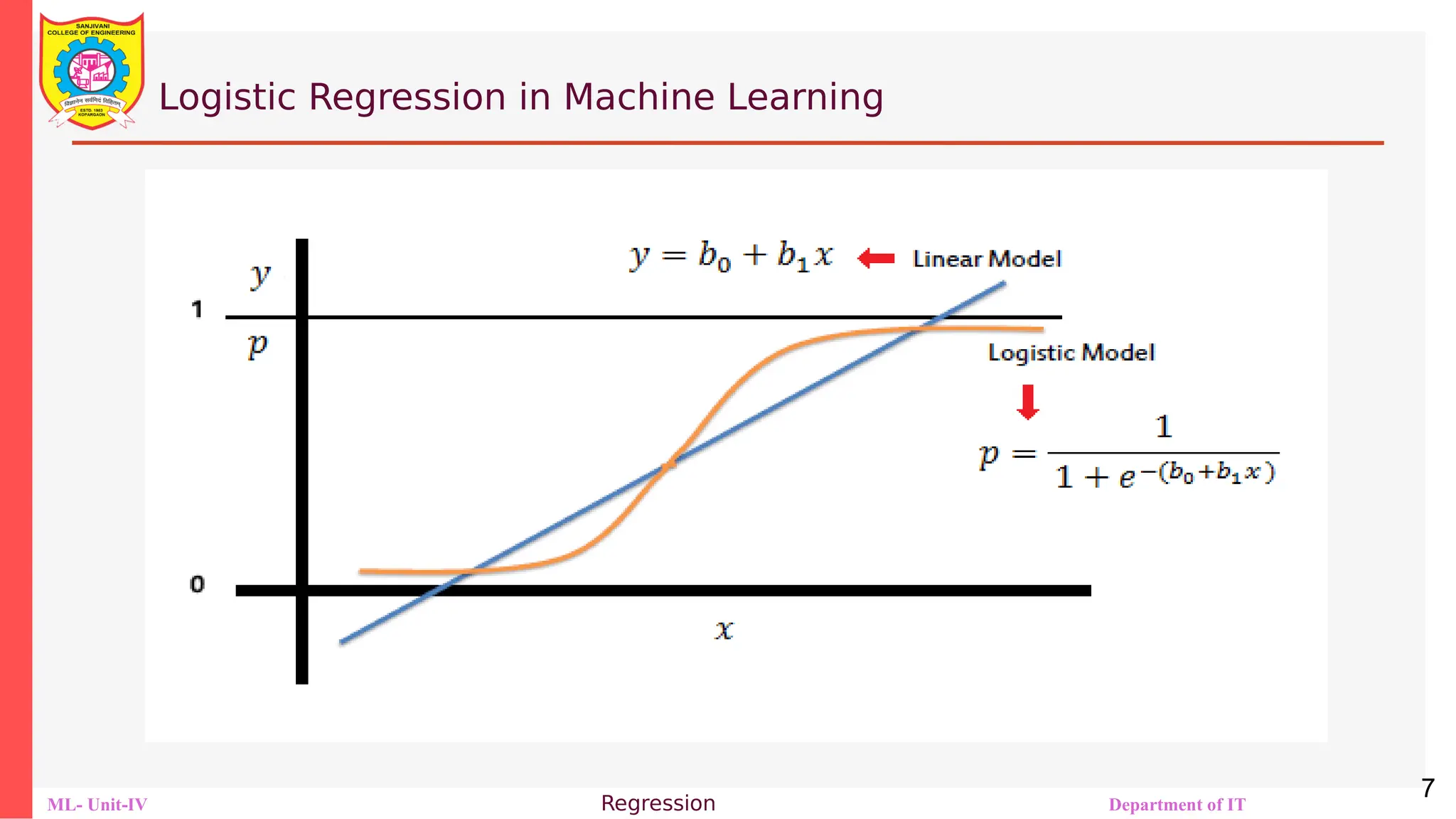
• In Logistic regression, instead of fitting a regression line, we fit an "S"
shaped logistic function, which predicts two maximum values (0 or 1).
• The curve from the logistic function indicates the likelihood of something
such as whether the cells are cancerous or not, a mouse is obese or not
based on its weight, etc.
• Logistic Regression is a significant machine learning algorithm because it
has the ability to provide probabilities and classify new data using
continuous and discrete datasets.
• Logistic Regression can be used to classify the observations using different
types of data and can easily determine the most effective variables used
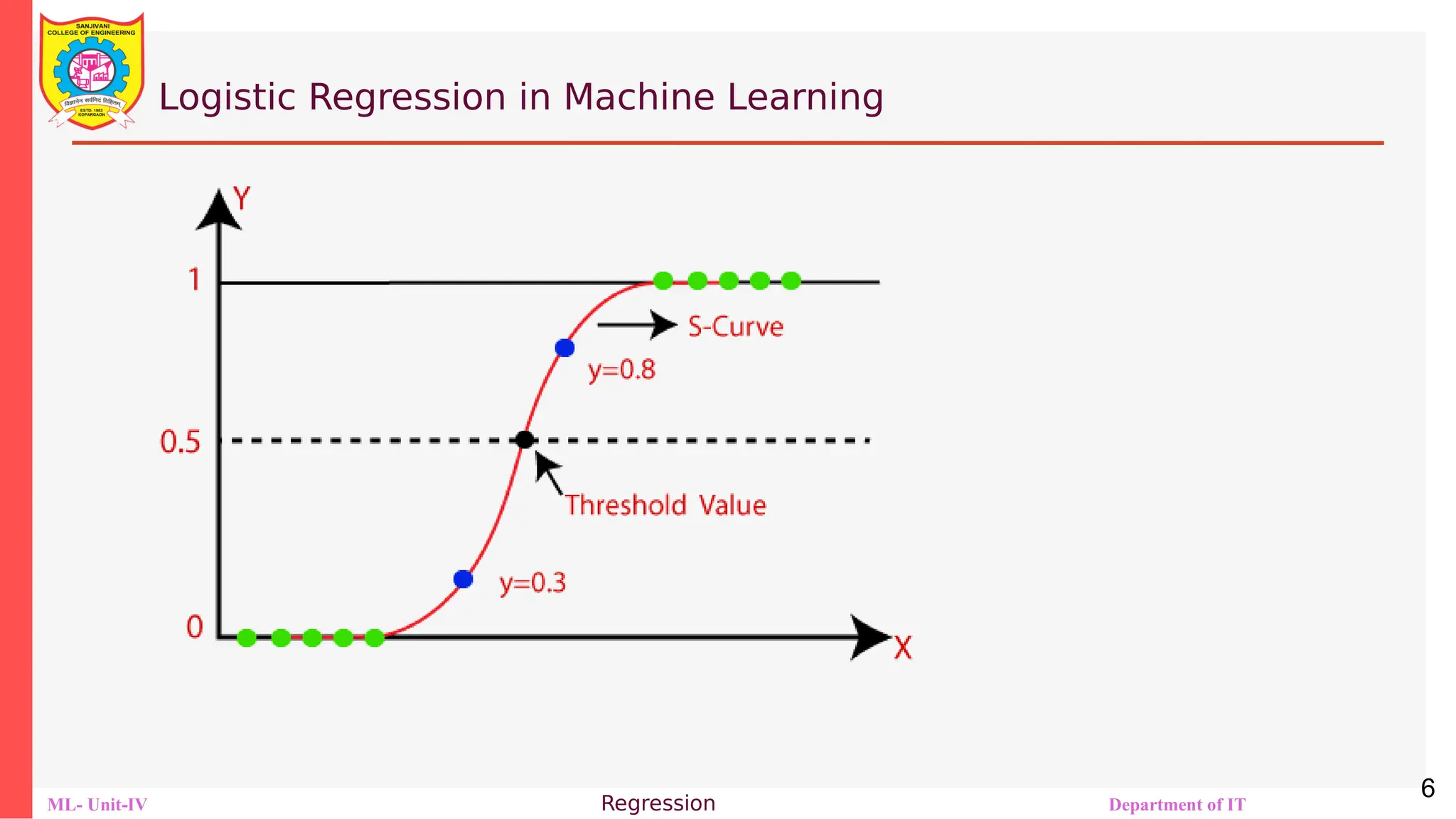
for the classification. The below image is showing the logistic function:
ML- Unit-IV Regression Department of IT
Logistic Regression in Machine Learning
6
ML- Unit-IV Regression Department of IT
Logistic Regression in Machine Learning
7
ML- Unit-IV Regression Department of IT
Logistic Regression in Machine Learning
8
Logistic Function (Sigmoid Function):
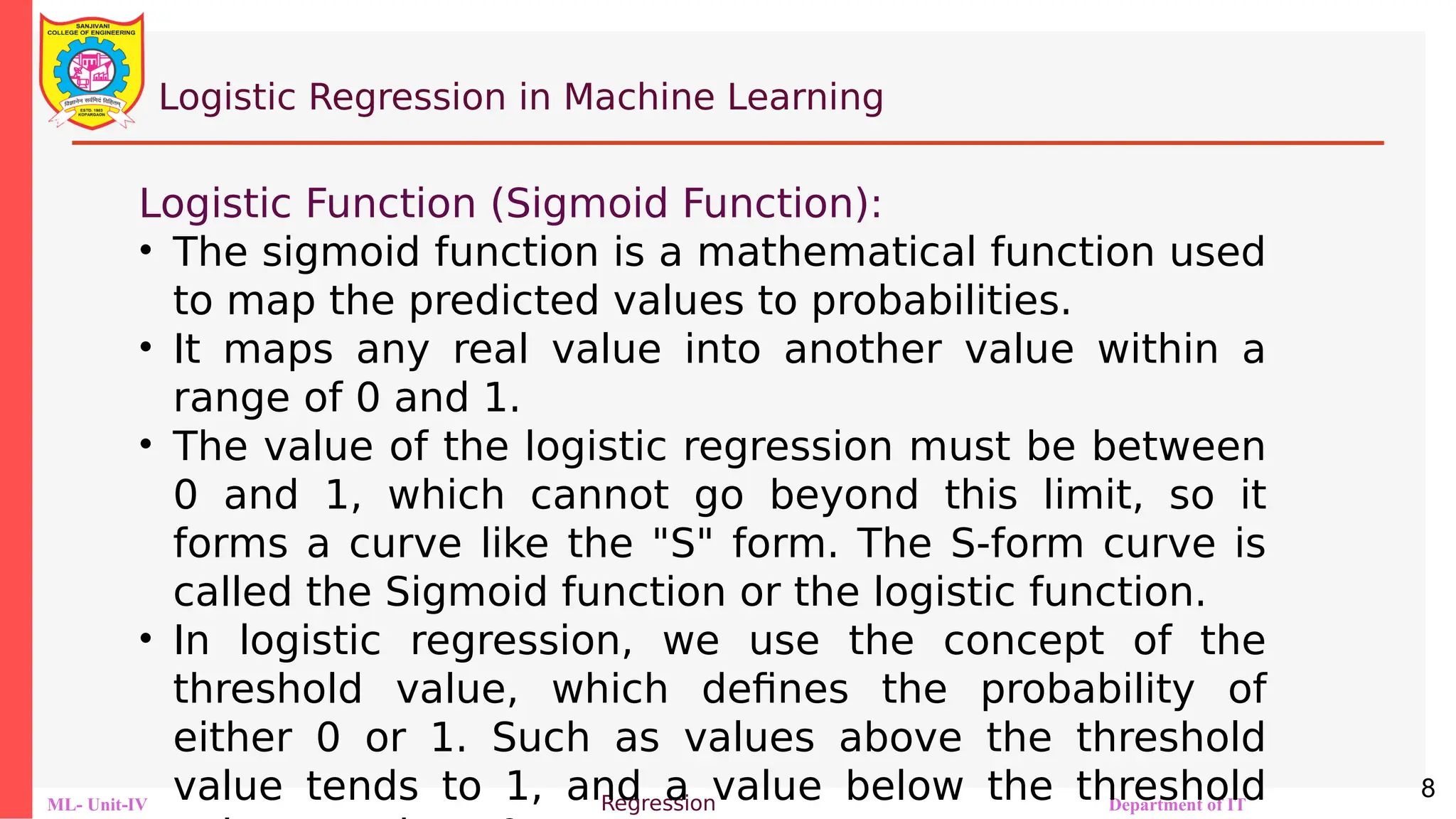
• The sigmoid function is a mathematical function used
to map the predicted values to probabilities.
• It maps any real value into another value within a
range of 0 and 1.
• The value of the logistic regression must be between
0 and 1, which cannot go beyond this limit, so it
forms a curve like the "S" form. The S-form curve is
called the Sigmoid function or the logistic function.
• In logistic regression, we use the concept of the
threshold value, which defines the probability of
either 0 or 1. Such as values above the threshold
value tends to 1, and a value below the threshold
ML- Unit-IV Regression Department of IT
Logistic Regression in Machine Learning
9
Type of Logistic Regression:
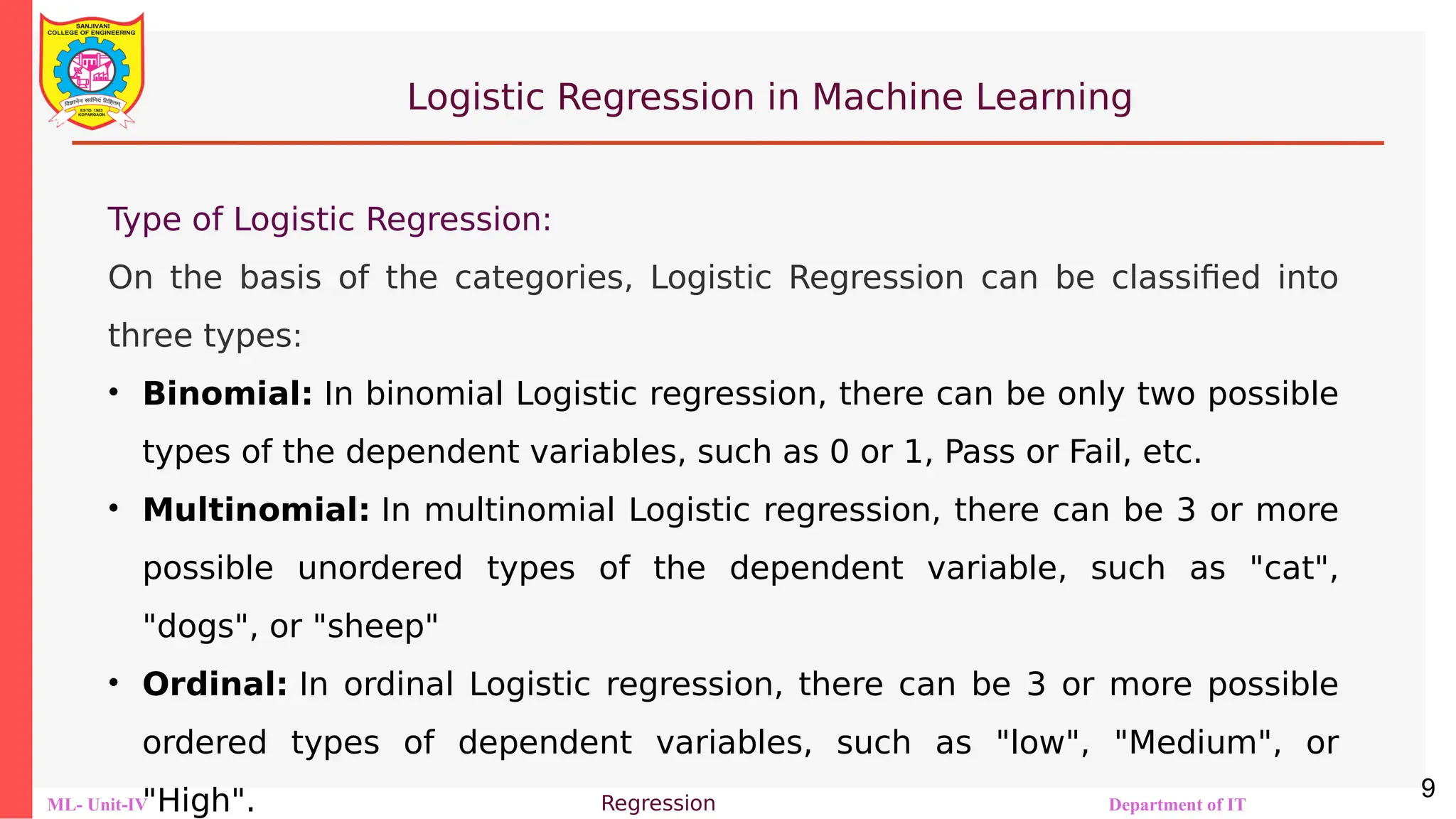
On the basis of the categories, Logistic Regression can be classified into
three types:
• Binomial: In binomial Logistic regression, there can be only two possible
types of the dependent variables, such as 0 or 1, Pass or Fail, etc.
• Multinomial: In multinomial Logistic regression, there can be 3 or more
possible unordered types of the dependent variable, such as "cat",
"dogs", or "sheep"
• Ordinal: In ordinal Logistic regression, there can be 3 or more possible
ordered types of dependent variables, such as "low", "Medium", or
"High".
ML- Unit-IV Regression Department of IT
Linear Regression Vs Logistic Regression
10
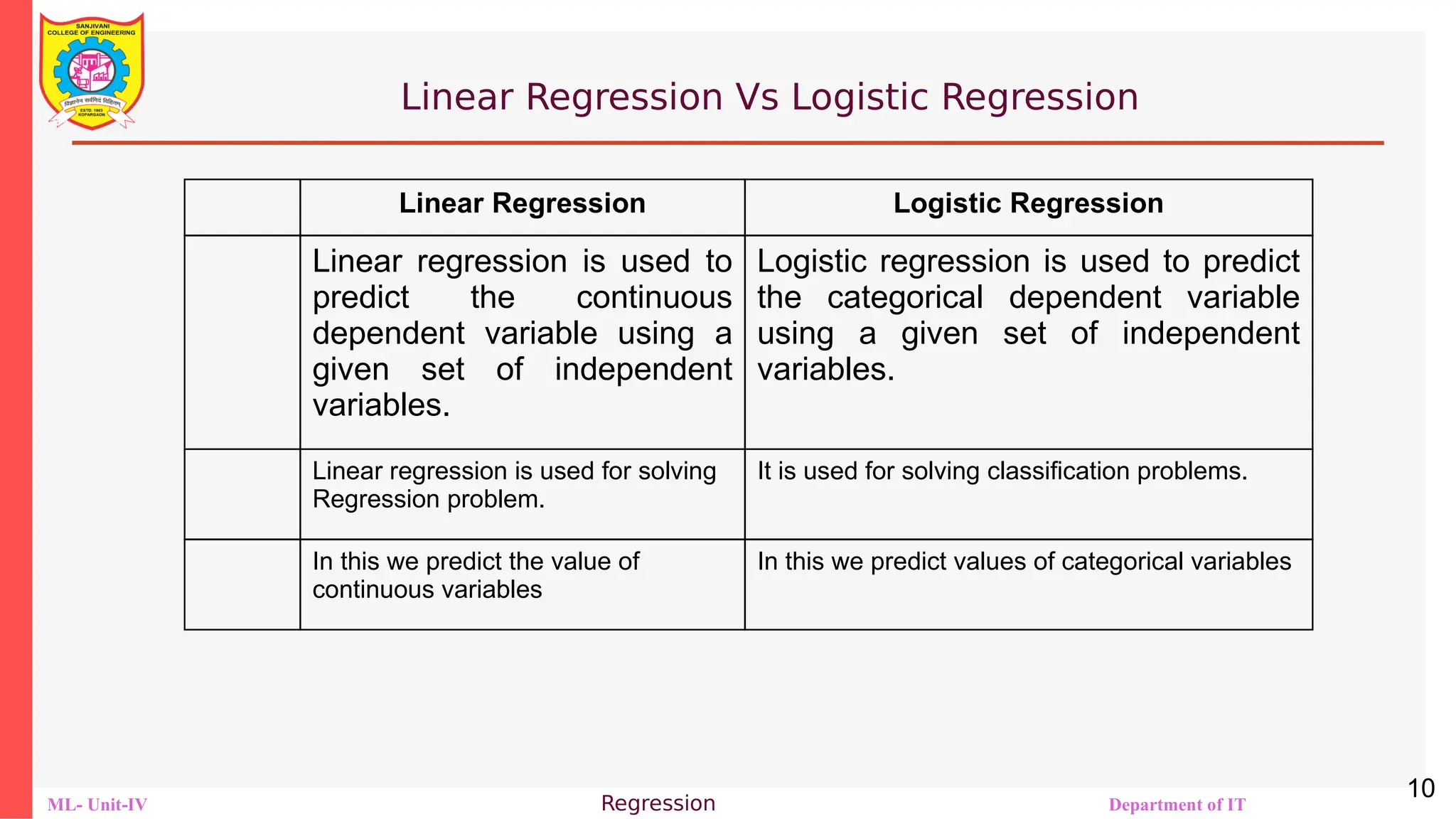
Linear Regression Logistic Regression
Linear regression is used to
predict the continuous
dependent variable using a
given set of independent
variables.
Logistic regression is used to predict
the categorical dependent variable
using a given set of independent
variables.
Linear regression is used for solving
Regression problem.
It is used for solving classification problems.
In this we predict the value of
continuous variables
In this we predict values of categorical variables
ML- Unit-IV Regression Department of IT
Linear Regression Vs Logistic Regression
11
Linear Regression Logistic Regression
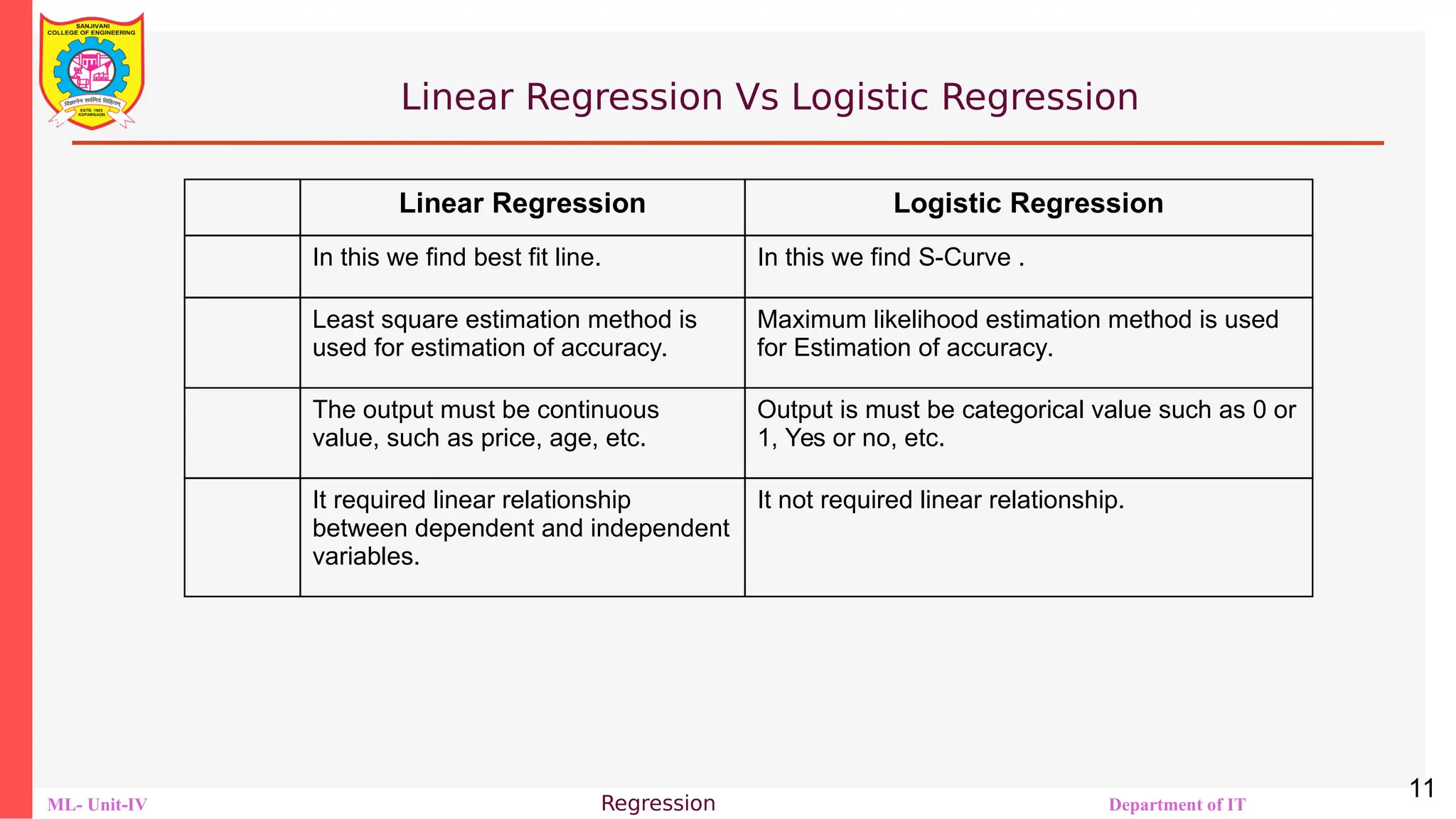
In this we find best fit line. In this we find S-Curve .
Least square estimation method is
used for estimation of accuracy.
Maximum likelihood estimation method is used
for Estimation of accuracy.
The output must be continuous
value, such as price, age, etc.
Output is must be categorical value such as 0 or
1, Yes or no, etc.
It required linear relationship
between dependent and independent
variables.
It not required linear relationship.
ML- Unit-IV Regression Department of IT
Linear Regression Vs Logistic Regression
12
Linear Regression Logistic Regression
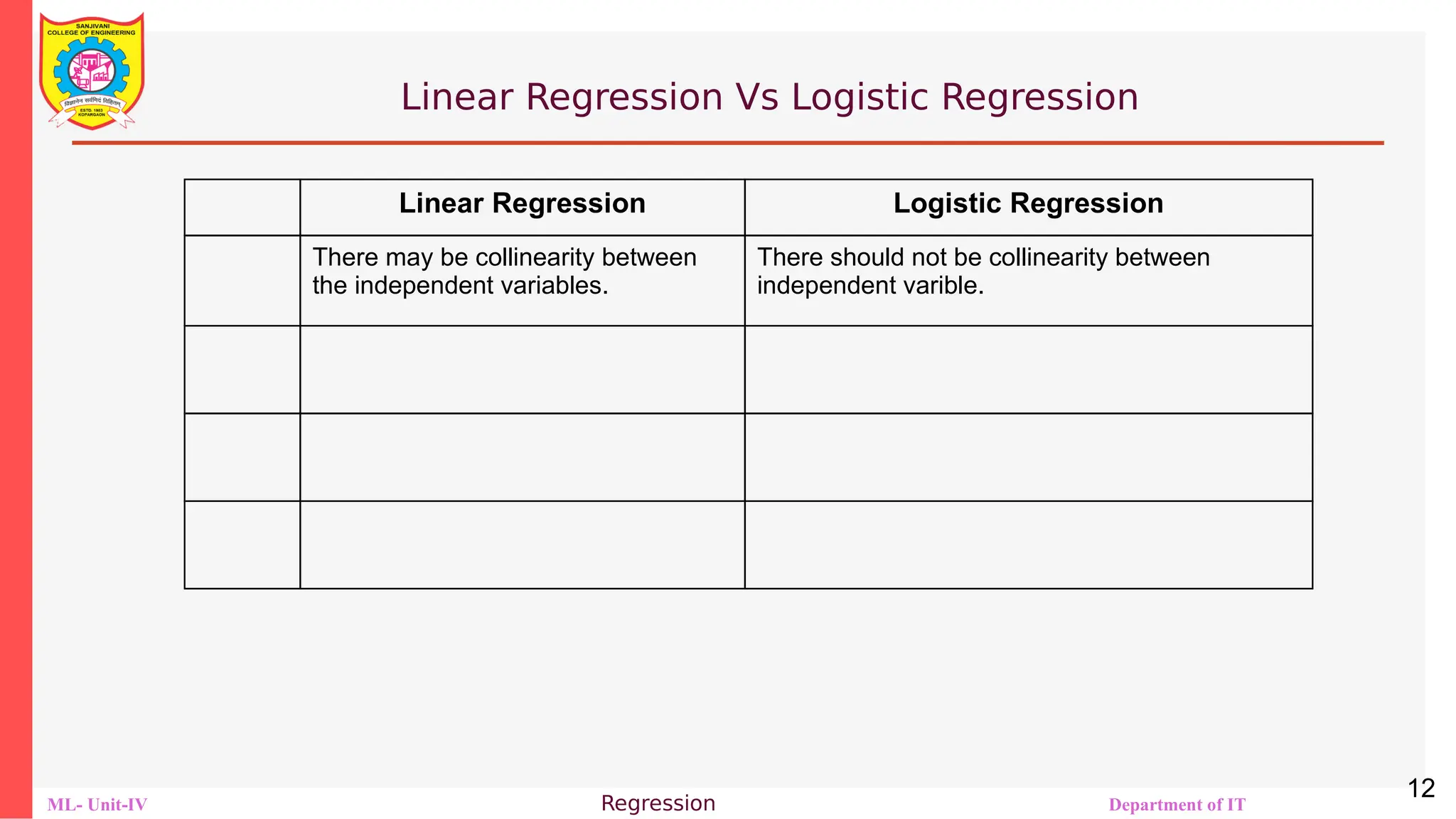
There may be collinearity between
the independent variables.
There should not be collinearity between
independent varible.
ML- Unit-IV Regression Department of IT
Logistic Regression in Machine Learning
13

Unit2_Logistic regression_machine learning.pdf

  • 1.
    Course - MachineLearning Course code-IT403 Unit-II Topic- Logistic Regression Sanjivani Rural Education Society’s Sanjivani College of Engineering, Kopargaon-423603 (An Autonomous Institute Affiliated to Savitribai Phule Pune University, Pune) NAAC ‘A’Grade Accredited, ISO 9001:2015 Certified Department of Information Technology (NBA Accredited) Dr.R.D.Chintamani Asst. Prof. 1
  • 2.
    ML- Unit-II RegressionDepartment of IT Unit-II- Regression • Syllabus • Linear Regression, Logistic Regression, Ridge Regression, Lasso Regression, • Polynomial Regression Types of Regression, performance metrics • Mean Squared Error (MSE), Root Mean Squared Error (RMSE), Mean Absolute • Error (MÆ), R² (R-Squared) 2
  • 3.
    ML- Unit-II RegressionDepartment of IT Unit-II- Regression 3
  • 4.
    ML- Unit-IV RegressionDepartment of IT Logistic Regression in Machine Learning • Logistic regression is one of the most popular Machine Learning algorithms, which comes under the Supervised Learning technique. It is used for predicting the categorical dependent variable using a given set of independent variables. • Logistic regression predicts the output of a categorical dependent variable. Therefore the outcome must be a categorical or discrete value. It can be either Yes or No, 0 or 1, true or False, etc. but instead of giving the exact value as 0 and 1, it gives the probabilistic values which lie between 0 and 1. • Logistic Regression is much similar to the Linear Regression except that how they are used. Linear Regression is used for solving Regression 4
  • 5.
    ML- Unit-IV RegressionDepartment of IT Logistic Regression in Machine Learning 5 • In Logistic regression, instead of fitting a regression line, we fit an "S" shaped logistic function, which predicts two maximum values (0 or 1). • The curve from the logistic function indicates the likelihood of something such as whether the cells are cancerous or not, a mouse is obese or not based on its weight, etc. • Logistic Regression is a significant machine learning algorithm because it has the ability to provide probabilities and classify new data using continuous and discrete datasets. • Logistic Regression can be used to classify the observations using different types of data and can easily determine the most effective variables used for the classification. The below image is showing the logistic function:
  • 6.
    ML- Unit-IV RegressionDepartment of IT Logistic Regression in Machine Learning 6
  • 7.
    ML- Unit-IV RegressionDepartment of IT Logistic Regression in Machine Learning 7
  • 8.
    ML- Unit-IV RegressionDepartment of IT Logistic Regression in Machine Learning 8 Logistic Function (Sigmoid Function): • The sigmoid function is a mathematical function used to map the predicted values to probabilities. • It maps any real value into another value within a range of 0 and 1. • The value of the logistic regression must be between 0 and 1, which cannot go beyond this limit, so it forms a curve like the "S" form. The S-form curve is called the Sigmoid function or the logistic function. • In logistic regression, we use the concept of the threshold value, which defines the probability of either 0 or 1. Such as values above the threshold value tends to 1, and a value below the threshold
  • 9.
    ML- Unit-IV RegressionDepartment of IT Logistic Regression in Machine Learning 9 Type of Logistic Regression: On the basis of the categories, Logistic Regression can be classified into three types: • Binomial: In binomial Logistic regression, there can be only two possible types of the dependent variables, such as 0 or 1, Pass or Fail, etc. • Multinomial: In multinomial Logistic regression, there can be 3 or more possible unordered types of the dependent variable, such as "cat", "dogs", or "sheep" • Ordinal: In ordinal Logistic regression, there can be 3 or more possible ordered types of dependent variables, such as "low", "Medium", or "High".
  • 10.
    ML- Unit-IV RegressionDepartment of IT Linear Regression Vs Logistic Regression 10 Linear Regression Logistic Regression Linear regression is used to predict the continuous dependent variable using a given set of independent variables. Logistic regression is used to predict the categorical dependent variable using a given set of independent variables. Linear regression is used for solving Regression problem. It is used for solving classification problems. In this we predict the value of continuous variables In this we predict values of categorical variables
  • 11.
    ML- Unit-IV RegressionDepartment of IT Linear Regression Vs Logistic Regression 11 Linear Regression Logistic Regression In this we find best fit line. In this we find S-Curve . Least square estimation method is used for estimation of accuracy. Maximum likelihood estimation method is used for Estimation of accuracy. The output must be continuous value, such as price, age, etc. Output is must be categorical value such as 0 or 1, Yes or no, etc. It required linear relationship between dependent and independent variables. It not required linear relationship.
  • 12.
    ML- Unit-IV RegressionDepartment of IT Linear Regression Vs Logistic Regression 12 Linear Regression Logistic Regression There may be collinearity between the independent variables. There should not be collinearity between independent varible.
  • 13.
    ML- Unit-IV RegressionDepartment of IT Logistic Regression in Machine Learning 13