Unit Testing Guidelines
                 Why, What and How...


@jhooks | 2010 | joelhooks.com
Why?
                It’s such a pain.
                there is never enough time!


@jhooks | 2010 | joelhooks.com
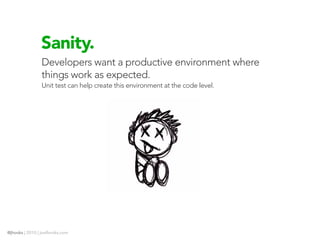
Sanity.
                Developers want a productive environment where
                things work as expected.
                Unit test can help create this environment at the code level.


@jhooks | 2010 | joelhooks.com
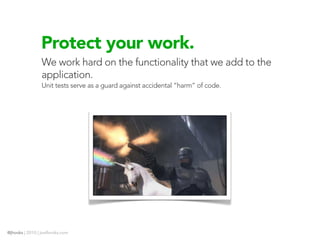
Protect your work.
                We work hard on the functionality that we add to the
                application.
                Unit tests serve as a guard against accidental “harm” of code.


@jhooks | 2010 | joelhooks.com
Developer documentation.
                Well written unit test provide excellent documentation
                for other developers.
                Unit tests describe how a piece of logical code should work in a way that English
                language docs often can’t.


@jhooks | 2010 | joelhooks.com
Collective ownership.
                Code that is protected can be worked on by anybody
                with greater assurance that nothing will be accidentally
                broken.


@jhooks | 2010 | joelhooks.com
Fearless refactoring.
                Code can be constantly improved upon with less fear
                of accidental breakage.
                Unit tests verify that changes don’t break the existing logic.


@jhooks | 2010 | joelhooks.com
What should be tested?
                 Models
                 Service classes
                 Commands
                 Utility classes
                 any other logical code


@jhooks | 2010 | joelhooks.com
When to write tests...
                 Before you write the code?
                 After you write the code?


@jhooks | 2010 | joelhooks.com
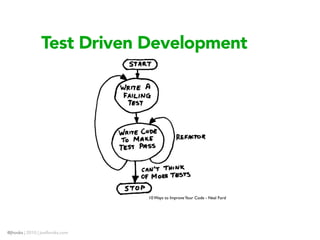
Test Driven Development


                                 10 Ways to Improve Your Code - Neal Ford


@jhooks | 2010 | joelhooks.com
Less fear.
                Writing unit tests firsts lets you focus on the
                functionality you are adding.
                Write the test. Write the code. Tests pass. Done.


@jhooks | 2010 | joelhooks.com
Ensure test coverage.
                Tests written before production code ensures that the
                production code is tested.
                Tests are not an afterthought.


@jhooks | 2010 | joelhooks.com
Reduces tedium of testing.
                Wait... What?!
                Writing tests before the production code eliminates the need for a massive testing
                effort after the code is written.


@jhooks | 2010 | joelhooks.com
Guarantees testable code.
                Testing first ensures that the production code can be
                tested.
                Testing after often results in the discovery that the code isn’t testable without
                refactoring. Refactoring that isn’t protected by tests.


@jhooks | 2010 | joelhooks.com
TDD is not a guarantee.
                Like most practices, TDD is no guarantee of quality or
                success in development.
                It is a tool.


@jhooks | 2010 | joelhooks.com
So when should I test?
                Test driven development is not required.
                Try it out. It can be painful to start, but once you get a rhythm going the benefits
                are very real.


@jhooks | 2010 | joelhooks.com
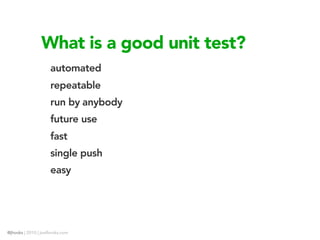
What is a good unit test?
                     automated
                     repeatable
                     run by anybody
                     future use
                     fast
                     single push
                     easy


@jhooks | 2010 | joelhooks.com
Unit tests are by developers for developers.
             Quality over quantity please.


@jhooks | 2010 | joelhooks.com
Trustworthy
                Developers will run and use tests they trust.
                A trustworthy test is free of bugs and does what it says it does.


@jhooks | 2010 | joelhooks.com
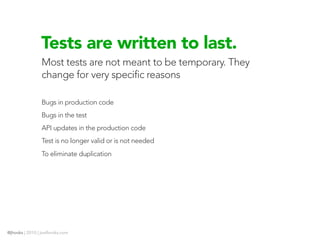
Tests are written to last.
                Most tests are not meant to be temporary. They
                change for very specific reasons

                Bugs in production code
                Bugs in the test
                API updates in the production code
                Test is no longer valid or is not needed
                To eliminate duplication


@jhooks | 2010 | joelhooks.com
There is no logic in the test.
                Logic in a unit tests makes the test harder to read and
                understand. There is more likely to be bugs in the test.
                It can also make the test harder to name.

                There should be no switch, if, or else statements.
                There should be no for each, for, or while statements.
                The test is a series of method calls with no control flow.


@jhooks | 2010 | joelhooks.com
Only one thing is tested.
                A unit test is testing a single behavior. Testing multiple
                things makes a test hard to understand.

                Assert only one thing.
                Should be easy to name (you don’t need an and in the name).
                When it fails, it is clear what actually failed.


@jhooks | 2010 | joelhooks.com
Maintainable
                Unmaintainable tests are ignored and are often
                simply removed from the suite.
                Unmaintainable tests cannot be trusted.


@jhooks | 2010 | joelhooks.com
Test the API
                Unit tests are written against the public contract of the
                unit being tested. We shouldn’t be trying to test
                private methods.

                Private and protected methods can affect the outcome of public methods.
                Does it make sense to make a private method public?
                Test the results of the public API that uses private methods
                Is the private method pure utility? Would it makes sense as a static method of a
                utility class?


@jhooks | 2010 | joelhooks.com
Avoid duplication (DRY)
                Avoiding the duplication of code in unit tests is as, if
                not more, important than it is with production code.

                Create helper methods like factories to assist in setup of common items
                Use setup methods for setup of items common to all test methods in the case
                Setup should be as short, simple, and as easy to read as possible


@jhooks | 2010 | joelhooks.com
Tests should be isolated.
                Don’t try to use Parsley, configure and access remote
                services, or otherwise try to simulate the broader
                application in a unit test.

                Are test methods constrained to a linear order of execution?
                Is the test calling other test methods?
                Do tests share global state?
                Test behaviors, not workflows.
                If shared state can’t be avoid, be sure to reset it in the teardown.


@jhooks | 2010 | joelhooks.com
Avoid multiple asserts.
                Unit tests are testing specific single behaviors. It seems
                like more work because results might be related, but
                the results should be verified independently.

                Give each assertion its own test
                Give each test a meaningful name
                This makes failures easy to understand and fix


@jhooks | 2010 | joelhooks.com
Avoid over-specification.
                Tests shouldn’t make assumptions about the
                implementation of behavior, instead they should focus
                on the results of the behavior.

                Does the test specify purely internal behavior of the unit?
                Is the test using complicated mock objects when simple stubs would be enough?
                Does the test assume specific results when it isn’t required?


@jhooks | 2010 | joelhooks.com
Readable
                Code in tests is easy to understand quickly. What is
                being tested is recognizable instantly without
                deciphering or translation.
                Readable tests are more trustworthy and maintainable.


@jhooks | 2010 | joelhooks.com
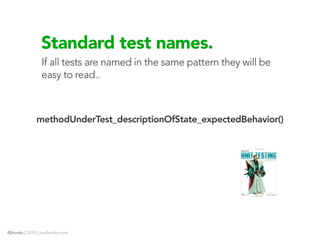
Standard test names.
                If all tests are named in the same pattern they will be
                easy to read..


              methodUnderTest_descriptionOfState_expectedBehavior()


@jhooks | 2010 | joelhooks.com
Good variable names.
                As with all code, good variable names can help
                greatly in making the code readable.

                Avoid abbreviations
                Use static constants instead of hardcoded values


@jhooks | 2010 | joelhooks.com
Consistent test structure.
                Setup -> Action -> Assert


         [Test]
         public function doSomeWork_workWasDone_isTrue()
         {
             //setup
             var aDependency:ISomeDependency = new SomeDependency();

                  //execute behavior
                  aDependency.doSomeWork();

                  //verify expected state is valid
                  assertThat(allTestsNeedThis.workWasDone, isTrue());
         }


@jhooks | 2010 | joelhooks.com

Unit Testing Guidelines

  • 1.
    Unit Testing Guidelines Why, What and How... @jhooks | 2010 | joelhooks.com
  • 2.
    Why? It’s such a pain. there is never enough time! @jhooks | 2010 | joelhooks.com
  • 3.
    Sanity. Developers want a productive environment where things work as expected. Unit test can help create this environment at the code level. @jhooks | 2010 | joelhooks.com
  • 4.
    Protect your work. We work hard on the functionality that we add to the application. Unit tests serve as a guard against accidental “harm” of code. @jhooks | 2010 | joelhooks.com
  • 5.
    Developer documentation. Well written unit test provide excellent documentation for other developers. Unit tests describe how a piece of logical code should work in a way that English language docs often can’t. @jhooks | 2010 | joelhooks.com
  • 6.
    Collective ownership. Code that is protected can be worked on by anybody with greater assurance that nothing will be accidentally broken. @jhooks | 2010 | joelhooks.com
  • 7.
    Fearless refactoring. Code can be constantly improved upon with less fear of accidental breakage. Unit tests verify that changes don’t break the existing logic. @jhooks | 2010 | joelhooks.com
  • 8.
    What should betested? Models Service classes Commands Utility classes any other logical code @jhooks | 2010 | joelhooks.com
  • 9.
    When to writetests... Before you write the code? After you write the code? @jhooks | 2010 | joelhooks.com
  • 10.
    Test Driven Development 10 Ways to Improve Your Code - Neal Ford @jhooks | 2010 | joelhooks.com
  • 11.
    Less fear. Writing unit tests firsts lets you focus on the functionality you are adding. Write the test. Write the code. Tests pass. Done. @jhooks | 2010 | joelhooks.com
  • 12.
    Ensure test coverage. Tests written before production code ensures that the production code is tested. Tests are not an afterthought. @jhooks | 2010 | joelhooks.com
  • 13.
    Reduces tedium oftesting. Wait... What?! Writing tests before the production code eliminates the need for a massive testing effort after the code is written. @jhooks | 2010 | joelhooks.com
  • 14.
    Guarantees testable code. Testing first ensures that the production code can be tested. Testing after often results in the discovery that the code isn’t testable without refactoring. Refactoring that isn’t protected by tests. @jhooks | 2010 | joelhooks.com
  • 15.
    TDD is nota guarantee. Like most practices, TDD is no guarantee of quality or success in development. It is a tool. @jhooks | 2010 | joelhooks.com
  • 16.
    So when shouldI test? Test driven development is not required. Try it out. It can be painful to start, but once you get a rhythm going the benefits are very real. @jhooks | 2010 | joelhooks.com
  • 17.
    What is agood unit test? automated repeatable run by anybody future use fast single push easy @jhooks | 2010 | joelhooks.com
  • 18.
    Unit tests areby developers for developers. Quality over quantity please. @jhooks | 2010 | joelhooks.com
  • 19.
    Trustworthy Developers will run and use tests they trust. A trustworthy test is free of bugs and does what it says it does. @jhooks | 2010 | joelhooks.com
  • 20.
    Tests are writtento last. Most tests are not meant to be temporary. They change for very specific reasons Bugs in production code Bugs in the test API updates in the production code Test is no longer valid or is not needed To eliminate duplication @jhooks | 2010 | joelhooks.com
  • 21.
    There is nologic in the test. Logic in a unit tests makes the test harder to read and understand. There is more likely to be bugs in the test. It can also make the test harder to name. There should be no switch, if, or else statements. There should be no for each, for, or while statements. The test is a series of method calls with no control flow. @jhooks | 2010 | joelhooks.com
  • 22.
    Only one thingis tested. A unit test is testing a single behavior. Testing multiple things makes a test hard to understand. Assert only one thing. Should be easy to name (you don’t need an and in the name). When it fails, it is clear what actually failed. @jhooks | 2010 | joelhooks.com
  • 23.
    Maintainable Unmaintainable tests are ignored and are often simply removed from the suite. Unmaintainable tests cannot be trusted. @jhooks | 2010 | joelhooks.com
  • 24.
    Test the API Unit tests are written against the public contract of the unit being tested. We shouldn’t be trying to test private methods. Private and protected methods can affect the outcome of public methods. Does it make sense to make a private method public? Test the results of the public API that uses private methods Is the private method pure utility? Would it makes sense as a static method of a utility class? @jhooks | 2010 | joelhooks.com
  • 25.
    Avoid duplication (DRY) Avoiding the duplication of code in unit tests is as, if not more, important than it is with production code. Create helper methods like factories to assist in setup of common items Use setup methods for setup of items common to all test methods in the case Setup should be as short, simple, and as easy to read as possible @jhooks | 2010 | joelhooks.com
  • 26.
    Tests should beisolated. Don’t try to use Parsley, configure and access remote services, or otherwise try to simulate the broader application in a unit test. Are test methods constrained to a linear order of execution? Is the test calling other test methods? Do tests share global state? Test behaviors, not workflows. If shared state can’t be avoid, be sure to reset it in the teardown. @jhooks | 2010 | joelhooks.com
  • 27.
    Avoid multiple asserts. Unit tests are testing specific single behaviors. It seems like more work because results might be related, but the results should be verified independently. Give each assertion its own test Give each test a meaningful name This makes failures easy to understand and fix @jhooks | 2010 | joelhooks.com
  • 28.
    Avoid over-specification. Tests shouldn’t make assumptions about the implementation of behavior, instead they should focus on the results of the behavior. Does the test specify purely internal behavior of the unit? Is the test using complicated mock objects when simple stubs would be enough? Does the test assume specific results when it isn’t required? @jhooks | 2010 | joelhooks.com
  • 29.
    Readable Code in tests is easy to understand quickly. What is being tested is recognizable instantly without deciphering or translation. Readable tests are more trustworthy and maintainable. @jhooks | 2010 | joelhooks.com
  • 30.
    Standard test names. If all tests are named in the same pattern they will be easy to read.. methodUnderTest_descriptionOfState_expectedBehavior() @jhooks | 2010 | joelhooks.com
  • 31.
    Good variable names. As with all code, good variable names can help greatly in making the code readable. Avoid abbreviations Use static constants instead of hardcoded values @jhooks | 2010 | joelhooks.com
  • 32.
    Consistent test structure. Setup -> Action -> Assert [Test] public function doSomeWork_workWasDone_isTrue() { //setup var aDependency:ISomeDependency = new SomeDependency(); //execute behavior aDependency.doSomeWork(); //verify expected state is valid assertThat(allTestsNeedThis.workWasDone, isTrue()); } @jhooks | 2010 | joelhooks.com