C l e a n U n i t T e s t P a t t e r n s 
F r a n k A p p e l Blog: www.codeaffine.com 
Email: fappel@codeaffine.com 
Twitter: @frank_appel
C l e a n U n i t T e s t P a t t e r n s 
Why bother? 
Structure 
Isolation 
Runners and Rules 
Assertions 
Q&A
Who I am.. 
Independent Software Developer 
Blogger (http://codeaffine.com/blog) 
Stalwart of agile methods and TDD in particular
C l e a n U n i t T e s t P a t t e r n s 
Why bother? 
Structure 
Isolation 
Runners and Rules 
Assertions 
Q&A
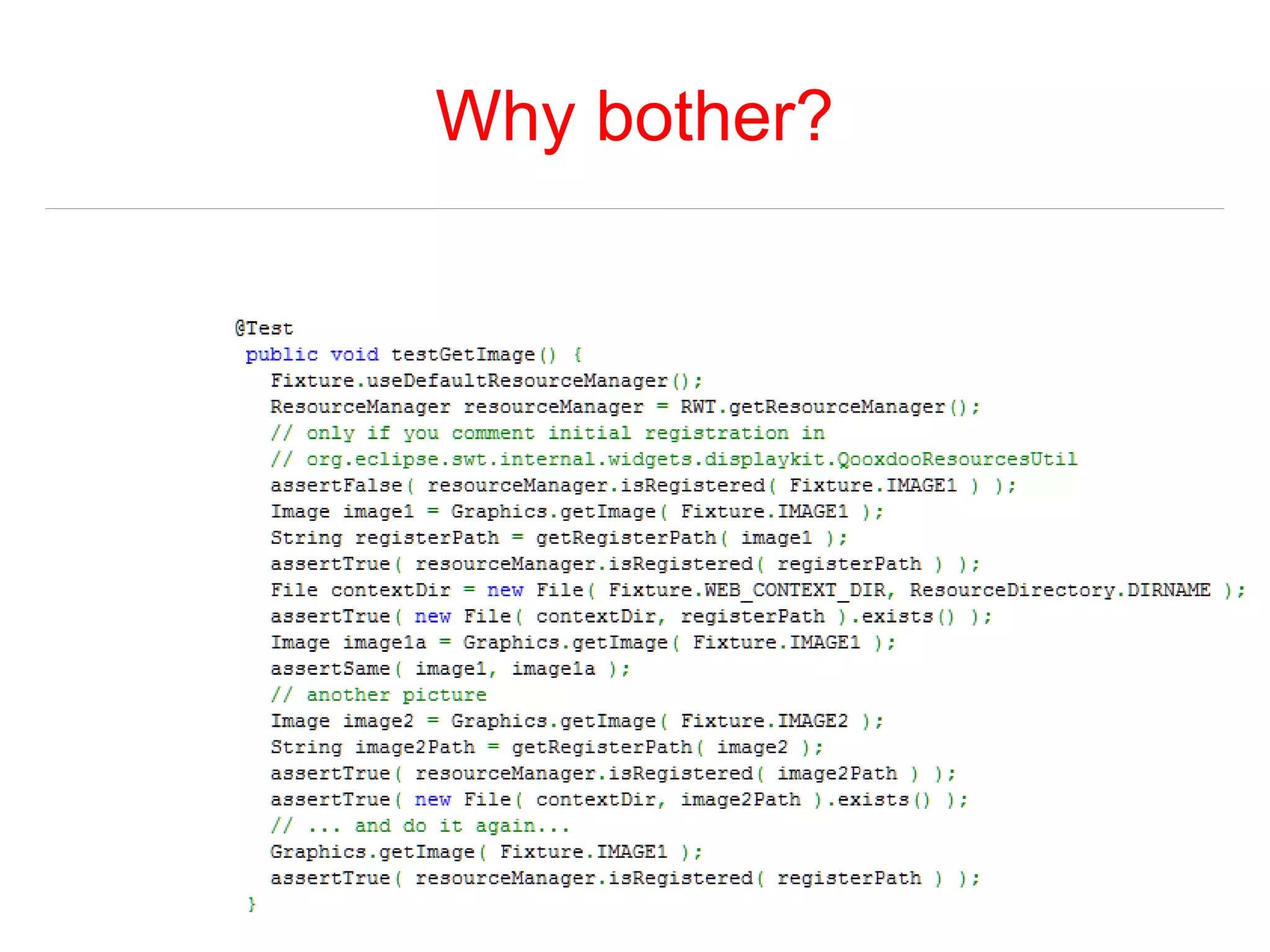
Why bother?
Why bother? 
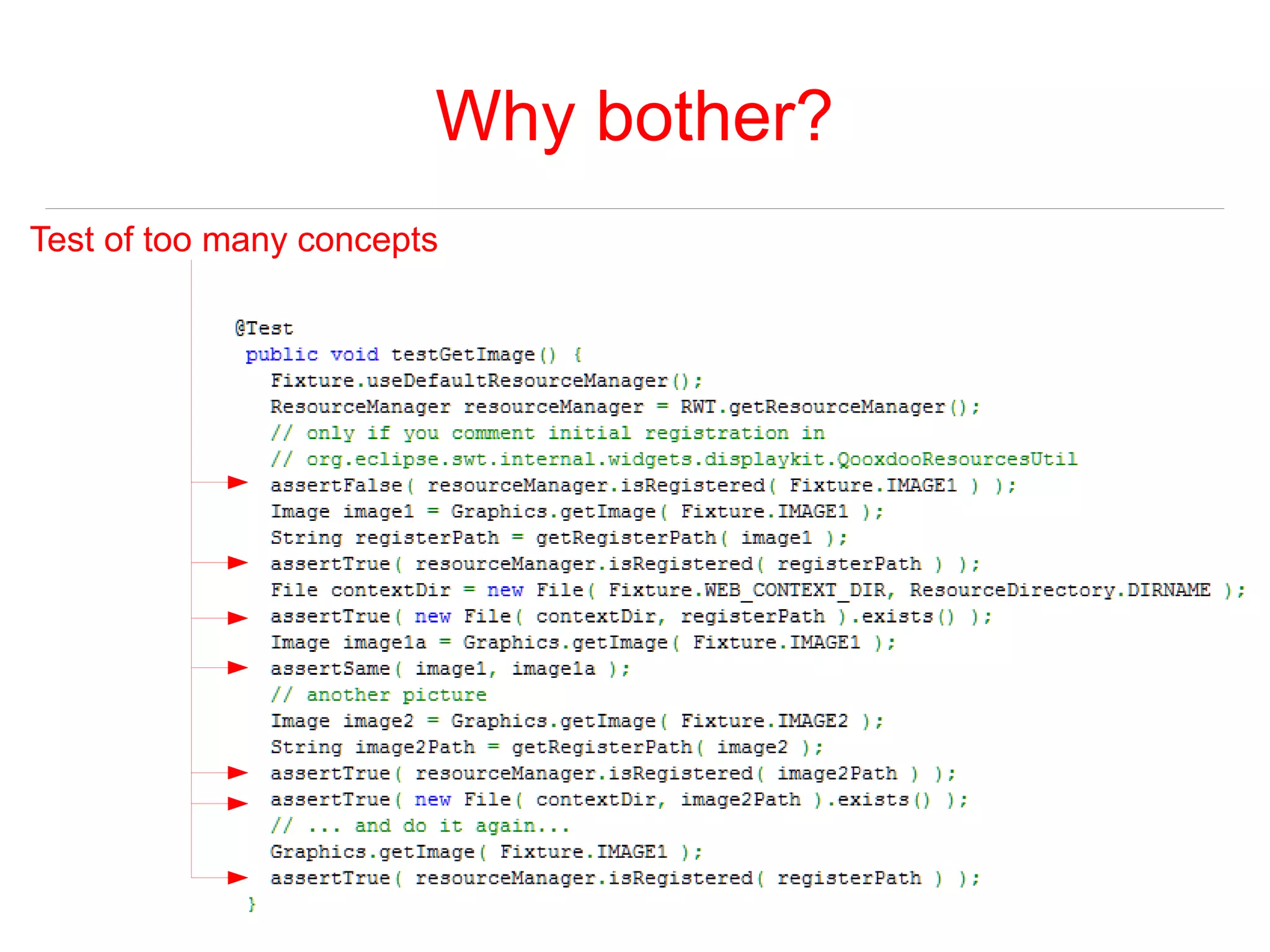
Test of too many concepts
Why bother?
Why bother? 
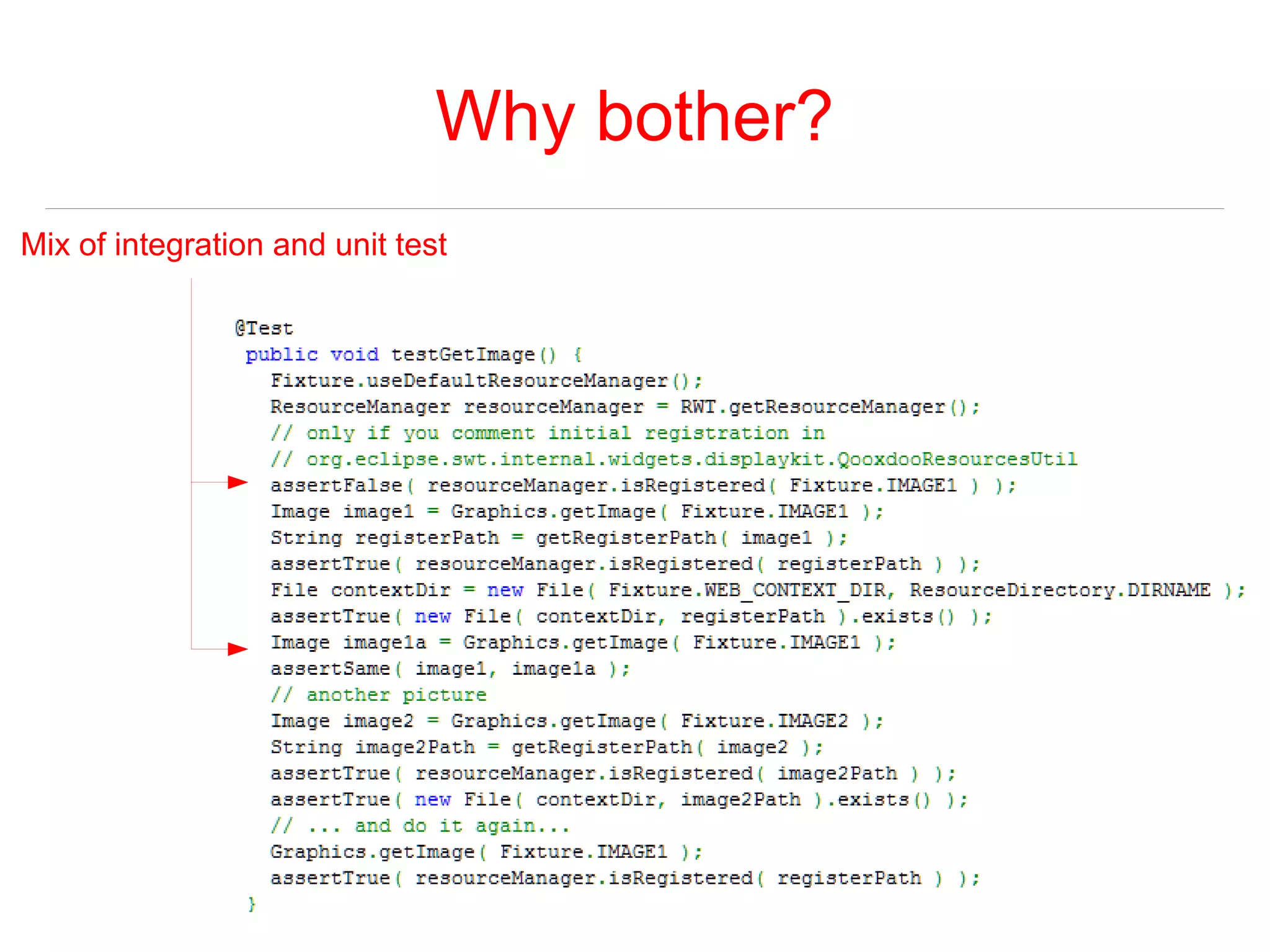
Mix of integration and unit test
Why bother?
Why bother? 
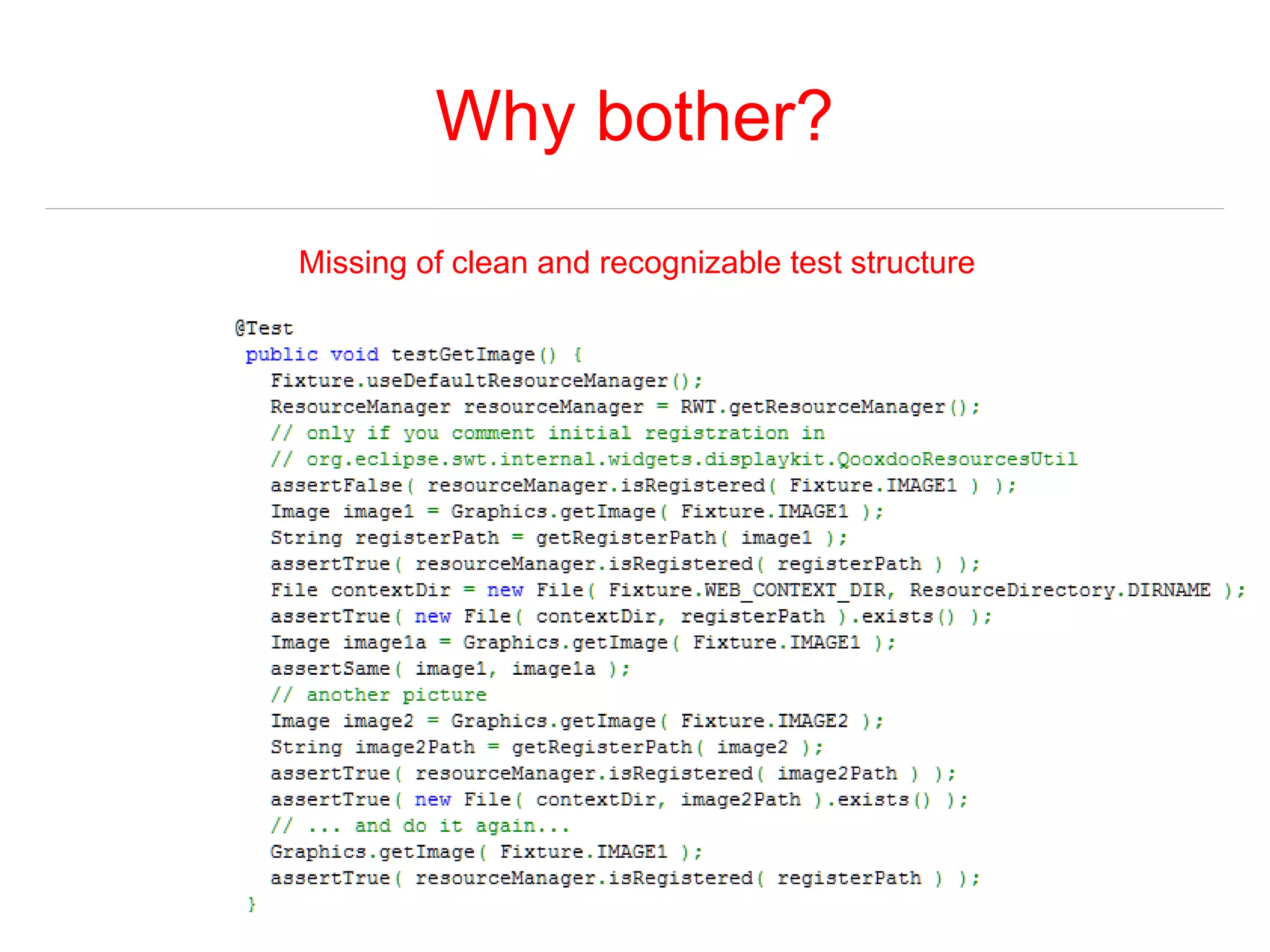
Missing of clean and recognizable test structure
Why bother?
Why bother? 
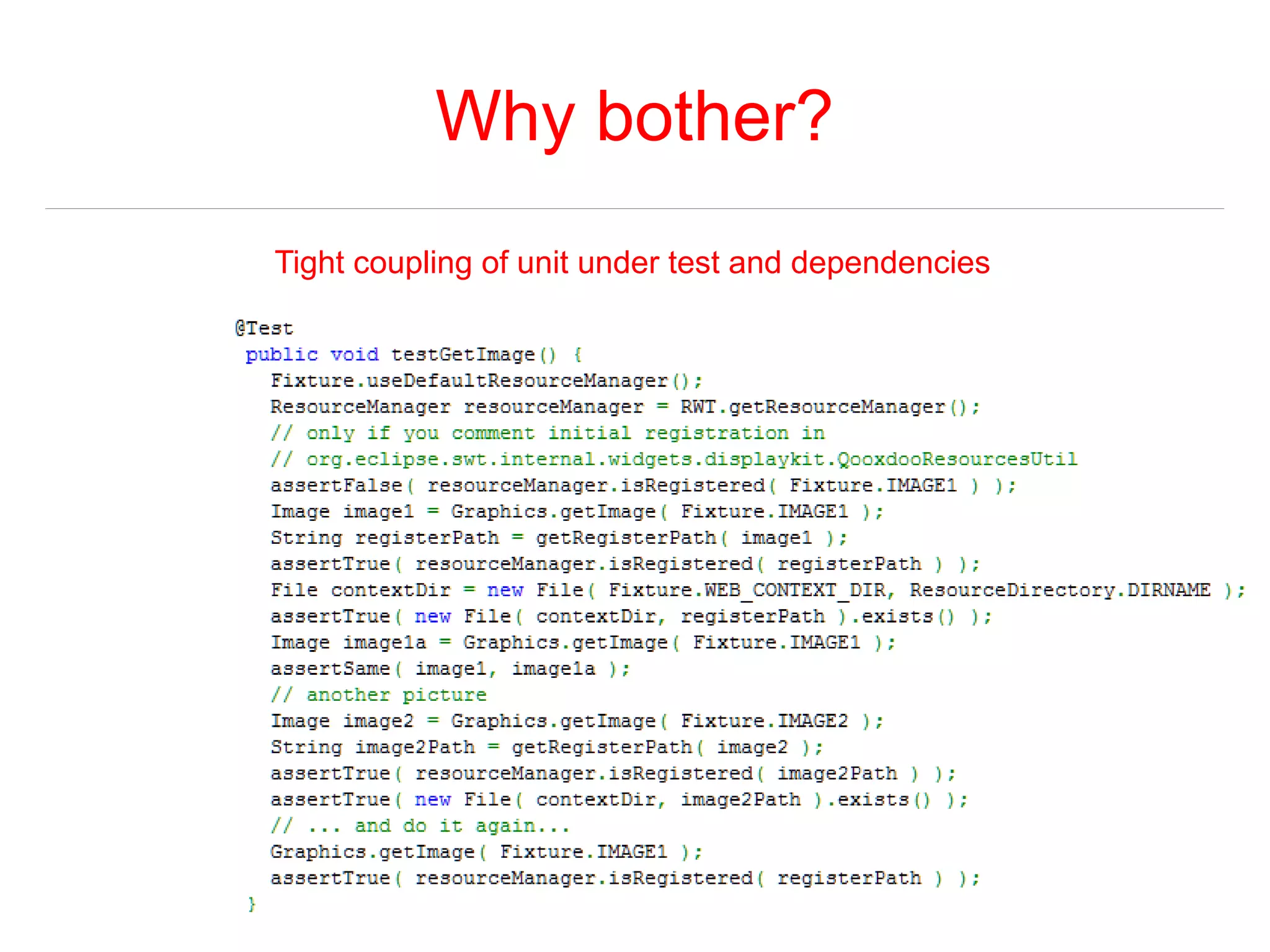
Tight coupling of unit under test and dependencies
Why bother?
Why bother? 
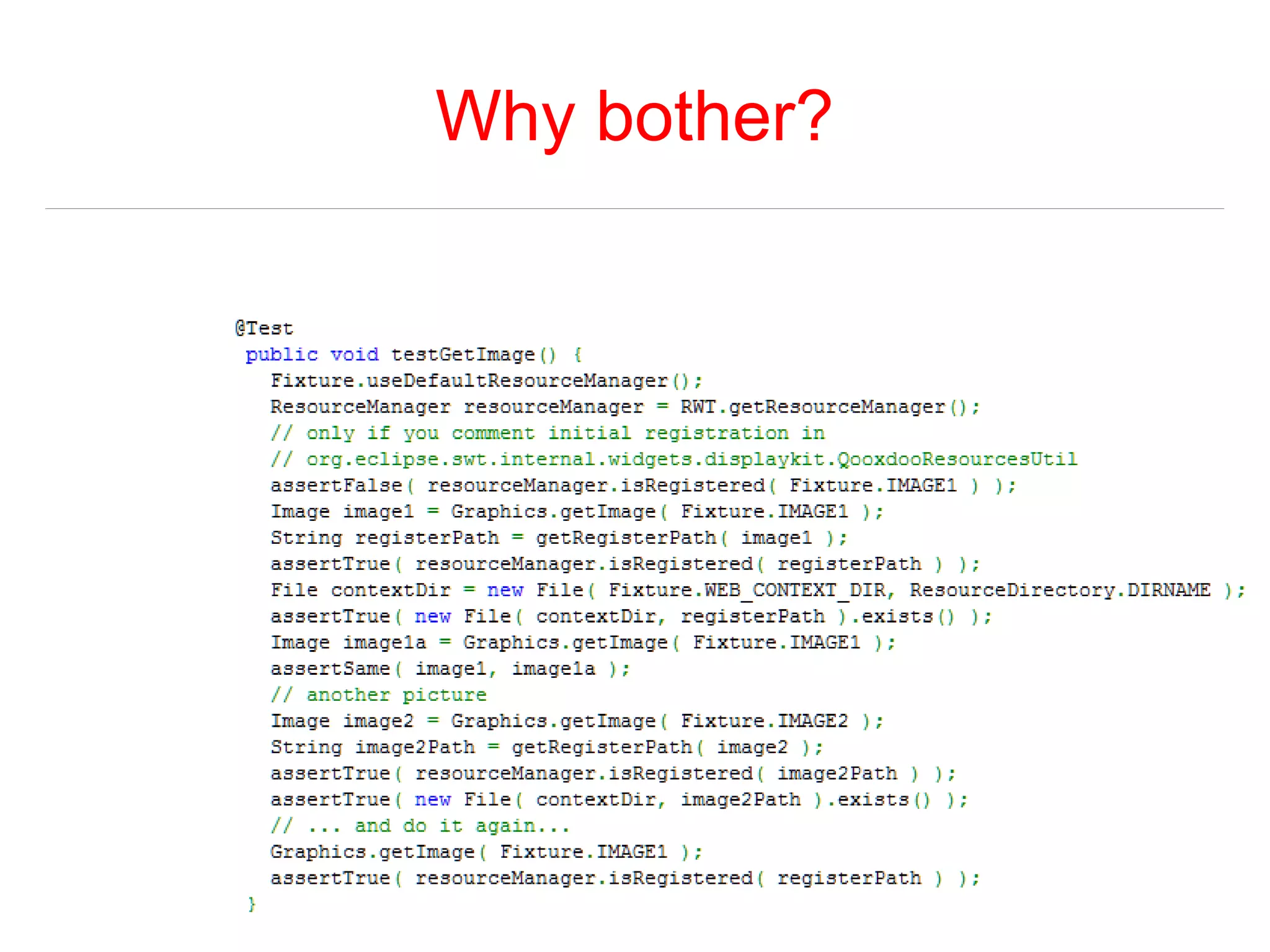
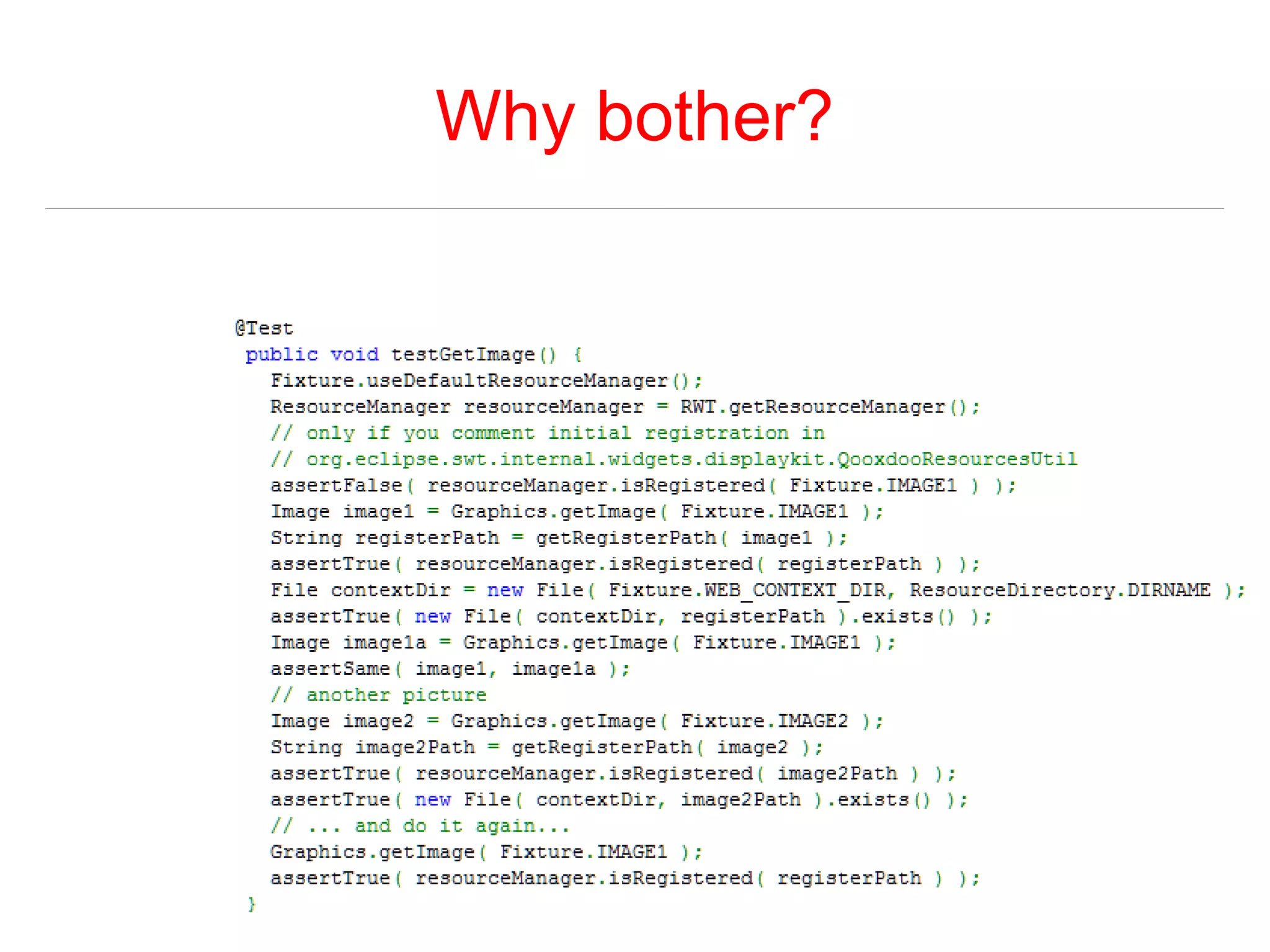
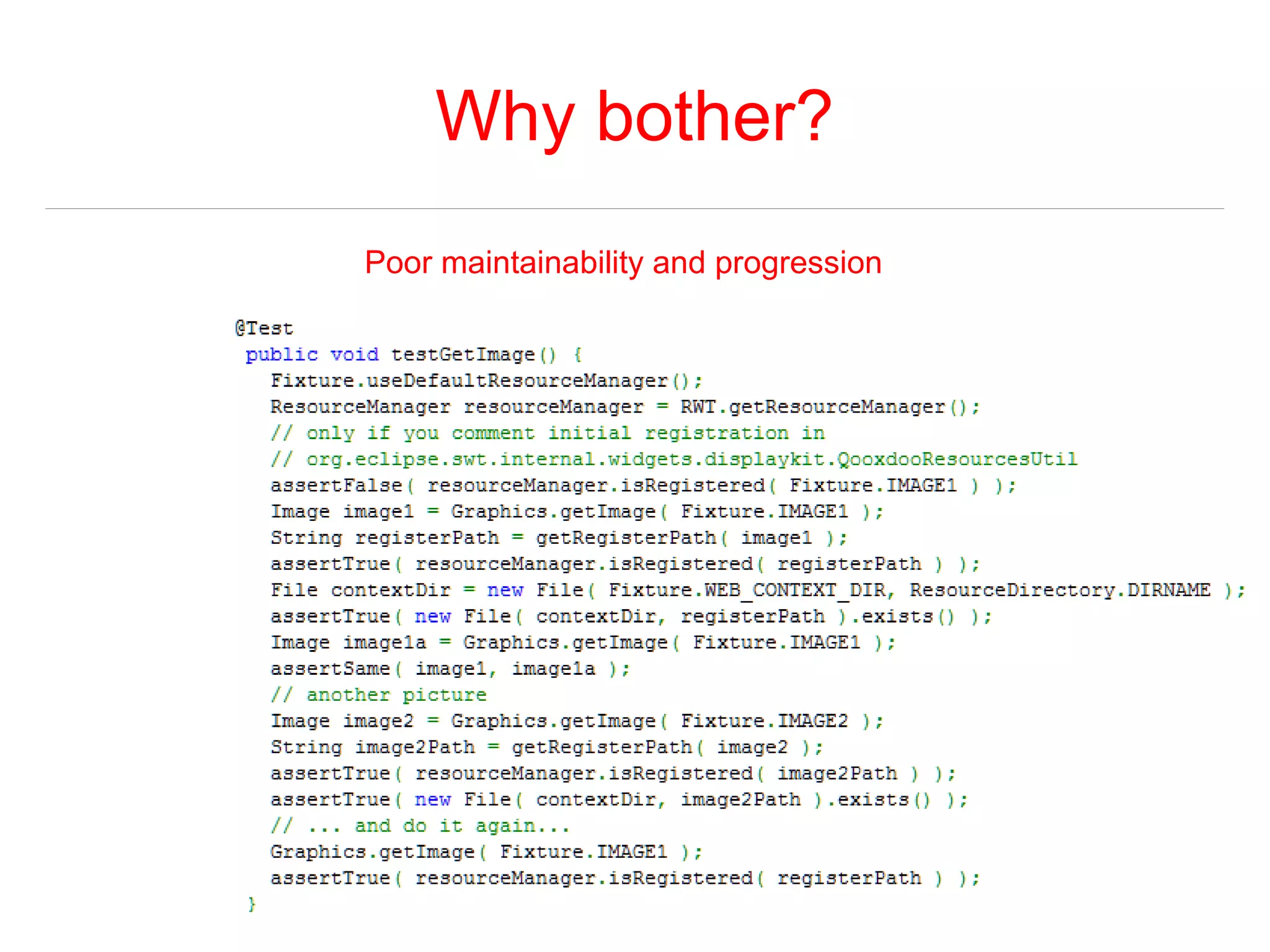
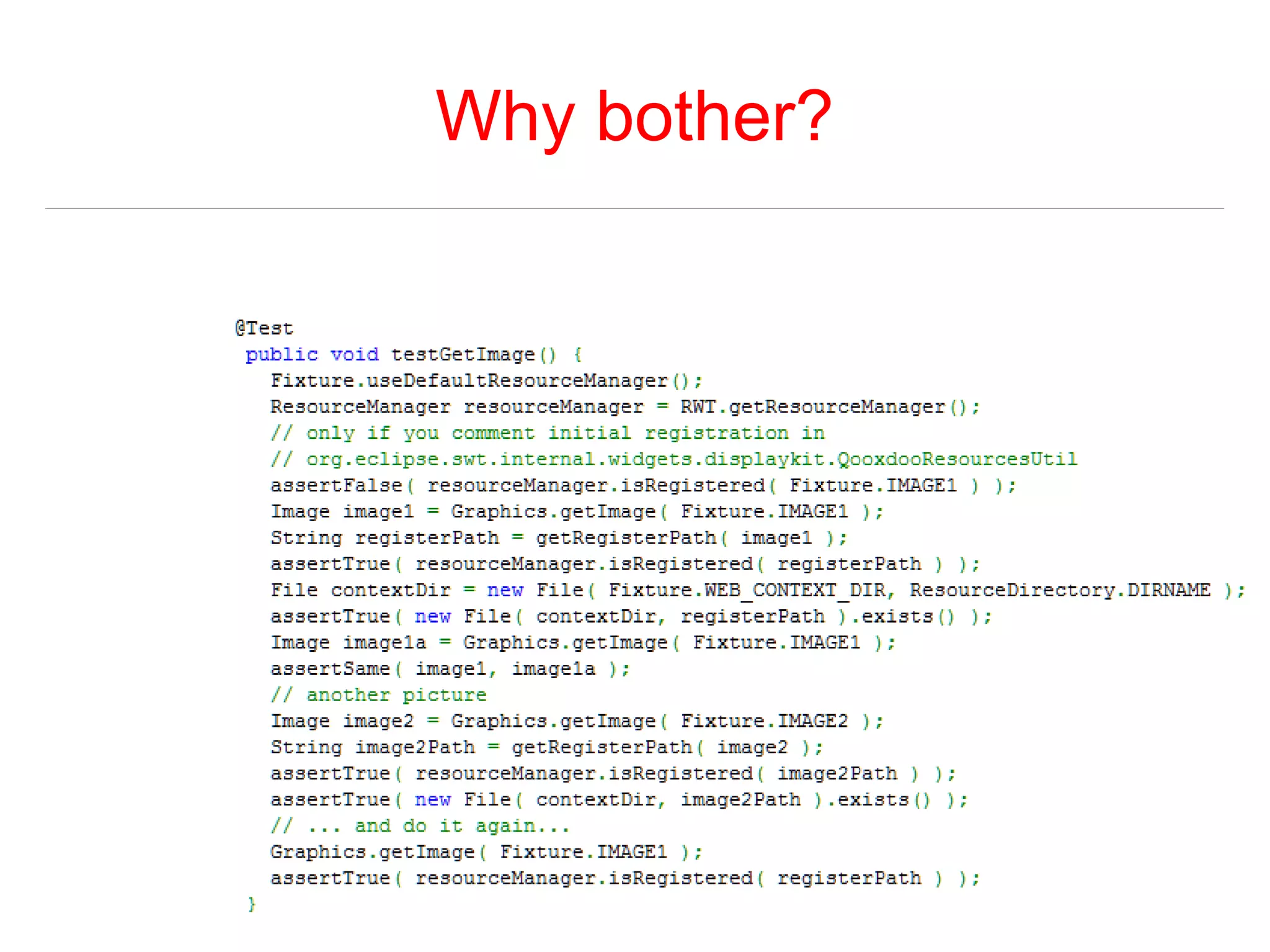
Poor maintainability and progression
Why bother?
Why bother? 
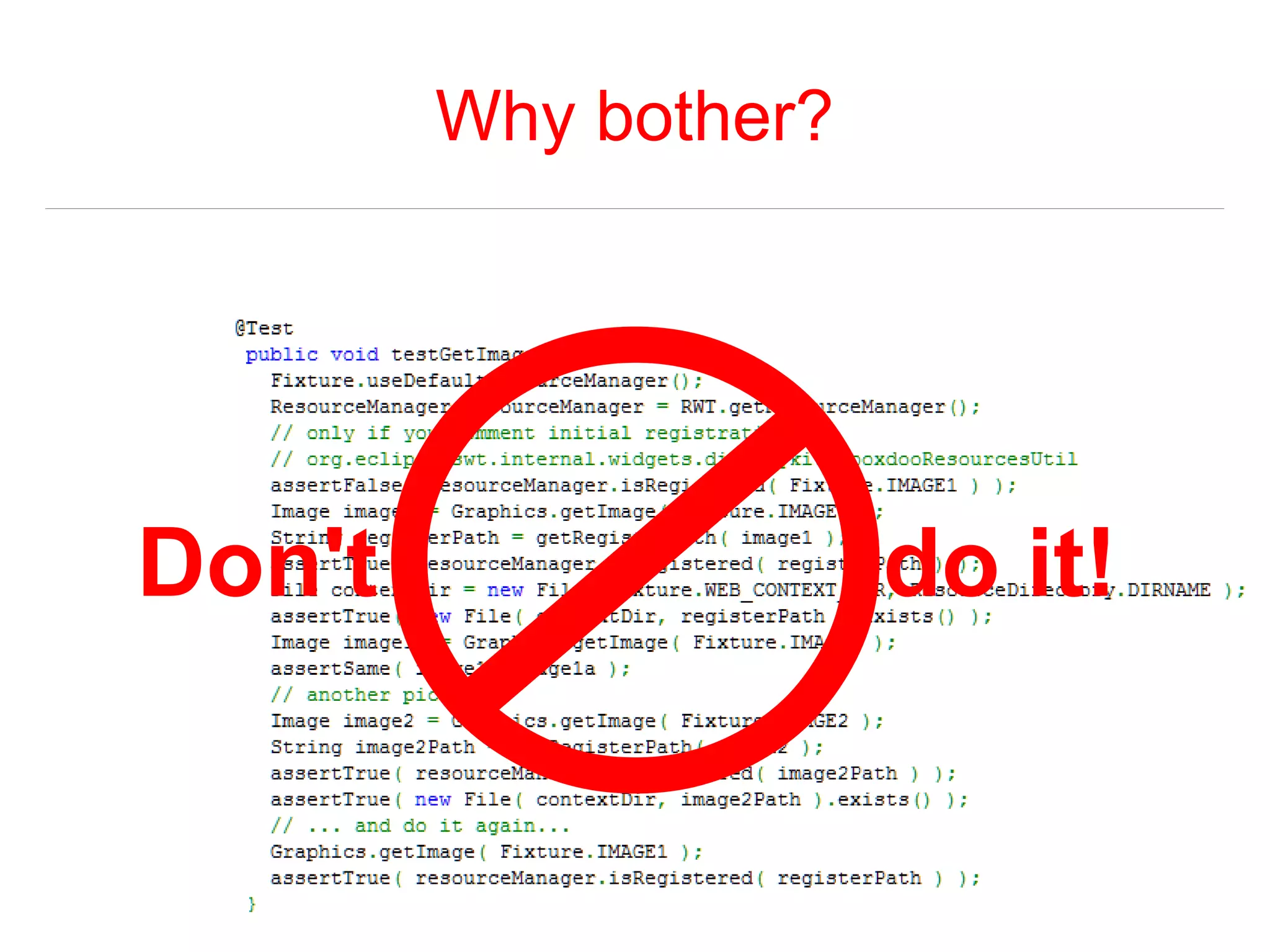
Don't do it!
C l e a n U n i t T e s t P a t t e r n s 
Why bother? 
Structure 
Isolation 
Runners and Rules 
Assertions 
Q&A
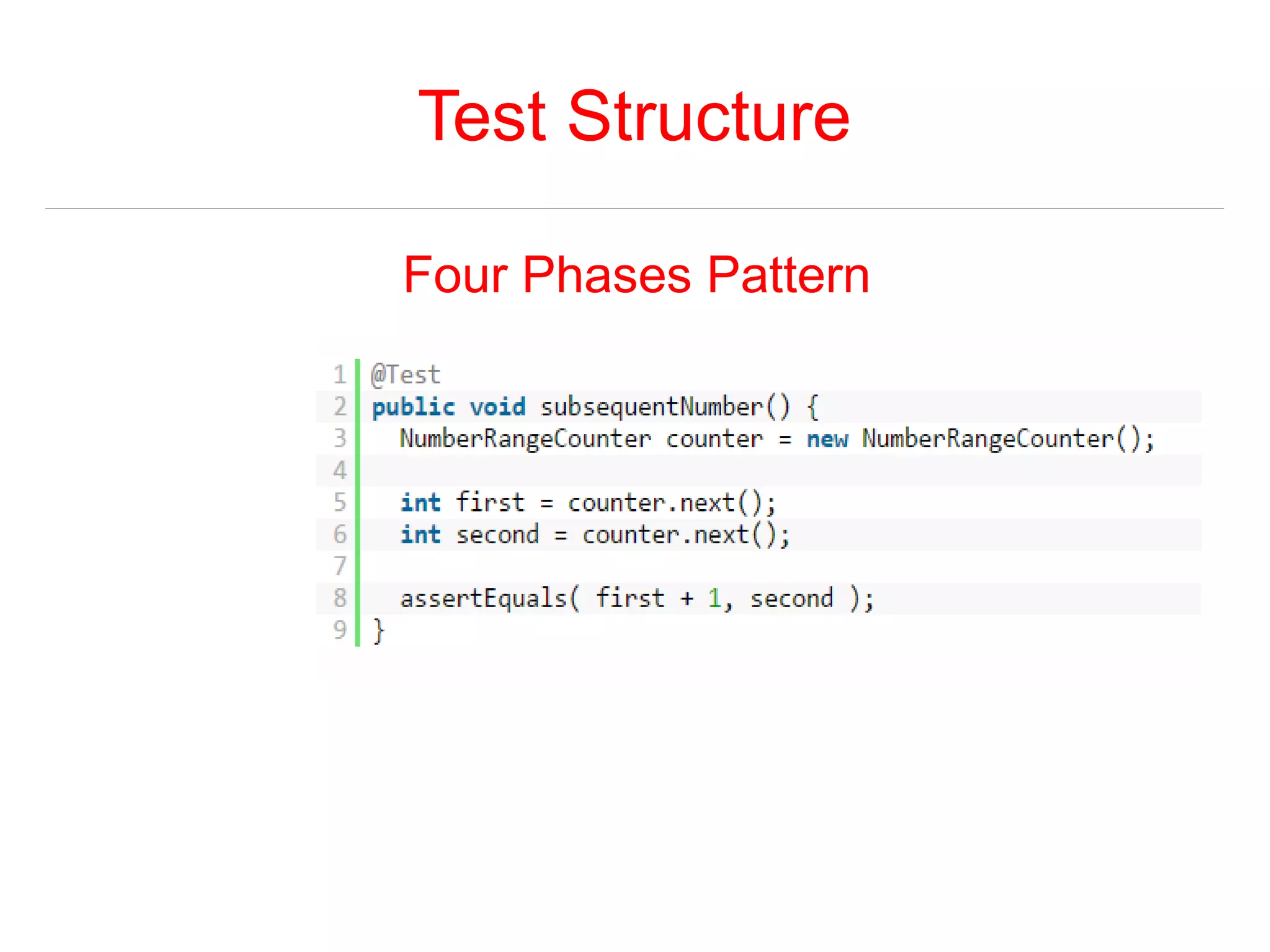
Test Structure 
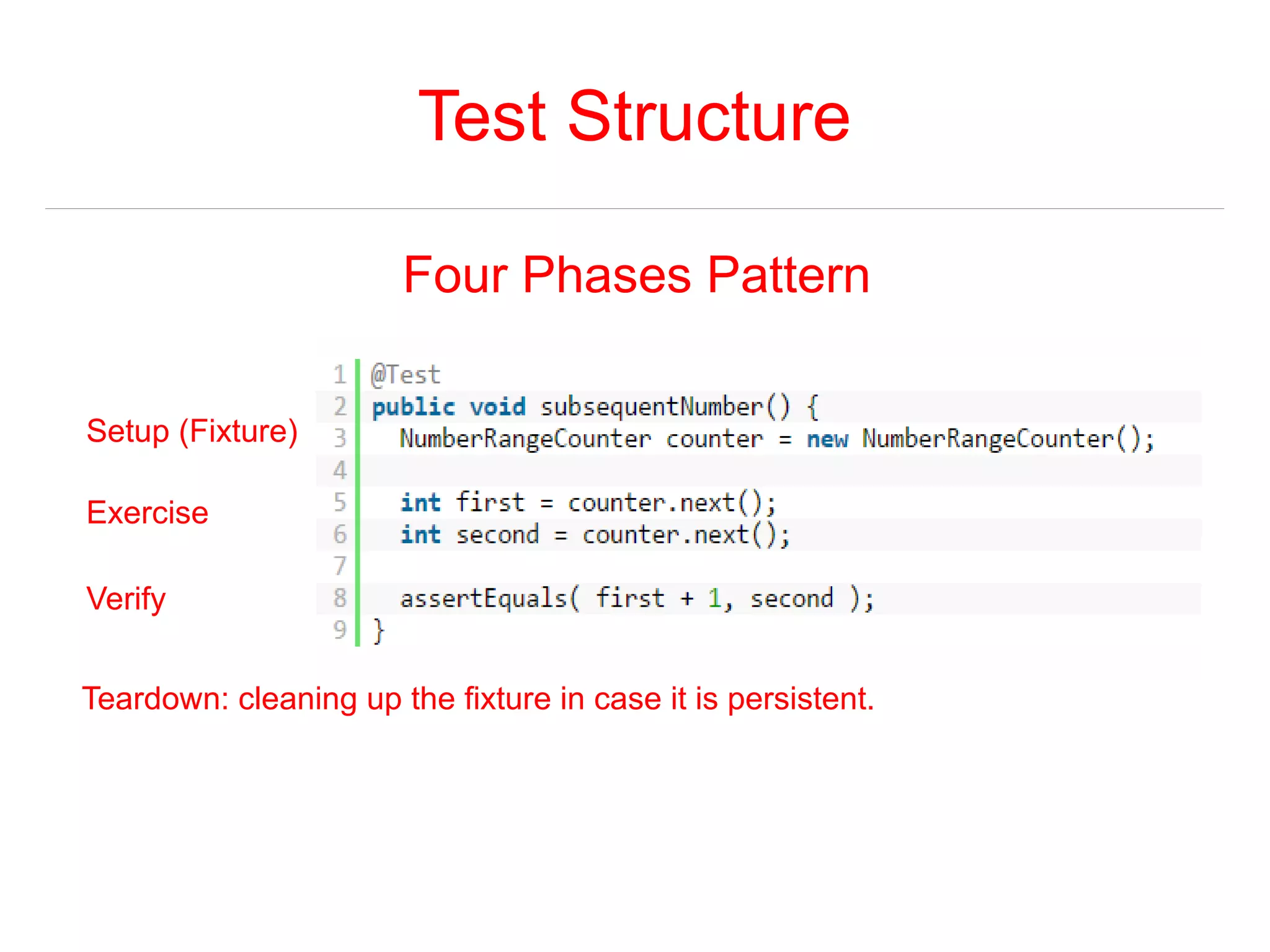
Four Phases Pattern
Test Structure 
Four Phases Pattern 
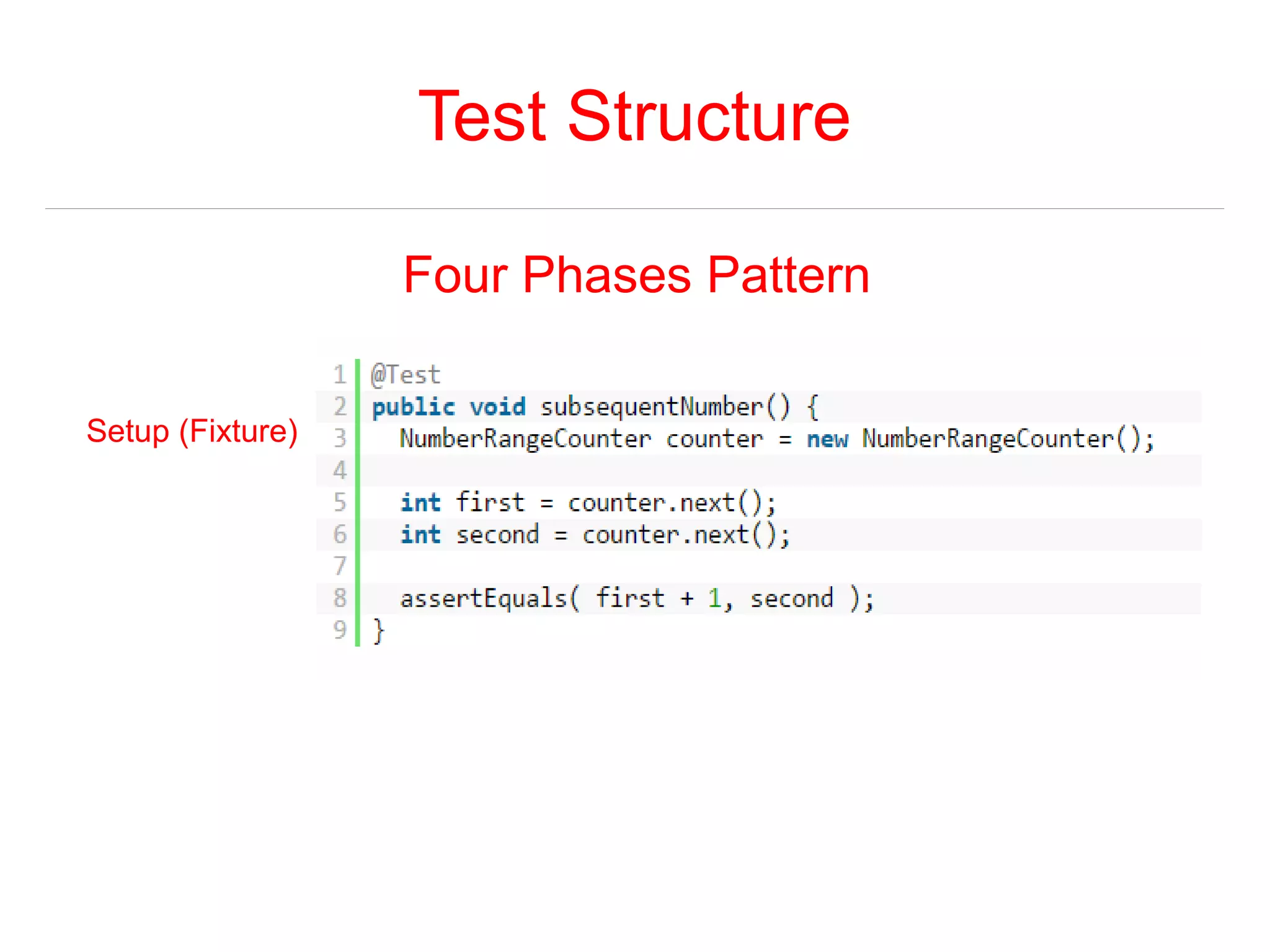
Setup (Fixture)
Test Structure 
Four Phases Pattern 
Setup (Fixture) 
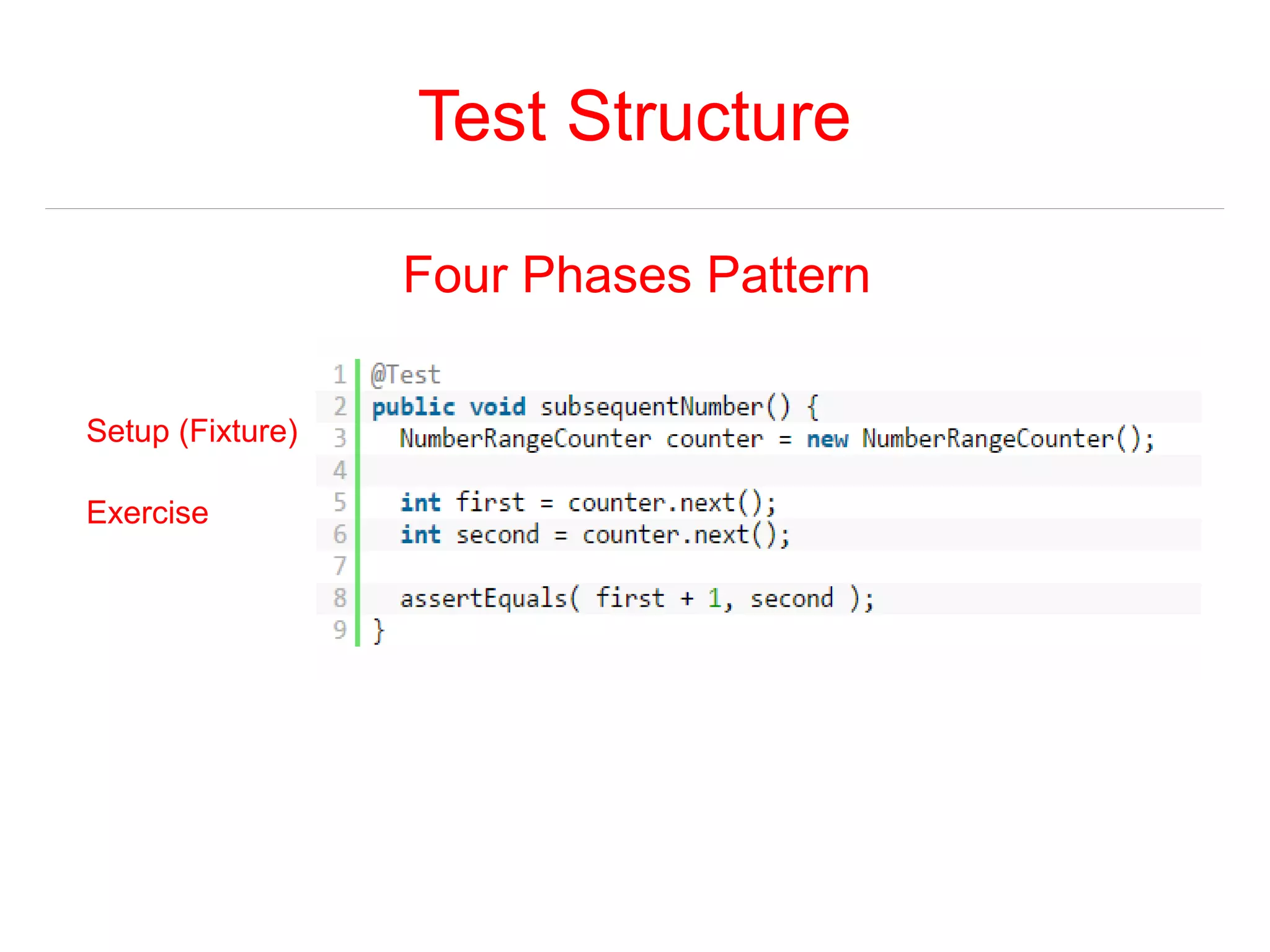
Exercise
Test Structure 
Four Phases Pattern 
Setup (Fixture) 
Exercise 
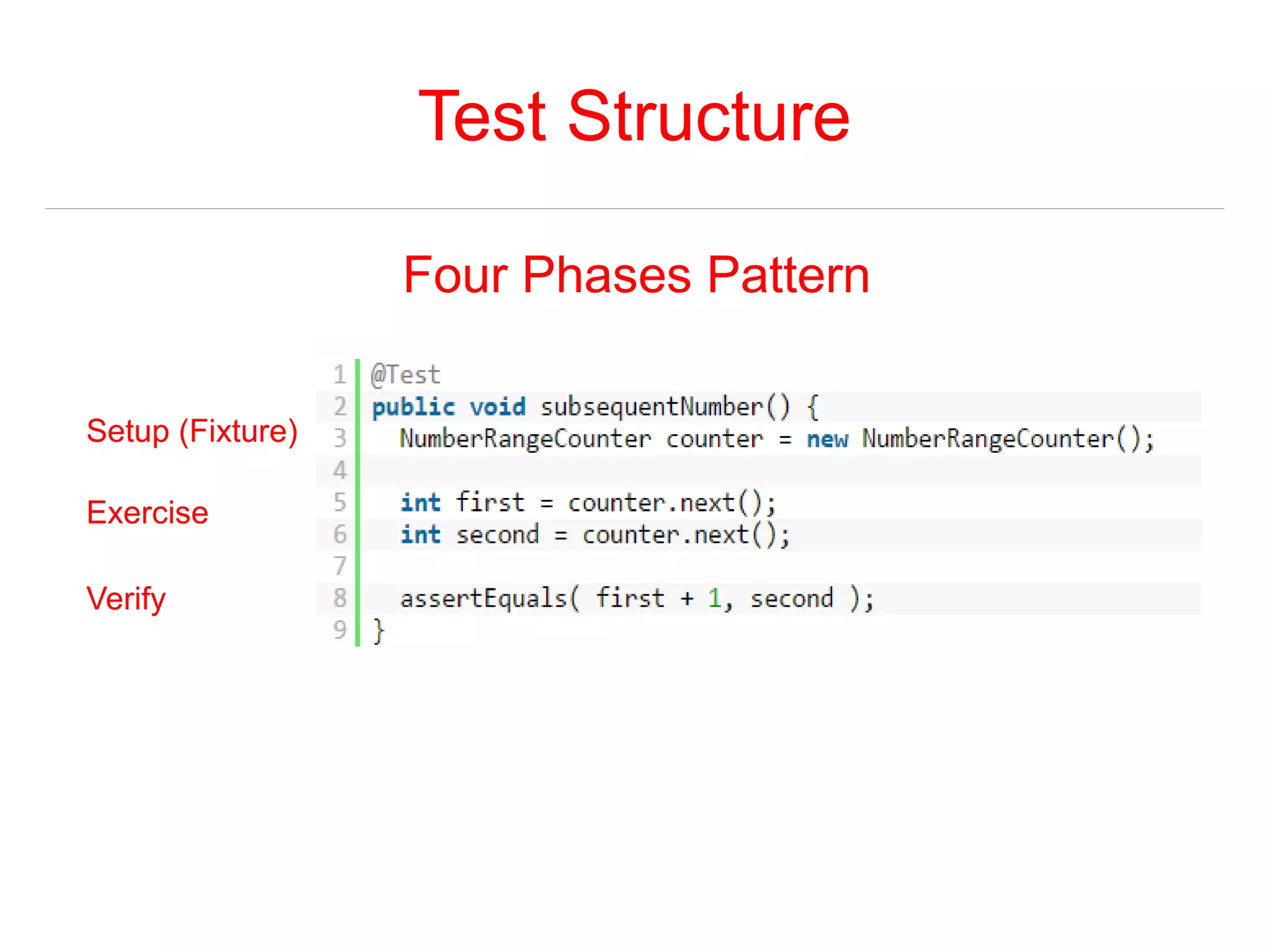
Verify
Test Structure 
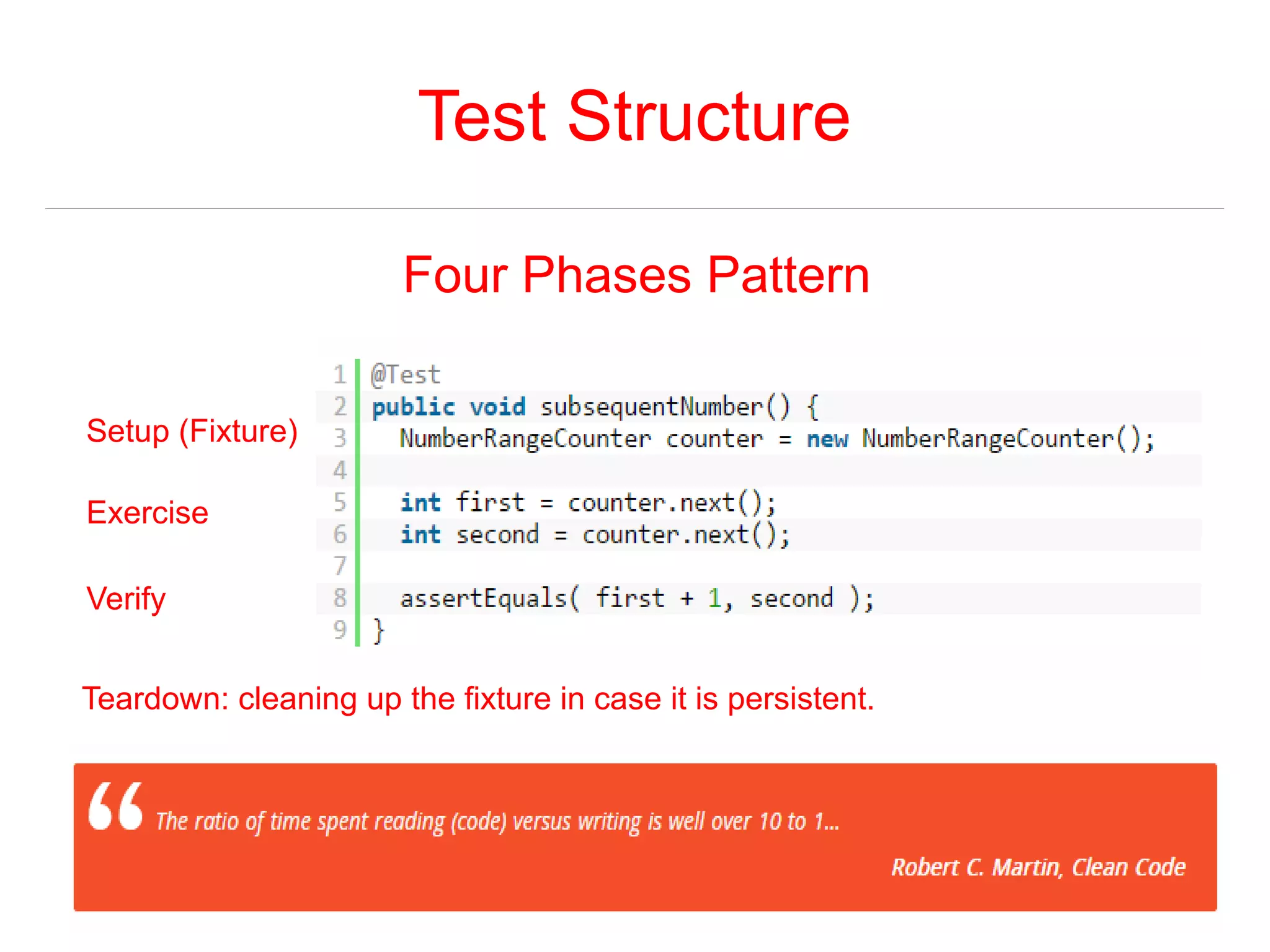
Four Phases Pattern 
Setup (Fixture) 
Exercise 
Verify 
Teardown: cleaning up the fixture in case it is persistent.
Test Structure 
Four Phases Pattern 
Setup (Fixture) 
Exercise 
Verify 
Teardown: cleaning up the fixture in case it is persistent.
Test Structure 
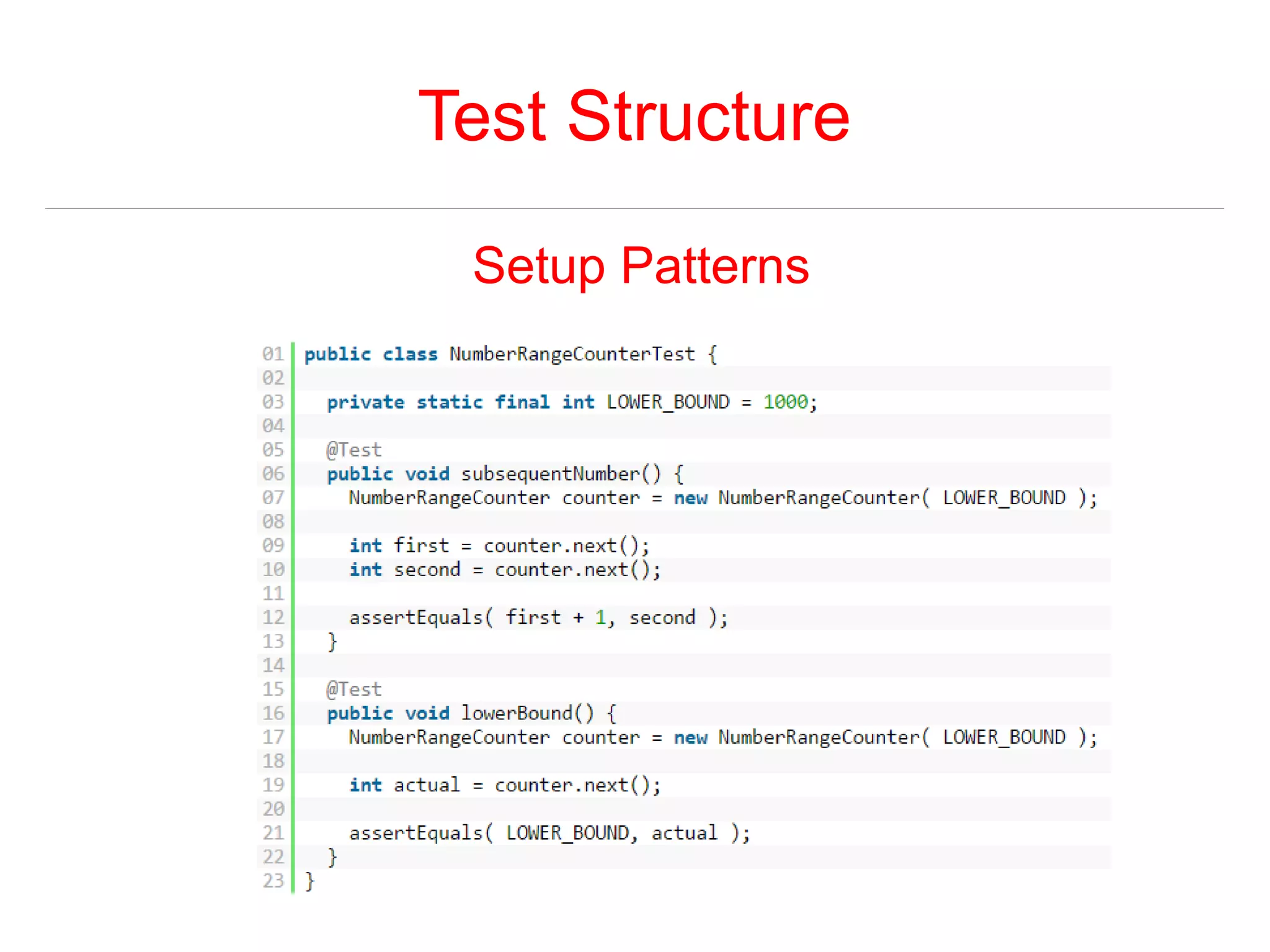
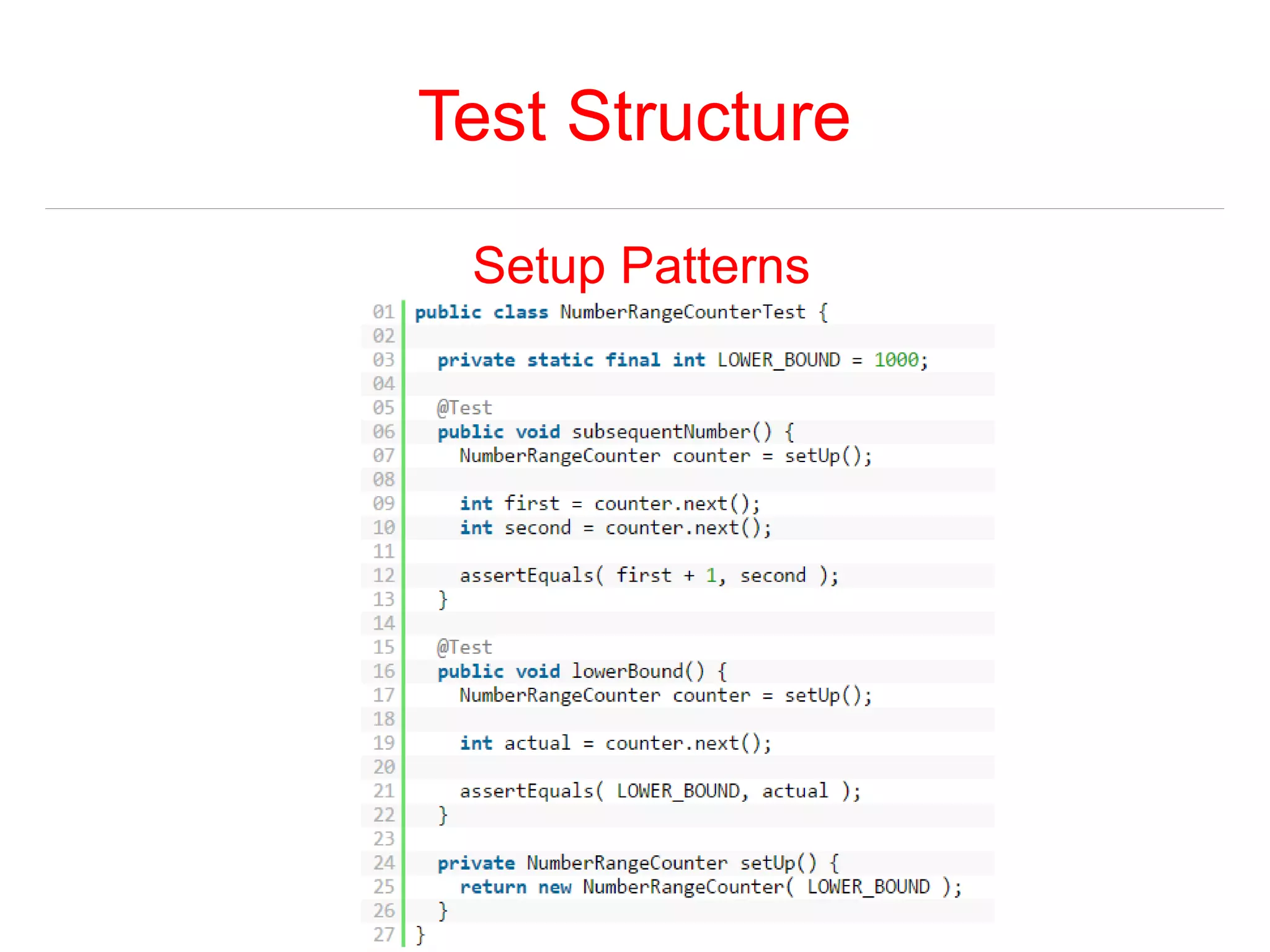
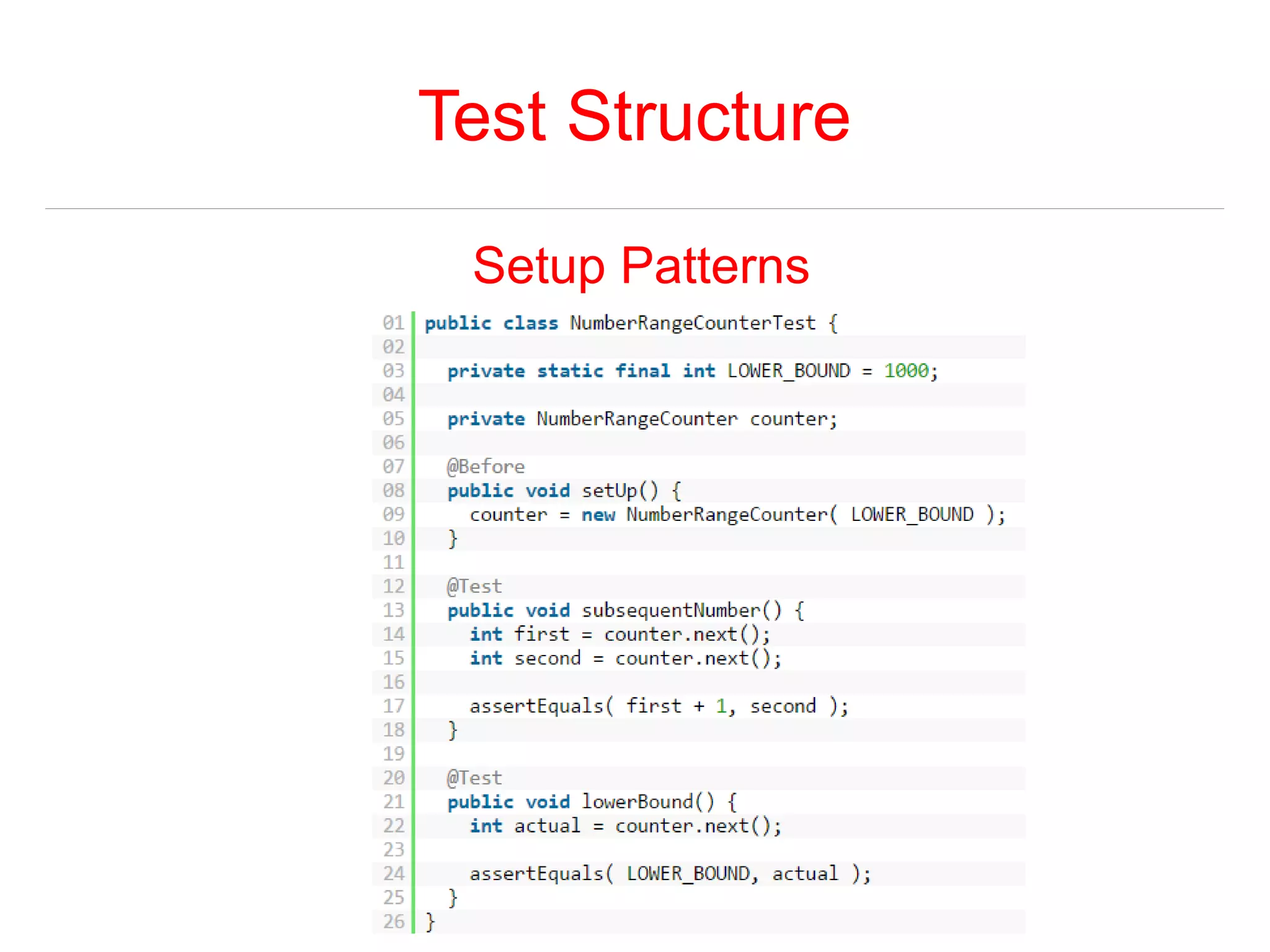
Setup Patterns
Test Structure 
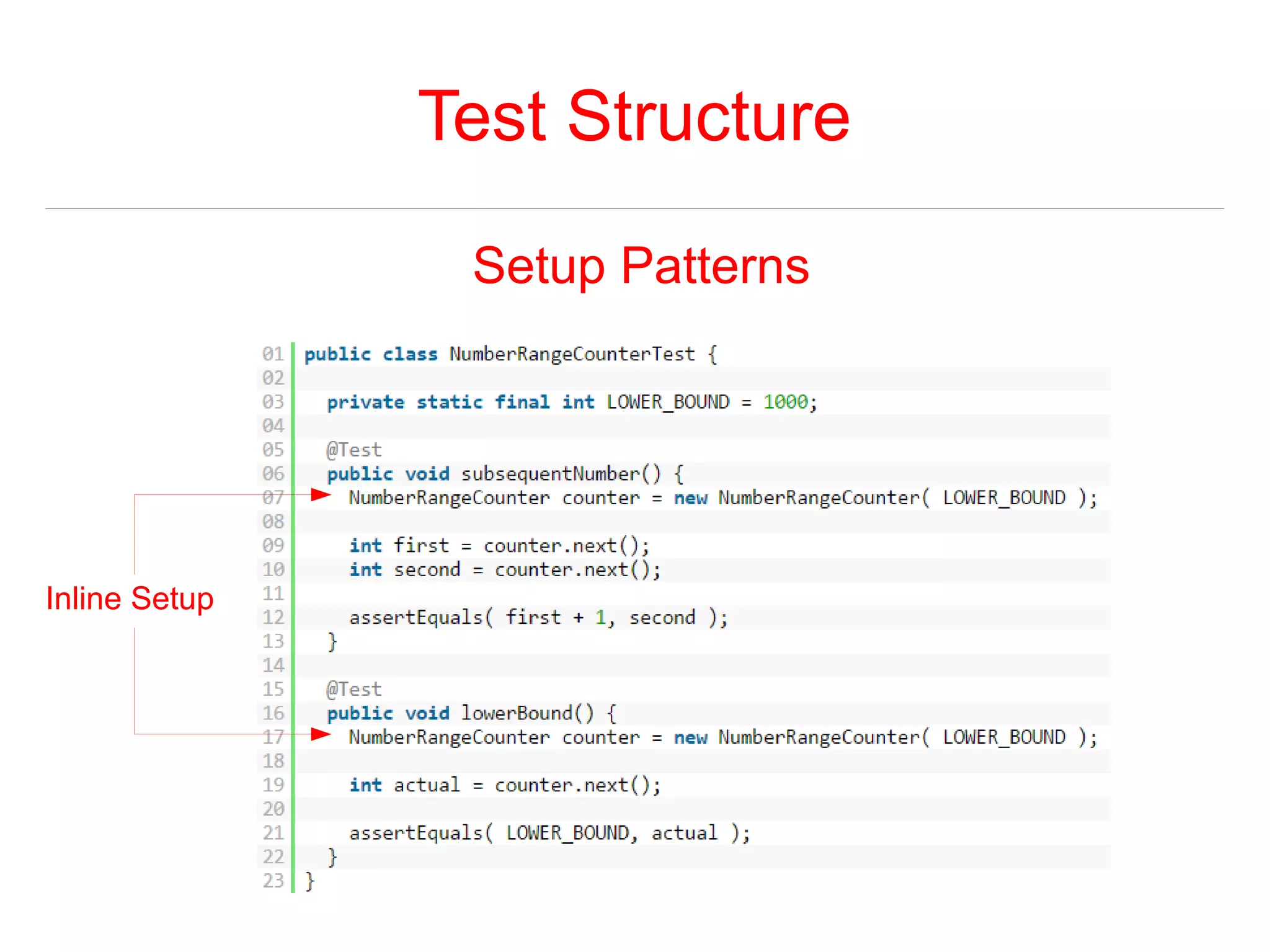
Setup Patterns 
Inline Setup
Test Structure 
Setup Patterns
Test Structure 
Setup Patterns
Test Structure 
Setup Patterns 
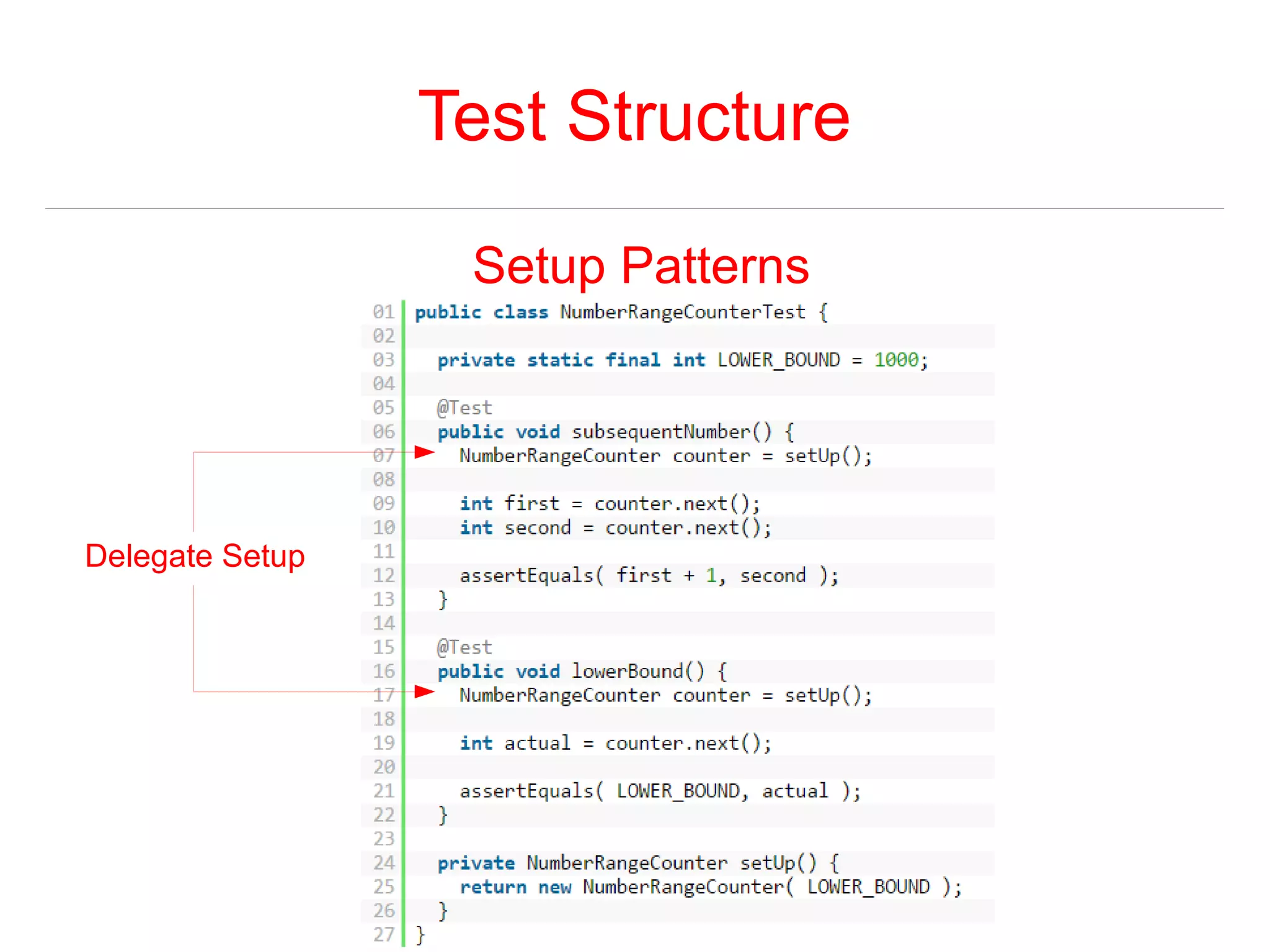
Delegate Setup
Test Structure 
Setup Patterns
Test Structure 
Setup Patterns
Test Structure 
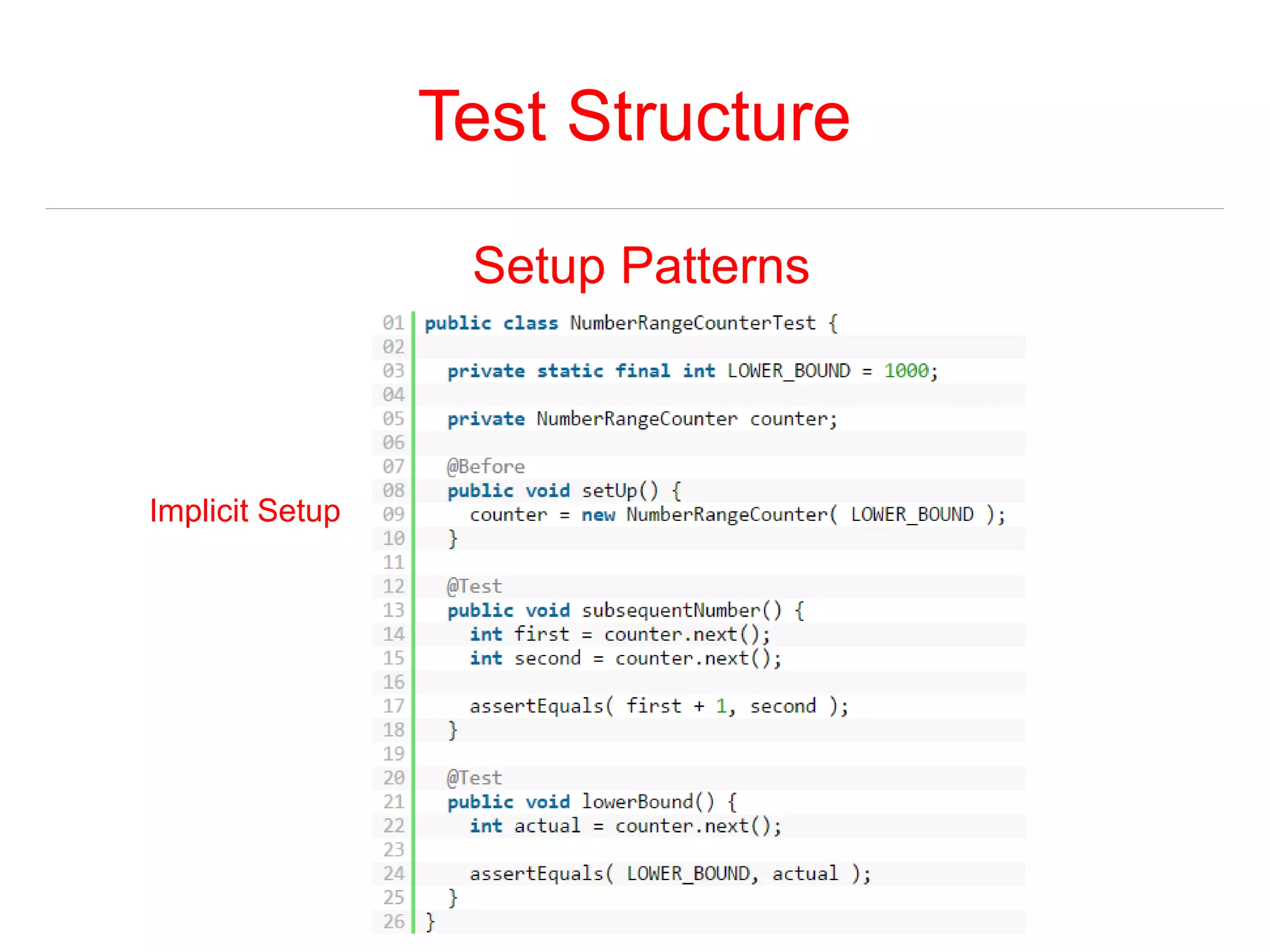
Setup Patterns 
Implicit Setup
Test Structure 
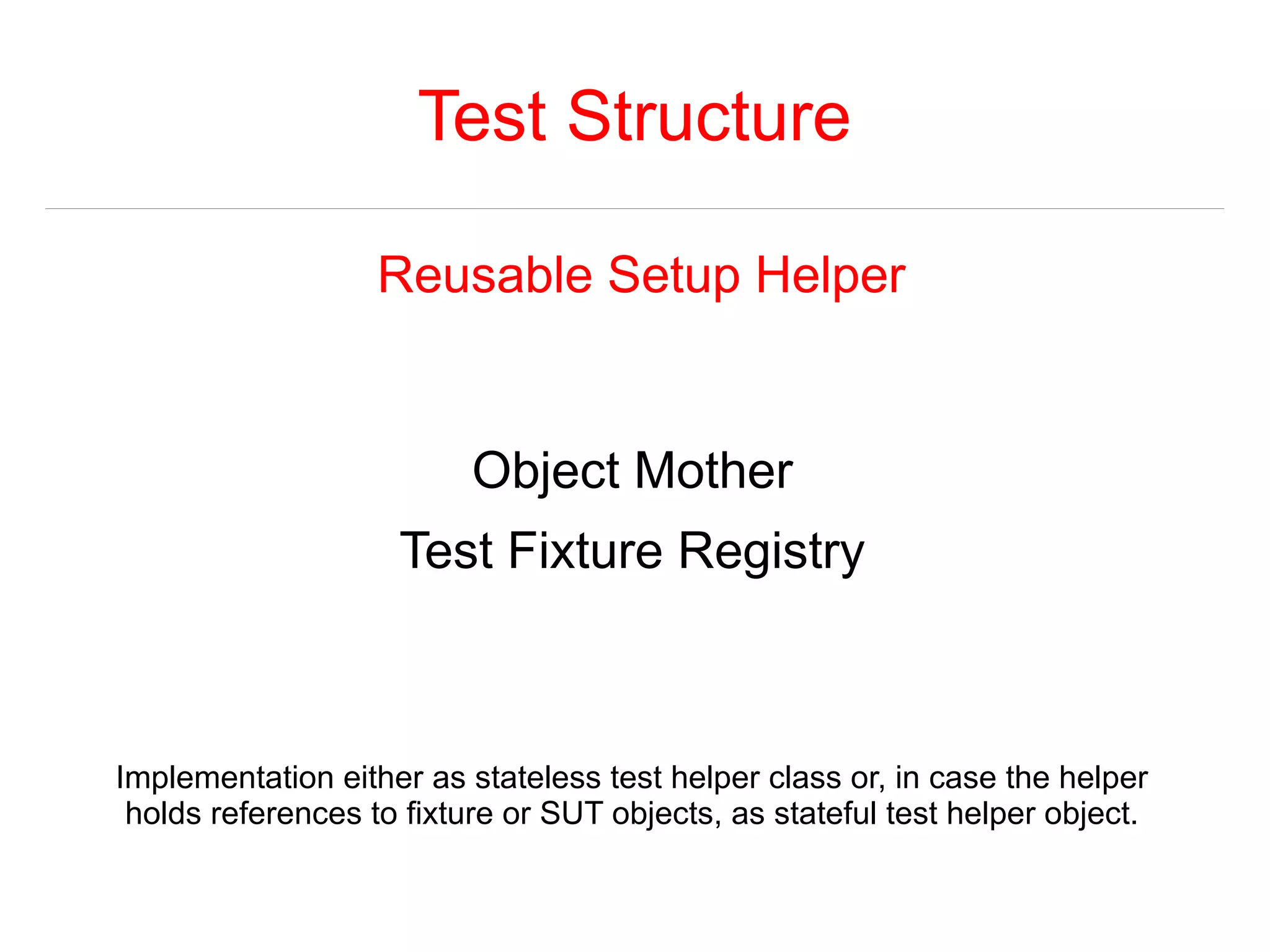
Reusable Setup Helper 
Object Mother 
Test Fixture Registry 
Implementation either as stateless test helper class or, in case the helper 
holds references to fixture or SUT objects, as stateful test helper object.
Test Structure 
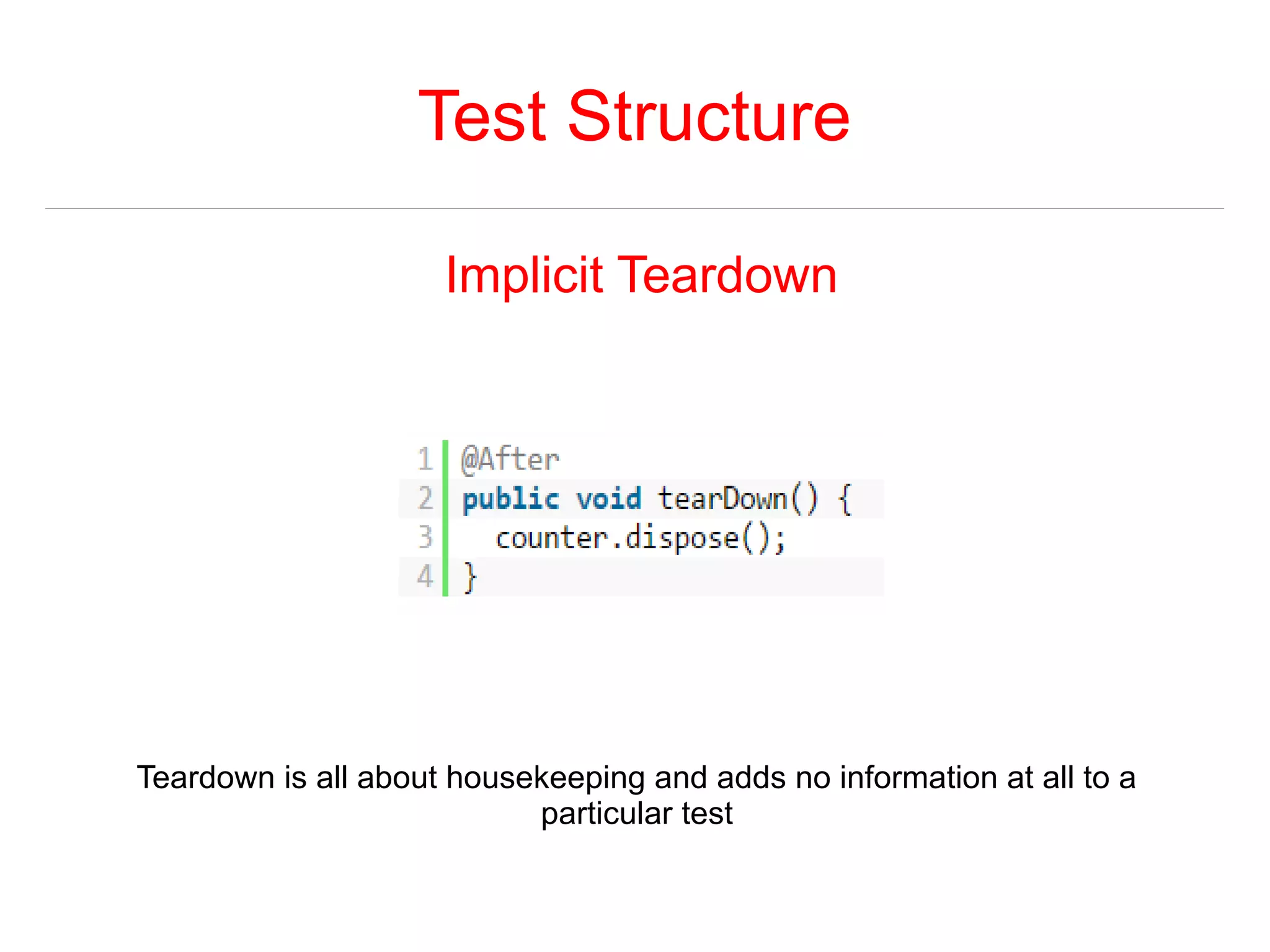
Implicit Teardown 
Teardown is all about housekeeping and adds no information at all to a 
particular test
Test Structure 
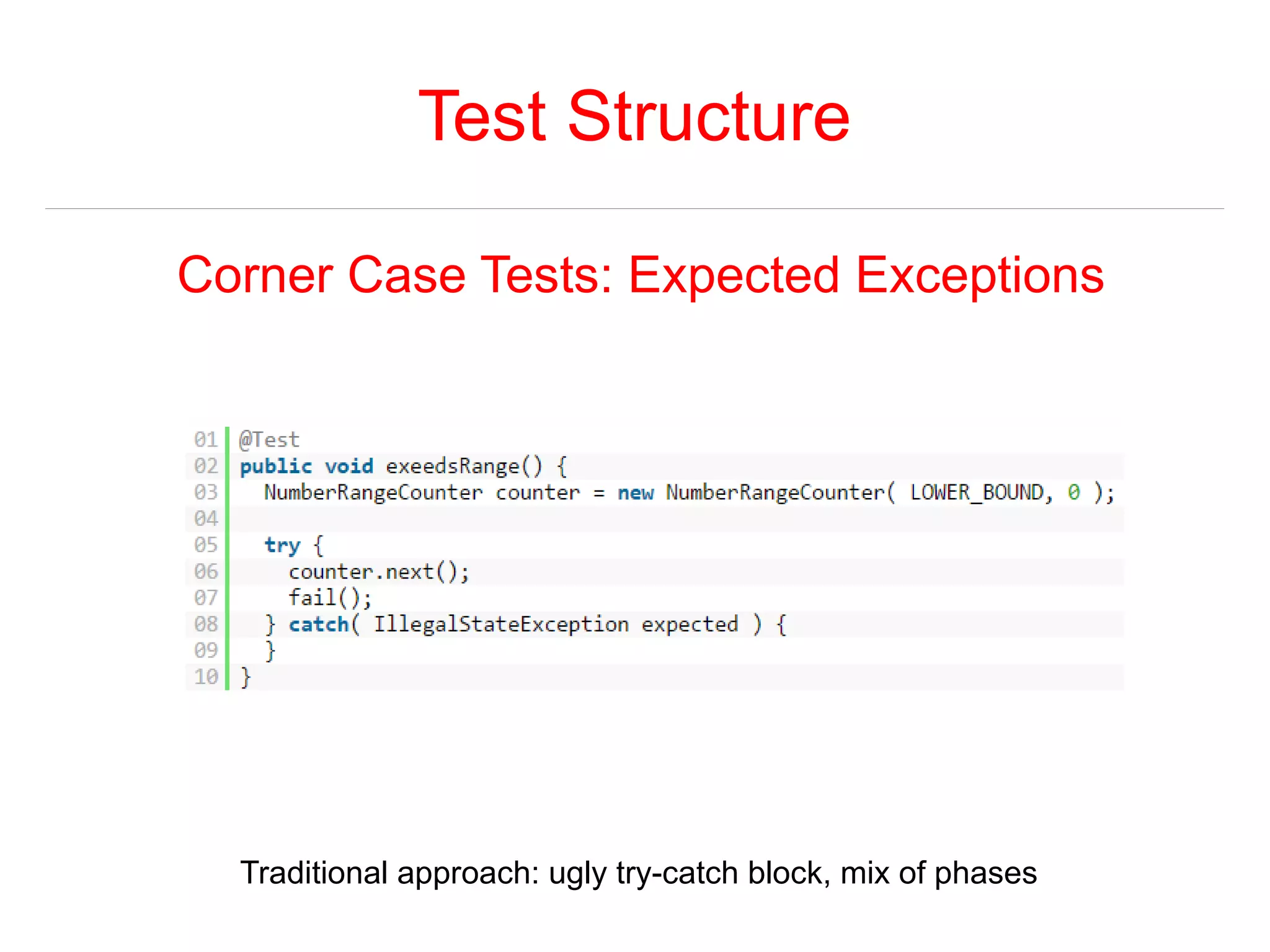
Corner Case Tests: Expected Exceptions 
Traditional approach: ugly try-catch block, mix of phases
Test Structure 
Corner Case Tests: Expected Exceptions
Test Structure 
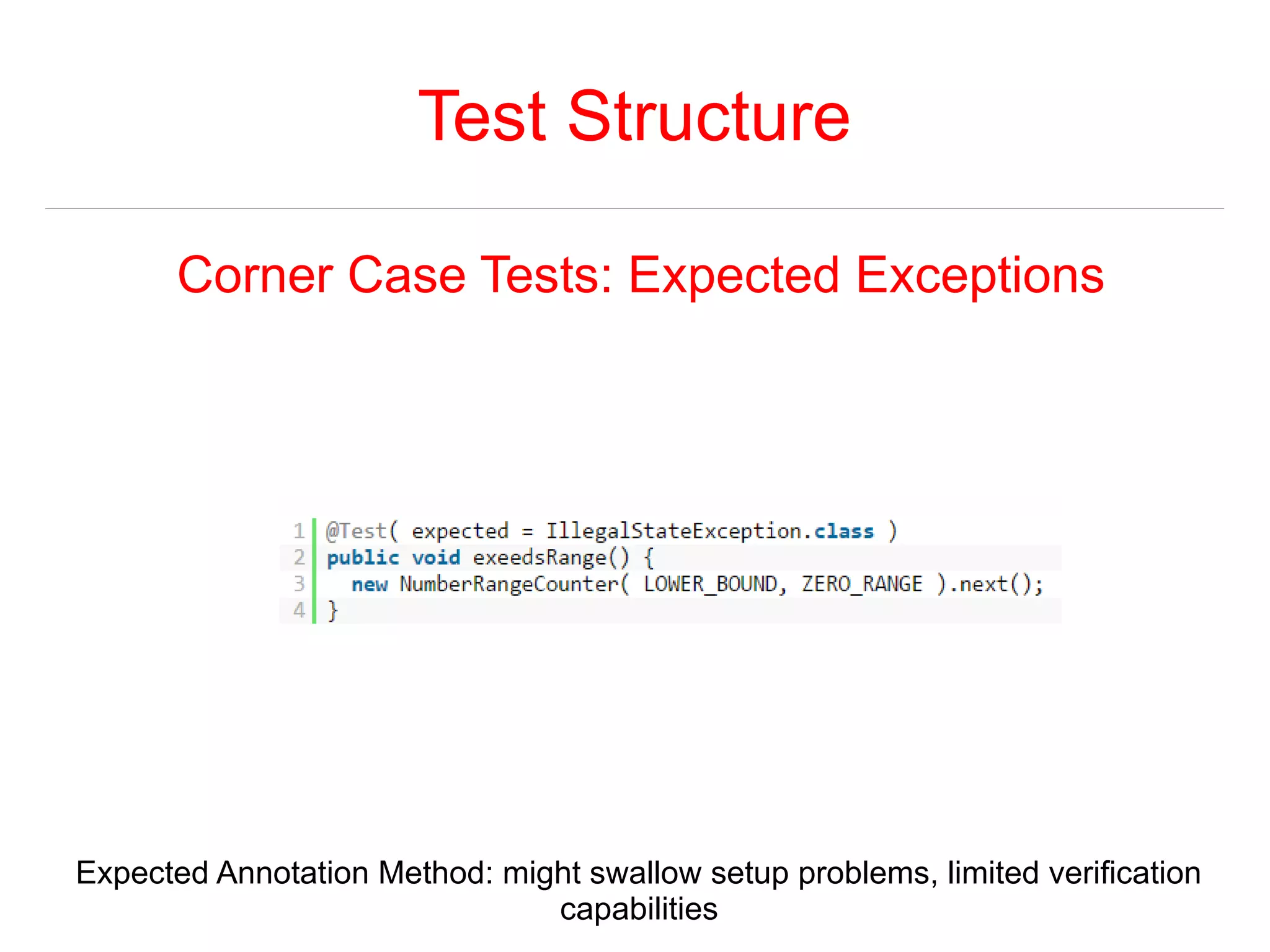
Corner Case Tests: Expected Exceptions 
Expected Annotation Method: might swallow setup problems, limited verification 
capabilities
Test Structure 
Corner Case Tests: Expected Exceptions
Test Structure 
Corner Case Tests: Expected Exceptions 
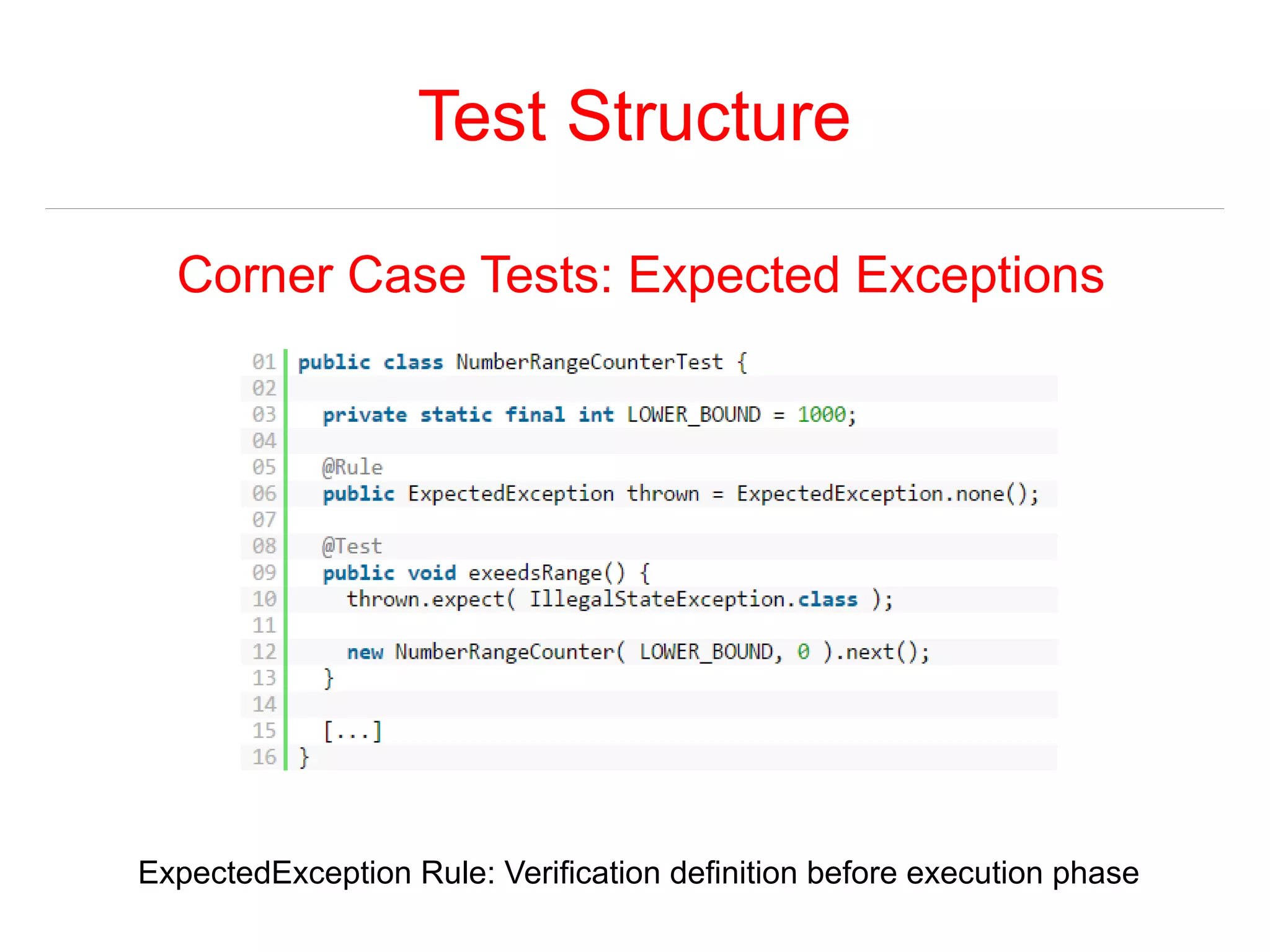
ExpectedException Rule: Verification definition before execution phase
Test Structure 
Corner Case Tests: Expected Exceptions
Test Structure 
Corner Case Tests: Expected Exceptions 
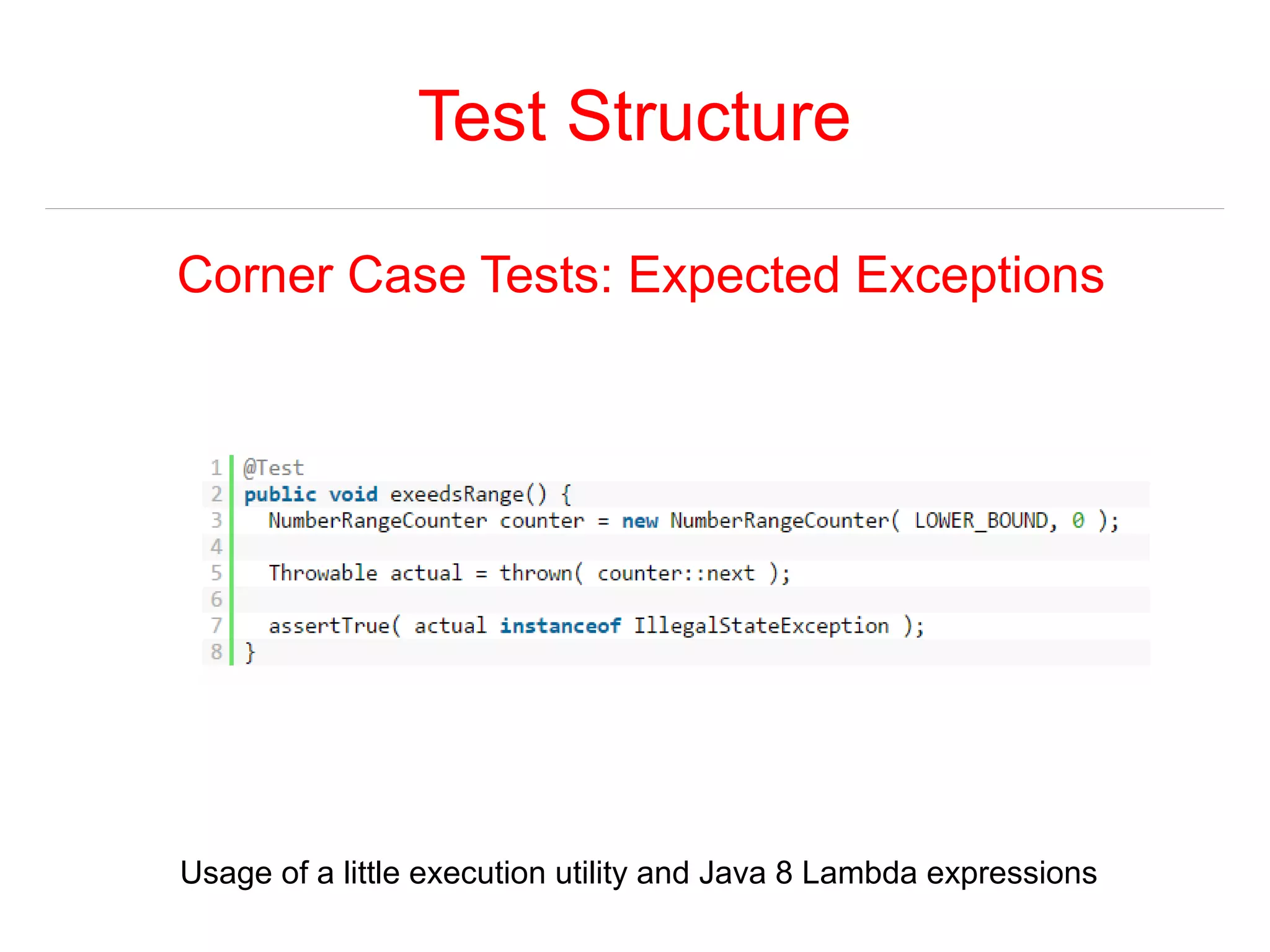
Usage of a little execution utility and Java 8 Lambda expressions
C l e a n U n i t T e s t P a t t e r n s 
Why bother? 
Structure 
Isolation 
Runners and Rules 
Assertions 
Q&A
Isolation 
Dependencies: SUT and DOC 
The tested Unit is usually referred to as system under test (SUT) 
Components the SUT depends on are denoted as depended-on 
component (DOC) 
Test related problems with DOCs 
DOCs we cannot control might impede decent test verification 
DOCs might also slow down test execution 
DOC’s behavior may change unexpectedly e.g. due to the usage of a 
newer version of a third party library
Isolation 
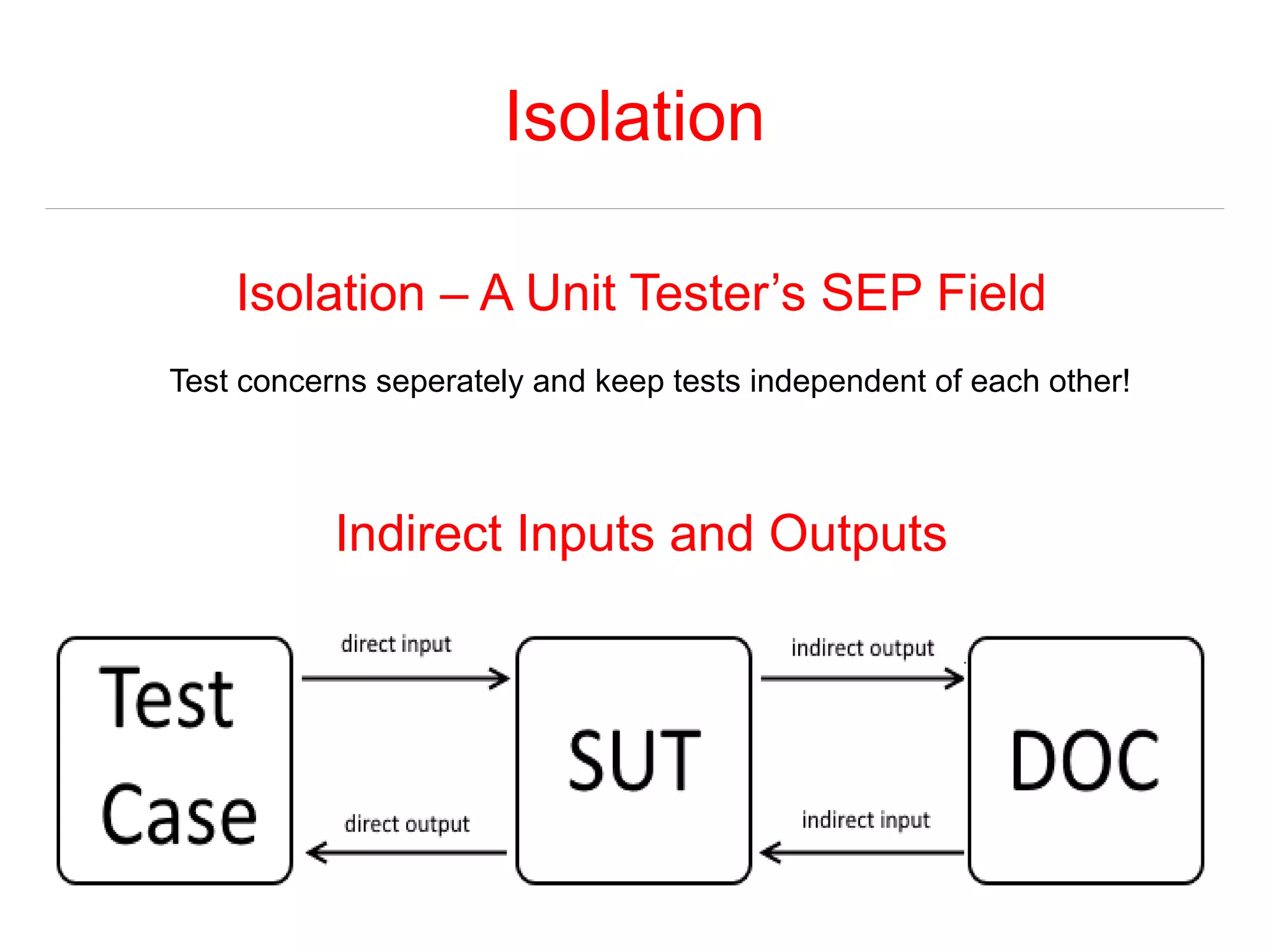
Isolation – A Unit Tester’s SEP Field 
Test concerns seperately and keep tests independent of each other! 
Indirect Inputs and Outputs
Isolation 
Test Double Patterns 
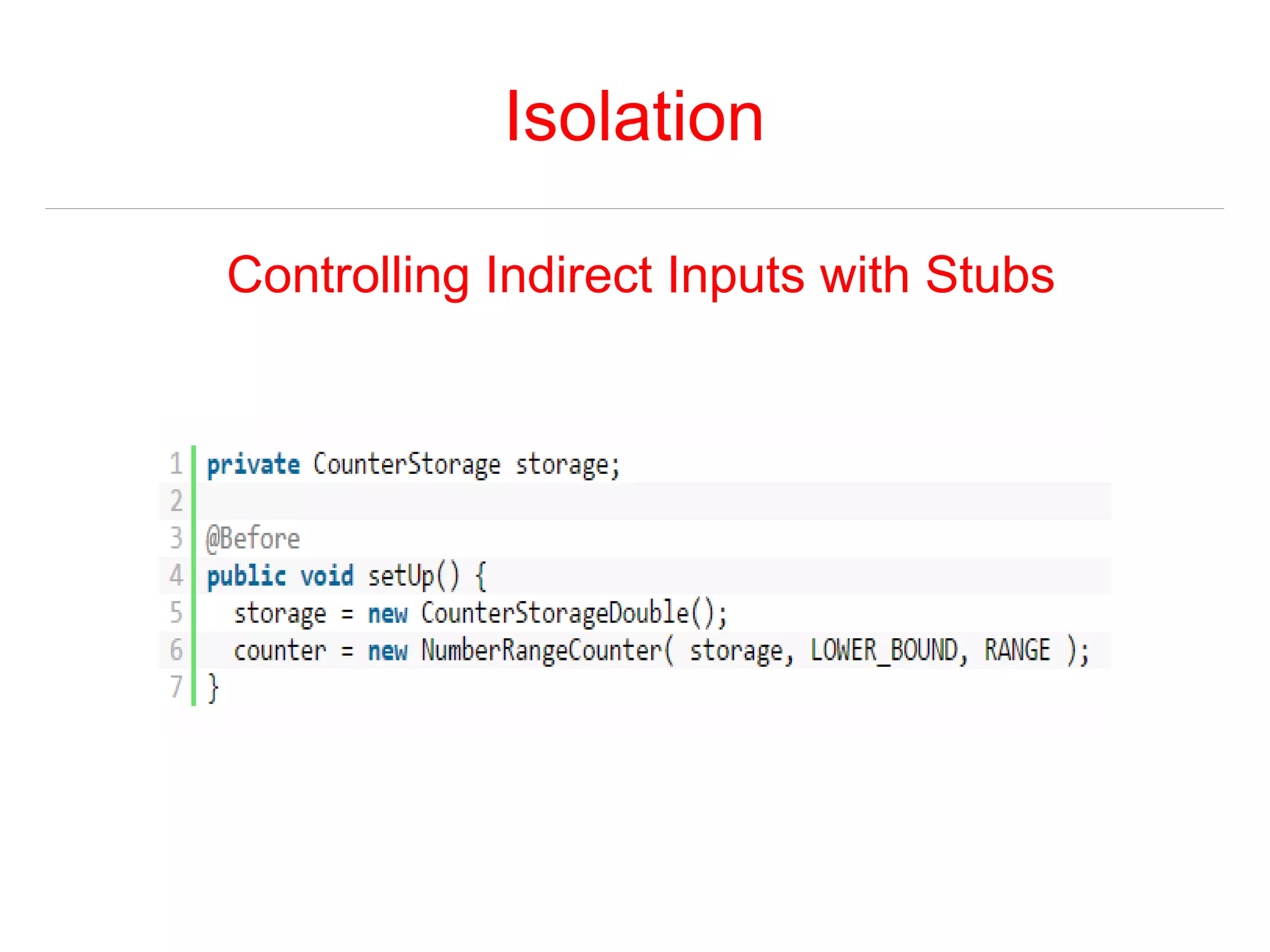
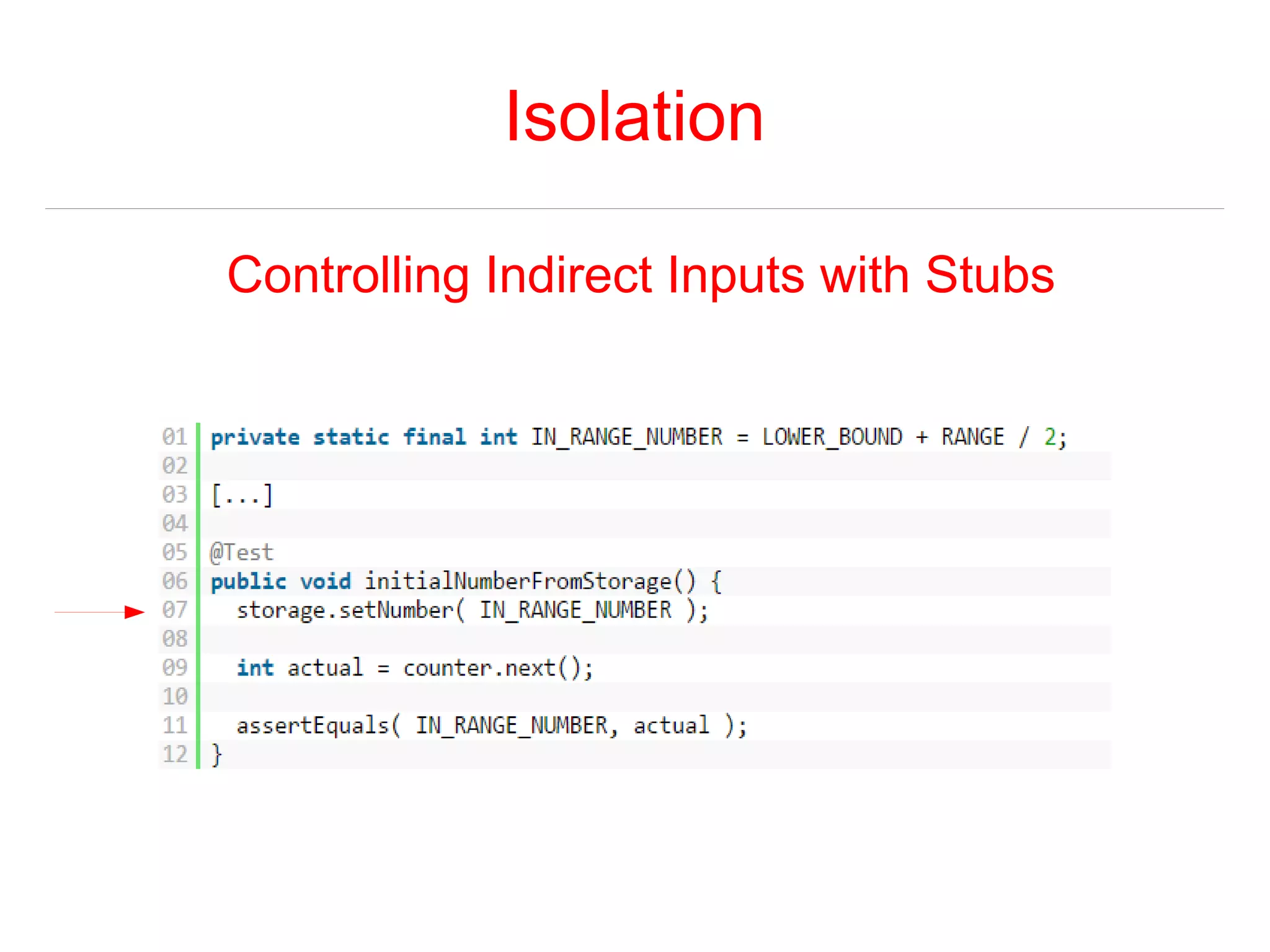
A unit should be designed in a way that each DOC can be replaced by a 
so called Test Double, which is a lightweight stand-in component for the 
DOC. 
A DOC is provided using dependency injection or a service locator. This 
ensures a loosely coupled micro-architecture that allows replacement of 
the DOC with the test double.
Isolation 
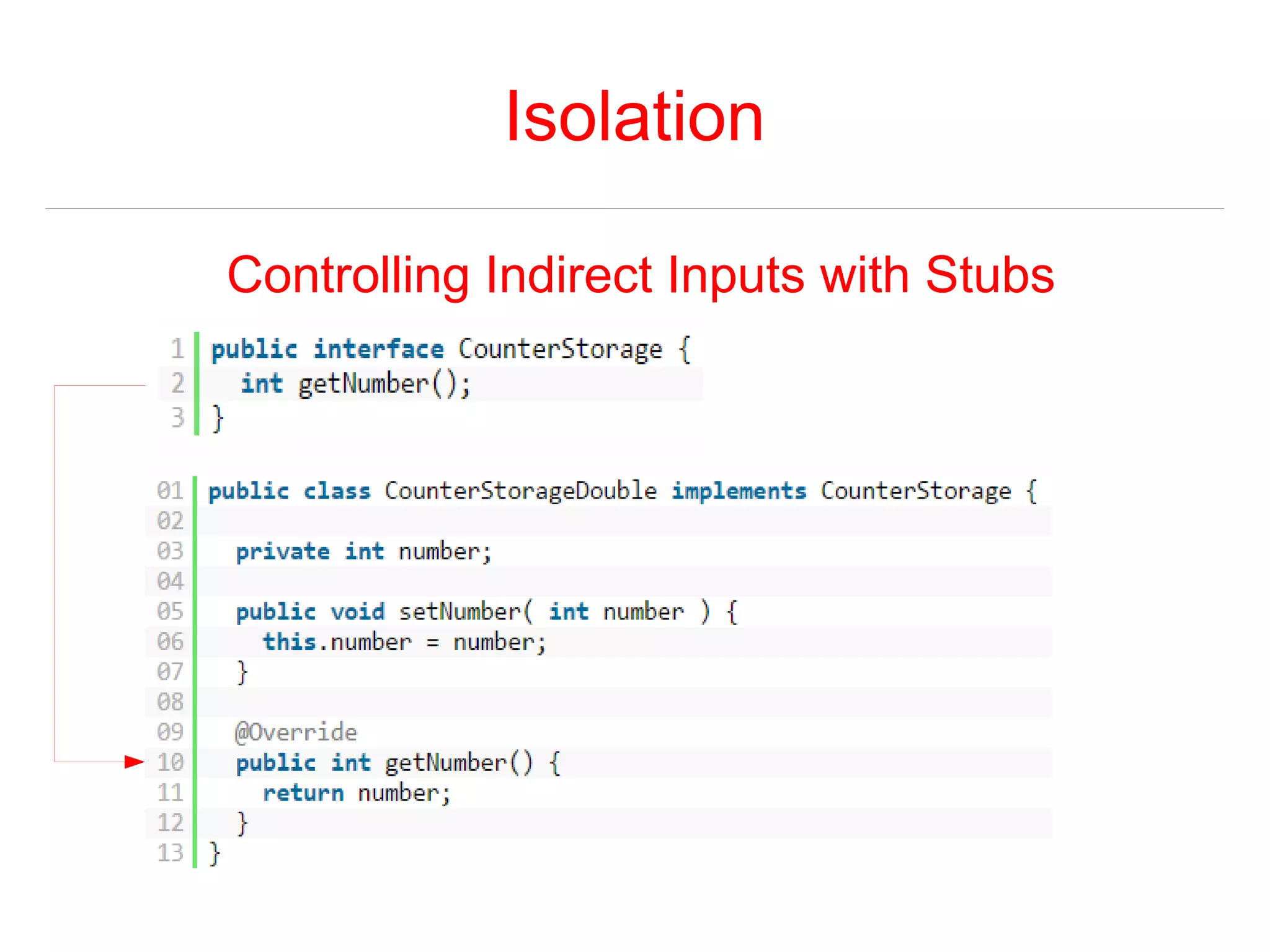
Controlling Indirect Inputs with Stubs
Isolation 
Controlling Indirect Inputs with Stubs
Isolation 
Controlling Indirect Inputs with Stubs
Isolation 
Controlling Indirect Inputs with Stubs
Isolation 
Controlling Indirect Inputs with Stubs
Isolation 
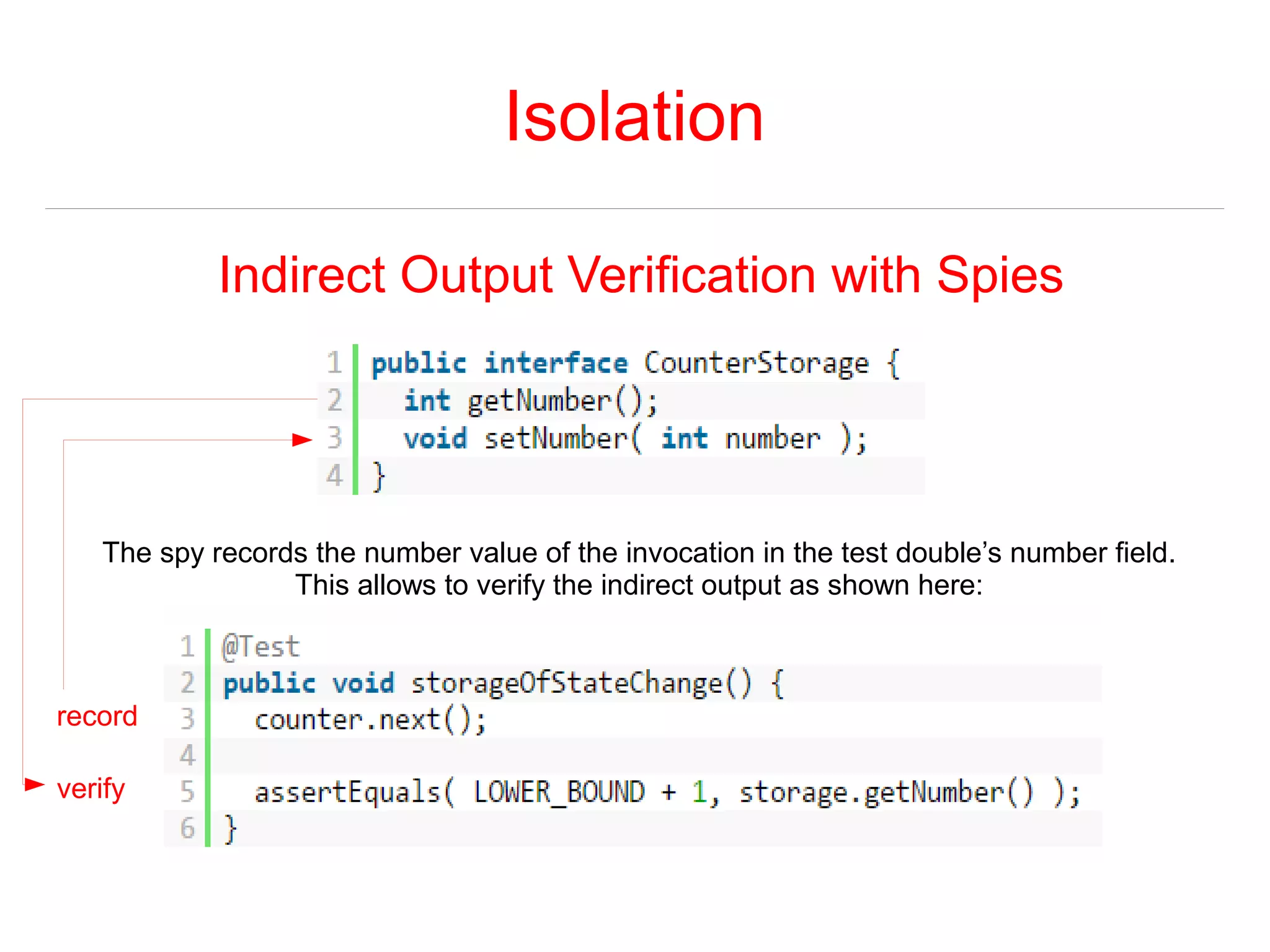
Indirect Output Verification with Spies 
The spy records the number value of the invocation in the test double’s number field. 
This allows to verify the indirect output as shown here: 
record 
verify
Isolation 
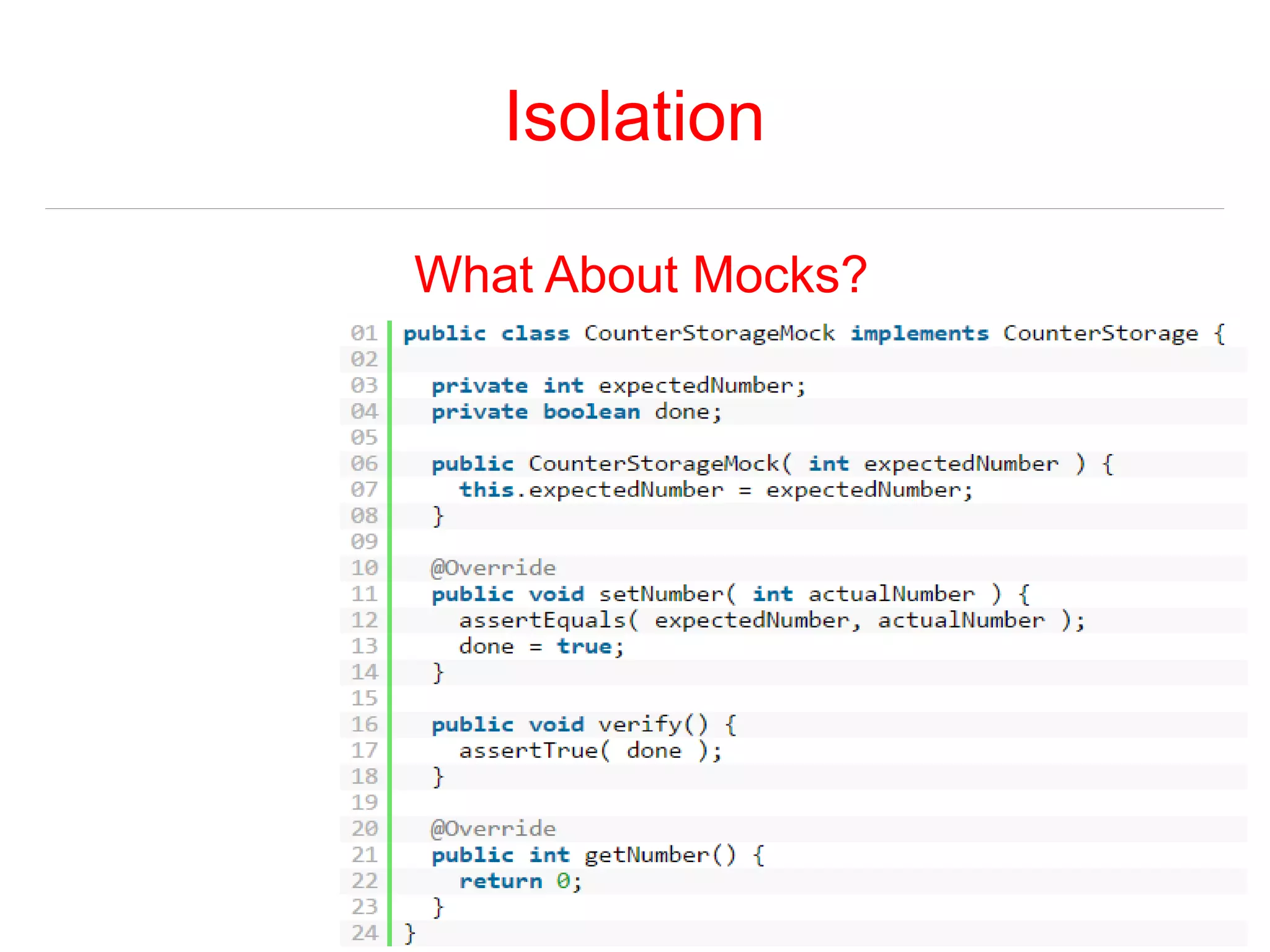
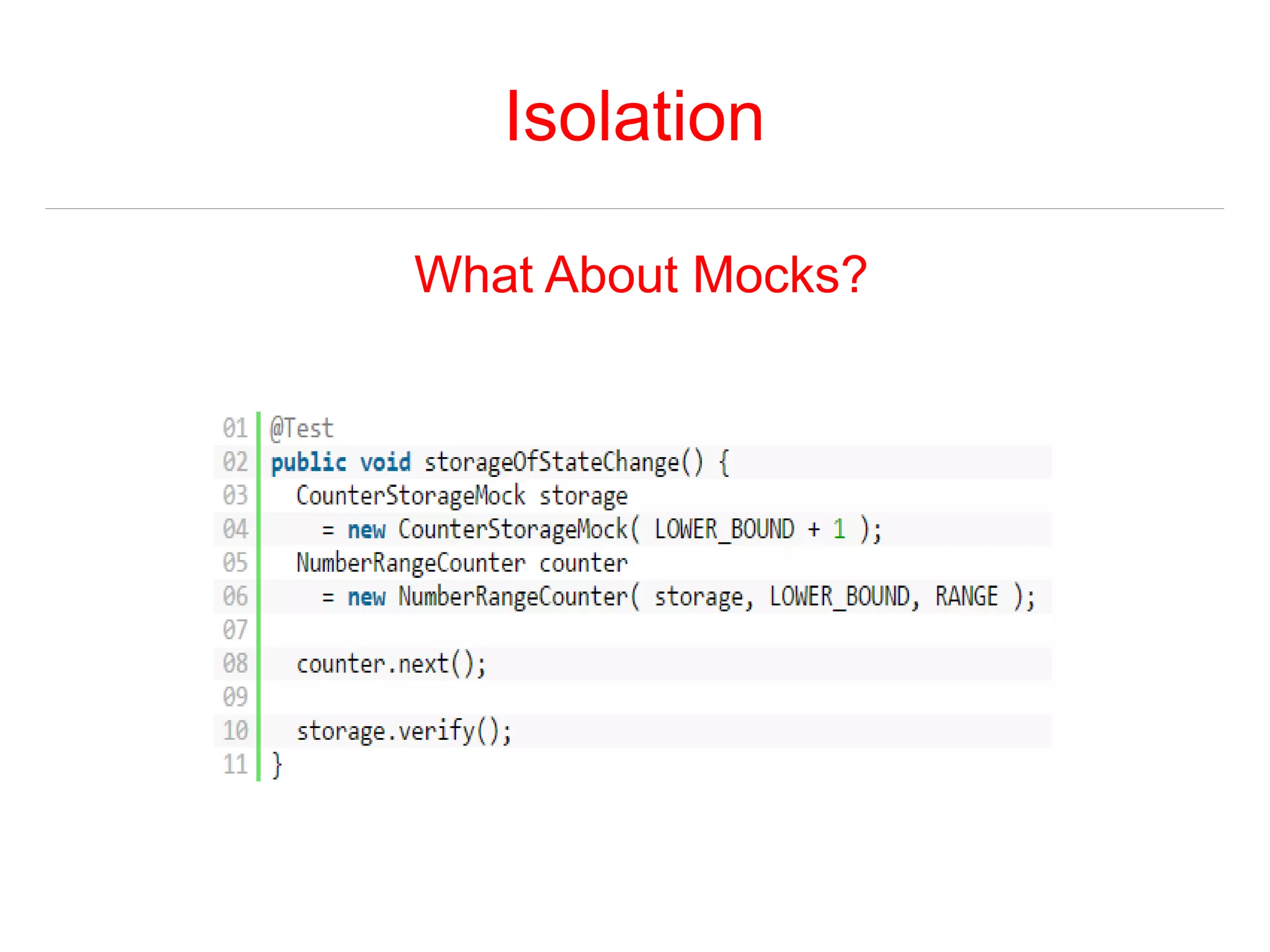
What About Mocks?
Isolation 
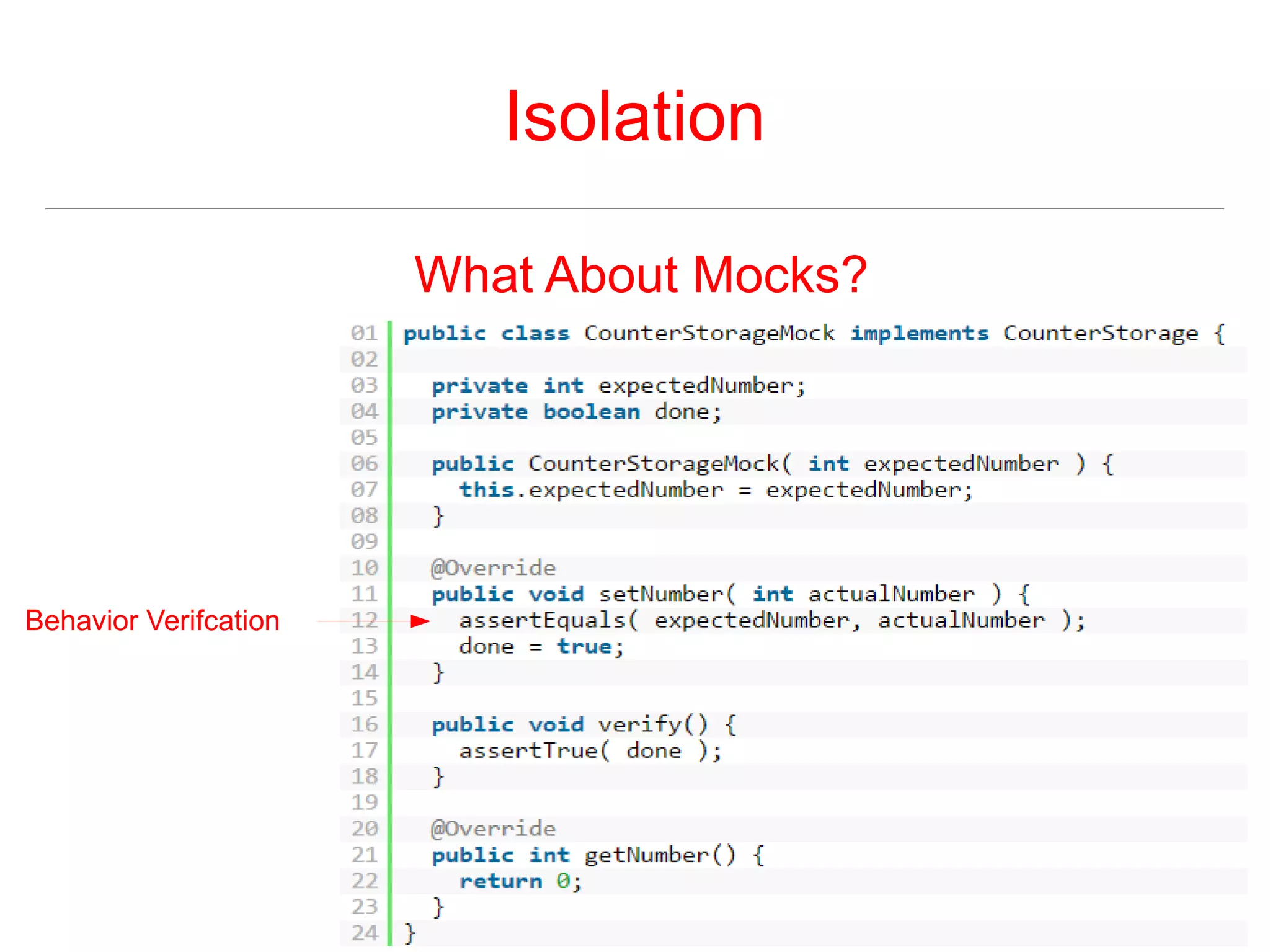
What About Mocks? 
Behavior Verifcation
Isolation 
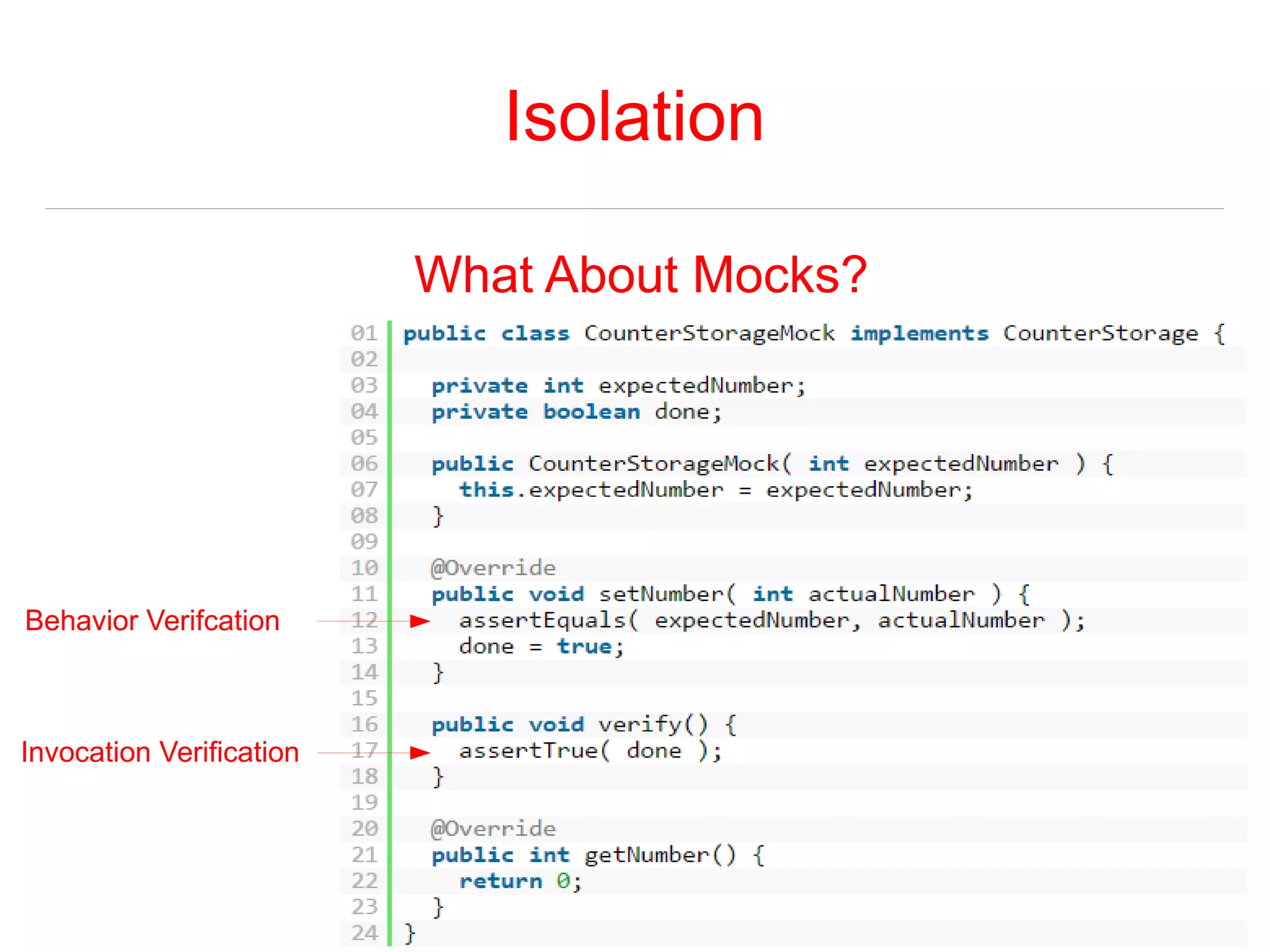
What About Mocks? 
Behavior Verifcation 
Invocation Verification
Isolation 
What About Mocks?
Isolation 
What About Mocks?
Isolation 
Spy or Mock? 
Mocks break the usual test structure 
Behavior verification is somewhat hidden 
but 
Mocks provide a precise stacktrace to the failure cause
Isolation 
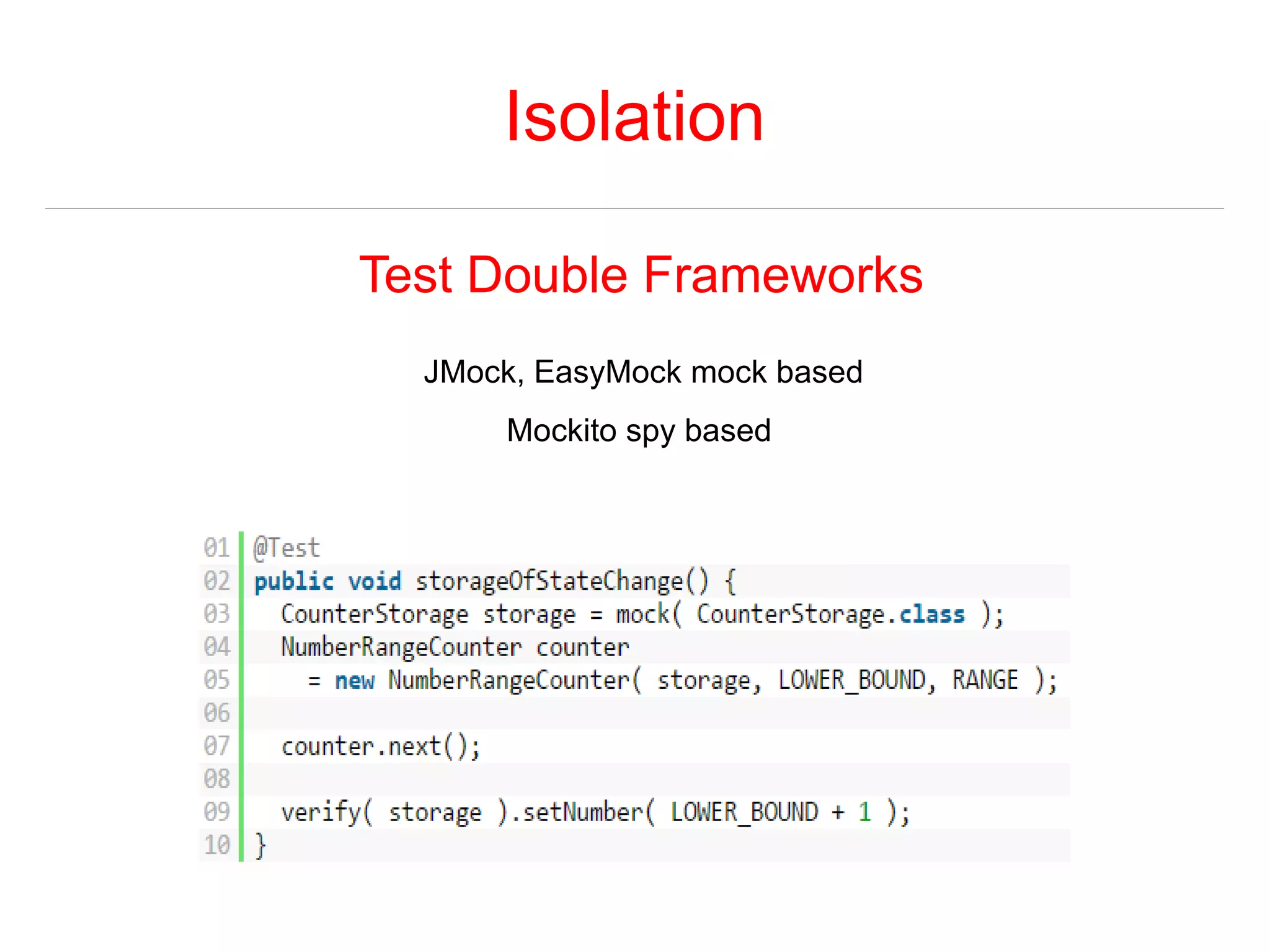
Test Double Frameworks 
JMock, EasyMock mock based 
Mockito spy based
Isolation 
Test Double Frameworks 
Only create test doubles for types you own 
(indication for integration tests and an abstracting adapter layer) 
A test double should not return another test double 
(potential violation of law of demeter)
C l e a n U n i t T e s t P a t t e r n s 
Why bother? 
Structure 
Isolation 
Runners and Rules 
Assertions 
Q&A
Runners 
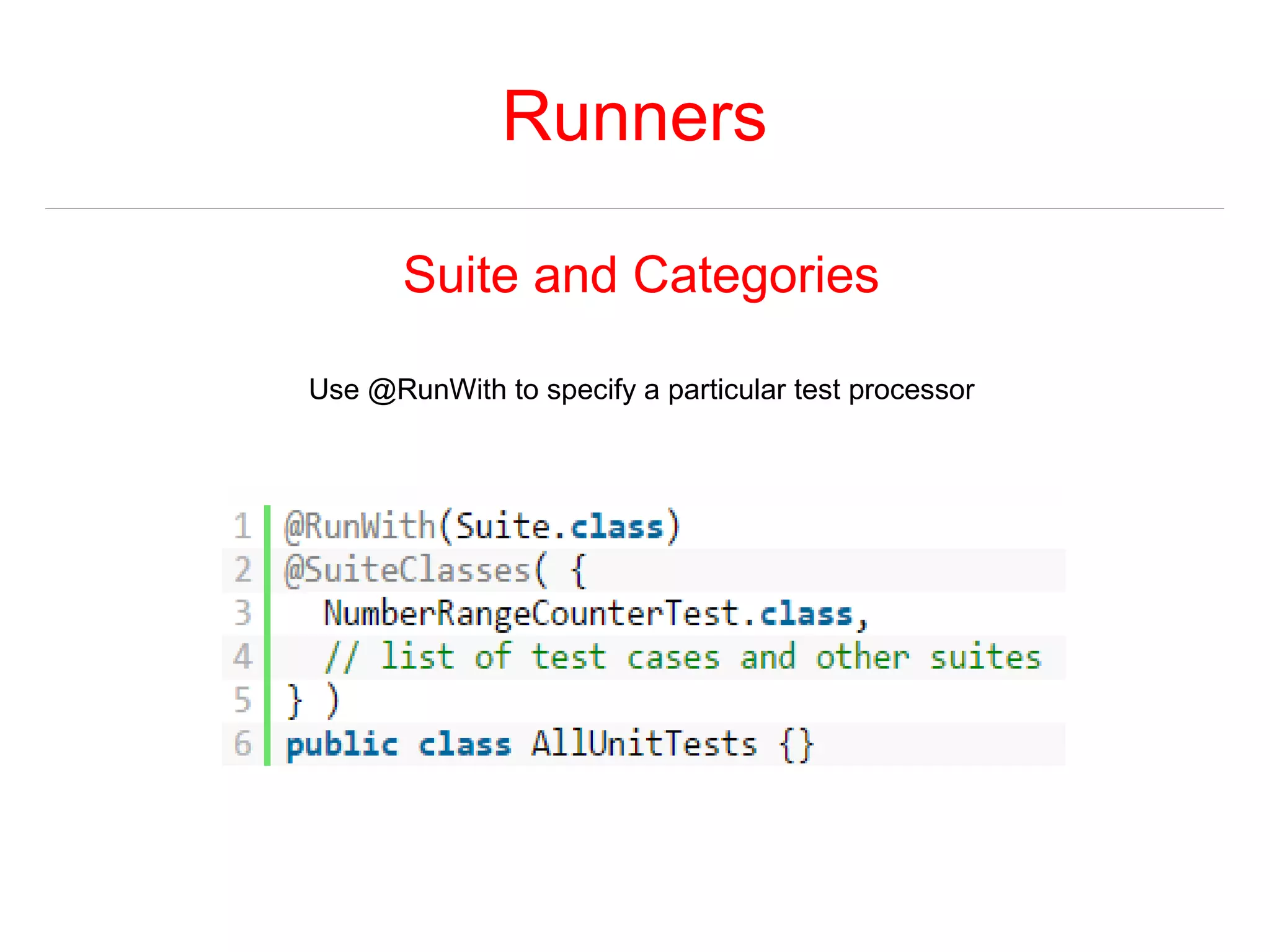
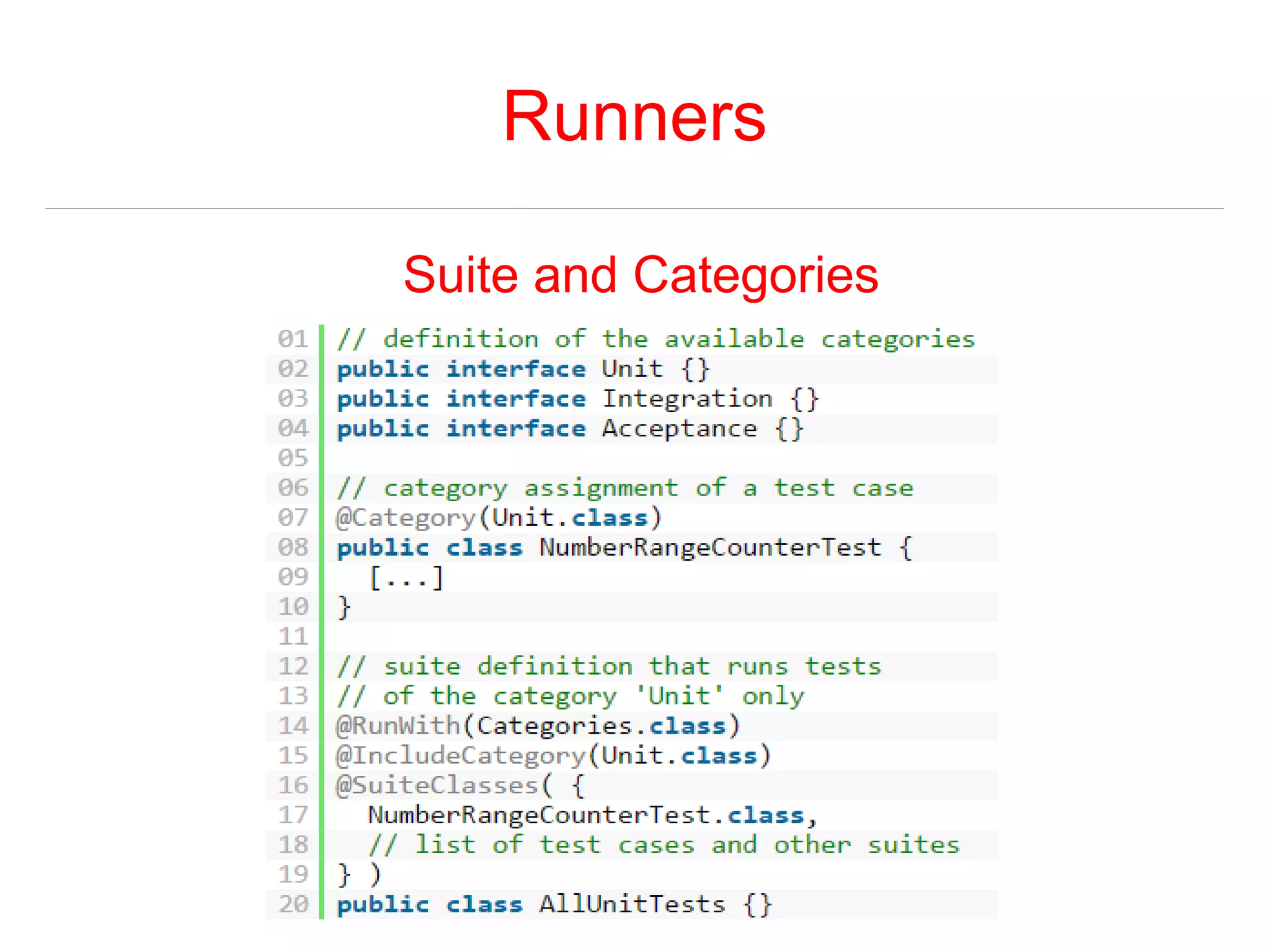
Suite and Categories 
Use @RunWith to specify a particular test processor
Runners 
Suite and Categories
Runners 
Suite and Categories
Runners 
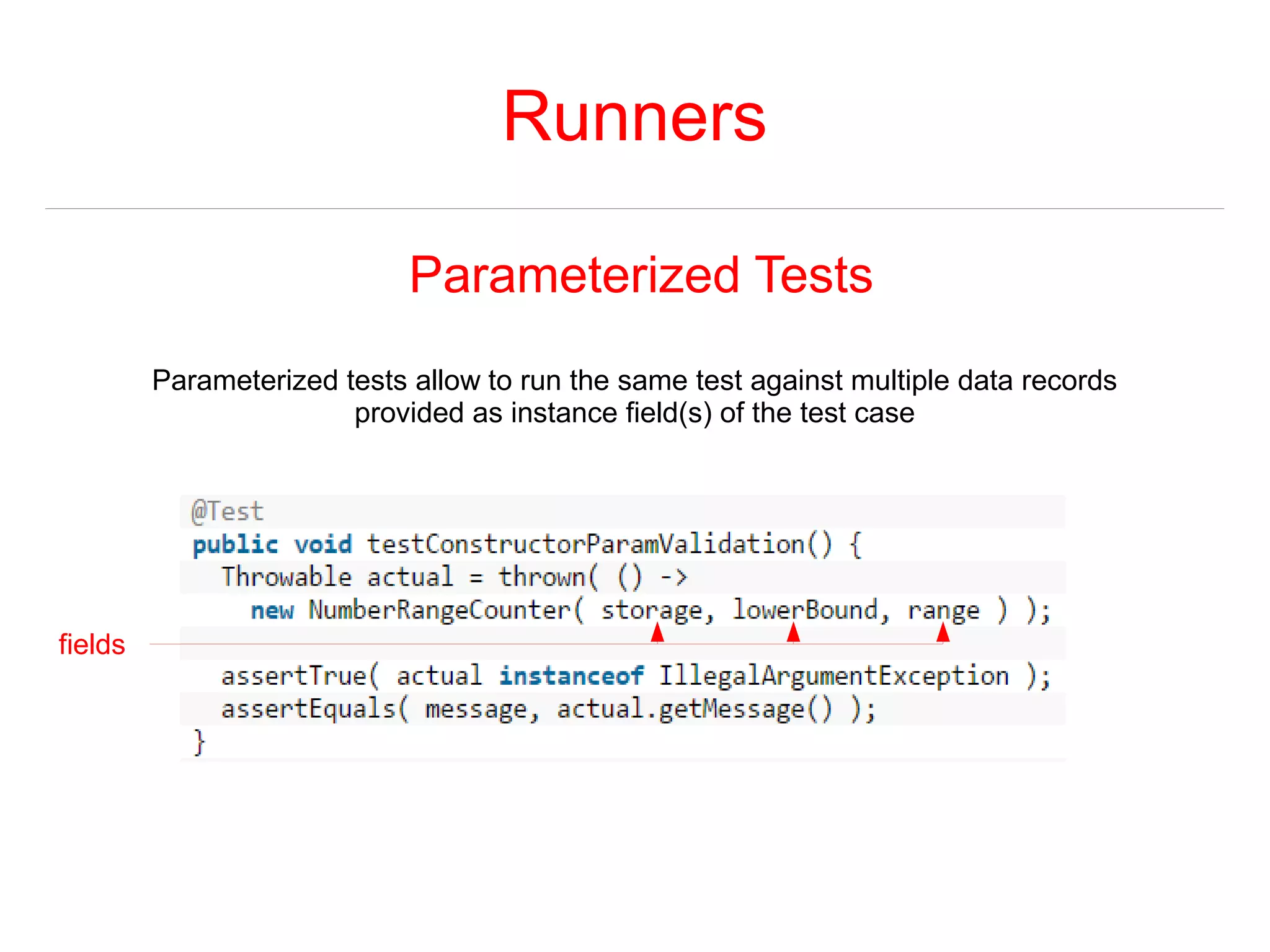
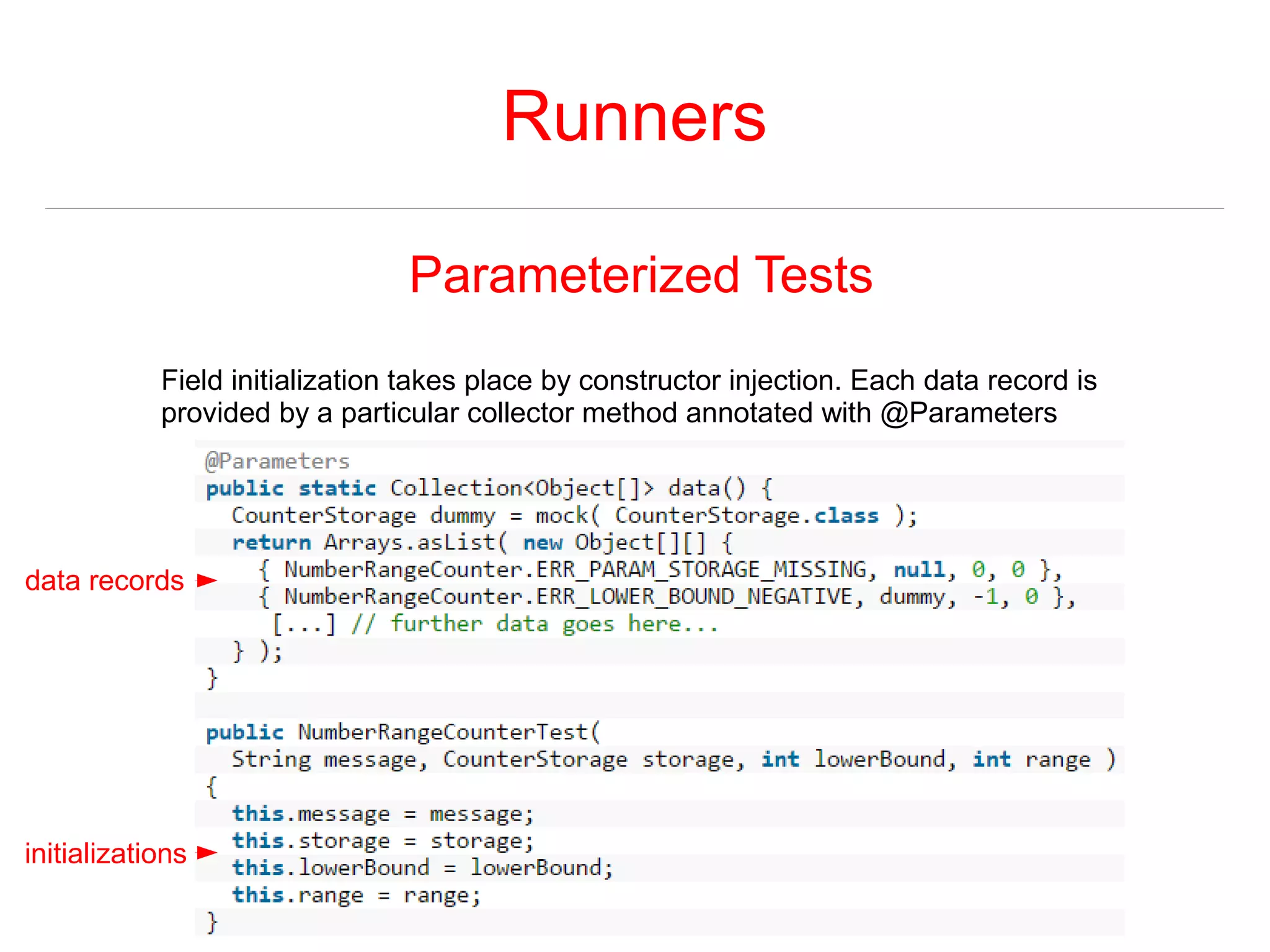
Parameterized Tests 
Parameterized tests allow to run the same test against multiple data records 
provided as instance field(s) of the test case 
fields
Runners 
Parameterized Tests
Runners 
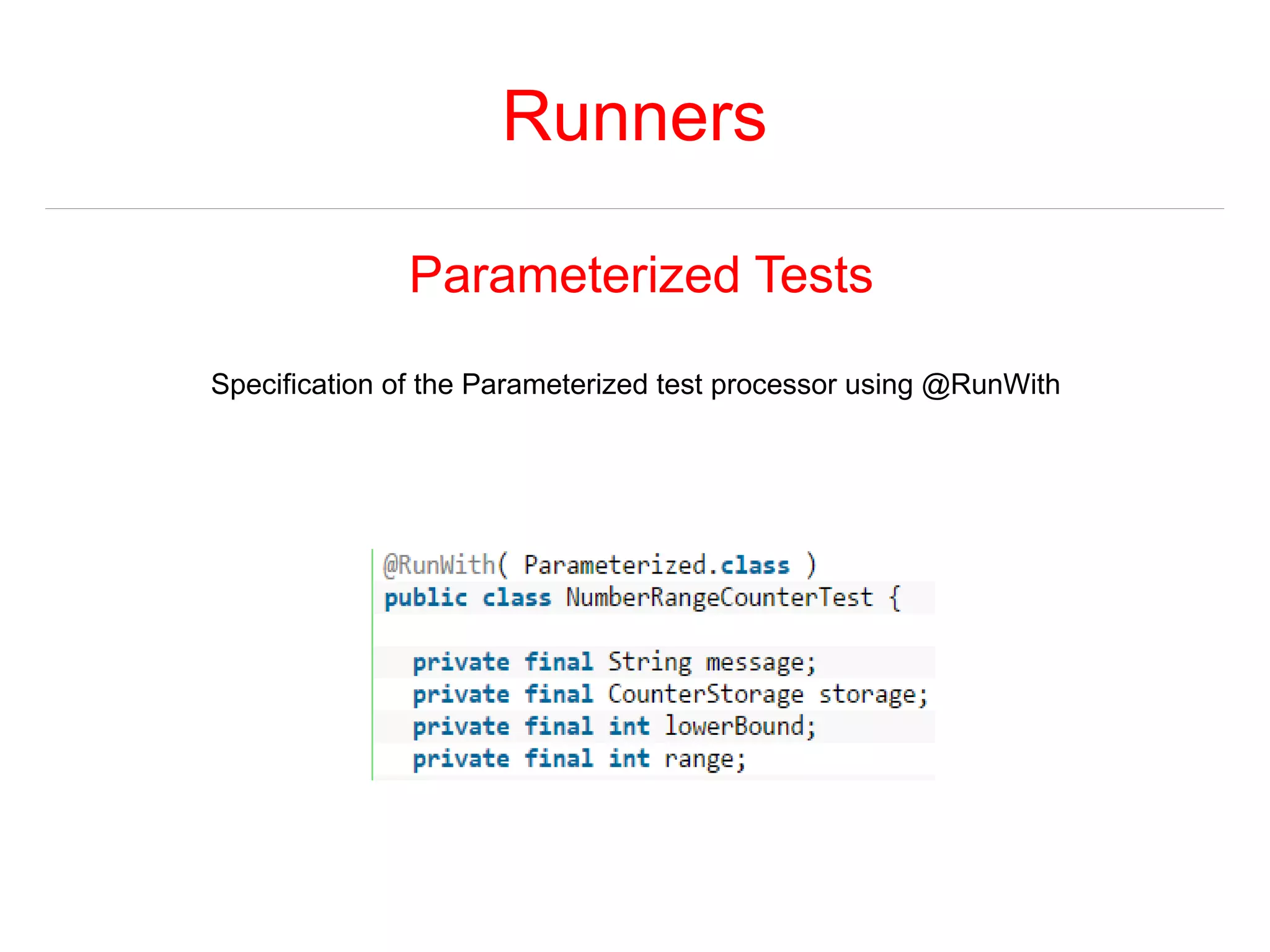
Parameterized Tests 
Specification of the Parameterized test processor using @RunWith
Runners 
Parameterized Tests
Runners 
Parameterized Tests 
Field initialization takes place by constructor injection. Each data record is 
provided by a particular collector method annotated with @Parameters 
data records 
initializations
Runners 
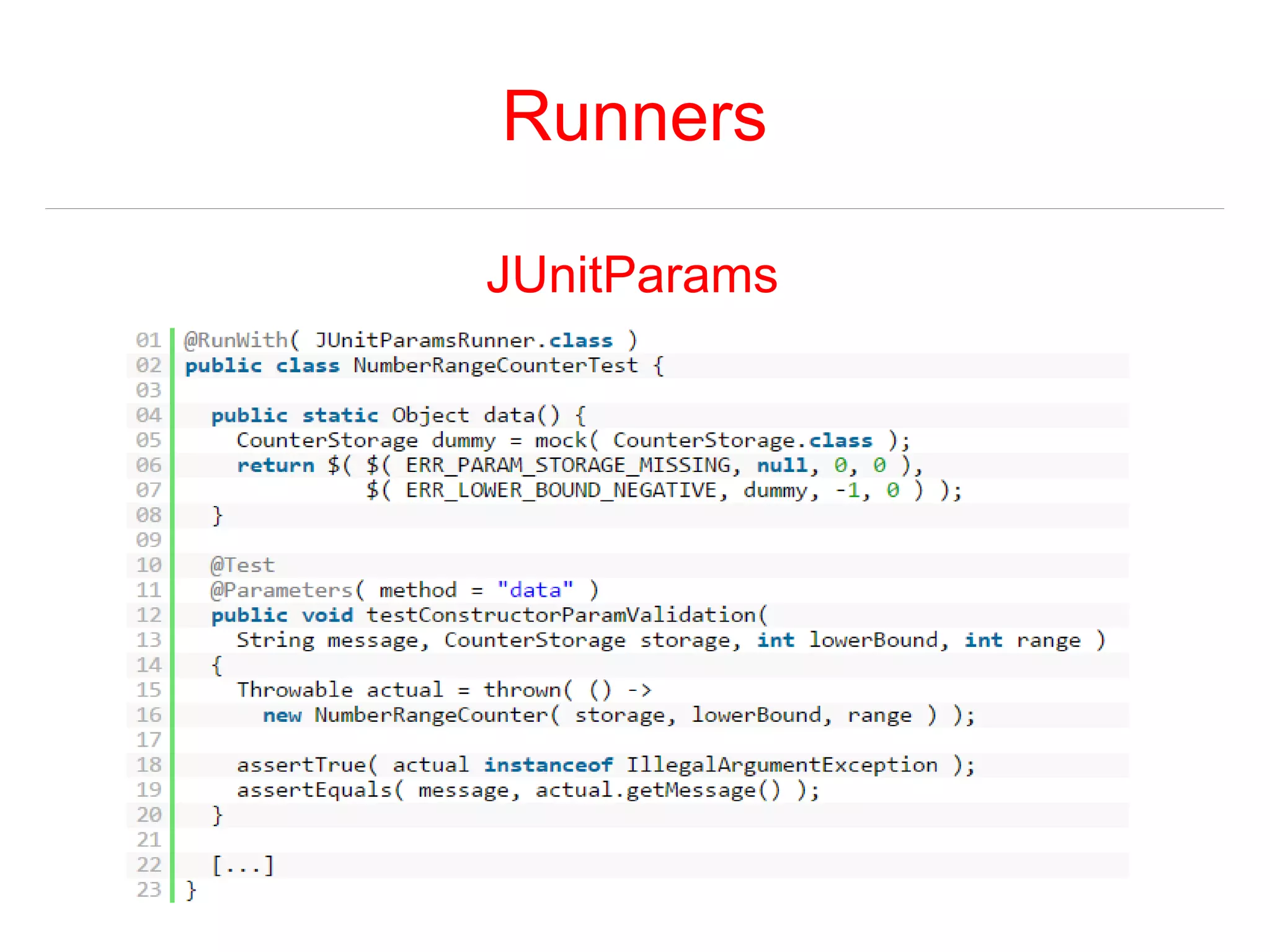
JUnitParams
Rules 
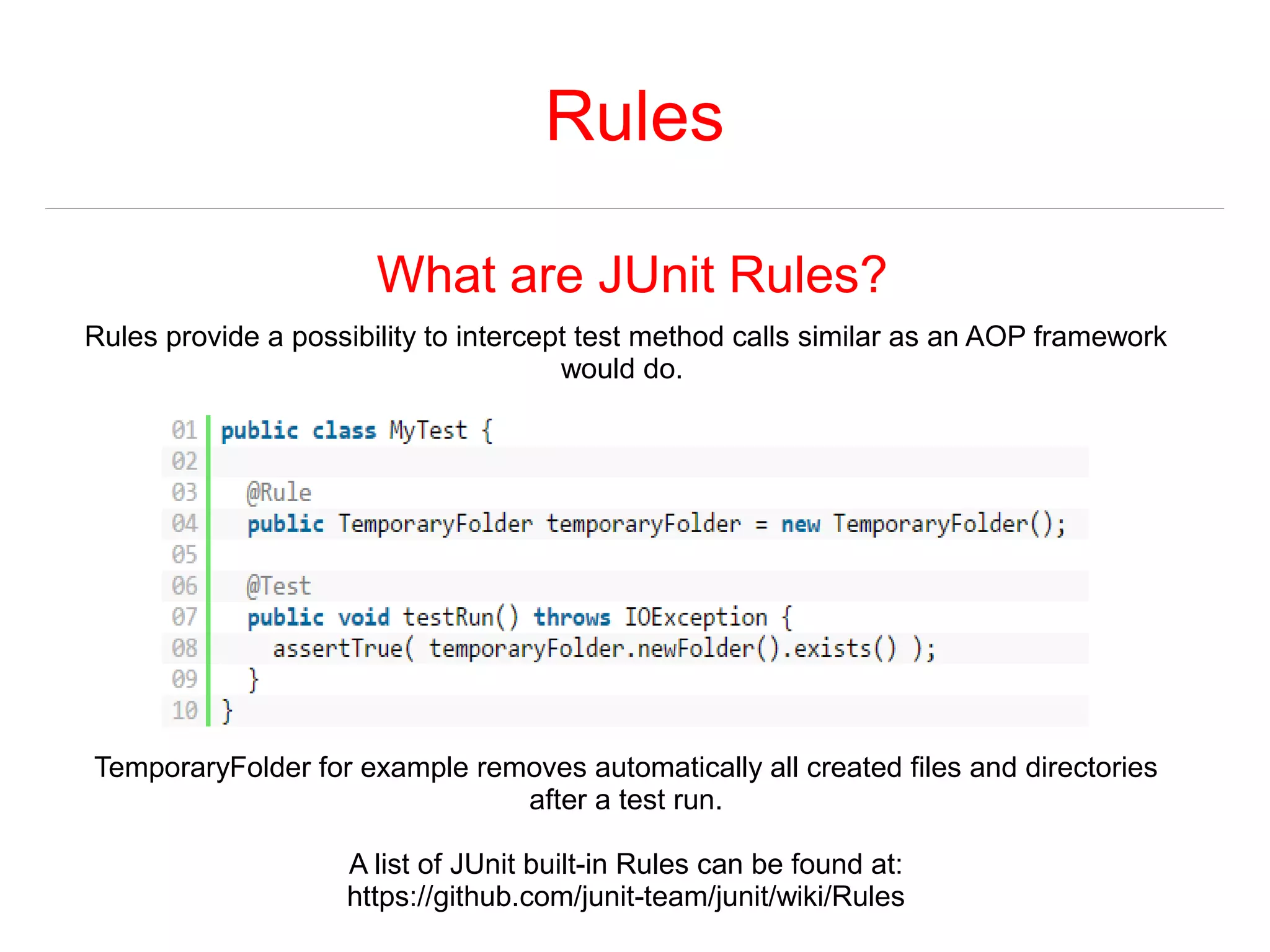
What are JUnit Rules? 
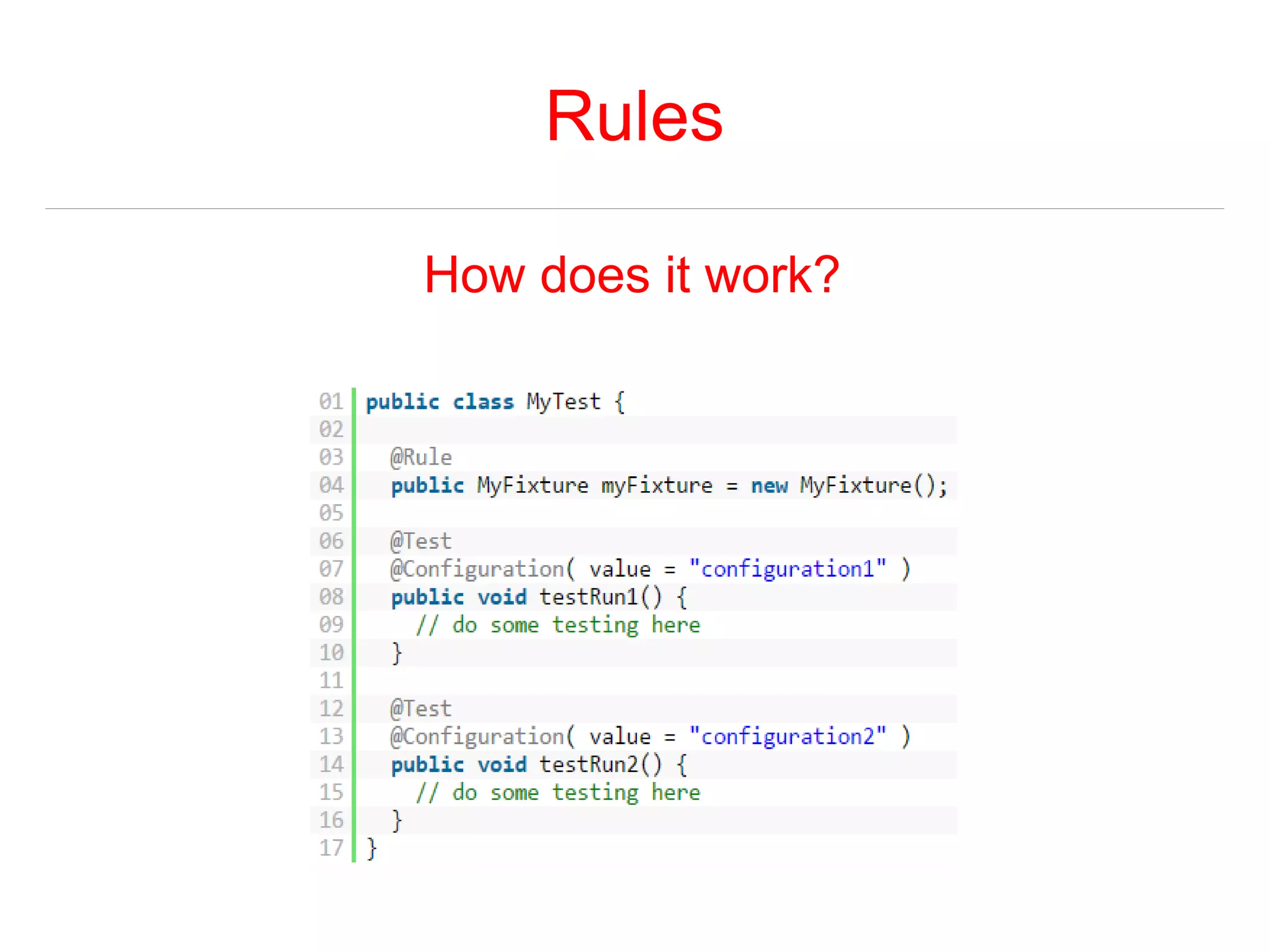
Rules provide a possibility to intercept test method calls similar as an AOP framework 
would do. 
TemporaryFolder for example removes automatically all created files and directories 
after a test run. 
A list of JUnit built-in Rules can be found at: 
https://github.com/junit-team/junit/wiki/Rules
Rules 
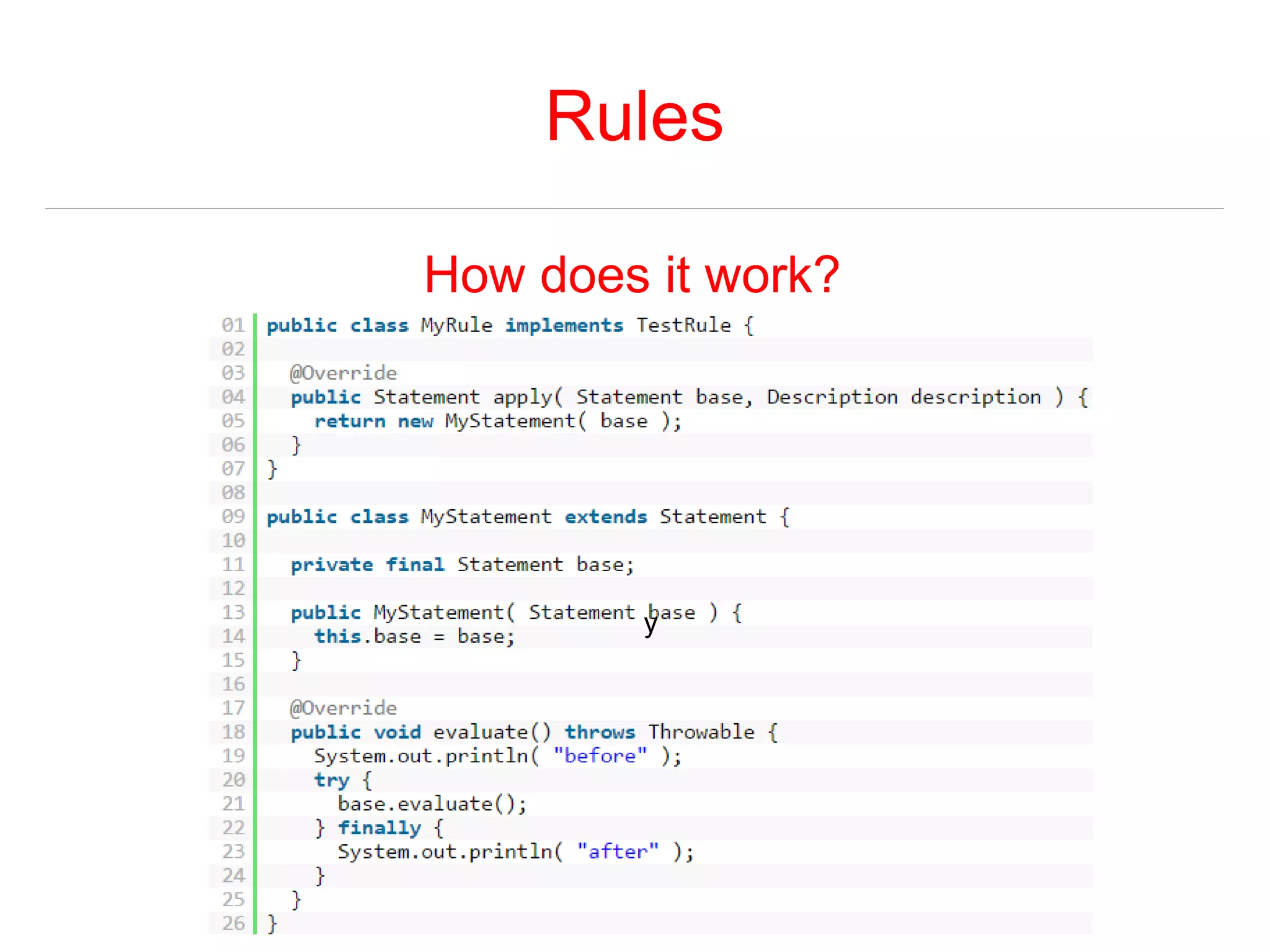
How does it work? 
y
Rules 
How does it work?
Rules 
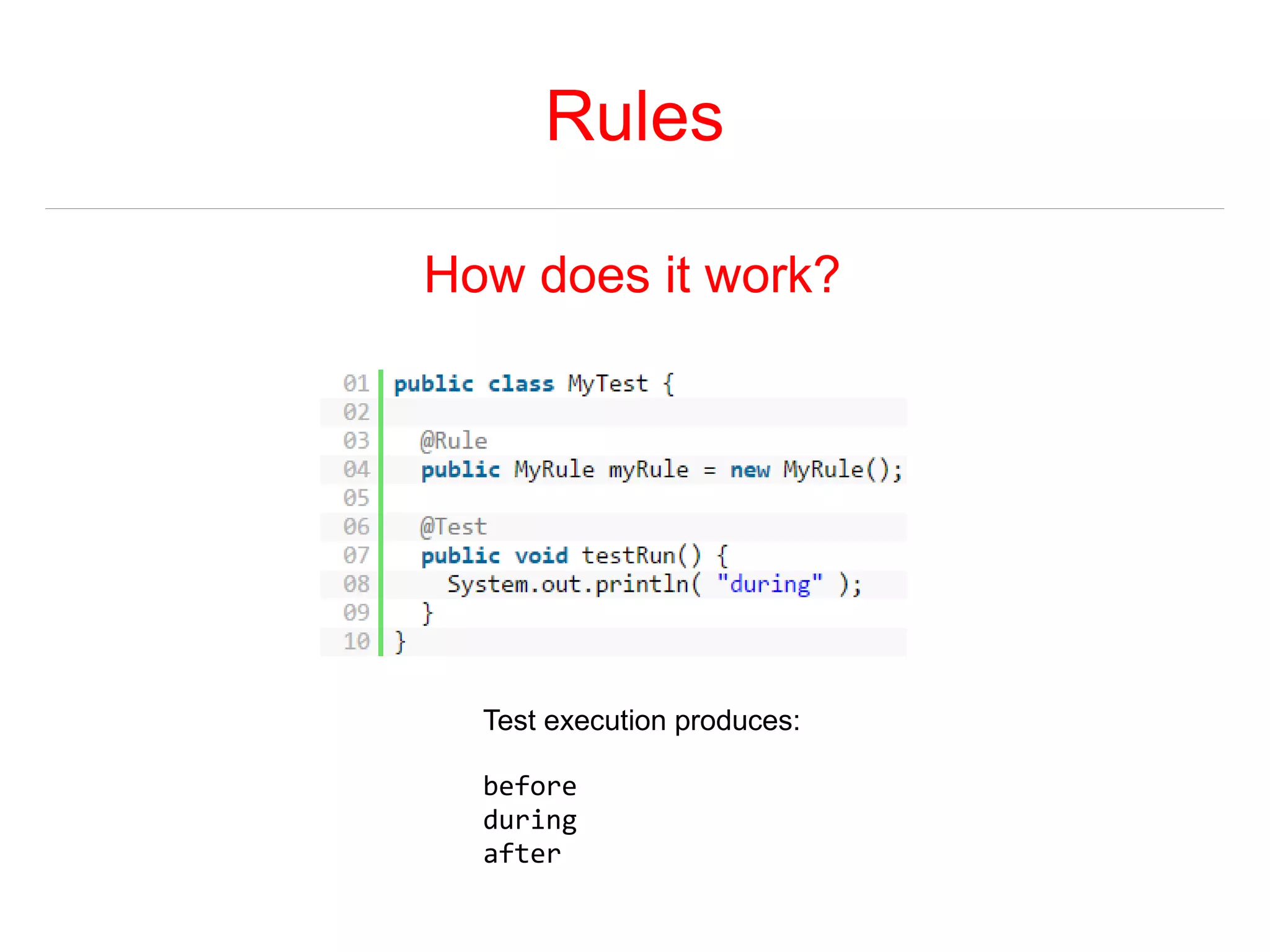
How does it work? 
Test execution produces: 
before 
during 
after
Rules 
How does it work?
Rules 
How does it work?
C l e a n U n i t T e s t P a t t e r n s 
Why bother? 
Structure 
Isolation 
Runners and Rules 
Assertions 
Q&A
Assertions 
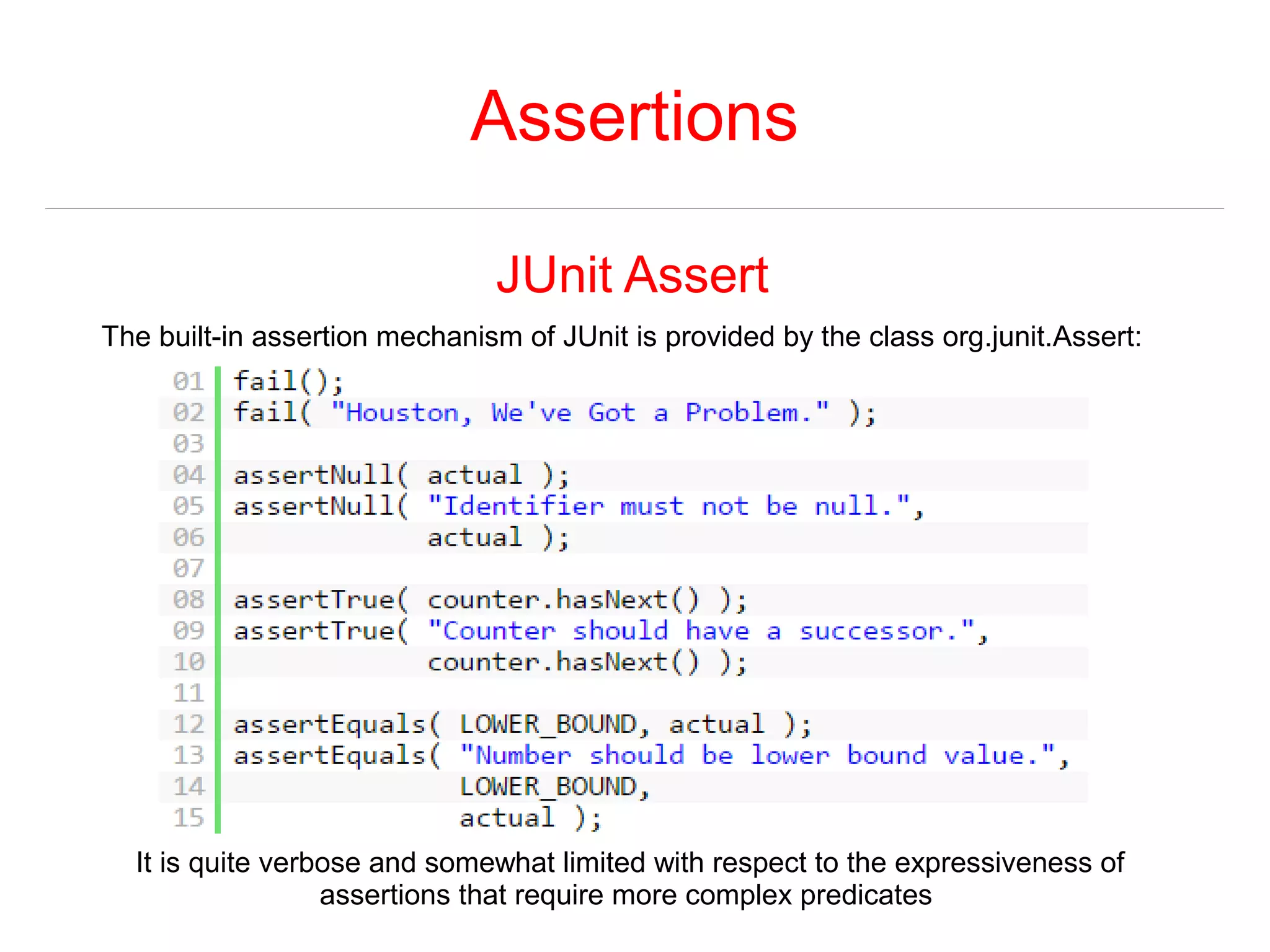
JUnit Assert 
The built-in assertion mechanism of JUnit is provided by the class org.junit.Assert: 
It is quite verbose and somewhat limited with respect to the expressiveness of 
assertions that require more complex predicates
Assertions 
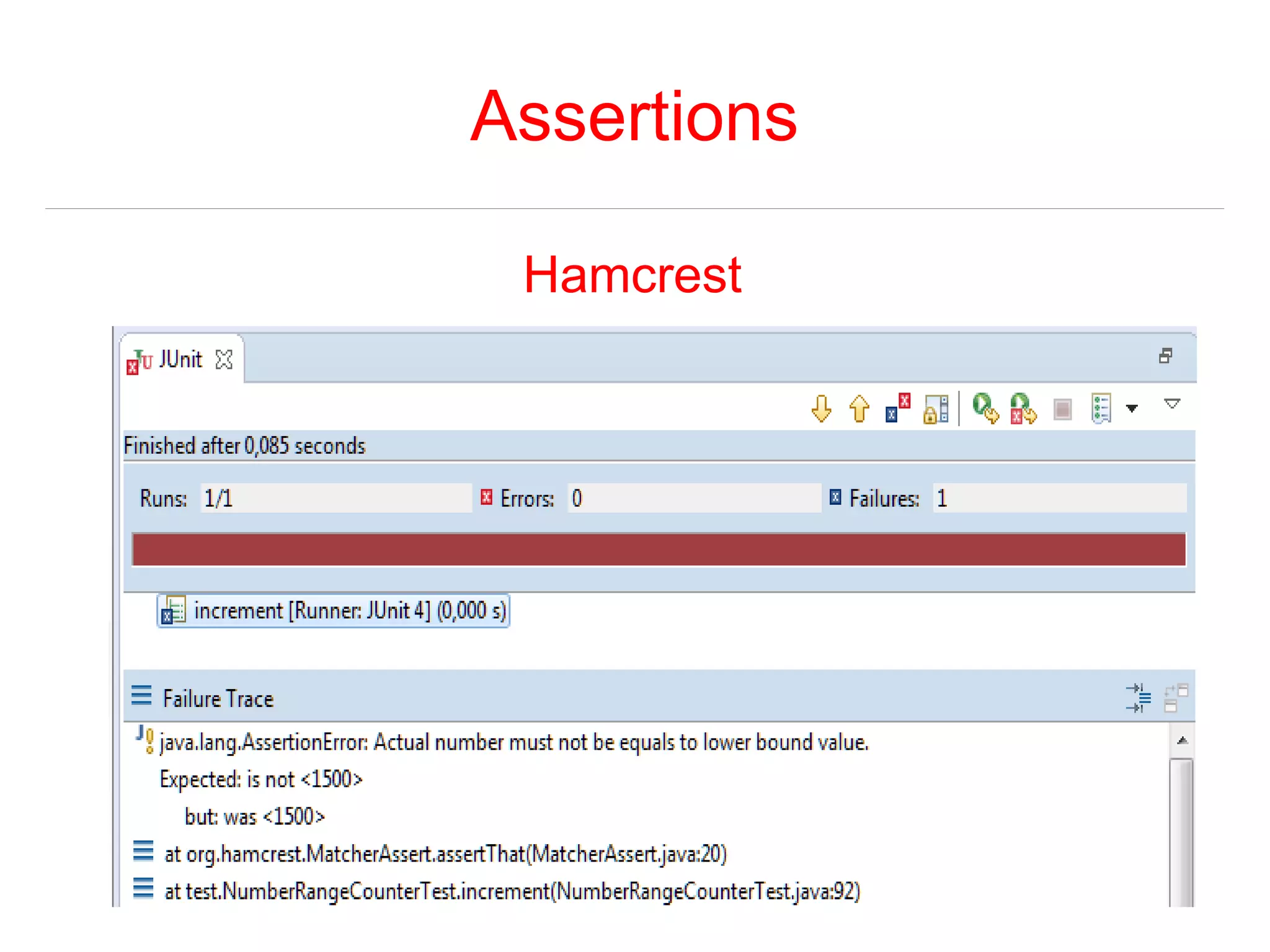
Hamcrest 
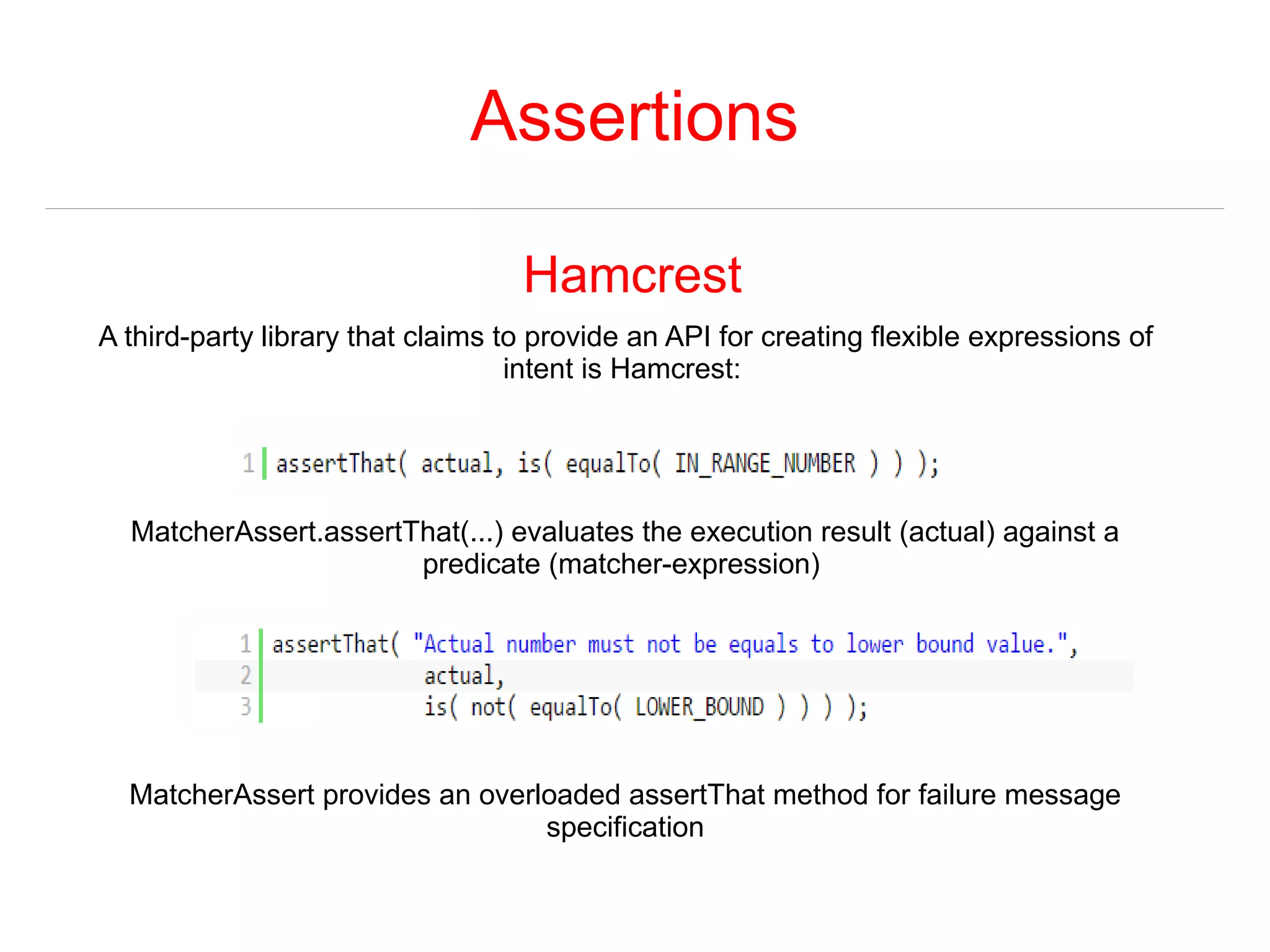
A third-party library that claims to provide an API for creating flexible expressions of 
intent is Hamcrest: 
MatcherAssert.assertThat(...) evaluates the execution result (actual) against a 
predicate (matcher-expression) 
MatcherAssert provides an overloaded assertThat method for failure message 
specification
Assertions 
Hamcrest
Assertions 
Hamcrest
Assertions 
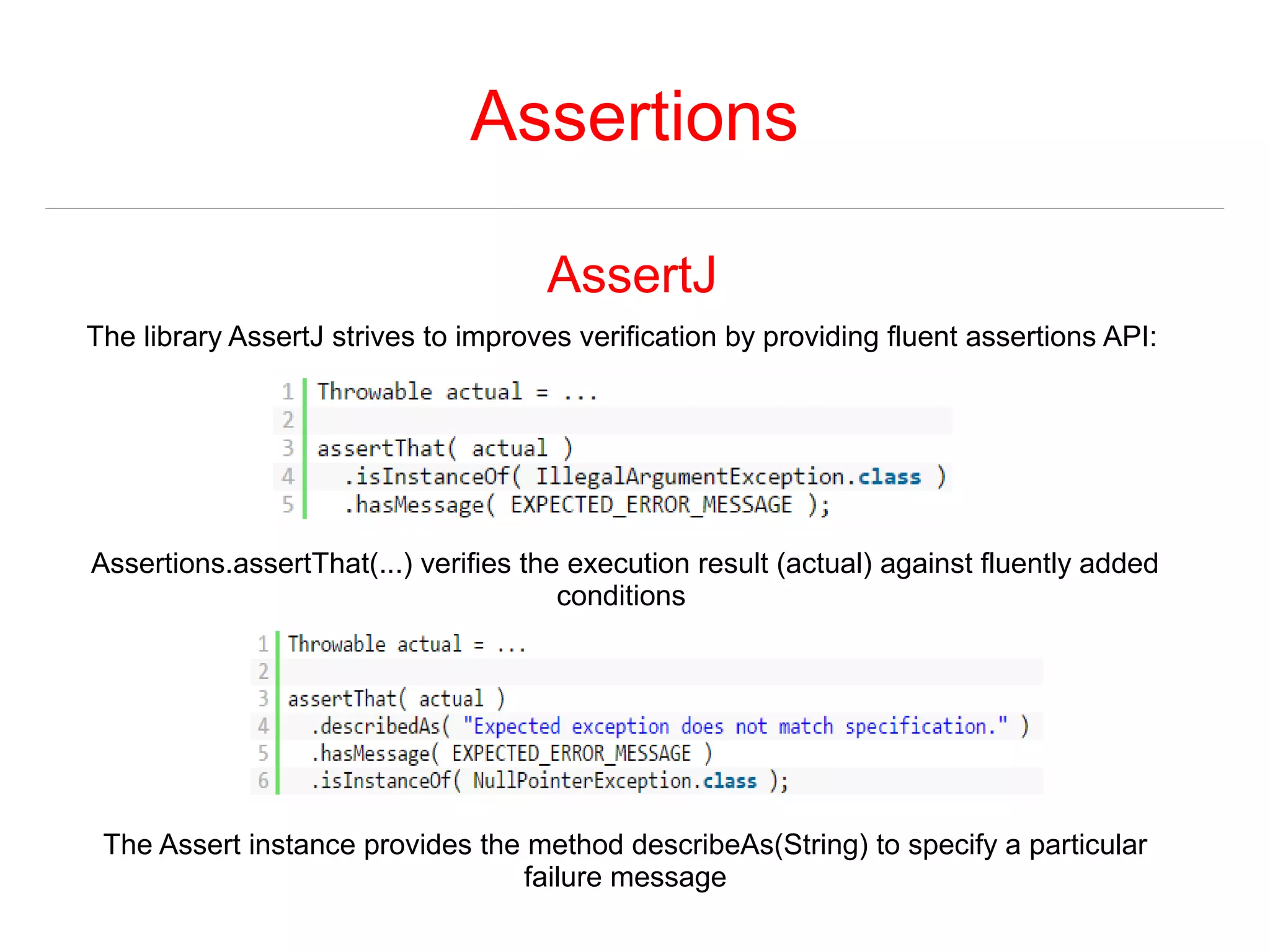
AssertJ 
The library AssertJ strives to improves verification by providing fluent assertions API: 
Assertions.assertThat(...) verifies the execution result (actual) against fluently added 
conditions 
The Assert instance provides the method describeAs(String) to specify a particular 
failure message
Assertions 
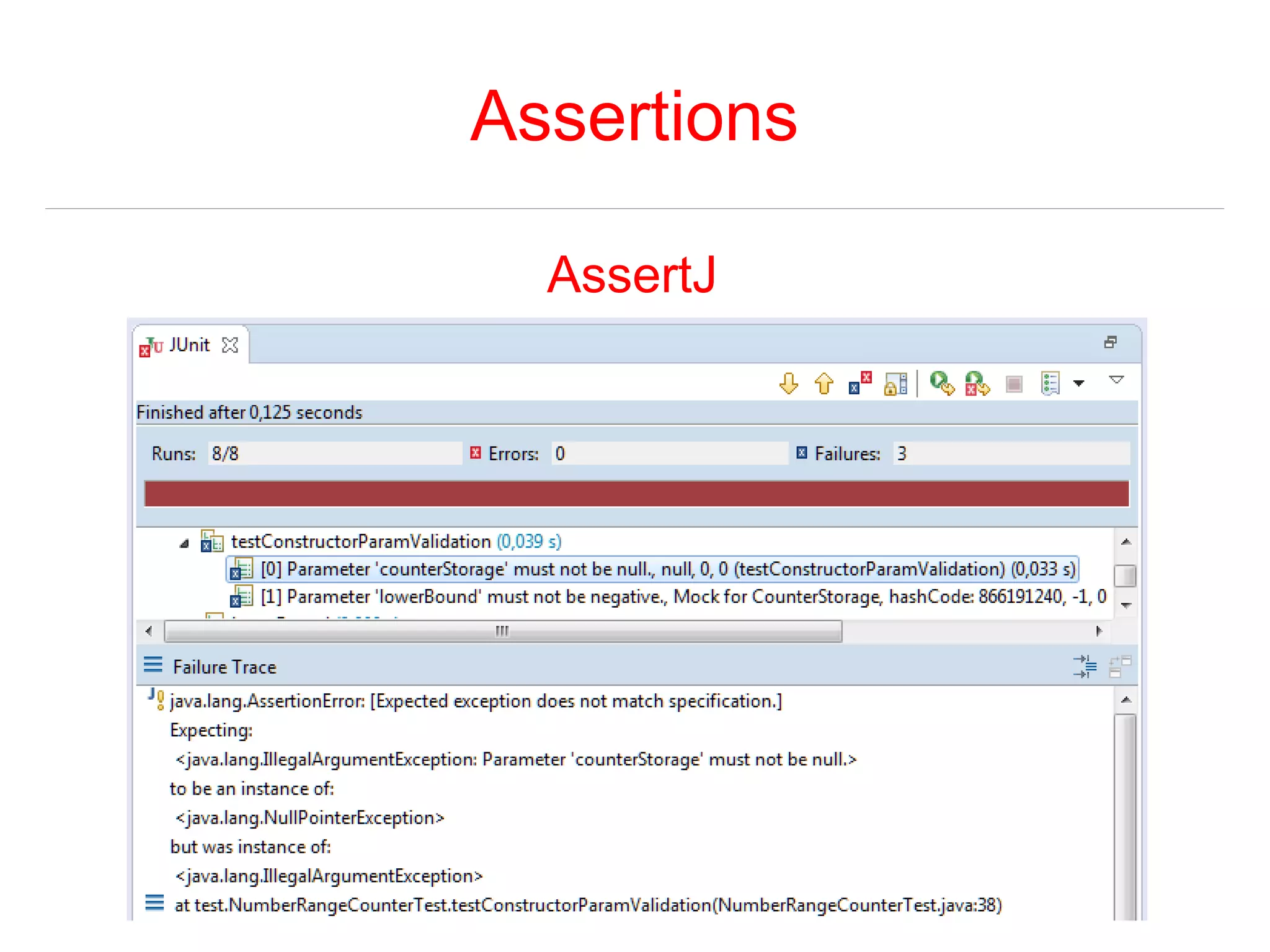
AssertJ
Assertions 
AssertJ
Assertions 
Which one to use? 
JUnit Assert is surely somewhat dated and less object-oriented 
Hamcrest matchers provide a clean separation of assertion 
and predicate definition 
AssertJ assertions score with a compact and easy to use programming 
style 
Hamcrest and AssertJ support custom matchers/assertions for domain 
specific types 
So now you are spoilt for choice…
C l e a n U n i t T e s t P a t t e r n s 
Why bother? 
Structure 
Isolation 
Runners and Rules 
Assertions 
Q&A
C l e a n U n i t T e s t P a t t e r n s 
References 
xUnit Test Patterns, Gerard Meszaros, 2007 
Clean Code, Chapter 9: Unit Tests, Robert C. Martin, 2009 
Growing Object-Oriented Software, Guided by Tests, Chapter 8, Steve Freeman, Nat Pryce, 2010 
Practical Unit Testing with JUnit and Mockito, Appendix C. Test Spy vs. Mock, Tomek Kaczanowski, 
2013 
JUnit in a Nutshell: Yet Another JUnit Tutorial, 
http://www.codeaffine.com/2014/09/24/junit-nutshell-junit-tutorial, Frank Appel 2014 
Clean JUnit Throwable-Tests with Java 8 Lambdas, 
http://www.codeaffine.com/2014/07/28/clean-junit-throwable-tests-with-java-8-lambdas/, 
Frank Appel 2014 
F r a n k A p p e l Blog: www.codeaffine.com 
Email: fappel@codeaffine.com 
Twitter: @frank_appel

Clean Unit Test Patterns

  • 1.
    C l ea n U n i t T e s t P a t t e r n s F r a n k A p p e l Blog: www.codeaffine.com Email: fappel@codeaffine.com Twitter: @frank_appel
  • 2.
    C l ea n U n i t T e s t P a t t e r n s Why bother? Structure Isolation Runners and Rules Assertions Q&A
  • 3.
    Who I am.. Independent Software Developer Blogger (http://codeaffine.com/blog) Stalwart of agile methods and TDD in particular
  • 4.
    C l ea n U n i t T e s t P a t t e r n s Why bother? Structure Isolation Runners and Rules Assertions Q&A
  • 5.
  • 6.
    Why bother? Testof too many concepts
  • 7.
  • 8.
    Why bother? Mixof integration and unit test
  • 9.
  • 10.
    Why bother? Missingof clean and recognizable test structure
  • 11.
  • 12.
    Why bother? Tightcoupling of unit under test and dependencies
  • 13.
  • 14.
    Why bother? Poormaintainability and progression
  • 15.
  • 16.
  • 17.
    C l ea n U n i t T e s t P a t t e r n s Why bother? Structure Isolation Runners and Rules Assertions Q&A
  • 18.
    Test Structure FourPhases Pattern
  • 19.
    Test Structure FourPhases Pattern Setup (Fixture)
  • 20.
    Test Structure FourPhases Pattern Setup (Fixture) Exercise
  • 21.
    Test Structure FourPhases Pattern Setup (Fixture) Exercise Verify
  • 22.
    Test Structure FourPhases Pattern Setup (Fixture) Exercise Verify Teardown: cleaning up the fixture in case it is persistent.
  • 23.
    Test Structure FourPhases Pattern Setup (Fixture) Exercise Verify Teardown: cleaning up the fixture in case it is persistent.
  • 24.
  • 25.
    Test Structure SetupPatterns Inline Setup
  • 26.
  • 27.
  • 28.
    Test Structure SetupPatterns Delegate Setup
  • 29.
  • 30.
  • 31.
    Test Structure SetupPatterns Implicit Setup
  • 32.
    Test Structure ReusableSetup Helper Object Mother Test Fixture Registry Implementation either as stateless test helper class or, in case the helper holds references to fixture or SUT objects, as stateful test helper object.
  • 33.
    Test Structure ImplicitTeardown Teardown is all about housekeeping and adds no information at all to a particular test
  • 34.
    Test Structure CornerCase Tests: Expected Exceptions Traditional approach: ugly try-catch block, mix of phases
  • 35.
    Test Structure CornerCase Tests: Expected Exceptions
  • 36.
    Test Structure CornerCase Tests: Expected Exceptions Expected Annotation Method: might swallow setup problems, limited verification capabilities
  • 37.
    Test Structure CornerCase Tests: Expected Exceptions
  • 38.
    Test Structure CornerCase Tests: Expected Exceptions ExpectedException Rule: Verification definition before execution phase
  • 39.
    Test Structure CornerCase Tests: Expected Exceptions
  • 40.
    Test Structure CornerCase Tests: Expected Exceptions Usage of a little execution utility and Java 8 Lambda expressions
  • 41.
    C l ea n U n i t T e s t P a t t e r n s Why bother? Structure Isolation Runners and Rules Assertions Q&A
  • 42.
    Isolation Dependencies: SUTand DOC The tested Unit is usually referred to as system under test (SUT) Components the SUT depends on are denoted as depended-on component (DOC) Test related problems with DOCs DOCs we cannot control might impede decent test verification DOCs might also slow down test execution DOC’s behavior may change unexpectedly e.g. due to the usage of a newer version of a third party library
  • 43.
    Isolation Isolation –A Unit Tester’s SEP Field Test concerns seperately and keep tests independent of each other! Indirect Inputs and Outputs
  • 44.
    Isolation Test DoublePatterns A unit should be designed in a way that each DOC can be replaced by a so called Test Double, which is a lightweight stand-in component for the DOC. A DOC is provided using dependency injection or a service locator. This ensures a loosely coupled micro-architecture that allows replacement of the DOC with the test double.
  • 45.
  • 46.
  • 47.
  • 48.
  • 49.
  • 50.
    Isolation Indirect OutputVerification with Spies The spy records the number value of the invocation in the test double’s number field. This allows to verify the indirect output as shown here: record verify
  • 51.
  • 52.
    Isolation What AboutMocks? Behavior Verifcation
  • 53.
    Isolation What AboutMocks? Behavior Verifcation Invocation Verification
  • 54.
  • 55.
  • 56.
    Isolation Spy orMock? Mocks break the usual test structure Behavior verification is somewhat hidden but Mocks provide a precise stacktrace to the failure cause
  • 57.
    Isolation Test DoubleFrameworks JMock, EasyMock mock based Mockito spy based
  • 58.
    Isolation Test DoubleFrameworks Only create test doubles for types you own (indication for integration tests and an abstracting adapter layer) A test double should not return another test double (potential violation of law of demeter)
  • 59.
    C l ea n U n i t T e s t P a t t e r n s Why bother? Structure Isolation Runners and Rules Assertions Q&A
  • 60.
    Runners Suite andCategories Use @RunWith to specify a particular test processor
  • 61.
  • 62.
  • 63.
    Runners Parameterized Tests Parameterized tests allow to run the same test against multiple data records provided as instance field(s) of the test case fields
  • 64.
  • 65.
    Runners Parameterized Tests Specification of the Parameterized test processor using @RunWith
  • 66.
  • 67.
    Runners Parameterized Tests Field initialization takes place by constructor injection. Each data record is provided by a particular collector method annotated with @Parameters data records initializations
  • 68.
  • 69.
    Rules What areJUnit Rules? Rules provide a possibility to intercept test method calls similar as an AOP framework would do. TemporaryFolder for example removes automatically all created files and directories after a test run. A list of JUnit built-in Rules can be found at: https://github.com/junit-team/junit/wiki/Rules
  • 70.
    Rules How doesit work? y
  • 71.
  • 72.
    Rules How doesit work? Test execution produces: before during after
  • 73.
  • 74.
  • 75.
    C l ea n U n i t T e s t P a t t e r n s Why bother? Structure Isolation Runners and Rules Assertions Q&A
  • 76.
    Assertions JUnit Assert The built-in assertion mechanism of JUnit is provided by the class org.junit.Assert: It is quite verbose and somewhat limited with respect to the expressiveness of assertions that require more complex predicates
  • 77.
    Assertions Hamcrest Athird-party library that claims to provide an API for creating flexible expressions of intent is Hamcrest: MatcherAssert.assertThat(...) evaluates the execution result (actual) against a predicate (matcher-expression) MatcherAssert provides an overloaded assertThat method for failure message specification
  • 78.
  • 79.
  • 80.
    Assertions AssertJ Thelibrary AssertJ strives to improves verification by providing fluent assertions API: Assertions.assertThat(...) verifies the execution result (actual) against fluently added conditions The Assert instance provides the method describeAs(String) to specify a particular failure message
  • 81.
  • 82.
  • 83.
    Assertions Which oneto use? JUnit Assert is surely somewhat dated and less object-oriented Hamcrest matchers provide a clean separation of assertion and predicate definition AssertJ assertions score with a compact and easy to use programming style Hamcrest and AssertJ support custom matchers/assertions for domain specific types So now you are spoilt for choice…
  • 84.
    C l ea n U n i t T e s t P a t t e r n s Why bother? Structure Isolation Runners and Rules Assertions Q&A
  • 85.
    C l ea n U n i t T e s t P a t t e r n s References xUnit Test Patterns, Gerard Meszaros, 2007 Clean Code, Chapter 9: Unit Tests, Robert C. Martin, 2009 Growing Object-Oriented Software, Guided by Tests, Chapter 8, Steve Freeman, Nat Pryce, 2010 Practical Unit Testing with JUnit and Mockito, Appendix C. Test Spy vs. Mock, Tomek Kaczanowski, 2013 JUnit in a Nutshell: Yet Another JUnit Tutorial, http://www.codeaffine.com/2014/09/24/junit-nutshell-junit-tutorial, Frank Appel 2014 Clean JUnit Throwable-Tests with Java 8 Lambdas, http://www.codeaffine.com/2014/07/28/clean-junit-throwable-tests-with-java-8-lambdas/, Frank Appel 2014 F r a n k A p p e l Blog: www.codeaffine.com Email: fappel@codeaffine.com Twitter: @frank_appel