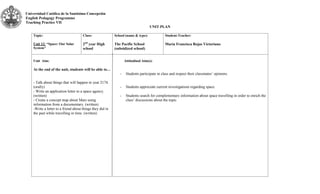
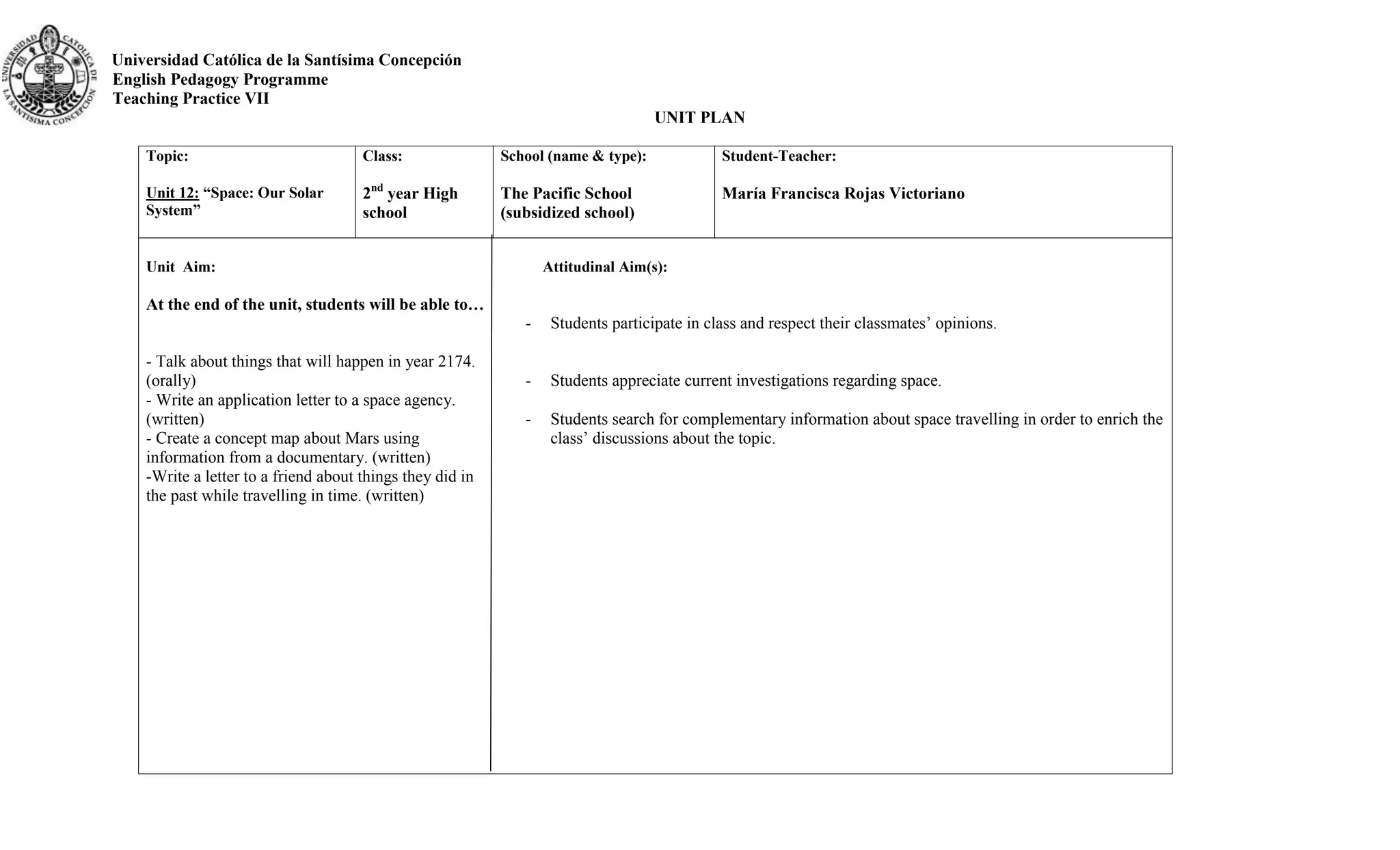
Universidad Católica de la Santísima Concepción
English Pedagogy Programme
Teaching Practice VII
UNIT PLAN
Topic:

Class:

School (name & type):

Student-Teacher:

Unit 12: “Space: Our Solar
System”

2nd year High
school

The Pacific School
(subsidized school)

María Francisca Rojas Victoriano

Unit Aim:

Attitudinal Aim(s):

At the end of the unit, students will be able to…
- Talk about things that will happen in year 2174.
(orally)
- Write an application letter to a space agency.
(written)
- Create a concept map about Mars using
information from a documentary. (written)
-Write a letter to a friend about things they did in
the past while travelling in time. (written)

Students participate in class and respect their classmates’ opinions.

-

Students appreciate current investigations regarding space.

-

Students search for complementary information about space travelling in order to enrich the
class’ discussions about the topic.
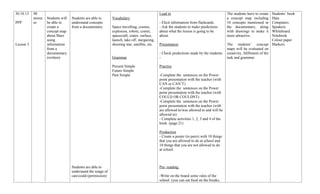
Date

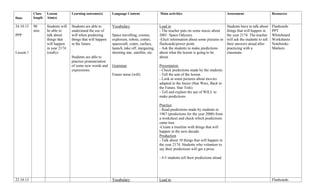
24.10.13
PPP

Lesson 1

Class
length

Lesson
Aim(s)

Learning outcome(s)

Language Content

Main activities

Assessment

Resources

90
min

Students will
be able to
talk about
things that
will happen
in year 2174.
(orally)

Students are able to
understand the use of
will when predicting
things that will happen
in the future.

Vocabulary

Lead in
- The teacher puts on some music about
2001: Space Odyssey.
-Elicit information about some pictures in
flashcards/power point.
- Ask the students to make predictions
about what the lesson is going to be
about.

Students have to talk about
things that will happen in
the year 2174. The teacher
will ask the students to tell
their answers aloud after
practicing with a
classmate.

Flashcards
PPT
Whiteboard
Worksheets
Notebooks
Markers.

Students are able to
practice pronunciation
of some new words and
expressions.

Space travelling, cosmic,
explosion, robots, comet,
spacecraft, crater, surface,
launch, take off, stargazing,
shooting star, satellite, etc.

Grammar
Future tense (will)

Presentation
- Check predictions made by the students.
- Tell the aim of the lesson.
- Look at some pictures about movies
adapted in the future (Star Wars, Back to
the Future, Star Trek).
- Tell and explain the use of WILL to
make predictions.
Practice
- Read predictions made by students in
1967 (predictions for the year 2000) from
a worksheet and check which predictions
came true.
-Create a timeline with things that will
happen in the next decade.
Production
- Talk about 10 things that will happen in
the year 2174. Students who volunteer to
say their predictions will get a prize.
- 4-5 students tell their predictions aloud.

23.10.13

Vocabulary

Lead in

Flashcards.
PPP

Lesson 2

90
minut
es

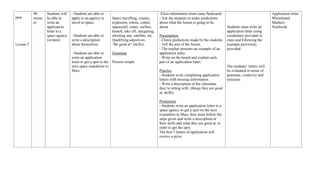
Students will
be able to
write an
application
letter to a
space agency.
(written)

- Students are able to
apply to an agency to
travel to space.

- Students are able to
write a description
about themselves.

Space travelling, cosmic,
explosion, robots, comet,
spacecraft, crater, surface,
launch, take off, stargazing,
shooting star, satellite, etc.
Qualifying adjectives.
“Be good at” (skills)

- Students are able to
Grammar
write an application
letter to get a spot in the Present simple
next space expedition to
Mars.

-Elicit information from some flashcards.
- Ask the students to make predictions
about what the lesson is going to be
about.

Students must write an
application letter using
Presentation
vocabulary provided in
- Check predictions made by the students. class and following the
- Tell the aim of the lesson.
example previously
- The teacher presents an example of an
provided.
application letter.
- Write on the board and explain each
part of an application letter.
The students’ letters will
Practice
be evaluated in terms of
- Students work completing application
grammar, creativity and
letters with missing information.
structure.
- Write a description of the classmate
they’re sitting with. (things they are good
at, skills)
Production
- Students write an application letter to a
space agency to get a spot on the next
expedition to Mars; they must follow the
steps given and write a description of
their skills and what they are good at, in
order to get the spot.
The best 5 letters of application will
receive a prize.

Application letter
Whiteboard
Markers
Notebook.
30.10.13
PPP

Lesson 3

90
minut
es

Students’ book
Data
- Elicit information from flashcards.
Computers
- Ask the students to make predictions
Speakers
about what the lesson is going to be
Whiteboard
about.
Notebook
Colour paper
Presentation
The students’ concept Markers
maps will be evaluated on
- Check predictions made by the students. creativity, fulfilment of the
task and grammar.
Lead in

Students will
be able to
create a
concept map
about Mars
using
information
from a
documentary.
(written)

Students are able to
understand concepts
from a documentary.

Vocabulary
Space travelling, cosmic,
explosion, robots, comet,
spacecraft, crater, surface,
launch, take off, stargazing,
shooting star, satellite, etc.

Grammar
Present Simple
Future Simple
Past Simple

Practice
-Complete the sentences on the Power
point presentation with the teacher (with
CAN or CAN’T)
-Complete the sentences on the Power
point presentation with the teacher (with
COULD OR COULDNT)
-Complete the sentences on the Power
point presentation with the teacher (with
are allowed to/was allowed to and will be
allowed to)
- Complete activities 1, 2, 3 and 4 of the
book. (page 21)
Production
- Create a poster (in pairs) with 10 things
that you are allowed to do at school and
10 things that you are not allowed to do
at school.

Students are able to
understand the usage of
can/could (permission)

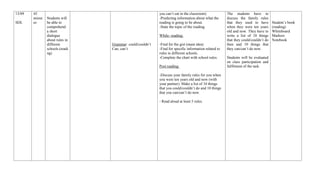
Pre- reading:
-Write on the board some rules of the
school. (you can eat food on the breaks,

The students have to create
a concept map including
10 concepts mentioned in
the documentary, along
with drawings to make it
more attractive.
13/09
SDL

45
minut
es

Students will
be able to
comprehend
a short
dialogue
about rules in
different
schools.(readi
ng)

you can’t eat in the classroom)
-Predicting information about what the
reading is going to be about.
-State the topic of the reading
While- reading:
Grammar: could/couldn’t
Can, can’t

-Find for the gist (main idea)
-Find for specific information related to
rules in different schools.
-Complete the chart with school rules.
Post reading:
-Discuss your family rules for you when
you were ten years old and now (with
your partner). Make a list of 10 things
that you could/couldn’t do and 10 things
that you can/can’t do now.
- Read aloud at least 5 rules.

The students have to
discuss the family rules
that they used to have
when they were ten years
old and now. They have to
write a list of 10 things
that they could/couldn’t do
then and 10 things that
they can/can’t do now.
Students will be evaluated
on class participation and
fulfilment of the task.

Student’s book
(reading)
Whiteboard
Markers
Notebook

Unit plan 2 m unit 12

  • 1.
    Universidad Católica dela Santísima Concepción English Pedagogy Programme Teaching Practice VII UNIT PLAN Topic: Class: School (name & type): Student-Teacher: Unit 12: “Space: Our Solar System” 2nd year High school The Pacific School (subsidized school) María Francisca Rojas Victoriano Unit Aim: Attitudinal Aim(s): At the end of the unit, students will be able to… - Talk about things that will happen in year 2174. (orally) - Write an application letter to a space agency. (written) - Create a concept map about Mars using information from a documentary. (written) -Write a letter to a friend about things they did in the past while travelling in time. (written) Students participate in class and respect their classmates’ opinions. - Students appreciate current investigations regarding space. - Students search for complementary information about space travelling in order to enrich the class’ discussions about the topic.
  • 2.
    Date 24.10.13 PPP Lesson 1 Class length Lesson Aim(s) Learning outcome(s) LanguageContent Main activities Assessment Resources 90 min Students will be able to talk about things that will happen in year 2174. (orally) Students are able to understand the use of will when predicting things that will happen in the future. Vocabulary Lead in - The teacher puts on some music about 2001: Space Odyssey. -Elicit information about some pictures in flashcards/power point. - Ask the students to make predictions about what the lesson is going to be about. Students have to talk about things that will happen in the year 2174. The teacher will ask the students to tell their answers aloud after practicing with a classmate. Flashcards PPT Whiteboard Worksheets Notebooks Markers. Students are able to practice pronunciation of some new words and expressions. Space travelling, cosmic, explosion, robots, comet, spacecraft, crater, surface, launch, take off, stargazing, shooting star, satellite, etc. Grammar Future tense (will) Presentation - Check predictions made by the students. - Tell the aim of the lesson. - Look at some pictures about movies adapted in the future (Star Wars, Back to the Future, Star Trek). - Tell and explain the use of WILL to make predictions. Practice - Read predictions made by students in 1967 (predictions for the year 2000) from a worksheet and check which predictions came true. -Create a timeline with things that will happen in the next decade. Production - Talk about 10 things that will happen in the year 2174. Students who volunteer to say their predictions will get a prize. - 4-5 students tell their predictions aloud. 23.10.13 Vocabulary Lead in Flashcards.
  • 3.
    PPP Lesson 2 90 minut es Students will beable to write an application letter to a space agency. (written) - Students are able to apply to an agency to travel to space. - Students are able to write a description about themselves. Space travelling, cosmic, explosion, robots, comet, spacecraft, crater, surface, launch, take off, stargazing, shooting star, satellite, etc. Qualifying adjectives. “Be good at” (skills) - Students are able to Grammar write an application letter to get a spot in the Present simple next space expedition to Mars. -Elicit information from some flashcards. - Ask the students to make predictions about what the lesson is going to be about. Students must write an application letter using Presentation vocabulary provided in - Check predictions made by the students. class and following the - Tell the aim of the lesson. example previously - The teacher presents an example of an provided. application letter. - Write on the board and explain each part of an application letter. The students’ letters will Practice be evaluated in terms of - Students work completing application grammar, creativity and letters with missing information. structure. - Write a description of the classmate they’re sitting with. (things they are good at, skills) Production - Students write an application letter to a space agency to get a spot on the next expedition to Mars; they must follow the steps given and write a description of their skills and what they are good at, in order to get the spot. The best 5 letters of application will receive a prize. Application letter Whiteboard Markers Notebook.
  • 4.
    30.10.13 PPP Lesson 3 90 minut es Students’ book Data -Elicit information from flashcards. Computers - Ask the students to make predictions Speakers about what the lesson is going to be Whiteboard about. Notebook Colour paper Presentation The students’ concept Markers maps will be evaluated on - Check predictions made by the students. creativity, fulfilment of the task and grammar. Lead in Students will be able to create a concept map about Mars using information from a documentary. (written) Students are able to understand concepts from a documentary. Vocabulary Space travelling, cosmic, explosion, robots, comet, spacecraft, crater, surface, launch, take off, stargazing, shooting star, satellite, etc. Grammar Present Simple Future Simple Past Simple Practice -Complete the sentences on the Power point presentation with the teacher (with CAN or CAN’T) -Complete the sentences on the Power point presentation with the teacher (with COULD OR COULDNT) -Complete the sentences on the Power point presentation with the teacher (with are allowed to/was allowed to and will be allowed to) - Complete activities 1, 2, 3 and 4 of the book. (page 21) Production - Create a poster (in pairs) with 10 things that you are allowed to do at school and 10 things that you are not allowed to do at school. Students are able to understand the usage of can/could (permission) Pre- reading: -Write on the board some rules of the school. (you can eat food on the breaks, The students have to create a concept map including 10 concepts mentioned in the documentary, along with drawings to make it more attractive.
  • 5.
    13/09 SDL 45 minut es Students will be ableto comprehend a short dialogue about rules in different schools.(readi ng) you can’t eat in the classroom) -Predicting information about what the reading is going to be about. -State the topic of the reading While- reading: Grammar: could/couldn’t Can, can’t -Find for the gist (main idea) -Find for specific information related to rules in different schools. -Complete the chart with school rules. Post reading: -Discuss your family rules for you when you were ten years old and now (with your partner). Make a list of 10 things that you could/couldn’t do and 10 things that you can/can’t do now. - Read aloud at least 5 rules. The students have to discuss the family rules that they used to have when they were ten years old and now. They have to write a list of 10 things that they could/couldn’t do then and 10 things that they can/can’t do now. Students will be evaluated on class participation and fulfilment of the task. Student’s book (reading) Whiteboard Markers Notebook