Earth Calling
How much/many of the following does your town/ city have? Tell the class
• Traffic
• Smoke from factories
• Homeless people
• Recycling centers
• Trees/ plants
• Stray animals
• Dirty parks/ rivers/beaches/streets
• Bottle banks
• Clean-up campaigns
• Bins
• Wildlife parks
Too much/many, (not) enough, quite a few/ lot, no, any
Look at the text. What type of text is it? Why was it written? what do the title and quotation mean?
What do you expect to read?
• How do plants grow?
In nature, the roots of a plant grow underground and
cover a large area. This way they keep the plant strong
and healthy. Shoots are young plants that have come
up through the earth to find the sunlight that they need
to survive. Shoots may seem small and fragile, but they
can break open brick walls. Their strength is quite
amazing
• What is Roots and Shoots?
Inspired by her belief that every individual can make a
difference, Dr Jane Goodall decided in 1991 to from a
young people’s environmental group of 16 local
schoolchildren in East Africa. Its name was Roots and
Shoots and the members organized recycling programs
and cleaned up local parks, rivers and beaches. They
also helped old people and homeless in their
neighborhood as well as protecting the natural habitat
Of local animals. Today, Roots and Shoots has
over 3000 groups in more than 68 countries
worldwide which are actively involved in Dr Jane
Goodall’s projects
• How can you become a member of Roots and
Shoots?
Any young person, between preschool and
university , can join the Roots and Shoots
programm. If you want to start your own Roots
and Shoots group, simply find other young
people in your neighborhood who want to
participate, and an adult to be the group leader.
Then, contact the Jane Goodall institute for a
membership form.
Present perfect tense
FORM
[has/have + past participle]
Examples:
You have seen that movie many times.
Have you seen that movie many times?
You have not seen that movie many times.
USE 1 Unspecified Time Before Now
We use the Present Perfect to say that an action happened at an unspecified time
before now. The exact time is not important. You CANNOT use the Present Perfect
with specific time expressions such as: yesterday, one year ago, last week, when I
was a child, when I lived in Japan, at that moment, that day, one day, etc. We CAN
use the Present Perfect with unspecific expressions such as: ever, never, once, many
times, several times, before, so far, already, yet, etc.
Examples:
I have seen that movie twenty times.
I think I have met him once before.
There have been many earthquakes in California.
People have traveled to the Moon.
People have not traveled to Mars.
Have you read the book yet?
Nobody has ever climbed that mountain.
A: Has there ever been a war in the United States?
B: Yes, there has been a war in the United States.
Have you been to Mexico in the last year?
I have seen that movie six times in the last month.
They have had three tests in the last week.
She graduated from university less than three years ago. She has worked for three different
companies so far.
My car has broken down three times this week.
We use the Present Perfect to show that something started in the past and has
continued up until now. "For five minutes," "for two weeks," and "since Tuesday" are
all durations which can be used with the Present Perfect.
Examples:
I have had a cold for two weeks.
She has been in England for six months.
Mary has loved chocolate since she was a little girl.
Although the above use of Present Perfect is normally limited to Non-Continuous
Verbs and non-continuous uses of Mixed Verbs, the words "live," "work," "teach," and
"study" are sometimes used in this way even though they are NOT Non-Continuous
Verbs.
ADVERB PLACEMENT
The examples below show the placement for grammar adverbs such as: always, only,
never, ever, still, just, yet, since, so far, etc.
Examples:
You have only seen that movie one time.
Have you only seen that movie one time?
Present perfect continuous tense
Form
[has/have + been + present participle]
Examples:
You have been waiting here for two hours.
Have you been waiting here for two hours?
You have not been waiting here for two hours.
USE 1 Duration from the Past Until Now
We use the Present Perfect Continuous to show that something started in the past
and has continued up until now. "For five minutes," "for two weeks," and "since
Tuesday" are all durations which can be used with the Present Perfect Continuous.
Examples:
They have been talking for the last hour.
She has been working at that company for three years.
What have you been doing for the last 30 minutes?
James has been teaching at the university since June.
We have been waiting here for over two hours!
Why has Nancy not been taking her medicine for the last three days?
USE 2 Recently, Lately
You can also use the Present Perfect Continuous WITHOUT a duration such as "for two weeks." Without
the duration, the tense has a more general meaning of "lately." We often use the words "lately" or
"recently" to emphasize this meaning.
Examples:
Recently, I have been feeling really tired.
She has been watching too much television lately.
Have you been exercising lately?
Mary has been feeling a little depressed.
Lisa has not been practicing her English.
What have you been doing?
ADVERB PLACEMENT
The examples below show the placement for grammar adverbs such as: always, only, never, ever, still,
just, since, so far, yet, etc.
Examples:
You have only been waiting here for one hour.
Have you only been waiting here for one hour?
Have you ever been to Japan?
No, I have never been to Japan
They have been finishing just it
Listening:
Listen and fill in the gaps (1-6). Which title best matches this speech?
a. We Can Make a Difference b. Help Save Animals
At home’
• Recycle everything you can
• Grow some of your own food
• Plant 1)….and bushes in your garden
Transport
• Ride your bike or 2)… instead of driving
• Use public transport
• Drive sensible: don’t waste petrol
At work
• Print things 3)… paper
• Print or copy on both sides of the paper
• Use the 4)… instead of the lift
Shopping
• Don’t buy food which is wrapped in 5) ….
• Buy locally grown food and product
Read the text and choose the best answer (A-D) for each space ( 1-10). Then explain the highlighted
words
No ordinary zoo
How would you like to visit a rainforest, explore the bottom of an ocean and still be home 0) in time for dinner? Well, if you live in
Omaha, USA, you can! The Henry Doorly Zoo in Omaha is like no 1) ……zoo. There are 2)…..of wild and endangered animals here
but they live in an environmental exactly 3)….. Their own. The zoo includes the world’s largest indoor rainforest, known 4)….. The Lied
Jungle. You can cross rope bridges, walk through caves and admire wonderful waterfalls. Leopards and pythons move through the
bushes, monkeys jump from tree to tree and birds 5) …. Above your head. The zoo is home 6) …. Many species including bears,
giraffes, deer, jaguars and pumas. Next 7) … the Lied Jungle is the Kingdom of the Seas Aquarium. Here you can see penguins
sliding off ice cliffs 8) ….. The cold water below. 9) …. A walk along the 25-metre glass tunnel which runs through a big tank, with a
wide variety of fish swimming around you. The zoo is open 10) …. Day of the year except Thanksgiving, Christmas and New Year’s
Day.
0. a. on b. in c. at d. for
1. a. such b. every c. any d. other
2. A. much b. more c. many d. lots
3. A. like b. as c. same d. to
4. A. as b. like c. such d. for
5. A. move b. cross c. fly d. pass
6. A. for b. of c. to d. in
7. A. in b. to c. by d. with
8. A. under b. in c. into d. on
9. A. do b. go c. make d. take
10. A. most b. all c. every d. each
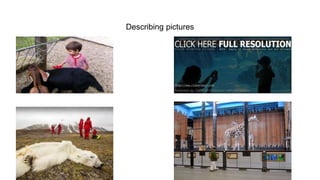
Describing pictures

Unit III

  • 1.
    Earth Calling How much/manyof the following does your town/ city have? Tell the class • Traffic • Smoke from factories • Homeless people • Recycling centers • Trees/ plants • Stray animals • Dirty parks/ rivers/beaches/streets • Bottle banks • Clean-up campaigns • Bins • Wildlife parks Too much/many, (not) enough, quite a few/ lot, no, any
  • 2.
    Look at thetext. What type of text is it? Why was it written? what do the title and quotation mean? What do you expect to read? • How do plants grow? In nature, the roots of a plant grow underground and cover a large area. This way they keep the plant strong and healthy. Shoots are young plants that have come up through the earth to find the sunlight that they need to survive. Shoots may seem small and fragile, but they can break open brick walls. Their strength is quite amazing • What is Roots and Shoots? Inspired by her belief that every individual can make a difference, Dr Jane Goodall decided in 1991 to from a young people’s environmental group of 16 local schoolchildren in East Africa. Its name was Roots and Shoots and the members organized recycling programs and cleaned up local parks, rivers and beaches. They also helped old people and homeless in their neighborhood as well as protecting the natural habitat Of local animals. Today, Roots and Shoots has over 3000 groups in more than 68 countries worldwide which are actively involved in Dr Jane Goodall’s projects • How can you become a member of Roots and Shoots? Any young person, between preschool and university , can join the Roots and Shoots programm. If you want to start your own Roots and Shoots group, simply find other young people in your neighborhood who want to participate, and an adult to be the group leader. Then, contact the Jane Goodall institute for a membership form.
  • 3.
    Present perfect tense FORM [has/have+ past participle] Examples: You have seen that movie many times. Have you seen that movie many times? You have not seen that movie many times. USE 1 Unspecified Time Before Now We use the Present Perfect to say that an action happened at an unspecified time before now. The exact time is not important. You CANNOT use the Present Perfect with specific time expressions such as: yesterday, one year ago, last week, when I was a child, when I lived in Japan, at that moment, that day, one day, etc. We CAN use the Present Perfect with unspecific expressions such as: ever, never, once, many times, several times, before, so far, already, yet, etc.
  • 4.
    Examples: I have seenthat movie twenty times. I think I have met him once before. There have been many earthquakes in California. People have traveled to the Moon. People have not traveled to Mars. Have you read the book yet? Nobody has ever climbed that mountain. A: Has there ever been a war in the United States? B: Yes, there has been a war in the United States. Have you been to Mexico in the last year? I have seen that movie six times in the last month. They have had three tests in the last week. She graduated from university less than three years ago. She has worked for three different companies so far. My car has broken down three times this week.
  • 5.
    We use thePresent Perfect to show that something started in the past and has continued up until now. "For five minutes," "for two weeks," and "since Tuesday" are all durations which can be used with the Present Perfect. Examples: I have had a cold for two weeks. She has been in England for six months. Mary has loved chocolate since she was a little girl. Although the above use of Present Perfect is normally limited to Non-Continuous Verbs and non-continuous uses of Mixed Verbs, the words "live," "work," "teach," and "study" are sometimes used in this way even though they are NOT Non-Continuous Verbs. ADVERB PLACEMENT The examples below show the placement for grammar adverbs such as: always, only, never, ever, still, just, yet, since, so far, etc. Examples: You have only seen that movie one time. Have you only seen that movie one time?
  • 6.
    Present perfect continuoustense Form [has/have + been + present participle] Examples: You have been waiting here for two hours. Have you been waiting here for two hours? You have not been waiting here for two hours. USE 1 Duration from the Past Until Now We use the Present Perfect Continuous to show that something started in the past and has continued up until now. "For five minutes," "for two weeks," and "since Tuesday" are all durations which can be used with the Present Perfect Continuous. Examples: They have been talking for the last hour. She has been working at that company for three years.
  • 7.
    What have youbeen doing for the last 30 minutes? James has been teaching at the university since June. We have been waiting here for over two hours! Why has Nancy not been taking her medicine for the last three days? USE 2 Recently, Lately You can also use the Present Perfect Continuous WITHOUT a duration such as "for two weeks." Without the duration, the tense has a more general meaning of "lately." We often use the words "lately" or "recently" to emphasize this meaning. Examples: Recently, I have been feeling really tired. She has been watching too much television lately. Have you been exercising lately? Mary has been feeling a little depressed. Lisa has not been practicing her English. What have you been doing? ADVERB PLACEMENT The examples below show the placement for grammar adverbs such as: always, only, never, ever, still, just, since, so far, yet, etc.
  • 8.
    Examples: You have onlybeen waiting here for one hour. Have you only been waiting here for one hour? Have you ever been to Japan? No, I have never been to Japan They have been finishing just it Listening: Listen and fill in the gaps (1-6). Which title best matches this speech? a. We Can Make a Difference b. Help Save Animals At home’ • Recycle everything you can • Grow some of your own food • Plant 1)….and bushes in your garden Transport • Ride your bike or 2)… instead of driving • Use public transport • Drive sensible: don’t waste petrol At work • Print things 3)… paper • Print or copy on both sides of the paper • Use the 4)… instead of the lift Shopping • Don’t buy food which is wrapped in 5) …. • Buy locally grown food and product
  • 9.
    Read the textand choose the best answer (A-D) for each space ( 1-10). Then explain the highlighted words No ordinary zoo How would you like to visit a rainforest, explore the bottom of an ocean and still be home 0) in time for dinner? Well, if you live in Omaha, USA, you can! The Henry Doorly Zoo in Omaha is like no 1) ……zoo. There are 2)…..of wild and endangered animals here but they live in an environmental exactly 3)….. Their own. The zoo includes the world’s largest indoor rainforest, known 4)….. The Lied Jungle. You can cross rope bridges, walk through caves and admire wonderful waterfalls. Leopards and pythons move through the bushes, monkeys jump from tree to tree and birds 5) …. Above your head. The zoo is home 6) …. Many species including bears, giraffes, deer, jaguars and pumas. Next 7) … the Lied Jungle is the Kingdom of the Seas Aquarium. Here you can see penguins sliding off ice cliffs 8) ….. The cold water below. 9) …. A walk along the 25-metre glass tunnel which runs through a big tank, with a wide variety of fish swimming around you. The zoo is open 10) …. Day of the year except Thanksgiving, Christmas and New Year’s Day. 0. a. on b. in c. at d. for 1. a. such b. every c. any d. other 2. A. much b. more c. many d. lots 3. A. like b. as c. same d. to 4. A. as b. like c. such d. for 5. A. move b. cross c. fly d. pass 6. A. for b. of c. to d. in 7. A. in b. to c. by d. with 8. A. under b. in c. into d. on 9. A. do b. go c. make d. take 10. A. most b. all c. every d. each
  • 10.