B.E.
Semester VII
CAD CAM
Unit V
ROBOTICS
MSPM’s
Shir. Shivaji Institute of
Engineering And Management
Studies, Parbhani 431401
Faculty
Prof. Pramod Ashokrao Sadavarte
UNIT V
Syllabus
 Robot configurations,
 Drives for robots,
 Sensors used in robotics,
 Programming technique,
 Programming languages,
 Applications,
 Latest development in robotics .
UNIT V
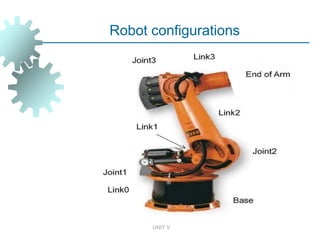
Robot configurations
UNIT V
History of Robotics -PUMA
UNIT V
History of Robotics - SCARA
UNIT V
Three Laws of Robotics:
 Law One: A robot may not injure a human
being, or, through inaction, allow a human
being to come to harm.
 Law Two: A robot must obey orders given it by
human beings , except when such orders
would conflict with the first law.
 Law Three: A robot must protect its own
existence, as long as such protection does not
conflict with the first or second law.
UNIT V
Drives for robots
 Types of drive systems:-
1.Hydraulic drive
2. Electric drive
3. Pneumatic drive
UNIT V
Sensors used in robotics
UNIT V
UNIT V
Programming technique
UNIT V
Programming languages
UNIT V
Applications
 Present Applications of Robots:-
(i) Material transfer applications
(ii) Machine loading and unloading
(iii) Processing operations like,
(a) Spot welding
(b) Continuous arc welding
(c) Spray coating
(d) Drilling, routing, machining operations
(e) Grinding, polishing debarring wire brushing
(g) Laser drilling and cutting etc.
(iv) Assembly tasks, assembly cell designs, parts mating.
(v) Inspection, automation. UNIT V
Latest development in robotics
 The profile of the future robot based on the research activities
will include the following,
(i) Intelligence
(ii) Sensor capabilities
(iii) Telepresence
(iv) Mechanical design
(v) Mobility and navigation (walking machines)
(vi) Universal gripper
(vii) Systems and integration and networking
(viii) FMS (Flexible Manufacturing Systems)
UNIT V
(Ix) Hazardous and inaccessible non-
manufacturing environments
(x) Underground coal mining
(xi) Fire fighting operations
(xii) Robots in space
(xiii) Security guards
(xiv) Garbage collection and waste disposal
operations
(xv) Household robots
(xvi) Medical care and hospital duties etc.
UNIT V
UNIT V

unit III.ppt

  • 1.
    B.E. Semester VII CAD CAM UnitV ROBOTICS MSPM’s Shir. Shivaji Institute of Engineering And Management Studies, Parbhani 431401 Faculty Prof. Pramod Ashokrao Sadavarte UNIT V
  • 2.
    Syllabus  Robot configurations, Drives for robots,  Sensors used in robotics,  Programming technique,  Programming languages,  Applications,  Latest development in robotics . UNIT V
  • 3.
  • 4.
    History of Robotics-PUMA UNIT V
  • 5.
    History of Robotics- SCARA UNIT V
  • 6.
    Three Laws ofRobotics:  Law One: A robot may not injure a human being, or, through inaction, allow a human being to come to harm.  Law Two: A robot must obey orders given it by human beings , except when such orders would conflict with the first law.  Law Three: A robot must protect its own existence, as long as such protection does not conflict with the first or second law. UNIT V
  • 7.
    Drives for robots Types of drive systems:- 1.Hydraulic drive 2. Electric drive 3. Pneumatic drive UNIT V
  • 8.
    Sensors used inrobotics UNIT V
  • 9.
  • 10.
  • 11.
  • 12.
    Applications  Present Applicationsof Robots:- (i) Material transfer applications (ii) Machine loading and unloading (iii) Processing operations like, (a) Spot welding (b) Continuous arc welding (c) Spray coating (d) Drilling, routing, machining operations (e) Grinding, polishing debarring wire brushing (g) Laser drilling and cutting etc. (iv) Assembly tasks, assembly cell designs, parts mating. (v) Inspection, automation. UNIT V
  • 13.
    Latest development inrobotics  The profile of the future robot based on the research activities will include the following, (i) Intelligence (ii) Sensor capabilities (iii) Telepresence (iv) Mechanical design (v) Mobility and navigation (walking machines) (vi) Universal gripper (vii) Systems and integration and networking (viii) FMS (Flexible Manufacturing Systems) UNIT V
  • 14.
    (Ix) Hazardous andinaccessible non- manufacturing environments (x) Underground coal mining (xi) Fire fighting operations (xii) Robots in space (xiii) Security guards (xiv) Garbage collection and waste disposal operations (xv) Household robots (xvi) Medical care and hospital duties etc. UNIT V
  • 15.