MICROCONTROLLER
BASED SYSTEM DESIGN
Unit-I : Introduction to Microcomputer
24/01/2025 Microcontroller Based System Design 2
Learning Objectives
By the end of the class, students will be able to:
1. Understand the significance and history of
microcomputer technology.
2. Describe the basic functions of microcomputer control.
24/01/2025 Microcontroller Based System Design 3
Outline
• Introduction
• Significance of Microcomputer Technology
• History of Microcomputer Technology
• Basic Function of Microcomputer Control
24/01/2025 Microcontroller Based System Design 4
Introducti
on
24/01/2025 Microcontroller Based System Design 5
Introduction: Understanding
Microcomputers
What is a Microcomputer?
• A microcomputer is a small, versatile computing device that
uses a microprocessor as its central processing unit (CPU).
• These systems are designed for individual use, typically
integrating other key components like memory, input/output
interfaces, and storage within a compact unit.
• Breakdown of the Term:
 “Micro” refers to the small size of the processor.
 “Computer” implies a system capable of processing
data, running programs, and solving problems.
24/01/2025 Microcontroller Based System Design 6
Introduction: Understanding
Microcomputers
• Key Characteristics:
 Compact and portable compared to earlier computers
(mainframes and minicomputers).
 Affordable, making computing accessible to the masses.
 Flexible, as they can be programmed for a variety of
applications.
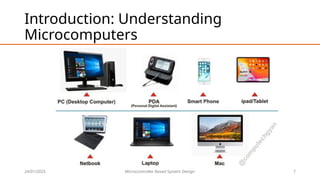
• Examples of Microcomputers:
 Personal Computers (PCs): Desktops and laptops.
 Embedded Systems: Found in microwaves, washing machines,
and automobiles.
 Development Boards: Raspberry Pi and Arduino.
24/01/2025 Microcontroller Based System Design 7
Introduction: Understanding
Microcomputers
24/01/2025 Microcontroller Based System Design 8
Introduction: Understanding
Microcomputers
Why Study Microcomputers?
• Microcomputers are a cornerstone of modern technology.
They power the devices we use every day and play a critical
role in advancing industries.
• Relevance Today:
 They are used in homes, offices, healthcare, and industries
for applications like communication, data processing, and
automation.
 Microcomputers enable advancements in fields like
Artificial Intelligence, Internet of Things (IoT), and robotics.
24/01/2025 Microcontroller Based System Design 9
Introduction: Understanding
Microcomputers
Evolution of Computing Systems
• Early Computers (1940s-1960s):
 ENIAC (1945): One of the first electronic general-purpose
computers, occupying entire rooms.
 Mainframes were large, expensive, and used primarily by
governments and large organizations.
• Minicomputers (1960s-1970s):
 Smaller and cheaper than mainframes but still too expensive
for individuals.
 Used in small organizations and for specific applications like
engineering.
24/01/2025 Microcontroller Based System Design 10
Introduction: Understanding
Microcomputers
• Birth of Microcomputers (1970s):
 The development of microprocessors like the Intel 4004 in
1971 revolutionized computing.
 Introduction of personal computers like the Altair 8800
(1975) and Apple I (1976).
• Modern Microcomputers:
 Today’s microcomputers include powerful devices like
laptops, smartphones, and IoT platforms.
 They are more compact, efficient, and powerful, catering to
diverse needs like gaming, automation, and AI applications.
24/01/2025 Microcontroller Based System Design 11
Significance of
Microcomputer
Technology
24/01/2025 Microcontroller Based System Design 12
Significance of Microcomputer
Technology
Revolution in Computing
• Transition from Large Systems:
 Early computers were massive, expensive, and accessible only to
large organizations. Microcomputers brought computing power to
small businesses, schools, and homes.
• Cost-Effectiveness:
 The development of microcomputers made computers affordable
and led to widespread adoption.
• Versatility:
 Microcomputers can be used for general-purpose tasks like word
processing, gaming, and browsing, or specialized applications like
robotics and IoT.
24/01/2025 Microcontroller Based System Design 13
Significance of Microcomputer
Technology
Impact on Society
• Accessibility:
 Microcomputers democratized access to technology, enabling
individuals from various backgrounds to leverage computing
power.
• Advancements in Technology:
 Enabled the development of software and operating systems that
support modern computing, like Microsoft Windows and Linux.
• Integration into Modern Life:
 Microcomputers are at the heart of smartphones, IoT devices,
smart TVs, and even cars, enhancing convenience and efficiency
in everyday life.
24/01/2025 Microcontroller Based System Design 14
History of
Microcomputer
Technology
24/01/2025 Microcontroller Based System Design 15
History of Microcomputer Technology
Early Development (1970s)
• The Birth of Microprocessors:
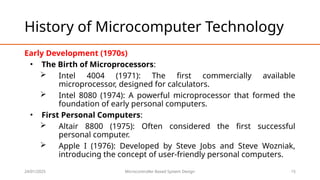
 Intel 4004 (1971): The first commercially available
microprocessor, designed for calculators.
 Intel 8080 (1974): A powerful microprocessor that formed the
foundation of early personal computers.
• First Personal Computers:
 Altair 8800 (1975): Often considered the first successful
personal computer.
 Apple I (1976): Developed by Steve Jobs and Steve Wozniak,
introducing the concept of user-friendly personal computers.
24/01/2025 Microcontroller Based System Design 16
History of Microcomputer Technology
Evolution in the 1980s
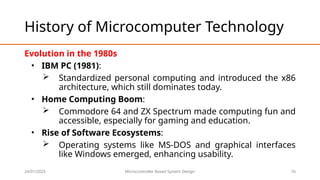
• IBM PC (1981):
 Standardized personal computing and introduced the x86
architecture, which still dominates today.
• Home Computing Boom:
 Commodore 64 and ZX Spectrum made computing fun and
accessible, especially for gaming and education.
• Rise of Software Ecosystems:
 Operating systems like MS-DOS and graphical interfaces
like Windows emerged, enhancing usability.
24/01/2025 Microcontroller Based System Design 17
History of Microcomputer Technology
Modern Developments
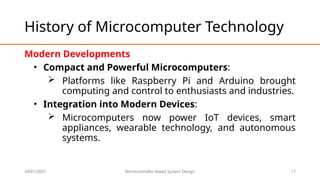
• Compact and Powerful Microcomputers:
 Platforms like Raspberry Pi and Arduino brought
computing and control to enthusiasts and industries.
• Integration into Modern Devices:
 Microcomputers now power IoT devices, smart
appliances, wearable technology, and autonomous
systems.
24/01/2025 Microcontroller Based System Design 18
Basic Function of
Microcomputer
Control
24/01/2025 Microcontroller Based System Design 19
Basic Function of Microcomputer
Control
Key Components
1. Microprocessor (CPU)
2. Memory (RAM and ROM)
3. Input/Output Interfaces
4. Storage (HDD, SSD, or Flash Memory)
Control Functions
5. Data Processing
6. Communication
7. Automation
24/01/2025 Microcontroller Based System Design 20
Basic Function of Microcomputer
Control
24/01/2025 Microcontroller Based System Design 21
Basic Function of Microcomputer
Control (Key Components)
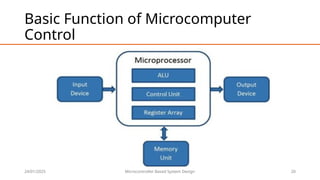
Central Processing Unit (CPU)
• The “brain” of the microcomputer.
• Executes instructions from programs and processes data.
• Comprised of:
 Control Unit (CU): Directs operations of the microcomputer.
 Arithmetic Logic Unit (ALU): Performs mathematical and
logical operations.
24/01/2025 Microcontroller Based System Design 22
Basic Function of Microcomputer
Control (Key Components)
Memory
• RAM (Random Access Memory):
 Temporary storage for active processes.
 Volatile – loses data when power is off.
 Example: Running multiple applications
simultaneously.
• ROM (Read-Only Memory):
 Stores permanent instructions (firmware).
 Non-volatile – retains data even when power is off.
24/01/2025 Microcontroller Based System Design 23
Basic Function of Microcomputer
Control (Key Components)
Input and Output (I/O) Interfaces
• Facilitates communication between the user and the
microcomputer.
 Input Devices: Keyboard, mouse, sensors.
 Output Devices: Monitor, speakers, actuators.
Storage
• Long-term data storage using hard drives, SSDs, or flash
memory.
24/01/2025 Microcontroller Based System Design 24
Basic Function of Microcomputer
Control (Key Components)
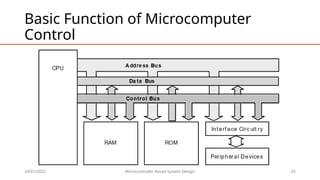
System Bus:
• Transfers data between components.
 Data Bus: Carries actual data.
 Address Bus: Specifies memory locations.
 Control Bus: Coordinates control signals.
24/01/2025 Microcontroller Based System Design 25
Basic Function of Microcomputer
Control
24/01/2025 Microcontroller Based System Design 26
Basic Function of Microcomputer
Control (Control Functions)
Data Processing
• How It Works:
 CPU fetches data from memory.
 Performs computations (arithmetic or logic).
 Sends results to output or stores them back in memory.
• Example:
 Processing user input in a word processor and displaying the
edited text.
24/01/2025 Microcontroller Based System Design 27
Basic Function of Microcomputer
Control (Control Functions)
Communication
• Internal Communication: Between the CPU, memory, and
peripherals via the system bus.
• External Communication: Using ports like USB, Ethernet, or Wi-Fi.
• Example:
 Sending a print command to a printer or transferring files to a
USB drive.
24/01/2025 Microcontroller Based System Design 28
Basic Function of Microcomputer
Control (Control Functions)
Automation
• Microcomputers automate processes by executing predefined
instructions.
• Example:
 A microcontroller in a washing machine cycles through wash,
rinse, and spin functions automatically.
 An industrial robot performing repetitive tasks.
24/01/2025 Microcontroller Based System Design 29
Basic Function of Microcomputer
Control (Control Functions)
Monitoring and Feedback
• Monitors inputs from sensors, processes the data, and provides
feedback or control.
• Example:
 A thermostat adjusting the temperature based on room
conditions.
 A car’s anti-lock braking system (ABS) responding to wheel
slippage.
24/01/2025 Microcontroller Based System Design 30
Basic Function of Microcomputer
Control (Control Functions)
Decision Making
• Microcomputers use programmed logic to make decisions.
• Example:
 An irrigation system deciding when to water crops based on
soil moisture data.

Unit-I_Lecture-1.pptx Lecture notes and diagrams

  • 1.
    MICROCONTROLLER BASED SYSTEM DESIGN Unit-I: Introduction to Microcomputer
  • 2.
    24/01/2025 Microcontroller BasedSystem Design 2 Learning Objectives By the end of the class, students will be able to: 1. Understand the significance and history of microcomputer technology. 2. Describe the basic functions of microcomputer control.
  • 3.
    24/01/2025 Microcontroller BasedSystem Design 3 Outline • Introduction • Significance of Microcomputer Technology • History of Microcomputer Technology • Basic Function of Microcomputer Control
  • 4.
    24/01/2025 Microcontroller BasedSystem Design 4 Introducti on
  • 5.
    24/01/2025 Microcontroller BasedSystem Design 5 Introduction: Understanding Microcomputers What is a Microcomputer? • A microcomputer is a small, versatile computing device that uses a microprocessor as its central processing unit (CPU). • These systems are designed for individual use, typically integrating other key components like memory, input/output interfaces, and storage within a compact unit. • Breakdown of the Term:  “Micro” refers to the small size of the processor.  “Computer” implies a system capable of processing data, running programs, and solving problems.
  • 6.
    24/01/2025 Microcontroller BasedSystem Design 6 Introduction: Understanding Microcomputers • Key Characteristics:  Compact and portable compared to earlier computers (mainframes and minicomputers).  Affordable, making computing accessible to the masses.  Flexible, as they can be programmed for a variety of applications. • Examples of Microcomputers:  Personal Computers (PCs): Desktops and laptops.  Embedded Systems: Found in microwaves, washing machines, and automobiles.  Development Boards: Raspberry Pi and Arduino.
  • 7.
    24/01/2025 Microcontroller BasedSystem Design 7 Introduction: Understanding Microcomputers
  • 8.
    24/01/2025 Microcontroller BasedSystem Design 8 Introduction: Understanding Microcomputers Why Study Microcomputers? • Microcomputers are a cornerstone of modern technology. They power the devices we use every day and play a critical role in advancing industries. • Relevance Today:  They are used in homes, offices, healthcare, and industries for applications like communication, data processing, and automation.  Microcomputers enable advancements in fields like Artificial Intelligence, Internet of Things (IoT), and robotics.
  • 9.
    24/01/2025 Microcontroller BasedSystem Design 9 Introduction: Understanding Microcomputers Evolution of Computing Systems • Early Computers (1940s-1960s):  ENIAC (1945): One of the first electronic general-purpose computers, occupying entire rooms.  Mainframes were large, expensive, and used primarily by governments and large organizations. • Minicomputers (1960s-1970s):  Smaller and cheaper than mainframes but still too expensive for individuals.  Used in small organizations and for specific applications like engineering.
  • 10.
    24/01/2025 Microcontroller BasedSystem Design 10 Introduction: Understanding Microcomputers • Birth of Microcomputers (1970s):  The development of microprocessors like the Intel 4004 in 1971 revolutionized computing.  Introduction of personal computers like the Altair 8800 (1975) and Apple I (1976). • Modern Microcomputers:  Today’s microcomputers include powerful devices like laptops, smartphones, and IoT platforms.  They are more compact, efficient, and powerful, catering to diverse needs like gaming, automation, and AI applications.
  • 11.
    24/01/2025 Microcontroller BasedSystem Design 11 Significance of Microcomputer Technology
  • 12.
    24/01/2025 Microcontroller BasedSystem Design 12 Significance of Microcomputer Technology Revolution in Computing • Transition from Large Systems:  Early computers were massive, expensive, and accessible only to large organizations. Microcomputers brought computing power to small businesses, schools, and homes. • Cost-Effectiveness:  The development of microcomputers made computers affordable and led to widespread adoption. • Versatility:  Microcomputers can be used for general-purpose tasks like word processing, gaming, and browsing, or specialized applications like robotics and IoT.
  • 13.
    24/01/2025 Microcontroller BasedSystem Design 13 Significance of Microcomputer Technology Impact on Society • Accessibility:  Microcomputers democratized access to technology, enabling individuals from various backgrounds to leverage computing power. • Advancements in Technology:  Enabled the development of software and operating systems that support modern computing, like Microsoft Windows and Linux. • Integration into Modern Life:  Microcomputers are at the heart of smartphones, IoT devices, smart TVs, and even cars, enhancing convenience and efficiency in everyday life.
  • 14.
    24/01/2025 Microcontroller BasedSystem Design 14 History of Microcomputer Technology
  • 15.
    24/01/2025 Microcontroller BasedSystem Design 15 History of Microcomputer Technology Early Development (1970s) • The Birth of Microprocessors:  Intel 4004 (1971): The first commercially available microprocessor, designed for calculators.  Intel 8080 (1974): A powerful microprocessor that formed the foundation of early personal computers. • First Personal Computers:  Altair 8800 (1975): Often considered the first successful personal computer.  Apple I (1976): Developed by Steve Jobs and Steve Wozniak, introducing the concept of user-friendly personal computers.
  • 16.
    24/01/2025 Microcontroller BasedSystem Design 16 History of Microcomputer Technology Evolution in the 1980s • IBM PC (1981):  Standardized personal computing and introduced the x86 architecture, which still dominates today. • Home Computing Boom:  Commodore 64 and ZX Spectrum made computing fun and accessible, especially for gaming and education. • Rise of Software Ecosystems:  Operating systems like MS-DOS and graphical interfaces like Windows emerged, enhancing usability.
  • 17.
    24/01/2025 Microcontroller BasedSystem Design 17 History of Microcomputer Technology Modern Developments • Compact and Powerful Microcomputers:  Platforms like Raspberry Pi and Arduino brought computing and control to enthusiasts and industries. • Integration into Modern Devices:  Microcomputers now power IoT devices, smart appliances, wearable technology, and autonomous systems.
  • 18.
    24/01/2025 Microcontroller BasedSystem Design 18 Basic Function of Microcomputer Control
  • 19.
    24/01/2025 Microcontroller BasedSystem Design 19 Basic Function of Microcomputer Control Key Components 1. Microprocessor (CPU) 2. Memory (RAM and ROM) 3. Input/Output Interfaces 4. Storage (HDD, SSD, or Flash Memory) Control Functions 5. Data Processing 6. Communication 7. Automation
  • 20.
    24/01/2025 Microcontroller BasedSystem Design 20 Basic Function of Microcomputer Control
  • 21.
    24/01/2025 Microcontroller BasedSystem Design 21 Basic Function of Microcomputer Control (Key Components) Central Processing Unit (CPU) • The “brain” of the microcomputer. • Executes instructions from programs and processes data. • Comprised of:  Control Unit (CU): Directs operations of the microcomputer.  Arithmetic Logic Unit (ALU): Performs mathematical and logical operations.
  • 22.
    24/01/2025 Microcontroller BasedSystem Design 22 Basic Function of Microcomputer Control (Key Components) Memory • RAM (Random Access Memory):  Temporary storage for active processes.  Volatile – loses data when power is off.  Example: Running multiple applications simultaneously. • ROM (Read-Only Memory):  Stores permanent instructions (firmware).  Non-volatile – retains data even when power is off.
  • 23.
    24/01/2025 Microcontroller BasedSystem Design 23 Basic Function of Microcomputer Control (Key Components) Input and Output (I/O) Interfaces • Facilitates communication between the user and the microcomputer.  Input Devices: Keyboard, mouse, sensors.  Output Devices: Monitor, speakers, actuators. Storage • Long-term data storage using hard drives, SSDs, or flash memory.
  • 24.
    24/01/2025 Microcontroller BasedSystem Design 24 Basic Function of Microcomputer Control (Key Components) System Bus: • Transfers data between components.  Data Bus: Carries actual data.  Address Bus: Specifies memory locations.  Control Bus: Coordinates control signals.
  • 25.
    24/01/2025 Microcontroller BasedSystem Design 25 Basic Function of Microcomputer Control
  • 26.
    24/01/2025 Microcontroller BasedSystem Design 26 Basic Function of Microcomputer Control (Control Functions) Data Processing • How It Works:  CPU fetches data from memory.  Performs computations (arithmetic or logic).  Sends results to output or stores them back in memory. • Example:  Processing user input in a word processor and displaying the edited text.
  • 27.
    24/01/2025 Microcontroller BasedSystem Design 27 Basic Function of Microcomputer Control (Control Functions) Communication • Internal Communication: Between the CPU, memory, and peripherals via the system bus. • External Communication: Using ports like USB, Ethernet, or Wi-Fi. • Example:  Sending a print command to a printer or transferring files to a USB drive.
  • 28.
    24/01/2025 Microcontroller BasedSystem Design 28 Basic Function of Microcomputer Control (Control Functions) Automation • Microcomputers automate processes by executing predefined instructions. • Example:  A microcontroller in a washing machine cycles through wash, rinse, and spin functions automatically.  An industrial robot performing repetitive tasks.
  • 29.
    24/01/2025 Microcontroller BasedSystem Design 29 Basic Function of Microcomputer Control (Control Functions) Monitoring and Feedback • Monitors inputs from sensors, processes the data, and provides feedback or control. • Example:  A thermostat adjusting the temperature based on room conditions.  A car’s anti-lock braking system (ABS) responding to wheel slippage.
  • 30.
    24/01/2025 Microcontroller BasedSystem Design 30 Basic Function of Microcomputer Control (Control Functions) Decision Making • Microcomputers use programmed logic to make decisions. • Example:  An irrigation system deciding when to water crops based on soil moisture data.