Python Reference
                                 Udacity cs101: Unit 1
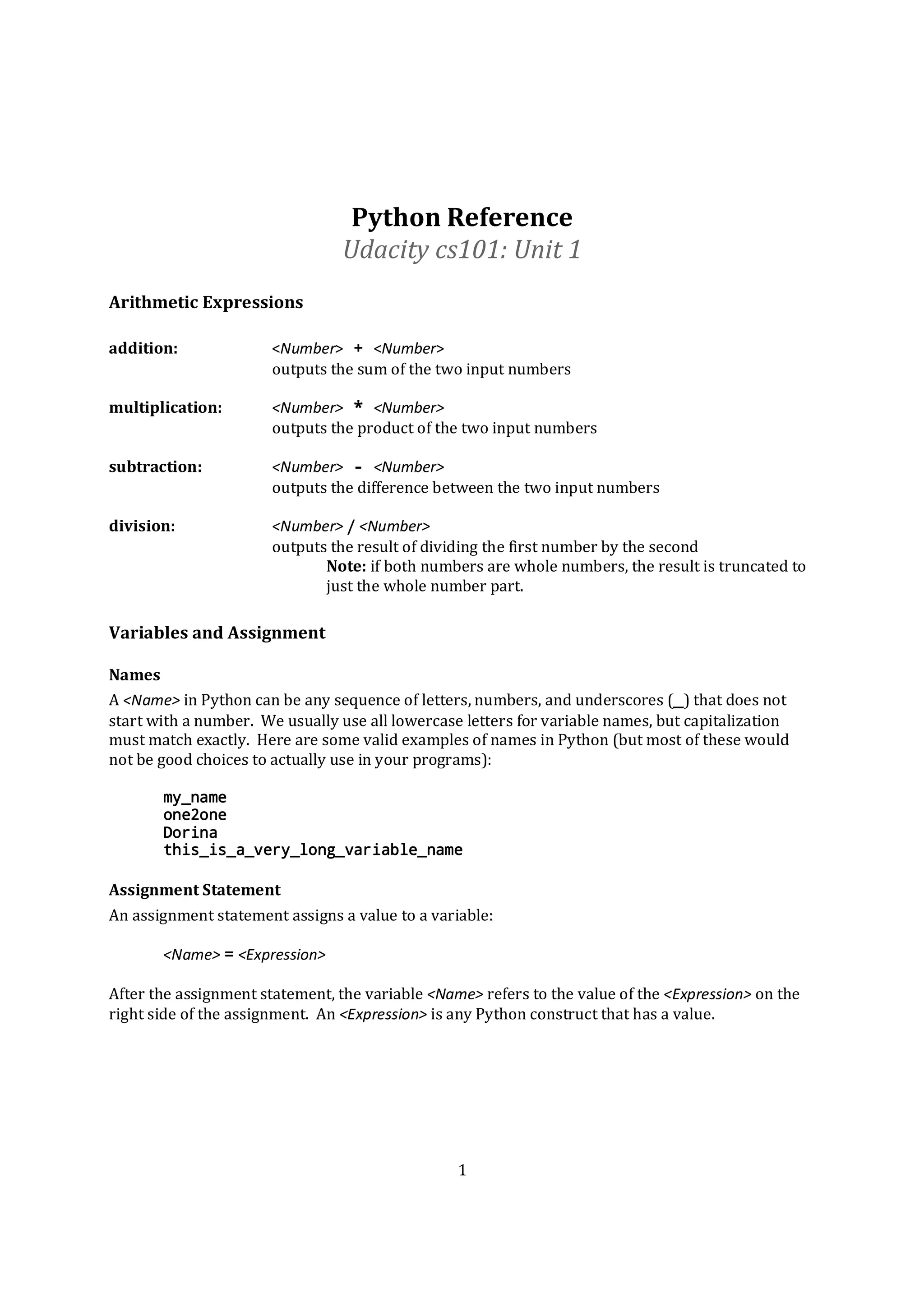
Arithmetic Expressions

addition:              <Number> + <Number>
                       outputs the sum of the two input numbers

multiplication:        <Number> * <Number>
                       outputs the product of the two input numbers

subtraction:           <Number> - <Number>
                       outputs the difference between the two input numbers

division:              <Number> / <Number>
                       outputs the result of dividing the first number by the second
                              Note: if both numbers are whole numbers, the result is truncated to
                              just the whole number part.

Variables and Assignment

Names
                                                                                _
A <Name> in Python can be any sequence of letters, numbers, and underscores (_) that does not
start with a number. We usually use all lowercase letters for variable names, but capitalization
must match exactly. Here are some valid examples of names in Python (but most of these would
not be good choices to actually use in your programs):

       my_name
       one2one
       Dorina
       this_is_a_very_long_variable_name

Assignment Statement
An assignment statement assigns a value to a variable:

       <Name> = <Expression>

After the assignment statement, the variable <Name> refers to the value of the <Expression> on the
right side of the assignment. An <Expression> is any Python construct that has a value.


                                                 1
Multiple Assignment
We can put more than one name on the left side of an assignment statement, and a corresponding
number of expressions on the right side:

       <Name1>, <Name2>, ... = <Expression1>, <Expression2>, ...
              ,        ,                    ,              ,

All of the expressions on the right side are evaluated first. Then, each name on the left side is
assigned to reference the value of the corresponding expression on the right side. This is handy for
swapping variable values. For example,

       s, t = t, s

would swap the values of s and t so after the assignment statement s now refers to the previous
value of t, and t refers to the previous value of s .

Strings
A string is sequence of characters surrounded by quotes. The quotes can be either single or double
quotes, but the quotes at both ends of the string must be the same type. Here are some examples of
strings in Python:

       "silly"
       'string'
       "I'm a valid string, even with a single quote in the middle!"

String Concatenation
We can use the + operator on strings, but it has a different meaning than when it is used on
numbers.

string concatenation:          <String> + <String>
                               outputs the concatenation of the two input strings (pasting the string
                               together with no space between them)

We can also use the multiplication operator on strings:

string multiplication:         <String> * <Number>
                               outputs a string that is <Number> copies of the input <String> pasted
                               together


Indexing Strings
The indexing operator provides a way to extract subsequences of characters from a string.

string indexing:                        [
                               <String>[<Number>]  ]
                               outputs a single-character string containing the character at position
                               <Number> of the input <String>. Positions in the string are counted
                                                   s[1]
                               starting from 0, so s[1] outputs the second character in s . If the
                               <Number> is negative, positions are counted from the end of the
                                       s[-
                               string: s[-1] is the last character in s.

                                                  2
string extraction:                      [                  :
                                <String>[<Start Number>:<Stop Number>]    ]
                                outputs a string that is the subsequence of the input string starting
                                from position <Start Number> and ending just before position
                                <Stop Number>. If <Start Number> is missing, starts from the
                                beginning of the input string; if <Stop Number> is missing, goes to the
                                end of the input string.

Finding Subsequence in Strings
The find method provides a way to find sub-sequences of characters in strings.

find:                                           .find(<target string>)
                                                .find(
                                <search string>.find(                    )
                                outputs a number giving the position in <search string> where
                                <target string> first appears. If there is no occurrence of
                                <target string> in <search string>, outputs -1.

                                                           find:
To find later occurrences, we can also pass in a number to find

find at or after:                               .find(<target string>, <start number>)
                                                .find(
                                <search string>.find(                    ,                 )
                                outputs a number giving the position in <search string> where
                                <target string> first appears that is at or after the position give by
                                <start number>. If there is no occurrence of <target string> in
                                <search string> at or after <start number>, outputs -1.

Converting Numbers to Strings
(Introduced in the last homework question, not in the lecture.)

str:                            str(<Number>)
                                str(            )
                                outputs a string that represents the input number. For example,
                                                             '23'.
                                str(23) outputs the string '23'


                                                    3

Unit i pyton ref

  • 1.
    Python Reference Udacity cs101: Unit 1 Arithmetic Expressions addition: <Number> + <Number> outputs the sum of the two input numbers multiplication: <Number> * <Number> outputs the product of the two input numbers subtraction: <Number> - <Number> outputs the difference between the two input numbers division: <Number> / <Number> outputs the result of dividing the first number by the second Note: if both numbers are whole numbers, the result is truncated to just the whole number part. Variables and Assignment Names _ A <Name> in Python can be any sequence of letters, numbers, and underscores (_) that does not start with a number. We usually use all lowercase letters for variable names, but capitalization must match exactly. Here are some valid examples of names in Python (but most of these would not be good choices to actually use in your programs): my_name one2one Dorina this_is_a_very_long_variable_name Assignment Statement An assignment statement assigns a value to a variable: <Name> = <Expression> After the assignment statement, the variable <Name> refers to the value of the <Expression> on the right side of the assignment. An <Expression> is any Python construct that has a value. 1
  • 2.
    Multiple Assignment We canput more than one name on the left side of an assignment statement, and a corresponding number of expressions on the right side: <Name1>, <Name2>, ... = <Expression1>, <Expression2>, ... , , , , All of the expressions on the right side are evaluated first. Then, each name on the left side is assigned to reference the value of the corresponding expression on the right side. This is handy for swapping variable values. For example, s, t = t, s would swap the values of s and t so after the assignment statement s now refers to the previous value of t, and t refers to the previous value of s . Strings A string is sequence of characters surrounded by quotes. The quotes can be either single or double quotes, but the quotes at both ends of the string must be the same type. Here are some examples of strings in Python: "silly" 'string' "I'm a valid string, even with a single quote in the middle!" String Concatenation We can use the + operator on strings, but it has a different meaning than when it is used on numbers. string concatenation: <String> + <String> outputs the concatenation of the two input strings (pasting the string together with no space between them) We can also use the multiplication operator on strings: string multiplication: <String> * <Number> outputs a string that is <Number> copies of the input <String> pasted together Indexing Strings The indexing operator provides a way to extract subsequences of characters from a string. string indexing: [ <String>[<Number>] ] outputs a single-character string containing the character at position <Number> of the input <String>. Positions in the string are counted s[1] starting from 0, so s[1] outputs the second character in s . If the <Number> is negative, positions are counted from the end of the s[- string: s[-1] is the last character in s. 2
  • 3.
    string extraction: [ : <String>[<Start Number>:<Stop Number>] ] outputs a string that is the subsequence of the input string starting from position <Start Number> and ending just before position <Stop Number>. If <Start Number> is missing, starts from the beginning of the input string; if <Stop Number> is missing, goes to the end of the input string. Finding Subsequence in Strings The find method provides a way to find sub-sequences of characters in strings. find: .find(<target string>) .find( <search string>.find( ) outputs a number giving the position in <search string> where <target string> first appears. If there is no occurrence of <target string> in <search string>, outputs -1. find: To find later occurrences, we can also pass in a number to find find at or after: .find(<target string>, <start number>) .find( <search string>.find( , ) outputs a number giving the position in <search string> where <target string> first appears that is at or after the position give by <start number>. If there is no occurrence of <target string> in <search string> at or after <start number>, outputs -1. Converting Numbers to Strings (Introduced in the last homework question, not in the lecture.) str: str(<Number>) str( ) outputs a string that represents the input number. For example, '23'. str(23) outputs the string '23' 3