















Overview - The Tsars
      Unit 5 Lesson 2
Why do we have to learn about a bunch of
Russian Rulers who died long before the
20th Century in a class called 20th
Century History?
I’m glad you asked...

The objective is for YOU to be able to
discern patterns in Russian history that
continue into the 20th Century!
I’m glad you asked...

The objective is for YOU to be able to
discern patterns in Russian history that
continue into the 20th Century!

e.g. The relationship b/w the rulers and
the peasants.
The Tsars (supreme rulers in Russia)
were powerful, autocratic rulers
The Tsars (supreme rulers in Russia)
were powerful, autocratic rulers

Autocracy - Gov’t by one person w/
supreme, unlimited power.
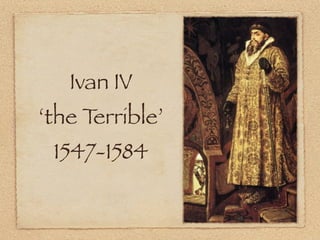
Ivan IV
‘the Terrible’
 1547-1584
Ivan IV
‘the Terrible’
 1547-1584
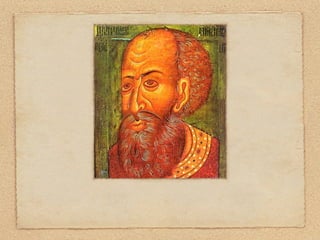
Ivan the Terrible
Ivan the Terrible
 First Russian ruler to call himself a Tsar
Ivan the Terrible
 First Russian ruler to call himself a Tsar
 Made the Tsar’s position stronger than
 ever before
Ivan the Terrible
 First Russian ruler to call himself a Tsar
 Made the Tsar’s position stronger than
 ever before
 Ranked nobles below himself
Ivan the Terrible
 First Russian ruler to call himself a Tsar
 Made the Tsar’s position stronger than
 ever before
 Ranked nobles below himself
 Exiled and purged nobles who failed to
 give him abject obedience
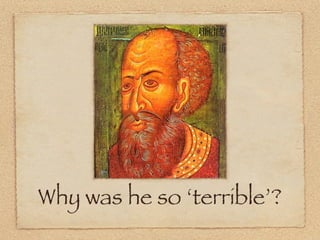
Why was he so ‘terrible’?
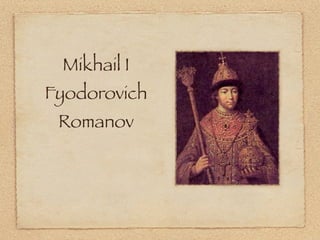
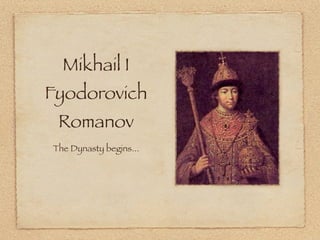
Mikhail I
Fyodorovich
 Romanov
Mikhail I
Fyodorovich
 Romanov
Mikhail I
Fyodorovich
 Romanov
The Dynasty begins...
Mikhail I Fyodorovich Romanov

 1613 - 1645
Mikhail I Fyodorovich Romanov

 1613 - 1645
 Elected to the throne by the Muscovites
Mikhail I Fyodorovich Romanov

 1613 - 1645
 Elected to the throne by the Muscovites
 First of a dynasty that would last until 1917
Mikhail I Fyodorovich Romanov

 1613 - 1645
 Elected to the throne by the Muscovites
 First of a dynasty that would last until 1917
 Peasants became serfs - attached to the
 land, heavily taxed & forbidden to move
Mikhail I Fyodorovich Romanov

 1613 - 1645
 Elected to the throne by the Muscovites
 First of a dynasty that would last until 1917
 Peasants became serfs - attached to the
 land, heavily taxed & forbidden to move
 Peasant revolts common
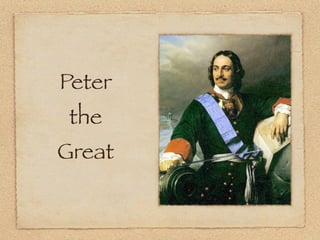
Peter
 the
Great
Peter
 the
Great
Peter the Great
Peter the Great
 1682 - 1725
Peter the Great
 1682 - 1725
 Brought Russia into the European
 sphere
Peter the Great
 1682 - 1725
 Brought Russia into the European
 sphere
 Dawn of the Russian Empire
Peter the Great
 1682 - 1725
 Brought Russia into the European
 sphere
 Dawn of the Russian Empire
 Autocratic state
Peter the Great
 1682 - 1725
 Brought Russia into the European
 sphere
 Dawn of the Russian Empire
 Autocratic state
 Creation of a ‘senate’ solely for tax
 collection
Incorporated the Church (Russian
Orthodox) into gov’t as a tool of state
Incorporated the Church (Russian
Orthodox) into gov’t as a tool of state

Church led by a gov’t appointed official.
Catherine
the Great
Catherine
the Great
Catherine the Great
Catherine the Great
 1762-1773
Catherine the Great
 1762-1773
 Had her husband (Peter III) murdered
Catherine the Great
 1762-1773
 Had her husband (Peter III) murdered
 Legalized the selling of serfs apart from
 the land.
Catherine the Great
 1762-1773
 Had her husband (Peter III) murdered
 Legalized the selling of serfs apart from
 the land.
 Major peasant uprising in 1773 -
 ruthlessly suppressed
Catherine the Great
 1762-1773
 Had her husband (Peter III) murdered
 Legalized the selling of serfs apart from
 the land.
 Major peasant uprising in 1773 -
 ruthlessly suppressed
 Under her rule, Russia became a major
 European power
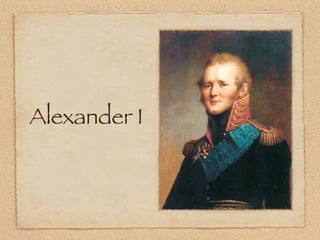
Alexander I
Alexander I
Alexander I
Alexander I

 1801-1825
Alexander I

 1801-1825
 Reformist - planned a constitution in
 secret.
Alexander I

 1801-1825
 Reformist - planned a constitution in
 secret.
 Considered ending serfdom
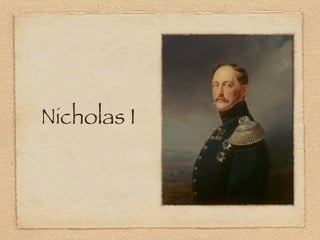
Nicholas I
Nicholas I
Nicholas I
Nicholas I
1825-1855
Nicholas I
1825-1855
Reactionary - crushed a revolt that sought to
create a constitutional monarchy
Nicholas I
1825-1855
Reactionary - crushed a revolt that sought to
create a constitutional monarchy
‘Autocracy, Orthodoxy & Nationality’
Nicholas I
1825-1855
Reactionary - crushed a revolt that sought to
create a constitutional monarchy
‘Autocracy, Orthodoxy & Nationality’
loyalty unlimited power to Tsar, traditions of
the Russian Orthodox Church and Russian
nationalism
Nicholas I
1825-1855
Reactionary - crushed a revolt that sought to
create a constitutional monarchy
‘Autocracy, Orthodoxy & Nationality’
loyalty unlimited power to Tsar, traditions of
the Russian Orthodox Church and Russian
nationalism
Suppression of non-Russian people and
religions
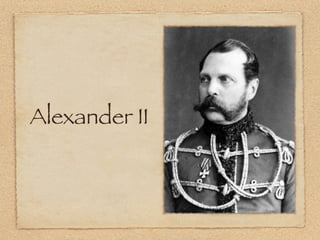
Alexander II
Alexander II
Alexander II
Alexander II

Widespread desire for reform in the
empire during Alexander II’s reign.
Alexander II

Widespread desire for reform in the
empire during Alexander II’s reign.
A humanitarian movement attacked
serfdom.
Alexander II

Widespread desire for reform in the
empire during Alexander II’s reign.
A humanitarian movement attacked
serfdom.
In 1859, one-third of the Russian
population was serfs.
Alexander II
Alexander II
 1855-1881
Alexander II
 1855-1881
 Alexander abolished serfdom in 1861
 rather than wait for a revolution from the
 people.
Alexander II
 1855-1881
 Alexander abolished serfdom in 1861
 rather than wait for a revolution from the
 people.
 Practical, aware of the feelings of the
 times - able to bring about reform.
Alexander II
 1855-1881
 Alexander abolished serfdom in 1861
 rather than wait for a revolution from the
 people.
 Practical, aware of the feelings of the
 times - able to bring about reform.
 Followed a liberal course of action, but
 was assassinated by left-wing
 revolutionaries anyway... :(
Alexander III
Alexander III
Alexander III
Alexander III
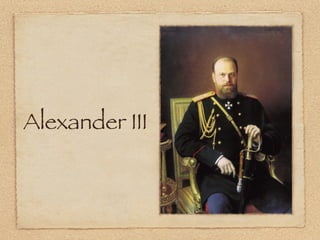
 1881-1894
Alexander III
 1881-1894
 Son of Alex II.
Alexander III
 1881-1894
 Son of Alex II.
 Very reactionary.
Alexander III
 1881-1894
 Son of Alex II.
 Very reactionary.
 Wanted a return to autocracy.
Alexander III
 1881-1894
 Son of Alex II.
 Very reactionary.
 Wanted a return to autocracy.
 Felt Russia could only be saved from
 chaos if it shut itself off from subversive
 influences of W. Europe.
Alexander III
Alexander III
 His tutor and advisor taught him, and his
 son Nicholas, to “fear freedom of speech
 and press and to hate democracy,
 constitutions, and the parliamentary
 system.”
 Revolutionaries hunted down
 Russification was carried out in the
 empire.
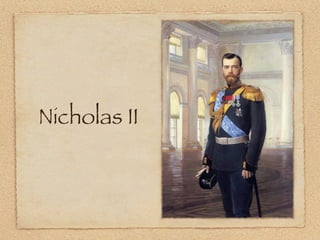
Nicholas II
Nicholas II
info on Nicholas II can be found in the
textbook.
SOURCES


All pictures are public domain taken from
Wikimedia Commons.

Unit 5 lsn 2 the tsars