Name of Institution
1
Functioning Of
Election Commission
Psephology and Data Analysis
BPS, 4TH SEM
Dr ANNA NATH GANGULY
AMITY UNIVERSITY
Name of Institution
In this unit the student, will understand
the following:
• What is a constitutional body?
• What is Election Commission?
• Part XV of the Indian Constitution
• In depth study of Article 324
• Functions of the Election Commission
• The Election Machinery
2
Name of Institution
Election Commission
3
.
● Autonomous Constitutional Body
● Article 324, Part XV of the Indian Constitution
● Draft Constitution : Article 289 , introduced in the
constituent assembly by Dr. B.R. Ambedkar
● In the Constituent Assembly - unanimous
agreement that the process of election must be
independent from the interference of
Legislature/Executive
3
Name of Institution
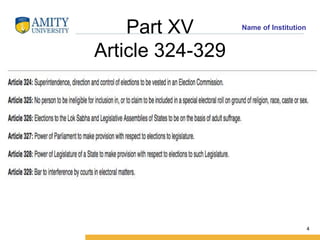
Part XV
Article 324-329
4
.
4
Name of Institution
What is Article 324?
5
Part Xv Of The Constitution Of India
Elections
Article 324. Superintendence , direction, and control of elections to be vested in an Election Commission.
(1) The superintendence, direction and control of the preparation of the electoral rolls for, and the conduct of, all elections to Parliament
and to the Legislature of every State and of elections to the offices of President and Vice-President held under this Constitution[1] [***]
shall be vested in a Commission (referred to in this Constitution as the Election Commission).
(2) The Election Commission shall consist of the Chief Election Commissioner and such number of other Election Commissioners, if any,
as the President may from time to time fix and the appointment of the Chief Election Commissioner and other Election Commissioners
shall, subject to the provisions of any law made in that behalf by Parliament, be made by the President.
(3) When any other Election Commissioner is so appointed the Chief Election Commissioner shall act as the Chairman of the Election
Commission.
(4) Before each general election to the House of the People and to the Legislative Assembly of each State, and before the first general
election and thereafter before each biennial election to the Legislative Council of each State having such Council, the President may also
appoint after consultation with the Election Commission such Regional Commissioners as he may consider necessary to assist the
Election Commission in the performance of the functions conferred on the Commission by clause (1).
(5) Subject to the provisions of any law made by Parliament, the conditions of service and tenure of office of the Election Commissioners
and the Regional Commissioners shall be such as the President may by rule determine:
Provided that the Chief Election Commissioner shall not be removed from his office except in like manner and on the like grounds as a
Judge of the Supreme Court and the conditions of service of the Chief Election Commissioner shall not be varied to his disadvantage after
his appointment:
Provided further that any other Election Commissioner or a Regional Commissioner shall not be removed from office except on the
recommendation of the Chief Election Commissioner.
(6) The President, or the Governor[2] [***] of a State, shall, when so requested by the Election Commission, make available to the Election
Commission or to a Regional Commissioner such staff as may be necessary for the discharge of the functions conferred on the Election
Commission by clause (1). [3]
Name of Institution
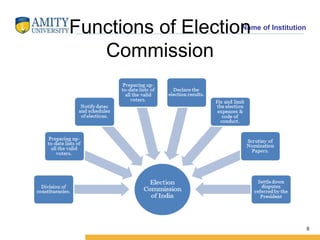
Functions of Election
Commission
6
Name of Institution
Election Machinery
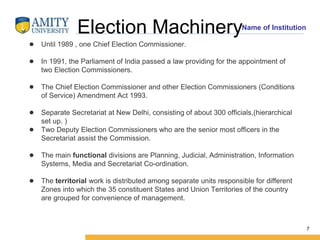
● Until 1989 , one Chief Election Commissioner.
● In 1991, the Parliament of India passed a law providing for the appointment of
two Election Commissioners.
● The Chief Election Commissioner and other Election Commissioners (Conditions
of Service) Amendment Act 1993.
● Separate Secretariat at New Delhi, consisting of about 300 officials,(hierarchical
set up. )
● Two Deputy Election Commissioners who are the senior most officers in the
Secretariat assist the Commission.
● The main functional divisions are Planning, Judicial, Administration, Information
Systems, Media and Secretariat Co-ordination.
● The territorial work is distributed among separate units responsible for different
Zones into which the 35 constituent States and Union Territories of the country
are grouped for convenience of management.
7
Name of Institution
Election Machinery
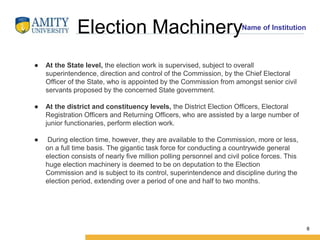
● At the State level, the election work is supervised, subject to overall
superintendence, direction and control of the Commission, by the Chief Electoral
Officer of the State, who is appointed by the Commission from amongst senior civil
servants proposed by the concerned State government.
● At the district and constituency levels, the District Election Officers, Electoral
Registration Officers and Returning Officers, who are assisted by a large number of
junior functionaries, perform election work.
● During election time, however, they are available to the Commission, more or less,
on a full time basis. The gigantic task force for conducting a countrywide general
election consists of nearly five million polling personnel and civil police forces. This
huge election machinery is deemed to be on deputation to the Election
Commission and is subject to its control, superintendence and discipline during the
election period, extending over a period of one and half to two months.
8
Name of Institution
Case Study
● The Supreme Court in Mohinder Singh Gill and Anor v. Chief Election
Commissioner and Ors[ AIR 1978 SC 851} the Election Commission had declared
the poll taken in Firozepur parliamentary constituency in the State of Punjab at
the time of the 1977-general election to the House of the People as void, on
the basis of certain complaints.
● The petitioners contended that the Election Commission under the enacted
law could only direct fresh poll at the polling stations where the poll was
allegedly vitiated, and not in the entire parliamentary constituency.
● The Supreme Court rejected the contention of the petitioners. A Constitution
Bench of the Supreme Court held that art 324 is a plenary provision vesting
the whole responsibility for national and State elections in the Election
Commission and the words (superintendence, direction and control’ used in
Art 324 are the broadest terms.
9

Module 1 Lesson 1 Functionnig of Election Commission.pptx

  • 1.
    Name of Institution 1 FunctioningOf Election Commission Psephology and Data Analysis BPS, 4TH SEM Dr ANNA NATH GANGULY AMITY UNIVERSITY
  • 2.
    Name of Institution Inthis unit the student, will understand the following: • What is a constitutional body? • What is Election Commission? • Part XV of the Indian Constitution • In depth study of Article 324 • Functions of the Election Commission • The Election Machinery 2
  • 3.
    Name of Institution ElectionCommission 3 . ● Autonomous Constitutional Body ● Article 324, Part XV of the Indian Constitution ● Draft Constitution : Article 289 , introduced in the constituent assembly by Dr. B.R. Ambedkar ● In the Constituent Assembly - unanimous agreement that the process of election must be independent from the interference of Legislature/Executive 3
  • 4.
    Name of Institution PartXV Article 324-329 4 . 4
  • 5.
    Name of Institution Whatis Article 324? 5 Part Xv Of The Constitution Of India Elections Article 324. Superintendence , direction, and control of elections to be vested in an Election Commission. (1) The superintendence, direction and control of the preparation of the electoral rolls for, and the conduct of, all elections to Parliament and to the Legislature of every State and of elections to the offices of President and Vice-President held under this Constitution[1] [***] shall be vested in a Commission (referred to in this Constitution as the Election Commission). (2) The Election Commission shall consist of the Chief Election Commissioner and such number of other Election Commissioners, if any, as the President may from time to time fix and the appointment of the Chief Election Commissioner and other Election Commissioners shall, subject to the provisions of any law made in that behalf by Parliament, be made by the President. (3) When any other Election Commissioner is so appointed the Chief Election Commissioner shall act as the Chairman of the Election Commission. (4) Before each general election to the House of the People and to the Legislative Assembly of each State, and before the first general election and thereafter before each biennial election to the Legislative Council of each State having such Council, the President may also appoint after consultation with the Election Commission such Regional Commissioners as he may consider necessary to assist the Election Commission in the performance of the functions conferred on the Commission by clause (1). (5) Subject to the provisions of any law made by Parliament, the conditions of service and tenure of office of the Election Commissioners and the Regional Commissioners shall be such as the President may by rule determine: Provided that the Chief Election Commissioner shall not be removed from his office except in like manner and on the like grounds as a Judge of the Supreme Court and the conditions of service of the Chief Election Commissioner shall not be varied to his disadvantage after his appointment: Provided further that any other Election Commissioner or a Regional Commissioner shall not be removed from office except on the recommendation of the Chief Election Commissioner. (6) The President, or the Governor[2] [***] of a State, shall, when so requested by the Election Commission, make available to the Election Commission or to a Regional Commissioner such staff as may be necessary for the discharge of the functions conferred on the Election Commission by clause (1). [3]
  • 6.
    Name of Institution Functionsof Election Commission 6
  • 7.
    Name of Institution ElectionMachinery ● Until 1989 , one Chief Election Commissioner. ● In 1991, the Parliament of India passed a law providing for the appointment of two Election Commissioners. ● The Chief Election Commissioner and other Election Commissioners (Conditions of Service) Amendment Act 1993. ● Separate Secretariat at New Delhi, consisting of about 300 officials,(hierarchical set up. ) ● Two Deputy Election Commissioners who are the senior most officers in the Secretariat assist the Commission. ● The main functional divisions are Planning, Judicial, Administration, Information Systems, Media and Secretariat Co-ordination. ● The territorial work is distributed among separate units responsible for different Zones into which the 35 constituent States and Union Territories of the country are grouped for convenience of management. 7
  • 8.
    Name of Institution ElectionMachinery ● At the State level, the election work is supervised, subject to overall superintendence, direction and control of the Commission, by the Chief Electoral Officer of the State, who is appointed by the Commission from amongst senior civil servants proposed by the concerned State government. ● At the district and constituency levels, the District Election Officers, Electoral Registration Officers and Returning Officers, who are assisted by a large number of junior functionaries, perform election work. ● During election time, however, they are available to the Commission, more or less, on a full time basis. The gigantic task force for conducting a countrywide general election consists of nearly five million polling personnel and civil police forces. This huge election machinery is deemed to be on deputation to the Election Commission and is subject to its control, superintendence and discipline during the election period, extending over a period of one and half to two months. 8
  • 9.
    Name of Institution CaseStudy ● The Supreme Court in Mohinder Singh Gill and Anor v. Chief Election Commissioner and Ors[ AIR 1978 SC 851} the Election Commission had declared the poll taken in Firozepur parliamentary constituency in the State of Punjab at the time of the 1977-general election to the House of the People as void, on the basis of certain complaints. ● The petitioners contended that the Election Commission under the enacted law could only direct fresh poll at the polling stations where the poll was allegedly vitiated, and not in the entire parliamentary constituency. ● The Supreme Court rejected the contention of the petitioners. A Constitution Bench of the Supreme Court held that art 324 is a plenary provision vesting the whole responsibility for national and State elections in the Election Commission and the words (superintendence, direction and control’ used in Art 324 are the broadest terms. 9