UNIT IV -Part 2
IOT Platforms Design
Methodology
Mrs. Kiran M. Pradhan
Internet of Things
MSc.CS FY Sem-II
07-04-2020
IOT Platforms DesignMethodology
It includes:
Purpose & Requirements
Specification
Process Specification
Domain Model Specification
Information Model Specification
Service Specification
IOT Platforms DesignMethodology
IoT Level Specifications
Functional view Specification
Operational View
Specification
Device & component
Integration
Application Development
Process Specification
• Purpose : A home automation system that allows controlling of the
lights in a home remotely using a web application.
• Behavior : The home automation system should have auto and
manual
modes. In auto mode, the system measures the light level in the room
and
switches on the light when it gets dark. In manual mode, the
system provides the option of manually and remotely switching
on/off the light.
• System Management Requirement : The system should provide
remote monitoring and control functions.
• Data Analysis Requirement : The system should perform local
analysis of the data.
• Application Deployment Requirement : The application should be
deployed locally on the device, but should be accessible remotely
• Security Requirement : The system should have basic user
authentication capability.
Process Specification(secondstep)
In this step, the use cases of the IoT
system are formally described basedon
and derived from the purpose and
requirement specifications.
Domain Model Specification
• The third step in the IoT design methodology is to define the
Domain Model.
• The domain model describes the main concepts, entities and
objects in the domain of IoT system to be designed. Domain
model defines the attributes of the objects and relationships
between objects.
• Domain model provides an abstract representation of the
concepts, objects and entities in the IoT domain,
independent of any specific technology or platform.
Domain Model Specification
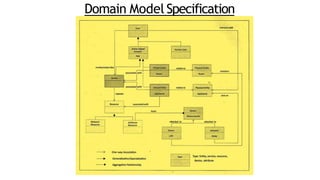
The entities, objects and concepts defined in the domain
model include:
Physical Entity : Physical Entity is a discrete and identifiable
entity in the physical environment (e.g. a room, a light, an
appliance, a car, etc.).
Virtual Entity : Virtual Entity is a representation of the Physical
Entity in the digital world.
Device :provides a medium for interactions between Physical
Entities and Virtual Entities. Devices are either attached to
Physical Entities or placed near Physical Entities.
Domain Model Specification
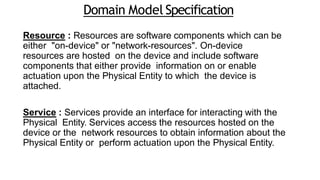
Resource : Resources are software components which can be
either "on-device" or "network-resources". On-device
resources are hosted on the device and include software
components that either provide information on or enable
actuation upon the Physical Entity to which the device is
attached.
Service : Services provide an interface for interacting with the
Physical Entity. Services access the resources hosted on the
device or the network resources to obtain information about the
Physical Entity or perform actuation upon the Physical Entity.
Domain Model Specification
Thankyou
Ref: IOT by Ashdeep Bahga &Vijay
Madisetti
5
1

Unit 4 -IOT2.pptx

  • 1.
    UNIT IV -Part2 IOT Platforms Design Methodology Mrs. Kiran M. Pradhan Internet of Things MSc.CS FY Sem-II 07-04-2020
  • 2.
    IOT Platforms DesignMethodology Itincludes: Purpose & Requirements Specification Process Specification Domain Model Specification Information Model Specification Service Specification
  • 3.
    IOT Platforms DesignMethodology IoTLevel Specifications Functional view Specification Operational View Specification Device & component Integration Application Development
  • 4.
    Process Specification • Purpose: A home automation system that allows controlling of the lights in a home remotely using a web application. • Behavior : The home automation system should have auto and manual modes. In auto mode, the system measures the light level in the room and switches on the light when it gets dark. In manual mode, the system provides the option of manually and remotely switching on/off the light. • System Management Requirement : The system should provide remote monitoring and control functions. • Data Analysis Requirement : The system should perform local analysis of the data. • Application Deployment Requirement : The application should be deployed locally on the device, but should be accessible remotely • Security Requirement : The system should have basic user authentication capability.
  • 5.
    Process Specification(secondstep) In thisstep, the use cases of the IoT system are formally described basedon and derived from the purpose and requirement specifications.
  • 6.
    Domain Model Specification •The third step in the IoT design methodology is to define the Domain Model. • The domain model describes the main concepts, entities and objects in the domain of IoT system to be designed. Domain model defines the attributes of the objects and relationships between objects. • Domain model provides an abstract representation of the concepts, objects and entities in the IoT domain, independent of any specific technology or platform.
  • 7.
    Domain Model Specification Theentities, objects and concepts defined in the domain model include: Physical Entity : Physical Entity is a discrete and identifiable entity in the physical environment (e.g. a room, a light, an appliance, a car, etc.). Virtual Entity : Virtual Entity is a representation of the Physical Entity in the digital world. Device :provides a medium for interactions between Physical Entities and Virtual Entities. Devices are either attached to Physical Entities or placed near Physical Entities.
  • 8.
    Domain Model Specification Resource: Resources are software components which can be either "on-device" or "network-resources". On-device resources are hosted on the device and include software components that either provide information on or enable actuation upon the Physical Entity to which the device is attached. Service : Services provide an interface for interacting with the Physical Entity. Services access the resources hosted on the device or the network resources to obtain information about the Physical Entity or perform actuation upon the Physical Entity.
  • 9.
  • 10.
    Thankyou Ref: IOT byAshdeep Bahga &Vijay Madisetti 5 1