UNIT III
• Foreign Exchange Management Act
• Regulations
• Notifications
• Press Notes
• Master Circulars
• Master Directions
• AP Dir Series
• Offences
• FAQs
WHAT IS FEMA?
• In the bustling world of global finance, every country needs a set of rules to manage
its foreign money matters. For India, this rulebook is called FEMA, or the Foreign
Exchange Management Act.
• FEMA stands for the Foreign Exchange Management Act. Introduced in early 2000, it's
essentially the rulebook that governs how India deals with foreign money. Think of it
as a guardian that ensures all foreign monetary transactions in India happen
smoothly and legally.
WHY IS FEMA IMPORTANT?
• The world of international finance is vast and complex. For a country like India, with its
burgeoning economy and global aspirations, managing foreign financial interactions is
crucial. This is where the Foreign Exchange Management Act, or FEMA, plays a pivotal
role.
• Streamlining Transactions: At its core, FEMA is designed to streamline and regulate all
of India's foreign exchange transactions. For instance, if a business in Pune wants to import
machinery from Germany, there are currency exchanges, payments, and several other
financial intricacies involved. FEMA provides a clear framework for such transactions,
ensuring they are conducted smoothly and within the legal parameters set by the country.
• Protecting National Interests: FEMA isn't just about facilitating transactions; it's also
about safeguarding India's financial interests. By setting guidelines on foreign
investments, it ensures that the inflow and outflow of funds benefit the nation's economy
and don't lead to any undue volatility or financial strain.
THE BIGGER ROLE OF FEMA
• Attracting Foreign Investment: In today's globalised world, countries compete to attract foreign
investors. Clear regulations, like those provided by FEMA, make India an attractive destination
for foreign companies and investors. They know what to expect and understand the rules of the
game, making them more confident in investing their money.
• Economic Stability: FEMA also plays a role in maintaining India's economic stability. By
monitoring and regulating foreign investments and transactions, it ensures that there aren't any
abrupt capital movements that could destabilise the economy.
• Empowering Individuals: On a personal level, for individuals like students studying abroad or
professionals working in foreign countries, FEMA provides guidelines on how they can manage
their earnings, savings, and investments in relation to India.
• In essence, while FEMA might seem like just another piece of legislation, its impact is
profound. It shapes India's interactions on the global financial stage, ensuring clarity, stability,
and growth.
MAIN GOALS: WHAT FEMA AIMS TO
ACHIEVE
• The Foreign Exchange Management Act (FEMA) stands as a pivotal piece of
legislation in India's financial framework. Instituted in 1999, its objectives were clear-
cut and aimed at modernising India's approach to foreign exchange in line with its
evolving economic stature.
Facilitation of External Trade and Payments: At the heart of FEMA was the goal to
simplify and facilitate external trade and payments. Data underscores this objective:
• Trade Growth: Post-liberalization, India's exports witnessed a significant surge. From
USD 18 billion in 1991, they catapulted to over USD 50 billion by 2001. FEMA's
streamlined processes played a role in supporting this growth.
• Ensuring an Orderly Foreign Exchange Market: With the global economic integration,
India's foreign exchange market needed stability. FEMA provided the regulatory
framework to achieve this.
• Currency Stability: The Indian Rupee, which saw fluctuations ranging from INR 32-49
against the US Dollar in the 90s, stabilised to a narrower band of INR 45-48 by 2003,
reflecting the market's orderly development.
Attracting and Managing Foreign Investment: FEMA's transparent guidelines were
instrumental in making India a magnet for foreign investments:
• FDI Inflow: A testament to FEMA's success in this domain is the FDI data. From a
modest inflow of USD 1 billion in 1992, India attracted over USD 10 billion by 2005,
marking a tenfold increase.
Safeguarding Interests of Resident Indians: For the vast diaspora of Indians overseas,
FEMA offered clarity on managing foreign earnings and investments:
• NRI Remittances: The confidence in FEMA's framework can be gauged from the
remittance data. Non-Resident Indians (NRIs) remitted around USD 12 billion in 2000,
a figure that rose to over USD 20 billion by 2005.
• FEMA wasn't just a regulatory change; it was a strategic initiative. By setting clear,
data-backed objectives and meeting them, FEMA solidified India's position in the
global economic arena, ensuring that the nation's foreign exchange activities were
both robust and resilient.
OVERALL STRUCTURE
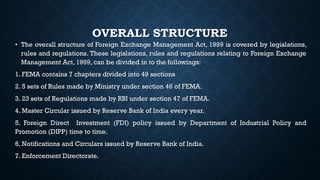
• The overall structure of Foreign Exchange Management Act, 1999 is covered by legislations,
rules and regulations. These legislations, rules and regulations relating to Foreign Exchange
Management Act, 1999, can be divided in to the followings:
1. FEMA contains 7 chapters divided into 49 sections
2. 5 sets of Rules made by Ministry under section 46 of FEMA.
3. 23 sets of Regulations made by RBI under section 47 of FEMA.
4. Master Circular issued by Reserve Bank of India every year.
5. Foreign Direct Investment (FDI) policy issued by Department of Industrial Policy and
Promotion (DIPP) time to time.
6. Notifications and Circulars issued by Reserve Bank of India.
7. Enforcement Directorate.
• FEMA contains 7 Chapters divided into 49 sections of which 12 sections cover
operational part and the rest 37 sections deal with contraventions, penalties,
adjudication, appeals, enforcement directions, etc.
• FEMA makes provisions for dealings in foreign exchanges.
• Broadly, all current account transactions are free. However, Central Government can
impose reasonable restrictions by issuing rules.
• The capital account transactions will be regulated by RBI/Central Government for
which necessary circulars/notifications will have to be issued under FEMA.
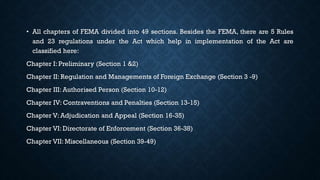
• All chapters of FEMA divided into 49 sections. Besides the FEMA, there are 5 Rules
and 23 regulations under the Act which help in implementation of the Act are
classified here:
Chapter I: Preliminary (Section 1 &2)
Chapter II: Regulation and Managements of Foreign Exchange (Section 3 -9)
Chapter III: Authorised Person (Section 10-12)
Chapter IV: Contraventions and Penalties (Section 13-15)
Chapter V: Adjudication and Appeal (Section 16-35)
Chapter VI: Directorate of Enforcement (Section 36-38)
Chapter VII: Miscellaneous (Section 39-49)
OVERALL SCHEME OF FEMA
• Section 3 of FEMA provides that making any payment to person not resident of India and receiving any
payment from person resident outside India, acquiring any asset out of India or dealing with foreign
currency or foreign security can be only as per general or special permission of RBI.
• Section 4 of FEMA provides that no person resident in India shall acquire, hold, own or possess or transfer
any foreign exchange, foreign security or any immovable property outside India only as per provisions of
FEMA.
• Broadly, all current account transactions are free. However, Central Government can impose reasonable
instructions by issuing rules.[section 5 of FEMA].
• Capital Account Transactions are permitted to the extent specified by RBI or Central Government by
issuing regulations. [section 6 of FEMA- powers relating to non-debt capital account transactions have
been transferred to Central Government w.e.f.15-10-2019].
• FEMA envisages that RBI will have a controlling role in management of foreign exchange. Since RBI cannot
directly handle foreign exchange transactions, it authorises ‘Authorised Persons’ to deal in foreign
exchange as per directions issued by RBI. [section 10 of FEMA].
• RBI is empowered to issue directions to such ‘Authorised Persons’ under section 11 of FEMA. These
directions are issued through AP(DIR) circulars.
• FEMA also makes provisions for enforcement, penalties,adjudication and appeals.
GENERAL RELAXATIONS FROM SECTION 3 OF
FEMA
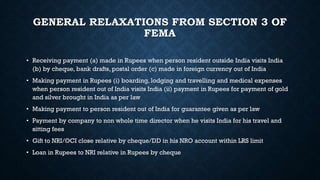
• Receiving payment (a) made in Rupees when person resident outside India visits India
(b) by cheque, bank drafts, postal order (c) made in foreign currency out of India
• Making payment in Rupees (i) boarding, lodging and travelling and medical expenses
when person resident out of India visits India (ii) payment in Rupees for payment of gold
and silver brought in India as per law
• Making payment to person resident out of India for guarantee given as per law
• Payment by company to non whole time director when he visits India for his travel and
sitting fees
• Gift to NRI/OCI close relative by cheque/DD in his NRO account within LRS limit
• Loan in Rupees to NRI relative in Rupees by cheque
RULES
• As per section 46 of the Act, the Central Government may, by notification,make rules to carry out the provisions
of FEMA, 1999. Inter alia, such rules may provide for:
(a) the imposition of reasonable restrictions on current account transactions under section 5;
(b) the manner in which the contravention may be compounded under sub-section (1) of section 15;
(c) the manner of holding an inquiry by the Adjudicating Authority under sub-section (1) of section 16;
(d) the form of appeal and fee for filing such appeal under sections 17 and 19;
(e) the salary and allowances payable to and the other terms and conditions of service of the Chairperson and
other Members of the Appellate Tribunal and the Special Director (Appeals) under section 23;
(f) the salaries and allowances and other conditions of service of the officers and employees of the Appellate
Tribunal and the office of the Special Director (Appeals) under sub-section (3) of section 27;
(g) the additional matters in respect of which the Appellate Tribunal and the Special Director (Appeals) may
exercise the powers of civil court under clause (i) of sub-section (2) of section 28;
(h) the aggregate value of foreign exchange referred to in sub-section (1) of section 37A;]
(i) the authority or person and the manner in which any document may be authenticated under clause (ii) of
section 39; and
(j) any other matter which is required to be, or may be, prescribed.
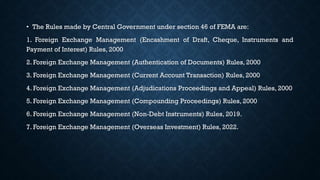
• The Rules made by Central Government under section 46 of FEMA are:
1. Foreign Exchange Management (Encashment of Draft, Cheque, Instruments and
Payment of Interest) Rules, 2000
2. Foreign Exchange Management (Authentication of Documents) Rules, 2000
3. Foreign Exchange Management (Current Account Transaction) Rules, 2000
4. Foreign Exchange Management (Adjudications Proceedings and Appeal) Rules, 2000
5. Foreign Exchange Management (Compounding Proceedings) Rules, 2000
6. Foreign Exchange Management (Non-Debt Instruments) Rules, 2019.
7. Foreign Exchange Management (Overseas Investment) Rules, 2022.
The main functions of RBI under FEMA are as follows –
(a) Control over dealings in foreign exchange by giving general or special permission for dealing in foreign
exchange, excluding those cases where specific provisions have been made in Act, rules or regulations – section 3 of
FEMA
(b) RBI cannot impose any restrictions on current account transactions. These can be imposed only by Central
Government in consultation with RBI – section 5 of FEMA.
(c) Specifying conditions for payment in respect of capital account transaction involving debt instruments – section
6(2) of FEMA [powers in respect of non-debt instruments are with Central Government w.e.f.15-10-2019].
(d) Regulate/prohibit/restrict specified transactions in foreign exchange – section 6(3) of FEMA
(e) Specify (by regulation) period and manner in which foreign exchange due from export of goods and services
should be received – section 8
(f) To grant exemption from realisation and repatriation in cases specified u/s 9 [These cover provisions in respect of
possession of foreign currency or foreign coins, foreign currency accounts, foreign exchange acquired from
employment,business,trade, services etc.]
(g) Granting authorisation to ‘Authorised Person’ to deal in foreign exchange, to give directions to them and to inspect
the authorised person – sections 10, 11 and 12.
(h) To make regulations – section 47
(i) Administer FEM (Non-debt Instruments) Rules,2019
REGULATIONS
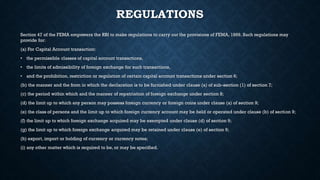
Section 47 of the FEMA empowers the RBI to make regulations to carry out the provisions of FEMA, 1999. Such regulations may
provide for:
(a) For Capital Account transaction:
• the permissible classes of capital account transactions,
• the limits of admissibility of foreign exchange for such transactions,
• and the prohibition, restriction or regulation of certain capital account transactions under section 6;
(b) the manner and the from in which the declaration is to be furnished under clause (a) of sub-section (1) of section 7;
(c) the period within which and the manner of repatriation of foreign exchange under section 8;
(d) the limit up to which any person may possess foreign currency or foreign coins under clause (a) of section 9;
(e) the class of persons and the limit up to which foreign currency account may be held or operated under clause (b) of section 9;
(f) the limit up to which foreign exchange acquired may be exempted under clause (d) of section 9;
(g) the limit up to which foreign exchange acquired may be retained under clause (e) of section 9;
(h) export, import or holding of currency or currency notes;
(i) any other matter which is required to be, or may be specified.
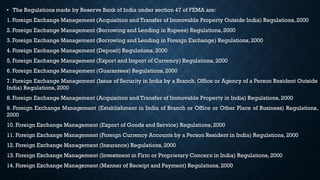
• The Regulations made by Reserve Bank of India under section 47 of FEMA are:
1. Foreign Exchange Management (Acquisition and Transfer of Immovable Property Outside India) Regulations,2000
2. Foreign Exchange Management (Borrowing and Lending in Rupees) Regulations, 2000
3. Foreign Exchange Management (Borrowing and Lending in Foreign Exchange) Regulations,2000
4. Foreign Exchange Management (Deposit) Regulations, 2000
5. Foreign Exchange Management (Export and Import of Currency) Regulations, 2000
6. Foreign Exchange Management (Guarantees) Regulations,2000
7. Foreign Exchange Management (Issue of Security in India by a Branch, Office or Agency of a Person Resident Outside
India) Regulations, 2000
8. Foreign Exchange Management (Acquisition and Transfer of Immovable Property in India) Regulations, 2000
9. Foreign Exchange Management (Establishment in India of Branch or Office or Other Place of Business) Regulations,
2000
10. Foreign Exchange Management (Export of Goods and Service) Regulations,2000
11. Foreign Exchange Management (Foreign Currency Accounts by a Person Resident in India) Regulations, 2000
12. Foreign Exchange Management (Insurance) Regulations,2000
13. Foreign Exchange Management (Investment in Firm or Proprietary Concern in India) Regulations, 2000
14. Foreign Exchange Management (Manner of Receipt and Payment) Regulations,2000
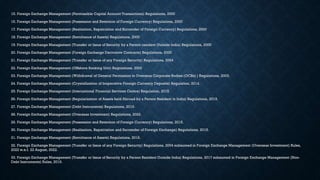
15. Foreign Exchange Management (Permissible Capital Account Transactions) Regulations, 2000
16. Foreign Exchange Management (Possession and Retention of Foreign Currency) Regulations, 2000
17. Foreign Exchange Management (Realization, Repatriation and Surrender of Foreign Currency) Regulations, 2000
18. Foreign Exchange Management (Remittance of Assets) Regulations, 2000
19. Foreign Exchange Management (Transfer or Issue of Security by a Person resident Outside India) Regulations, 2000
20. Foreign Exchange Management (Foreign Exchange Derivative Contracts) Regulations, 2000
21. Foreign Exchange Management (Transfer or Issue of any Foreign Security) Regulations, 2004
22. Foreign Exchange Management (Offshore Banking Unit) Regulations, 2002
23. Foreign Exchange Management (Withdrawal of General Permission to Overseas Corporate Bodies (OCBs) ) Regulations, 2003.
24. Foreign Exchange Management (Crystallization of Inoperative Foreign Currency Deposits) Regulation, 2014.
25. Foreign Exchange Management (International Financial Services Centre) Regulation, 2015.
26. Foreign Exchange Management (Regularization of Assets held Abroad by a Person Resident in India) Regulations, 2015.
27. Foreign Exchange Management (Debt Instruments) Regulations, 2019.
28. Foreign Exchange Management (Overseas Investment) Regulations, 2022.
29. Foreign Exchange Management (Possession and Retention of Foreign Currency) Regulations, 2015.
30. Foreign Exchange Management (Realisation, Repatriation and Surrender of Foreign Exchange) Regulations, 2015.
31. Foreign Exchange Management (Remittance of Assets) Regulations, 2016.
32. Foreign Exchange Management (Transfer or Issue of any Foreign Security) Regulations, 2004 subsumed in Foreign Exchange Management (Overseas Investment) Rules,
2022 w.e.f. 22 August, 2022.
33. Foreign Exchange Management (Transfer or Issue of Security by a Person Resident Outside India) Regulations, 2017 subsumed in Foreign Exchange Management (Non-
Debt Instruments) Rules, 2019.
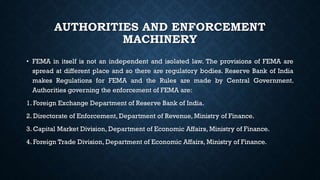
AUTHORITIES AND ENFORCEMENT
MACHINERY
• FEMA in itself is not an independent and isolated law. The provisions of FEMA are
spread at different place and so there are regulatory bodies. Reserve Bank of India
makes Regulations for FEMA and the Rules are made by Central Government.
Authorities governing the enforcement of FEMA are:
1. Foreign Exchange Department of Reserve Bank of India.
2. Directorate of Enforcement, Department of Revenue, Ministry of Finance.
3. Capital Market Division, Department of Economic Affairs, Ministry of Finance.
4. Foreign Trade Division, Department of Economic Affairs, Ministry of Finance.
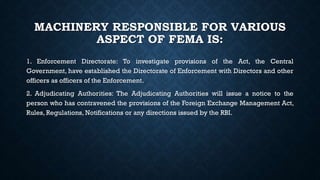
MACHINERY RESPONSIBLE FOR VARIOUS
ASPECT OF FEMA IS:
1. Enforcement Directorate: To investigate provisions of the Act, the Central
Government, have established the Directorate of Enforcement with Directors and other
officers as officers of the Enforcement.
2. Adjudicating Authorities: The Adjudicating Authorities will issue a notice to the
person who has contravened the provisions of the Foreign Exchange Management Act,
Rules, Regulations, Notifications or any directions issued by the RBI.
3. Special Director (Appeals): Any person aggrieved by an order made by the Adjudicating
Authority, being an Assistant Director of Enforcement or a Deputy Director of Enforcement
can prefer an appeal to the Special Director (Appeals.)
4. Appellate Tribunal: Any person aggrieved by an order made by the adjudicating
Authority, or the Special Director (Appeals) can prefer an appeal to the Appellate Tribunal.
• FEMA envisages that RBI shall have controlling role in management of foreign exchange.
Since RBI cannot directly handle foreign exchange transactions, it authorizes “Authorised
Persons” to deal in foreign exchange as per direction issued by RBI. RBI is empowered to
issue direction to such “Authorised Persons”. These Directions are issued through AP(DIR)
Circulars. (AP stand for Authorised Person and DIR stand for Directions)
BASIC GUIDELINES OF FEMA
1. Regulation of Foreign Exchange Transactions
• Authorised Channels: FEMA mandates that all foreign exchange transactions be
routed through authorised persons. As of 2022, there are more than 2,500 authorised
dealers (ADs) licensed by the Reserve Bank of India (RBI) to handle foreign
exchange.
• Example: If a startup in Mumbai wishes to pay for software services from the US, the
payment must be processed through these ADs, ensuring transparency and
compliance.
2. Mandatory Reporting: Significant foreign exchange transactions, be it a hefty investment
or a sizable trade deal, must be reported to the RBI. In June 2023, India reported foreign
exchange reserves worth over USD 600 billion, highlighting the scale of operations under
FEMA's purview.
3. Directives on Foreign Direct Investment (FDI)
• Sectoral Caps: FEMA provides clear guidelines on FDI limits across sectors. For instance,
the aviation sector has a 49% FDI cap, while the telecom sector allows up to 100%.
• Repatriation Norms: While India attracted FDI worth USD 71 billion in the Financial Year
2022-23, FEMA ensures that profits and dividends from such investments can be sent back
to the investor's home country, following specific procedures.
4. Property Transactions for NRIs and PIOs
• Buying Property:While NRIs and PIOs can purchase residential and commercial
properties in India, agricultural land is off-limits. In 2018, property investments by
NRIs stood at a staggering USD 10.2 billion. Example: An NRI based in London can
buy an apartment in Bangalore but cannot purchase farmland in Punjab.
• Selling Off:While selling property, the funds, especially if they're to be sent abroad,
must adhere to certain conditions, ensuring the money is clean and accounted for.
5. Banking Directives for NRIs
• Types of Accounts: FEMA outlines the rules for NRI accounts like NRE, NRO, and
FCNR. As of 2020, deposits in NRE accounts alone surpassed USD 130 billion.
• Loan Provisions: While NRIs can take loans against their deposits, there are
restrictions. For instance, the loan amount cannot be used for relending or
agricultural activities.
6. Offences and Their Repercussions
• Penalties: Non-compliance with FEMA can be costly. In 2019, penalties worth INR
1,200 crore were levied on various entities for FEMA violations.
PENAL PROVISIONS
• Governed by Chapter IV viz. Contravention and penalties.
- Sec 13: Penalties.
- Sec 14: Enforcement of the order of the Adjudication Authority.
- Sec 15:Powers to Compound contravention RBI / DoE [A.P(Dir ) No. 56/2010)].
- Sec 49: Sunset clause [ FERA violations]
Section 13 – Contravention of
• Act
• Rules,
• Regulations,
• Notifications,
• Directions or
• Orders
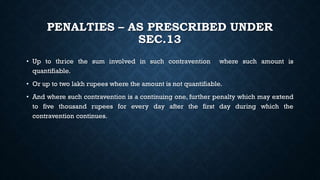
PENALTIES – AS PRESCRIBED UNDER
SEC.13
• Up to thrice the sum involved in such contravention where such amount is
quantifiable.
• Or up to two lakh rupees where the amount is not quantifiable.
• And where such contravention is a continuing one, further penalty which may extend
to five thousand rupees for every day after the first day during which the
contravention continues.
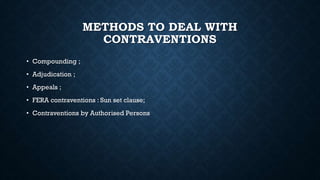
METHODS TO DEAL WITH
CONTRAVENTIONS
• Compounding ;
• Adjudication ;
• Appeals ;
• FERA contraventions : Sun set clause;
• Contraventions by Authorised Persons
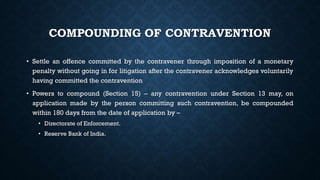
COMPOUNDING OF CONTRAVENTION
• Settle an offence committed by the contravener through imposition of a monetary
penalty without going in for litigation after the contravener acknowledges voluntarily
having committed the contravention
• Powers to compound (Section 15) – any contravention under Section 13 may, on
application made by the person committing such contravention, be compounded
within 180 days from the date of application by –
• Directorate of Enforcement.
• Reserve Bank of India.
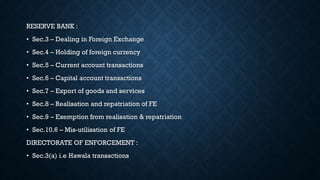
RESERVE BANK :
• Sec.3 – Dealing in Foreign Exchange
• Sec.4 – Holding of foreign currency
• Sec.5 – Current account transactions
• Sec.6 – Capital account transactions
• Sec.7 – Export of goods and services
• Sec.8 – Realisation and repatriation of FE
• Sec.9 – Exemption from realisation & repatriation
• Sec.10.6 – Mis-utilisation of FE
DIRECTORATE OF ENFORCEMENT :
• Sec.3(a) i.e Hawala transactions
NOT COMPOUNDABLE
If an appeal under Sec. 17 or 19 of FEMA filed;
• The contravention is not quantifiable;
• A contravention has been finally adjudicated and disposed off by the Adjudication
Authority;
• Contraventions related to any transaction without proper approval or permission
form the concerned Govt. or any Statutory Authority : the requisite approval not
obtained;
• A contravention, prima facie, involves money laundering, security, etc., & needs
investigation
DETECTION OF CONTRAVENTION
• Voluntary disclosure;
• Analysis of data;
• Market Intelligence;
• RBI’s inspections;
• Others – Media reporting / complaints.
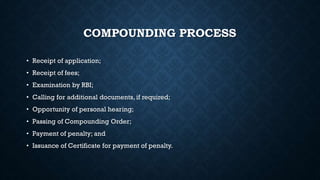
COMPOUNDING PROCESS
• Receipt of application;
• Receipt of fees;
• Examination by RBI;
• Calling for additional documents, if required;
• Opportunity of personal hearing;
• Passing of Compounding Order;
• Payment of penalty; and
• Issuance of Certificate for payment of penalty.
• The compounding application is disposed of on merits , upon consideration of
records and submissions made by the applicant in the application as well as during
the personal hearing and at the absolute discretion of the Compounding Authority.
• Compounding Authority acts under the supervision of the Governor of the RBI.
FINANCIAL IMPLICATIONS
• Violations can attract penalties up to three times the contravention amount. For
instance, an unauthorised foreign transaction of INR 10 crore could lead to fines of up
to INR 30 crore. In 2018, the Adani Group was reportedly fined a large amount for
FEMA contraventions related to their power project.
1. Compounding Route: The RBI offers a resolution mechanism where certain violations
can be settled without litigation. In 2016, the popular e-commerce platform, Flipkart,
faced a compounding application for alleged breaches of FEMA regulations. In 2019,
the RBI compounded over 1,500 cases, collecting fines of approximately INR 150 crore.
2. Legal Consequences
Structured Adjudication: FEMA violations undergo a rigorous adjudication process. If
unsatisfied with the initial decision, entities can appeal to higher authorities, ensuring a
fair assessment. In the past five years, over 60% of appealed cases saw a reduction in
penalties after reassessment. Vodafone, in its long-standing dispute with Indian
authorities, has often navigated the FEMA adjudication process regarding its
acquisition of Hutchison Essar.
3. Asset Seizure
Property at Risk: Grave violations can lead to asset confiscation. For example, acquiring
a property abroad without necessary permissions could result in the seizure of an
equivalent property in India. In a landmark case, properties of the Sahara Group were
attached due to FEMA violations linked to their overseas hotels.
4. Jail Terms: Deliberate evasion or fraud can lead to imprisonment. Depending on the
violation's magnitude, jail terms can range from one to five years.
5. Reputational Fallout
Trust Deficit: Beyond legal and financial repercussions, FEMA violations can tarnish an
entity's reputation. Such entities might face challenges in securing partnerships,
investments, or even customer trust. The Kingfisher Airlines debacle, where FEMA
violations were among the many charges, led to a significant erosion of the brand's
trust and value.
• FEMA's guidelines are clear, and the consequences of violations are stringent. For
businesses and individuals, adherence isn't just about compliance; it's about
upholding a standard of transparency and integrity in the global economic arena.
• https://www.taxmann.com/post/blog/introduction-to-overseas-investments-in-
foreign-entities/

Foreign exchange management act - regulations & notifications

  • 1.
    UNIT III • ForeignExchange Management Act • Regulations • Notifications • Press Notes • Master Circulars • Master Directions • AP Dir Series • Offences • FAQs
  • 2.
    WHAT IS FEMA? •In the bustling world of global finance, every country needs a set of rules to manage its foreign money matters. For India, this rulebook is called FEMA, or the Foreign Exchange Management Act. • FEMA stands for the Foreign Exchange Management Act. Introduced in early 2000, it's essentially the rulebook that governs how India deals with foreign money. Think of it as a guardian that ensures all foreign monetary transactions in India happen smoothly and legally.
  • 3.
    WHY IS FEMAIMPORTANT? • The world of international finance is vast and complex. For a country like India, with its burgeoning economy and global aspirations, managing foreign financial interactions is crucial. This is where the Foreign Exchange Management Act, or FEMA, plays a pivotal role. • Streamlining Transactions: At its core, FEMA is designed to streamline and regulate all of India's foreign exchange transactions. For instance, if a business in Pune wants to import machinery from Germany, there are currency exchanges, payments, and several other financial intricacies involved. FEMA provides a clear framework for such transactions, ensuring they are conducted smoothly and within the legal parameters set by the country. • Protecting National Interests: FEMA isn't just about facilitating transactions; it's also about safeguarding India's financial interests. By setting guidelines on foreign investments, it ensures that the inflow and outflow of funds benefit the nation's economy and don't lead to any undue volatility or financial strain.
  • 4.
    THE BIGGER ROLEOF FEMA • Attracting Foreign Investment: In today's globalised world, countries compete to attract foreign investors. Clear regulations, like those provided by FEMA, make India an attractive destination for foreign companies and investors. They know what to expect and understand the rules of the game, making them more confident in investing their money. • Economic Stability: FEMA also plays a role in maintaining India's economic stability. By monitoring and regulating foreign investments and transactions, it ensures that there aren't any abrupt capital movements that could destabilise the economy. • Empowering Individuals: On a personal level, for individuals like students studying abroad or professionals working in foreign countries, FEMA provides guidelines on how they can manage their earnings, savings, and investments in relation to India. • In essence, while FEMA might seem like just another piece of legislation, its impact is profound. It shapes India's interactions on the global financial stage, ensuring clarity, stability, and growth.
  • 5.
    MAIN GOALS: WHATFEMA AIMS TO ACHIEVE • The Foreign Exchange Management Act (FEMA) stands as a pivotal piece of legislation in India's financial framework. Instituted in 1999, its objectives were clear- cut and aimed at modernising India's approach to foreign exchange in line with its evolving economic stature.
  • 6.
    Facilitation of ExternalTrade and Payments: At the heart of FEMA was the goal to simplify and facilitate external trade and payments. Data underscores this objective: • Trade Growth: Post-liberalization, India's exports witnessed a significant surge. From USD 18 billion in 1991, they catapulted to over USD 50 billion by 2001. FEMA's streamlined processes played a role in supporting this growth. • Ensuring an Orderly Foreign Exchange Market: With the global economic integration, India's foreign exchange market needed stability. FEMA provided the regulatory framework to achieve this. • Currency Stability: The Indian Rupee, which saw fluctuations ranging from INR 32-49 against the US Dollar in the 90s, stabilised to a narrower band of INR 45-48 by 2003, reflecting the market's orderly development.
  • 7.
    Attracting and ManagingForeign Investment: FEMA's transparent guidelines were instrumental in making India a magnet for foreign investments: • FDI Inflow: A testament to FEMA's success in this domain is the FDI data. From a modest inflow of USD 1 billion in 1992, India attracted over USD 10 billion by 2005, marking a tenfold increase.
  • 8.
    Safeguarding Interests ofResident Indians: For the vast diaspora of Indians overseas, FEMA offered clarity on managing foreign earnings and investments: • NRI Remittances: The confidence in FEMA's framework can be gauged from the remittance data. Non-Resident Indians (NRIs) remitted around USD 12 billion in 2000, a figure that rose to over USD 20 billion by 2005. • FEMA wasn't just a regulatory change; it was a strategic initiative. By setting clear, data-backed objectives and meeting them, FEMA solidified India's position in the global economic arena, ensuring that the nation's foreign exchange activities were both robust and resilient.
  • 9.
    OVERALL STRUCTURE • Theoverall structure of Foreign Exchange Management Act, 1999 is covered by legislations, rules and regulations. These legislations, rules and regulations relating to Foreign Exchange Management Act, 1999, can be divided in to the followings: 1. FEMA contains 7 chapters divided into 49 sections 2. 5 sets of Rules made by Ministry under section 46 of FEMA. 3. 23 sets of Regulations made by RBI under section 47 of FEMA. 4. Master Circular issued by Reserve Bank of India every year. 5. Foreign Direct Investment (FDI) policy issued by Department of Industrial Policy and Promotion (DIPP) time to time. 6. Notifications and Circulars issued by Reserve Bank of India. 7. Enforcement Directorate.
  • 10.
    • FEMA contains7 Chapters divided into 49 sections of which 12 sections cover operational part and the rest 37 sections deal with contraventions, penalties, adjudication, appeals, enforcement directions, etc. • FEMA makes provisions for dealings in foreign exchanges. • Broadly, all current account transactions are free. However, Central Government can impose reasonable restrictions by issuing rules. • The capital account transactions will be regulated by RBI/Central Government for which necessary circulars/notifications will have to be issued under FEMA.
  • 11.
    • All chaptersof FEMA divided into 49 sections. Besides the FEMA, there are 5 Rules and 23 regulations under the Act which help in implementation of the Act are classified here: Chapter I: Preliminary (Section 1 &2) Chapter II: Regulation and Managements of Foreign Exchange (Section 3 -9) Chapter III: Authorised Person (Section 10-12) Chapter IV: Contraventions and Penalties (Section 13-15) Chapter V: Adjudication and Appeal (Section 16-35) Chapter VI: Directorate of Enforcement (Section 36-38) Chapter VII: Miscellaneous (Section 39-49)
  • 12.
    OVERALL SCHEME OFFEMA • Section 3 of FEMA provides that making any payment to person not resident of India and receiving any payment from person resident outside India, acquiring any asset out of India or dealing with foreign currency or foreign security can be only as per general or special permission of RBI. • Section 4 of FEMA provides that no person resident in India shall acquire, hold, own or possess or transfer any foreign exchange, foreign security or any immovable property outside India only as per provisions of FEMA. • Broadly, all current account transactions are free. However, Central Government can impose reasonable instructions by issuing rules.[section 5 of FEMA]. • Capital Account Transactions are permitted to the extent specified by RBI or Central Government by issuing regulations. [section 6 of FEMA- powers relating to non-debt capital account transactions have been transferred to Central Government w.e.f.15-10-2019]. • FEMA envisages that RBI will have a controlling role in management of foreign exchange. Since RBI cannot directly handle foreign exchange transactions, it authorises ‘Authorised Persons’ to deal in foreign exchange as per directions issued by RBI. [section 10 of FEMA]. • RBI is empowered to issue directions to such ‘Authorised Persons’ under section 11 of FEMA. These directions are issued through AP(DIR) circulars. • FEMA also makes provisions for enforcement, penalties,adjudication and appeals.
  • 13.
    GENERAL RELAXATIONS FROMSECTION 3 OF FEMA • Receiving payment (a) made in Rupees when person resident outside India visits India (b) by cheque, bank drafts, postal order (c) made in foreign currency out of India • Making payment in Rupees (i) boarding, lodging and travelling and medical expenses when person resident out of India visits India (ii) payment in Rupees for payment of gold and silver brought in India as per law • Making payment to person resident out of India for guarantee given as per law • Payment by company to non whole time director when he visits India for his travel and sitting fees • Gift to NRI/OCI close relative by cheque/DD in his NRO account within LRS limit • Loan in Rupees to NRI relative in Rupees by cheque
  • 14.
    RULES • As persection 46 of the Act, the Central Government may, by notification,make rules to carry out the provisions of FEMA, 1999. Inter alia, such rules may provide for: (a) the imposition of reasonable restrictions on current account transactions under section 5; (b) the manner in which the contravention may be compounded under sub-section (1) of section 15; (c) the manner of holding an inquiry by the Adjudicating Authority under sub-section (1) of section 16; (d) the form of appeal and fee for filing such appeal under sections 17 and 19; (e) the salary and allowances payable to and the other terms and conditions of service of the Chairperson and other Members of the Appellate Tribunal and the Special Director (Appeals) under section 23; (f) the salaries and allowances and other conditions of service of the officers and employees of the Appellate Tribunal and the office of the Special Director (Appeals) under sub-section (3) of section 27; (g) the additional matters in respect of which the Appellate Tribunal and the Special Director (Appeals) may exercise the powers of civil court under clause (i) of sub-section (2) of section 28; (h) the aggregate value of foreign exchange referred to in sub-section (1) of section 37A;] (i) the authority or person and the manner in which any document may be authenticated under clause (ii) of section 39; and (j) any other matter which is required to be, or may be, prescribed.
  • 15.
    • The Rulesmade by Central Government under section 46 of FEMA are: 1. Foreign Exchange Management (Encashment of Draft, Cheque, Instruments and Payment of Interest) Rules, 2000 2. Foreign Exchange Management (Authentication of Documents) Rules, 2000 3. Foreign Exchange Management (Current Account Transaction) Rules, 2000 4. Foreign Exchange Management (Adjudications Proceedings and Appeal) Rules, 2000 5. Foreign Exchange Management (Compounding Proceedings) Rules, 2000 6. Foreign Exchange Management (Non-Debt Instruments) Rules, 2019. 7. Foreign Exchange Management (Overseas Investment) Rules, 2022.
  • 16.
    The main functionsof RBI under FEMA are as follows – (a) Control over dealings in foreign exchange by giving general or special permission for dealing in foreign exchange, excluding those cases where specific provisions have been made in Act, rules or regulations – section 3 of FEMA (b) RBI cannot impose any restrictions on current account transactions. These can be imposed only by Central Government in consultation with RBI – section 5 of FEMA. (c) Specifying conditions for payment in respect of capital account transaction involving debt instruments – section 6(2) of FEMA [powers in respect of non-debt instruments are with Central Government w.e.f.15-10-2019]. (d) Regulate/prohibit/restrict specified transactions in foreign exchange – section 6(3) of FEMA (e) Specify (by regulation) period and manner in which foreign exchange due from export of goods and services should be received – section 8 (f) To grant exemption from realisation and repatriation in cases specified u/s 9 [These cover provisions in respect of possession of foreign currency or foreign coins, foreign currency accounts, foreign exchange acquired from employment,business,trade, services etc.] (g) Granting authorisation to ‘Authorised Person’ to deal in foreign exchange, to give directions to them and to inspect the authorised person – sections 10, 11 and 12. (h) To make regulations – section 47 (i) Administer FEM (Non-debt Instruments) Rules,2019
  • 17.
    REGULATIONS Section 47 ofthe FEMA empowers the RBI to make regulations to carry out the provisions of FEMA, 1999. Such regulations may provide for: (a) For Capital Account transaction: • the permissible classes of capital account transactions, • the limits of admissibility of foreign exchange for such transactions, • and the prohibition, restriction or regulation of certain capital account transactions under section 6; (b) the manner and the from in which the declaration is to be furnished under clause (a) of sub-section (1) of section 7; (c) the period within which and the manner of repatriation of foreign exchange under section 8; (d) the limit up to which any person may possess foreign currency or foreign coins under clause (a) of section 9; (e) the class of persons and the limit up to which foreign currency account may be held or operated under clause (b) of section 9; (f) the limit up to which foreign exchange acquired may be exempted under clause (d) of section 9; (g) the limit up to which foreign exchange acquired may be retained under clause (e) of section 9; (h) export, import or holding of currency or currency notes; (i) any other matter which is required to be, or may be specified.
  • 18.
    • The Regulationsmade by Reserve Bank of India under section 47 of FEMA are: 1. Foreign Exchange Management (Acquisition and Transfer of Immovable Property Outside India) Regulations,2000 2. Foreign Exchange Management (Borrowing and Lending in Rupees) Regulations, 2000 3. Foreign Exchange Management (Borrowing and Lending in Foreign Exchange) Regulations,2000 4. Foreign Exchange Management (Deposit) Regulations, 2000 5. Foreign Exchange Management (Export and Import of Currency) Regulations, 2000 6. Foreign Exchange Management (Guarantees) Regulations,2000 7. Foreign Exchange Management (Issue of Security in India by a Branch, Office or Agency of a Person Resident Outside India) Regulations, 2000 8. Foreign Exchange Management (Acquisition and Transfer of Immovable Property in India) Regulations, 2000 9. Foreign Exchange Management (Establishment in India of Branch or Office or Other Place of Business) Regulations, 2000 10. Foreign Exchange Management (Export of Goods and Service) Regulations,2000 11. Foreign Exchange Management (Foreign Currency Accounts by a Person Resident in India) Regulations, 2000 12. Foreign Exchange Management (Insurance) Regulations,2000 13. Foreign Exchange Management (Investment in Firm or Proprietary Concern in India) Regulations, 2000 14. Foreign Exchange Management (Manner of Receipt and Payment) Regulations,2000
  • 19.
    15. Foreign ExchangeManagement (Permissible Capital Account Transactions) Regulations, 2000 16. Foreign Exchange Management (Possession and Retention of Foreign Currency) Regulations, 2000 17. Foreign Exchange Management (Realization, Repatriation and Surrender of Foreign Currency) Regulations, 2000 18. Foreign Exchange Management (Remittance of Assets) Regulations, 2000 19. Foreign Exchange Management (Transfer or Issue of Security by a Person resident Outside India) Regulations, 2000 20. Foreign Exchange Management (Foreign Exchange Derivative Contracts) Regulations, 2000 21. Foreign Exchange Management (Transfer or Issue of any Foreign Security) Regulations, 2004 22. Foreign Exchange Management (Offshore Banking Unit) Regulations, 2002 23. Foreign Exchange Management (Withdrawal of General Permission to Overseas Corporate Bodies (OCBs) ) Regulations, 2003. 24. Foreign Exchange Management (Crystallization of Inoperative Foreign Currency Deposits) Regulation, 2014. 25. Foreign Exchange Management (International Financial Services Centre) Regulation, 2015. 26. Foreign Exchange Management (Regularization of Assets held Abroad by a Person Resident in India) Regulations, 2015. 27. Foreign Exchange Management (Debt Instruments) Regulations, 2019. 28. Foreign Exchange Management (Overseas Investment) Regulations, 2022. 29. Foreign Exchange Management (Possession and Retention of Foreign Currency) Regulations, 2015. 30. Foreign Exchange Management (Realisation, Repatriation and Surrender of Foreign Exchange) Regulations, 2015. 31. Foreign Exchange Management (Remittance of Assets) Regulations, 2016. 32. Foreign Exchange Management (Transfer or Issue of any Foreign Security) Regulations, 2004 subsumed in Foreign Exchange Management (Overseas Investment) Rules, 2022 w.e.f. 22 August, 2022. 33. Foreign Exchange Management (Transfer or Issue of Security by a Person Resident Outside India) Regulations, 2017 subsumed in Foreign Exchange Management (Non- Debt Instruments) Rules, 2019.
  • 20.
    AUTHORITIES AND ENFORCEMENT MACHINERY •FEMA in itself is not an independent and isolated law. The provisions of FEMA are spread at different place and so there are regulatory bodies. Reserve Bank of India makes Regulations for FEMA and the Rules are made by Central Government. Authorities governing the enforcement of FEMA are: 1. Foreign Exchange Department of Reserve Bank of India. 2. Directorate of Enforcement, Department of Revenue, Ministry of Finance. 3. Capital Market Division, Department of Economic Affairs, Ministry of Finance. 4. Foreign Trade Division, Department of Economic Affairs, Ministry of Finance.
  • 21.
    MACHINERY RESPONSIBLE FORVARIOUS ASPECT OF FEMA IS: 1. Enforcement Directorate: To investigate provisions of the Act, the Central Government, have established the Directorate of Enforcement with Directors and other officers as officers of the Enforcement. 2. Adjudicating Authorities: The Adjudicating Authorities will issue a notice to the person who has contravened the provisions of the Foreign Exchange Management Act, Rules, Regulations, Notifications or any directions issued by the RBI.
  • 22.
    3. Special Director(Appeals): Any person aggrieved by an order made by the Adjudicating Authority, being an Assistant Director of Enforcement or a Deputy Director of Enforcement can prefer an appeal to the Special Director (Appeals.) 4. Appellate Tribunal: Any person aggrieved by an order made by the adjudicating Authority, or the Special Director (Appeals) can prefer an appeal to the Appellate Tribunal. • FEMA envisages that RBI shall have controlling role in management of foreign exchange. Since RBI cannot directly handle foreign exchange transactions, it authorizes “Authorised Persons” to deal in foreign exchange as per direction issued by RBI. RBI is empowered to issue direction to such “Authorised Persons”. These Directions are issued through AP(DIR) Circulars. (AP stand for Authorised Person and DIR stand for Directions)
  • 23.
    BASIC GUIDELINES OFFEMA 1. Regulation of Foreign Exchange Transactions • Authorised Channels: FEMA mandates that all foreign exchange transactions be routed through authorised persons. As of 2022, there are more than 2,500 authorised dealers (ADs) licensed by the Reserve Bank of India (RBI) to handle foreign exchange. • Example: If a startup in Mumbai wishes to pay for software services from the US, the payment must be processed through these ADs, ensuring transparency and compliance.
  • 24.
    2. Mandatory Reporting:Significant foreign exchange transactions, be it a hefty investment or a sizable trade deal, must be reported to the RBI. In June 2023, India reported foreign exchange reserves worth over USD 600 billion, highlighting the scale of operations under FEMA's purview. 3. Directives on Foreign Direct Investment (FDI) • Sectoral Caps: FEMA provides clear guidelines on FDI limits across sectors. For instance, the aviation sector has a 49% FDI cap, while the telecom sector allows up to 100%. • Repatriation Norms: While India attracted FDI worth USD 71 billion in the Financial Year 2022-23, FEMA ensures that profits and dividends from such investments can be sent back to the investor's home country, following specific procedures.
  • 25.
    4. Property Transactionsfor NRIs and PIOs • Buying Property:While NRIs and PIOs can purchase residential and commercial properties in India, agricultural land is off-limits. In 2018, property investments by NRIs stood at a staggering USD 10.2 billion. Example: An NRI based in London can buy an apartment in Bangalore but cannot purchase farmland in Punjab. • Selling Off:While selling property, the funds, especially if they're to be sent abroad, must adhere to certain conditions, ensuring the money is clean and accounted for.
  • 26.
    5. Banking Directivesfor NRIs • Types of Accounts: FEMA outlines the rules for NRI accounts like NRE, NRO, and FCNR. As of 2020, deposits in NRE accounts alone surpassed USD 130 billion. • Loan Provisions: While NRIs can take loans against their deposits, there are restrictions. For instance, the loan amount cannot be used for relending or agricultural activities. 6. Offences and Their Repercussions • Penalties: Non-compliance with FEMA can be costly. In 2019, penalties worth INR 1,200 crore were levied on various entities for FEMA violations.
  • 27.
    PENAL PROVISIONS • Governedby Chapter IV viz. Contravention and penalties. - Sec 13: Penalties. - Sec 14: Enforcement of the order of the Adjudication Authority. - Sec 15:Powers to Compound contravention RBI / DoE [A.P(Dir ) No. 56/2010)]. - Sec 49: Sunset clause [ FERA violations]
  • 28.
    Section 13 –Contravention of • Act • Rules, • Regulations, • Notifications, • Directions or • Orders
  • 29.
    PENALTIES – ASPRESCRIBED UNDER SEC.13 • Up to thrice the sum involved in such contravention where such amount is quantifiable. • Or up to two lakh rupees where the amount is not quantifiable. • And where such contravention is a continuing one, further penalty which may extend to five thousand rupees for every day after the first day during which the contravention continues.
  • 30.
    METHODS TO DEALWITH CONTRAVENTIONS • Compounding ; • Adjudication ; • Appeals ; • FERA contraventions : Sun set clause; • Contraventions by Authorised Persons
  • 31.
    COMPOUNDING OF CONTRAVENTION •Settle an offence committed by the contravener through imposition of a monetary penalty without going in for litigation after the contravener acknowledges voluntarily having committed the contravention • Powers to compound (Section 15) – any contravention under Section 13 may, on application made by the person committing such contravention, be compounded within 180 days from the date of application by – • Directorate of Enforcement. • Reserve Bank of India.
  • 32.
    RESERVE BANK : •Sec.3 – Dealing in Foreign Exchange • Sec.4 – Holding of foreign currency • Sec.5 – Current account transactions • Sec.6 – Capital account transactions • Sec.7 – Export of goods and services • Sec.8 – Realisation and repatriation of FE • Sec.9 – Exemption from realisation & repatriation • Sec.10.6 – Mis-utilisation of FE DIRECTORATE OF ENFORCEMENT : • Sec.3(a) i.e Hawala transactions
  • 33.
    NOT COMPOUNDABLE If anappeal under Sec. 17 or 19 of FEMA filed; • The contravention is not quantifiable; • A contravention has been finally adjudicated and disposed off by the Adjudication Authority; • Contraventions related to any transaction without proper approval or permission form the concerned Govt. or any Statutory Authority : the requisite approval not obtained; • A contravention, prima facie, involves money laundering, security, etc., & needs investigation
  • 34.
    DETECTION OF CONTRAVENTION •Voluntary disclosure; • Analysis of data; • Market Intelligence; • RBI’s inspections; • Others – Media reporting / complaints.
  • 35.
    COMPOUNDING PROCESS • Receiptof application; • Receipt of fees; • Examination by RBI; • Calling for additional documents, if required; • Opportunity of personal hearing; • Passing of Compounding Order; • Payment of penalty; and • Issuance of Certificate for payment of penalty.
  • 36.
    • The compoundingapplication is disposed of on merits , upon consideration of records and submissions made by the applicant in the application as well as during the personal hearing and at the absolute discretion of the Compounding Authority. • Compounding Authority acts under the supervision of the Governor of the RBI.
  • 37.
    FINANCIAL IMPLICATIONS • Violationscan attract penalties up to three times the contravention amount. For instance, an unauthorised foreign transaction of INR 10 crore could lead to fines of up to INR 30 crore. In 2018, the Adani Group was reportedly fined a large amount for FEMA contraventions related to their power project. 1. Compounding Route: The RBI offers a resolution mechanism where certain violations can be settled without litigation. In 2016, the popular e-commerce platform, Flipkart, faced a compounding application for alleged breaches of FEMA regulations. In 2019, the RBI compounded over 1,500 cases, collecting fines of approximately INR 150 crore.
  • 38.
    2. Legal Consequences StructuredAdjudication: FEMA violations undergo a rigorous adjudication process. If unsatisfied with the initial decision, entities can appeal to higher authorities, ensuring a fair assessment. In the past five years, over 60% of appealed cases saw a reduction in penalties after reassessment. Vodafone, in its long-standing dispute with Indian authorities, has often navigated the FEMA adjudication process regarding its acquisition of Hutchison Essar. 3. Asset Seizure Property at Risk: Grave violations can lead to asset confiscation. For example, acquiring a property abroad without necessary permissions could result in the seizure of an equivalent property in India. In a landmark case, properties of the Sahara Group were attached due to FEMA violations linked to their overseas hotels. 4. Jail Terms: Deliberate evasion or fraud can lead to imprisonment. Depending on the violation's magnitude, jail terms can range from one to five years.
  • 39.
    5. Reputational Fallout TrustDeficit: Beyond legal and financial repercussions, FEMA violations can tarnish an entity's reputation. Such entities might face challenges in securing partnerships, investments, or even customer trust. The Kingfisher Airlines debacle, where FEMA violations were among the many charges, led to a significant erosion of the brand's trust and value. • FEMA's guidelines are clear, and the consequences of violations are stringent. For businesses and individuals, adherence isn't just about compliance; it's about upholding a standard of transparency and integrity in the global economic arena.
  • 40.