OCR –
Level 3 Cambridge Introductory
Diploma in Media
Unit 30:
UK Media Publishing
P1 and P2 Evidence
Name: Thomas McEnaney
Candidate Number: 4096
Center Name: St. Andrew’s Catholic
School
Center Number: 64135
Set Brief - Print
Project/Brief –
Music Magazine & Promotion
On November 28, 1922 founders Henry Luce and Britton Hadden created Time
Inc.
Their mission statement in 1922, Time magazine co-founders Henry Luce and
Briton Hadden acknowledged that no magazine had yet adapted to the needs of
the busy reader who wanted to stay informed. Staying true to their mission, Time
Inc. continue to adapt and innovate, making sure the products are relevant and
appealing to the busy consumer who needs to know but also wants to be inspired
by what’s going on in the world.
Their UK based publisher competitor is the Bauer media group and they own
brands such as: Q and Mojo magazines are in the same genre of music as NME.
They do not just own NME they also own other magazines which are also world
popular such as:
Making contact with
I decided to make contact with NME directly by emailing them a few questions I
needed help with as the information on the internet and magazine was not sufficient
enough to carry out my research in the detail needed it to be.
Unfortunately the email I sent was not to the right member of staff, however I have
been put in contact with the right member of staff who will be able to help me with
my research and hopefully any other information they are available to give me.
 The first issue was published on the 7th March 1952 Source http://www.bbc.co.uk/programmes/b01pgqdx
 The magazine has recently changed its publisher from IPC Media to Time INC. as it was
wholly bought out by Time INC.
 Time Inc. is one of the largest media companies in the world connecting to more than 130
million customers each month across multiple platforms through influential brands such
as Time, People, Sports Illustrated, In Style, Real Simple, Travel + Leisure, Food & Wine,
Wallpaper and NME.
 Time Inc. UK is Britain’s leading publisher of print and digital magazine content.
(Source http://www.timeinc.com/about/company-profile/)
 Similar products to NME include Kerrang, Q and Mojo. These magazines are all
similar because they share the same sub genre of music to one another.
 The sub genre of my magazine is music and therefore when it is being sold in stores it is
going to be in the music section so anyone who does not know about NME can quickly
establish what it is about.
 Brand Ideology-The slogan for NME is "Thirst for music“. The connotations of this
verbal code are that they have a desire for needing music as badly as dehydration and
acts as their water which is a basic essential need in life we need everyday to survive.
This connotes the lengths they’ll go to for finding and listening to new music.
 The frequency of NME is weekly and is distributed across the world including Britain
America and Asia as well as downloadable copy on the Android market and Apple App
store
Relationship between distributer, retailer and
consumer
 Distributor
 NME distributor is Time Inc. as well as being their publisher which means
that they are able to save money and cost of hiring staff who are able to take
more than one job role within the business and can have full control of the
magazine. A way they advertise is by using self promotion in other
magazines and television shows they own which is cheap and effective to
reaching an already established audience.
 Retailer
 The main retailers who sell NME are major supermarkets such as Tesco
Sainsbury's and Waitrose. Although they are also sold in local smaller news
agents and post offices.
 Consumer
 The consumer for the magazine is mainly 70% Of the readers are aged 15 to
34 which shows how it is aimed at young music fans who are into more
indie rock compared to those who are over the age of 35 and unlikely to
listen or read about the latest news in that music genre.
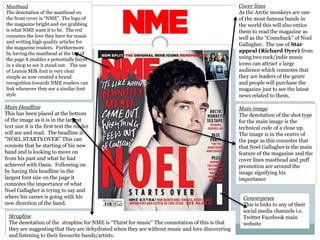
Masthead
The denotation of the masthead on
the front cover is “NME”. The logo of
the magazine bright and eye grabbing
is what NME want it to be. The red
connotes the love they have for music
and writing high quality articles for
the magazine readers. Furthermore
by having the masthead at the top of
the page it enables a potentially buyer
in a shop to see it stand out. The use
of Lemon Milk font is very clear
simple as now created a brand
recognition towards NME readers can
link whenever they see a similar font
style
Main image
The denotation of the shot type
for the main image is the
technical code of a close up.
The image is in the centre of
the page as this connotes that
that Noel Gallagher is the main
feature of the magazine and the
cover lines masthead and puff
promotion are around the
image signifying his
importance
Main Headline
This has been placed at the bottom
of the image as it is in the largest
text size it is the first text the reader
will see and read. The headline is
“NOEL STARTS OVER” This can
connote that he starting of his new
band and is looking to move on
from his past and what he had
achieved with Oasis. Following on
by having this headline in the
largest font size on the page it
connotes the importance of what
Noel Gallagher is trying to say and
where his career is going with his
new direction of the band.
Convergence
This is links to any of their
social media channels i.e.
Twitter Facebook main
website
Strapline
The denotation of the strapline for NME is “Thirst for music” The connotation of this is that
they are suggesting that they are dehydrated when they are without music and love discovering
and listening to their favourite bands/artists.
Cover lines
As the Arctic monkeys are one
of the most famous bands in
the world this will also entice
them to read the magazine as
well as the “Comeback” of Noel
Gallagher. The use of Star
appeal (Richard Dyer) from
using two rock/indie music
icons can attract a large
audience which connotes that
they are leaders of the genre
and people will purchase the
magazine just to see the latest
news related to them,
Denotations and Connotations
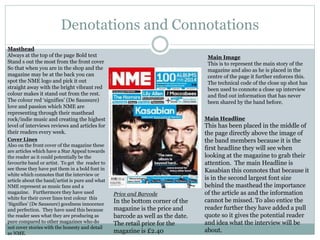
Main Image
This is to represent the main story of the
magazine and also as he is placed in the
centre of the page it further enforces this.
The technical code of the close up shot has
been used to connote a close up interview
and find out information that has never
been shared by the band before.
Masthead
Always at the top of the page Bold text
Stand s out the most from the front cover
So that when you are in the shop and the
magazine may be at the back you can
spot the NME logo and pick it out
straight away with the bright vibrant red
colour makes it stand out from the rest.
The colour red ‘signifies’ (De Saussure)
love and passion which NME are
representing through their masthead
rock/indie music and creating the highest
level of interviews reviews and articles for
their readers every week.
Price and Barcode
In the bottom corner of the
magazine is the price and
barcode as well as the date.
The retail price for the
magazine is £2.40
Main Headline
This has been placed in the middle of
the page directly above the image of
the band members because it is the
first headline they will see when
looking at the magazine to grab their
attention. The main Headline is
Kasabian this connotes that because it
is in the second largest font size
behind the masthead the importance
of the article as and the information
cannot be missed. To also entice the
reader further they have added a pull
quote so it gives the potential reader
and idea what the interview will be
about.
Cover Lines
Also on the front cover of the magazine these
are articles which have a Star Appeal towards
the reader as it could potentially be the
favourite band or artist. To get the reader to
see these they have put them in a bold font in
white which connotes that the interview or
article about the band/artist is pure and what
NME represent as music fans and a
magazine. Furthermore they have used
white for their cover lines text colour this
‘Signifies’ (De Saussure) goodness innocence
and perfection. They have used this because
the reader sees what they are producing as
pure compared to other magazines who do
not cover stories with the honesty and detail
as NME.
Denotations and Connotations
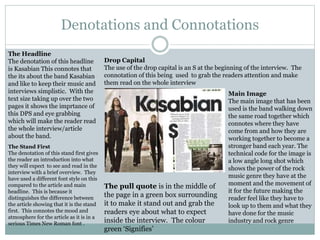
The pull quote is in the middle of
the page in a green box surrounding
it to make it stand out and grab the
readers eye about what to expect
inside the interview. The colour
green ‘Signifies’
The Headline
The denotation of this headline
is Kasabian This connotes that
the its about the band Kasabian
and like to keep their music and
interviews simplistic. With the
text size taking up over the two
pages it shows the imprtance of
this DPS and eye grabbing
which will make the reader read
the whole interview/article
about the band.
The Stand First
The denotation of this stand first gives
the reader an introduction into what
they will expect to see and read in the
interview with a brief overview. They
have used a different font style on this
compared to the article and main
headline. This is because it
distinguishes the difference between
the article showing that it is the stand
first. This connotes the mood and
atmosphere for the article as it is in a
serious Times New Roman font .
Main Image
The main image that has been
used is the band walking down
the same road together which
connotes where they have
come from and how they are
working together to become a
stronger band each year. The
technical code for the image is
a low angle long shot which
shows the power of the rock
music genre they have at the
moment and the movement of
it for the future making the
reader feel like they have to
look up to them and what they
have done for the music
industry and rock genre
Drop Capital
The use of the drop capital is an S at the beginning of the interview. The
connotation of this being used to grab the readers attention and make
them read on the whole interview
NME DPS Analysis
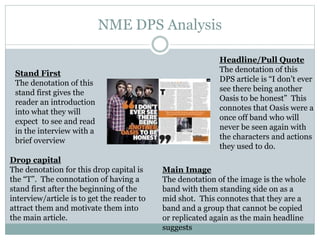
Headline/Pull Quote
The denotation of this
DPS article is “I don’t ever
see there being another
Oasis to be honest” This
connotes that Oasis were a
once off band who will
never be seen again with
the characters and actions
they used to do.
Drop capital
The denotation for this drop capital is
the “T”. The connotation of having a
stand first after the beginning of the
interview/article is to get the reader to
attract them and motivate them into
the main article.
Main Image
The denotation of the image is the whole
band with them standing side on as a
mid shot. This connotes that they are a
band and a group that cannot be copied
or replicated again as the main headline
suggests
Stand First
The denotation of this
stand first gives the
reader an introduction
into what they will
expect to see and read
in the interview with a
brief overview
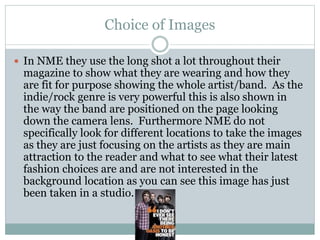
Choice of Images
 In NME they use the long shot a lot throughout their
magazine to show what they are wearing and how they
are fit for purpose showing the whole artist/band. As the
indie/rock genre is very powerful this is also shown in
the way the band are positioned on the page looking
down the camera lens. Furthermore NME do not
specifically look for different locations to take the images
as they are just focusing on the artists as they are main
attraction to the reader and what to see what their latest
fashion choices are and are not interested in the
background location as you can see this image has just
been taken in a studio.
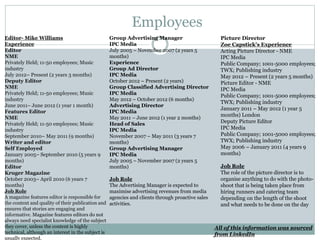
Employees
Editor- Mike Williams
Experience
Editor
NME
Privately Held; 11-50 employees; Music
industry
July 2012– Present (2 years 3 months)
Deputy Editor
NME
Privately Held; 11-50 employees; Music
industry
June 2011– June 2012 (1 year 1 month)
Features Editor
NME
Privately Held; 11-50 employees; Music
industry
September 2010– May 2011 (9 months)
Writer and editor
Self Employed
January 2005– September 2010 (5 years 9
months)
Editor
Kruger Magazine
October 2003– April 2010 (6 years 7
months)
Job Role
A magazine features editor is responsible for
the content and quality of their publication and
ensures that stories are engaging and
informative. Magazine features editors do not
always need specialist knowledge of the subject
they cover, unless the content is highly
technical, although an interest in the subject is
usually expected.
Picture Director
Zoe Capstick's Experience
Acting Picture Director - NME
IPC Media
Public Company; 1001-5000 employees;
TWX; Publishing industry
May 2012 – Present (2 years 5 months)
Picture Editor - NME
IPC Media
Public Company; 1001-5000 employees;
TWX; Publishing industry
January 2011 – May 2012 (1 year 5
months) London
Deputy Picture Editor
IPC Media
Public Company; 1001-5000 employees;
TWX; Publishing industry
May 2006 – January 2011 (4 years 9
months)
Job Role
The role of the picture director is to
organise anything to do with the photo-
shoot that is being taken place from
hiring runners and catering team
depending on the length of the shoot
and what needs to be done on the day
All of this information was sourced
from LinkedIn
Group Advertising Manager
IPC Media
July 2005 – November 2007 (2 years 5
months)
Experience
Group Ad Director
IPC Media
October 2012 – Present (2 years)
Group Classified Advertising Director
IPC Media
May 2012 – October 2012 (6 months)
Advertising Director
IPC Media
May 2011 – June 2012 (1 year 2 months)
Head of Sales
IPC Media
November 2007 – May 2011 (3 years 7
months)
Group Advertising Manager
IPC Media
July 2005 – November 2007 (2 years 5
months)
Job Role
The Advertising Manager is expected to
maximise advertising revenues from media
agencies and clients through proactive sales
activities.
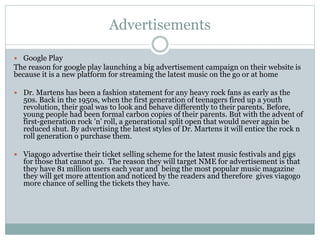
Advertisements
 Google Play
The reason for google play launching a big advertisement campaign on their website is
because it is a new platform for streaming the latest music on the go or at home
 Dr. Martens has been a fashion statement for any heavy rock fans as early as the
50s. Back in the 1950s, when the first generation of teenagers fired up a youth
revolution, their goal was to look and behave differently to their parents. Before,
young people had been formal carbon copies of their parents. But with the advent of
first-generation rock 'n' roll, a generational split open that would never again be
reduced shut. By advertising the latest styles of Dr. Martens it will entice the rock n
roll generation o purchase them.
 Viagogo advertise their ticket selling scheme for the latest music festivals and gigs
for those that cannot go. The reason they will target NME for advertisement is that
they have 81 million users each year and being the most popular music magazine
they will get more attention and noticed by the readers and therefore gives viagogo
more chance of selling the tickets they have.
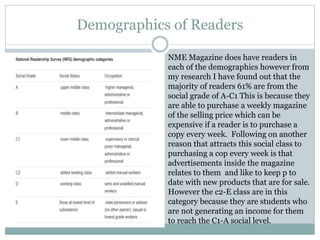
Demographics of Readers
NME Magazine does have readers in
each of the demographics however from
my research I have found out that the
majority of readers 61% are from the
social grade of A-C1 This is because they
are able to purchase a weekly magazine
of the selling price which can be
expensive if a reader is to purchase a
copy every week. Following on another
reason that attracts this social class to
purchasing a cop every week is that
advertisements inside the magazine
relates to them and like to keep p to
date with new products that are for sale.
However the c2-E class are in this
category because they are students who
are not generating an income for them
to reach the C1-A social level.
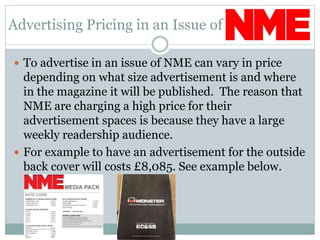
Advertising Pricing in an Issue of
 To advertise in an issue of NME can vary in price
depending on what size advertisement is and where
in the magazine it will be published. The reason that
NME are charging a high price for their
advertisement spaces is because they have a large
weekly readership audience.
 For example to have an advertisement for the outside
back cover will costs £8,085. See example below.
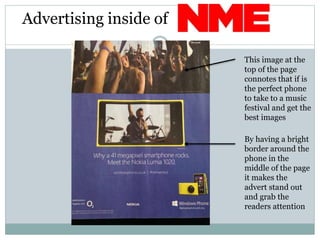
Advertising inside of
This image at the
top of the page
connotes that if is
the perfect phone
to take to a music
festival and get the
best images
By having a bright
border around the
phone in the
middle of the page
it makes the
advert stand out
and grab the
readers attention
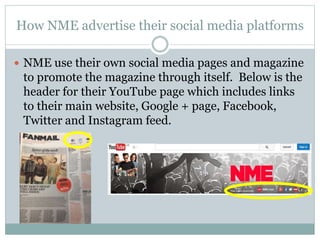
How NME advertise their social media platforms
 NME use their own social media pages and magazine
to promote the magazine through itself. Below is the
header for their YouTube page which includes links
to their main website, Google + page, Facebook,
Twitter and Instagram feed.
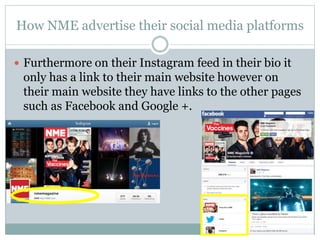
How NME advertise their social media platforms
 Furthermore on their Instagram feed in their bio it
only has a link to their main website however on
their main website they have links to the other pages
such as Facebook and Google +.
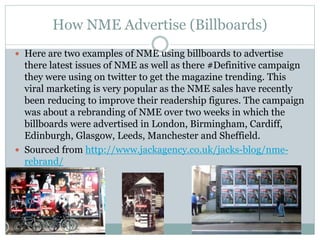
How NME Advertise (Billboards)
 Here are two examples of NME using billboards to advertise
there latest issues of NME as well as there #Definitive campaign
they were using on twitter to get the magazine trending. This
viral marketing is very popular as the NME sales have recently
been reducing to improve their readership figures. The campaign
was about a rebranding of NME over two weeks in which the
billboards were advertised in London, Birmingham, Cardiff,
Edinburgh, Glasgow, Leeds, Manchester and Sheffield.
 Sourced from http://www.jackagency.co.uk/jacks-blog/nme-
rebrand/
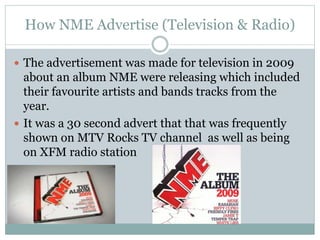
How NME Advertise (Television & Radio)
 The advertisement was made for television in 2009
about an album NME were releasing which included
their favourite artists and bands tracks from the
year.
 It was a 30 second advert that that was frequently
shown on MTV Rocks TV channel as well as being
on XFM radio station
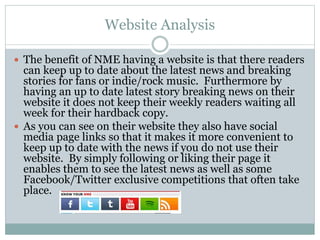
Website Analysis
 The benefit of NME having a website is that there readers
can keep up to date about the latest news and breaking
stories for fans or indie/rock music. Furthermore by
having an up to date latest story breaking news on their
website it does not keep their weekly readers waiting all
week for their hardback copy.
 As you can see on their website they also have social
media page links so that it makes it more convenient to
keep up to date with the news if you do not use their
website. By simply following or liking their page it
enables them to see the latest news as well as some
Facebook/Twitter exclusive competitions that often take
place.
Website Analysis
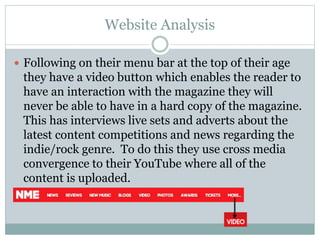
 Following on their menu bar at the top of their age
they have a video button which enables the reader to
have an interaction with the magazine they will
never be able to have in a hard copy of the magazine.
This has interviews live sets and adverts about the
latest content competitions and news regarding the
indie/rock genre. To do this they use cross media
convergence to their YouTube where all of the
content is uploaded.
Website Analysis
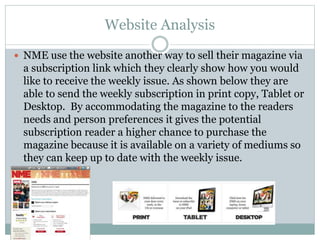
 NME use the website another way to sell their magazine via
a subscription link which they clearly show how you would
like to receive the weekly issue. As shown below they are
able to send the weekly subscription in print copy, Tablet or
Desktop. By accommodating the magazine to the readers
needs and person preferences it gives the potential
subscription reader a higher chance to purchase the
magazine because it is available on a variety of mediums so
they can keep up to date with the weekly issue.
Website Analysis
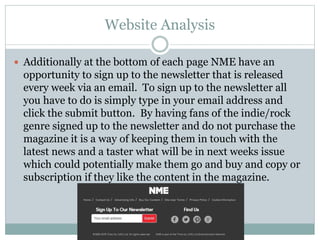
 Additionally at the bottom of each page NME have an
opportunity to sign up to the newsletter that is released
every week via an email. To sign up to the newsletter all
you have to do is simply type in your email address and
click the submit button. By having fans of the indie/rock
genre signed up to the newsletter and do not purchase the
magazine it is a way of keeping them in touch with the
latest news and a taster what will be in next weeks issue
which could potentially make them go and buy and copy or
subscription if they like the content in the magazine.
Socio economic needs
 In recent years there has been an increase of adults
who fall into the A,B and C1 Socio economic group
which means that the spending power of a growing
audience is getting larger meaning that potentially
my magazine is going to grow faster than first
anticipated with this research. This means that the
bands artists and readers are having more personal
identity with the stories and songs they are making.
Audience Theory- Psychographics
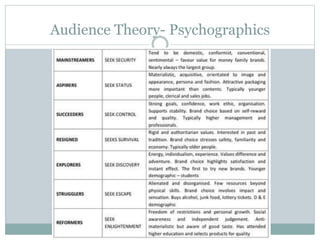
 The psychographic of the NME reader will fit into is
the Explorers this is because the target audience of
NME is a young student age range. Another reason
for the psychographic is because they have energy
and seek to find new brands which can relate to
finding new artist and bands by reading magazines
so they can keep ahead of the mainstream music
followers.
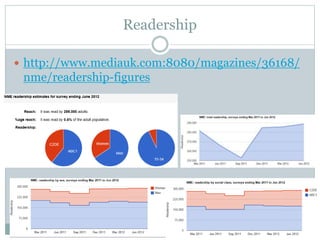
Readership
 http://www.mediauk.com:8080/magazines/36168/
nme/readership-figures
Which group does NME fall into?
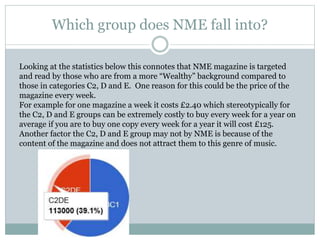
Looking at the statistics below this connotes that NME magazine is targeted
and read by those who are from a more “Wealthy” background compared to
those in categories C2, D and E. One reason for this could be the price of the
magazine every week.
For example for one magazine a week it costs £2.40 which stereotypically for
the C2, D and E groups can be extremely costly to buy every week for a year on
average if you are to buy one copy every week for a year it will cost £125.
Another factor the C2, D and E group may not by NME is because of the
content of the magazine and does not attract them to this genre of music.
What age reads NME?
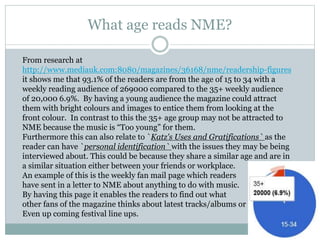
From research at
http://www.mediauk.com:8080/magazines/36168/nme/readership-figures
it shows me that 93.1% of the readers are from the age of 15 to 34 with a
weekly reading audience of 269000 compared to the 35+ weekly audience
of 20,000 6.9%. By having a young audience the magazine could attract
them with bright colours and images to entice them from looking at the
front colour. In contrast to this the 35+ age group may not be attracted to
NME because the music is “Too young” for them.
Furthermore this can also relate to `Katz's Uses and Gratifications` as the
reader can have `personal identification` with the issues they may be being
interviewed about. This could be because they share a similar age and are in
a similar situation either between your friends or workplace.
An example of this is the weekly fan mail page which readers
have sent in a letter to NME about anything to do with music.
By having this page it enables the readers to find out what
other fans of the magazine thinks about latest tracks/albums or
Even up coming festival line ups.
Stereotypical lifestyle of the reader
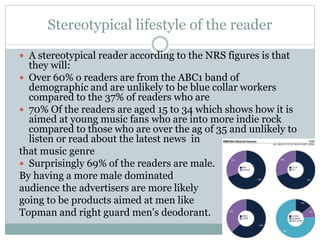
 A stereotypical reader according to the NRS figures is that
they will:
 Over 60% o readers are from the ABC1 band of
demographic and are unlikely to be blue collar workers
compared to the 37% of readers who are
 70% Of the readers are aged 15 to 34 which shows how it is
aimed at young music fans who are into more indie rock
compared to those who are over the ag of 35 and unlikely to
listen or read about the latest news in
that music genre
 Surprisingly 69% of the readers are male.
By having a more male dominated
audience the advertisers are more likely
going to be products aimed at men like
Topman and right guard men's deodorant.
Circulation Figures
 These figures are as of 14th August 2014
 According to figures that have been released the
average digital and print circulation figures of the
magazine have been down 18.8% falling to 15,380 in
the first six months of 2014. However interestingly
the digital version of NME circulation figures have
grown 16.1% to averagely 1,518 weekly readers on the
digital issues.
 http://www.mediaweek.co.uk/article/1307929/mag
azines-abcs-nme-print-sales-drop-below-15000
Sponsorships
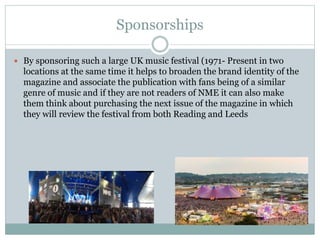
 NME are sponsors of a stage at the well respected
Reading and Leeds festivals which takes place on the
of the August Bank holiday weekend. On the official
Reading & Leeds website the NME logo is on the
bottom of every page
Sponsorships
 By sponsoring such a large UK music festival (1971- Present in two
locations at the same time it helps to broaden the brand identity of the
magazine and associate the publication with fans being of a similar
genre of music and if they are not readers of NME it can also make
them think about purchasing the next issue of the magazine in which
they will review the festival from both Reading and Leeds
Style of Language (On the magazine)
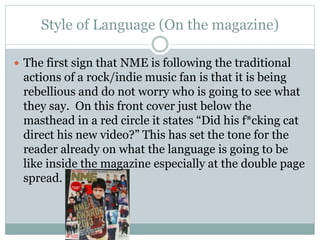
 The first sign that NME is following the traditional
actions of a rock/indie music fan is that it is being
rebellious and do not worry who is going to see what
they say. On this front cover just below the
masthead in a red circle it states “Did his f*cking cat
direct his new video?” This has set the tone for the
reader already on what the language is going to be
like inside the magazine especially at the double page
spread.
Style of Language (Inside the magazine)
 Further more the tone of language inside the magazine
follows on from the front cover however the explicit
words do not miss any letters or covered up by the *. For
example on the double page spread of the issue the pull
quote is “Its nice to know we didn’t f*ck anything up last
year”-Simon Neal. By using these aggressive and
informal words it shows that NME produce exactly what
the band or artist is saying. Additionally NME also do
not have grammatically correct English they start
sentences with “And”. Finally the image caption includes
“Oh wait a minute” as the picture was being taken
suggests that it was unorganised and both photographer
and band (Biffy Clyro) were going along with it as it was
taking place.
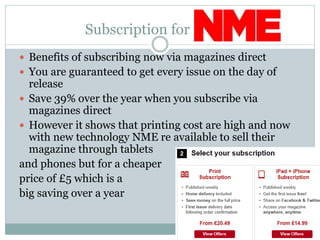
Subscription for
 Benefits of subscribing now via magazines direct
 You are guaranteed to get every issue on the day of
release
 Save 39% over the year when you subscribe via
magazines direct
 However it shows that printing cost are high and now
with new technology NME re available to sell their
magazine through tablets
and phones but for a cheaper
price of £5 which is a
big saving over a year
Production Process
Source: http://www.cindycheung.co.uk/blog/design-development-process-of-creating-a-
Date of publication
This is the date of which the magazine will be released on to the public and
customers. NME will now have an established order of work including the editorial
finishing and planning stages.
Managing the schedule
This is one of the most important stages of the process. For the magazine to be
produced successfully the schedule must be managed precisely. The schedule must
be made so that there is a back up plan in case any mishaps go wrong and you can
always meet the deadline with a story if you do not make a schedule like this you
will not make a successful magazine.
Editorial and budgetary decision
This stage is the process of the editorial team deciding what topics will be
discussed in that weeks issue of the magazine. After deciding what will be
discussed illustrations and photographs will be used for the magazine.
After the images have been selected the finance team look at the invest available for
them and how it will be spent on the magazine.
Production Process
Content Acquisition
This is the most important stage above all others. This is because if there is no
content there is no magazine. There are two ways that content can be collated
firstly is using in house staff and the other way is to use external writers that are
specialists in a specific topic.
Sub-editing
This is quality control. If the company has an sub editor it is there job to:
Checking accuracy of the facts provided
Words are properly spelt
Working on page layout
Follows the house style
Page layout
Their job is to make sure that all of the pages are in a specific house style and
follow the running order of the contents page.
Production Process
Proofreading
Once the content stage has been completed each topic will be
analysed searching for any grammatical changes before the
hardened edition of the magazine will be released each
problem is changed immediately and will only be printed once
the team are happy every change has been made.
Distribution
This is the last stage of the entire process. The printing
company have finished printing and the magazines are now
getting ready for deliveries so they can be sold to the public.
Social media products
 NME currently have six social media pages including
their own website, Twitter, Facebook, Google+,
Instagram and YouTube.
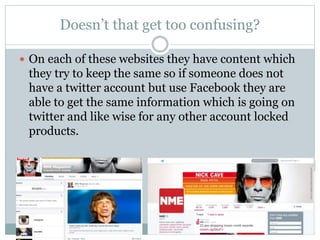
Doesn’t that get too confusing?
 On each of these websites they have content which
they try to keep the same so if someone does not
have a twitter account but use Facebook they are
able to get the same information which is going on
twitter and like wise for any other account locked
products.
Video content
 However the YouTube page is different compared to
the other versions this is because unlike the other
sites YouTube allows NME to put up exclusive
interviews with bands and artists back stage before a
gig or from a interview which is in the hardback copy
of the magazine.
Section 2
 Examples of British red top newspapers include The Sun,
the Daily Star, the Daily Mirror and the Daily Sport.
Compact tabloids In contrast to red top tabloids,
compresses use an editorial style more closely associated
with broadsheet newspapers.
 The broadsheet is the largest of newspaper formats and is
known by having long vertical pages The term derives
from types of popular prints usually just of a single sheet,
sold on the streets and containing various types of
material, from ballads to political satire.
 The Free sheet newspaper is a smaller sized newspaper
which is commonly handed out at train stations and
examples of free sheet is the Metro
Free Sheet (Metro)
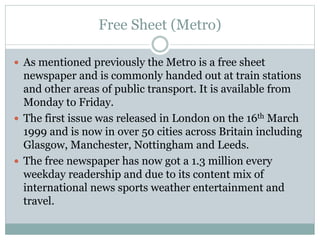
 As mentioned previously the Metro is a free sheet
newspaper and is commonly handed out at train stations
and other areas of public transport. It is available from
Monday to Friday.
 The first issue was released in London on the 16th March
1999 and is now in over 50 cities across Britain including
Glasgow, Manchester, Nottingham and Leeds.
 The free newspaper has now got a 1.3 million every
weekday readership and due to its content mix of
international news sports weather entertainment and
travel.
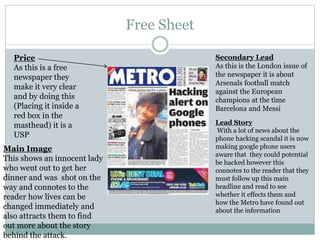
Free Sheet
Price
As this is a free
newspaper they
make it very clear
and by doing this
(Placing it inside a
red box in the
masthead) it is a
USP
Lead Story
With a lot of news about the
phone hacking scandal it is now
making google phone users
aware that they could potential
be hacked however this
connotes to the reader that they
must follow up this main
headline and read to see
whether it effects them and
how the Metro have found out
about the information
Secondary Lead
As this is the London issue of
the newspaper it is about
Arsenals football match
against the European
champions at the time
Barcelona and Messi
Main Image
This shows an innocent lady
who went out to get her
dinner and was shot on the
way and connotes to the
reader how lives can be
changed immediately and
also attracts them to find
out more about the story
behind the attack.
Broadsheet (The Times)
 This is one of Britain's oldest newspapers and is still
published in London every day. It was founded I n1785
by John Walter it is also included as one of Britain's “Big
Three”. Its total readership is 1047000 a week from
those aged 15+ however the majority of its readers are
aged 35+ with research from
https://media.info/newspapers/titles/the-
times/readership-figures
 In March of 2014 913,000 of its readers were 35+
compared to the 242,000 readers aged 15-43 which
shows its target demographic and the information that is
being published to attract this certain age group of
readers.
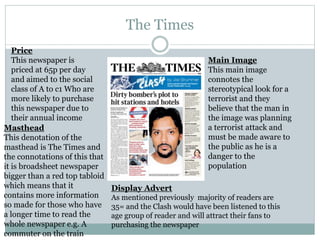
The Times
Price
This newspaper is
priced at 65p per day
and aimed to the social
class of A to c1 Who are
more likely to purchase
this newspaper due to
their annual income
Masthead
This denotation of the
masthead is The Times and
the connotations of this that
it is broadsheet newspaper
bigger than a red top tabloid
which means that it
contains more information
so made for those who have
a longer time to read the
whole newspaper e.g. A
commuter on the train
Main Image
This main image
connotes the
stereotypical look for a
terrorist and they
believe that the man in
the image was planning
a terrorist attack and
must be made aware to
the public as he is a
danger to the
population
Display Advert
As mentioned previously majority of readers are
35= and the Clash would have been listened to this
age group of reader and will attract their fans to
purchasing the newspaper
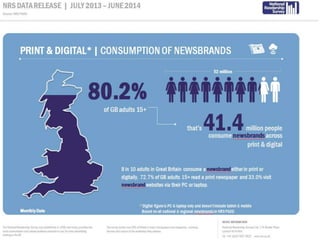
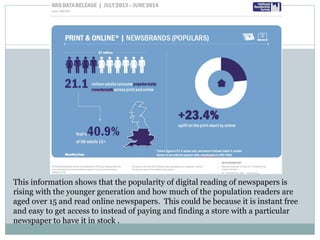
This information shows that the popularity of digital reading of newspapers is
rising with the younger generation and how much of the population readers are
aged over 15 and read online newspapers. This could be because it is instant free
and easy to get access to instead of paying and finding a store with a particular
newspaper to have it in stock .
Main Case Study
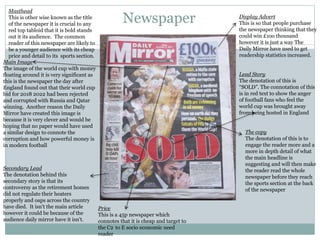
Newspaper Display Advert
This is so that people purchase
the newspaper thinking that they
could win £1oo thousand
however it is just a way The
Daily Mirror have used to get
readership statistics increased.
Main Image
The image of the world cup with money
floating around it is very significant as
this is the newspaper the day after
England found out that their world cup
bid for 2018 2022 had been rejected
and corrupted with Russia and Qatar
winning. Another reason the Daily
Mirror have created this image is
because it is very clever and would be
hoping that no paper would have used
a similar design to connote the
corruption and how powerful money is
in modern football
Secondary Lead
The denotation behind this
secondary story is that its
controversy as the retirement homes
did not regulate their heaters
properly and oaps across the country
have died. It isn't the main article
however it could be because of the
audience daily mirror have it isn't.
Masthead
This is other wise known as the title
of the newspaper it is crucial to any
red top tabloid that it is bold stands
out it its audience. The common
reader of this newspaper are likely to
be a younger audience with its cheap
price and detail to its sports section.
Lead Story
The denotation of this is
“SOLD”. The connotation of this
is in red text to show the anger
of football fans who feel the
world cup was brought away
from being hosted in England
Price
This is a 45p newspaper which
connotes that it is cheap and target to
the C2 to E socio economic need
reader
The copy
The denotation of this is to
engage the reader more and a
more in depth detail of what
the main headline is
suggesting and will then make
the reader read the whole
newspaper before they reach
the sports section at the back
of the newspaper
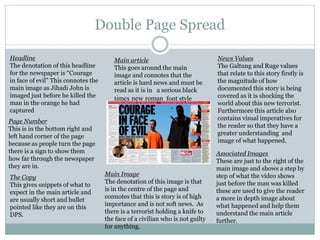
Double Page Spread
Headline
The denotation of this headline
for the newspaper is “Courage
in face of evil” This connotes the
main image as Jihadi John is
imaged just before he killed the
man in the orange he had
captured
Page Number
This is in the bottom right and
left hand corner of the page
because as people turn the page
there is a sign to show them
how far through the newspaper
they are in.
The Copy
This gives snippets of what to
expect in the main article and
are usually short and bullet
pointed like they are on this
DPS.
Main Image
The denotation of this image is that
is in the centre of the page and
connotes that this is story is of high
importance and is not soft news. As
there is a terrorist holding a knife to
the face of a civilian who is not guilty
for anything.
Associated Images
These are just to the right of the
main image and shows a step by
step of what the video shows
just before the man was killed
these are used to give the reader
a more in depth image about
what happened and help them
understand the main article
further.
Main article
This goes around the main
image and connotes that the
article is hard news and must be
read as it is in a serious black
times new roman font style
News Values
The Galtung and Ruge values
that relate to this story firstly is
the magnitude of how
documented this story is being
covered as it is shocking the
world about this new terrorist.
Furthermore this article also
contains visual imperatives for
the reader so that they have a
greater understanding and
image of what happened.
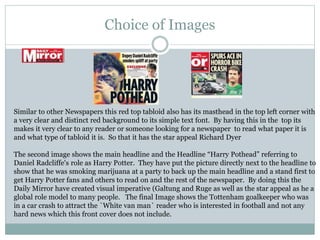
Choice of Images
Similar to other Newspapers this red top tabloid also has its masthead in the top left corner with
a very clear and distinct red background to its simple text font. By having this in the top its
makes it very clear to any reader or someone looking for a newspaper to read what paper it is
and what type of tabloid it is. So that it has the star appeal Richard Dyer
The second image shows the main headline and the Headline “Harry Pothead” referring to
Daniel Radcliffe's role as Harry Potter. They have put the picture directly next to the headline to
show that he was smoking marijuana at a party to back up the main headline and a stand first to
get Harry Potter fans and others to read on and the rest of the newspaper. By doing this the
Daily Mirror have created visual imperative (Galtung and Ruge as well as the star appeal as he a
global role model to many people. The final Image shows the Tottenham goalkeeper who was
in a car crash to attract the `White van man` reader who is interested in football and not any
hard news which this front cover does not include.
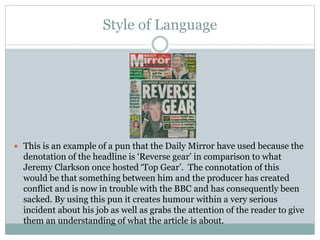
Style of Language
 This is an example of a pun that the Daily Mirror have used because the
denotation of the headline is ‘Reverse gear’ in comparison to what
Jeremy Clarkson once hosted ‘Top Gear’. The connotation of this
would be that something between him and the producer has created
conflict and is now in trouble with the BBC and has consequently been
sacked. By using this pun it creates humour within a very serious
incident about his job as well as grabs the attention of the reader to give
them an understanding of what the article is about.
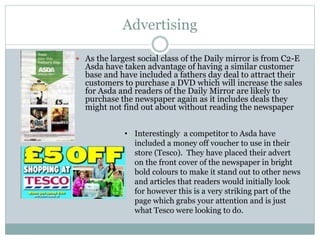
Advertising
 As the largest social class of the Daily mirror is from C2-E
Asda have taken advantage of having a similar customer
base and have included a fathers day deal to attract their
customers to purchase a DVD which will increase the sales
for Asda and readers of the Daily Mirror are likely to
purchase the newspaper again as it includes deals they
might not find out about without reading the newspaper
• Interestingly a competitor to Asda have
included a money off voucher to use in their
store (Tesco). They have placed their advert
on the front cover of the newspaper in bright
bold colours to make it stand out to other news
and articles that readers would initially look
for however this is a very striking part of the
page which grabs your attention and is just
what Tesco were looking to do.
News Values (Galtung & Ruge)
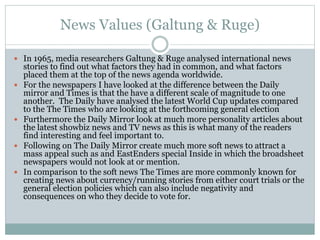
 In 1965, media researchers Galtung & Ruge analysed international news
stories to find out what factors they had in common, and what factors
placed them at the top of the news agenda worldwide.
 For the newspapers I have looked at the difference between the Daily
mirror and Times is that the have a different scale of magnitude to one
another. The Daily have analysed the latest World Cup updates compared
to the The Times who are looking at the forthcoming general election
 Furthermore the Daily Mirror look at much more personality articles about
the latest showbiz news and TV news as this is what many of the readers
find interesting and feel important to.
 Following on The Daily Mirror create much more soft news to attract a
mass appeal such as and EastEnders special Inside in which the broadsheet
newspapers would not look at or mention.
 In comparison to the soft news The Times are more commonly known for
creating news about currency/running stories from either court trials or the
general election policies which can also include negativity and
consequences on who they decide to vote for.
News Values (Galtung & Ruge)
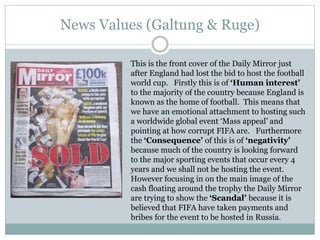
This is the front cover of the Daily Mirror just
after England had lost the bid to host the football
world cup. Firstly this is of ‘Human interest’
to the majority of the country because England is
known as the home of football. This means that
we have an emotional attachment to hosting such
a worldwide global event ‘Mass appeal’ and
pointing at how corrupt FIFA are. Furthermore
the ‘Consequence’ of this is of ‘negativity’
because much of the country is looking forward
to the major sporting events that occur every 4
years and we shall not be hosting the event.
However focusing in on the main image of the
cash floating around the trophy the Daily Mirror
are trying to show the ‘Scandal’ because it is
believed that FIFA have taken payments and
bribes for the event to be hosted in Russia.
News Values (Galtung & Ruge)
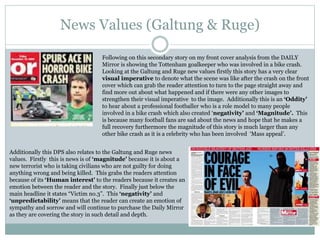
Following on this secondary story on my front cover analysis from the DAILY
Mirror is showing the Tottenham goalkeeper who was involved in a bike crash.
Looking at the Galtung and Ruge new values firstly this story has a very clear
visual imperative to denote what the scene was like after the crash on the front
cover which can grab the reader attention to turn to the page straight away and
find more out about what happened and if there were any other images to
strengthen their visual imperative to the image. Additionally this is an ‘Oddity’
to hear about a professional footballer who is a role model to many people
involved in a bike crash which also created ‘negativity’ and ‘Magnitude’. This
is because many football fans are sad about the news and hope that he makes a
full recovery furthermore the magnitude of this story is much larger than any
other bike crash as it is a celebrity who has been involved ‘Mass appeal’.
Additionally this DPS also relates to the Galtung and Ruge news
values. Firstly this is news is of ‘magnitude’ because it is about a
new terrorist who is taking civilians who are not guilty for doing
anything wrong and being killed. This grabs the readers attention
because of its ‘Human interest’ to the readers because it creates an
emotion between the reader and the story. Finally just below the
main headline it states “Victim no.3”. This ‘negativity’ and
‘unpredictability’ means that the reader can create an emotion of
sympathy and sorrow and will continue to purchase the Daily Mirror
as they are covering the story in such detail and depth.
Readership
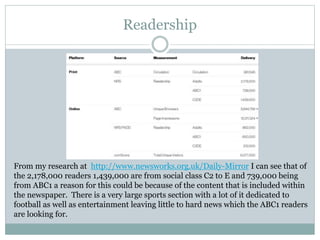
From my research at http://www.newsworks.org.uk/Daily-Mirror I can see that of
the 2,178,000 readers 1,439,000 are from social class C2 to E and 739,000 being
from ABC1 a reason for this could be because of the content that is included within
the newspaper. There is a very large sports section with a lot of it dedicated to
football as well as entertainment leaving little to hard news which the ABC1 readers
are looking for.
Website Analysis
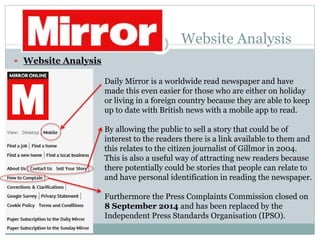
 Website Analysis
Daily Mirror is a worldwide read newspaper and have
made this even easier for those who are either on holiday
or living in a foreign country because they are able to keep
up to date with British news with a mobile app to read.
By allowing the public to sell a story that could be of
interest to the readers there is a link available to them and
this relates to the citizen journalist of Gillmor in 2004.
This is also a useful way of attracting new readers because
there potentially could be stories that people can relate to
and have personal identification in reading the newspaper.
Furthermore the Press Complaints Commission closed on
8 September 2014 and has been replaced by the
Independent Press Standards Organisation (IPSO).
Website Analysis
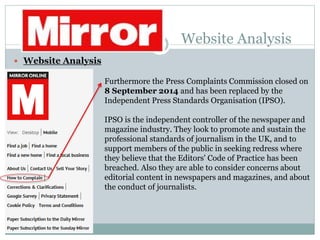
 Website Analysis
Furthermore the Press Complaints Commission closed on
8 September 2014 and has been replaced by the
Independent Press Standards Organisation (IPSO).
IPSO is the independent controller of the newspaper and
magazine industry. They look to promote and sustain the
professional standards of journalism in the UK, and to
support members of the public in seeking redress where
they believe that the Editors' Code of Practice has been
breached. Also they are able to consider concerns about
editorial content in newspapers and magazines, and about
the conduct of journalists.
Conclusion
 Within this learning outcome I focused on understanding
the existing print based media products (Magazine and
newspaper). I looked at magazines and newspapers
including NME, Daily Mirror, The Times and the The
Metro.
 I looked into the demographics of the audiences and
readership and they way they attract this specific
audience. Following on I also looked at the denotations
and connotations of front covers and double page
spreads and why they use the colours and see what they
represent.
 For the next learning outcome I plan to create and
‘Repeat’ some areas of the magazine when I start to
generate my own ideas for a print based media product.

UNIT 30 P1-P2

  • 1.
    OCR – Level 3Cambridge Introductory Diploma in Media Unit 30: UK Media Publishing P1 and P2 Evidence Name: Thomas McEnaney Candidate Number: 4096 Center Name: St. Andrew’s Catholic School Center Number: 64135 Set Brief - Print Project/Brief – Music Magazine & Promotion
  • 2.
    On November 28,1922 founders Henry Luce and Britton Hadden created Time Inc. Their mission statement in 1922, Time magazine co-founders Henry Luce and Briton Hadden acknowledged that no magazine had yet adapted to the needs of the busy reader who wanted to stay informed. Staying true to their mission, Time Inc. continue to adapt and innovate, making sure the products are relevant and appealing to the busy consumer who needs to know but also wants to be inspired by what’s going on in the world. Their UK based publisher competitor is the Bauer media group and they own brands such as: Q and Mojo magazines are in the same genre of music as NME. They do not just own NME they also own other magazines which are also world popular such as:
  • 3.
    Making contact with Idecided to make contact with NME directly by emailing them a few questions I needed help with as the information on the internet and magazine was not sufficient enough to carry out my research in the detail needed it to be. Unfortunately the email I sent was not to the right member of staff, however I have been put in contact with the right member of staff who will be able to help me with my research and hopefully any other information they are available to give me.
  • 4.
     The firstissue was published on the 7th March 1952 Source http://www.bbc.co.uk/programmes/b01pgqdx  The magazine has recently changed its publisher from IPC Media to Time INC. as it was wholly bought out by Time INC.  Time Inc. is one of the largest media companies in the world connecting to more than 130 million customers each month across multiple platforms through influential brands such as Time, People, Sports Illustrated, In Style, Real Simple, Travel + Leisure, Food & Wine, Wallpaper and NME.  Time Inc. UK is Britain’s leading publisher of print and digital magazine content. (Source http://www.timeinc.com/about/company-profile/)  Similar products to NME include Kerrang, Q and Mojo. These magazines are all similar because they share the same sub genre of music to one another.  The sub genre of my magazine is music and therefore when it is being sold in stores it is going to be in the music section so anyone who does not know about NME can quickly establish what it is about.  Brand Ideology-The slogan for NME is "Thirst for music“. The connotations of this verbal code are that they have a desire for needing music as badly as dehydration and acts as their water which is a basic essential need in life we need everyday to survive. This connotes the lengths they’ll go to for finding and listening to new music.  The frequency of NME is weekly and is distributed across the world including Britain America and Asia as well as downloadable copy on the Android market and Apple App store
  • 5.
    Relationship between distributer,retailer and consumer  Distributor  NME distributor is Time Inc. as well as being their publisher which means that they are able to save money and cost of hiring staff who are able to take more than one job role within the business and can have full control of the magazine. A way they advertise is by using self promotion in other magazines and television shows they own which is cheap and effective to reaching an already established audience.  Retailer  The main retailers who sell NME are major supermarkets such as Tesco Sainsbury's and Waitrose. Although they are also sold in local smaller news agents and post offices.  Consumer  The consumer for the magazine is mainly 70% Of the readers are aged 15 to 34 which shows how it is aimed at young music fans who are into more indie rock compared to those who are over the age of 35 and unlikely to listen or read about the latest news in that music genre.
  • 6.
    Masthead The denotation ofthe masthead on the front cover is “NME”. The logo of the magazine bright and eye grabbing is what NME want it to be. The red connotes the love they have for music and writing high quality articles for the magazine readers. Furthermore by having the masthead at the top of the page it enables a potentially buyer in a shop to see it stand out. The use of Lemon Milk font is very clear simple as now created a brand recognition towards NME readers can link whenever they see a similar font style Main image The denotation of the shot type for the main image is the technical code of a close up. The image is in the centre of the page as this connotes that that Noel Gallagher is the main feature of the magazine and the cover lines masthead and puff promotion are around the image signifying his importance Main Headline This has been placed at the bottom of the image as it is in the largest text size it is the first text the reader will see and read. The headline is “NOEL STARTS OVER” This can connote that he starting of his new band and is looking to move on from his past and what he had achieved with Oasis. Following on by having this headline in the largest font size on the page it connotes the importance of what Noel Gallagher is trying to say and where his career is going with his new direction of the band. Convergence This is links to any of their social media channels i.e. Twitter Facebook main website Strapline The denotation of the strapline for NME is “Thirst for music” The connotation of this is that they are suggesting that they are dehydrated when they are without music and love discovering and listening to their favourite bands/artists. Cover lines As the Arctic monkeys are one of the most famous bands in the world this will also entice them to read the magazine as well as the “Comeback” of Noel Gallagher. The use of Star appeal (Richard Dyer) from using two rock/indie music icons can attract a large audience which connotes that they are leaders of the genre and people will purchase the magazine just to see the latest news related to them,
  • 7.
    Denotations and Connotations MainImage This is to represent the main story of the magazine and also as he is placed in the centre of the page it further enforces this. The technical code of the close up shot has been used to connote a close up interview and find out information that has never been shared by the band before. Masthead Always at the top of the page Bold text Stand s out the most from the front cover So that when you are in the shop and the magazine may be at the back you can spot the NME logo and pick it out straight away with the bright vibrant red colour makes it stand out from the rest. The colour red ‘signifies’ (De Saussure) love and passion which NME are representing through their masthead rock/indie music and creating the highest level of interviews reviews and articles for their readers every week. Price and Barcode In the bottom corner of the magazine is the price and barcode as well as the date. The retail price for the magazine is £2.40 Main Headline This has been placed in the middle of the page directly above the image of the band members because it is the first headline they will see when looking at the magazine to grab their attention. The main Headline is Kasabian this connotes that because it is in the second largest font size behind the masthead the importance of the article as and the information cannot be missed. To also entice the reader further they have added a pull quote so it gives the potential reader and idea what the interview will be about. Cover Lines Also on the front cover of the magazine these are articles which have a Star Appeal towards the reader as it could potentially be the favourite band or artist. To get the reader to see these they have put them in a bold font in white which connotes that the interview or article about the band/artist is pure and what NME represent as music fans and a magazine. Furthermore they have used white for their cover lines text colour this ‘Signifies’ (De Saussure) goodness innocence and perfection. They have used this because the reader sees what they are producing as pure compared to other magazines who do not cover stories with the honesty and detail as NME.
  • 8.
    Denotations and Connotations Thepull quote is in the middle of the page in a green box surrounding it to make it stand out and grab the readers eye about what to expect inside the interview. The colour green ‘Signifies’ The Headline The denotation of this headline is Kasabian This connotes that the its about the band Kasabian and like to keep their music and interviews simplistic. With the text size taking up over the two pages it shows the imprtance of this DPS and eye grabbing which will make the reader read the whole interview/article about the band. The Stand First The denotation of this stand first gives the reader an introduction into what they will expect to see and read in the interview with a brief overview. They have used a different font style on this compared to the article and main headline. This is because it distinguishes the difference between the article showing that it is the stand first. This connotes the mood and atmosphere for the article as it is in a serious Times New Roman font . Main Image The main image that has been used is the band walking down the same road together which connotes where they have come from and how they are working together to become a stronger band each year. The technical code for the image is a low angle long shot which shows the power of the rock music genre they have at the moment and the movement of it for the future making the reader feel like they have to look up to them and what they have done for the music industry and rock genre Drop Capital The use of the drop capital is an S at the beginning of the interview. The connotation of this being used to grab the readers attention and make them read on the whole interview
  • 9.
    NME DPS Analysis Headline/PullQuote The denotation of this DPS article is “I don’t ever see there being another Oasis to be honest” This connotes that Oasis were a once off band who will never be seen again with the characters and actions they used to do. Drop capital The denotation for this drop capital is the “T”. The connotation of having a stand first after the beginning of the interview/article is to get the reader to attract them and motivate them into the main article. Main Image The denotation of the image is the whole band with them standing side on as a mid shot. This connotes that they are a band and a group that cannot be copied or replicated again as the main headline suggests Stand First The denotation of this stand first gives the reader an introduction into what they will expect to see and read in the interview with a brief overview
  • 10.
    Choice of Images In NME they use the long shot a lot throughout their magazine to show what they are wearing and how they are fit for purpose showing the whole artist/band. As the indie/rock genre is very powerful this is also shown in the way the band are positioned on the page looking down the camera lens. Furthermore NME do not specifically look for different locations to take the images as they are just focusing on the artists as they are main attraction to the reader and what to see what their latest fashion choices are and are not interested in the background location as you can see this image has just been taken in a studio.
  • 11.
    Employees Editor- Mike Williams Experience Editor NME PrivatelyHeld; 11-50 employees; Music industry July 2012– Present (2 years 3 months) Deputy Editor NME Privately Held; 11-50 employees; Music industry June 2011– June 2012 (1 year 1 month) Features Editor NME Privately Held; 11-50 employees; Music industry September 2010– May 2011 (9 months) Writer and editor Self Employed January 2005– September 2010 (5 years 9 months) Editor Kruger Magazine October 2003– April 2010 (6 years 7 months) Job Role A magazine features editor is responsible for the content and quality of their publication and ensures that stories are engaging and informative. Magazine features editors do not always need specialist knowledge of the subject they cover, unless the content is highly technical, although an interest in the subject is usually expected. Picture Director Zoe Capstick's Experience Acting Picture Director - NME IPC Media Public Company; 1001-5000 employees; TWX; Publishing industry May 2012 – Present (2 years 5 months) Picture Editor - NME IPC Media Public Company; 1001-5000 employees; TWX; Publishing industry January 2011 – May 2012 (1 year 5 months) London Deputy Picture Editor IPC Media Public Company; 1001-5000 employees; TWX; Publishing industry May 2006 – January 2011 (4 years 9 months) Job Role The role of the picture director is to organise anything to do with the photo- shoot that is being taken place from hiring runners and catering team depending on the length of the shoot and what needs to be done on the day All of this information was sourced from LinkedIn Group Advertising Manager IPC Media July 2005 – November 2007 (2 years 5 months) Experience Group Ad Director IPC Media October 2012 – Present (2 years) Group Classified Advertising Director IPC Media May 2012 – October 2012 (6 months) Advertising Director IPC Media May 2011 – June 2012 (1 year 2 months) Head of Sales IPC Media November 2007 – May 2011 (3 years 7 months) Group Advertising Manager IPC Media July 2005 – November 2007 (2 years 5 months) Job Role The Advertising Manager is expected to maximise advertising revenues from media agencies and clients through proactive sales activities.
  • 12.
    Advertisements  Google Play Thereason for google play launching a big advertisement campaign on their website is because it is a new platform for streaming the latest music on the go or at home  Dr. Martens has been a fashion statement for any heavy rock fans as early as the 50s. Back in the 1950s, when the first generation of teenagers fired up a youth revolution, their goal was to look and behave differently to their parents. Before, young people had been formal carbon copies of their parents. But with the advent of first-generation rock 'n' roll, a generational split open that would never again be reduced shut. By advertising the latest styles of Dr. Martens it will entice the rock n roll generation o purchase them.  Viagogo advertise their ticket selling scheme for the latest music festivals and gigs for those that cannot go. The reason they will target NME for advertisement is that they have 81 million users each year and being the most popular music magazine they will get more attention and noticed by the readers and therefore gives viagogo more chance of selling the tickets they have.
  • 13.
    Demographics of Readers NMEMagazine does have readers in each of the demographics however from my research I have found out that the majority of readers 61% are from the social grade of A-C1 This is because they are able to purchase a weekly magazine of the selling price which can be expensive if a reader is to purchase a copy every week. Following on another reason that attracts this social class to purchasing a cop every week is that advertisements inside the magazine relates to them and like to keep p to date with new products that are for sale. However the c2-E class are in this category because they are students who are not generating an income for them to reach the C1-A social level.
  • 14.
    Advertising Pricing inan Issue of  To advertise in an issue of NME can vary in price depending on what size advertisement is and where in the magazine it will be published. The reason that NME are charging a high price for their advertisement spaces is because they have a large weekly readership audience.  For example to have an advertisement for the outside back cover will costs £8,085. See example below.
  • 15.
    Advertising inside of Thisimage at the top of the page connotes that if is the perfect phone to take to a music festival and get the best images By having a bright border around the phone in the middle of the page it makes the advert stand out and grab the readers attention
  • 16.
    How NME advertisetheir social media platforms  NME use their own social media pages and magazine to promote the magazine through itself. Below is the header for their YouTube page which includes links to their main website, Google + page, Facebook, Twitter and Instagram feed.
  • 17.
    How NME advertisetheir social media platforms  Furthermore on their Instagram feed in their bio it only has a link to their main website however on their main website they have links to the other pages such as Facebook and Google +.
  • 18.
    How NME Advertise(Billboards)  Here are two examples of NME using billboards to advertise there latest issues of NME as well as there #Definitive campaign they were using on twitter to get the magazine trending. This viral marketing is very popular as the NME sales have recently been reducing to improve their readership figures. The campaign was about a rebranding of NME over two weeks in which the billboards were advertised in London, Birmingham, Cardiff, Edinburgh, Glasgow, Leeds, Manchester and Sheffield.  Sourced from http://www.jackagency.co.uk/jacks-blog/nme- rebrand/
  • 19.
    How NME Advertise(Television & Radio)  The advertisement was made for television in 2009 about an album NME were releasing which included their favourite artists and bands tracks from the year.  It was a 30 second advert that that was frequently shown on MTV Rocks TV channel as well as being on XFM radio station
  • 20.
    Website Analysis  Thebenefit of NME having a website is that there readers can keep up to date about the latest news and breaking stories for fans or indie/rock music. Furthermore by having an up to date latest story breaking news on their website it does not keep their weekly readers waiting all week for their hardback copy.  As you can see on their website they also have social media page links so that it makes it more convenient to keep up to date with the news if you do not use their website. By simply following or liking their page it enables them to see the latest news as well as some Facebook/Twitter exclusive competitions that often take place.
  • 21.
    Website Analysis  Followingon their menu bar at the top of their age they have a video button which enables the reader to have an interaction with the magazine they will never be able to have in a hard copy of the magazine. This has interviews live sets and adverts about the latest content competitions and news regarding the indie/rock genre. To do this they use cross media convergence to their YouTube where all of the content is uploaded.
  • 22.
    Website Analysis  NMEuse the website another way to sell their magazine via a subscription link which they clearly show how you would like to receive the weekly issue. As shown below they are able to send the weekly subscription in print copy, Tablet or Desktop. By accommodating the magazine to the readers needs and person preferences it gives the potential subscription reader a higher chance to purchase the magazine because it is available on a variety of mediums so they can keep up to date with the weekly issue.
  • 23.
    Website Analysis  Additionallyat the bottom of each page NME have an opportunity to sign up to the newsletter that is released every week via an email. To sign up to the newsletter all you have to do is simply type in your email address and click the submit button. By having fans of the indie/rock genre signed up to the newsletter and do not purchase the magazine it is a way of keeping them in touch with the latest news and a taster what will be in next weeks issue which could potentially make them go and buy and copy or subscription if they like the content in the magazine.
  • 24.
    Socio economic needs In recent years there has been an increase of adults who fall into the A,B and C1 Socio economic group which means that the spending power of a growing audience is getting larger meaning that potentially my magazine is going to grow faster than first anticipated with this research. This means that the bands artists and readers are having more personal identity with the stories and songs they are making.
  • 25.
  • 26.
    Audience Theory- Psychographics The psychographic of the NME reader will fit into is the Explorers this is because the target audience of NME is a young student age range. Another reason for the psychographic is because they have energy and seek to find new brands which can relate to finding new artist and bands by reading magazines so they can keep ahead of the mainstream music followers.
  • 27.
  • 28.
    Which group doesNME fall into? Looking at the statistics below this connotes that NME magazine is targeted and read by those who are from a more “Wealthy” background compared to those in categories C2, D and E. One reason for this could be the price of the magazine every week. For example for one magazine a week it costs £2.40 which stereotypically for the C2, D and E groups can be extremely costly to buy every week for a year on average if you are to buy one copy every week for a year it will cost £125. Another factor the C2, D and E group may not by NME is because of the content of the magazine and does not attract them to this genre of music.
  • 29.
    What age readsNME? From research at http://www.mediauk.com:8080/magazines/36168/nme/readership-figures it shows me that 93.1% of the readers are from the age of 15 to 34 with a weekly reading audience of 269000 compared to the 35+ weekly audience of 20,000 6.9%. By having a young audience the magazine could attract them with bright colours and images to entice them from looking at the front colour. In contrast to this the 35+ age group may not be attracted to NME because the music is “Too young” for them. Furthermore this can also relate to `Katz's Uses and Gratifications` as the reader can have `personal identification` with the issues they may be being interviewed about. This could be because they share a similar age and are in a similar situation either between your friends or workplace. An example of this is the weekly fan mail page which readers have sent in a letter to NME about anything to do with music. By having this page it enables the readers to find out what other fans of the magazine thinks about latest tracks/albums or Even up coming festival line ups.
  • 30.
    Stereotypical lifestyle ofthe reader  A stereotypical reader according to the NRS figures is that they will:  Over 60% o readers are from the ABC1 band of demographic and are unlikely to be blue collar workers compared to the 37% of readers who are  70% Of the readers are aged 15 to 34 which shows how it is aimed at young music fans who are into more indie rock compared to those who are over the ag of 35 and unlikely to listen or read about the latest news in that music genre  Surprisingly 69% of the readers are male. By having a more male dominated audience the advertisers are more likely going to be products aimed at men like Topman and right guard men's deodorant.
  • 31.
    Circulation Figures  Thesefigures are as of 14th August 2014  According to figures that have been released the average digital and print circulation figures of the magazine have been down 18.8% falling to 15,380 in the first six months of 2014. However interestingly the digital version of NME circulation figures have grown 16.1% to averagely 1,518 weekly readers on the digital issues.  http://www.mediaweek.co.uk/article/1307929/mag azines-abcs-nme-print-sales-drop-below-15000
  • 32.
    Sponsorships  NME aresponsors of a stage at the well respected Reading and Leeds festivals which takes place on the of the August Bank holiday weekend. On the official Reading & Leeds website the NME logo is on the bottom of every page
  • 33.
    Sponsorships  By sponsoringsuch a large UK music festival (1971- Present in two locations at the same time it helps to broaden the brand identity of the magazine and associate the publication with fans being of a similar genre of music and if they are not readers of NME it can also make them think about purchasing the next issue of the magazine in which they will review the festival from both Reading and Leeds
  • 34.
    Style of Language(On the magazine)  The first sign that NME is following the traditional actions of a rock/indie music fan is that it is being rebellious and do not worry who is going to see what they say. On this front cover just below the masthead in a red circle it states “Did his f*cking cat direct his new video?” This has set the tone for the reader already on what the language is going to be like inside the magazine especially at the double page spread.
  • 35.
    Style of Language(Inside the magazine)  Further more the tone of language inside the magazine follows on from the front cover however the explicit words do not miss any letters or covered up by the *. For example on the double page spread of the issue the pull quote is “Its nice to know we didn’t f*ck anything up last year”-Simon Neal. By using these aggressive and informal words it shows that NME produce exactly what the band or artist is saying. Additionally NME also do not have grammatically correct English they start sentences with “And”. Finally the image caption includes “Oh wait a minute” as the picture was being taken suggests that it was unorganised and both photographer and band (Biffy Clyro) were going along with it as it was taking place.
  • 36.
    Subscription for  Benefitsof subscribing now via magazines direct  You are guaranteed to get every issue on the day of release  Save 39% over the year when you subscribe via magazines direct  However it shows that printing cost are high and now with new technology NME re available to sell their magazine through tablets and phones but for a cheaper price of £5 which is a big saving over a year
  • 37.
    Production Process Source: http://www.cindycheung.co.uk/blog/design-development-process-of-creating-a- Dateof publication This is the date of which the magazine will be released on to the public and customers. NME will now have an established order of work including the editorial finishing and planning stages. Managing the schedule This is one of the most important stages of the process. For the magazine to be produced successfully the schedule must be managed precisely. The schedule must be made so that there is a back up plan in case any mishaps go wrong and you can always meet the deadline with a story if you do not make a schedule like this you will not make a successful magazine. Editorial and budgetary decision This stage is the process of the editorial team deciding what topics will be discussed in that weeks issue of the magazine. After deciding what will be discussed illustrations and photographs will be used for the magazine. After the images have been selected the finance team look at the invest available for them and how it will be spent on the magazine.
  • 38.
    Production Process Content Acquisition Thisis the most important stage above all others. This is because if there is no content there is no magazine. There are two ways that content can be collated firstly is using in house staff and the other way is to use external writers that are specialists in a specific topic. Sub-editing This is quality control. If the company has an sub editor it is there job to: Checking accuracy of the facts provided Words are properly spelt Working on page layout Follows the house style Page layout Their job is to make sure that all of the pages are in a specific house style and follow the running order of the contents page.
  • 39.
    Production Process Proofreading Once thecontent stage has been completed each topic will be analysed searching for any grammatical changes before the hardened edition of the magazine will be released each problem is changed immediately and will only be printed once the team are happy every change has been made. Distribution This is the last stage of the entire process. The printing company have finished printing and the magazines are now getting ready for deliveries so they can be sold to the public.
  • 40.
    Social media products NME currently have six social media pages including their own website, Twitter, Facebook, Google+, Instagram and YouTube.
  • 41.
    Doesn’t that gettoo confusing?  On each of these websites they have content which they try to keep the same so if someone does not have a twitter account but use Facebook they are able to get the same information which is going on twitter and like wise for any other account locked products.
  • 42.
    Video content  Howeverthe YouTube page is different compared to the other versions this is because unlike the other sites YouTube allows NME to put up exclusive interviews with bands and artists back stage before a gig or from a interview which is in the hardback copy of the magazine.
  • 44.
    Section 2  Examplesof British red top newspapers include The Sun, the Daily Star, the Daily Mirror and the Daily Sport. Compact tabloids In contrast to red top tabloids, compresses use an editorial style more closely associated with broadsheet newspapers.  The broadsheet is the largest of newspaper formats and is known by having long vertical pages The term derives from types of popular prints usually just of a single sheet, sold on the streets and containing various types of material, from ballads to political satire.  The Free sheet newspaper is a smaller sized newspaper which is commonly handed out at train stations and examples of free sheet is the Metro
  • 46.
    Free Sheet (Metro) As mentioned previously the Metro is a free sheet newspaper and is commonly handed out at train stations and other areas of public transport. It is available from Monday to Friday.  The first issue was released in London on the 16th March 1999 and is now in over 50 cities across Britain including Glasgow, Manchester, Nottingham and Leeds.  The free newspaper has now got a 1.3 million every weekday readership and due to its content mix of international news sports weather entertainment and travel.
  • 47.
    Free Sheet Price As thisis a free newspaper they make it very clear and by doing this (Placing it inside a red box in the masthead) it is a USP Lead Story With a lot of news about the phone hacking scandal it is now making google phone users aware that they could potential be hacked however this connotes to the reader that they must follow up this main headline and read to see whether it effects them and how the Metro have found out about the information Secondary Lead As this is the London issue of the newspaper it is about Arsenals football match against the European champions at the time Barcelona and Messi Main Image This shows an innocent lady who went out to get her dinner and was shot on the way and connotes to the reader how lives can be changed immediately and also attracts them to find out more about the story behind the attack.
  • 48.
    Broadsheet (The Times) This is one of Britain's oldest newspapers and is still published in London every day. It was founded I n1785 by John Walter it is also included as one of Britain's “Big Three”. Its total readership is 1047000 a week from those aged 15+ however the majority of its readers are aged 35+ with research from https://media.info/newspapers/titles/the- times/readership-figures  In March of 2014 913,000 of its readers were 35+ compared to the 242,000 readers aged 15-43 which shows its target demographic and the information that is being published to attract this certain age group of readers.
  • 49.
    The Times Price This newspaperis priced at 65p per day and aimed to the social class of A to c1 Who are more likely to purchase this newspaper due to their annual income Masthead This denotation of the masthead is The Times and the connotations of this that it is broadsheet newspaper bigger than a red top tabloid which means that it contains more information so made for those who have a longer time to read the whole newspaper e.g. A commuter on the train Main Image This main image connotes the stereotypical look for a terrorist and they believe that the man in the image was planning a terrorist attack and must be made aware to the public as he is a danger to the population Display Advert As mentioned previously majority of readers are 35= and the Clash would have been listened to this age group of reader and will attract their fans to purchasing the newspaper
  • 50.
    This information showsthat the popularity of digital reading of newspapers is rising with the younger generation and how much of the population readers are aged over 15 and read online newspapers. This could be because it is instant free and easy to get access to instead of paying and finding a store with a particular newspaper to have it in stock .
  • 51.
  • 52.
    Newspaper Display Advert Thisis so that people purchase the newspaper thinking that they could win £1oo thousand however it is just a way The Daily Mirror have used to get readership statistics increased. Main Image The image of the world cup with money floating around it is very significant as this is the newspaper the day after England found out that their world cup bid for 2018 2022 had been rejected and corrupted with Russia and Qatar winning. Another reason the Daily Mirror have created this image is because it is very clever and would be hoping that no paper would have used a similar design to connote the corruption and how powerful money is in modern football Secondary Lead The denotation behind this secondary story is that its controversy as the retirement homes did not regulate their heaters properly and oaps across the country have died. It isn't the main article however it could be because of the audience daily mirror have it isn't. Masthead This is other wise known as the title of the newspaper it is crucial to any red top tabloid that it is bold stands out it its audience. The common reader of this newspaper are likely to be a younger audience with its cheap price and detail to its sports section. Lead Story The denotation of this is “SOLD”. The connotation of this is in red text to show the anger of football fans who feel the world cup was brought away from being hosted in England Price This is a 45p newspaper which connotes that it is cheap and target to the C2 to E socio economic need reader The copy The denotation of this is to engage the reader more and a more in depth detail of what the main headline is suggesting and will then make the reader read the whole newspaper before they reach the sports section at the back of the newspaper
  • 53.
    Double Page Spread Headline Thedenotation of this headline for the newspaper is “Courage in face of evil” This connotes the main image as Jihadi John is imaged just before he killed the man in the orange he had captured Page Number This is in the bottom right and left hand corner of the page because as people turn the page there is a sign to show them how far through the newspaper they are in. The Copy This gives snippets of what to expect in the main article and are usually short and bullet pointed like they are on this DPS. Main Image The denotation of this image is that is in the centre of the page and connotes that this is story is of high importance and is not soft news. As there is a terrorist holding a knife to the face of a civilian who is not guilty for anything. Associated Images These are just to the right of the main image and shows a step by step of what the video shows just before the man was killed these are used to give the reader a more in depth image about what happened and help them understand the main article further. Main article This goes around the main image and connotes that the article is hard news and must be read as it is in a serious black times new roman font style News Values The Galtung and Ruge values that relate to this story firstly is the magnitude of how documented this story is being covered as it is shocking the world about this new terrorist. Furthermore this article also contains visual imperatives for the reader so that they have a greater understanding and image of what happened.
  • 54.
    Choice of Images Similarto other Newspapers this red top tabloid also has its masthead in the top left corner with a very clear and distinct red background to its simple text font. By having this in the top its makes it very clear to any reader or someone looking for a newspaper to read what paper it is and what type of tabloid it is. So that it has the star appeal Richard Dyer The second image shows the main headline and the Headline “Harry Pothead” referring to Daniel Radcliffe's role as Harry Potter. They have put the picture directly next to the headline to show that he was smoking marijuana at a party to back up the main headline and a stand first to get Harry Potter fans and others to read on and the rest of the newspaper. By doing this the Daily Mirror have created visual imperative (Galtung and Ruge as well as the star appeal as he a global role model to many people. The final Image shows the Tottenham goalkeeper who was in a car crash to attract the `White van man` reader who is interested in football and not any hard news which this front cover does not include.
  • 55.
    Style of Language This is an example of a pun that the Daily Mirror have used because the denotation of the headline is ‘Reverse gear’ in comparison to what Jeremy Clarkson once hosted ‘Top Gear’. The connotation of this would be that something between him and the producer has created conflict and is now in trouble with the BBC and has consequently been sacked. By using this pun it creates humour within a very serious incident about his job as well as grabs the attention of the reader to give them an understanding of what the article is about.
  • 56.
    Advertising  As thelargest social class of the Daily mirror is from C2-E Asda have taken advantage of having a similar customer base and have included a fathers day deal to attract their customers to purchase a DVD which will increase the sales for Asda and readers of the Daily Mirror are likely to purchase the newspaper again as it includes deals they might not find out about without reading the newspaper • Interestingly a competitor to Asda have included a money off voucher to use in their store (Tesco). They have placed their advert on the front cover of the newspaper in bright bold colours to make it stand out to other news and articles that readers would initially look for however this is a very striking part of the page which grabs your attention and is just what Tesco were looking to do.
  • 57.
    News Values (Galtung& Ruge)  In 1965, media researchers Galtung & Ruge analysed international news stories to find out what factors they had in common, and what factors placed them at the top of the news agenda worldwide.  For the newspapers I have looked at the difference between the Daily mirror and Times is that the have a different scale of magnitude to one another. The Daily have analysed the latest World Cup updates compared to the The Times who are looking at the forthcoming general election  Furthermore the Daily Mirror look at much more personality articles about the latest showbiz news and TV news as this is what many of the readers find interesting and feel important to.  Following on The Daily Mirror create much more soft news to attract a mass appeal such as and EastEnders special Inside in which the broadsheet newspapers would not look at or mention.  In comparison to the soft news The Times are more commonly known for creating news about currency/running stories from either court trials or the general election policies which can also include negativity and consequences on who they decide to vote for.
  • 58.
    News Values (Galtung& Ruge) This is the front cover of the Daily Mirror just after England had lost the bid to host the football world cup. Firstly this is of ‘Human interest’ to the majority of the country because England is known as the home of football. This means that we have an emotional attachment to hosting such a worldwide global event ‘Mass appeal’ and pointing at how corrupt FIFA are. Furthermore the ‘Consequence’ of this is of ‘negativity’ because much of the country is looking forward to the major sporting events that occur every 4 years and we shall not be hosting the event. However focusing in on the main image of the cash floating around the trophy the Daily Mirror are trying to show the ‘Scandal’ because it is believed that FIFA have taken payments and bribes for the event to be hosted in Russia.
  • 59.
    News Values (Galtung& Ruge) Following on this secondary story on my front cover analysis from the DAILY Mirror is showing the Tottenham goalkeeper who was involved in a bike crash. Looking at the Galtung and Ruge new values firstly this story has a very clear visual imperative to denote what the scene was like after the crash on the front cover which can grab the reader attention to turn to the page straight away and find more out about what happened and if there were any other images to strengthen their visual imperative to the image. Additionally this is an ‘Oddity’ to hear about a professional footballer who is a role model to many people involved in a bike crash which also created ‘negativity’ and ‘Magnitude’. This is because many football fans are sad about the news and hope that he makes a full recovery furthermore the magnitude of this story is much larger than any other bike crash as it is a celebrity who has been involved ‘Mass appeal’. Additionally this DPS also relates to the Galtung and Ruge news values. Firstly this is news is of ‘magnitude’ because it is about a new terrorist who is taking civilians who are not guilty for doing anything wrong and being killed. This grabs the readers attention because of its ‘Human interest’ to the readers because it creates an emotion between the reader and the story. Finally just below the main headline it states “Victim no.3”. This ‘negativity’ and ‘unpredictability’ means that the reader can create an emotion of sympathy and sorrow and will continue to purchase the Daily Mirror as they are covering the story in such detail and depth.
  • 60.
    Readership From my researchat http://www.newsworks.org.uk/Daily-Mirror I can see that of the 2,178,000 readers 1,439,000 are from social class C2 to E and 739,000 being from ABC1 a reason for this could be because of the content that is included within the newspaper. There is a very large sports section with a lot of it dedicated to football as well as entertainment leaving little to hard news which the ABC1 readers are looking for.
  • 61.
    Website Analysis  WebsiteAnalysis Daily Mirror is a worldwide read newspaper and have made this even easier for those who are either on holiday or living in a foreign country because they are able to keep up to date with British news with a mobile app to read. By allowing the public to sell a story that could be of interest to the readers there is a link available to them and this relates to the citizen journalist of Gillmor in 2004. This is also a useful way of attracting new readers because there potentially could be stories that people can relate to and have personal identification in reading the newspaper. Furthermore the Press Complaints Commission closed on 8 September 2014 and has been replaced by the Independent Press Standards Organisation (IPSO).
  • 62.
    Website Analysis  WebsiteAnalysis Furthermore the Press Complaints Commission closed on 8 September 2014 and has been replaced by the Independent Press Standards Organisation (IPSO). IPSO is the independent controller of the newspaper and magazine industry. They look to promote and sustain the professional standards of journalism in the UK, and to support members of the public in seeking redress where they believe that the Editors' Code of Practice has been breached. Also they are able to consider concerns about editorial content in newspapers and magazines, and about the conduct of journalists.
  • 63.
    Conclusion  Within thislearning outcome I focused on understanding the existing print based media products (Magazine and newspaper). I looked at magazines and newspapers including NME, Daily Mirror, The Times and the The Metro.  I looked into the demographics of the audiences and readership and they way they attract this specific audience. Following on I also looked at the denotations and connotations of front covers and double page spreads and why they use the colours and see what they represent.  For the next learning outcome I plan to create and ‘Repeat’ some areas of the magazine when I start to generate my own ideas for a print based media product.