B.Tech & B.TechSpecialization in Artificial Intelligence and Data Science
& B.Tech Specialization Cyber Forensics
Semester: 5th
Natural Language Processing
BTAI-25-511 / BTCF-25-511 / BTAI-25-510
Unit : 2
Jyoti Bala
E.Code : E24T6554
FACULTY OF ENGINEERING TECHNOLOGY & COMPUTING
2.
Theories and Algorithmsof
Parsing
Parsing involves analyzing strings based on grammatical rules, a
fundamental concept in computer science. This presentation explores
key parsing approaches, their applications, and the challenges they
address.
3.
Top-Down Parsing: APredictive Approach
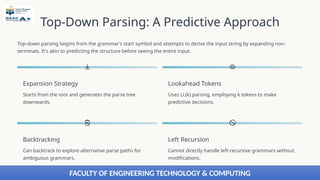
Top-down parsing begins from the grammar's start symbol and attempts to derive the input string by expanding non-
terminals. It's akin to predicting the structure before seeing the entire input.
Expansion Strategy
Starts from the root and generates the parse tree
downwards.
Lookahead Tokens
Uses LL(k) parsing, employing k tokens to make
predictive decisions.
Backtracking
Can backtrack to explore alternative parse paths for
ambiguous grammars.
Left Recursion
Cannot directly handle left-recursive grammars without
modifications.
FACULTY OF ENGINEERING TECHNOLOGY & COMPUTING
4.
Bottom-Up Parsing: Buildingfrom the Ground Up
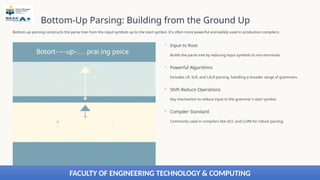
Bottom-up parsing constructs the parse tree from the input symbols up to the start symbol. It's often more powerful and widely used in production compilers.
Input to Root
Builds the parse tree by reducing input symbols to non-terminals.
Powerful Algorithms
Includes LR, SLR, and LALR parsing, handling a broader range of grammars.
Shift-Reduce Operations
Key mechanism to reduce input to the grammar's start symbol.
Compiler Standard
Commonly used in compilers like GCC and LLVM for robust parsing.
FACULTY OF ENGINEERING TECHNOLOGY & COMPUTING
5.
Challenges with Top-DownParsing
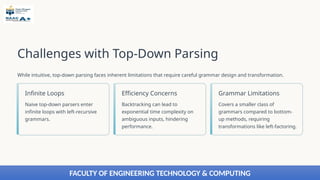
While intuitive, top-down parsing faces inherent limitations that require careful grammar design and transformation.
Infinite Loops
Naive top-down parsers enter
infinite loops with left-recursive
grammars.
Efficiency Concerns
Backtracking can lead to
exponential time complexity on
ambiguous inputs, hindering
performance.
Grammar Limitations
Covers a smaller class of
grammars compared to bottom-
up methods, requiring
transformations like left-factoring.
FACULTY OF ENGINEERING TECHNOLOGY & COMPUTING
6.
Challenges with Bottom-Up
Parsing
Despitetheir power, bottom-up parsing algorithms come with their own
set of complexities, particularly in implementation and error handling.
• Table Complexity: Construction of parser tables can be intricate and
memory-intensive.
• Debugging Difficulty: Generated parsers are often challenging to
debug.
• Ambiguity Resolution: Requires explicit rules for precedence and
associativity.
• Error Recovery: Implementing robust error recovery mechanisms
can be complex.
FACULTY OF ENGINEERING TECHNOLOGY & COMPUTING
7.
Resolving Ambiguity inParsing
Ambiguity poses a significant challenge, where a single input string can yield multiple valid parse trees. Addressing this is
crucial for accurate interpretation.
Multiple Parses
Input can have more than one correct structural interpretation.
Attachment Issues
Uncertainty in how modifiers link to other sentence elements.
Rule-Based Fixes
Resolved via precedence and associativity rules, often
leading to canonical parses.
Probabilistic Methods
Statistical models improve disambiguation, especially in
Natural Language Processing.
FACULTY OF ENGINEERING TECHNOLOGY & COMPUTING
8.
Hybrid Parsing: CombiningStrengths
Hybrid approaches blend the deterministic nature of rule-based grammars with the adaptability of statistical models, leading to more robust parsing systems.
The Best of Both Worlds
By integrating grammar rules with probabilistic models, hybrid parsing gains both
precision and flexibility.
• PCFGs: Assign likelihoods to different parse trees.
• Improved Accuracy: Better performance on complex or noisy data.
• Real-world Application: Crucial for natural language processing and web text
analysis.
FACULTY OF ENGINEERING TECHNOLOGY & COMPUTING
9.
Robust Parsing forNoisy Web Text
Web documents present unique challenges for parsers due to their unstructured nature, informal language, and frequent
errors. Robust solutions are vital for extracting meaningful data.
Handling Noise
Designed to gracefully manage typos, slang, and
incomplete sentences.
Scalability
Techniques like chart parsers and memoization ensure
efficient processing of large datasets.
ML Integration
Machine learning models guide parsing decisions for
improved accuracy.
Dynamic Approaches
Utilizes dynamic programming (Earley, GLR parsers) for
flexible and error-tolerant parsing.
FACULTY OF ENGINEERING TECHNOLOGY & COMPUTING
10.
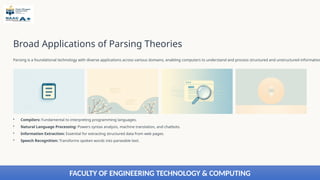
Broad Applications ofParsing Theories
Parsing is a foundational technology with diverse applications across various domains, enabling computers to understand and process structured and unstructured information
• Compilers: Fundamental to interpreting programming languages.
• Natural Language Processing: Powers syntax analysis, machine translation, and chatbots.
• Information Extraction: Essential for extracting structured data from web pages.
• Speech Recognition: Transforms spoken words into parseable text.
FACULTY OF ENGINEERING TECHNOLOGY & COMPUTING
11.
Key Takeaways andFuture Outlook
Parsing methodologies are constantly evolving, driven by the need for more robust, scalable, and intelligent systems to
handle the complexities of real-world data.
Complementary Approaches
Top-down and bottom-up parsing offer distinct
advantages and drawbacks, often complementing each
other.
Ambiguity is Key
Effective ambiguity resolution is paramount for accurate
and reliable parsing.
Hybrid's Promise
Hybrid and probabilistic methods significantly enhance
robustness on noisy, real-world data.
Future Directions
Research continues to focus on scalable, error-resilient
parsing for increasingly diverse text formats.
FACULTY OF ENGINEERING TECHNOLOGY & COMPUTING
12.
FACULTY OF ENGINEERINGTECHNOLOGY & COMPUTING
Thank You
For Any Query Contact :
Er. Jyoti Bala
ap4.cse@deshbhagatuniversity.in





![Cd2 [autosaved]](https://cdn.slidesharecdn.com/ss_thumbnails/cd2autosaved-161231072301-thumbnail.jpg?width=640&height=640&fit=bounds)


