Copyright © 2016 Elsevier
Chapter 2 ::
Programming Language Syntax
Programming Language Pragmatics, Fourth Edition
Michael L. Scott
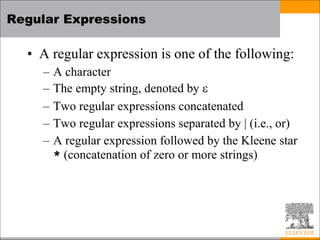
Regular Expressions
• A regular expression is one of the following:
– A character
– The empty string, denoted by 
– Two regular expressions concatenated
– Two regular expressions separated by | (i.e., or)
– A regular expression followed by the Kleene star
* (concatenation of zero or more strings)
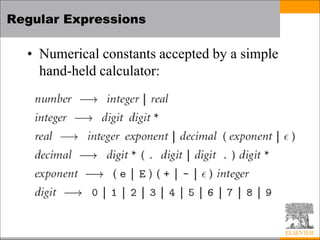
Regular Expressions
• Numerical constants accepted by a simple
hand-held calculator:
Context-Free Grammars
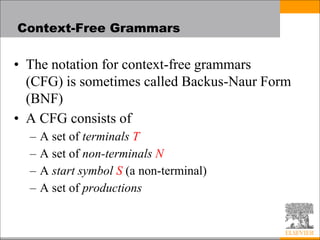
• The notation for context-free grammars
(CFG) is sometimes called Backus-Naur Form
(BNF)
• A CFG consists of
– A set of terminals T
– A set of non-terminals N
– A start symbol S (a non-terminal)
– A set of productions
Context-Free Grammars
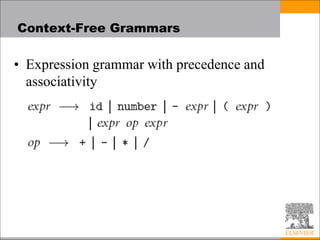
• Expression grammar with precedence and
associativity
Context-Free Grammars
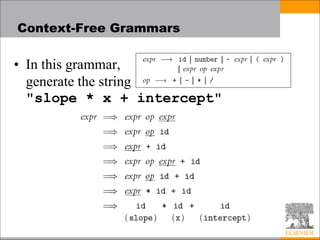
• In this grammar,
generate the string
"slope * x + intercept"
Context-Free Grammars
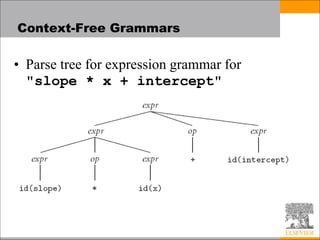
• Parse tree for expression grammar for
"slope * x + intercept"
Context-Free Grammars
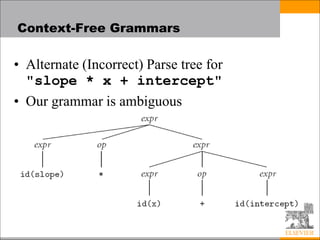
• Alternate (Incorrect) Parse tree for
"slope * x + intercept"
• Our grammar is ambiguous
Context-Free Grammars
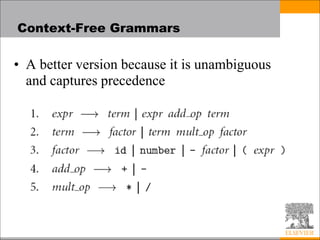
• A better version because it is unambiguous
and captures precedence
Context-Free Grammars
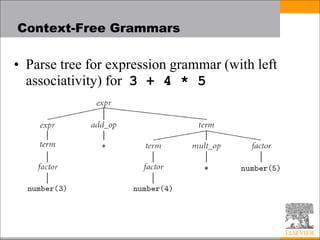
• Parse tree for expression grammar (with left
associativity) for 3 + 4 * 5
Scanning
• Recall scanner is responsible for
– tokenizing source
– removing comments
– (often) dealing with pragmas (i.e., significant
comments)
– saving text of identifiers, numbers, strings
– saving source locations (file, line, column) for
error messages
Scanning
• Suppose we are building an ad-hoc (hand-
written) scanner for Pascal:
– We read the characters one at a time with look-ahead
• If it is one of the one-character tokens
{ ( ) [ ] < > , ; = + - etc }
we announce that token
• If it is a ., we look at the next character
– If that is a dot, we announce .
– Otherwise, we announce . and reuse the look-ahead
Scanning
• If it is a <, we look at the next character
– if that is a = we announce <=
– otherwise, we announce < and reuse the look-
ahead, etc
• If it is a letter, we keep reading letters and
digits and maybe underscores until we can't
anymore
– then we check to see if it is a reserve word
Scanning
• If it is a digit, we keep reading until we find
a non-digit
– if that is not a . we announce an integer
– otherwise, we keep looking for a real number
– if the character after the . is not a digit we
announce an integer and reuse the . and the
look-ahead
Scanning
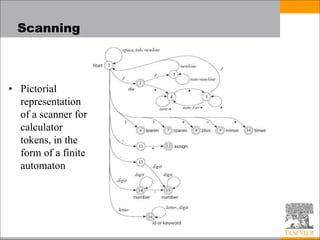
• Pictorial
representation
of a scanner for
calculator
tokens, in the
form of a finite
automaton
Scanning
• This is a deterministic finite automaton
(DFA)
– Lex, scangen, etc. build these things
automatically from a set of regular
expressions
– Specifically, they construct a machine that
accepts the language
identifier | int const
| real const | comment | symbol
| ...
Scanning
• We run the machine over and over to get
one token after another
– Nearly universal rule:
• always take the longest possible token from the
input
thus foobar is foobar and never f or foo or foob
• more to the point, 3.14159 is a real const and
never 3, ., and 14159
• Regular expressions "generate" a regular
language; DFAs "recognize" it
Scanning
• Scanners tend to be built three ways
– ad-hoc
– semi-mechanical pure DFA
(usually realized as nested case statements)
– table-driven DFA
• Ad-hoc generally yields the fastest, most
compact code by doing lots of special-
purpose things, though good automatically-
generated scanners come very close
Scanning
• Writing a pure DFA as a set of nested case
statements is a surprisingly useful
programming technique
– though it's often easier to use perl, awk, sed
– for details see Figure 2.11
• Table-driven DFA is what lex and scangen
produce
– lex (flex) in the form of C code
– scangen in the form of numeric tables and a
separate driver (for details see Figure 2.12)
Scanning
• Note that the rule about longest-possible tokens
means you return only when the next character
can't be used to continue the current token
– the next character will generally need to be saved for
the next token
• In some cases, you may need to peek at more than
one character of look-ahead in order to know
whether to proceed
– In Pascal, for example, when you have a 3 and you a
see a dot
• do you proceed (in hopes of getting 3.14)?
or
• do you stop (in fear of getting 3..5)?
Scanning
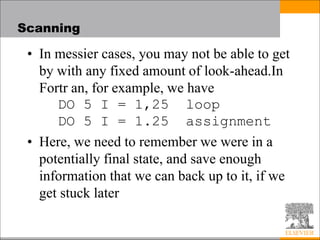
• In messier cases, you may not be able to get
by with any fixed amount of look-ahead.In
Fortr an, for example, we have
DO 5 I = 1,25 loop
DO 5 I = 1.25 assignment
• Here, we need to remember we were in a
potentially final state, and save enough
information that we can back up to it, if we
get stuck later
Parsing
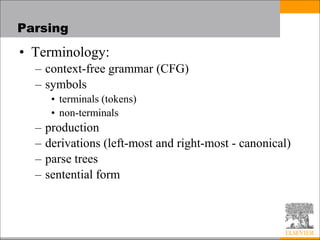
• Terminology:
– context-free grammar (CFG)
– symbols
• terminals (tokens)
• non-terminals
– production
– derivations (left-most and right-most - canonical)
– parse trees
– sentential form
Parsing
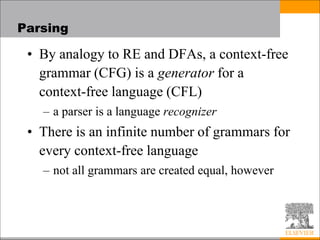
• By analogy to RE and DFAs, a context-free
grammar (CFG) is a generator for a
context-free language (CFL)
– a parser is a language recognizer
• There is an infinite number of grammars for
every context-free language
– not all grammars are created equal, however
Parsing
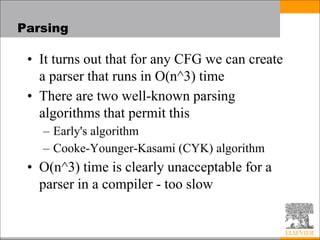
• It turns out that for any CFG we can create
a parser that runs in O(n^3) time
• There are two well-known parsing
algorithms that permit this
– Early's algorithm
– Cooke-Younger-Kasami (CYK) algorithm
• O(n^3) time is clearly unacceptable for a
parser in a compiler - too slow
Parsing
• Fortunately, there are large classes of
grammars for which we can build parsers
that run in linear time
– The two most important classes are called
LL and LR
• LL stands for
'Left-to-right, Leftmost derivation'.
• LR stands for
'Left-to-right, Rightmost derivation’
Parsing
• LL parsers are also called 'top-down', or
'predictive' parsers & LR parsers are also called
'bottom-up', or 'shift-reduce' parsers
• There are several important sub-classes of LR
parsers
– SLR
– LALR
• We won't be going into detail on the
differences between them
Parsing
• Every LL(1) grammar is also LR(1), though
right recursion in production tends to require
very deep stacks and complicates semantic
analysis
• Every CFL that can be parsed deterministically
has an SLR(1) grammar (which is LR(1))
• Every deterministic CFL with the prefix
property (no valid string is a prefix of another
valid string) has an LR(0) grammar
Parsing
• You commonly see LL or LR (or whatever)
written with a number in parentheses after it
– This number indicates how many tokens of
look-ahead are required in order to parse
– Almost all real compilers use one token of
look-ahead
• The expression grammar (with precedence
and associativity) you saw before is LR(1),
but not LL(1)
LL Parsing
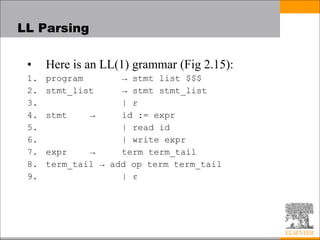
• Here is an LL(1) grammar (Fig 2.15):
1. program → stmt list $$$
2. stmt_list → stmt stmt_list
3. | ε
4. stmt → id := expr
5. | read id
6. | write expr
7. expr → term term_tail
8. term_tail → add op term term_tail
9. | ε
LL Parsing
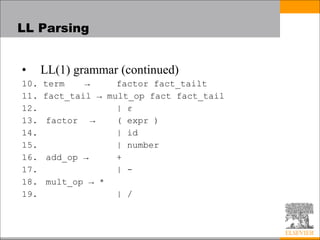
• LL(1) grammar (continued)
10. term → factor fact_tailt
11. fact_tail → mult_op fact fact_tail
12. | ε
13. factor → ( expr )
14. | id
15. | number
16. add_op → +
17. | -
18. mult_op → *
19. | /
LL Parsing
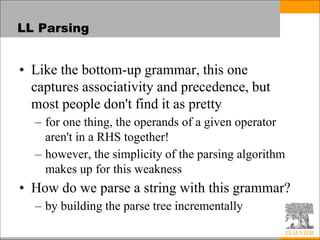
• Like the bottom-up grammar, this one
captures associativity and precedence, but
most people don't find it as pretty
– for one thing, the operands of a given operator
aren't in a RHS together!
– however, the simplicity of the parsing algorithm
makes up for this weakness
• How do we parse a string with this grammar?
– by building the parse tree incrementally
LL Parsing
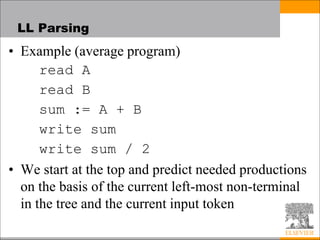
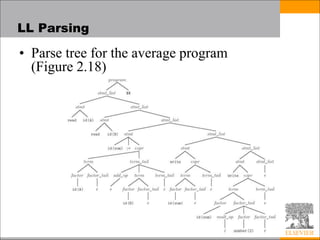
• Example (average program)
read A
read B
sum := A + B
write sum
write sum / 2
• We start at the top and predict needed productions
on the basis of the current left-most non-terminal
in the tree and the current input token
LL Parsing
• Parse tree for the average program
(Figure 2.18)
LL Parsing
• Table-driven LL parsing: you have a big
loop in which you repeatedly look up an
action in a two-dimensional table based on
current leftmost non-terminal and current
input token. The actions are
(1) match a terminal
(2) predict a production
(3) announce a syntax error
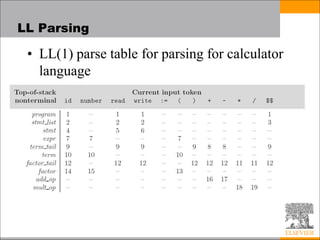
LL Parsing
• LL(1) parse table for parsing for calculator
language
LL Parsing
• To keep track of the left-most non-terminal,
you push the as-yet-unseen portions of
productions onto a stack
– for details see Figure 2.21
• The key thing to keep in mind is that the
stack contains all the stuff you expect to see
between now and the end of the program
– what you predict you will see
LL Parsing
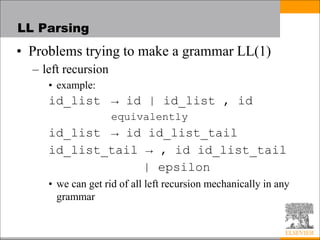
• Problems trying to make a grammar LL(1)
– left recursion
• example:
id_list → id | id_list , id
equivalently
id_list → id id_list_tail
id_list_tail → , id id_list_tail
| epsilon
• we can get rid of all left recursion mechanically in any
grammar
LL Parsing
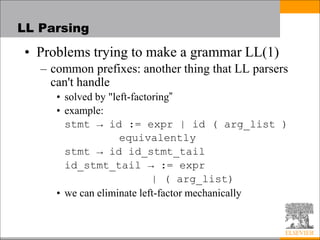
• Problems trying to make a grammar LL(1)
– common prefixes: another thing that LL parsers
can't handle
• solved by "left-factoring”
• example:
stmt → id := expr | id ( arg_list )
equivalently
stmt → id id_stmt_tail
id_stmt_tail → := expr
| ( arg_list)
• we can eliminate left-factor mechanically
LL Parsing
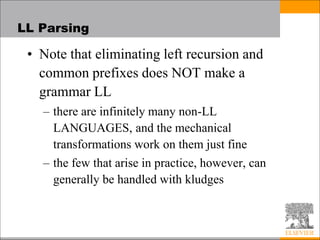
• Note that eliminating left recursion and
common prefixes does NOT make a
grammar LL
– there are infinitely many non-LL
LANGUAGES, and the mechanical
transformations work on them just fine
– the few that arise in practice, however, can
generally be handled with kludges
LL Parsing
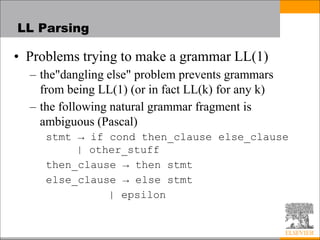
• Problems trying to make a grammar LL(1)
– the"dangling else" problem prevents grammars
from being LL(1) (or in fact LL(k) for any k)
– the following natural grammar fragment is
ambiguous (Pascal)
stmt → if cond then_clause else_clause
| other_stuff
then_clause → then stmt
else_clause → else stmt
| epsilon
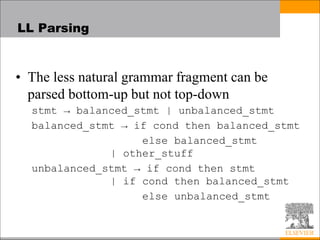
LL Parsing
• The less natural grammar fragment can be
parsed bottom-up but not top-down
stmt → balanced_stmt | unbalanced_stmt
balanced_stmt → if cond then balanced_stmt
else balanced_stmt
| other_stuff
unbalanced_stmt → if cond then stmt
| if cond then balanced_stmt
else unbalanced_stmt
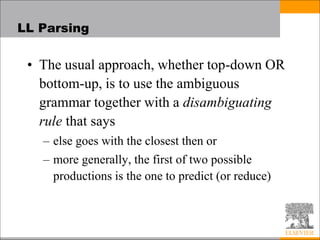
LL Parsing
• The usual approach, whether top-down OR
bottom-up, is to use the ambiguous
grammar together with a disambiguating
rule that says
– else goes with the closest then or
– more generally, the first of two possible
productions is the one to predict (or reduce)
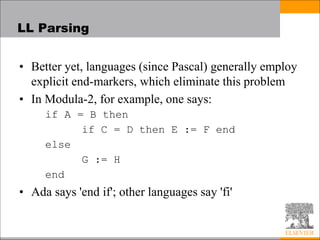
LL Parsing
• Better yet, languages (since Pascal) generally employ
explicit end-markers, which eliminate this problem
• In Modula-2, for example, one says:
if A = B then
if C = D then E := F end
else
G := H
end
• Ada says 'end if'; other languages say 'fi'
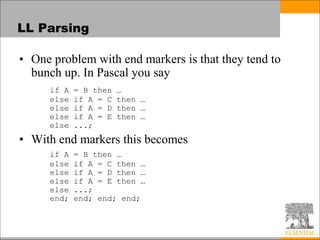
LL Parsing
• One problem with end markers is that they tend to
bunch up. In Pascal you say
if A = B then …
else if A = C then …
else if A = D then …
else if A = E then …
else ...;
• With end markers this becomes
if A = B then …
else if A = C then …
else if A = D then …
else if A = E then …
else ...;
end; end; end; end;
LL Parsing
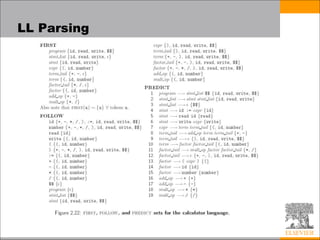
• The algorithm to build predict sets is
tedious (for a "real" sized grammar), but
relatively simple
• It consists of three stages:
– (1) compute FIRST sets for symbols
– (2) compute FOLLOW sets for non-terminals
(this requires computing FIRST sets for some
strings)
– (3) compute predict sets or table for all
productions
LL Parsing
• It is conventional in general discussions of grammars
to use
– lower case letters near the beginning of the alphabet for
terminals
– lower case letters near the end of the alphabet for strings
of terminals
– upper case letters near the beginning of the alphabet for
non-terminals
– upper case letters near the end of the alphabet for arbitrary
symbols
– greek letters for arbitrary strings of symbols
LL Parsing
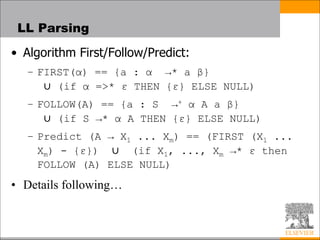
• Algorithm First/Follow/Predict:
– FIRST(α) == {a : α →* a β}
∪ (if α =>* ε THEN {ε} ELSE NULL)
– FOLLOW(A) == {a : S →+ α A a β}
∪ (if S →* α A THEN {ε} ELSE NULL)
– Predict (A → X1 ... Xm) == (FIRST (X1 ...
Xm) - {ε}) ∪ (if X1, ..., Xm →* ε then
FOLLOW (A) ELSE NULL)
• Details following…
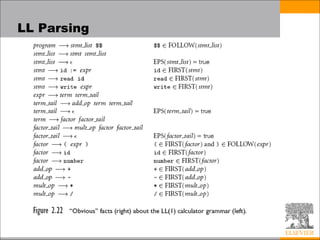
LL Parsing
LL Parsing
LL Parsing
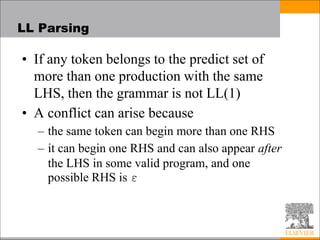
• If any token belongs to the predict set of
more than one production with the same
LHS, then the grammar is not LL(1)
• A conflict can arise because
– the same token can begin more than one RHS
– it can begin one RHS and can also appear after
the LHS in some valid program, and one
possible RHS is ε
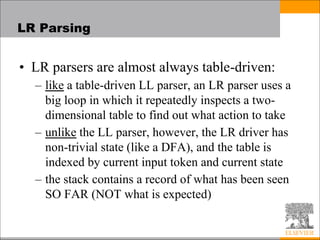
LR Parsing
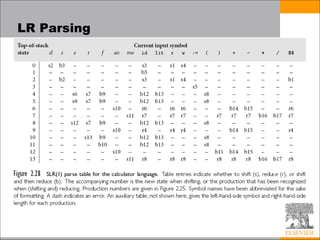
• LR parsers are almost always table-driven:
– like a table-driven LL parser, an LR parser uses a
big loop in which it repeatedly inspects a two-
dimensional table to find out what action to take
– unlike the LL parser, however, the LR driver has
non-trivial state (like a DFA), and the table is
indexed by current input token and current state
– the stack contains a record of what has been seen
SO FAR (NOT what is expected)
LR Parsing
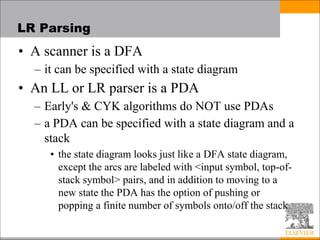
• A scanner is a DFA
– it can be specified with a state diagram
• An LL or LR parser is a PDA
– Early's & CYK algorithms do NOT use PDAs
– a PDA can be specified with a state diagram and a
stack
• the state diagram looks just like a DFA state diagram,
except the arcs are labeled with <input symbol, top-of-
stack symbol> pairs, and in addition to moving to a
new state the PDA has the option of pushing or
popping a finite number of symbols onto/off the stack
LR Parsing
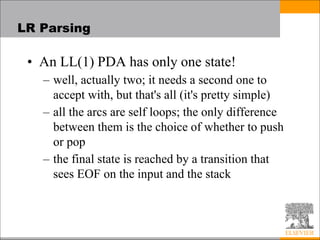
• An LL(1) PDA has only one state!
– well, actually two; it needs a second one to
accept with, but that's all (it's pretty simple)
– all the arcs are self loops; the only difference
between them is the choice of whether to push
or pop
– the final state is reached by a transition that
sees EOF on the input and the stack
LR Parsing
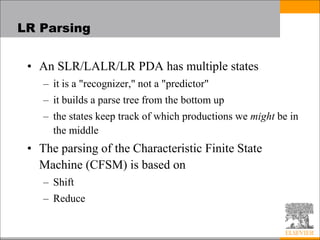
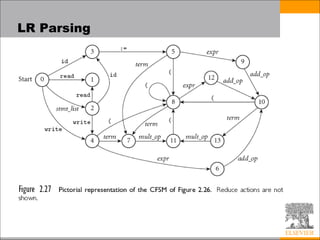
• An SLR/LALR/LR PDA has multiple states
– it is a "recognizer," not a "predictor"
– it builds a parse tree from the bottom up
– the states keep track of which productions we might be in
the middle
• The parsing of the Characteristic Finite State
Machine (CFSM) is based on
– Shift
– Reduce
LR Parsing
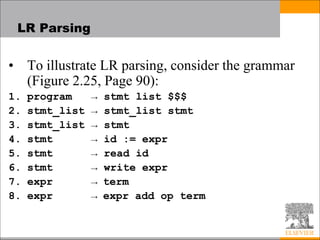
• To illustrate LR parsing, consider the grammar
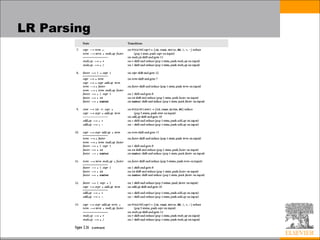
(Figure 2.25, Page 90):
1. program → stmt list $$$
2. stmt_list → stmt_list stmt
3. stmt_list → stmt
4. stmt → id := expr
5. stmt → read id
6. stmt → write expr
7. expr → term
8. expr → expr add op term
LR Parsing
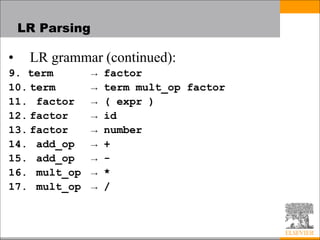
• LR grammar (continued):
9. term → factor
10. term → term mult_op factor
11. factor → ( expr )
12. factor → id
13. factor → number
14. add_op → +
15. add_op → -
16. mult_op → *
17. mult_op → /
LR Parsing
• This grammar is SLR(1), a particularly nice
class of bottom-up grammar
– it isn't exactly what we saw originally
– we've eliminated the epsilon production to
simplify the presentation
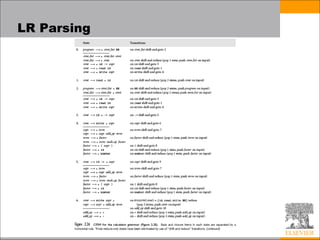
• For details on the table driven SLR(1)
parsing please note the following slides
LR Parsing
LR Parsing
LR Parsing
LR Parsing
LR Parsing
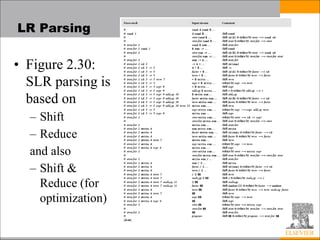
• Figure 2.30:
SLR parsing is
based on
– Shift
– Reduce
and also
– Shift &
Reduce (for
optimization)

Programming_Language_Syntax.ppt

  • 1.
    Copyright © 2016Elsevier Chapter 2 :: Programming Language Syntax Programming Language Pragmatics, Fourth Edition Michael L. Scott
  • 2.
    Regular Expressions • Aregular expression is one of the following: – A character – The empty string, denoted by  – Two regular expressions concatenated – Two regular expressions separated by | (i.e., or) – A regular expression followed by the Kleene star * (concatenation of zero or more strings)
  • 3.
    Regular Expressions • Numericalconstants accepted by a simple hand-held calculator:
  • 4.
    Context-Free Grammars • Thenotation for context-free grammars (CFG) is sometimes called Backus-Naur Form (BNF) • A CFG consists of – A set of terminals T – A set of non-terminals N – A start symbol S (a non-terminal) – A set of productions
  • 5.
    Context-Free Grammars • Expressiongrammar with precedence and associativity
  • 6.
    Context-Free Grammars • Inthis grammar, generate the string "slope * x + intercept"
  • 7.
    Context-Free Grammars • Parsetree for expression grammar for "slope * x + intercept"
  • 8.
    Context-Free Grammars • Alternate(Incorrect) Parse tree for "slope * x + intercept" • Our grammar is ambiguous
  • 9.
    Context-Free Grammars • Abetter version because it is unambiguous and captures precedence
  • 10.
    Context-Free Grammars • Parsetree for expression grammar (with left associativity) for 3 + 4 * 5
  • 11.
    Scanning • Recall scanneris responsible for – tokenizing source – removing comments – (often) dealing with pragmas (i.e., significant comments) – saving text of identifiers, numbers, strings – saving source locations (file, line, column) for error messages
  • 12.
    Scanning • Suppose weare building an ad-hoc (hand- written) scanner for Pascal: – We read the characters one at a time with look-ahead • If it is one of the one-character tokens { ( ) [ ] < > , ; = + - etc } we announce that token • If it is a ., we look at the next character – If that is a dot, we announce . – Otherwise, we announce . and reuse the look-ahead
  • 13.
    Scanning • If itis a <, we look at the next character – if that is a = we announce <= – otherwise, we announce < and reuse the look- ahead, etc • If it is a letter, we keep reading letters and digits and maybe underscores until we can't anymore – then we check to see if it is a reserve word
  • 14.
    Scanning • If itis a digit, we keep reading until we find a non-digit – if that is not a . we announce an integer – otherwise, we keep looking for a real number – if the character after the . is not a digit we announce an integer and reuse the . and the look-ahead
  • 15.
    Scanning • Pictorial representation of ascanner for calculator tokens, in the form of a finite automaton
  • 16.
    Scanning • This isa deterministic finite automaton (DFA) – Lex, scangen, etc. build these things automatically from a set of regular expressions – Specifically, they construct a machine that accepts the language identifier | int const | real const | comment | symbol | ...
  • 17.
    Scanning • We runthe machine over and over to get one token after another – Nearly universal rule: • always take the longest possible token from the input thus foobar is foobar and never f or foo or foob • more to the point, 3.14159 is a real const and never 3, ., and 14159 • Regular expressions "generate" a regular language; DFAs "recognize" it
  • 18.
    Scanning • Scanners tendto be built three ways – ad-hoc – semi-mechanical pure DFA (usually realized as nested case statements) – table-driven DFA • Ad-hoc generally yields the fastest, most compact code by doing lots of special- purpose things, though good automatically- generated scanners come very close
  • 19.
    Scanning • Writing apure DFA as a set of nested case statements is a surprisingly useful programming technique – though it's often easier to use perl, awk, sed – for details see Figure 2.11 • Table-driven DFA is what lex and scangen produce – lex (flex) in the form of C code – scangen in the form of numeric tables and a separate driver (for details see Figure 2.12)
  • 20.
    Scanning • Note thatthe rule about longest-possible tokens means you return only when the next character can't be used to continue the current token – the next character will generally need to be saved for the next token • In some cases, you may need to peek at more than one character of look-ahead in order to know whether to proceed – In Pascal, for example, when you have a 3 and you a see a dot • do you proceed (in hopes of getting 3.14)? or • do you stop (in fear of getting 3..5)?
  • 21.
    Scanning • In messiercases, you may not be able to get by with any fixed amount of look-ahead.In Fortr an, for example, we have DO 5 I = 1,25 loop DO 5 I = 1.25 assignment • Here, we need to remember we were in a potentially final state, and save enough information that we can back up to it, if we get stuck later
  • 22.
    Parsing • Terminology: – context-freegrammar (CFG) – symbols • terminals (tokens) • non-terminals – production – derivations (left-most and right-most - canonical) – parse trees – sentential form
  • 23.
    Parsing • By analogyto RE and DFAs, a context-free grammar (CFG) is a generator for a context-free language (CFL) – a parser is a language recognizer • There is an infinite number of grammars for every context-free language – not all grammars are created equal, however
  • 24.
    Parsing • It turnsout that for any CFG we can create a parser that runs in O(n^3) time • There are two well-known parsing algorithms that permit this – Early's algorithm – Cooke-Younger-Kasami (CYK) algorithm • O(n^3) time is clearly unacceptable for a parser in a compiler - too slow
  • 25.
    Parsing • Fortunately, thereare large classes of grammars for which we can build parsers that run in linear time – The two most important classes are called LL and LR • LL stands for 'Left-to-right, Leftmost derivation'. • LR stands for 'Left-to-right, Rightmost derivation’
  • 26.
    Parsing • LL parsersare also called 'top-down', or 'predictive' parsers & LR parsers are also called 'bottom-up', or 'shift-reduce' parsers • There are several important sub-classes of LR parsers – SLR – LALR • We won't be going into detail on the differences between them
  • 27.
    Parsing • Every LL(1)grammar is also LR(1), though right recursion in production tends to require very deep stacks and complicates semantic analysis • Every CFL that can be parsed deterministically has an SLR(1) grammar (which is LR(1)) • Every deterministic CFL with the prefix property (no valid string is a prefix of another valid string) has an LR(0) grammar
  • 28.
    Parsing • You commonlysee LL or LR (or whatever) written with a number in parentheses after it – This number indicates how many tokens of look-ahead are required in order to parse – Almost all real compilers use one token of look-ahead • The expression grammar (with precedence and associativity) you saw before is LR(1), but not LL(1)
  • 29.
    LL Parsing • Hereis an LL(1) grammar (Fig 2.15): 1. program → stmt list $$$ 2. stmt_list → stmt stmt_list 3. | ε 4. stmt → id := expr 5. | read id 6. | write expr 7. expr → term term_tail 8. term_tail → add op term term_tail 9. | ε
  • 30.
    LL Parsing • LL(1)grammar (continued) 10. term → factor fact_tailt 11. fact_tail → mult_op fact fact_tail 12. | ε 13. factor → ( expr ) 14. | id 15. | number 16. add_op → + 17. | - 18. mult_op → * 19. | /
  • 31.
    LL Parsing • Likethe bottom-up grammar, this one captures associativity and precedence, but most people don't find it as pretty – for one thing, the operands of a given operator aren't in a RHS together! – however, the simplicity of the parsing algorithm makes up for this weakness • How do we parse a string with this grammar? – by building the parse tree incrementally
  • 32.
    LL Parsing • Example(average program) read A read B sum := A + B write sum write sum / 2 • We start at the top and predict needed productions on the basis of the current left-most non-terminal in the tree and the current input token
  • 33.
    LL Parsing • Parsetree for the average program (Figure 2.18)
  • 34.
    LL Parsing • Table-drivenLL parsing: you have a big loop in which you repeatedly look up an action in a two-dimensional table based on current leftmost non-terminal and current input token. The actions are (1) match a terminal (2) predict a production (3) announce a syntax error
  • 35.
    LL Parsing • LL(1)parse table for parsing for calculator language
  • 36.
    LL Parsing • Tokeep track of the left-most non-terminal, you push the as-yet-unseen portions of productions onto a stack – for details see Figure 2.21 • The key thing to keep in mind is that the stack contains all the stuff you expect to see between now and the end of the program – what you predict you will see
  • 37.
    LL Parsing • Problemstrying to make a grammar LL(1) – left recursion • example: id_list → id | id_list , id equivalently id_list → id id_list_tail id_list_tail → , id id_list_tail | epsilon • we can get rid of all left recursion mechanically in any grammar
  • 38.
    LL Parsing • Problemstrying to make a grammar LL(1) – common prefixes: another thing that LL parsers can't handle • solved by "left-factoring” • example: stmt → id := expr | id ( arg_list ) equivalently stmt → id id_stmt_tail id_stmt_tail → := expr | ( arg_list) • we can eliminate left-factor mechanically
  • 39.
    LL Parsing • Notethat eliminating left recursion and common prefixes does NOT make a grammar LL – there are infinitely many non-LL LANGUAGES, and the mechanical transformations work on them just fine – the few that arise in practice, however, can generally be handled with kludges
  • 40.
    LL Parsing • Problemstrying to make a grammar LL(1) – the"dangling else" problem prevents grammars from being LL(1) (or in fact LL(k) for any k) – the following natural grammar fragment is ambiguous (Pascal) stmt → if cond then_clause else_clause | other_stuff then_clause → then stmt else_clause → else stmt | epsilon
  • 41.
    LL Parsing • Theless natural grammar fragment can be parsed bottom-up but not top-down stmt → balanced_stmt | unbalanced_stmt balanced_stmt → if cond then balanced_stmt else balanced_stmt | other_stuff unbalanced_stmt → if cond then stmt | if cond then balanced_stmt else unbalanced_stmt
  • 42.
    LL Parsing • Theusual approach, whether top-down OR bottom-up, is to use the ambiguous grammar together with a disambiguating rule that says – else goes with the closest then or – more generally, the first of two possible productions is the one to predict (or reduce)
  • 43.
    LL Parsing • Betteryet, languages (since Pascal) generally employ explicit end-markers, which eliminate this problem • In Modula-2, for example, one says: if A = B then if C = D then E := F end else G := H end • Ada says 'end if'; other languages say 'fi'
  • 44.
    LL Parsing • Oneproblem with end markers is that they tend to bunch up. In Pascal you say if A = B then … else if A = C then … else if A = D then … else if A = E then … else ...; • With end markers this becomes if A = B then … else if A = C then … else if A = D then … else if A = E then … else ...; end; end; end; end;
  • 45.
    LL Parsing • Thealgorithm to build predict sets is tedious (for a "real" sized grammar), but relatively simple • It consists of three stages: – (1) compute FIRST sets for symbols – (2) compute FOLLOW sets for non-terminals (this requires computing FIRST sets for some strings) – (3) compute predict sets or table for all productions
  • 46.
    LL Parsing • Itis conventional in general discussions of grammars to use – lower case letters near the beginning of the alphabet for terminals – lower case letters near the end of the alphabet for strings of terminals – upper case letters near the beginning of the alphabet for non-terminals – upper case letters near the end of the alphabet for arbitrary symbols – greek letters for arbitrary strings of symbols
  • 47.
    LL Parsing • AlgorithmFirst/Follow/Predict: – FIRST(α) == {a : α →* a β} ∪ (if α =>* ε THEN {ε} ELSE NULL) – FOLLOW(A) == {a : S →+ α A a β} ∪ (if S →* α A THEN {ε} ELSE NULL) – Predict (A → X1 ... Xm) == (FIRST (X1 ... Xm) - {ε}) ∪ (if X1, ..., Xm →* ε then FOLLOW (A) ELSE NULL) • Details following…
  • 48.
  • 49.
  • 50.
    LL Parsing • Ifany token belongs to the predict set of more than one production with the same LHS, then the grammar is not LL(1) • A conflict can arise because – the same token can begin more than one RHS – it can begin one RHS and can also appear after the LHS in some valid program, and one possible RHS is ε
  • 51.
    LR Parsing • LRparsers are almost always table-driven: – like a table-driven LL parser, an LR parser uses a big loop in which it repeatedly inspects a two- dimensional table to find out what action to take – unlike the LL parser, however, the LR driver has non-trivial state (like a DFA), and the table is indexed by current input token and current state – the stack contains a record of what has been seen SO FAR (NOT what is expected)
  • 52.
    LR Parsing • Ascanner is a DFA – it can be specified with a state diagram • An LL or LR parser is a PDA – Early's & CYK algorithms do NOT use PDAs – a PDA can be specified with a state diagram and a stack • the state diagram looks just like a DFA state diagram, except the arcs are labeled with <input symbol, top-of- stack symbol> pairs, and in addition to moving to a new state the PDA has the option of pushing or popping a finite number of symbols onto/off the stack
  • 53.
    LR Parsing • AnLL(1) PDA has only one state! – well, actually two; it needs a second one to accept with, but that's all (it's pretty simple) – all the arcs are self loops; the only difference between them is the choice of whether to push or pop – the final state is reached by a transition that sees EOF on the input and the stack
  • 54.
    LR Parsing • AnSLR/LALR/LR PDA has multiple states – it is a "recognizer," not a "predictor" – it builds a parse tree from the bottom up – the states keep track of which productions we might be in the middle • The parsing of the Characteristic Finite State Machine (CFSM) is based on – Shift – Reduce
  • 55.
    LR Parsing • Toillustrate LR parsing, consider the grammar (Figure 2.25, Page 90): 1. program → stmt list $$$ 2. stmt_list → stmt_list stmt 3. stmt_list → stmt 4. stmt → id := expr 5. stmt → read id 6. stmt → write expr 7. expr → term 8. expr → expr add op term
  • 56.
    LR Parsing • LRgrammar (continued): 9. term → factor 10. term → term mult_op factor 11. factor → ( expr ) 12. factor → id 13. factor → number 14. add_op → + 15. add_op → - 16. mult_op → * 17. mult_op → /
  • 57.
    LR Parsing • Thisgrammar is SLR(1), a particularly nice class of bottom-up grammar – it isn't exactly what we saw originally – we've eliminated the epsilon production to simplify the presentation • For details on the table driven SLR(1) parsing please note the following slides
  • 58.
  • 59.
  • 60.
  • 61.
  • 62.
    LR Parsing • Figure2.30: SLR parsing is based on – Shift – Reduce and also – Shift & Reduce (for optimization)