Top-Down
Parsing
&
Predictive
Parsing
PRESENTED BY,
VENISHA S
I M. SC. COMPUTER SCIENCE
Defining Top-Down Parsing
1 Goal-Oriented
Top-down parsing aims to construct a parse tree for a
sentence, starting from the top (root) and working
downwards.
2 Predictive Approach
It predicts the structure of the sentence based on
the grammar rules and attempts to match the input
symbols.
3 Recursive Process
Top-down parsing typically employs recursion to explore
different possibilities and find a valid parse.
4 Leftmost Derivation
It usually follows a leftmost derivation strategy,
expanding non-terminal symbols from left to right.
The Recursive Descent Algorithm
1 Initialization
Start with the starting symbol of the grammar.
2 Expansion
Recursively expand non-terminal symbols based on
the grammar rules.
3 Matching
Match the expanded terminal symbols with the input symbols,
one by one.
4 Backtracking
If a mismatch occurs, backtrack to previous expansions and try
alternative rules.
Advantages of Top-Down Parsing
Simplicity
Top-down parsing is conceptually
simple to understand
and implement.
Flexibility
It can handle a wide range of
grammar rules and
handle ambiguity.
Efficiency
For simple grammars,
it can be faster than
bottom-up parsing.
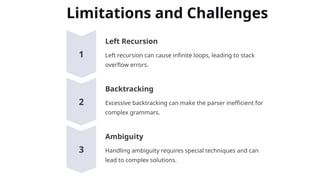
Limitations and Challenges
Left Recursion
Left recursion can cause infinite loops, leading to stack
overflow errors.
Backtracking
Excessive backtracking can make the parser inefficient for
complex grammars.
Ambiguity
Handling ambiguity requires special techniques and can
lead to complex solutions.
Parsing Context-Free Grammars
Grammar Rule Description
S -> NP VP A sentence (S) consists of a noun phrase
(NP) and a verb phrase (VP).
NP -> DT NN A noun phrase (NP) can be a determiner
(DT) followed by a noun (NN).
VP -> VB NP A verb phrase (VP) can be a verb (VB)
followed by a noun phrase (NP).
DT -> 'the' A determiner (DT) can be the word 'the'.
NN -> 'cat' A noun (NN) can be the word 'cat'.
VB -> 'chased' A verb (VB) can be the word 'chased'.
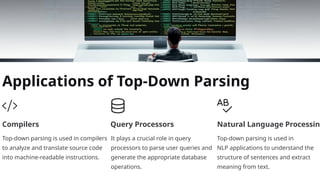
Applications of Top-Down Parsing
Compilers
Top-down parsing is used in compilers
to analyze and translate source code
into machine-readable instructions.
Query Processors
It plays a crucial role in query
processors to parse user queries and
generate the appropriate database
operations.
Natural Language Processing
Top-down parsing is used in
NLP applications to understand the
structure of sentences and extract
meaning from text.
Predictive
Parsing
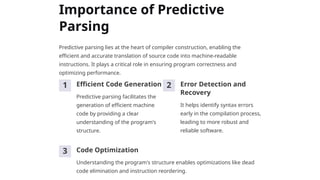
Importance of Predictive
Parsing
Predictive parsing lies at the heart of compiler construction, enabling the
efficient and accurate translation of source code into machine-readable
instructions. It plays a critical role in ensuring program correctness and
optimizing performance.
1 Efficient Code Generation
Predictive parsing facilitates the
generation of efficient machine
code by providing a clear
understanding of the program's
structure.
2 Error Detection and
Recovery
It helps identify syntax errors
early in the compilation process,
leading to more robust and
reliable software.
3 Code Optimization
Understanding the program's structure enables optimizations like dead
code elimination and instruction reordering.
Underlying Principles of Predictive Parsing
Predictive parsing relies on the idea of predicting the next symbol in the input based on
the current state of the parser. It leverages a parsing table that maps grammar rules and
input symbols to actions, guiding the parser's decisions.
Grammar Rules
Predictive parsing requires a context-free grammar,
which defines the rules governing the language's
syntax. The grammar must be LL(1) for unambiguous
parsing.
Parsing Table
The parsing table serves as a guide for the parser,
indicating which actions to take based on the
current input symbol and the current state
of the parser. The actions typically involve
shifting or reducing the input string.
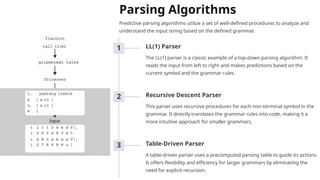
Parsing Algorithms
Predictive parsing algorithms utilize a set of well-defined procedures to analyze and
understand the input string based on the defined grammar.
1 LL(1) Parser
The LL(1) parser is a classic example of a top-down parsing algorithm. It
reads the input from left to right and makes predictions based on the
current symbol and the grammar rules.
2 Recursive Descent Parser
This parser uses recursive procedures for each non-terminal symbol in the
grammar. It directly translates the grammar rules into code, making it a
more intuitive approach for smaller grammars.
3 Table-Driven Parser
A table-driven parser uses a precomputed parsing table to guide its actions.
It offers flexibility and efficiency for larger grammars by eliminating the
need for explicit recursion.
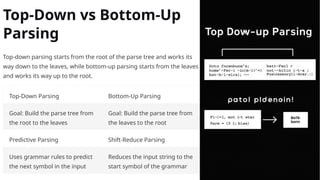
Top-Down vs Bottom-Up
Parsing
Top-down parsing starts from the root of the parse tree and works its
way down to the leaves, while bottom-up parsing starts from the leaves
and works its way up to the root.
Top-Down Parsing Bottom-Up Parsing
Goal: Build the parse tree from
the root to the leaves
Goal: Build the parse tree from
the leaves to the root
Predictive Parsing Shift-Reduce Parsing
Uses grammar rules to predict
the next symbol in the input
Reduces the input string to the
start symbol of the grammar
Challenges in Predictive Parsing
Despite its strengths, predictive parsing has some limitations. Understanding these challenges is crucial for
selecting the appropriate parsing approach.
Left Recursion
Left recursion in the grammar can
cause the parser to enter an infinite
loop, leading to parsing errors.
Ambiguity
If the grammar is ambiguous, the
parser might generate multiple parse
trees for the same input, creating
uncertainty in the interpretation.
Efficiency Considerations
Predictive parsing can become less
efficient for larger grammars,
especially if they are complex or
contain many non-terminals.
Applications of Predictive Parsing
Predictive parsing finds extensive use in a wide range of computing applications. It is a
cornerstone of compiler design, enabling the efficient analysis and translation of
source code.
Compiler Construction
Predictive parsing is fundamental in compiler design, responsible for
analyzing the syntax of programs and generating intermediate
representations.
Language Processors
Predictive parsing is crucial for language processors, such as
interpreters and virtual machines, which execute programs written in
specific languages.
Text Editors and IDEs
Predictive parsing plays a role in text editors and IDEs, providing
features like syntax highlighting, code completion, and error detection.
Future Trends in Predictive Parsing
Performance Optimization
Researchers are developing techniques
to optimize the performance of
predictive parsing algorithms for
larger and more complex grammars.
Data-Driven Parsing
Data-driven approaches to predictive
parsing are gaining traction, leveraging
statistical techniques and
machine learning to improve parsing
accuracy.
Cloud-Based Parsing
The move towards cloud computing
is influencing parsing techniques,
with cloud-based parsing solutions
offering scalability and distributed
processing capabilities.
THANK YOU!!!

TOPDOWN-PREDICTIVE.pptx TOP-DOWN PARSING & PREDICTIVE PARSING

  • 1.
  • 2.
    Defining Top-Down Parsing 1Goal-Oriented Top-down parsing aims to construct a parse tree for a sentence, starting from the top (root) and working downwards. 2 Predictive Approach It predicts the structure of the sentence based on the grammar rules and attempts to match the input symbols. 3 Recursive Process Top-down parsing typically employs recursion to explore different possibilities and find a valid parse. 4 Leftmost Derivation It usually follows a leftmost derivation strategy, expanding non-terminal symbols from left to right.
  • 3.
    The Recursive DescentAlgorithm 1 Initialization Start with the starting symbol of the grammar. 2 Expansion Recursively expand non-terminal symbols based on the grammar rules. 3 Matching Match the expanded terminal symbols with the input symbols, one by one. 4 Backtracking If a mismatch occurs, backtrack to previous expansions and try alternative rules.
  • 4.
    Advantages of Top-DownParsing Simplicity Top-down parsing is conceptually simple to understand and implement. Flexibility It can handle a wide range of grammar rules and handle ambiguity. Efficiency For simple grammars, it can be faster than bottom-up parsing.
  • 5.
    Limitations and Challenges LeftRecursion Left recursion can cause infinite loops, leading to stack overflow errors. Backtracking Excessive backtracking can make the parser inefficient for complex grammars. Ambiguity Handling ambiguity requires special techniques and can lead to complex solutions.
  • 6.
    Parsing Context-Free Grammars GrammarRule Description S -> NP VP A sentence (S) consists of a noun phrase (NP) and a verb phrase (VP). NP -> DT NN A noun phrase (NP) can be a determiner (DT) followed by a noun (NN). VP -> VB NP A verb phrase (VP) can be a verb (VB) followed by a noun phrase (NP). DT -> 'the' A determiner (DT) can be the word 'the'. NN -> 'cat' A noun (NN) can be the word 'cat'. VB -> 'chased' A verb (VB) can be the word 'chased'.
  • 7.
    Applications of Top-DownParsing Compilers Top-down parsing is used in compilers to analyze and translate source code into machine-readable instructions. Query Processors It plays a crucial role in query processors to parse user queries and generate the appropriate database operations. Natural Language Processing Top-down parsing is used in NLP applications to understand the structure of sentences and extract meaning from text.
  • 8.
  • 9.
    Importance of Predictive Parsing Predictiveparsing lies at the heart of compiler construction, enabling the efficient and accurate translation of source code into machine-readable instructions. It plays a critical role in ensuring program correctness and optimizing performance. 1 Efficient Code Generation Predictive parsing facilitates the generation of efficient machine code by providing a clear understanding of the program's structure. 2 Error Detection and Recovery It helps identify syntax errors early in the compilation process, leading to more robust and reliable software. 3 Code Optimization Understanding the program's structure enables optimizations like dead code elimination and instruction reordering.
  • 10.
    Underlying Principles ofPredictive Parsing Predictive parsing relies on the idea of predicting the next symbol in the input based on the current state of the parser. It leverages a parsing table that maps grammar rules and input symbols to actions, guiding the parser's decisions. Grammar Rules Predictive parsing requires a context-free grammar, which defines the rules governing the language's syntax. The grammar must be LL(1) for unambiguous parsing. Parsing Table The parsing table serves as a guide for the parser, indicating which actions to take based on the current input symbol and the current state of the parser. The actions typically involve shifting or reducing the input string.
  • 11.
    Parsing Algorithms Predictive parsingalgorithms utilize a set of well-defined procedures to analyze and understand the input string based on the defined grammar. 1 LL(1) Parser The LL(1) parser is a classic example of a top-down parsing algorithm. It reads the input from left to right and makes predictions based on the current symbol and the grammar rules. 2 Recursive Descent Parser This parser uses recursive procedures for each non-terminal symbol in the grammar. It directly translates the grammar rules into code, making it a more intuitive approach for smaller grammars. 3 Table-Driven Parser A table-driven parser uses a precomputed parsing table to guide its actions. It offers flexibility and efficiency for larger grammars by eliminating the need for explicit recursion.
  • 12.
    Top-Down vs Bottom-Up Parsing Top-downparsing starts from the root of the parse tree and works its way down to the leaves, while bottom-up parsing starts from the leaves and works its way up to the root. Top-Down Parsing Bottom-Up Parsing Goal: Build the parse tree from the root to the leaves Goal: Build the parse tree from the leaves to the root Predictive Parsing Shift-Reduce Parsing Uses grammar rules to predict the next symbol in the input Reduces the input string to the start symbol of the grammar
  • 13.
    Challenges in PredictiveParsing Despite its strengths, predictive parsing has some limitations. Understanding these challenges is crucial for selecting the appropriate parsing approach. Left Recursion Left recursion in the grammar can cause the parser to enter an infinite loop, leading to parsing errors. Ambiguity If the grammar is ambiguous, the parser might generate multiple parse trees for the same input, creating uncertainty in the interpretation. Efficiency Considerations Predictive parsing can become less efficient for larger grammars, especially if they are complex or contain many non-terminals.
  • 14.
    Applications of PredictiveParsing Predictive parsing finds extensive use in a wide range of computing applications. It is a cornerstone of compiler design, enabling the efficient analysis and translation of source code. Compiler Construction Predictive parsing is fundamental in compiler design, responsible for analyzing the syntax of programs and generating intermediate representations. Language Processors Predictive parsing is crucial for language processors, such as interpreters and virtual machines, which execute programs written in specific languages. Text Editors and IDEs Predictive parsing plays a role in text editors and IDEs, providing features like syntax highlighting, code completion, and error detection.
  • 15.
    Future Trends inPredictive Parsing Performance Optimization Researchers are developing techniques to optimize the performance of predictive parsing algorithms for larger and more complex grammars. Data-Driven Parsing Data-driven approaches to predictive parsing are gaining traction, leveraging statistical techniques and machine learning to improve parsing accuracy. Cloud-Based Parsing The move towards cloud computing is influencing parsing techniques, with cloud-based parsing solutions offering scalability and distributed processing capabilities.
  • 16.