Input – Output Analysis
 Definition:
Input-Output Analysis is a quantitative economic technique developed by
Wassily Leontief, used to study the interdependencies among different sectors
of an economy. It represents the flow of goods and services between
industries in a structured mathematical format.
Input-Output Table
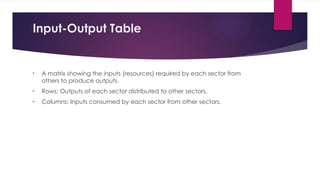
• A matrix showing the inputs (resources) required by each sector from
others to produce outputs.
• Rows: Outputs of each sector distributed to other sectors.
• Columns: Inputs consumed by each sector from other sectors.
Leontief Production Function
 Leontief Production Function:
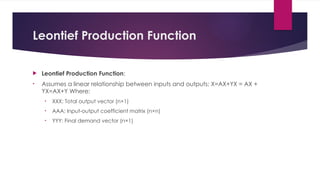
• Assumes a linear relationship between inputs and outputs: X=AX+YX = AX +
YX=AX+Y Where:
• XXX: Total output vector (n×1)
• AAA: Input-output coefficient matrix (n×n)
• YYY: Final demand vector (n×1)
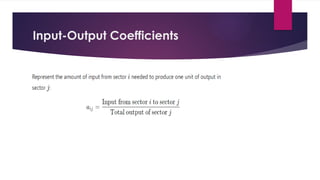
Input-Output Coefficients
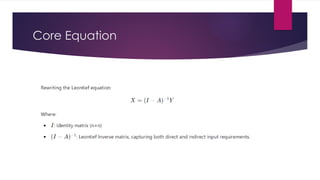
Core Equation
Assumptions
1. Linear Production Technology: Input-output relationships are fixed
(constant returns to scale).
2. No Substitution: Inputs are used in fixed proportions.
3. Closed Economy: Initially assumes no external trade (can be extended to
include imports and exports).
4. Static Analysis: Focuses on a snapshot in time rather than dynamic
changes.

Input-output Analysis - Mathematical Economics.pptx

  • 1.
    Input – OutputAnalysis  Definition: Input-Output Analysis is a quantitative economic technique developed by Wassily Leontief, used to study the interdependencies among different sectors of an economy. It represents the flow of goods and services between industries in a structured mathematical format.
  • 2.
    Input-Output Table • Amatrix showing the inputs (resources) required by each sector from others to produce outputs. • Rows: Outputs of each sector distributed to other sectors. • Columns: Inputs consumed by each sector from other sectors.
  • 3.
    Leontief Production Function Leontief Production Function: • Assumes a linear relationship between inputs and outputs: X=AX+YX = AX + YX=AX+Y Where: • XXX: Total output vector (n×1) • AAA: Input-output coefficient matrix (n×n) • YYY: Final demand vector (n×1)
  • 4.
  • 5.
  • 6.
    Assumptions 1. Linear ProductionTechnology: Input-output relationships are fixed (constant returns to scale). 2. No Substitution: Inputs are used in fixed proportions. 3. Closed Economy: Initially assumes no external trade (can be extended to include imports and exports). 4. Static Analysis: Focuses on a snapshot in time rather than dynamic changes.