PROPER NOUNS
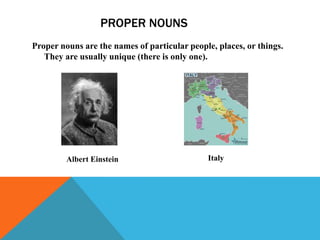
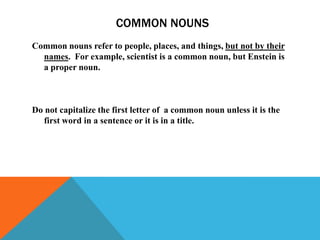
Proper nouns are the names of particular people, places, or things.
   They are usually unique (there is only one).


         Albert Einstein                      Italy
COMMON NOUNS
Common nouns refer to people, places, and things, but not by their
  names. For example, scientist is a common noun, but Enstein is
  a proper noun.


Do not capitalize the first letter of a common noun unless it is the
   first word in a sentence or it is in a title.
COUNT NOUNS
Common nouns can be count or non-count.

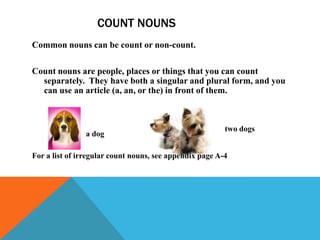
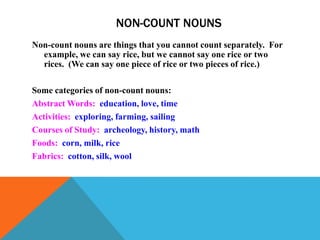
Count nouns are people, places or things that you can count
  separately. They have both a singular and plural form, and you
  can use an article (a, an, or the) in front of them.


                                                         two dogs
                a dog

For a list of irregular count nouns, see appendix page A-4
NON-COUNT NOUNS
Non-count nouns are things that you cannot count separately. For
  example, we can say rice, but we cannot say one rice or two
  rices. (We can say one piece of rice or two pieces of rice.)

Some categories of non-count nouns:
Abstract Words: education, love, time
Activities: exploring, farming, sailing
Courses of Study: archeology, history, math
Foods: corn, milk, rice
Fabrics: cotton, silk, wool
NON-COUNT NOUNS
Some common non-count nouns do not fit into categories:
equipment        homework          news
furniture        information       work


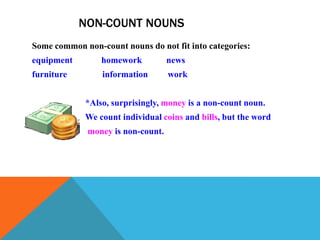
             *Also, surprisingly, money is a non-count noun.
             We count individual coins and bills, but the word
             money is non-count.
NON-COUNT NOUNS
Non-count nouns have NO plural forms.
She bought a lot of wool. Not: wools


Non-count nouns take singular verbs and pronouns.
Archeology is an interesting subject. It was his favorite subject.


We usually do not use a or an with non-count nouns. However we can
  use the.
I bought a sugar at the store.
 Please put the sugar on the shelf.
PRACTICE
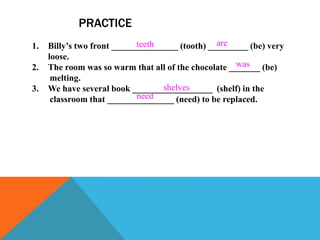
1.                           teeth               are
     Billy’s two front _______________ (tooth) _________ (be) very
     loose.
2.                                                    was
     The room was so warm that all of the chocolate _______ (be)
      melting.
3.                                 shelves
     We have several book __________________ (shelf) in the
                             need
      classroom that _______________ (need) to be replaced.
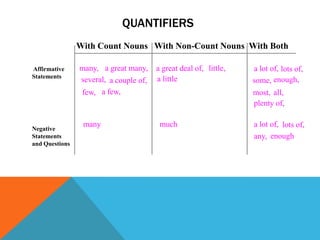
QUANTIFIERS
Use quantifiers with nouns to talk about how many or how much.
   Some quantifiers go only with count nouns, and some go only
   with non-count nouns. Others can go with both.
QUANTIFIERS
                With Count Nouns With Non-Count Nouns With Both

Affirmative     many, a great many,     a great deal of, little,   a lot of, lots of,
Statements                              a little
                several, a couple of,                              some, enough,
                 few, a few,                                       most, all,
                                                                   plenty of,

                 many                    much                      a lot of, lots of,
Negative
Statements                                                         any, enough
and Questions
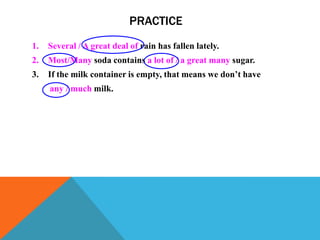
PRACTICE
1.   Several / A great deal of rain has fallen lately.
2.   Most/Many soda contains a lot of / a great many sugar.
3.   If the milk container is empty, that means we don’t have
     any / much milk.
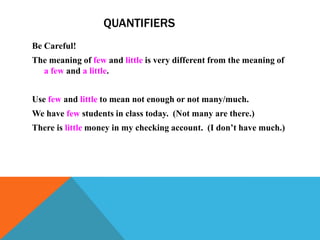
QUANTIFIERS
Be Careful!
The meaning of few and little is very different from the meaning of
  a few and a little.


Use few and little to mean not enough or not many/much.
We have few students in class today. (Not many are there.)
There is little money in my checking account. (I don’t have much.)
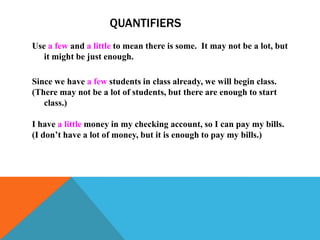
QUANTIFIERS
Use a few and a little to mean there is some. It may not be a lot, but
   it might be just enough.

Since we have a few students in class already, we will begin class.
(There may not be a lot of students, but there are enough to start
   class.)

I have a little money in my checking account, so I can pay my bills.
(I don’t have a lot of money, but it is enough to pay my bills.)
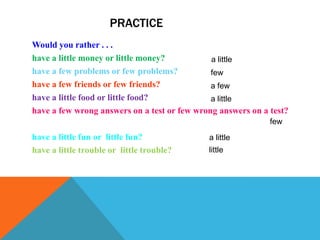
PRACTICE
Would you rather . . .
have a little money or little money?          a little
have a few problems or few problems?          few
have a few friends or few friends?            a few
have a little food or little food?            a little
have a few wrong answers on a test or few wrong answers on a test?
                                                             few
have a little fun or little fun?             a little
have a little trouble or little trouble?     little

Unit 17 Nouns and Quantifiers

  • 2.
    PROPER NOUNS Proper nounsare the names of particular people, places, or things. They are usually unique (there is only one). Albert Einstein Italy
  • 3.
    COMMON NOUNS Common nounsrefer to people, places, and things, but not by their names. For example, scientist is a common noun, but Enstein is a proper noun. Do not capitalize the first letter of a common noun unless it is the first word in a sentence or it is in a title.
  • 4.
    COUNT NOUNS Common nounscan be count or non-count. Count nouns are people, places or things that you can count separately. They have both a singular and plural form, and you can use an article (a, an, or the) in front of them. two dogs a dog For a list of irregular count nouns, see appendix page A-4
  • 5.
    NON-COUNT NOUNS Non-count nounsare things that you cannot count separately. For example, we can say rice, but we cannot say one rice or two rices. (We can say one piece of rice or two pieces of rice.) Some categories of non-count nouns: Abstract Words: education, love, time Activities: exploring, farming, sailing Courses of Study: archeology, history, math Foods: corn, milk, rice Fabrics: cotton, silk, wool
  • 6.
    NON-COUNT NOUNS Some commonnon-count nouns do not fit into categories: equipment homework news furniture information work *Also, surprisingly, money is a non-count noun. We count individual coins and bills, but the word money is non-count.
  • 7.
    NON-COUNT NOUNS Non-count nounshave NO plural forms. She bought a lot of wool. Not: wools Non-count nouns take singular verbs and pronouns. Archeology is an interesting subject. It was his favorite subject. We usually do not use a or an with non-count nouns. However we can use the. I bought a sugar at the store. Please put the sugar on the shelf.
  • 8.
    PRACTICE 1. teeth are Billy’s two front _______________ (tooth) _________ (be) very loose. 2. was The room was so warm that all of the chocolate _______ (be) melting. 3. shelves We have several book __________________ (shelf) in the need classroom that _______________ (need) to be replaced.
  • 9.
    QUANTIFIERS Use quantifiers withnouns to talk about how many or how much. Some quantifiers go only with count nouns, and some go only with non-count nouns. Others can go with both.
  • 10.
    QUANTIFIERS With Count Nouns With Non-Count Nouns With Both Affirmative many, a great many, a great deal of, little, a lot of, lots of, Statements a little several, a couple of, some, enough, few, a few, most, all, plenty of, many much a lot of, lots of, Negative Statements any, enough and Questions
  • 11.
    PRACTICE 1. Several / A great deal of rain has fallen lately. 2. Most/Many soda contains a lot of / a great many sugar. 3. If the milk container is empty, that means we don’t have any / much milk.
  • 12.
    QUANTIFIERS Be Careful! The meaningof few and little is very different from the meaning of a few and a little. Use few and little to mean not enough or not many/much. We have few students in class today. (Not many are there.) There is little money in my checking account. (I don’t have much.)
  • 13.
    QUANTIFIERS Use a fewand a little to mean there is some. It may not be a lot, but it might be just enough. Since we have a few students in class already, we will begin class. (There may not be a lot of students, but there are enough to start class.) I have a little money in my checking account, so I can pay my bills. (I don’t have a lot of money, but it is enough to pay my bills.)
  • 14.
    PRACTICE Would you rather. . . have a little money or little money? a little have a few problems or few problems? few have a few friends or few friends? a few have a little food or little food? a little have a few wrong answers on a test or few wrong answers on a test? few have a little fun or little fun? a little have a little trouble or little trouble? little