Nouns & Quantifiers

  Barbora Richtarcikova
Nouns
• Common nouns refer to people, places, or things
Examples:
          People- child, boss
          Places- city, farm
          Things- house, money

• Abstract nouns refer to ideas and feelings
Examples:
            Abstract- freedom, love, time, stress
Count & Non-count Nouns

• Count nouns are nouns you can count separately.
Examples:
          I have a dog.
          We have two cars.

• Non-count nouns are nouns you cannot count
  separately.
Examples:
             I didn’t have enough money,
             I have a lot of stress at work.
Count & Non-count Nouns

• Some nouns have both a count and a non-count
  meaning.

Example:
             We had a good time at the party.
            Time = an experience
            Count

             I don’t have any time today.
            Time = availability
            Non-count
Quantifiers

• Quantifiers are words that come before nouns in order
  to indicate the amount or how much of a non-count
  noun is being stated, or the number or how many of a
  count noun is being stated.

• Remember that amount and how much refer to non-
  count nouns while number and how many refer
  to count nouns.
Quantifiers for Count & Non-count
                  Nouns
•  Use quantifiers some, enough, a lot of, and any with
  both count nouns and non-count nouns.
Examples:
            There are a lot of flowers here.
            He is in a lot of trouble.

• Any is used in questions and negative sentences.
Examples:
            Do you have any money?
            I don’t have any change.
Quantifiers for Count Nouns

•  Use quantifiers a few, several, and many with plural
  count nouns in affirmative sentences.
Example:
           There are several options to choose from.

• Use many in questions and negative sentences.
Examples:
           How many problems do you have?
           I don’t have many problems.
Quantifiers for Non-count Nouns

•  Use quantifiers a little, a great deal of, and much
  with non-count nouns in affirmative sentences.
Example:
            You have a great deal of luck.

• Use much in questions and negative sentences.
Example:
           How much effort did you put in this project?
           I didn’t put in much effort.
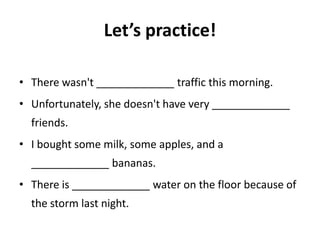
Let’s practice!

• There wasn't _____________ traffic this morning.
• Unfortunately, she doesn't have very _____________
  friends.
• I bought some milk, some apples, and a
  _____________ bananas.
• There is _____________ water on the floor because of
  the storm last night.
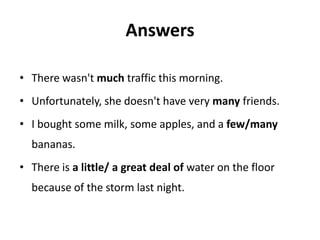
Answers

• There wasn't much traffic this morning.
• Unfortunately, she doesn't have very many friends.
• I bought some milk, some apples, and a few/many
  bananas.
• There is a little/ a great deal of water on the floor
  because of the storm last night.
Thank you!

Nouns and Quantifiers

  • 1.
    Nouns & Quantifiers Barbora Richtarcikova
  • 2.
    Nouns • Common nounsrefer to people, places, or things Examples: People- child, boss Places- city, farm Things- house, money • Abstract nouns refer to ideas and feelings Examples: Abstract- freedom, love, time, stress
  • 3.
    Count & Non-countNouns • Count nouns are nouns you can count separately. Examples: I have a dog. We have two cars. • Non-count nouns are nouns you cannot count separately. Examples: I didn’t have enough money, I have a lot of stress at work.
  • 4.
    Count & Non-countNouns • Some nouns have both a count and a non-count meaning. Example: We had a good time at the party.  Time = an experience  Count I don’t have any time today.  Time = availability  Non-count
  • 5.
    Quantifiers • Quantifiers arewords that come before nouns in order to indicate the amount or how much of a non-count noun is being stated, or the number or how many of a count noun is being stated. • Remember that amount and how much refer to non- count nouns while number and how many refer to count nouns.
  • 6.
    Quantifiers for Count& Non-count Nouns • Use quantifiers some, enough, a lot of, and any with both count nouns and non-count nouns. Examples: There are a lot of flowers here. He is in a lot of trouble. • Any is used in questions and negative sentences. Examples: Do you have any money? I don’t have any change.
  • 7.
    Quantifiers for CountNouns • Use quantifiers a few, several, and many with plural count nouns in affirmative sentences. Example: There are several options to choose from. • Use many in questions and negative sentences. Examples: How many problems do you have? I don’t have many problems.
  • 8.
    Quantifiers for Non-countNouns • Use quantifiers a little, a great deal of, and much with non-count nouns in affirmative sentences. Example: You have a great deal of luck. • Use much in questions and negative sentences. Example: How much effort did you put in this project? I didn’t put in much effort.
  • 9.
    Let’s practice! • Therewasn't _____________ traffic this morning. • Unfortunately, she doesn't have very _____________ friends. • I bought some milk, some apples, and a _____________ bananas. • There is _____________ water on the floor because of the storm last night.
  • 10.
    Answers • There wasn'tmuch traffic this morning. • Unfortunately, she doesn't have very many friends. • I bought some milk, some apples, and a few/many bananas. • There is a little/ a great deal of water on the floor because of the storm last night.
  • 11.