Revision and hw check
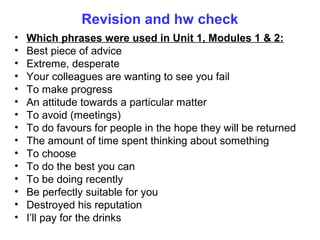
• Which phrases were used in Unit 1, Modules 1 & 2:
• Best piece of advice
• Extreme, desperate
• Your colleagues are wanting to see you fail
• To make progress
• An attitude towards a particular matter
• To avoid (meetings)
• To do favours for people in the hope they will be returned
• The amount of time spent thinking about something
• To choose
• To do the best you can
• To be doing recently
• Be perfectly suitable for you
• Destroyed his reputation
• I’ll pay for the drinks
Revision and hw check
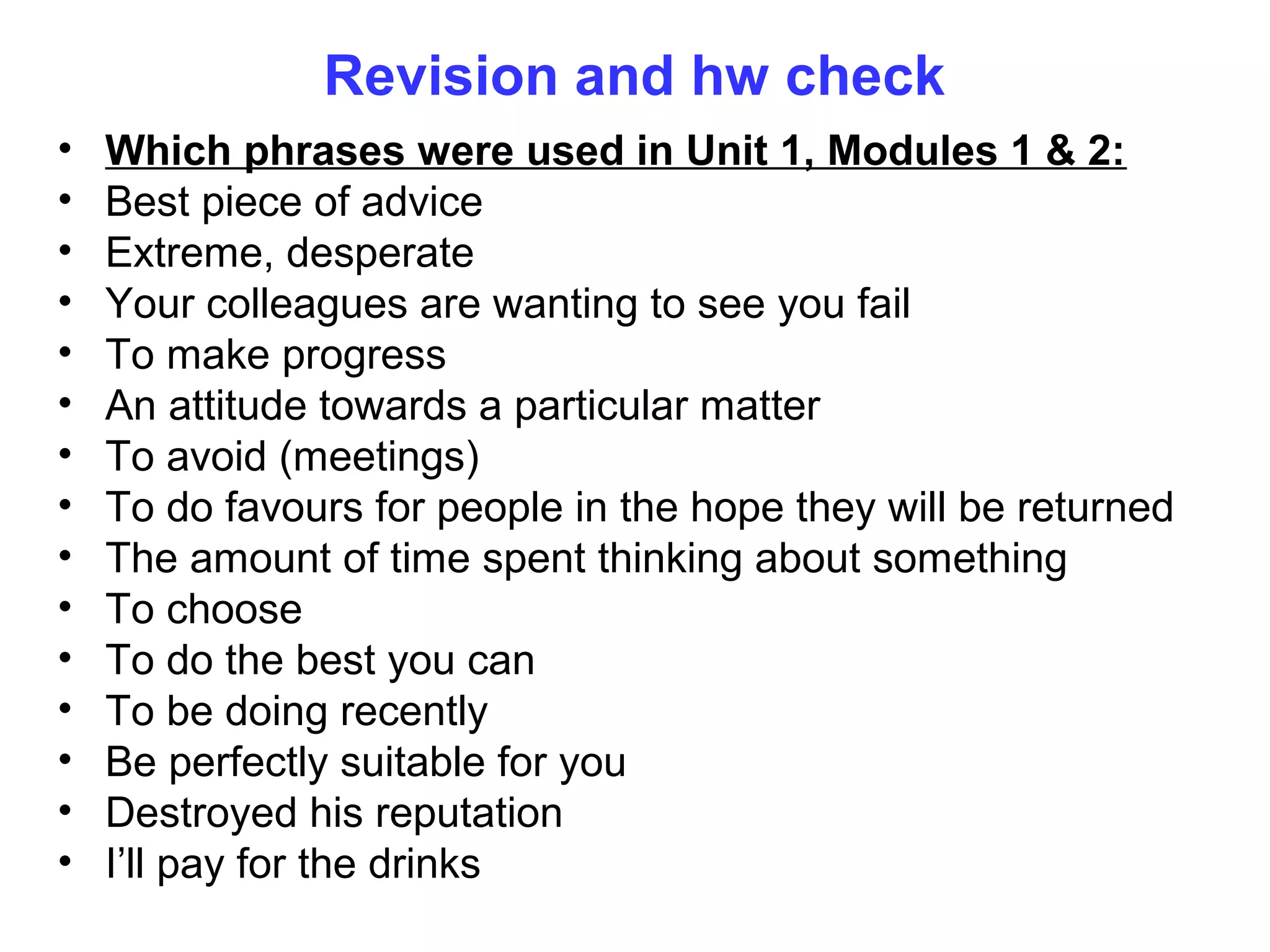
• Which phrases were used in Unit 1, Modules 1 & 2:
• Best piece of advice – Top tip
• Extreme, desperate - Drastic
• Your colleagues are wanting to see you fail – Out to get you
• To make progress – to get on
• An attitude towards a particular matter – stance /stans/
• To avoid (meetings) – to steer clear of
• To do favours... in the hope they will be returned - scratch a
few backs
• The amount of time spent thinking about something mind
• To choose – opt for share
• To do the best you can – to give it your all
• To be doing recently – to be up to (sth)
• Be perfectly suitable for you – suit you down to the ground
• Destroyed his reputation – blew his reputation
• I’ll pay for the drinks – The drinks are on me
The Peter Principle
• In a h___________ every employee tends to
r_____ to his or her level of i_____________ .
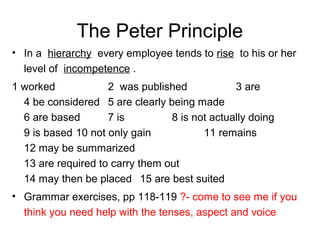
The Peter Principle
• In a hierarchy every employee tends to rise to his or her
level of incompetence .
1 worked 2 was published 3 are
4 be considered 5 are clearly being made
6 are based 7 is 8 is not actually doing
9 is based 10 not only gain 11 remains
12 may be summarized
13 are required to carry them out
14 may then be placed 15 are best suited
• Grammar exercises, pp 118-119 ?- come to see me if you
think you need help with the tenses, aspect and voice
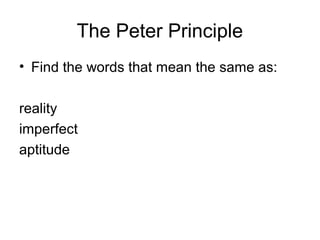
The Peter Principle
• Find the words that mean the same as:
reality
imperfect
aptitude
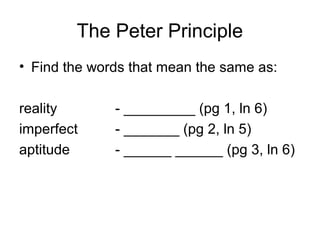
The Peter Principle
• Find the words that mean the same as:
reality - _________ (pg 1, ln 6)
imperfect - _______ (pg 2, ln 5)
aptitude - ______ ______ (pg 3, ln 6)
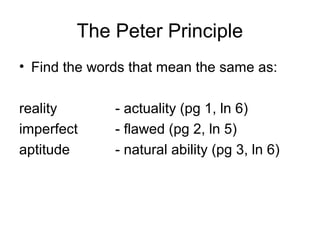
The Peter Principle
• Find the words that mean the same as:
reality - actuality (pg 1, ln 6)
imperfect - flawed (pg 2, ln 5)
aptitude - natural ability (pg 3, ln 6)
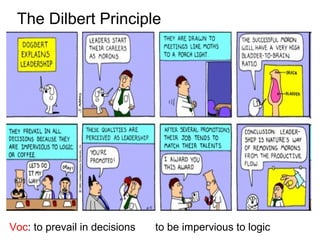
The Dilbert Principle
Voc: to prevail in decisions to be impervious to logic
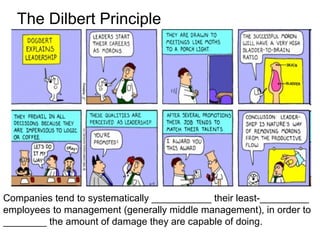
The Dilbert Principle
Companies tend to systematically ___________ their least-_________
employees to management (generally middle management), in order to
________ the amount of damage they are capable of doing.
The Dilbert Principle
Companies tend to systematically promote their
least-competent / most incompetent employees
to management (generally middle management),
in order to limit the amount of damage they are
capable of doing.
Behavioural competences, p 10
(Vocabulary)
• Extension activity
v adj n
analyze
application
communicate
expectation
priority
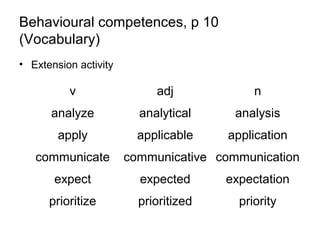
Behavioural competences, p 10
(Vocabulary)
• Extension activity
v adj n
analyze analytical analysis
apply applicable application
communicate communicative communication
expect expected expectation
prioritize prioritized priority
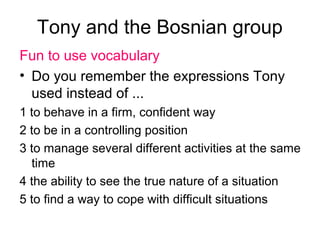
Tony and the Bosnian group
Fun to use vocabulary
• Do you remember the expressions Tony
used instead of ...
1 to behave in a firm, confident way
2 to be in a controlling position
3 to manage several different activities at the same
time
4 the ability to see the true nature of a situation
5 to find a way to cope with difficult situations
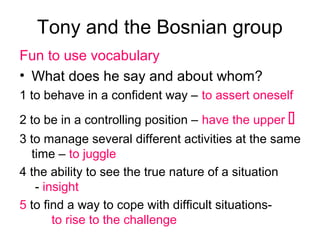
Tony and the Bosnian group
Fun to use vocabulary
• What does he say and about whom?
1 to behave in a confident way – to assert oneself
2 to be in a controlling position – have the upper 
3 to manage several different activities at the same
time – to juggle
4 the ability to see the true nature of a situation
- insight
5 to find a way to cope with difficult situations-
to rise to the challenge
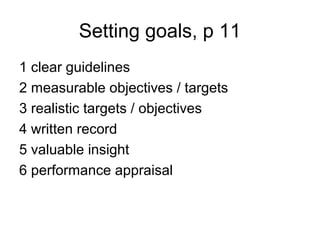
Setting goals, p 11
1 clear guidelines
2 measurable objectives / targets
3 realistic targets / objectives
4 written record
5 valuable insight
6 performance appraisal
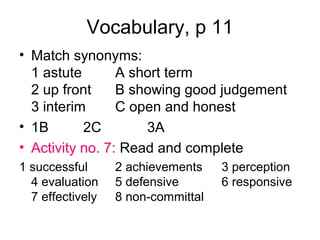
Vocabulary, p 11
• Match synonyms:
1 astute A short term
2 up front B showing good judgement
3 interim C open and honest
• 1B 2C 3A
• Activity no. 7: Read and complete
1 successful 2 achievements 3 perception
4 evaluation 5 defensive 6 responsive
7 effectively 8 non-committal
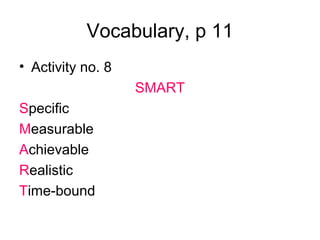
Vocabulary, p 11
• Activity no. 8
SMART
Specific
Measurable
Achievable
Realistic
Time-bound
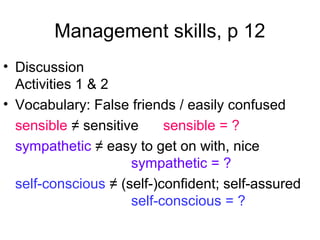
Management skills, p 12
• Discussion
Activities 1 & 2
• Vocabulary: False friends / easily confused
sensible ≠ sensitive sensible = ?
sympathetic ≠ easy to get on with, nice
sympathetic = ?
self-conscious ≠ (self-)confident; self-assured
self-conscious = ?
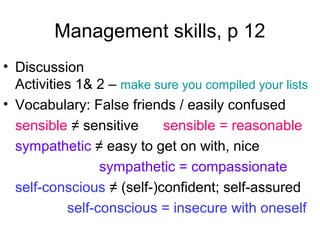
Management skills, p 12
• Discussion
Activities 1& 2 – make sure you compiled your lists
• Vocabulary: False friends / easily confused
sensible ≠ sensitive sensible = reasonable
sympathetic ≠ easy to get on with, nice
sympathetic = compassionate
self-conscious ≠ (self-)confident; self-assured
self-conscious = insecure with oneself
Management skills, p 12
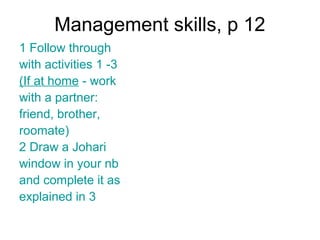
1 Follow through
with activities 1 -3
(If at home - work
with a partner:
friend, brother,
roomate)
2 Draw a Johari
window in your nb
and complete it as
explained in 3
Management skills, p 12
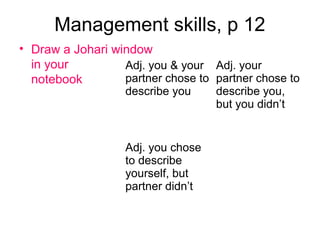
• Draw a Johari window
in your
notebook
Adj. you & your
partner chose to
describe you
Adj. your
partner chose to
describe you,
but you didn’t
Adj. you chose
to describe
yourself, but
partner didn’t
Listening: Johari window, cont.
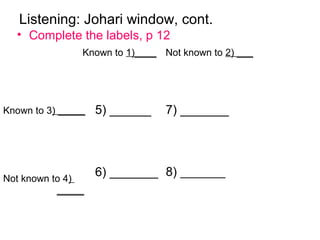
• Complete the labels, p 12
5) ______ 7) _______
6) _______ 8) _______
Known to 1)____ Not known to 2) ___
Known to 3) _____
Not known to 4)
_____
Listening: Johari window, cont.
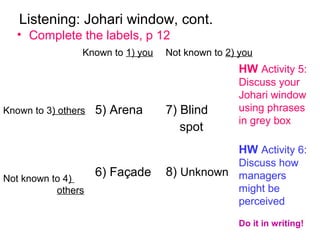
• Complete the labels, p 12
5) Arena 7) Blind
spot
6) Façade 8) Unknown
Known to 1) you Not known to 2) you
Known to 3) others
Not known to 4)
others
HW Activity 5:
Discuss your
Johari window
using phrases
in grey box
HW Activity 6:
Discuss how
managers
might be
perceived
Do it in writing!
The Truth game
• Designed to help enlarge the Arena and reduce
the other areas
• Listen and decide which questions they are
talking about.
• Put the phrases in the correct order
• Find expressions which are used for...
• Play the Truth game! – next time in class
• Draw a second Johari – next time in class
• Complete the Report sheet – next time in class
HW – Internet research: the Nohari window

Unit 1 m 3 4 6-web

  • 1.
    Revision and hwcheck • Which phrases were used in Unit 1, Modules 1 & 2: • Best piece of advice • Extreme, desperate • Your colleagues are wanting to see you fail • To make progress • An attitude towards a particular matter • To avoid (meetings) • To do favours for people in the hope they will be returned • The amount of time spent thinking about something • To choose • To do the best you can • To be doing recently • Be perfectly suitable for you • Destroyed his reputation • I’ll pay for the drinks
  • 2.
    Revision and hwcheck • Which phrases were used in Unit 1, Modules 1 & 2: • Best piece of advice – Top tip • Extreme, desperate - Drastic • Your colleagues are wanting to see you fail – Out to get you • To make progress – to get on • An attitude towards a particular matter – stance /stans/ • To avoid (meetings) – to steer clear of • To do favours... in the hope they will be returned - scratch a few backs • The amount of time spent thinking about something mind • To choose – opt for share • To do the best you can – to give it your all • To be doing recently – to be up to (sth) • Be perfectly suitable for you – suit you down to the ground • Destroyed his reputation – blew his reputation • I’ll pay for the drinks – The drinks are on me
  • 3.
    The Peter Principle •In a h___________ every employee tends to r_____ to his or her level of i_____________ .
  • 4.
    The Peter Principle •In a hierarchy every employee tends to rise to his or her level of incompetence . 1 worked 2 was published 3 are 4 be considered 5 are clearly being made 6 are based 7 is 8 is not actually doing 9 is based 10 not only gain 11 remains 12 may be summarized 13 are required to carry them out 14 may then be placed 15 are best suited • Grammar exercises, pp 118-119 ?- come to see me if you think you need help with the tenses, aspect and voice
  • 5.
    The Peter Principle •Find the words that mean the same as: reality imperfect aptitude
  • 6.
    The Peter Principle •Find the words that mean the same as: reality - _________ (pg 1, ln 6) imperfect - _______ (pg 2, ln 5) aptitude - ______ ______ (pg 3, ln 6)
  • 7.
    The Peter Principle •Find the words that mean the same as: reality - actuality (pg 1, ln 6) imperfect - flawed (pg 2, ln 5) aptitude - natural ability (pg 3, ln 6)
  • 8.
    The Dilbert Principle Voc:to prevail in decisions to be impervious to logic
  • 9.
    The Dilbert Principle Companiestend to systematically ___________ their least-_________ employees to management (generally middle management), in order to ________ the amount of damage they are capable of doing.
  • 10.
    The Dilbert Principle Companiestend to systematically promote their least-competent / most incompetent employees to management (generally middle management), in order to limit the amount of damage they are capable of doing.
  • 11.
    Behavioural competences, p10 (Vocabulary) • Extension activity v adj n analyze application communicate expectation priority
  • 12.
    Behavioural competences, p10 (Vocabulary) • Extension activity v adj n analyze analytical analysis apply applicable application communicate communicative communication expect expected expectation prioritize prioritized priority
  • 13.
    Tony and theBosnian group Fun to use vocabulary • Do you remember the expressions Tony used instead of ... 1 to behave in a firm, confident way 2 to be in a controlling position 3 to manage several different activities at the same time 4 the ability to see the true nature of a situation 5 to find a way to cope with difficult situations
  • 14.
    Tony and theBosnian group Fun to use vocabulary • What does he say and about whom? 1 to behave in a confident way – to assert oneself 2 to be in a controlling position – have the upper  3 to manage several different activities at the same time – to juggle 4 the ability to see the true nature of a situation - insight 5 to find a way to cope with difficult situations- to rise to the challenge
  • 15.
    Setting goals, p11 1 clear guidelines 2 measurable objectives / targets 3 realistic targets / objectives 4 written record 5 valuable insight 6 performance appraisal
  • 16.
    Vocabulary, p 11 •Match synonyms: 1 astute A short term 2 up front B showing good judgement 3 interim C open and honest • 1B 2C 3A • Activity no. 7: Read and complete 1 successful 2 achievements 3 perception 4 evaluation 5 defensive 6 responsive 7 effectively 8 non-committal
  • 17.
    Vocabulary, p 11 •Activity no. 8 SMART Specific Measurable Achievable Realistic Time-bound
  • 18.
    Management skills, p12 • Discussion Activities 1 & 2 • Vocabulary: False friends / easily confused sensible ≠ sensitive sensible = ? sympathetic ≠ easy to get on with, nice sympathetic = ? self-conscious ≠ (self-)confident; self-assured self-conscious = ?
  • 19.
    Management skills, p12 • Discussion Activities 1& 2 – make sure you compiled your lists • Vocabulary: False friends / easily confused sensible ≠ sensitive sensible = reasonable sympathetic ≠ easy to get on with, nice sympathetic = compassionate self-conscious ≠ (self-)confident; self-assured self-conscious = insecure with oneself
  • 20.
    Management skills, p12 1 Follow through with activities 1 -3 (If at home - work with a partner: friend, brother, roomate) 2 Draw a Johari window in your nb and complete it as explained in 3
  • 21.
    Management skills, p12 • Draw a Johari window in your notebook Adj. you & your partner chose to describe you Adj. your partner chose to describe you, but you didn’t Adj. you chose to describe yourself, but partner didn’t
  • 22.
    Listening: Johari window,cont. • Complete the labels, p 12 5) ______ 7) _______ 6) _______ 8) _______ Known to 1)____ Not known to 2) ___ Known to 3) _____ Not known to 4) _____
  • 23.
    Listening: Johari window,cont. • Complete the labels, p 12 5) Arena 7) Blind spot 6) Façade 8) Unknown Known to 1) you Not known to 2) you Known to 3) others Not known to 4) others HW Activity 5: Discuss your Johari window using phrases in grey box HW Activity 6: Discuss how managers might be perceived Do it in writing!
  • 24.
    The Truth game •Designed to help enlarge the Arena and reduce the other areas • Listen and decide which questions they are talking about. • Put the phrases in the correct order • Find expressions which are used for... • Play the Truth game! – next time in class • Draw a second Johari – next time in class • Complete the Report sheet – next time in class HW – Internet research: the Nohari window